Samye Monastery
Samye Monastery, People's Republic of China
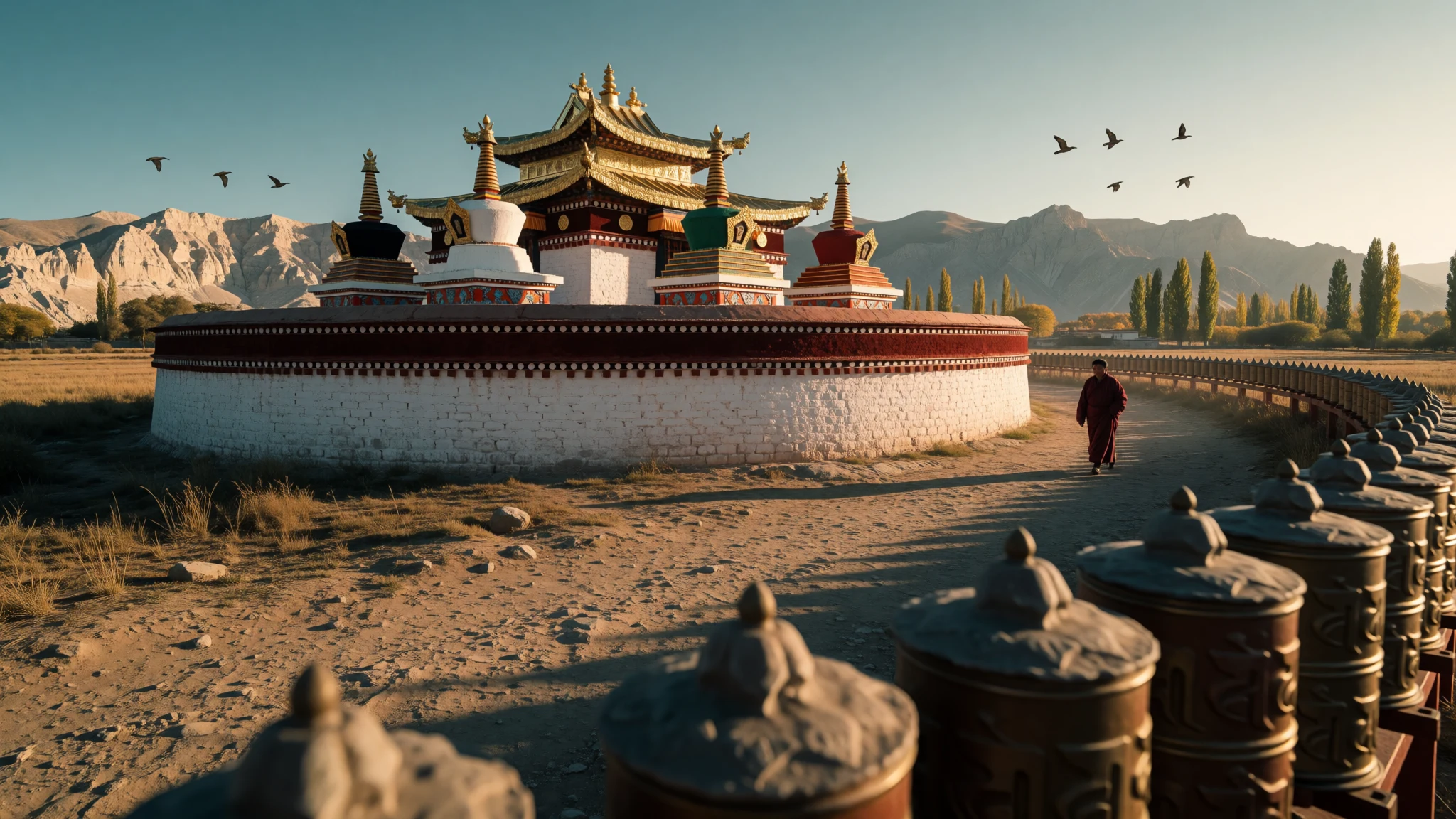
Samye Monastery is where Buddhism first took institutional root in Tibet, laid out as a living mandala on the Yarlung valley floor.
The place
Samye Monastery stands in the Chimpu valley, on the north bank of the Yarlung Tsangpo (Brahmaputra), below the Hapori hill and south-east of Lhasa. Administratively it belongs to Zhanang county in Shannan prefecture, in the Tibet Autonomous Region of China. The setting is open and dry: a wide river plain, sand dunes in places, barley fields, and bare hills rising behind.
The monastery is known in Tibetan as Samye (bsam yas), in Chinese as Sangye Si (桑耶寺), and by a much longer ceremonial name meaning roughly 'the shrine of unchanging spontaneous presence'. It belongs to the Nyingma school and is described as the first Tibetan Buddhist monastery built in Tibet. Wikidata gives its founding as 779, the year the first Tibetan monks were ordained here, though construction began earlier.
The layout is the point. A tall central temple represents the centre of the Buddhist cosmos, and around it sit smaller temples for the continents and the sun and moon, four coloured stupas at the corners, and an encircling wall with gates at the cardinal directions. Seen from the hill above, the plan reads as a diagram laid out in stone.
The site was wrecked during the Cultural Revolution and rebuilt after 1988, so much of what stands today is restoration, with older fragments and murals mixed in. Samye is small and rural; the village beside it has a few guesthouses and basic eateries, and the pace is slow. Getting here takes effort, and that keeps numbers modest compared with Lhasa.
Its story
Samye Monastery was commissioned by King Trisong Detsen, who wanted a permanent home for Buddhism in Tibet. Early records disagree on exact dates. The Testament of Ba places the foundation in a 'hare year', which could be 763 or 775, and the consecration in a 'sheep year', 767 or 779. The later Blue Annals, from 1476, give still later dates, which sit awkwardly with other evidence. On the king as patron, every account agrees.
Two Indian teachers dominate the legend. Shantarakshita, an abbot and philosopher, oversaw the building and the first ordinations. Padmasambhava, the tantric master revered as the founder of Tibetan Vajrayana, is said to have subdued the local spirits that kept wrecking the work, so that construction could be finished.
The design drew on a wider Buddhist world. The mandala plan is linked to Odantapuri, a monastery in present-day Bihar, India, and the same idea of a temple as a model universe appears at Todai-ji in Japan. Like Todai-ji, Samye is dedicated to Vairocana, the central cosmic Buddha of the Mahavairocana Tantra.
Samye also carries some of Tibet's few surviving early written records. A stone pillar of the eighth century stands before the main temple, recording the founding of Samye and other monasteries and the oaths the king and nobles swore to protect their endowments. A large bronze bell at the entrance carries an inscription saying it was made by one of Trisong Detsen's queens. Wikivoyage also mentions a famous debate, usually dated to 792, in which Indian and Chinese forms of Buddhism were set against each other and the Indian tradition prevailed.
What to see
- The Utse, the central temple — Centre of the monastery complex
The main hall is the heart of the mandala and the reason to come. Its floors rise in different architectural styles, and the ground floor holds a large assembly hall and chapels. Expect butter-lamp smoke, dim light and murals. Much is restored, so look for the older fragments.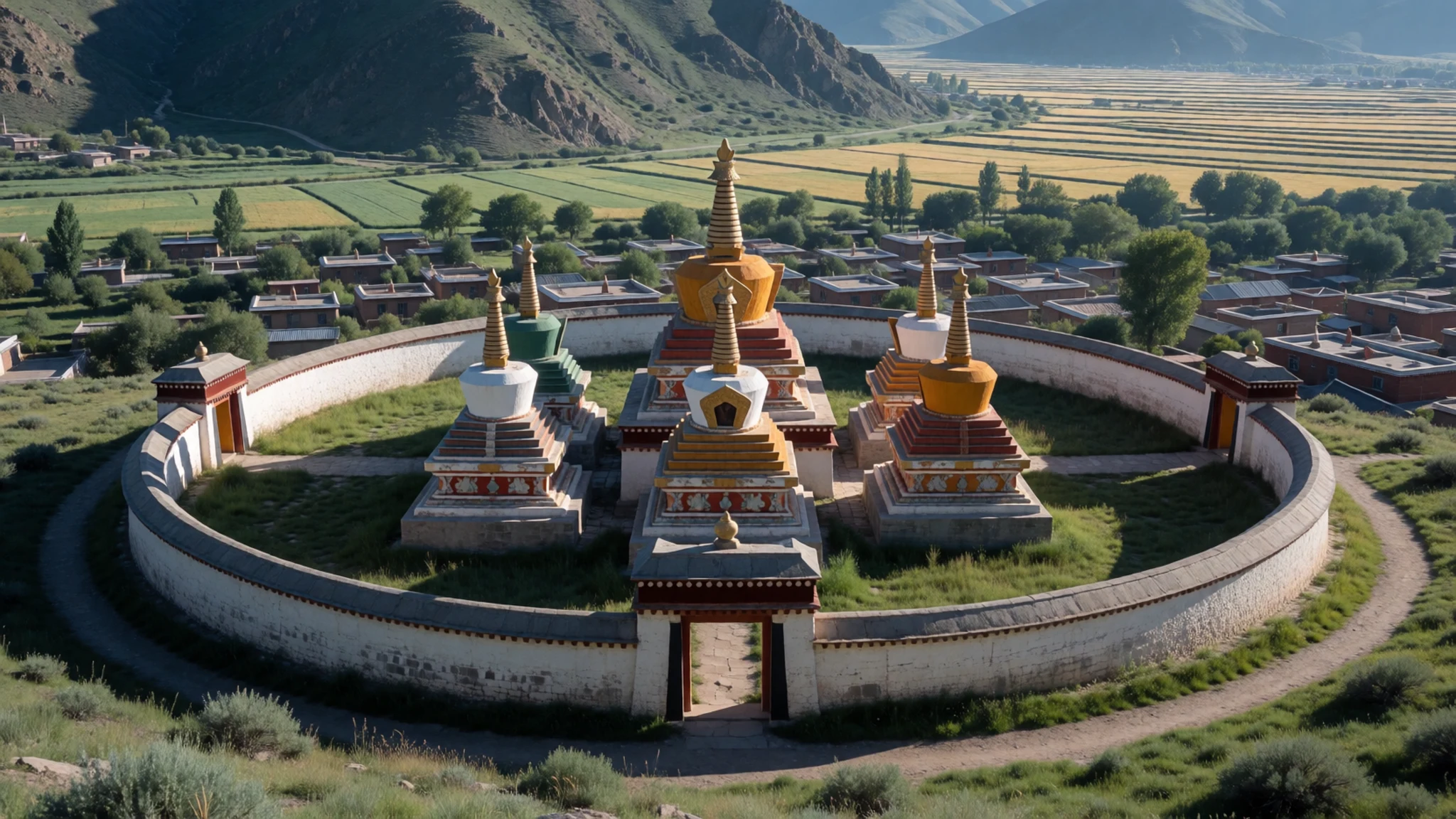
- The four coloured stupas — Corners of the central temple compound
At the corners of the central complex stand four stupas, each in a different colour: white, red, black and green. They mark the quarters of the mandala and are worth a slow walk around, since each has its own proportions and wears its age differently.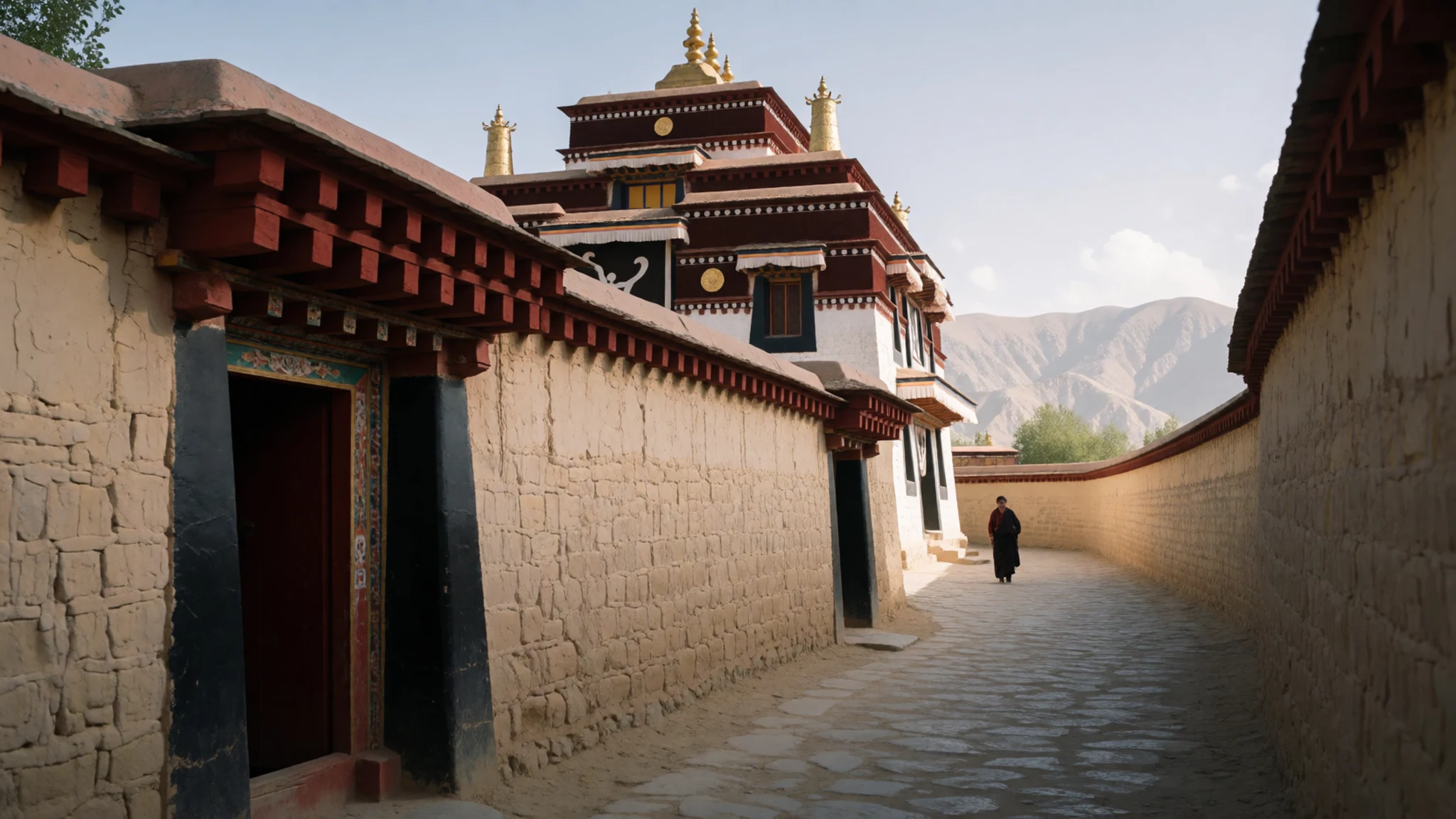
- The encircling wall and gates — Perimeter of the monastery
A circular outer wall, with openings at the four cardinal points, represents the rim of the universe. Walking the kora, the clockwise circuit, around it is the simplest way to grasp the plan. Pilgrims do it steadily, spinning prayer wheels as they go.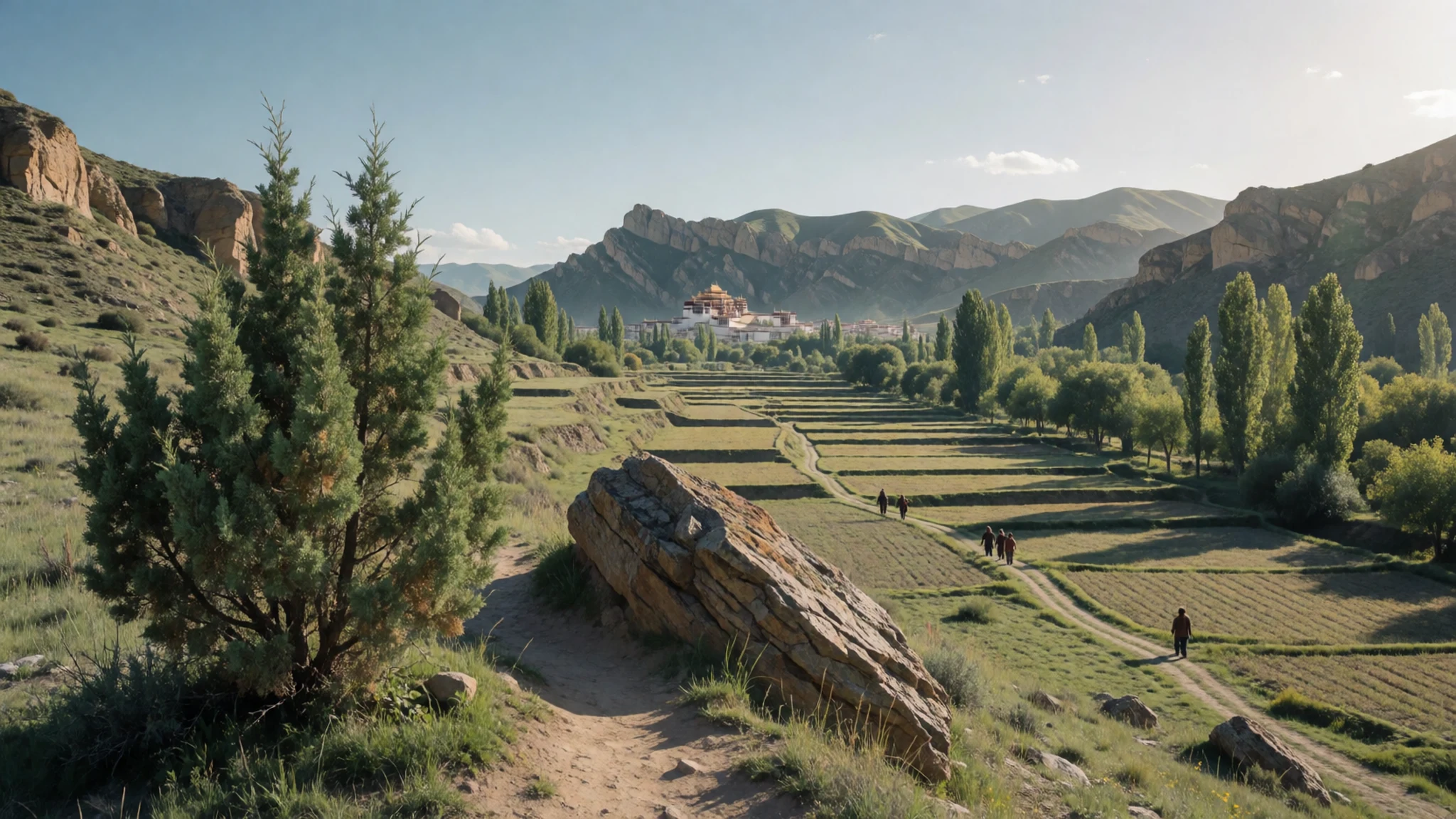
- The eighth-century stone pillar — Entrance area of the main temple
In front of the main temple stands a stone pillar, undated but placed in the eighth century. Its inscription records the building of Samye and the royal oaths to protect the monastery's endowments. It is one of the few early Tibetan written records that survive in public view.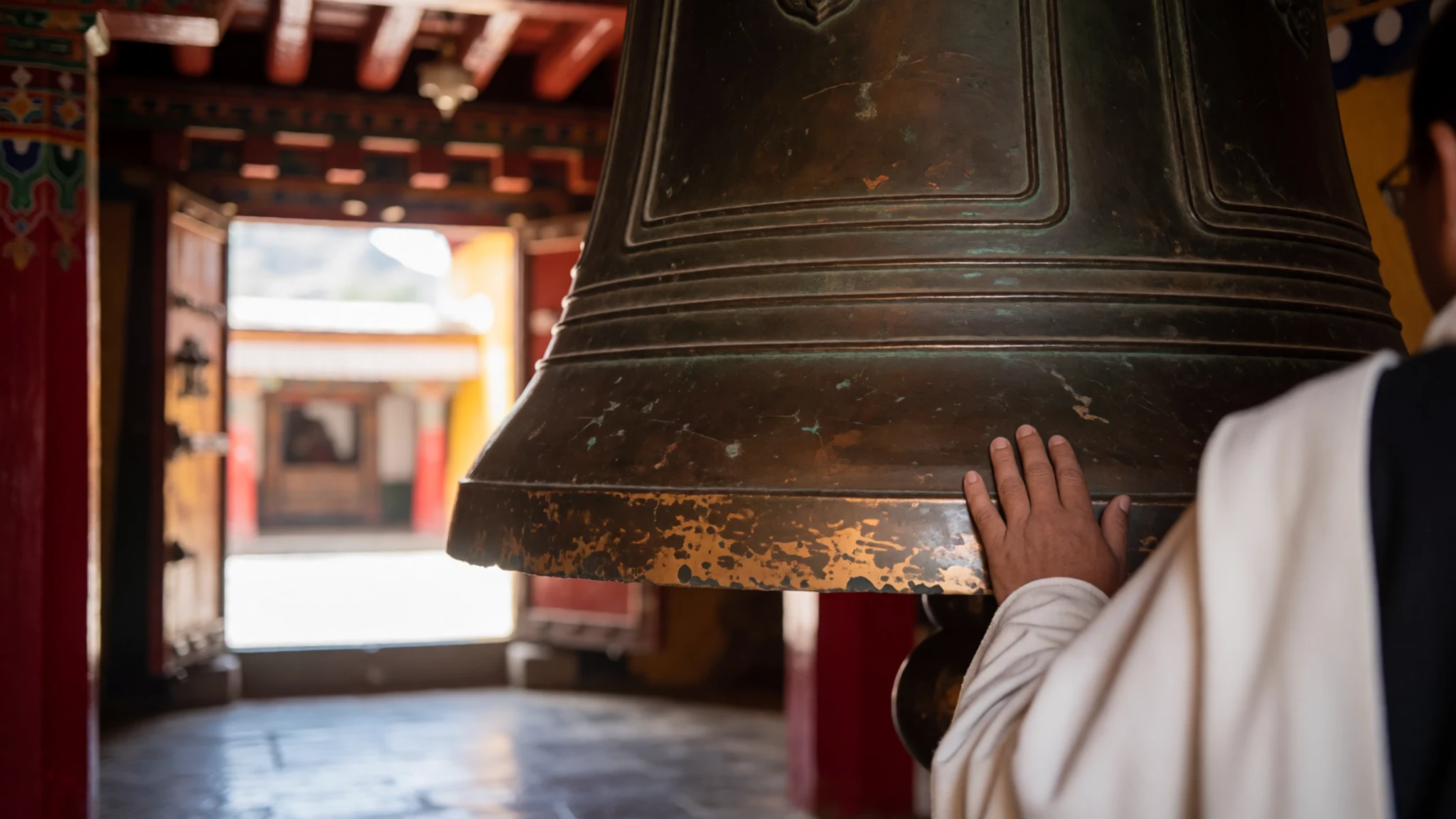
- The bronze bell — Monastery entrance
A large bronze bell hangs at the entrance, with an inscription saying one of King Trisong Detsen's queens had it made. It is easy to walk past among the crowds of pilgrims, but it is a rare dated-in-spirit record of the monastery's founders.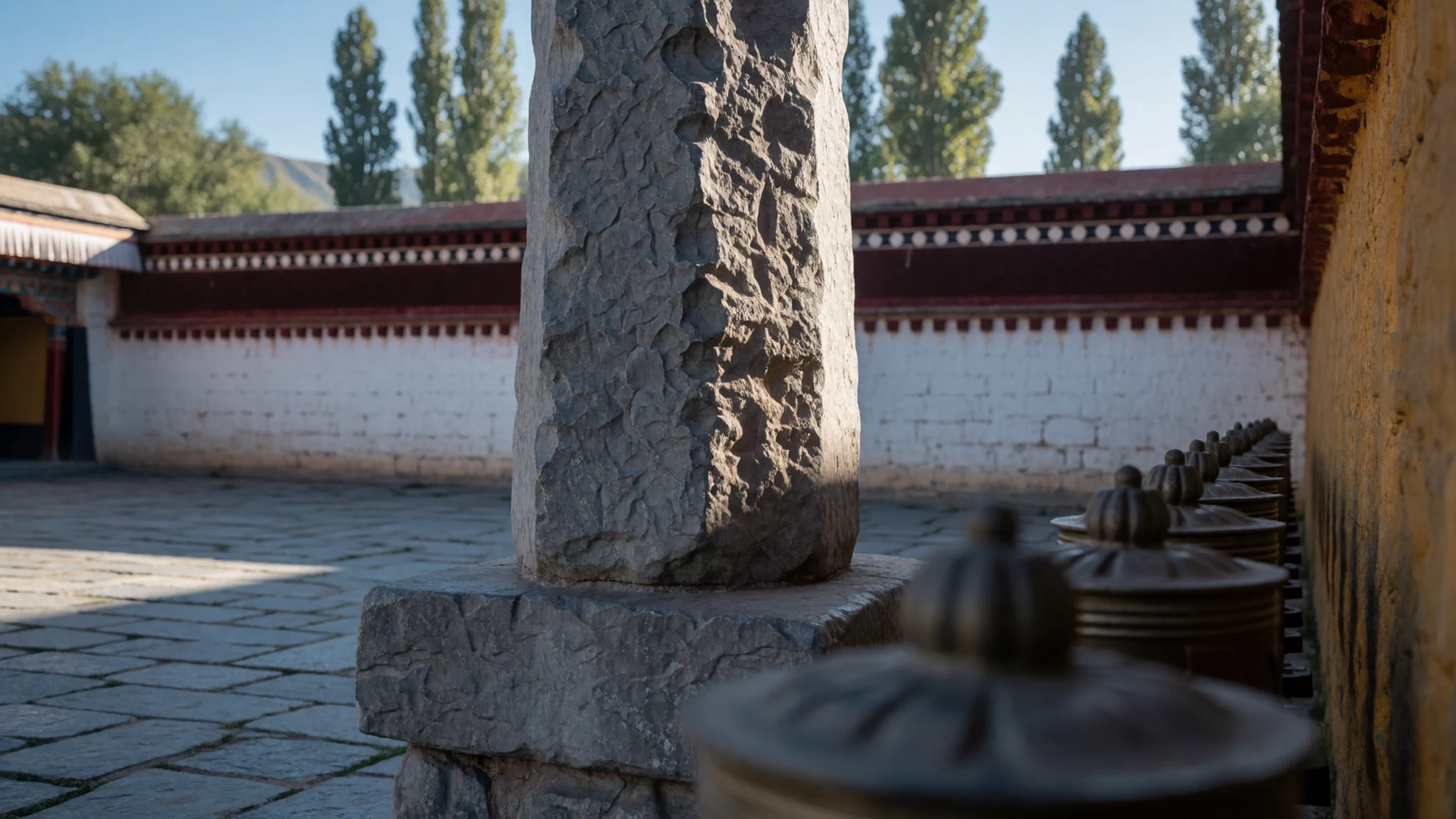
- Hapori hill — Immediately north of the monastery
The hill behind the monastery is a short climb, and the view repays it: the full circle of the mandala laid out on the plain, with the river beyond. Go early or late for softer light, and take water, as the slope is dry and exposed.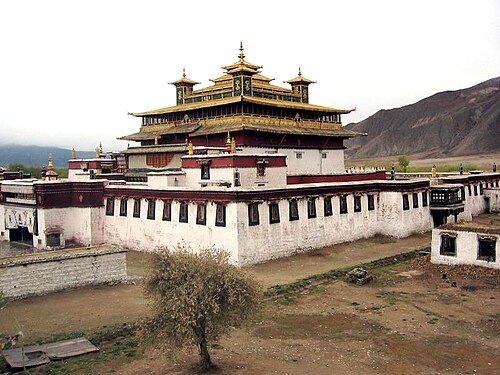
Culture
Samye Monastery belongs to the Nyingma school, the oldest of the four main schools of Tibetan Buddhism, and it is both a working monastery and a pilgrimage site. Pilgrims arrive from across the region, many of them walking the circuit of the outer wall clockwise, turning prayer wheels, murmuring mantras and prostrating at doorways.
The temple is dedicated to Vairocana, and its layout expresses a Buddhist view of the cosmos in architecture: a centre, four directions, and a boundary. Learning to read this plan changes how the place feels. A butter lamp is a common offering, and the smell of burning butter is part of the atmosphere in every chapel.
The monastery's history also carries weight. It was the setting for the first ordinations of Tibetan monks, and after the damage of the Cultural Revolution it was rebuilt from 1988 onwards. Many local people treat it as a place of renewal as much as of memory, and religious practice here is quiet, sincere and ongoing rather than staged for visitors.
Visitors sometimes find rules about photography and access vary between chapels and change without notice, and that visits to Tibet are subject to permit requirements that officials set. Check current rules before travelling.
Walk clockwise around temples and stupas, remove hats and sunglasses inside the chapels, and ask before photographing monks or pilgrims, as some chapels also forbid cameras entirely.
What to wear
Traditional Tibetan dress around Samye is the chuba, a long wrap-over robe of wool or sheepskin, tied at the waist with a sash. Women often wear the sleeveless chuba over a blouse with a striped woollen apron called a pangden, a hand-woven textile, while men wear heavier versions for the cold. Festival days bring out brocade, turquoise and coral jewellery, and wide-brimmed hats or fur caps.
In daily life today, many local people wear a mix of practical modern clothing: fleece, padded jackets, jeans and trainers, with the chuba kept for religious occasions and festivals. Monks wear maroon and saffron robes. Pilgrims in the temple courtyards often wear the chuba because it is warm and traditional.
Visitors should dress for altitude and sun. Days can be bright and warm but mornings and evenings are cold, and the wind off the river plain is sharp, so layers matter: a fleece, a windproof shell, a hat and strong sunscreen. Inside the temples, cover shoulders and knees, and avoid shorts, tight tops or anything short. Wear sturdy, comfortable shoes with good grip for uneven stone floors and for the walk up Hapori hill, and be ready to slip them off if asked.
What to eat
- Butter tea (po cha) — Village tea houses and guesthouses near the monastery
Salty tea churned with yak butter, the standard warming drink of the Tibetan plateau. It is an acquired taste for many visitors, but it helps in the cold and dry air. Guesthouses and tea houses in the village serve it all day.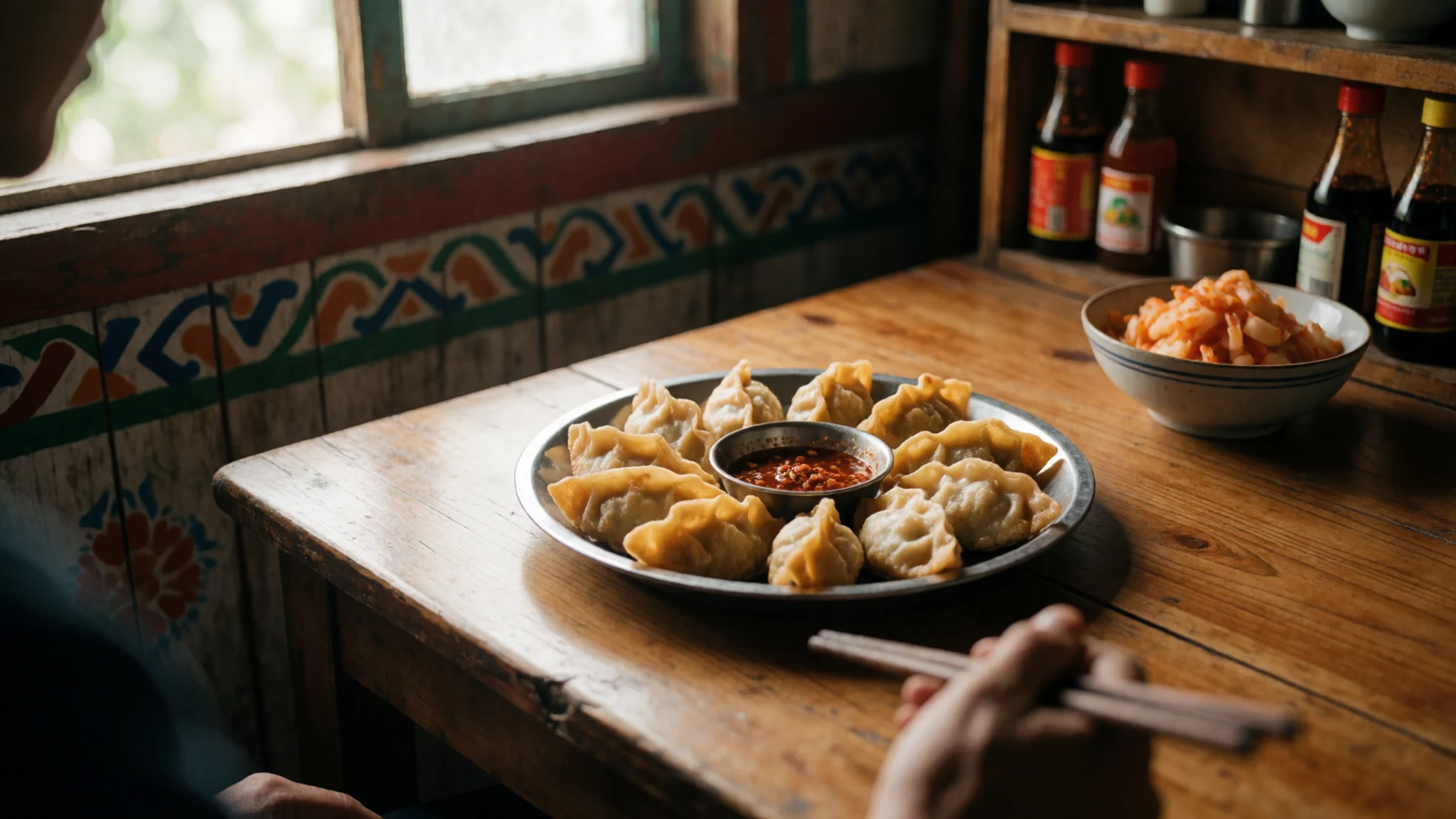
- Tsampa — Family-run guesthouses and village eateries
Roasted barley flour, mixed with butter tea into a dough or eaten with yoghurt. It is the staple of the plateau, filling and easy to carry. Locals eat it daily, and guesthouse kitchens will often prepare it if asked. - Momos — Small eateries in the village near the east gate
Steamed or fried dumplings filled with yak meat, mutton or vegetables, usually served with a chilli sauce. They are the easiest dish to find and a safe choice for first-time visitors, with vegetarian versions common. - Thukpa — Village restaurants and guesthouse dining rooms
A noodle soup with vegetables or meat, hearty and warming after a morning of walking in the cold. It is a reliable meal in the evening when the temperature drops across the valley. - Yak yoghurt (sho) — Guesthouse kitchens and local households
Thick, tangy yoghurt made from yak or dri milk, often served with sugar. It is a common breakfast item and a good counter to the heavy butter flavours elsewhere. Availability varies with the season.
Plan it
Best time. April to June and September to October, when days are mild and dry and skies are usually clear; winter is very cold and some services may be reduced, and the summer monsoon months bring cloud and some rain.
How long. 1–2
Getting there. Fly to Lhasa Gonggar Airport, then take the morning bus from Lhasa to the Brahmaputra river crossing (about 90 minutes), a flat-bottomed boat across the river (about an hour), and a tractor ride to the monastery (about 40 minutes). Buses back to Lhasa via Tsethang leave in the morning and take about 6 hours. Check current schedules locally.
Budget. low
Tips
- Leave Lhasa on the early bus, as the connections depend on it
- Carry cash, as cards are unlikely to work in the village
- Take water, sun protection and layers; the altitude is high and the weather changes quickly
- Check current permit and travel rules for Tibet well before you book
- Stay a night if you can, to see the monastery in early light
Etiquette
- Walk clockwise around temples, stupas and prayer wheels
- Ask before photographing monks, pilgrims or chapel interiors
- Dress modestly and remove hats inside the chapels
Nearby
Sources
- Wikidata Q1430211 (CC0)
- Wikipedia: Samye (CC BY-SA 4.0)
- Wikivoyage: Samye (CC BY-SA 4.0)
- Gerd Eichmann, Samye Monastery in Tibet (CC BY-SA 4.0)
- A grand view of Samye (CC BY-SA 2.0)
- ckmck, Samye Monastery (CC BY 2.5)
- 1903 Routes between Tibet and India by O'Connor (CC BY-SA 4.0)
- Bundesarchiv Bild 135-KA-09-061 (CC BY-SA 3.0 de)
- Preston Rhea, From Samye to the Yarlung Zangbo (CC BY-SA 2.0)
- Luca Galuzzi, Samye Monastery (CC BY-SA 2.5)
- 1903 Routes between Tibet and India, Bhutan detail (CC BY-SA 4.0)


