Playa de las Catedrales
Playa de las Catedrales, Spain
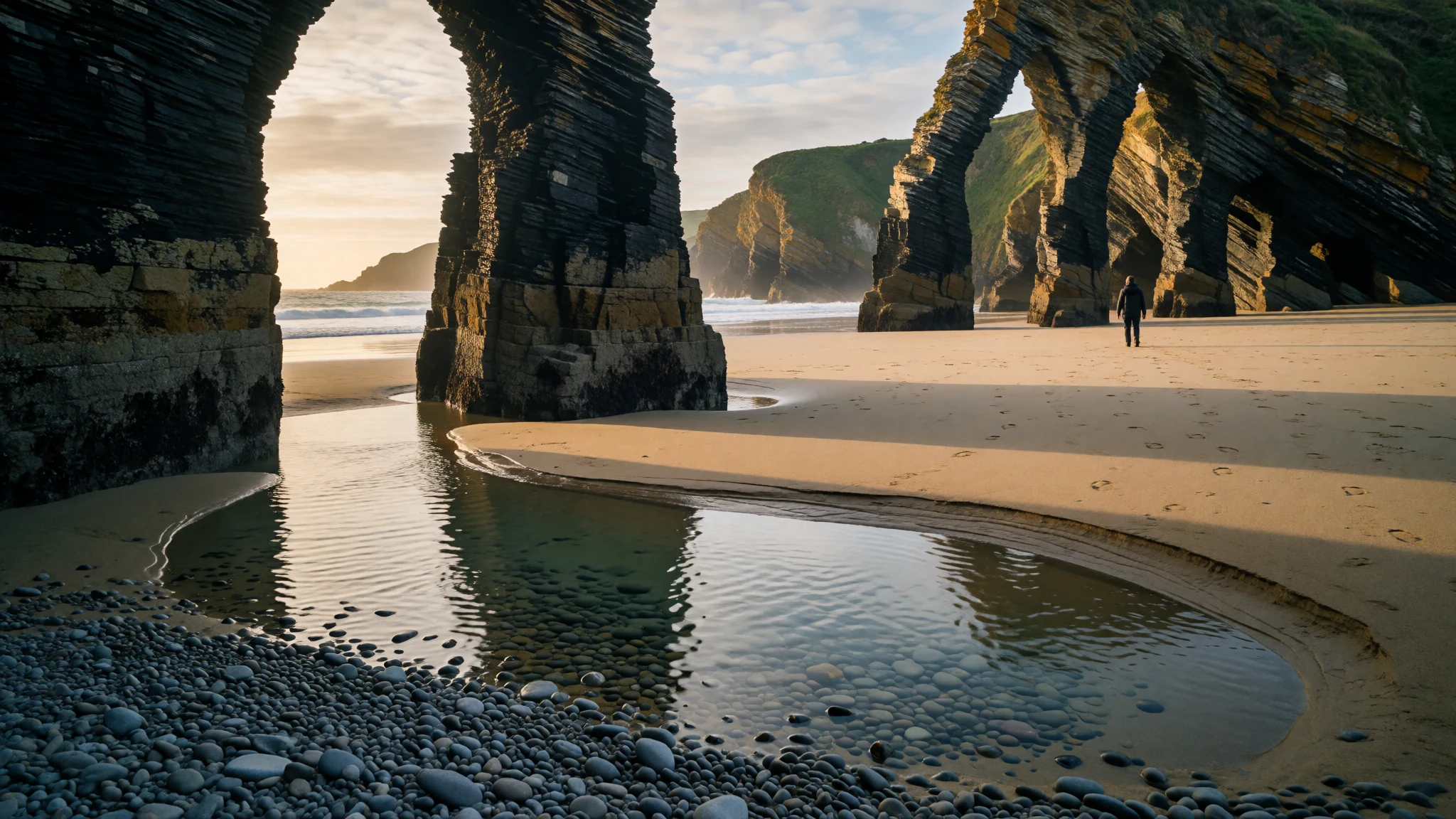
Playa de las Catedrales is a Galician beach where low tide opens a gallery of sea-carved rock arches beneath green Atlantic cliffs.
The place
Playa de las Catedrales, called Praia das Catedrais in Galician, sits on the Cantabrian coast of Galicia in north-west Spain. The name is a tourism label. The beach is officially Praia de Augas Santas, the beach of the holy waters, and local people still use that name. It lies in the municipality of Ribadeo, in Lugo province, a short drive west of Ribadeo town along a road that follows the cliffs. The nickname comes from the rock. Waves and wind have cut the hard shoreline into tall arches, buttress-like fins and dark passages, and at low tide the sand between them becomes a walkable gallery. At high tide most of that disappears: the water reaches the foot of the cliff and the beach shrinks to almost nothing, so the place is really two landscapes, depending on the clock. The setting is a stretch of coast where steep green headlands drop into the Atlantic, and the weather changes quickly. Fog, drizzle and bright sun can all pass through within an hour. The regional environment ministry of the Xunta de Galicia has declared the beach a Natural Monument, which is why access is managed and why the rules about rocks and shells are taken seriously. Facilities are modest: a car park, a path down to the sand and little else, with Ribadeo supplying beds, meals and the nearest visitor information. It is a beach for walking and looking rather than for swimming or lying out, and the sand is often cold underfoot even in summer.
Its story
Playa de las Catedrales owes its look to the sea and to the shape of the Galician coast. The shoreline here is cut by rias, river valleys drowned when sea levels rose after the last ice age, and the open stretches between them take the full force of Atlantic swell. Waves, spray and wind have worked on the cliff for a very long time, finding cracks and softer bands in the rock until the weaker parts fell away and the arches were left standing. The process has not stopped, which is one reason the shoreline is protected as a Natural Monument. The official name, Augas Santas, points to an older layer of local memory, the holy waters, while Catedrais is the name that tourism made famous, borrowed from the buttressed look of the rock. Nearby Ribadeo has its own maritime story. Its harbour once sent goods, liquor especially, to Baltic ports, until ships grew too big for it and the trade moved east to Gijón. Today the port is for leisure boats, and the town lives on visitors, fishing heritage and passing pilgrims on the Camino del Norte, the northern road to Santiago de Compostela. A former prime minister of Spain, Leopoldo Calvo-Sotelo, spent his last years in Ribadeo and is buried in the town cemetery.
What to see
- The arches at low tide — Praia de Augas Santas, Ribadeo municipality
Playa de las Catedrales is at its best when the sea has pulled back. The arches rise to the height of a church nave, and the sand runs through them into small caves and side passages. Walk slowly, watch the wet rock and keep an eye on the waterline, because the tide returns quietly and fills the gaps first.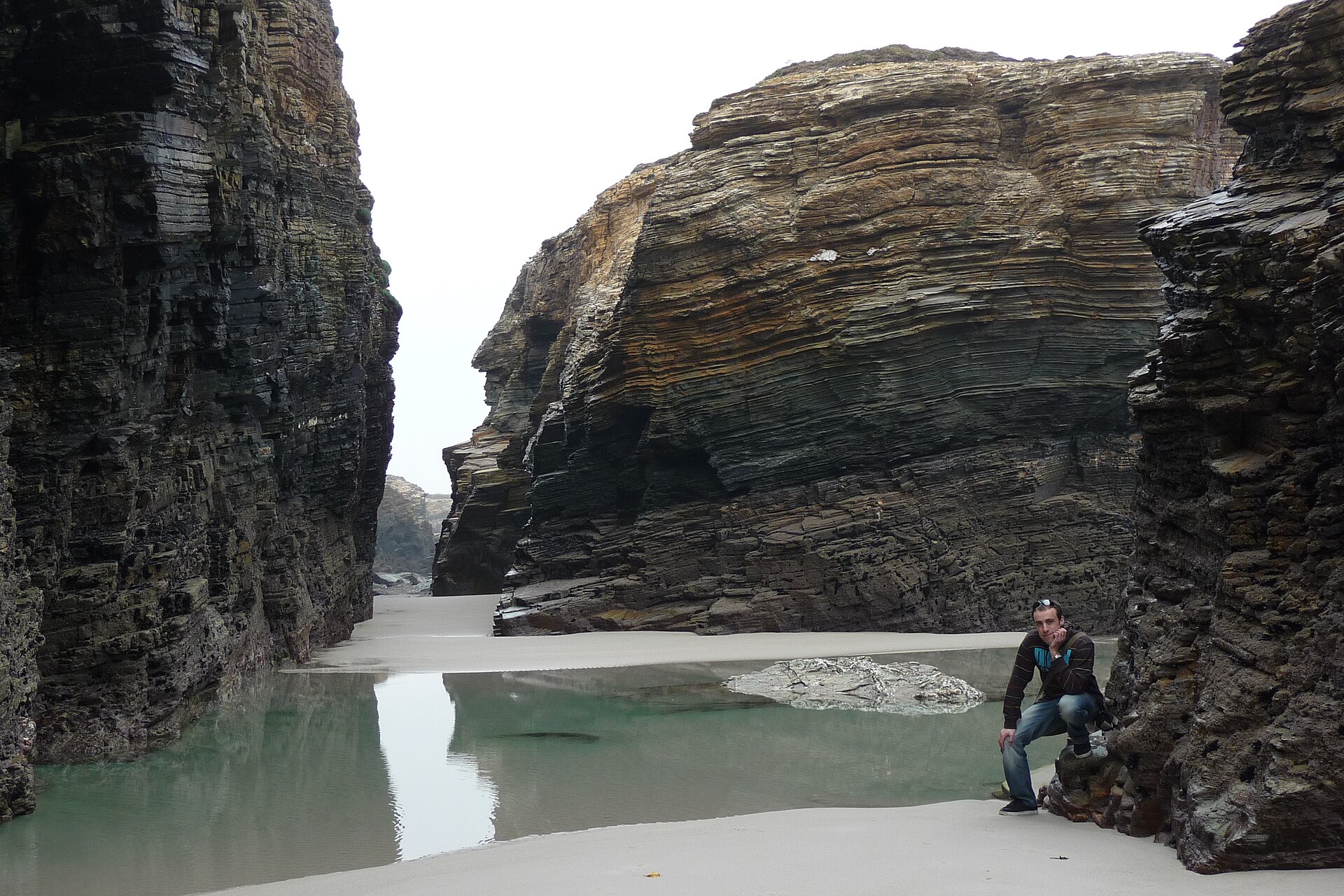
- The cliff-top viewpoints — Cliff path above the beach
The cliff above the beach gives a view that the sand level cannot: the arches line up like a row of ribs along the shore, and the Atlantic shows its mood. This is also the place to judge the tide before going down. On grey days mist can hide the beach completely, so a second look at another hour sometimes pays off.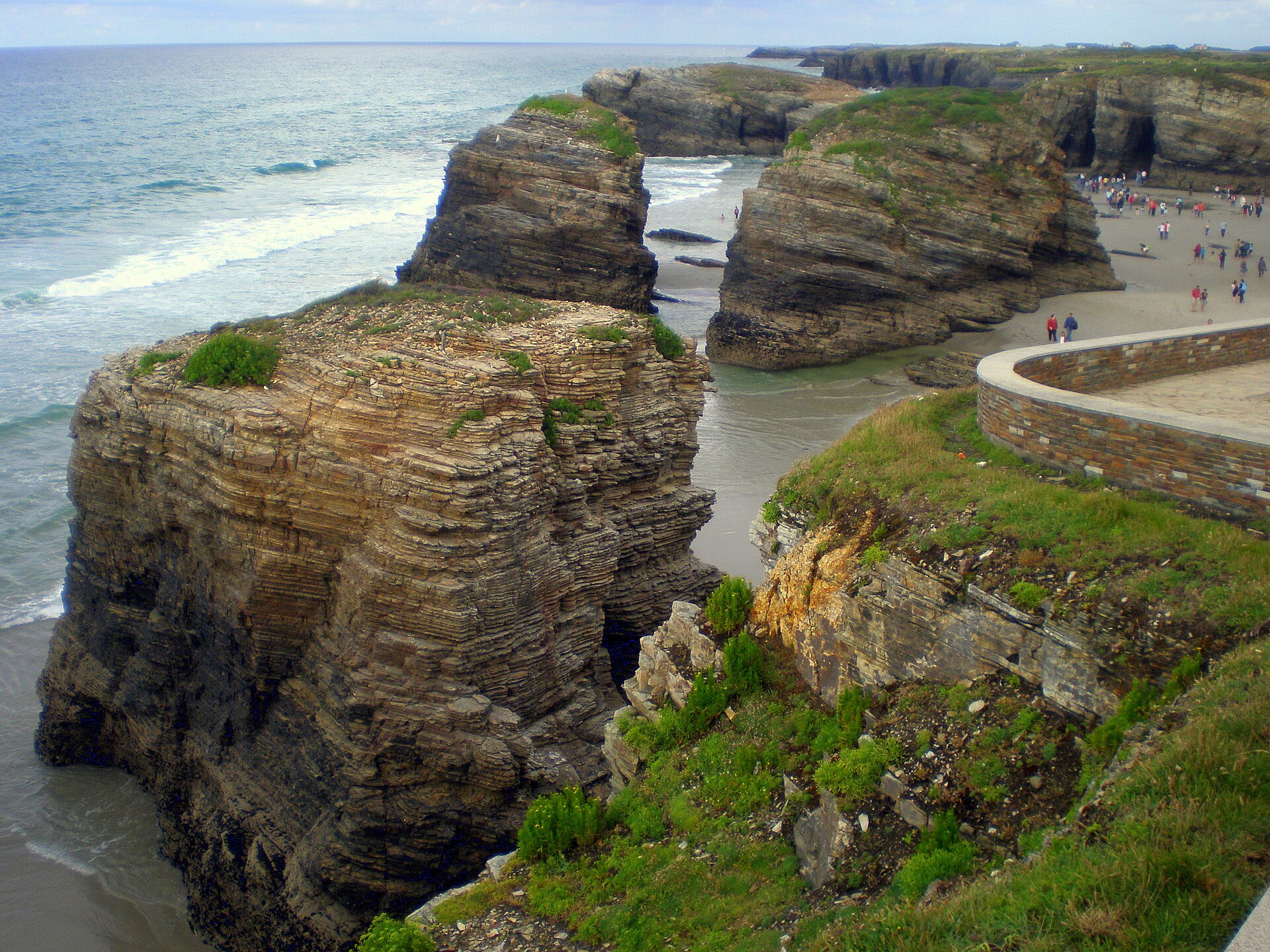
- Torre dos Moreno — Praza de España, Ribadeo
Torre dos Moreno is a modernista house with a tower, built as a private home and now the landmark of Praza de España in Ribadeo. Visitors currently see only the outside, so the pleasure is the façade and the square around it, a convenient place to begin a slow walk through the town. - Capela da Santísima Trindade — Near the marina, Ribadeo
Capela da Santísima Trindade, the Holy Trinity chapel, stands near Ribadeo's marina and dates from the Middle Ages, when the town walls ran beside it. It is small and plain, a short stop on a waterfront stroll rather than a long detour, and a reminder that Ribadeo was a working port long before beach tourism. - Faro de Ribadeo — Islet at the mouth of the ria, Ribadeo
Faro de Ribadeo is a lighthouse on a small islet joined to the shore by a bridge. There is no way inside, so it is a place for sea air, a look across the mouth of the ria and a break from the beach crowds. Wind is usual here, so a jacket is sensible even in sunshine. - Santa María do Campo — West side of Praza de España, Ribadeo
Santa María do Campo stands on the west side of Praza de España and began as part of a Franciscan monastery. Parts of the fabric are medieval, and it remains a working church. Visiting hours are unreliable, so treat it as a lucky find: admire the exterior, and step in quietly if the door happens to be open.
Culture
Playa de las Catedrales belongs to Galicia, a region with its own language, Galician, and a distinct sense of identity within Spain. The beach's official name, Augas Santas, and its Galician name, Praia das Catedrais, appear on many signs, and hearing Galician in shops and cafés is normal. Ribadeo, the nearest town, feels like a working coastal port: people meet in the main square, pubs fill in the evening, and meals run long and unhurried. Weather shapes habits here. Rain is accepted, jackets are always close, and plans change with the tide as readily as with the clouds. Seafood is central to local life, from octopus at village fiestas to shellfish gathered from the rocks, and the Celtic-influenced music of the gaita, the Galician bagpipe, turns up at festivals along the coast. Pilgrimage is another thread, since walkers on the northern Camino pass through on their way to Santiago de Compostela, and locals are used to travellers with rucksacks and sore feet. Conservation is taken seriously at the beach, which is a protected Natural Monument, so signs and staff may direct visitors. Respect the rules and the tide: stay on the marked paths, do not climb the arches or take rocks, shells or sand away, and leave the beach as soon as the water starts to return.
What to wear
Playa de las Catedrales sits in Galicia, where traditional dress belongs to festivals and folk groups rather than daily life. Festive costume draws on wool and linen: full skirts in strong colours, aprons, embroidered or black shawls for women, and dark waistcoats, breeches and woollen jackets for men. Wooden clogs, called zocos, were once practical footwear for wet ground, and gaita players in folk bands often wear a matching dark outfit. Day to day, people on this coast dress for the weather: waterproof jackets, fleeces, jeans and sturdy shoes, with fisherman's knits in colder months. In town the look is smart casual, and formality is mostly kept for church services and fiestas. A visitor should treat the beach as a walk rather than a swim. Bring a windproof, waterproof layer and a warm mid-layer even in summer, plus trainers or light boots with a good grip, since the rock is wet, algae-covered and sharp. Flip-flops are a poor idea. A hat and sun cream are worth packing for bright days, and a spare pair of socks helps if a wave catches the feet. Churches in Ribadeo do not demand strict covering, but covered shoulders and knees are polite inside, especially during services.
What to eat
- Pulpo á feira — A pulpería or tavern in central Ribadeo
Boiled octopus, sliced and dressed with olive oil, coarse salt and paprika, served on a wooden plate. Look for a pulpería or tavern in central Ribadeo, and eat it with bread and a glass of Galician white wine. - Empanada gallega — Bakeries in Ribadeo
A double-crust pie filled with tuna, cockles, pork or cod, with onion and peppers in a tomato sauce. Bakeries in Ribadeo sell it by the slice, and it travels well, so it makes an easy picnic for the cliff path. - Percebes — Seafood restaurants and bars near the harbour, Ribadeo
Goose barnacles, boiled briefly and eaten with the fingers, taste strongly of the sea. They are gathered from wave-battered rocks, so they are seasonal and costly; ask before ordering. Seafood restaurants and bars around the harbour area are the likeliest places. - Caldo galego — Family-run eateries in Ribadeo
A warming soup of white beans, potatoes, greens and pork, a staple in cold, damp weather. Family-run eateries in Ribadeo serve it, especially outside summer, and it makes a sensible meal after a windy morning on the sand. - Tarta de Santiago — Bakeries and cafés in Ribadeo
An almond cake dusted with icing sugar, traditionally marked with a cross. Bakeries and cafés in town sell slices, and it goes well with coffee after a meal. Pilgrims on the Camino often pick one up at stops along the way. - Galician white wine — Pubs and wine bars in central Ribadeo
Crisp, fresh and best with seafood, Galician white wine is poured by the glass in pubs and wine bars across Ribadeo's centre. Ask for a local bottle and let the staff suggest one to match your plate.
Plan it
Best time. Late May–June and September–early October offer the best balance of drier spells, mild air and manageable crowds; July and August are busiest, and winter brings rain, wind and rough seas. Whatever the month, plan the visit around low tide rather than the calendar.
How long. 1–2
Getting there. Fly to Santiago de Compostela (SCQ), the best-served airport in the region, or A Coruña (LCG), slightly closer but with fewer international flights. From either, continue by road via Lugo to the north coast, or by bus; Alsa coaches run from Oviedo, and a slow narrow-gauge rail line reaches Ribadeo from Ferrol. For the beach itself, public transport is limited, so a hire car or taxi from Ribadeo is the usual last leg.
Budget. mid
Tips
- Check the official site (http://galicianaturaleunica.xunta.gal/gl/praia-catedrais) for current access rules and any booking requirement before travelling
- Look up the tide table and aim to arrive well before low tide, so there is time to walk and return safely
- Wear shoes with a good grip and carry a waterproof layer, as the weather can change within the hour
- Arrive early in summer, when parking and the path down fill up
- Bring water and snacks, as there is little on the beach itself
Etiquette
- Do not climb on the arches or take rocks, shells or sand away
- Leave the beach as soon as the tide begins to return
- Take all rubbish with you
Nearby
Sources
- Wikidata Q2561808 (CC0)
- Wikipedia, As Catedrais beach (rev 1305474842) (CC BY-SA 4.0)
- Wikivoyage, Ribadeo (rev 5415721) (CC BY-SA 4.0)
- Photo 01, Ribadeo. Playa de las catedrales, Jaume Meneses (CC BY-SA 2.0)
- Photo 02, As Catedrais, nito (CC BY 3.0)
- Photo 03, As Catedrais, con marea baixa, Iván Cernadas (CC BY-SA 3.0 es)
- Photo 04, As Catedrais, Ribadeo (Galiza), Jose Luis Cernadas Iglesias (CC BY 2.5)
- Photo 05, Praia da Catedrais (Lugo), Jose Luis Cernadas Iglesias (CC BY 2.5)
- Photo 06, Cathedral beach, Wolffoxylady (CC BY-SA 4.0)
- Photo 07, Cathedral beach, Wolffoxylady (CC BY-SA 4.0)
- Photo 08, Cathedral beach, Wolffoxylady (CC BY-SA 4.0)


