Bilbao
Bilbao, Spain
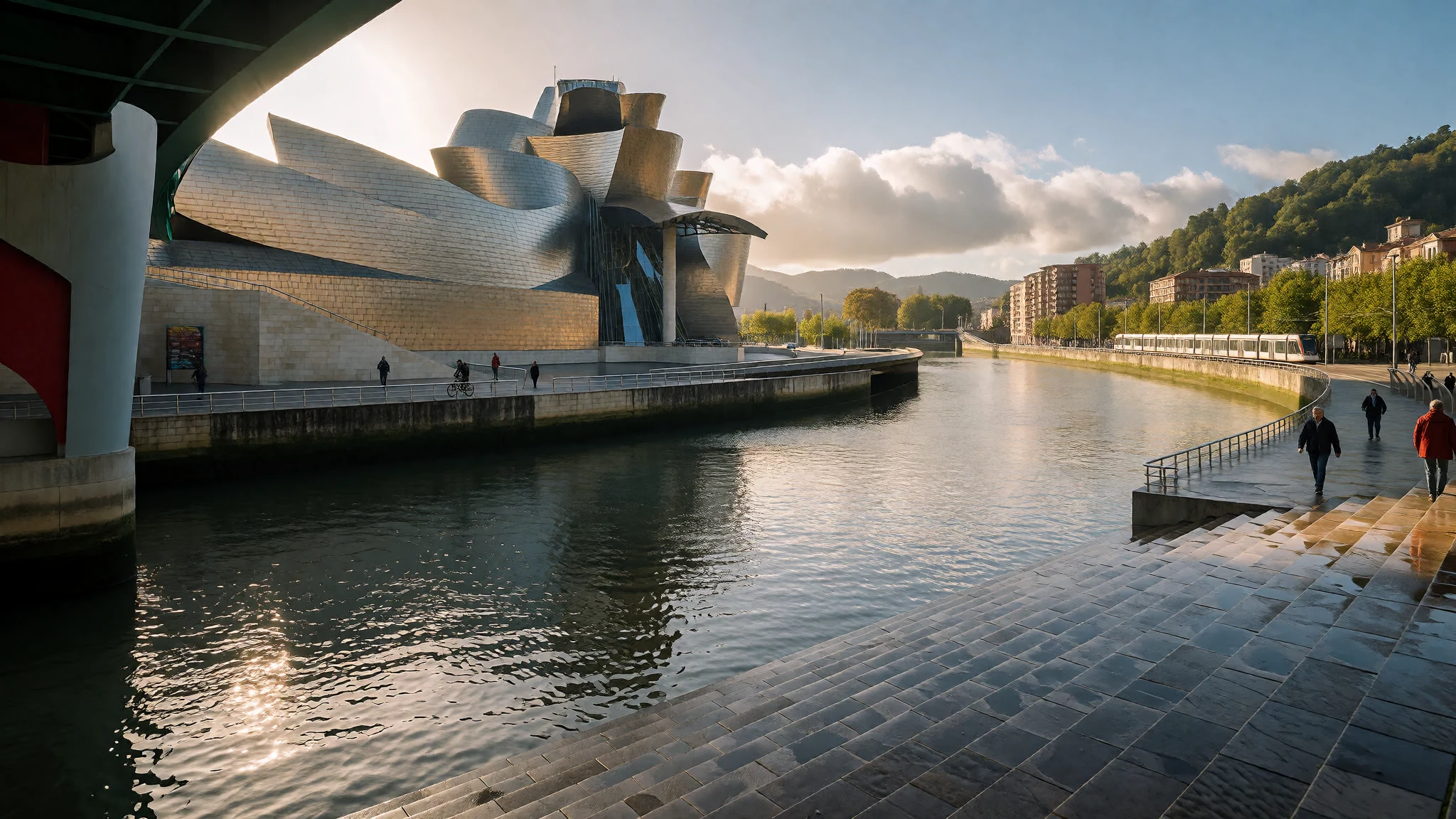
Bilbao pairs a daring modern art museum with a working-port soul, green hills, mild summers and some of Spain's most inventive small-plate bars.
The place
Bilbao is the main city of Biscay, a province of the Basque Country in northern Spain, and about 351,000 people live within its municipal limits. The wider metropolitan area holds several times that number, so the city works as the economic and cultural centre for a large part of the north coast. It lies along the Nervión estuary at about 19 m above sea level, a short way inland from the Bay of Biscay, with green hills pressing in on every side. That setting shapes daily life. Cloud and rain are common, and summers stay cooler than across most of Spain, which makes the city a pleasant escape from inland heat in July and August, though a waterproof jacket earns its place in any month. The old quarter, the Casco Viejo, is a knot of narrow streets called the Siete Calles on the river's right bank. Newer districts, laid out on broader lines, spread across the opposite bank, including the area around the Guggenheim. A riverside promenade ties the two together, passing bridges, former shipyards and old industrial ground that has been turned into parks and public squares. Bilbao was for generations a port and a steelmaking town, and its brick, iron and granite still carry that working past, even as galleries, universities and design studios take over land once given to heavy industry. The centre is compact enough to cover on foot, with a metro and tram for the longer stretches and the steeper slopes. Basque is spoken alongside Spanish, and street signs often appear in both. Most visitors arrive for one famous museum and end up staying for the bars, the walking and the moody northern light.
Its story
Bilbao became a town in 1300, when Diego López de Haro, the lord of Biscay, granted it a charter, but people had lived around the estuary long before that. Traces of a hilltop settlement have been found on Mount Malmasín, while burial sites on the heights of Avril and Artxanda reach back into prehistory. Under the church of San Antón, archaeologists uncovered older walls, a reminder that the riverside was occupied well before the charter. The new town was one of many founded across Biscay in the decades around it; Portugalete, Ondarroa, Lekeitio and Mungia followed the same pattern. Its position gave it an edge. Ships could come up the estuary, and the town became a trading outlet for goods moving between inland Castile and the sea, which gave it weight within the Crown of Castile. Centuries later, iron ore from the surrounding hills and a busy river port turned Bilbao into an industrial city, with steelworks and shipyards lining the Nervión; the Euskalduna yard is now a maritime museum. The city also saw fighting during the Carlist wars, and a painting of an assault on the Luchana bridge survives from the first of them. When heavy industry declined, Bilbao faced a hard period of closures and unemployment. The response was to clear the waterfront, extend the metro and commission a landmark art museum, an approach that planners elsewhere later copied. The city still shows both sides of that story: pride in its working past and a determined, rather careful modernity.
What to see
- Guggenheim Museum Bilbao — Abando, left bank of the Nervión
The Guggenheim Museum Bilbao is Frank Gehry's curving, titanium-clad gallery beside the river, and it put the city on the international art map. It holds modern and contemporary art. Weekday mornings are calmer. Outside, Jeff Koons's flower-covered Puppy guards the entrance. Check the official site for tickets and opening times. - Casco Viejo and the Siete Calles — Old town, right bank
Bilbao's Casco Viejo is the old town of seven original streets, now a lively tangle of shops, bars and small squares. The Ribera market sits on its riverside edge. Wander in the late morning for browsing, then return in the evening, when the bars fill and the lanes turn noisy and cheerful. - Museo de Bellas Artes — Doña Casilda park, near Abando
The Museo de Bellas Artes in Bilbao is the city's fine art museum, with thousands of paintings, sculptures, drawings, engravings and decorative objects spanning many centuries. It makes a quieter, older counterpart to the Guggenheim, and sits beside a park that is good for a rest afterwards. Check the official site for opening times. - Itsasmuseum — Former Euskalduna shipyard, riverside
Itsasmuseum, the maritime museum, stands on the old Euskalduna shipyard beside the performing arts centre of the same name. It explains how the estuary shaped Bilbao as a port and shipbuilding town. A walk along the river from the centre makes the setting part of the visit. - Basque Museum — Casco Viejo
The Basque Museum, opened in the early twentieth century, covers prehistory, archaeology, ethnography and the history of the Basque homeland. It suits visitors who want context for the language, customs and rural traditions seen around the city. Some find the layout a little awkward, so allow time and a clear plan.
Culture
Bilbao treats culture as part of everyday life rather than something kept for special occasions. The city has more than a dozen museums, from fine art and maritime history to Basque ethnography and bullfighting, and a theatre scene that runs from opera at the Euskalduna hall to contemporary dance at La Fundición. The ornate Arriaga Theatre was brought back into use as a municipal stage and now programmes music, theatre and dance, while Azkuna Zentroa, a converted wine warehouse, serves as a culture and leisure centre. Basque identity is strong. The language, Euskara, appears on signs and in schools, and the city's Basque name is Bilbo; visitors who try a simple 'eskerrik asko' (thank you) are usually met with a smile. Football matters too: Athletic Club, the local team, is known for favouring Basque-trained players, and its red-and-white shirts fill the streets on match days. In August the Aste Nagusia, or Big Week, brings concerts, fireworks and street parties to the city. Social life centres on the bars, where friends drift from one counter to the next in small groups, eating a little and drinking a little at each. Eating late is normal, and lunch is usually the main meal of the day. In a busy pintxo bar, wait to catch the staff's eye rather than pushing forward, and tell them honestly what you have eaten when you come to pay.
What to wear
Traditional Basque dress in Bilbao is mostly seen at festivals, folk dances and rural celebrations rather than on ordinary days. The txapela, a wide wool beret, is the emblem of Basque dress and is usually black. Folk costume often adds a white shirt, dark trousers, a red sash or neckerchief and rope-soled canvas shoes called alpargatas. Women's festival dress traditionally combines a full skirt of heavy cloth, an apron, a shawl and a headscarf, with wool and linen the common materials. Dance groups still wear these outfits, and the txapela remains a popular souvenir and gift. In daily life, Bilbao dresses in a relaxed, practical and fairly smart way: dark jackets, scarves, jeans and good trainers or leather shoes, with waterproof coats common because of the rain. On match days, red-and-white Athletic Club shirts are everywhere. Evening dress for bars and restaurants is smart casual rather than formal. Visitors should pack layers and a proper waterproof jacket in any season, plus a small umbrella. Shoes need grip, since pavements and cobbles turn slick in the wet and the old town has slopes and steps. Summer days can be warm, so bring a sunhat and light clothes as well. Churches and cathedrals expect covered shoulders, and a light scarf is useful for this.
What to eat
- Pintxos — Bars of the Casco Viejo and around Plaza Nueva
Pintxos are small bites, often served on bread and held together with a cocktail stick, laid along bar counters. Some are cold and ready to take; others are cooked to order. Bilbao's bars treat them as serious cooking in miniature. Friday and Saturday evenings are the busiest. - Gilda — Almost any pintxo bar
A Gilda is a skewer of green olive, pickled pepper and anchovy, salty, sharp and mildly spicy in a single bite. It is a classic first pintxo and goes well with a small glass of txakoli or a vermouth. - Bacalao a la vizcaína — Traditional Basque restaurants
Salt cod cooked in a sauce of dried red peppers, onion and garlic is a Biscayan classic. The sauce is rich but not fiery, and the dish suits a wet evening. Look for it as a main course in traditional restaurants. - Marmitako — Family-run restaurants and daily set menus
Marmitako is a tuna and potato stew with peppers, linked to fishing crews on the Basque coast. It is warming and filling, and most often appears on menus in cooler months or when tuna is in season. - Txakoli — Pintxo bars and wine shops
Txakoli is a dry, lightly sparkling white wine, often poured from a height into a wide glass to bring out its fizz. It is the usual partner for seafood and pintxos, and it is served young and cold. - Idiazabal cheese — Mercado de la Ribera and delicatessens
Idiazabal is a firm sheep's-milk cheese, sometimes smoked, with a nutty, slightly sharp taste. It turns up on pintxo plates and cheese boards, often with quince paste or walnuts, and is easy to buy from market stalls.
Plan it
Best time. May–June and September–October for mild temperatures and long days; summers are moderated by Bay of Biscay air, but rain is possible in every month and winters are grey and wet.
How long. 2–3
Getting there. Fly to Bilbao Airport, then take the Bizkaibus airport service from the arrivals hall into the centre; it accepts contactless bank cards, and fares are on the Bizkaibus website. Long-distance buses from Madrid, San Sebastián, Vitoria-Gasteiz and Santander use the Intermodal bus terminal, where you need a ticket or Barik card to reach the departure floor.
Budget. mid
Tips
- Book Guggenheim tickets through the official site and visit early on a weekday to avoid the biggest crowds.
- Carry a light waterproof jacket, because showers can arrive in any month.
- Pintxo bars are busiest on Friday and Saturday evenings, so go early or midweek for space at the counter.
- Walk the riverside between the old town and the museum district, and use the metro or tram on wet days.
- Keep a little cash for small bars and market stalls, although cards are widely accepted.
Etiquette
- Greet staff with a quick 'kaixo' or 'hola' when entering a bar or shop.
- Cover your shoulders and keep your voice low in churches.
- Tell the staff honestly what you have eaten when settling up at a pintxo bar.
Nearby
Sources
- Wikidata Q8692 (CC0)
- Wikipedia: Bilbao (rev 1384322677) (CC BY-SA 4.0)
- Wikivoyage: Bilbao (rev 5433963) (CC BY-SA 4.0)
- Cityscape - Bilbao, Spain (Tommie Hansen) (CC BY 3.0)
- Fotografías representativas de la ciudad de Bilbao (collage) (CC BY-SA 4.0)
- Relief map of Spain, Basque Country (Tschubby) (CC BY-SA 4.0)
- Physical location map Europe (Alexrk2) (CC BY 3.0)
- Statue of Don Diego López de Haro V (Fernando Pascullo) (CC BY 3.0)
- Bilbao in the year 1544 (Public domain)
- Ataque al Puente de Luchana (Public domain)
- Bilboko irudi historikoa (Public domain)


