Pico da Neblina
Pico da Neblina, Brazil
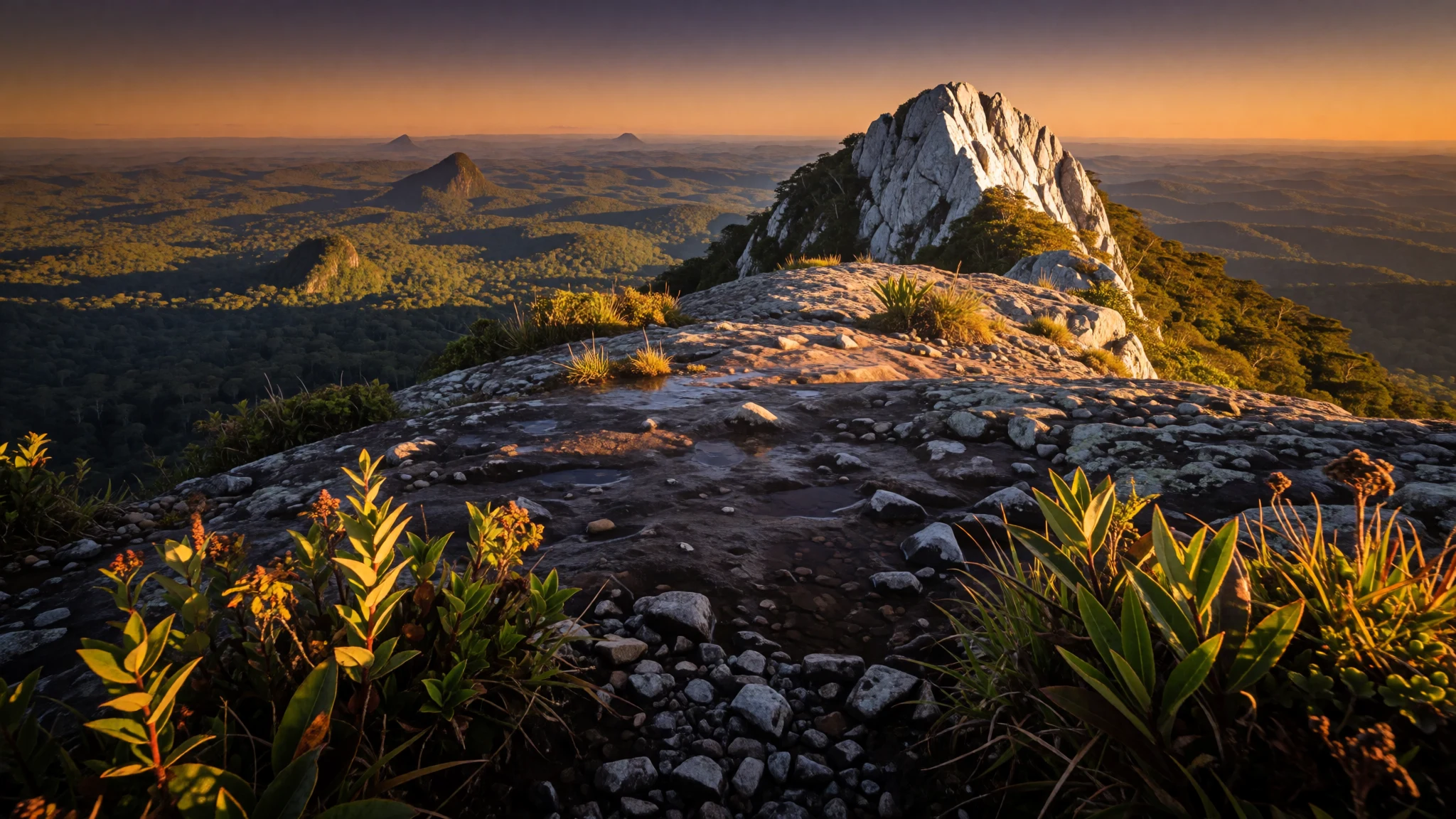
Experience Brazil's highest point, a mist-shrouded peak deep in the Amazon where ancient rainforests meet rare highland ecosystems.
The place
Pico da Neblina, which literally translates to Mist Peak, is the highest point in Brazil. Located in the northwestern reaches of the state of Amazonas, it forms part of the Serra do Imeri near the border with Venezuela. The mountain is a dramatic rise of quartz-rich rock that looms over the low-lying basin of the upper Rio Negro. Because of its equatorial position and altitude, the peak is frequently swallowed by heavy clouds and persistent rain, creating a damp, ethereal environment.
The landscape changes drastically as one ascends. The journey begins in the dense, humid Amazonian rainforest, which eventually gives way to montane forests. As the air cools and thins, the vegetation shifts again into a rugged world of low shrubs, hardy herbs, and exposed stone. This isolated environment has fostered the evolution of unique species, including rare frogs that have been separated from their nearest relatives for millions of years. The terrain is challenging, characterised by saturated ground and narrow ridges that require careful navigation. For the adventurous, it represents the ultimate frontier of Brazilian geography, sitting as the highest point of the Guiana Shield and the tallest summit in South America east of the Andes.
Its story
Pico da Neblina is more than just a geographical marker; it is a site of profound spiritual importance. The Yanomami people, who inhabit the surrounding Cauaburis region, call the mountain Yaripo, or the Mountain of the Winds. In Yanomami cosmology, Yaripo is a sacred space. The ridges and slopes are not merely rock and soil but are woven into ancestral narratives and rituals that connect the community to the spirits of the natural world. To the Yanomami, the mountain is a living entity tied to the balance of the forest.
For the outside world, the mountain remained a distant silhouette seen from the Rio Negro until the mid-twentieth century. It wasn't until the 1950s that expeditions truly began to penetrate the upper massif. The first confirmed ascent took place in 1965, led by José Ambrósio de Miranda Pombo, who was working on the official boundary between Brazil and Venezuela at the time. In more recent years, the story of the mountain has become one of conservation and conflict. The park has struggled against the encroachment of illegal gold mining, which has scarred the landscape and contaminated local streams with mercury. Today, the mountain stands as a symbol of both the raw power of nature and the fragile struggle to protect indigenous territories from external exploitation.
What to see
- The Summit Ridge — Pico da Neblina National Park
The highest point of Pico da Neblina offers a stark, rocky landscape often veiled in thick fog. The experience is defined by the transition from green jungle to a grey, windswept plateau of quartz rock. - Pico 31 de Março — Brazil-Venezuela Border
Located directly on the border between Brazil and Venezuela, this is the second-highest peak in the country. It shares the same rugged massif and provides a contrasting perspective of the borderlands. - Mamirauá Reserve — Amazonas State
One of the world's largest flooded forest areas, this reserve is essential for seeing the white uacari monkey and hundreds of bird species amidst towering hardwood trees. - Anavilhanas Archipelago — Rio Negro basin
A massive complex of over 400 river islands in the Rio Negro. It is a labyrinth of black water and jungle, best explored by regional boat. - Rio Acajatuba — Near Manaus
A tributary of the Rio Negro near Iranduba, known for its proximity to river islands and local legends regarding giant snakes that haunt the bay. - Yanomami Craft Markets — Manaus and regional hubs
Markets where indigenous artisans sell intricate baskets, hammocks, and ornaments crafted from local vines, seeds, and forest fibres.
Culture
The culture surrounding Pico da Neblina is deeply rooted in the heritage of the Yanomami people. Their relationship with the land is one of reciprocity and spiritual reverence, where the mountain is viewed as a guardian of the winds. This indigenous perspective clashes sharply with the extractive culture of illegal gold miners, who view the region as a source of wealth. In the nearby city of Manaus, a blend of colonial Portuguese influence and Amazonian river culture creates a vibrant atmosphere. Life here revolves around the ebb and flow of the rivers, with a strong emphasis on community and a deep knowledge of forest pharmacology and survival. The local identity is inextricably linked to the river, which serves as the primary highway for trade and travel. Respect for the forest's rhythms is central to daily life for those living in the interior. You should always seek explicit permission from indigenous leaders before entering Yanomami territories.
What to wear
Fashion at Pico da Neblina varies between the ancestral and the practical. Traditional Yanomami dress is minimal, focusing on body paint and ornaments made from seeds and feathers, designed for mobility in the humid undergrowth. In urban centres like Manaus, people wear light, breathable cotton clothing to cope with the stifling equatorial heat. For a visitor, the wardrobe must be split into two distinct kits. For the lowland jungle, lightweight, quick-drying long sleeves and trousers are essential to protect against insects and thorns. However, for the ascent of the peak, the climate shifts violently. High-quality waterproof gear, thermal layers, and sturdy, waterproof trekking boots are mandatory to survive the saturated ground and plummeting temperatures of the highlands. Moisture-wicking fabrics are far superior to cotton in this environment, as the latter never truly dries in the persistent mist.
What to eat
- Tacacá — street markets in Manaus
A pungent, hot local soup made with tucupi (manioc juice) and jambu, a leaf that creates a tingling sensation on the tongue. - Tapioquinha — morning markets
A chewy pancake made from manioc starch, typically toasted with butter and stuffed with farmer's cheese and palm fruit. - Pamonha — regional eateries
A sweet or savoury paste of young corn and coconut milk, steamed inside the corn's own husk. - Bolo de Macaxeira — local bakeries
A dense, translucent cake made from cassava root, known for its rich texture and slightly oily finish. - Açaí — fruit stalls throughout Amazonas
A thick, iron-rich purple berry pulp served traditionally as a savoury side dish rather than a sweet dessert. - Capuaçú — riverfront cafes
A creamy, aromatic fruit native to the Amazon, often enjoyed as a chilled juice or a dessert cream.
Plan it
Best time. June to August, during the 'dry' season, though the peak remains misty year-round; avoid the heaviest rains for safer trekking.
How long. 14–21
Getting there. Fly into Eduardo Gomes International Airport (MAO) in Manaus, followed by regional flights or multi-day boat journeys up the Rio Negro.
Budget. high
Tips
- Secure all necessary permits for the National Park and Indigenous Territory well in advance
- Hire a specialised guide experienced in high-altitude Amazonian terrain
- Pack high-grade water purification tablets for river water
- Bring heavy-duty waterproofs for both the jungle and the summit
- Carry a satellite communicator as there is no mobile signal in the interior
Etiquette
- Avoid photographing indigenous people without their express consent
- Stick strictly to marked trails to prevent further soil erosion
- Pack out every piece of rubbish to protect the fragile highland ecosystem
Nearby
Sources
- Wikidata Q739484 (CC0)
- Wikipedia (CC BY-SA 4.0)
- Wikivoyage (CC BY-SA 4.0)