Olduvai Gorge
Olduvai Gorge, Tanzania
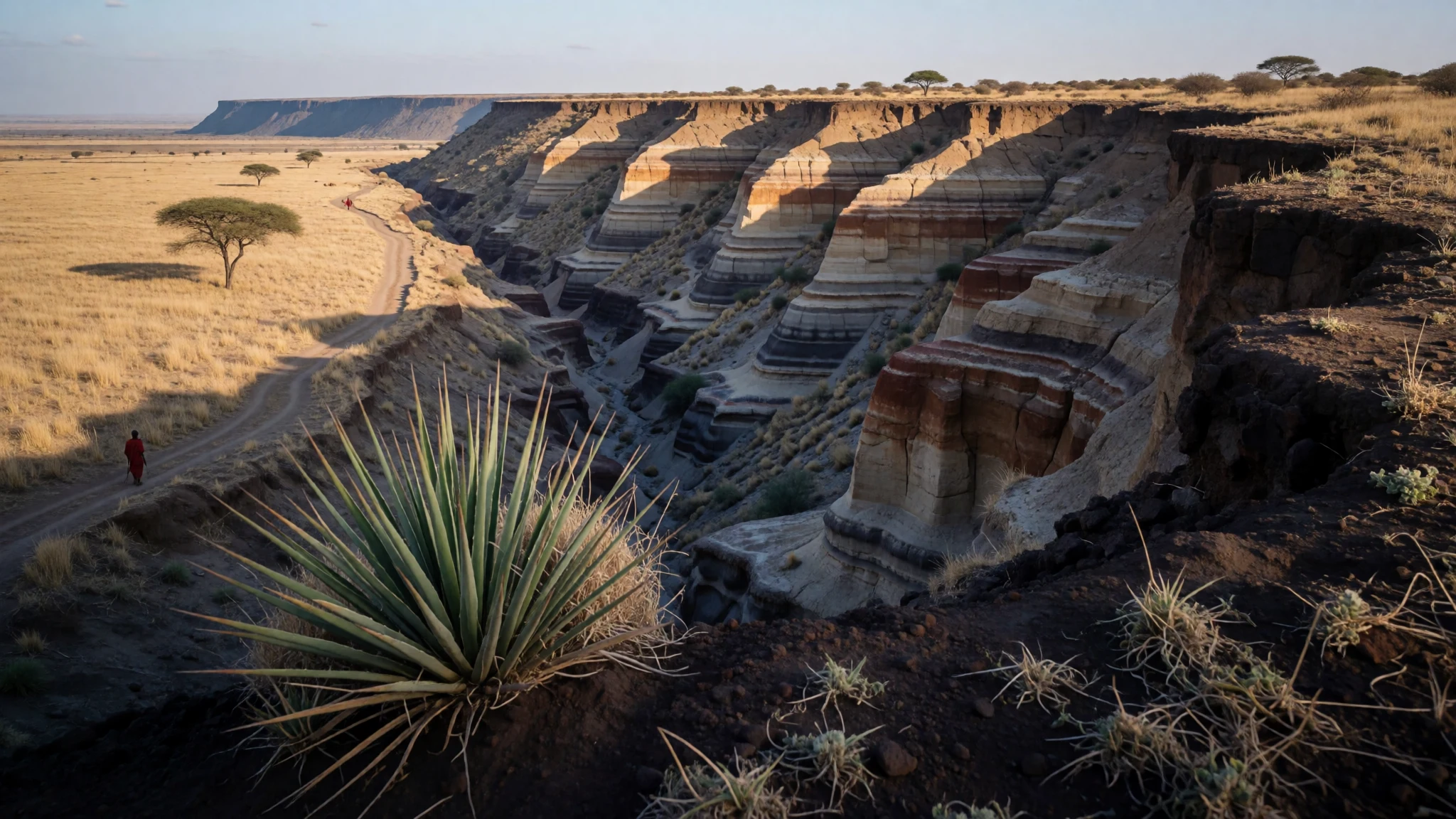
Olduvai Gorge is a quiet, sun-baked ravine in Tanzania where layered cliffs and old stone tools tell the story of early humans.
The place
Olduvai Gorge is a steep-sided ravine in northern Tanzania, cut into the dry eastern plains of the Serengeti inside the Ngorongoro Conservation Area. It belongs to the Great Rift Valley country that runs the length of East Africa, and it is long enough that nobody walks the whole thing; visits centre on a few viewpoints and the area around the small museum. Seasonal water has sliced deep into the bed of an ancient lake, and the walls now show their layers like pages in a closed book: bands of volcanic ash, clay and sand in cream, rust and grey. A side gorge coming down from Lemagrut Mountain joins the main channel, so the landscape has more than one arm. Wild sisal grows in spiky clumps along the slopes. The Maasai name, Oldupai, means the place of that plant, and this spelling is increasingly used in Tanzania alongside the older Olduvai. Researchers care about the gorge because the cut exposes ancient sediments that hold animal bones and stone tools, which can be compared layer by layer. Laetoli, another early-human locality, lies a drive away across the plains. The setting is open, hot and quiet, with acacia scrub, volcanic hills on the skyline and the odd herd of grazing animals. Most visitors come as a stop on a northern-circuit safari, somewhere between the crater and the Serengeti. It works best as a short, thoughtful visit rather than a full day, with a guide who can explain what the colours in the walls mean.
Its story
Olduvai Gorge entered science almost by accident. In 1911 a German doctor and palaeontologist, Wilhelm Kattwinkel, was in the region studying sleeping sickness when he came across the ravine and noticed fossil bones of an extinct three-toed horse in its walls. His report drew the geologist Hans Reck, who led a team there in 1913 and recovered human remains. War then cut short the expeditions that were planned to follow. Once Tanganyika passed to British administration, Louis Leakey visited Reck in Berlin, saw the fossils and became convinced that the gorge must also hold stone tools. He returned in 1931 with Reck and the palaeontologist Donald McInnes, and found hand axes close to camp soon after arriving. Mary Leakey first came in 1935, and the couple kept returning over the following decades. Between them, Louis and Mary Leakey carried out most of the excavations and recovered most of the hominin fossils that made the gorge famous. Simple chopped cobbles and flakes from these layers gave rise to the term Oldowan for early stone-tool making. A skull found in the area was first placed in the genus Australopithecus and later reclassified as Paranthropus boisei. What had been a remote ravine became a reference point for the study of human origins, and today it is a protected National Historic Site of Tanzania where research and visits continue side by side.
What to see
- The gorge rim viewpoint — Main viewing platform, eastern Serengeti Plains
The main viewing area at Olduvai Gorge looks down into the cut, where the pale walls fall away in steps. On a clear morning the layering is easy to read, and a guide can show where ash beds sit above older lake clays. Bring a hat; there is little shade.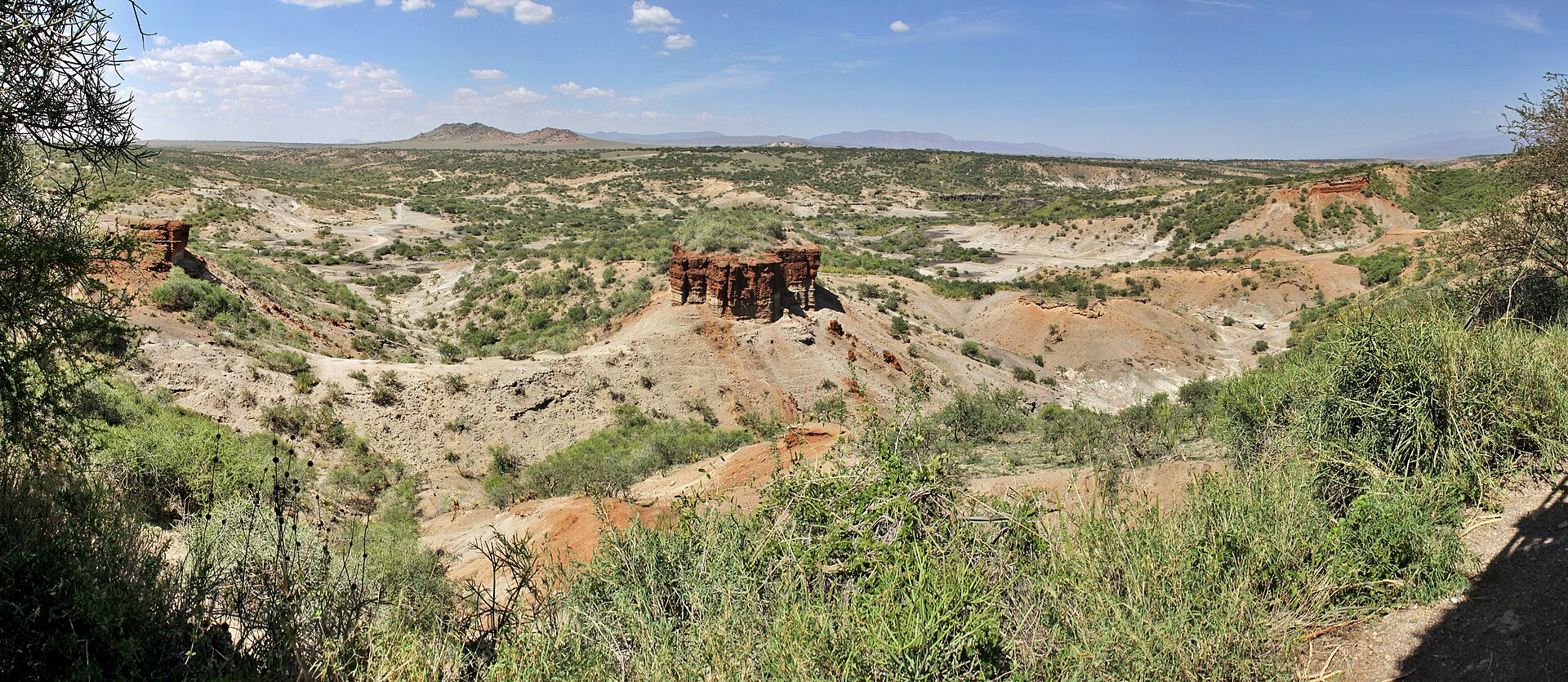
- The site museum — Beside the gorge rim
A small museum near the rim explains the excavations, the Leakeys' work and the sequence of layers using displays, casts and photographs. It is modest in scale, but it makes the dry landscape outside make sense. Opening arrangements change, so confirm with your operator or the conservation area authority.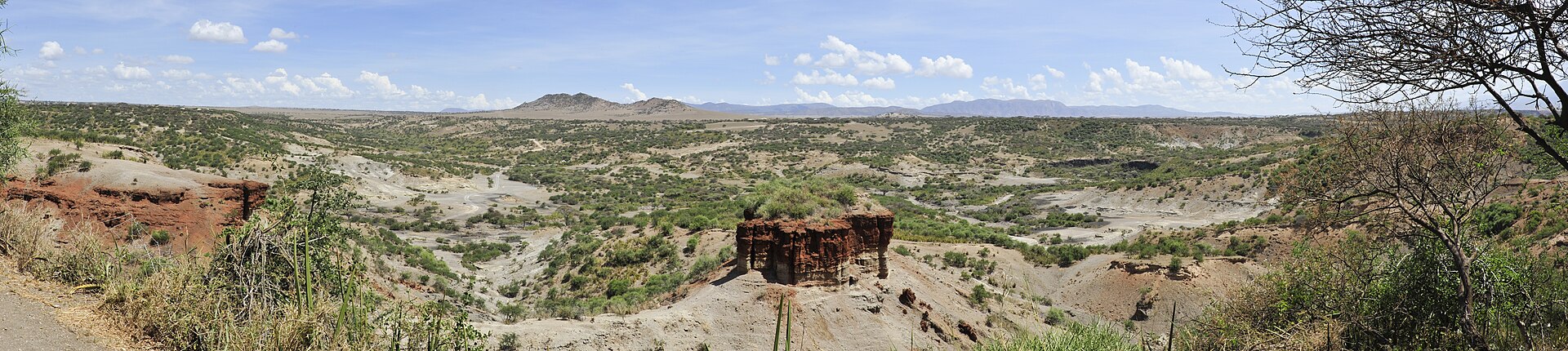
- Stone tools and the skull marker — Museum and marker area
Olduvai is known for basalt chopping tools, and the museum shows how they were made. A marker near the gorge records where a Paranthropus boisei skull was found, a quick reminder that real fieldwork happened on this spot, by hand, under the sun.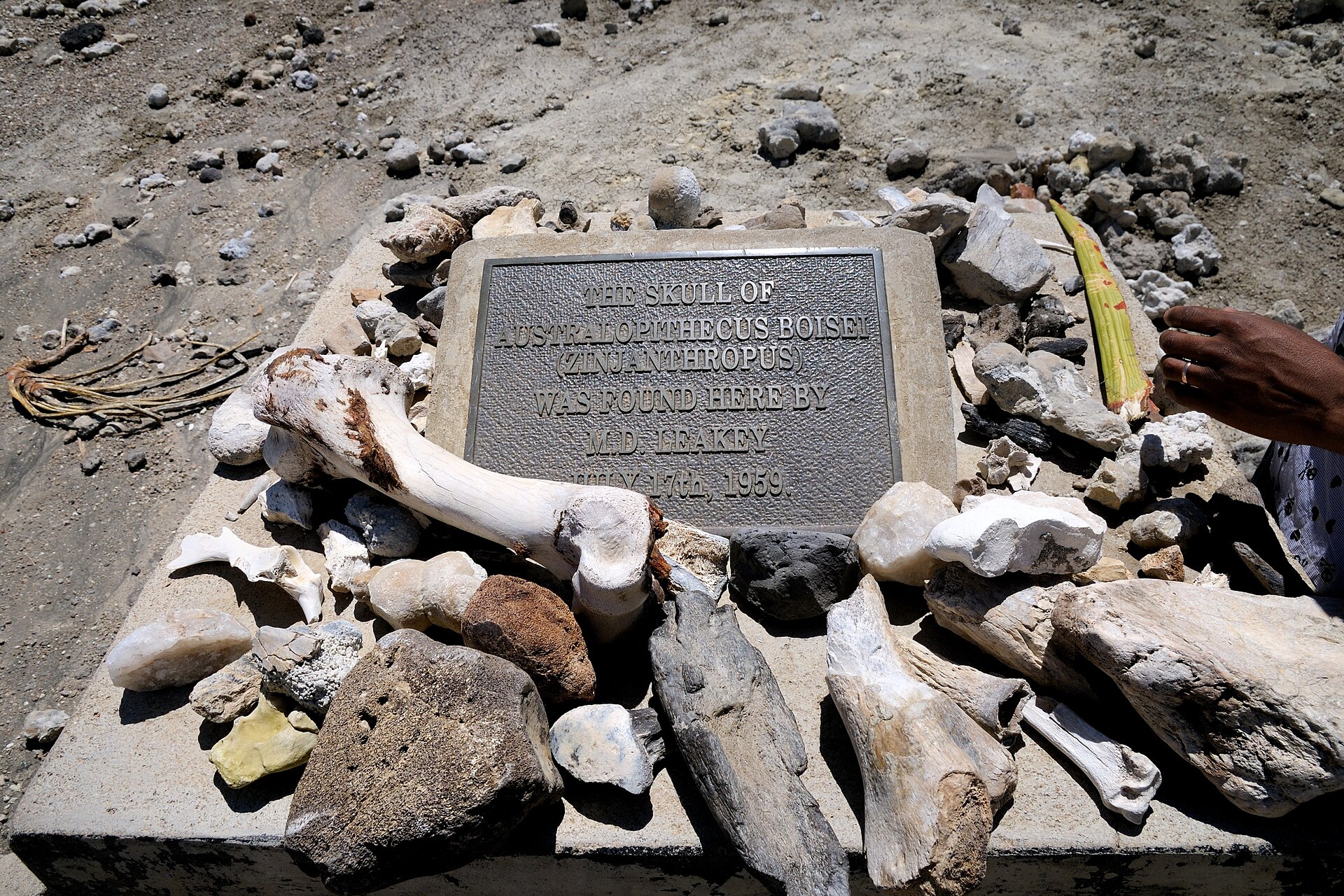
- The side gorge from Lemagrut — Western end of the gorge, below Lemagrut Mountain
A smaller gorge descends from Lemagrut Mountain and meets the main channel. Seen from the rim, it shows how the landscape was carved by many streams, not one. Ask your guide whether a stop is possible, as access depends on the day and the season. - Laetoli — South-east of Olduvai, Ngorongoro Conservation Area
Laetoli is another early-human locality in the same conservation area, a drive from the gorge across open plains. It pairs well with Olduvai for anyone keen on the deep past. Access is controlled, so arrange it through a licensed operator in advance.
Culture
Olduvai Gorge sits in Maasai pastoral country, and the people you meet nearby are herders whose cattle, goats and sheep move across the same plains that surround the gorge. Their way of life shapes the area: livestock share the land with wildlife, and settlements known as bomas sit at a distance from the main sights. Alongside that living culture runs the scientific one, since the Leakeys' camp and decades of digging have given the gorge a quiet, almost reverent atmosphere among guides, who are proud of its place in the story of human origins. Swahili is the common language across Tanzania, and a little effort goes a long way. Elders are greeted with shikamoo, which carries the sense of respect, and the usual reply is marahaba. Maasai greetings differ again, so ask your guide for a local phrase or two. Dress modestly away from the lodges, as the region is conservative, and keep voices low at the rim, where researchers and school groups often listen to talks. Take only photographs: stones, tool fragments and bone chips belong to the scientific record, and removing them is both illegal and a loss to the site. Ask before photographing any Maasai person, expect to agree a payment first, and never pick up stones or fossil fragments from the gorge.
What to wear
Around Olduvai Gorge, traditional dress means the Maasai shúkà, a rectangular cotton wrap worn over the shoulders or tied at the waist. Red is the colour most often seen, with checks and stripes in blue, black and other shades. Beadwork is the other hallmark: wide collars, earrings and bracelets in layered colours, made mostly by women and worn daily and at ceremonies. Elsewhere in Tanzania, Swahili women wear kanga and kitenge, printed cotton wraps, often with a proverb printed along the edge. Day to day, most people now wear a mix of modern and traditional clothing. Herders may pair a shúkà with sandals, a jacket or a woollen hat on cool mornings, while people in towns choose shirts, trousers, dresses and school uniforms, with kanga for work at home. For visitors, practical comfort matters more than style. The plains are hot and dusty by day and surprisingly cool at dawn, so pack light, long-sleeved cotton or linen shirts, long trousers, a wide-brimmed hat and sunglasses, plus a fleece for early drives. Neutral colours such as khaki, olive and sand suit game drives and hide dust. Shoes should be closed, sturdy and comfortable on rocky ground. Dress modestly in villages: covered shoulders and knees are appropriate, and a kanga makes a handy extra layer.
What to eat
- Ugali — Any roadside eatery or lodge kitchen on the safari route
A stiff maize-flour porridge, firm enough to shape by hand and eaten with the fingers. It comes with stews, grilled meat or greens, and every cook has a slightly different way of making it. Plain, filling and the usual accompaniment on a safari lunch. - Mtori — Local eateries in Karatu and the towns near the conservation area
A comforting soup of beef and green bananas, cooked down until creamy and mild. Often served in a bowl as a starter or a light meal, particularly in northern Tanzania. Squeeze lime over it if it comes with wedges. - Mchicha — Home-style restaurants and market eateries
A stew of leafy greens, similar to spinach, cooked with onion and tomato, and often made with meat or fish. It is a staple side dish that goes well with ugali and rice, and is one of the easier local dishes for vegetarians to ask about. - Nyama choma — Roadside grills and town eateries on the way to the park
Grilled meat, usually goat or beef, cooked over charcoal and cut into pieces for sharing. Order it by weight, eat with ugali and a kachumbari salad, and make sure the meat is cooked through before it reaches the plate. - Maandazi — Morning stalls and tea shops in towns along the route
Lightly spiced fried dough, a little like a doughnut without the sugar coating, eaten at breakfast or with sweet tea. It is cheap, portable and good for the long drive out to the gorge.
Plan it
Best time. June to October is the dry season: skies are clear, tracks are firmer and the days are warm without being oppressive. The long rains, roughly March to May, turn tracks to mud and some roads become difficult, and a shorter rainy spell can follow late in the year. Early mornings are cool at any time of year.
How long. 1–2
Getting there. Fly to Kilimanjaro International Airport or Arusha, then continue by road with a safari operator through the Ngorongoro Conservation Area. The gorge lies on the route between the crater and the Serengeti, and the last leg is on dirt tracks that need a four-wheel-drive vehicle.
Budget. high
Tips
- Book through a licensed safari operator, since access is arranged through the conservation area and most visitors go with a guide
- Visit in the morning, when light on the walls is best and the plains are cooler
- Carry plenty of drinking water, sun protection and a hat, as there is almost no shade at the rim
- Carry some cash for small purchases and tips, since card payment is unreliable in remote places
- UK and Indian passport holders need a visa, which can be applied for through the government e-visa system before travel; check current rules, including the new inbound travel insurance requirement for foreign visitors
Etiquette
- Ask before photographing people and agree any payment first
- Leave stones, tools and bone fragments exactly where they lie
- Greet elders with shikamoo and keep voices low at the rim
Nearby
Sources
- Wikidata Q217043 (CC0)
- Wikipedia: Olduvai Gorge (rev 1382241932) (CC BY-SA 4.0)
- Wikivoyage: Tanzania (rev 5408710) (CC BY-SA 4.0)
- Olduvai-Schlucht in Tansania 2011, Mike Krüger (CC BY-SA 4.0)
- Oldupai, Vinny Burgoo (CC BY 3.0)
- Olduvai Gorge from space, NASA/GSFC/METI/ERSDAC/JAROS and U.S./Japan ASTER Science Team (Public domain)
- Olduvai Gorge, Harvey Barrison (CC BY-SA 2.0)
- Neolithic lithic implement, Birmingham Museums Trust, Teresa Gilmore (CC BY-SA 2.0)
- Panoramic view of Olduvai Gorge, רנדום (CC BY 3.0)
- Olduvai stone chopping tool at British Museum, BabelStone (CC BY 3.0)
- Plaque marking the discovery of Australopithecus in Tanzania, George Lamson (CC BY-SA 2.0)


