Mount Heng
Mount Heng, People's Republic of China
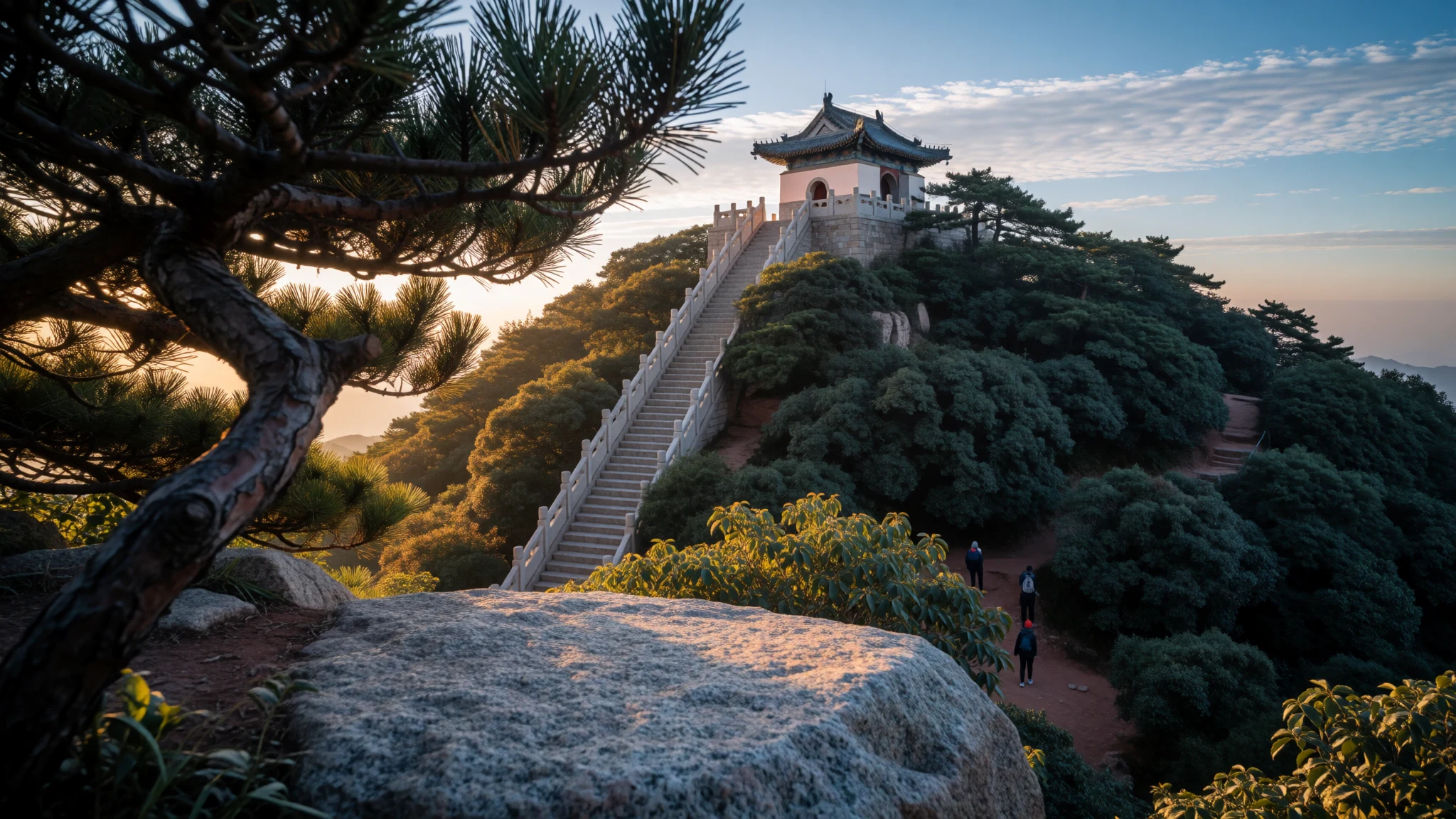
Mount Heng is a green southern pilgrimage mountain in Hunan, where temples, forest paths and a cable car reach a 1,300 m summit.
The place
Mount Heng (衡山, Héng Shān) rises in Hunan province in south-central China, and Chinese tradition counts it as the southern mountain of the Five Great Mountains. Strictly it is a range rather than a single peak: a chain of 72 summits stretching roughly 150 km, with Zhurong Peak topping out at 1,300 m. One end of the ridge lies near Hengyang and the other close to Changsha, so the whole is long, folded and mostly green.
The climate is humid subtropical, with plenty of rain, mild winters and summers that stay bearable, especially up high, where the air cools steadily with every step in elevation. Below about 800 m the slopes carry evergreen broadleaf forest on red soil; higher up, the trees shrink into dwarf woodland, scrub and grass. Much of the mountain lies inside a nature reserve with its own arboretum, and the forest cover is dense.
A visit usually starts at Nanyue, the small town at the foot, beside the Grand Temple. Guesthouses, tea sellers and incense shops line the approach. A cable car lifts walkers to the upper ridge, where a paved road leads to the summit temple. That upper stretch is where the crowds gather; the lower paths, ponds, inscribed rocks and small shrines are far quieter. The mountain carries China's AAAAA tourist rating, which means good infrastructure and also tour groups, particularly at weekends and on public holidays.
Its story
Mount Heng earned its standing through religion and imperial ritual long before tourism. As the southern mountain among the Five Great Mountains, it was a place where rulers and officials made offerings, and Nanyue Damiao, the Grand Temple at its foot, is the centrepiece of that tradition. The present complex traces its origins to 725 AD, but it has been damaged and rebuilt many times, so what stands now is layered rather than original.
Buddhists and Daoists have shared the mountain for centuries. Zhusheng Temple, an eighth-century Buddhist monastery, sits among older and newer shrines, and Zhurong Gong, a small stone temple, carries the same name as the highest peak. A temple from the Ming dynasty crowns the summit. Pilgrims once made the whole ascent on foot; most now ride the cable car for the steepest part, though plenty still walk.
The mountain has a quieter natural story too. In 1954 botanists found two wild velvet soapberry trees in the forest near Guangji Temple, and in 2012 two more turned up in the same area. Those four trees are reported to be the only ones remaining in the wild anywhere. The area was protected as a provincial nature reserve in 1984 and raised to national status in 2005, a sign that the forest here is valued as much as the shrines.
What to see
- Zhurong Peak — Summit of the park
Zhurong Peak is the summit of Mount Heng at 1,300 m, and a Ming dynasty temple stands on top. From the cable car it is a short, steady walk along a busy paved route. Go early or late in the day to miss the tour groups, and carry a layer, as the wind at the top can be cool.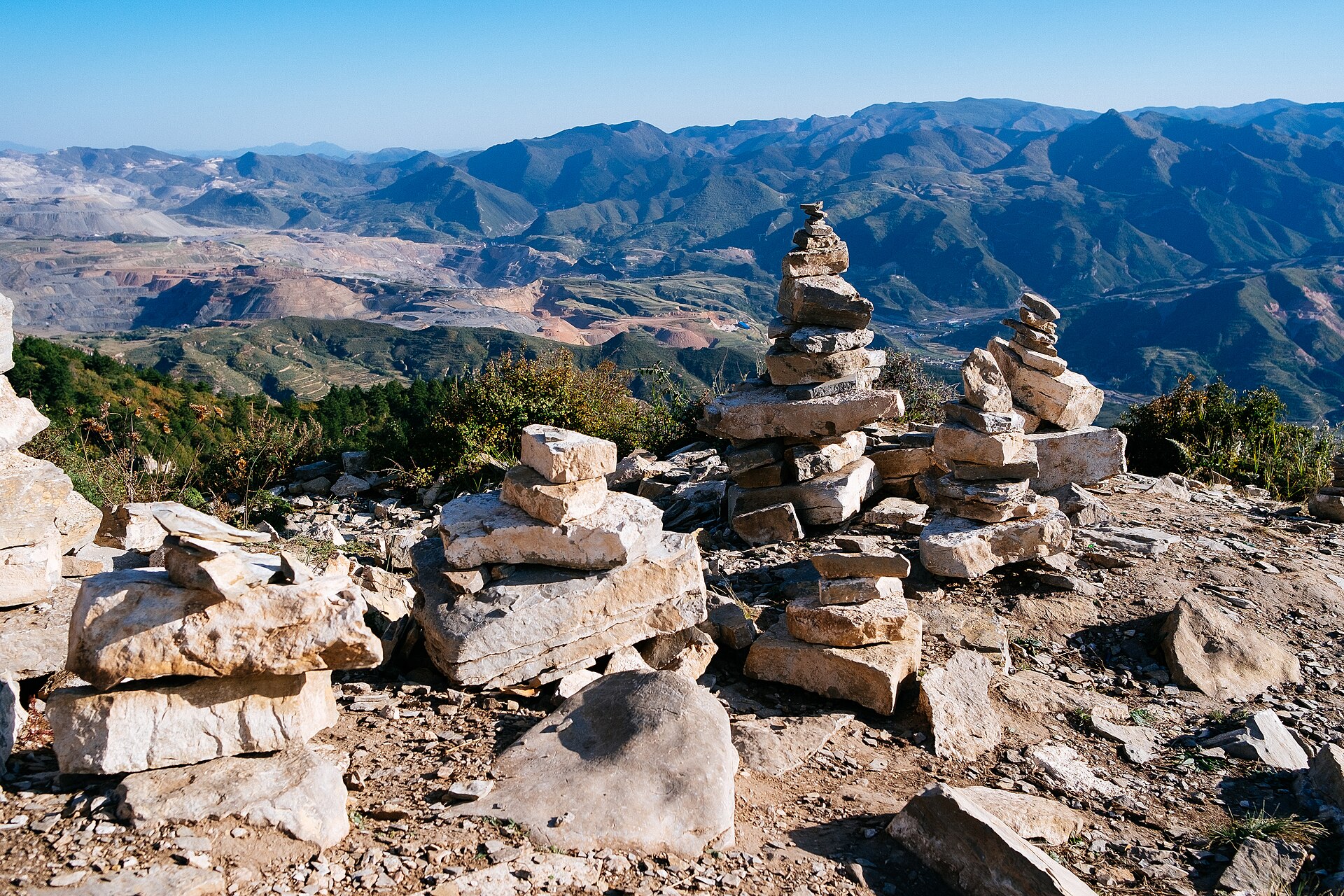
- Huixian Bridge — Just south of the summit
Huixian Bridge is a rock arch of a curious kind: a boulder has lodged in the gap between the mountainside and a second outcrop. It sits close to the summit yet draws few people. The short trail is a useful way to leave the main flow of visitors behind and hear the forest again. - Martyrs' Shrine — Lower slopes, near Nanyue
The Martyrs' Shrine is a large memorial complex on the lower slopes, laid out with terraces and landscaped grounds. It suits a slower, flatter part of the day and makes a sober contrast to the temples. Check locally what is open before making a special trip, as arrangements at memorial sites can change. - Xiangguang Peak — Western ridge
Xiangguang Peak is a quieter summit on the ridge, reached by an occasional bus from the terminal near the cable car base. Because the service is irregular, ask at the ticket desk before setting out and keep energy in reserve for a walk back. The reward is a view with far fewer people in it than at the main peak. - Nantai Temple — South-west ridge
Nantai Temple is easy to spot from much of the mountain, because its tall pagoda stands on the neighbouring ridge to the south-west. A bus runs occasionally from the cable car base, but only until early afternoon, so go in the morning. The temple is a calm place to stop and look back at the range. - Grand Temple of Mount Heng — Nanyue town, at the foot of the mountain
The Grand Temple of Mount Heng, Nanyue Damiao, stands just outside the main park gate and dates to 725 AD. It has been damaged and enlarged repeatedly, so it reads as a sprawl of halls, courtyards and gateways. It is worth an hour at the start or end of a day, with incense burning and worshippers coming and going.
Culture
Mount Heng is a working religious site, not only a scenic one. Buddhist and Daoist traditions overlap here, and the mountain's role as the southern one of the Five Great Mountains has drawn pilgrims for a very long time. Visitors will see worshippers lighting incense, kneeling on cushions at altars and leaving small donations at shrine doors. Monks and temple staff go about daily routines among the tour groups, and the mood can swing from lively to hushed within a few steps.
Many Chinese visitors climb for luck, health or family wishes, and the summit temple draws the most devotion. Inscribed rocks along the paths record poems and blessings left by earlier walkers, part of a long Chinese habit of writing on stone in beautiful places. Small villages inside the park, with their guesthouses and family-run eateries, give a more everyday sense of life on the mountain, and the pace there is slower than around the cable car.
In the main halls, speak quietly, step over thresholds rather than on them, and ask before photographing worshippers or monks, as many prefer not to be photographed while praying.
What to wear
Around Mount Heng, traditional dress is now mostly ceremonial rather than daily. Han Chinese robes in silk or cotton, in the Hanfu style, appear at festivals and in photographs, and some young visitors wear them for temple trips. Hunan's minority communities, including the Tujia and Miao, are known for embroidered jackets, indigo-dyed cotton, woven brocade and silver jewellery, worn chiefly at festivals and weddings elsewhere in the province rather than on the mountain itself.
Day to day, people on the mountain wear practical clothes: trainers, light jackets, caps, sun umbrellas and quick-dry layers. Pilgrims often dress a little more neatly than hikers, and older walkers favour sturdy shoes and a small towel against the damp.
Visitors should plan for a humid subtropical climate: warm and often wet below, noticeably cooler near the summit. Wear breathable layers, carry a light waterproof, and choose shoes with a good grip, since stone steps and mossy paths turn slick in rain. For temples, cover shoulders and knees, and keep a scarf or thin overshirt in the bag. A hat and sunscreen help on the open ridge road in summer.
What to eat
- Tofu sticks — Stalls at the peak and along the main paths
Sticks of tofu, fried or grilled and seasoned, are a classic mountain snack. They are sold near the peak and along the main paths. A handy, filling bite for a long climb, and the seasoning often carries a chilli kick. - Roasted corn — Snack stalls near the cable car stations and along the paths
Corn on the cob, boiled or roasted, appears at stalls on the busier stretches. It is simple fuel for the walk and a break from fried snacks. Seasonal fruit is often sold alongside it. - Rice noodles (mifen) — Small noodle shops in Nanyue town and Hengyang
Bowls of rice noodles in broth or stir-fried are a staple across Hunan and a dependable breakfast before a climb. Expect chilli, pickles and often a topping of pork or vegetables. Diners who dislike heat should ask for less spice. - Hunan-style stir-fries — Guesthouse dining rooms and the few small restaurants on the mountain
Hunan cooking is known for fresh chilli, garlic and smoky flavours. Guesthouses can usually arrange a family-style meal of stir-fried vegetables, tofu and pork with rice. Anyone wanting mild dishes should say so clearly when ordering. - Smoked cured pork (larou) — Local eateries around Nanyue
Smoked, cured pork is a Hunan favourite, usually sliced and stir-fried with chilli or leeks. Its smoky saltiness works well against plain rice. It is a common item on the menu at local eateries around the foot of the mountain.
Plan it
Best time. March–April and October–November, when the air is mild and the forest is fresh or turning. Summer is warm and wet, though the heights are cooler than the plain; winters are mild with plenty of rain.
How long. 1–2
Getting there. Fly to Changsha, take the maglev from the airport to Changsha South station, then a high-speed train to Hengshan West; the last leg is a bus or taxi to Nanyue at the foot of the mountain. Hengyang airport has a few flights daily, with a shuttle bus, but Changsha is often easier.
Budget. low
Tips
- Say both Hengshan and Nanyue when buying bus tickets, so you do not end up in the wrong town.
- Take the cable car up; the alternative is a long walk, partly on tarmac.
- Start early: the stretch near the top station and the summit is where tour groups cluster, while side trails stay calm.
- Carry water and snacks, as bottled drinks on the mountain cost more than in town.
- Guesthouses can be basic, so bring your own towel, soap and toothbrush, and carry some cash as well as a mobile payment option.
Etiquette
- Cover shoulders and knees and speak quietly in temple halls.
- Ask before photographing worshippers or monks.
- Step over temple thresholds rather than on them.
Nearby
Sources
- Wikidata Q644965 (CC0)
- Wikipedia: Mount Heng (Hunan), rev 1385282853 (CC BY-SA 4.0)
- Wikivoyage: Mount Heng (Hunan), rev 5300919 (CC BY-SA 4.0)
- Hengshan Mountain View, User:TheNeon (CC BY 3.0)
- A cement road on Mount Heng (Hunan), Huangdan2060 (CC0 1.0)
- Hengshan, China, marroyo12 (CC BY 2.5)
- The Chuanfa Temple on Mount Heng (Hunan), picture 1, Huangdan2060 (CC0 1.0)
- The Chuanfa Temple on Mount Heng (Hunan), picture 2, Huangdan2060 (CC0 1.0)
- The Chuanfa Temple on Mount Heng (Hunan), picture 3, Huangdan2060 (CC0 1.0)
- The Chuanfa Temple on Mount Heng (Hunan), picture 4, Huangdan2060 (CC0 1.0)
- Distant view of cable-way station, Mount Heng (Hunan), Huangdan2060 (CC0 1.0)


