Kubuqi Desert
Kubuqi Desert, People's Republic of China
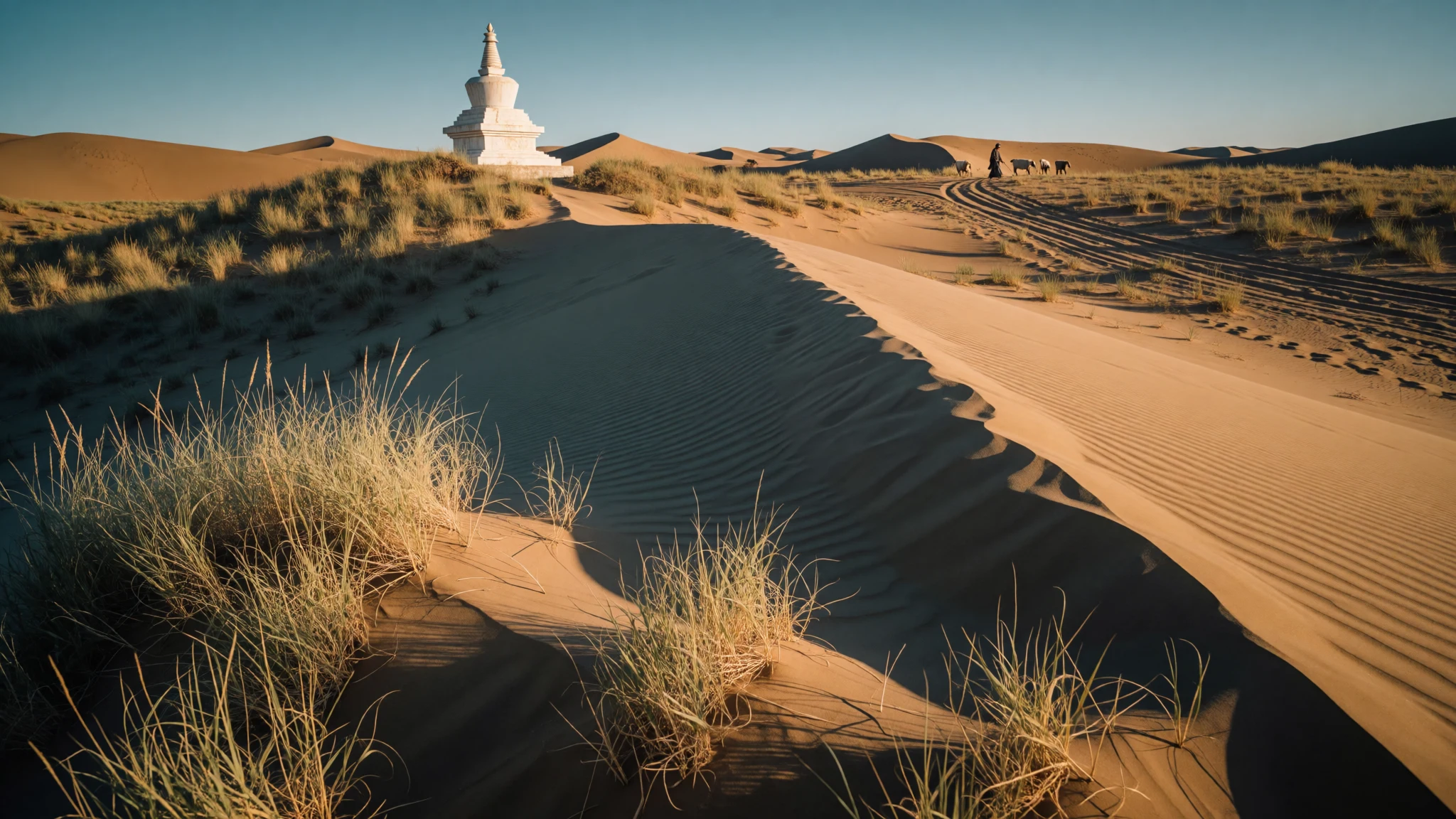
Kubuqi Desert puts golden dunes within reach of a new Inner Mongolian city, so camels, dune driving and Mongol heritage share one trip.
The place
Kubuqi Desert (库布齐沙漠, Kùbùqí Shāmò), also called the Hobq Desert after its Mongolian name, lies in the Ordos Basin of northwestern China, under the administration of Ordos City in Inner Mongolia. It sits between the Hetao plains and the Loess Plateau and forms part of the wider Ordos Desert, alongside the Mu Us Desert to its south. Its area is about 18,600 square kilometres, which makes it the seventh-largest desert in China. What surprises many first-time visitors is how close the sand is to modern urban life. This is not a remote expedition: resort areas have been built at the edge of the dunes, with camel caravans, dune driving and family entertainment laid on for groups. Photographs of the area show pale dunes broken by patches of steppe, a stupa standing out against the sand, and four-wheel-drive cars crawling over the slopes. The nearest bases are Ordos itself, whose new centre is Kangbashi, and the older city of Dongsheng. The name Ordos covers both the prefecture and the new city, so mentioning Kangbashi to locals avoids confusion. Altan Xire town lies across the Wulan Mulun River from Kangbashi and works as an extension of its business district. Most people stay in one of these towns and head out to the dunes for the day.
Its story
Kubuqi Desert has a modern story that is bound up with the city beside it. Ordos Kangbashi was built as a showpiece new city, with monumental buildings along a central axis and apartment blocks repeated by the dozen. When it was new in 2010 it had almost no street life, and Western media nicknamed it a ghost city. Several years later about 100,000 people lived there and the streets were busy by day, though evenings stayed quiet compared with Dongsheng, the older and livelier city nearby. For the desert, this matters because the new city brought hotels, a museum and transport links to a region that had little tourism infrastructure. A railway station opened in 2016 and made the area far easier to reach by train, including an overnight service from Beijing of about 15 hours. Older layers sit underneath all this. The Ordos region is tied to Mongol history, and it holds a temple dedicated to Genghis Khan that is a place of worship for ethnic Mongols. The result is an odd, layered destination: a desert with resort comforts, a planned city with a very short history, and a Mongol culture that predates both. Visitors who expect either empty wilderness or a finished metropolis tend to find something in between.
What to see
- Xiangshawan — Kubuqi Desert, near Ordos
Xiangshawan is the desert resort Wikivoyage names as the most popular place for dune sightseeing in the Kubuqi area, and it carries the top tourist rating in the province. Expect organised activities: camel caravans, dune driving and entertainment aimed at families. Go early or late in the day for softer light and gentler heat.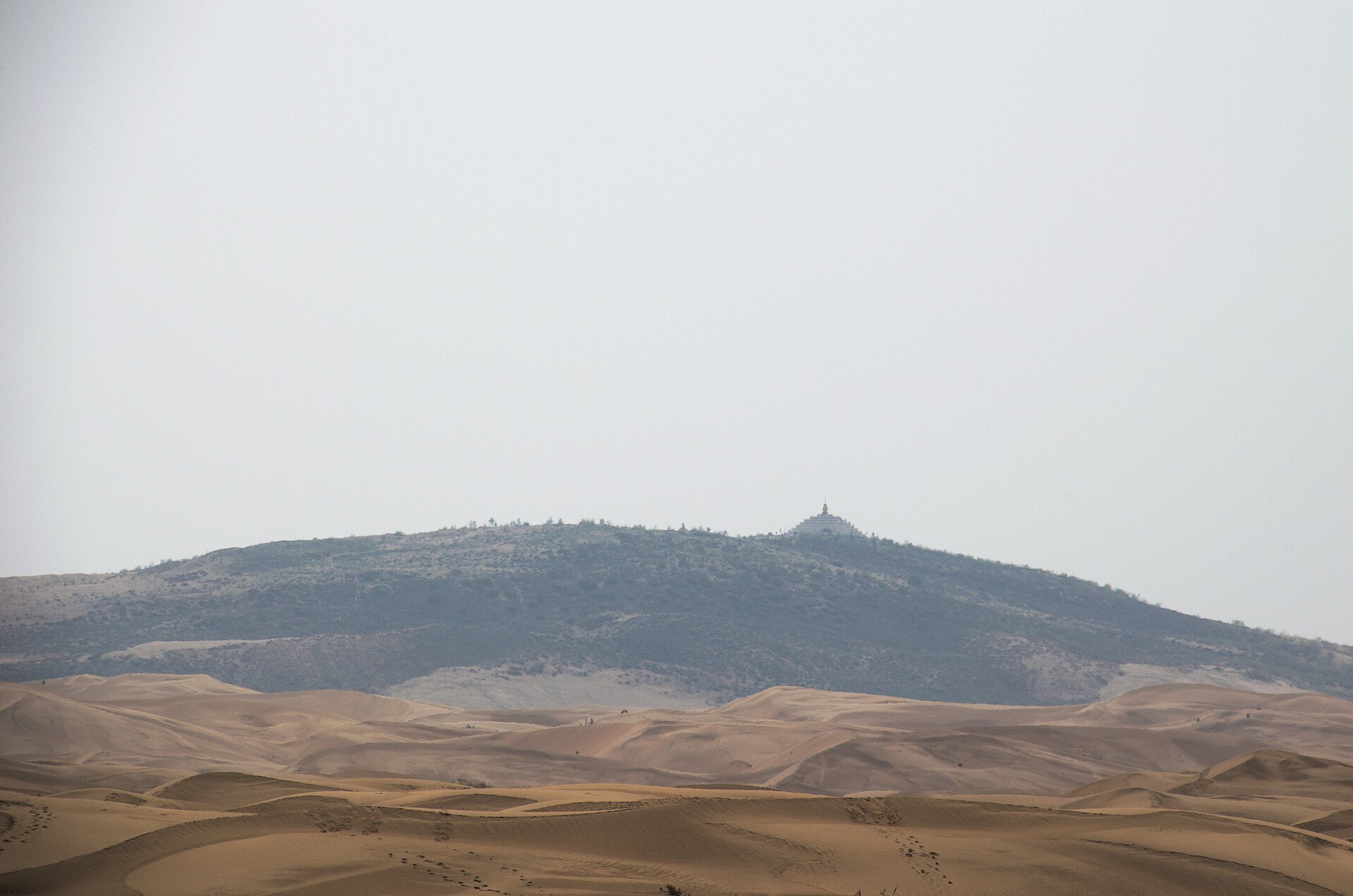
- Yinkentala — Kubuqi Desert, near Ordos
Yinkentala is another desert resort in the Kubuqi area, described as cheaper than Xiangshawan. It suits travellers who mainly want sand and dunes and can do without the family entertainment. It is a sensible alternative when the larger resort feels too busy or too packaged for the day you have.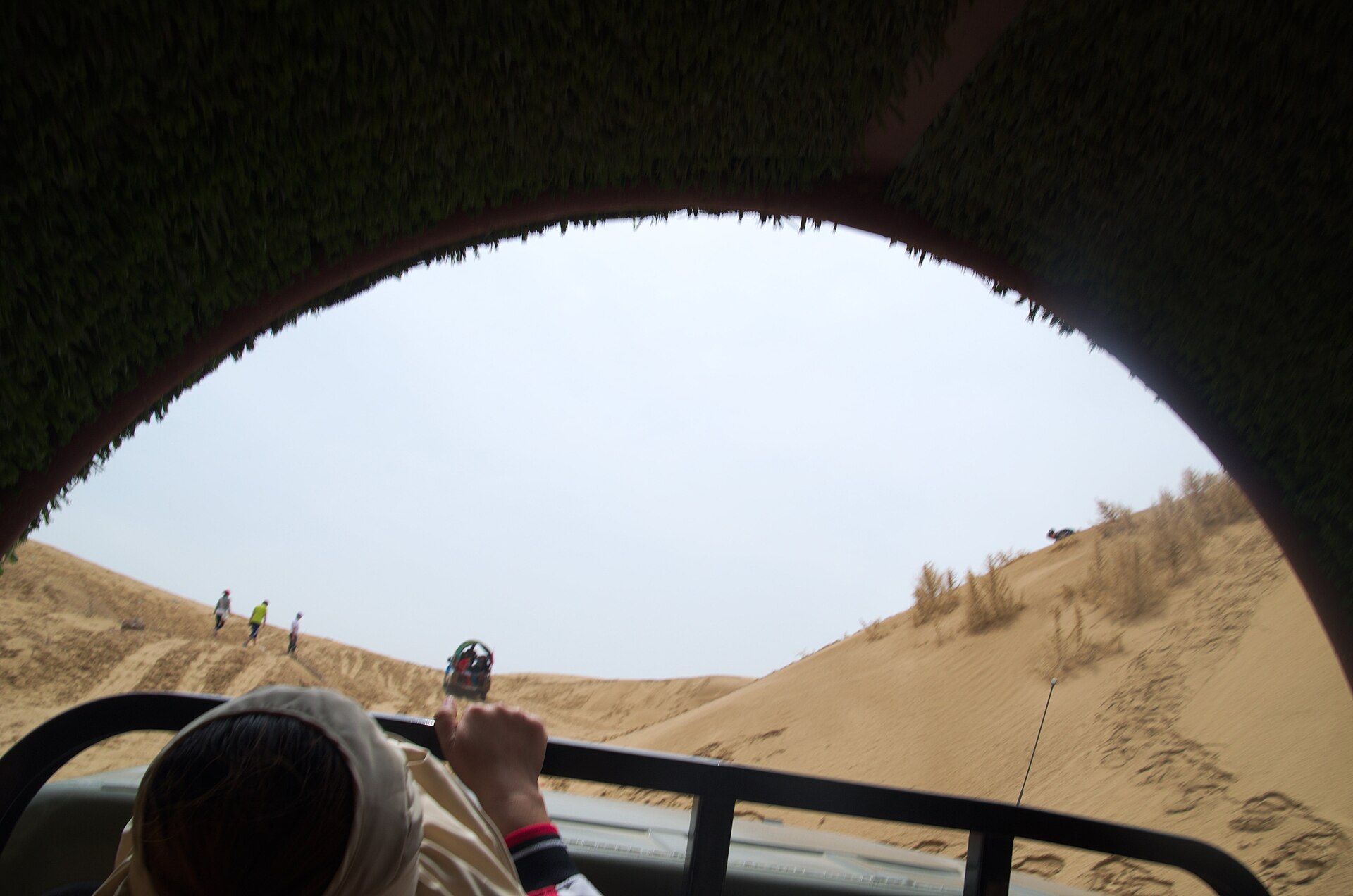
- Ordos Museum — Kangbashi, Ordos
The Ordos Museum is the architectural showpiece of Kangbashi, and it is worth an hour or two before or after the dunes. Its three exhibitions cover the region's fossil history, contemporary art inspired by local scenery, and the area's links to Genghis Khan. It gives the desert some context. - Mausoleum of Genghis Khan — South of Ordos city
The Mausoleum of Genghis Khan is not his tomb, since he was buried in an unmarked grave in a secret place. It is a temple dedicated to him and a major place of worship for ethnic Mongols. It is the other top-rated tourist site in Ordos prefecture, so allow a separate half-day. - Kangbashi Tourist Area — Kangbashi, Ordos
The Kangbashi Tourist Area is the flashy centre of the new city, a ceremonial mall running between the parallel Wenhua West Road and Wenhua East Road. It is a good place to see the planned-city atmosphere that earned Ordos its ghost-city reputation. The buildings are lit up after dark.
Culture
Kubuqi Desert sits in the Inner Mongolian part of China, and the culture of the area is Mongol at its root. The Ordos region is closely tied to Genghis Khan, and the temple dedicated to him is a major place of worship for ethnic Mongols, not just a sightseeing stop. Mongol life has traditionally centred on herding across the steppe, hospitality to travellers, milk-based foods and the horse, and echoes of all this survive in festivals, food and the way guests are welcomed. At the desert itself, the culture is mostly the culture of tourism: resorts, camel caravans and dune driving, run for visiting groups and families. Ordos city adds a modern Chinese layer, with new civic architecture, light shows on tall buildings at night and a self-conscious image as a planned city. Locals can find the name confusing too, since Ordos means both the prefecture and the new city, so it helps to say Kangbashi when you mean the new centre. Spend time in the museum and at the mausoleum if you want to understand the Mongol side of the story, because the desert resorts alone give only a thin picture. When you visit the Mausoleum of Genghis Khan, dress modestly, keep your voice low, and treat it as a living place of worship rather than a photo backdrop.
What to wear
Kubuqi Desert lies in Mongol country, and the traditional dress of the region is the deel, a long, high-collared robe fastened at the side and tied with a bright sash. It is made from silk, cotton or wool depending on season, with heavier lined versions for winter, and it is worn with leather boots and sometimes felt hats. Today you will mostly see it at festivals, weddings and ceremonies, and on staff at tourist sites. Everyday clothing in Ordos and Dongsheng is the same modern urban wear you would see across China: jeans, jackets, trainers, and sportswear. At the dune resorts, visitors wear sun hats, sunglasses and light outdoor gear. As a visitor, plan for sun and sand rather than formality. Choose loose, long-sleeved cotton or linen layers that protect skin from the sun, a wide-brimmed hat, sunglasses and a scarf or buff to pull over your face when wind lifts the sand. Closed shoes with a good grip work better than sandals on steep dune slopes, and shoes that slip off easily help when sand gets inside. Bring a warm layer for evenings and cooler seasons, as open country cools quickly after sunset. For the Mausoleum of Genghis Khan, cover shoulders and knees.
What to eat
- Boiled mutton on the bone — Mongolian restaurants in Dongsheng and Kangbashi
Boiled mutton served on the bone is the classic Mongol meal, eaten with the hands and a small knife, usually with little more than salt. Look for it in restaurants advertising Mongolian food in Dongsheng and Kangbashi, where it is often shared among a group. - Salted milk tea — Mongol-run restaurants and tourist camps near the dunes
Mongol milk tea is brewed with milk and salt, and it tastes closer to a light soup than to sweet chai. It is offered as a welcome drink in Mongol-run places. Try a cup with bread or fried dough before judging it. - Goat milk products — Kangbashi Food Plaza, first-floor provincial goods shop
Goat milk is a regional speciality, and Wikivoyage mentions goat milk powder among the provincial goods sold in a shop at Kangbashi Food Plaza. It is an easy edible souvenir that packs well and does not need refrigeration. - Dried milk curd — Local shops and stalls selling Mongol dairy goods
Dried milk curd is a hard, sour Mongol snack that keeps well and has a strong, tangy taste. It is usually sold in small pieces and suits a long drive or a day among the dunes. Start with a small portion, as the flavour is not for everyone. - Lamb skewers — Evening barbecue eateries in Dongsheng and Altan Xire
Barbecued lamb skewers, dusted with cumin and chilli, are a common evening meal across northern China. In Ordos they work as a relaxed alternative to a sit-down banquet after a day on the sand, usually with cold beer or tea.
Plan it
Best time. Late spring (May–June) and early autumn (September–October) are the more comfortable windows. Midsummer sun on open sand can be fierce and winters on the Inner Mongolian plateau are cold, so check the forecast before booking.
How long. 2–3
Getting there. Fly to Ordos airport, from where a shuttle runs at least hourly to Altan Xire, Kangbashi and Dongsheng; Baotou airport (142 km north) and Yulin Yuyang airport (169 km south) are alternatives. Trains run from Baotou, Hohhot and overnight from Beijing, but some services stop only at Dongsheng, so allow for a short bus or train transfer. From town, reach the dune resorts by taxi or organised tour.
Budget. mid
Tips
- Base yourself in Kangbashi, Altan Xire or Dongsheng; hotels in Altan Xire can be noticeably cheaper than in Kangbashi
- Tell taxi drivers 'Kangbashi' rather than 'Ordos' to avoid confusion between the new city and the prefecture
- Go to the dunes early or late, and carry water, sunscreen and a hat
- Carry some cash and a payment app, and check official sites for resort entry details and opening times
- Leave a separate half-day for the Mausoleum of Genghis Khan
Etiquette
- Dress modestly and speak quietly at the Mausoleum of Genghis Khan
- Ask before photographing people, especially staff in traditional dress and worshippers
- Take your rubbish out of the dunes with you
Nearby
Sources
- Wikidata Q1790940 (CC0)
- Wikipedia: Kubuqi Desert (rev 1350446838) (CC BY-SA 4.0)
- Wikivoyage: Ordos City (rev 5243790) (CC BY-SA 4.0)
- Photo: Dunes of sand and steppe in Kubuqi desert — Popolon (CC BY-SA 4.0)
- Photo: Travel in car inside sable dunes in Kubuqi desert — Popolon (CC BY-SA 4.0)
- Photo: Camels caravan for tourists in Kubuqi Desert — Popolon (CC BY-SA 4.0)
- Photo: Car going down and out of dunes from Kubuqi desert — Popolon (CC BY-SA 4.0)


