Kribi
Kribi, Cameroon
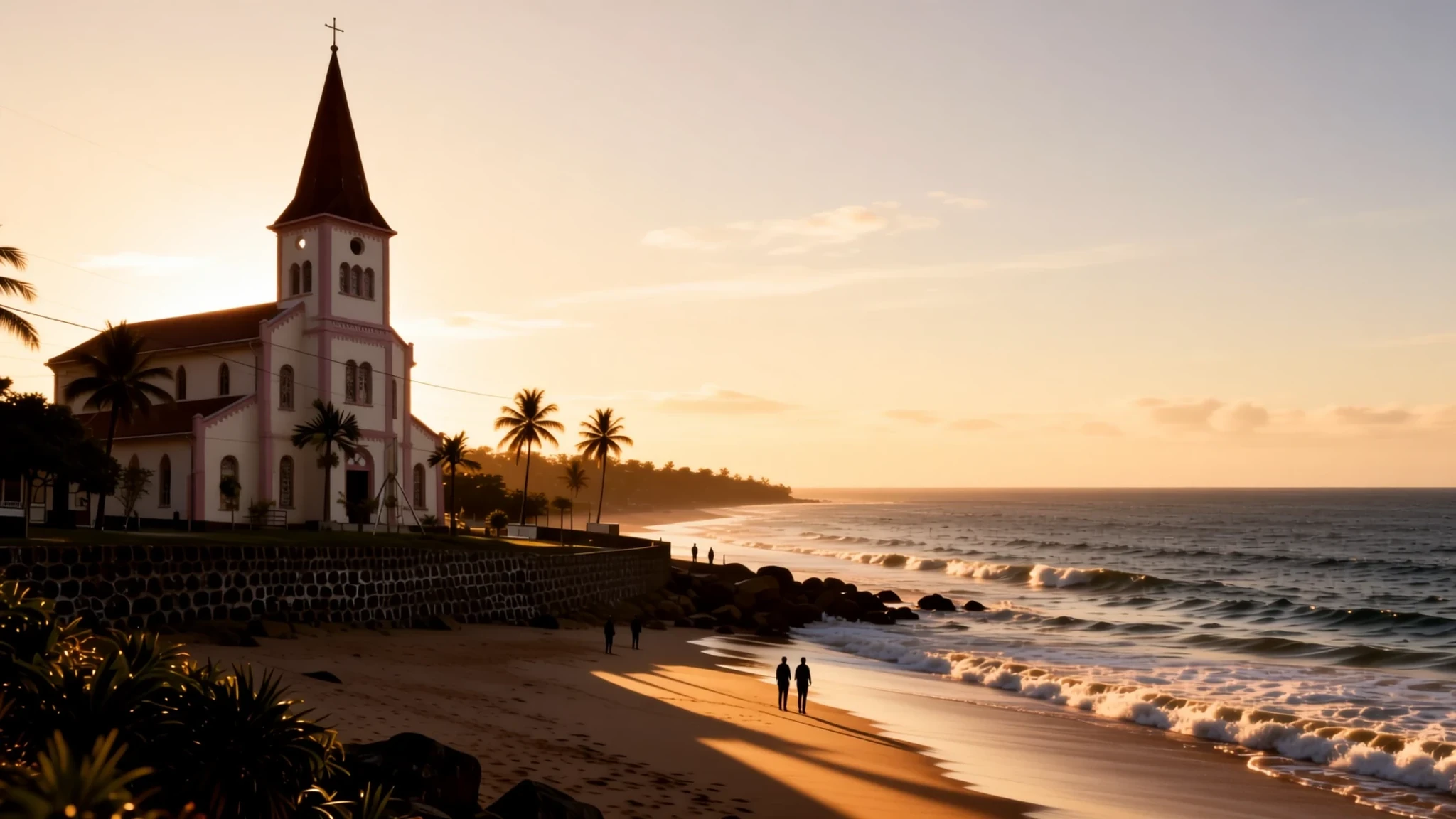
Kribi is a Cameroonian Atlantic beach town where fishing pirogues, warm surf and the Lobé River's falls into the sea share the same shore.
The place
Kribi sits on Cameroon's southern Atlantic coast, a low sandy town facing the Gulf of Guinea, with forest close behind the beach and a working waterfront along it. Long pale beaches run through the town, fishing boats rest above the tide line, and the sea stays warm enough for swimming through the year. South of the centre the Lobé River breaks into falls that drop onto the sand and into the surf, so river water and ocean water meet in the same view. That meeting of forest river and open Atlantic is the character of the place, more than any single building.
The town feels small even when the coast road is busy. A lighthouse marks the older waterfront, while a commercial harbour takes larger ships away from the swimming beaches. Between them, daily life is fish, pirogues, market stalls and the road that links this shore to Douala and to Yaoundé. French is the language of signs, schools and administration. On the beach and in the market, conversation moves between French and local coastal languages, and the day follows the boats more than the clock.
Inland, coconut and sand give way quickly to equatorial forest. Villages along the Lobé sit between the river and that forest, so the green is part of a walk to the falls. Heat and humidity do not lift: the air stays warm, rain arrives in heavy spells, and the light on the sand is strong by mid-morning. Weekends bring day-trippers from the bigger cities, and the beach near town turns social rather than empty. The port has added trucks and new buildings, and Kribi now holds a grilled-fish beach and an industrial waterfront side by side.
Its story
Kribi began as a coastal fishing settlement, a place where boats could land on a beach backed by forest and where the people of this stretch of the Gulf of Guinea lived from the sea. The Batanga and related coastal communities shaped that older town: fishing, canoe building, trade along the shore, and a social life organised around family, the beach and the river mouths. The Lobé was a working landmark and a source of fresh water at the edge of salt.
Colonial rule turned the landing beach into an administrative and trading post. Under German administration, and later under French rule, Kribi was tied into the export economy of the wider territory, with timber and other forest and coastal products leaving by sea. A lighthouse and a formal waterfront belong to that period, when the town was a small colonial station rather than a city. Independence did not move the capital here. Kribi stayed a secondary town, known inside Cameroon as a place people from the cities visited to swim, eat fish and leave the inland heat.
The newest chapter is the commercial port. A deep-water harbour, set apart from the old fishing beach, has brought cranes, truck traffic and jobs, and also argument about land, about the forest and the Bagyeli communities inland, and about how much of the coast should remain a swimming shore. Tourism grew alongside that change. Visitors come for the falls, the sand and the grilled fish, and they arrive in a town negotiating in plain sight between a fishing beach and an industrial gateway. The story of Kribi is that unfinished negotiation, with pirogues and cargo ships using the same sea.
What to see
- Chutes de la Lobé — South of town, where the Lobé meets the sea
The Chutes de la Lobé are the falls where the Lobé River drops onto the beach and into the Atlantic at the southern end of Kribi. The drops are low and close, reached on foot from the sand, with forest on the riverbank and surf in the same view. Families, fishers and day visitors share the rocks. After rain the water runs harder and the stone turns slick.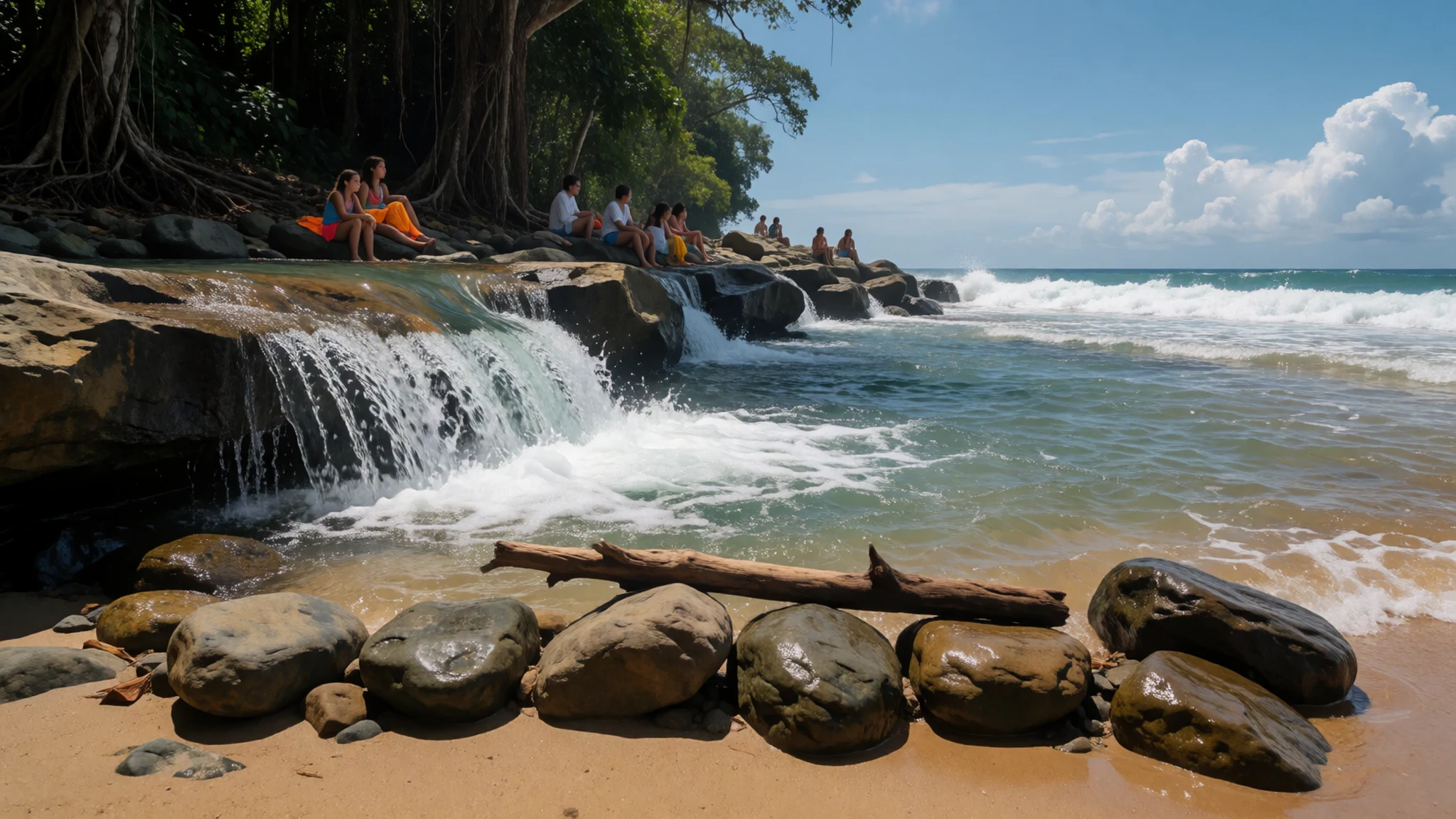
- Kribi beach — The town seafront
The town beach at Kribi is a long belt of pale sand with the Atlantic in front and palms and houses behind. Swimming is the point, though the surf can be lively and lifeguards should not be assumed. At weekends the sand fills with families from town and from Douala; a weekday morning is mostly fishers, walkers and a few travellers. Shade is scarce once the sun is high.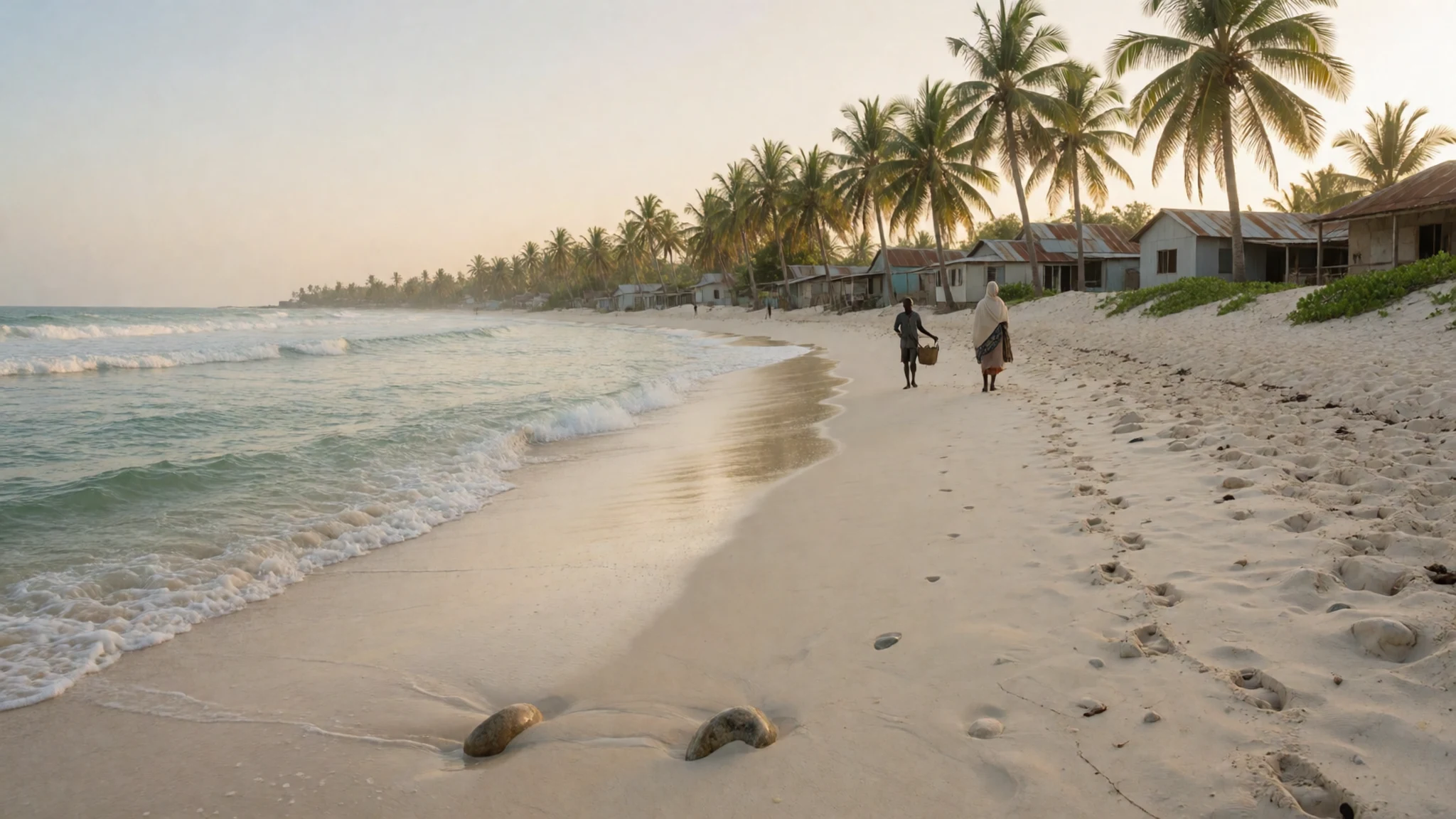
- Kribi lighthouse — The older waterfront
The lighthouse in Kribi is a slim tower on the older waterfront, left from the years when this was a colonial station. It marks that older part of town, away from the commercial harbour. Around the base the scene is road, boats and open sky, and the reason to pause is the long view along the sand. Climbing is not always possible; people nearby know whether the door is open.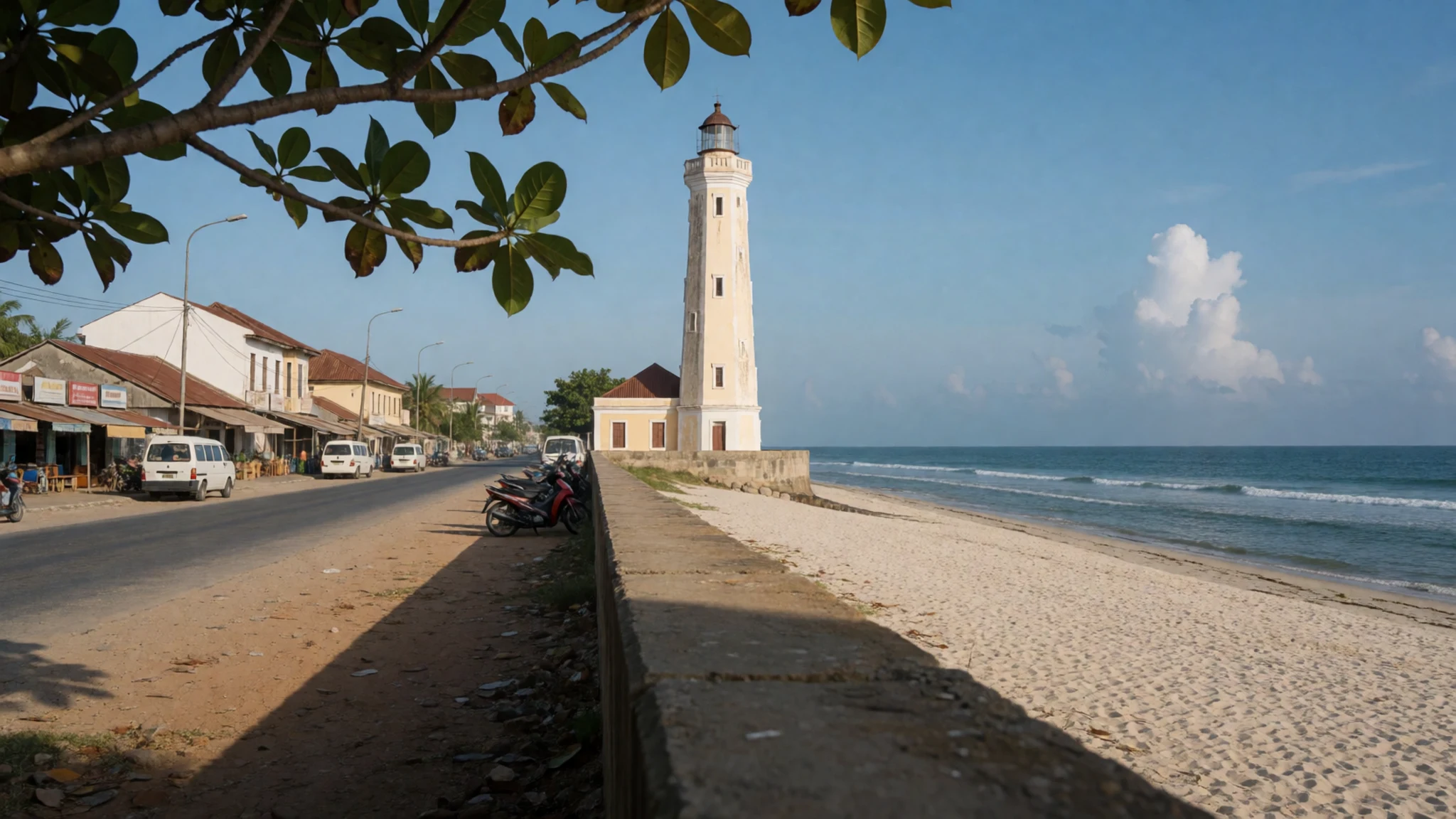
- Fishing waterfront — The fishing beach
The fishing waterfront in Kribi is where pirogues are beached, mended and pushed back through the surf. In the morning the catch comes off the boats onto the sand for sale; later the same stretch is ropes, nets and hulls in the shade. Smoke from fish on the grill hangs over the shore. Boats need room to launch, and a close portrait is something to ask for.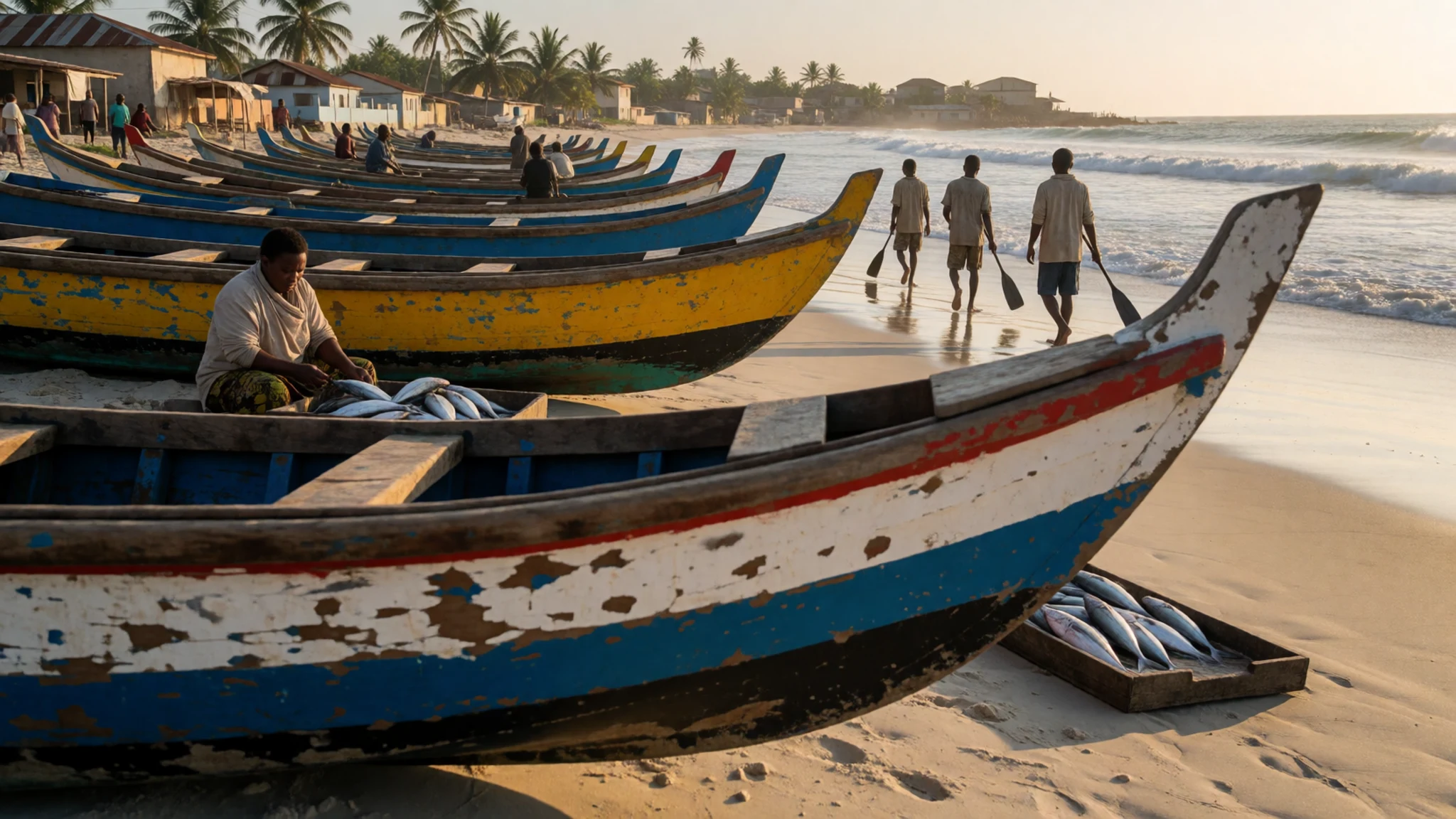
- Lobé riverbank — The Lobé inland of the falls, near Namikumbi
Upstream of the falls, the Lobé at Kribi is a dark forest river. The bank near the village of Namikumbi is tall trees and a quiet channel, with equatorial forest close behind. People farm, fish the river and use the paths between water and houses. The walk is short, humid and unmarked. Going beyond the obvious bank is best done with someone from the village.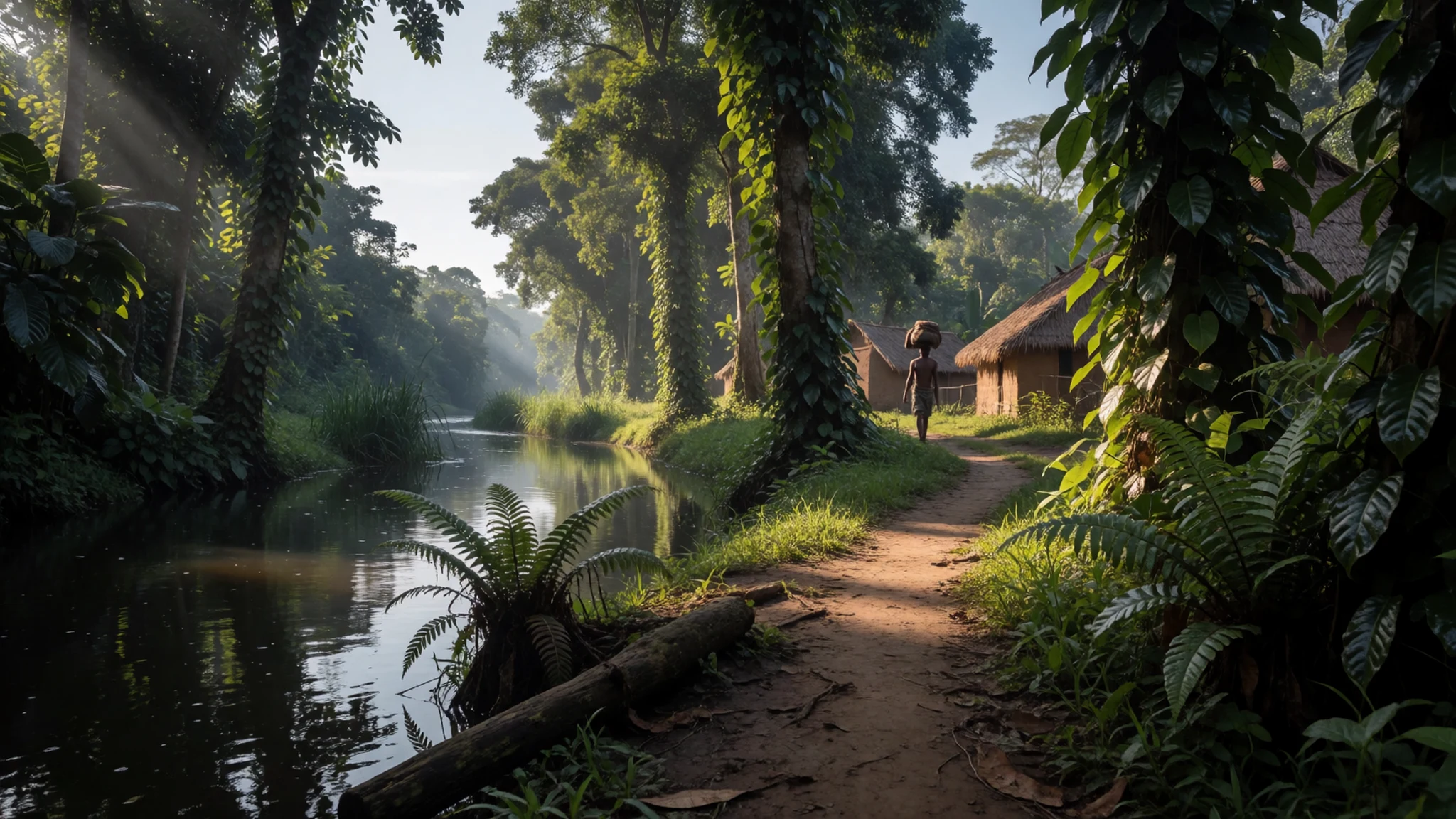
Culture
Kribi's public culture is coastal and Francophone, with Batanga and other southern coastal traditions under the French of school and shop signs. Family is the unit that shows. Sundays and holidays bring relatives to the beach, music spills from speakers and cars, and a meal is something people share. Football, church and the return of the boats structure the week more visibly than any formal arts calendar. Catholic and evangelical congregations are part of ordinary life, alongside a strong expectation of respect for elders and for the family on whose ground a guest stands.
The soundtrack is Cameroonian popular music, makossa among it, mixed with Congolese rumba and whatever the radio is playing; a beach afternoon is often loud on purpose. What a stranger reads as art is mostly dress, painted boats, hair and the theatre of the market. Inland, Bagyeli communities hold their own forest knowledge and a long, unequal history with logging, outside projects and the town. Their villages are home, and treating them as a sight causes real harm.
Greeting comes before business. A hello in French, then the question, is the ordinary order, whether the question is a direction, a price or a photograph. Shared food is a gesture, and a flat refusal with no reason can sound cold. On Kribi's beaches and in its markets, ask before photographing people, and change out of swimwear before you walk into church or the market.
What to wear
Kribi dresses for heat, salt and church, often all on the same day. The cloth that still signals a ceremony is pagne — wax-print cotton, cut by local tailors into wrappers, skirts, shirts and loose kaba gowns women wear for celebrations, mourning and Sunday. Men may wear a tailored shirt of the same print, or a flowing boubou when the occasion is formal. Cloth for a ceremony is chosen and sewn in town rather than bought as a costume.
Day to day, the beach town wears T-shirts, football shirts, jeans or lightweight trousers, sandals and flip-flops, with a wrapper or a headtie added when someone is coming from home or from church. Fishers work in shorts and old shirts, often barefoot on the sand. Young people dress in the same global street clothes seen in Douala, adjusted for humidity: nothing heavy, nothing that takes a day to dry. Office and bank errands bring smarter shirts; the market stays casual.
A visitor in Kribi should pack light cotton, a sun hat, sandals that can get wet, and a rain layer for sudden storms. Swimwear belongs on the beach. A shirt or a wrapper over it is the right walk back through town, and covered shoulders and knees are the respectful choice for church. Closed shoes are unnecessary on the sand and useful on rocky ground at the falls.
What to eat
- Poisson braisé — Beach grills along the town shore
Poisson braisé is whole fish split, rubbed with pepper and spices, and grilled on the Kribi beach until the skin blisters. Plantain, fried or roasted, comes with it, plus a sharp sauce of chilli and onion. The species follows the morning boats. Beach grills serve it straight off the fire.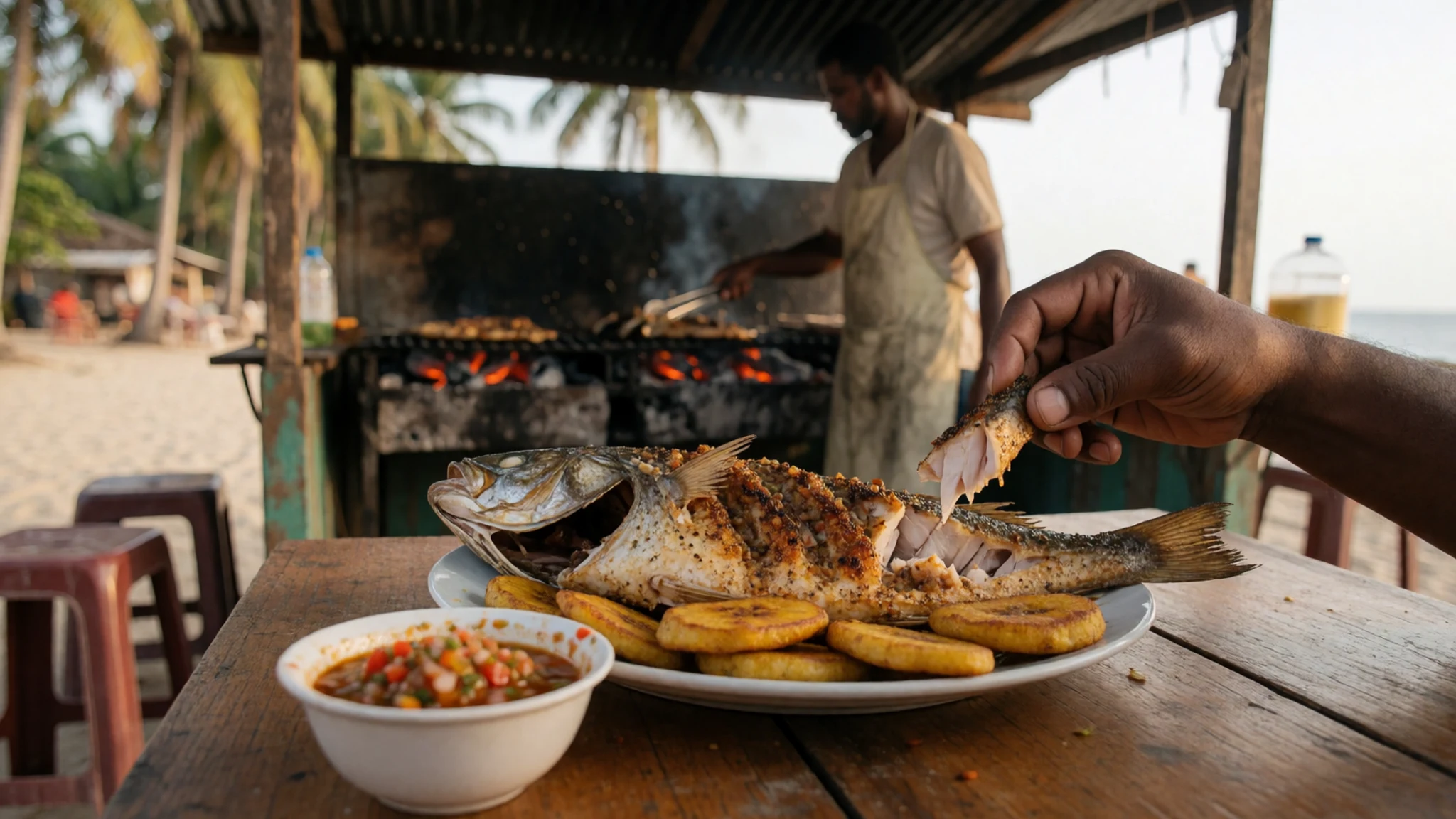
- Ndolé — Home-style eateries in town
Ndolé is Cameroon's bitterleaf stew, and in Kribi it often comes with shrimp or smoked fish. Ground peanuts thicken the greens, and the bitterness is deliberate. It is served with plantain, rice or miondo, the fermented cassava stick. Home-style eateries in town are the place to find a plate.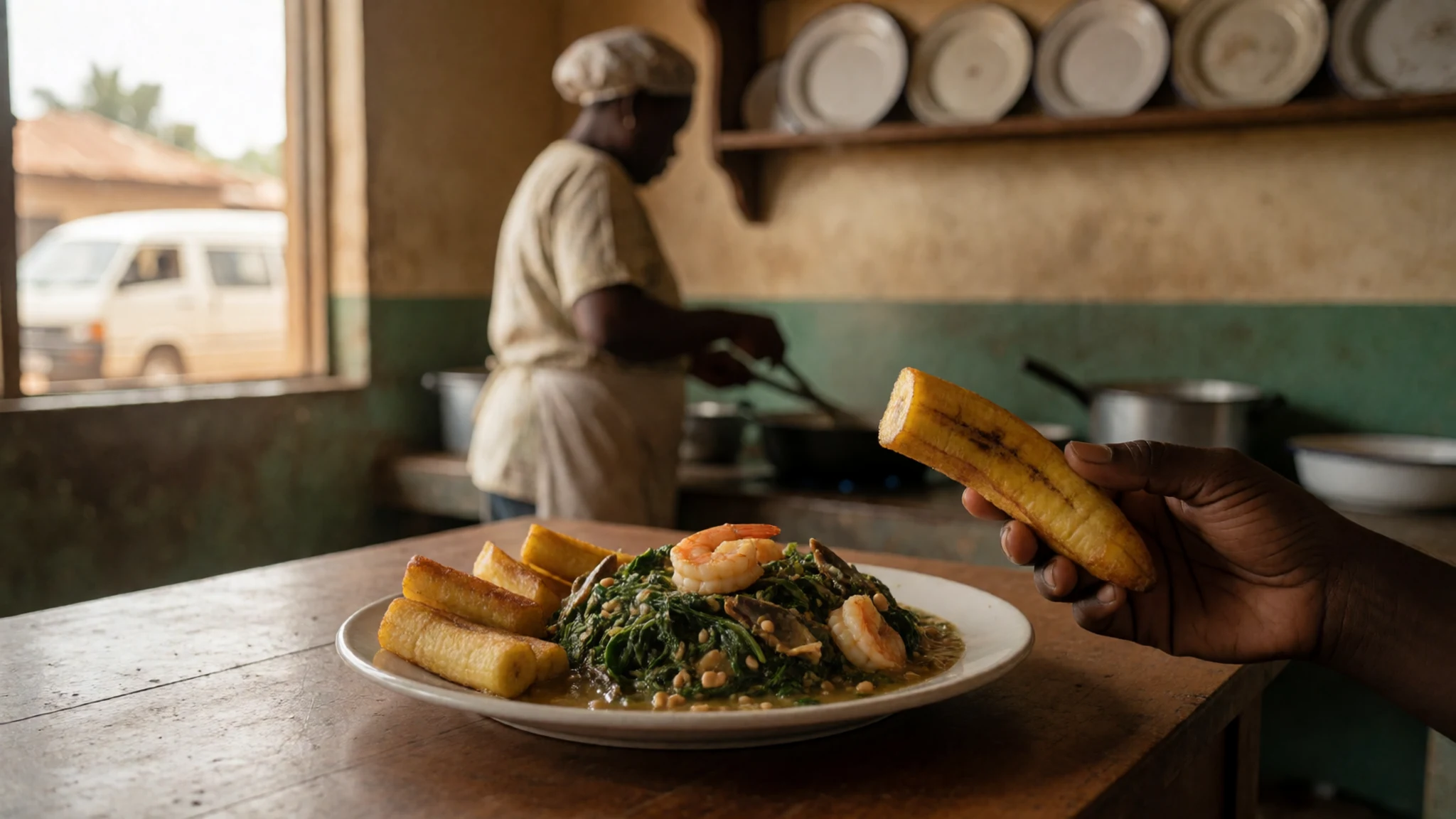
- Pepper soup — Evening stalls near the beach and the market
Pepper soup in Kribi is a hot, thin broth of fresh chilli, ginger and aromatic leaves, with fish or prawns in the bowl. It is evening food. Market stalls and small night spots near the beach ladle it out. The chilli heat is the point of the bowl. - Soya — Night grills along the main roads
Soya is the name Cameroon gives grilled meat skewers, and Kribi's night streets have them: beef or chicken, spiced and charred at a roadside fire. It is the plate to look for when the fish has sold out. Stands along the main roads set up as the evening cools. - Grilled prawns — Beach grills that cook the morning catch
Grilled prawns in Kribi are cooked in the shell, heads on, with the same pepper rub as the fish. They appear when the boats have them. Beach cooks working from the morning catch are the place to look. Plantain on the side is the usual plate.
Plan it
Best time. The turn of the year is the easier beach window in Kribi; December and January are the driest and most comfortable, May is the hottest, and a long wet season through the middle of the year peaks in September. Other months are humid and often wet, which fills the falls.
How long. 3–4
Getting there. Fly into Douala and take the coast road through Edéa to Kribi, or come by road from Yaoundé. The last leg is by bus or hired car, and heavy rain slows it.
Budget. mid
Tips
- Carry cash, because card machines are patchy outside larger lodgings.
- Visit the Lobé falls in the morning, before the weekend crowds.
- Swim with care: the surf is lively and lifeguards should not be assumed.
- Pack a light rain jacket and a dry bag; storms on this coast start quickly.
- Keep small notes for beach grills even if mobile money covers larger payments.
Etiquette
- Ask before photographing people at work, in the market or in a village.
- Wear swimwear on the beach and cover shoulders and knees for church and the market.
- Greet in French before you bargain, ask a direction or request a favour.
Nearby
Sources
- Wikidata (CC0)
- Wikipedia: Kribi (CC BY-SA 4.0)
- Wikivoyage: Kribi (CC BY-SA 4.0)