Khor Fakkan
Khor Fakkan, United Arab Emirates
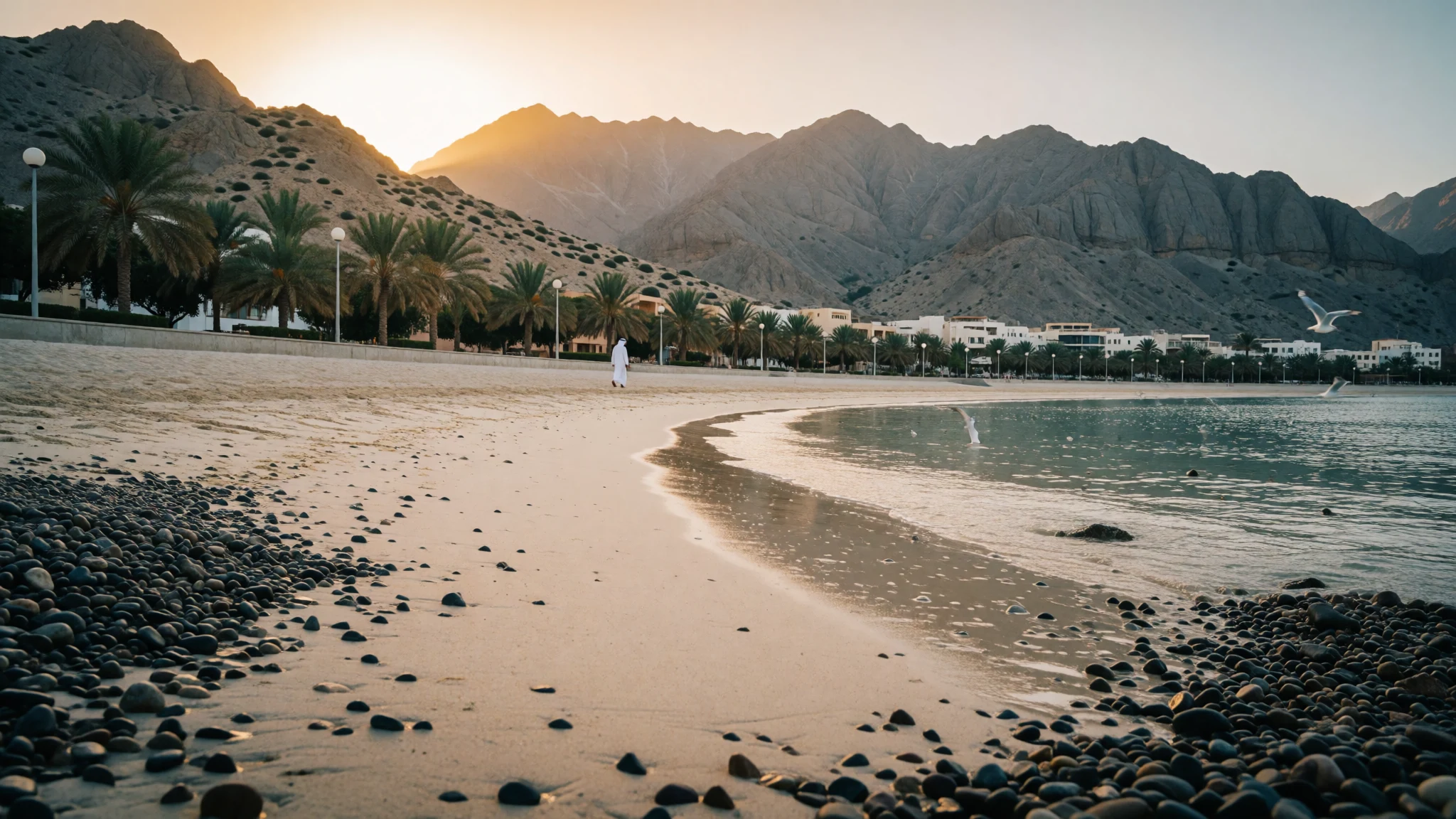
Khor Fakkan is a calm bay on the UAE's Indian Ocean coast, with a long corniche, coral to swim over and mountain trails behind.
The place
Khor Fakkan sits on the east coast of the United Arab Emirates, facing the Gulf of Oman, yet it belongs to the Emirate of Sharjah, whose main territory lies across the mountains on the Gulf side. Fujairah's land surrounds it, which makes the town an exclave, and the road in from Sharjah or Dubai climbs through the Hajar range. The name is usually translated as 'Creek of the Two Jaws', after the shape of the bay. The town has about 39,000 people and stands roughly 20 m above sea level. It is compact and easy to read: a container port at one end, a long curve of beach and corniche beside the bay, and bare mountains rising straight behind. A jetty serving the port shelters the water from the prevailing winds, so the bay is often calm. Jebel al Hilqah, at 1,023 m, is the highest point of that backdrop. Most visitors are day-trippers and weekenders from elsewhere in the UAE, drawn by sand, shade and the coral where divers and snorkellers go. Winter, from November to April, is sunny and warm by day with cool evenings and low humidity, though January to March can bring rain and storms. Summer is hard going, with noon highs around 40 °C in July and August and warm, humid nights. The local council's website is http://khorcouncil.gov.ae/en.
Its story
People have lived around Khor Fakkan for a very long time. Archaeologists from the Sharjah Archaeological Museum have recorded a settlement and 34 graves from the 2nd millennium BC on rocky outcrops above the harbour, and post holes show that palm-frond huts of the barasti type were being built here in prehistory. By the early 16th century the bay was a village ringed with gardens and farms, as a Portuguese traveller, Duarte Barbosa, noted. The Portuguese then took it and called it Corfacão, making it one of a chain of fortified stations, alongside Muscat, Sohar and Hormuz, that let them police the approaches to the Gulf. A wall across the pass in the mountains, with a single gate and tower, guarded the town from raids out of the interior. The fortifications did not last. By 1666 the fort was a ruin, and a Dutch ship's log from the period describes about two hundred small date-frond houses by the beach, two ruined forts without guns or garrison, and wells of fresh water feeding date palms, figs and melons. One suggested cause of the decay is the Omani attack of 1623, led by Sheikh Muhammad Suhari. Today the port, not the forts, is what drives the town.
What to see
- Khor Fakkan beach and corniche — North of the town centre
The beach lies north of the town centre, a wide curve of pale sand with a landscaped corniche and green gardens behind it. Early morning and late afternoon are best for walking, when the heat eases. Weekends fill up with families from across the UAE, so weekdays are quieter.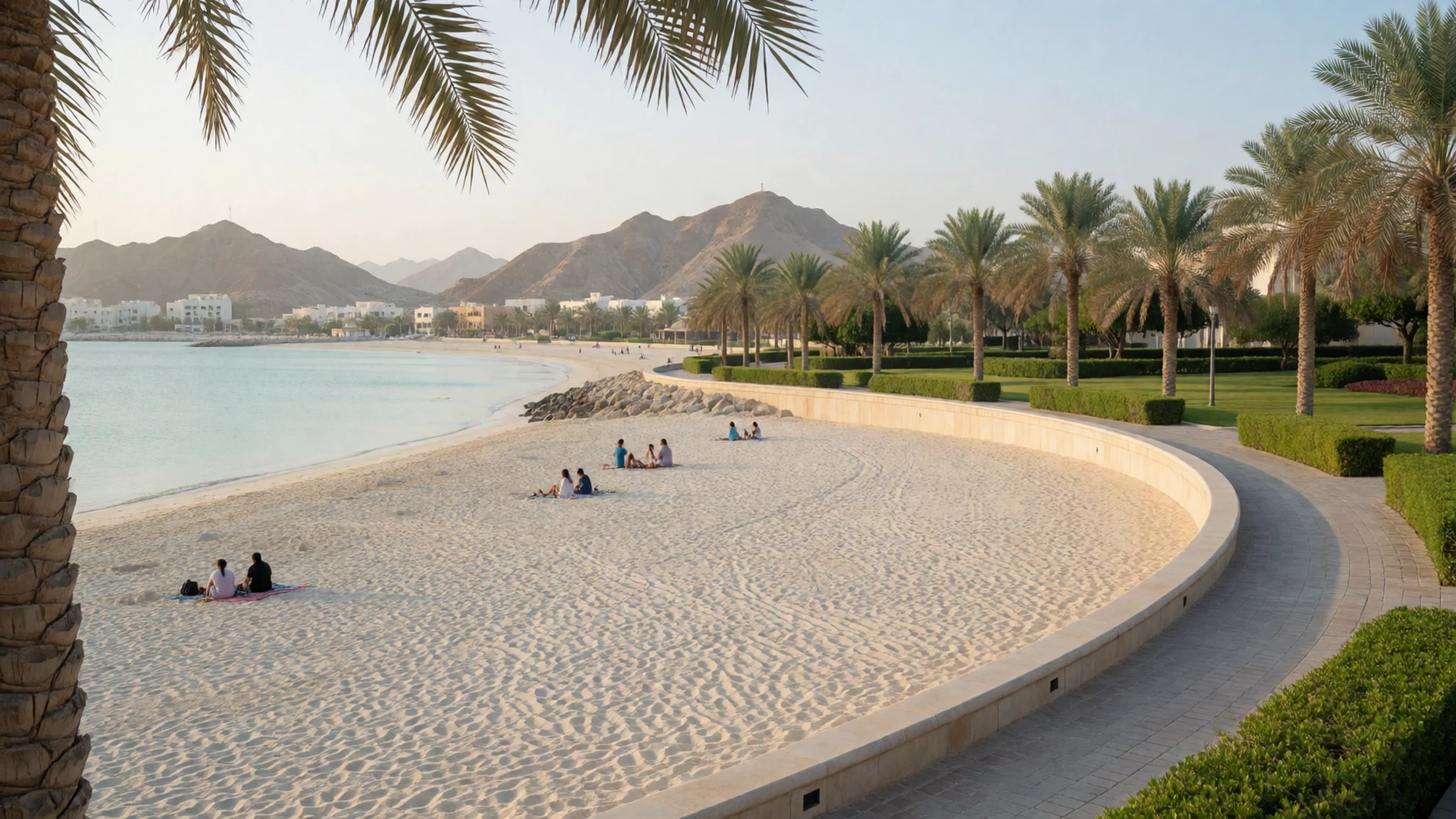
- Coral reefs and the bay — The bay and offshore reefs
Offshore reefs are the reason divers and snorkellers come. Local dive operators run trips from the bay, and the jetty keeps the water sheltered on most days. Visibility and sea state change with the season, so ask the operator on the day rather than relying on a forecast.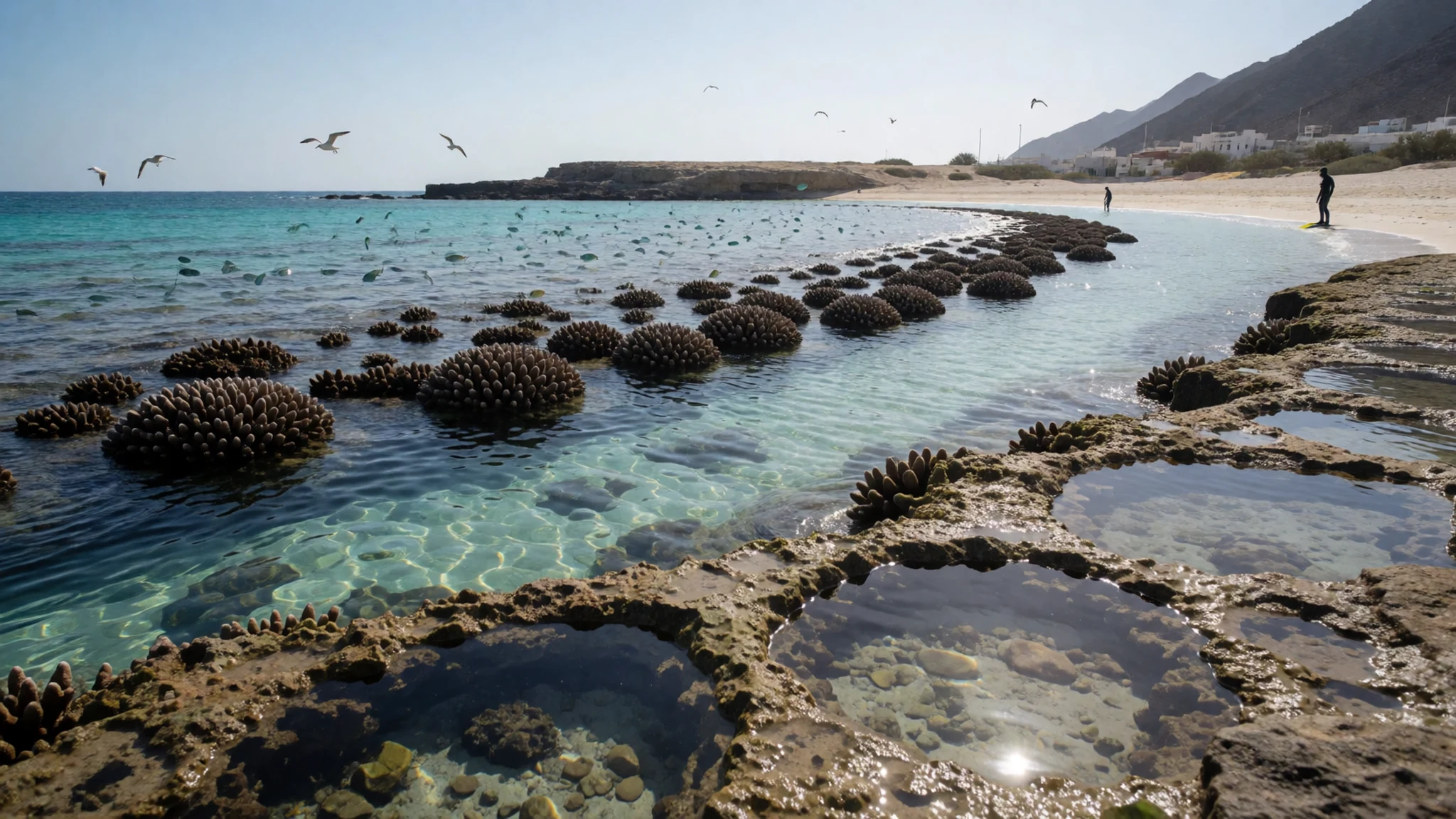
- Portuguese fortress sites — Hills and outcrops above the harbour
The Portuguese held Corfacão in the 16th century, and the town's forts were ruined within a few generations. Little stands today, so this is a stop for those who like reading a landscape, with old plans and illustrations helping to picture the walls and gate.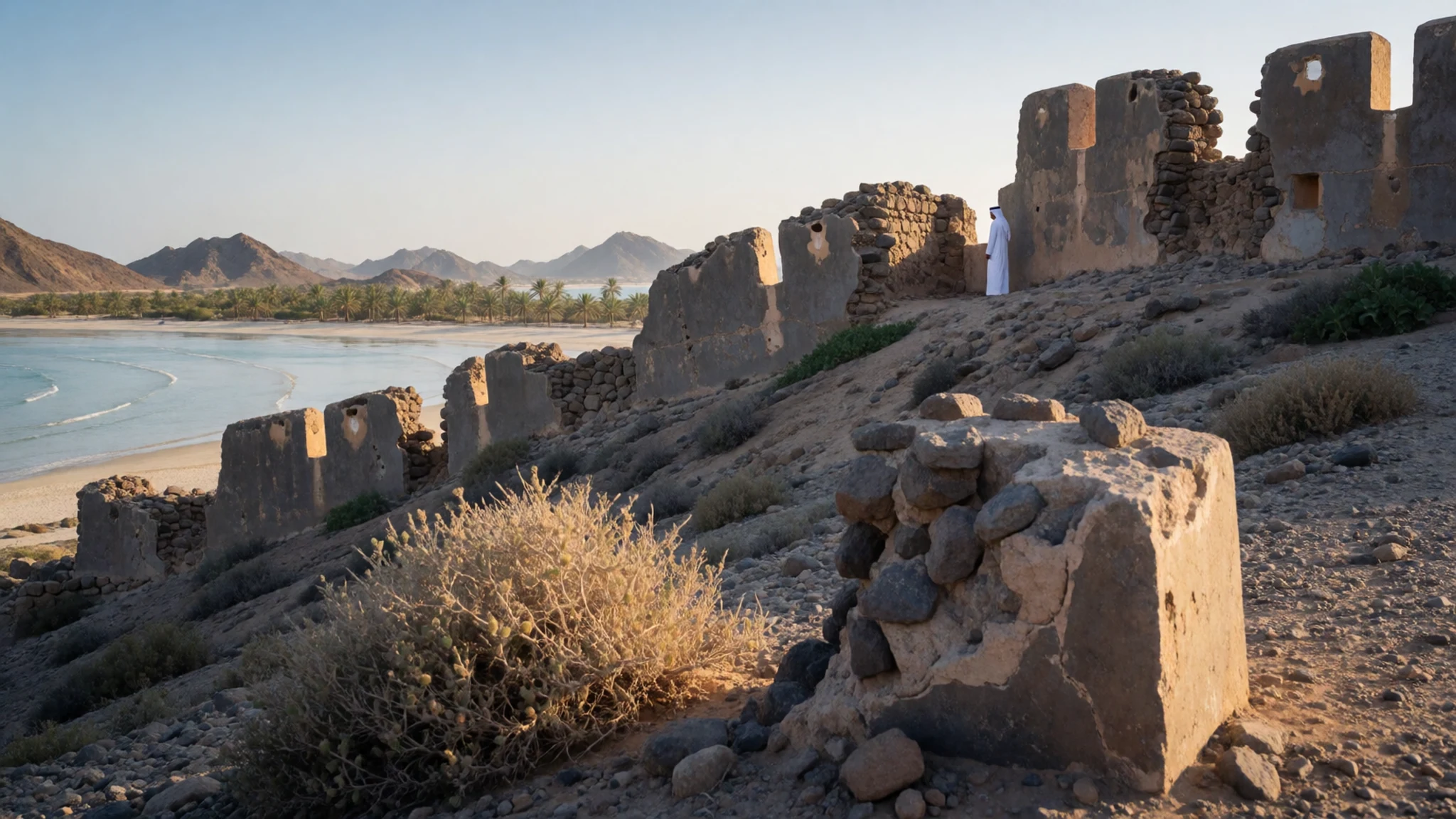
- Hiking trail beside the port — Hillside beside the port
A path climbs the slope beside the sea port, and at sunrise it gives a wide view over the bay, the ships and the open sea. The ground is rocky and unshaded, so start early, wear proper shoes and carry more water than seems necessary.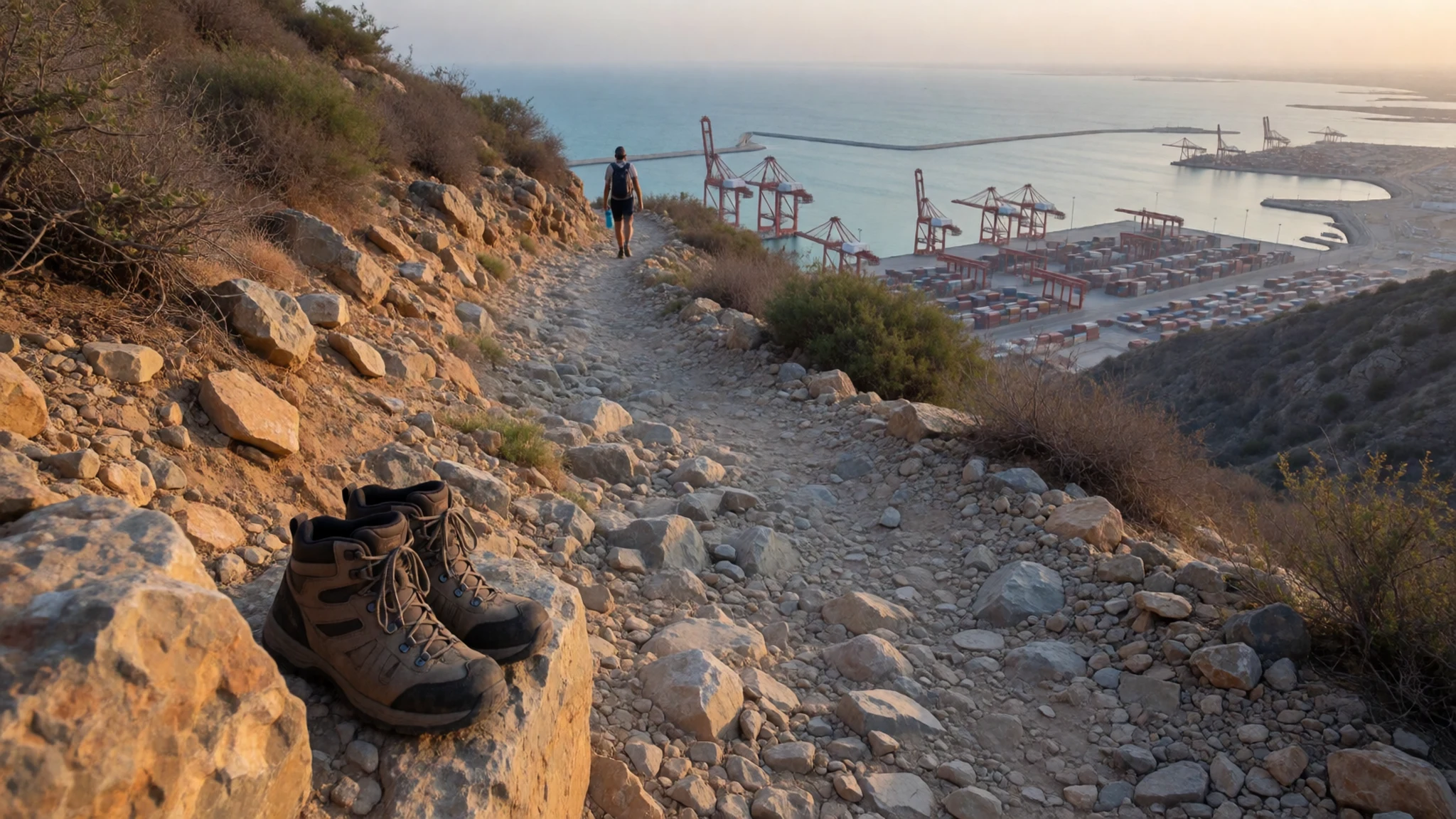
- Al Rafisah Dam — Wadi Rafisah, in the mountains inland
In the Hajar Mountains above the town, a dam holds back water in a rocky valley. A local story says the reservoir covers an old village, and that rooftops show when the surface is still. It is a short drive from the coast and cooler in the shade of the hills.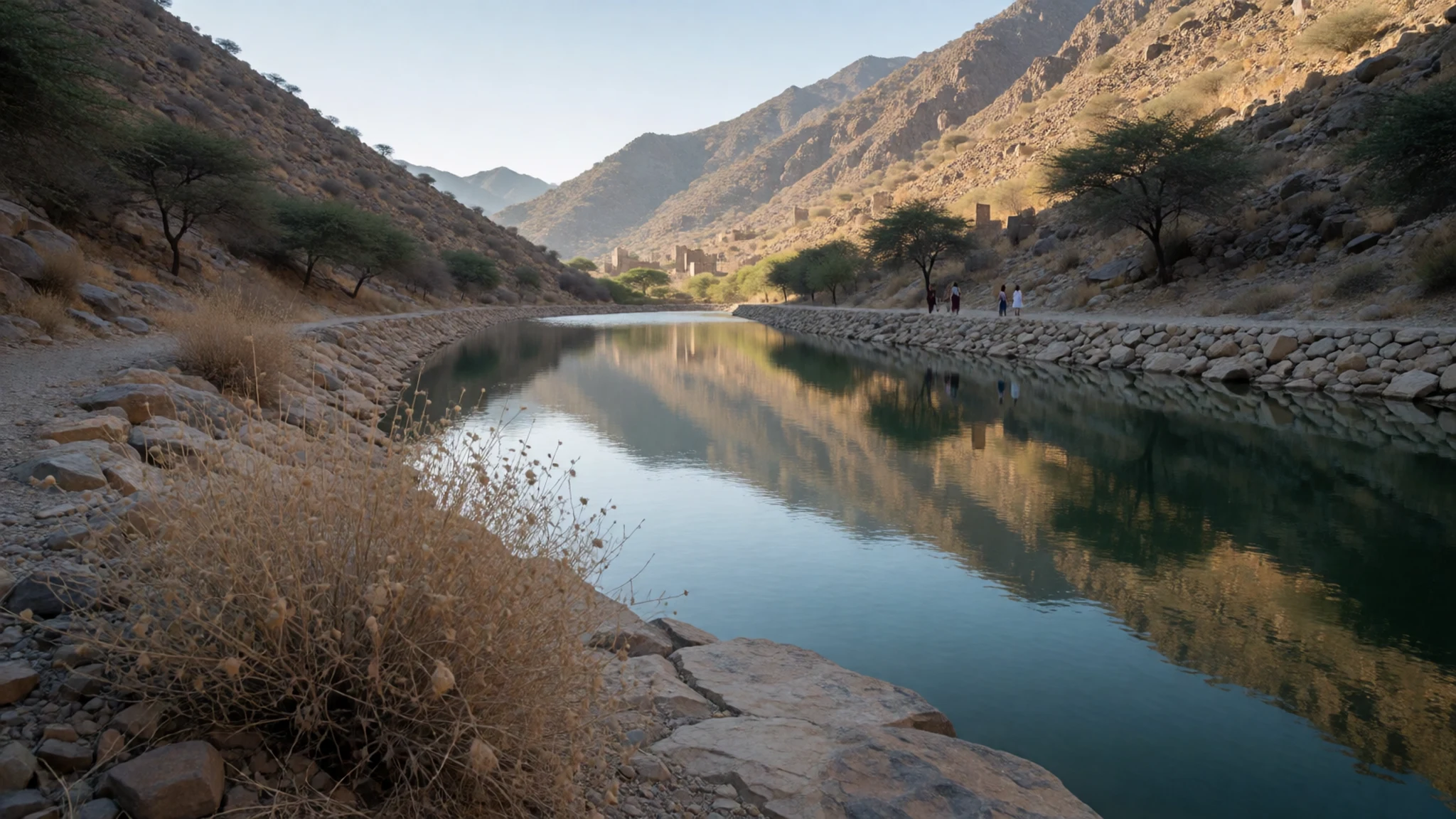
- Al Miqsar village and watchtower — Head of Wadi Rafisah
At the head of Wadi Rafisah stands a restored mountain village with a watchtower, built of local stone and mud. It shows how people lived in the hills before roads, with a lookout over the valley. Opening arrangements may change, so check locally before making the trip.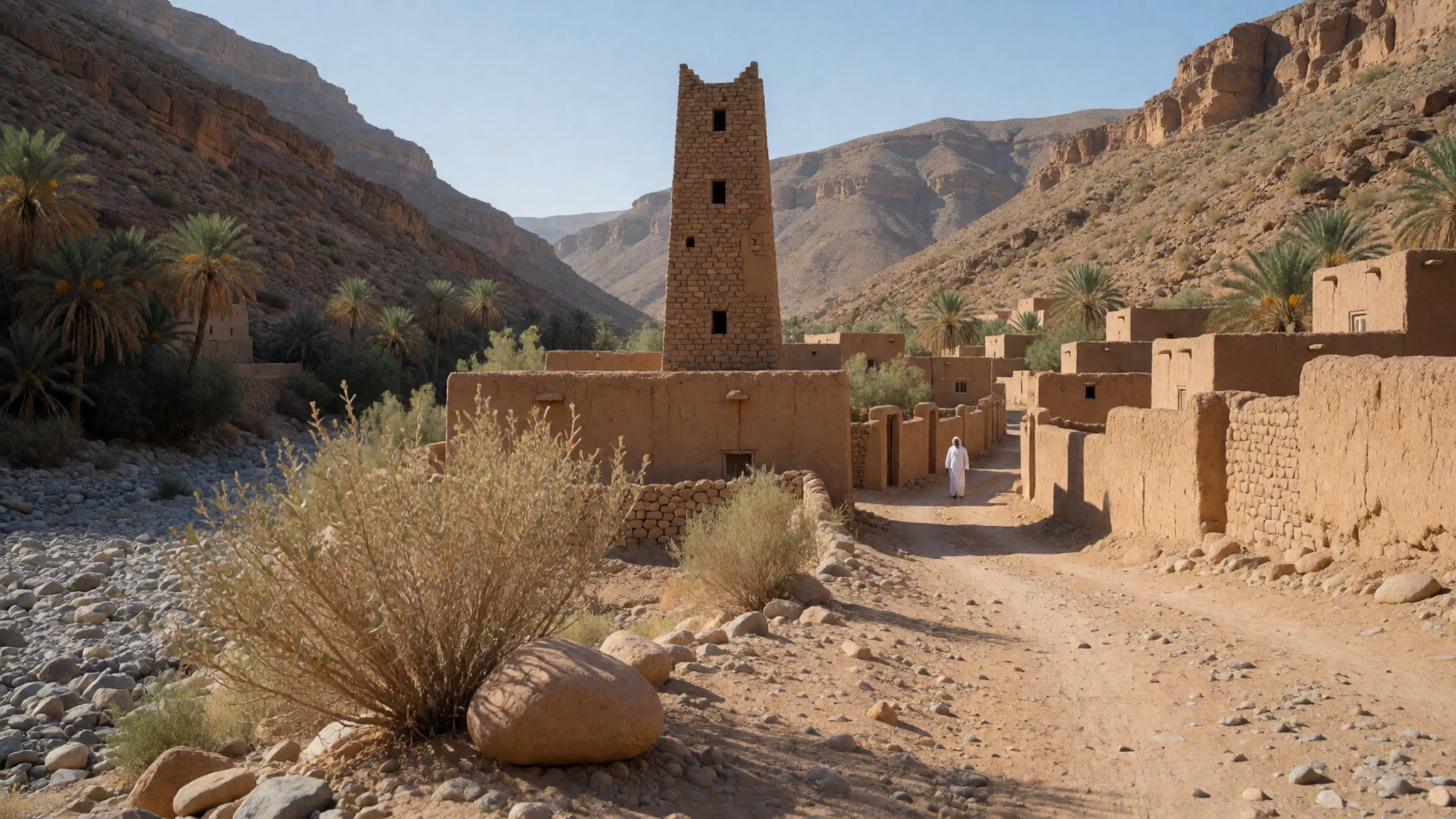
Culture
Khor Fakkan is an Emirati town on the Indian Ocean with a working port, so its culture is shaped by both the sea and the mountains. Fishing, palm cultivation and trade across the water were the old basis of life, and the barasti hut of woven palm fronds is the traditional house of the coast. Today the population is mixed, with many residents from South Asia, the wider Arab world and South-East Asia, and the town's eateries and shops reflect that. Family life matters a great deal: weekends bring relatives to the corniche and beach in the evening, picnics spread on the grass and children out late. Hospitality is a point of pride, and being offered Arabic coffee and dates is common in homes and some cultural venues. The UAE is a Muslim country, and daily life follows prayer times, with a quieter mood during Ramadan, when eating, drinking and smoking in public during daylight hours is discouraged. Fridays are the main day for congregational prayer. Friendly greetings, patience and polite conversation are valued, and visitors are generally met with courtesy. Public displays of affection, loud behaviour and drinking outside licensed venues can cause offence or trouble. Ask permission before photographing local people, especially women and families, and never photograph the port and its security areas.
What to wear
In Khor Fakkan, as across the UAE, traditional Emirati dress is the kandura for men, a long, loose, usually white robe made from light cotton or similar fabric, worn with a ghutra headcloth held by a black cord called the agal. Women wear the abaya, a long black cloak, often with a shayla headscarf, and some embroidered or decorated dresses appear at celebrations and family occasions. Heavier, darker robes may be seen in winter. In daily life, many Emiratis wear this dress to work and at religious events, while the wider population wears a mix of clothes: jeans and shirts, shalwar kameez, saris, uniforms for port and shop workers, and sportswear on the corniche. Beachwear is common on the sand, but people dress more fully once they leave it. Visitors should dress for heat and for modesty. Light, loose cotton or linen that covers shoulders and knees is comfortable and respectful in town, in shops and at any mosque or heritage site. Swimwear belongs on the beach and in pools. Women who enter a mosque should cover hair, arms and legs. For mountain trails and the dam, wear sturdy closed shoes with grip, a hat and sun protection, since the rock is hot and sharp underfoot.
What to eat
- Grilled fresh fish — Seafront eateries and fish counters near the port
Catches from the Indian Ocean are cooked simply over charcoal or in a spiced marinade and served with rice, salad and bread. Look for seafront eateries and fish counters near the port, and choose the fish whole so that freshness is easy to judge.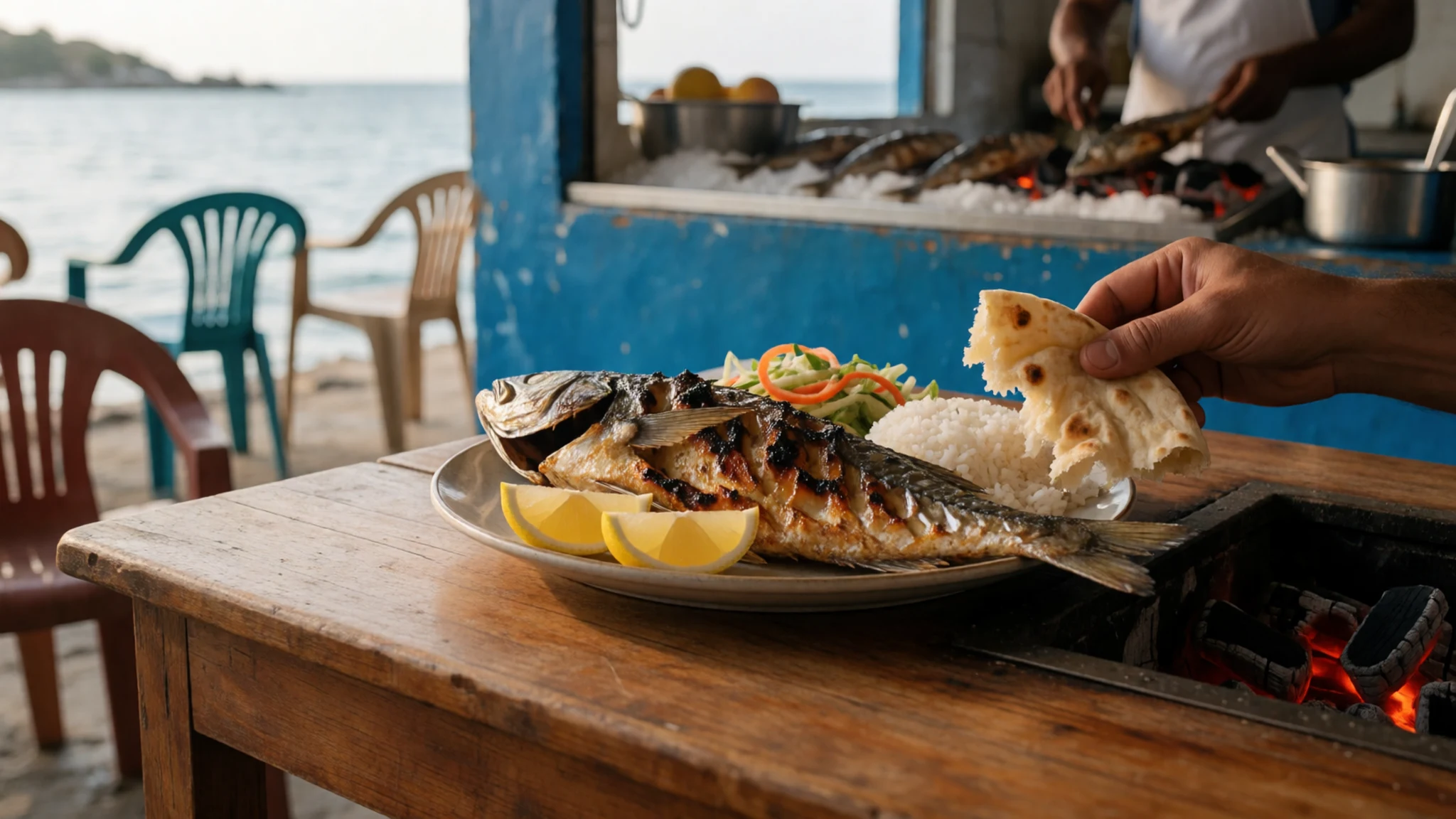
- Machboos — Local Emirati and Arabic restaurants in town
A spiced rice dish of chicken, lamb or fish, built on dried lime, onion and warm spices, and common in Gulf homes. It is hearty, fragrant and usually served on a shared platter. Local Emirati and Arabic restaurants in the town are the best places to try it.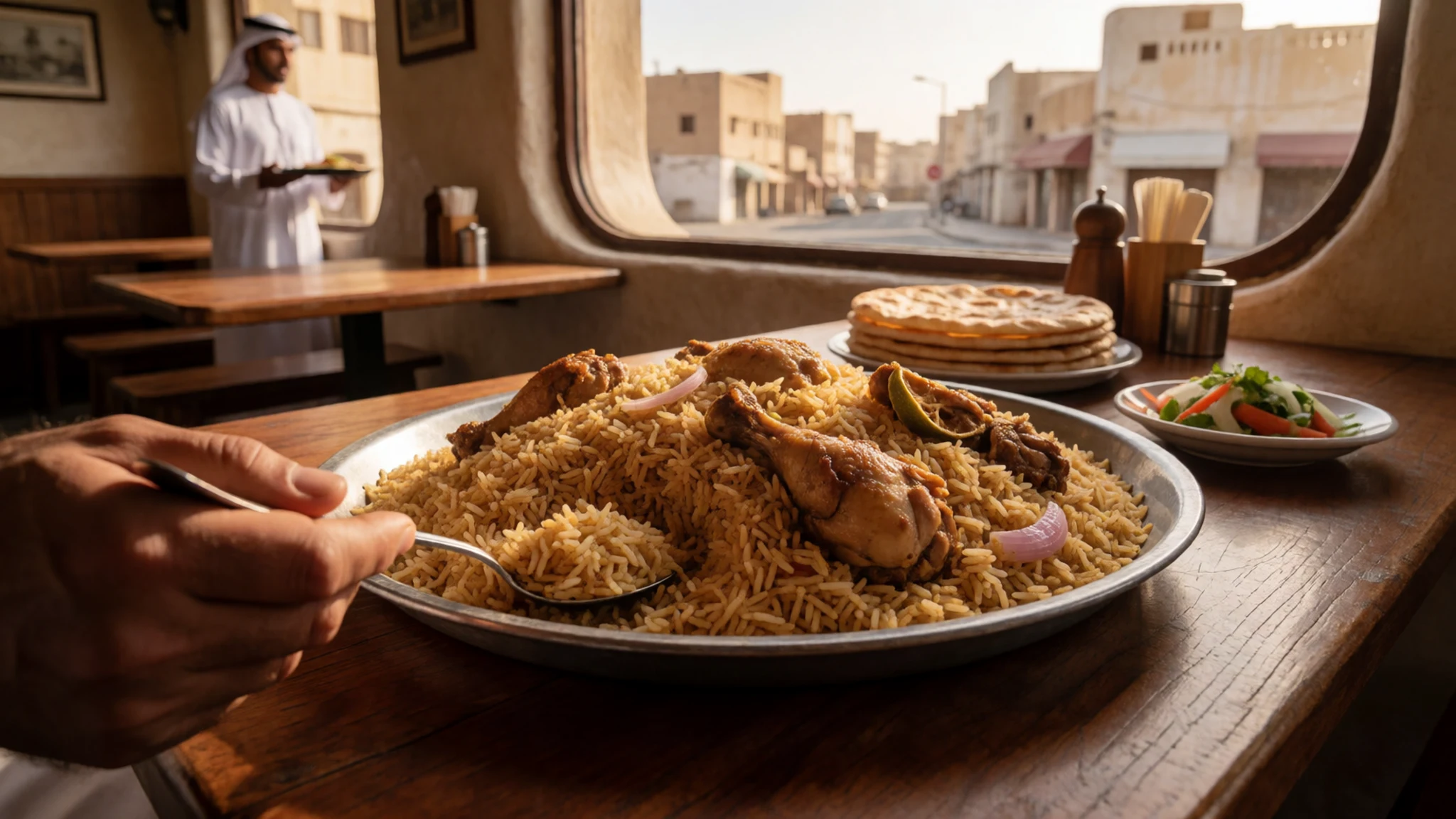
- Shawarma — Small counter eateries by the corniche and town centre
Sliced marinated meat wrapped in flatbread with pickles, garlic sauce and salad is an easy, cheap meal after a morning on the beach. Small counter eateries near the corniche and town centre serve it quickly, and many do a vegetarian falafel wrap too. - Luqaimat — Cafés and sweet shops, and festival stalls
These are small fried dough balls, crisp outside and soft within, finished with date syrup or honey. They are a traditional sweet of the Gulf, often served warm. Look for them in cafés and sweet shops, or at festivals and family gatherings. - Arabic coffee and dates — Cafés, hotels' lobbies and cultural venues
Lightly roasted coffee, scented with cardamom and poured in small cups, is served with dates as a gesture of welcome. Accept a cup, shake it gently when you want no more, and try different dates. Cafés and cultural venues often offer it. - South Asian curries and biryani — Small eateries in the town centre
With many residents from India, Pakistan and Bangladesh, the town has plenty of eateries serving biryani, dal, fresh breads and curries at modest prices. These are reliable choices for vegetarians and for anyone wanting a break from grilled meat and seafood.
Plan it
Best time. November to April, when days are sunny and warm, evenings are cool and humidity is low. January to March can bring rain and storms, so keep plans flexible. May to September gets steadily hotter, and July and August are very hot and humid, even at night.
How long. 1–2
Getting there. Fly into Fujairah, Sharjah or Dubai, then go by road: Khor Fakkan is reached by highway across the Hajar Mountains from Sharjah and by the coast road from Fujairah. A hired car or taxi is the simplest last leg, and there is no rail service.
Budget. mid
Tips
- Visit the corniche and any hiking trail early in the morning or late in the afternoon, to avoid the heat
- Carry plenty of water on mountain trails and at the dam, where there is little shade
- Expect crowds on weekends and public holidays, and plan a weekday visit for quiet
- Carry some cash for small eateries and stalls, though cards are widely accepted
- Check sea conditions and the operator's safety record before diving or snorkelling
Etiquette
- Dress modestly away from the beach, with shoulders and knees covered
- Do not photograph people without asking, or port and security areas at all
- During Ramadan, avoid eating, drinking or smoking in public during daylight
Nearby
Sources
- Wikidata Q764279 (CC0)
- Wikipedia: Khor Fakkan (rev 1386067482) (CC BY-SA 4.0)
- Wikivoyage: Khor Fakkan (rev 4723848) (CC BY-SA 4.0)
- Photo: Khorfakkan beach — Vicharam (CC BY 3.0)
- Photo: The best Hiking path in UAE 02 — Ashiq pang (CC BY-SA 4.0)
- Photo: Corfacão — Hugo Refachinho (CC BY-SA 4.0)
- Photo: Stamp of United Arab Emirates, 1976 — Post of United Arab Emirates (Public domain)
- Photo: Al Miqsar — Alexandermcnabb (CC BY-SA 4.0)
- Photo: Khor Fakkan Al Rafisah Dam — Alexandermcnabb (CC BY-SA 4.0)
- Photo: Looking For The Horizon — Muhammed Hijas Padikkal (CC BY-SA 4.0)
- Photo: Al Rafisah Dam near Khor Fakkan — DavidZsilinszky (CC BY-SA 4.0)


