Gunung Padang
Gunung Padang, Indonesia
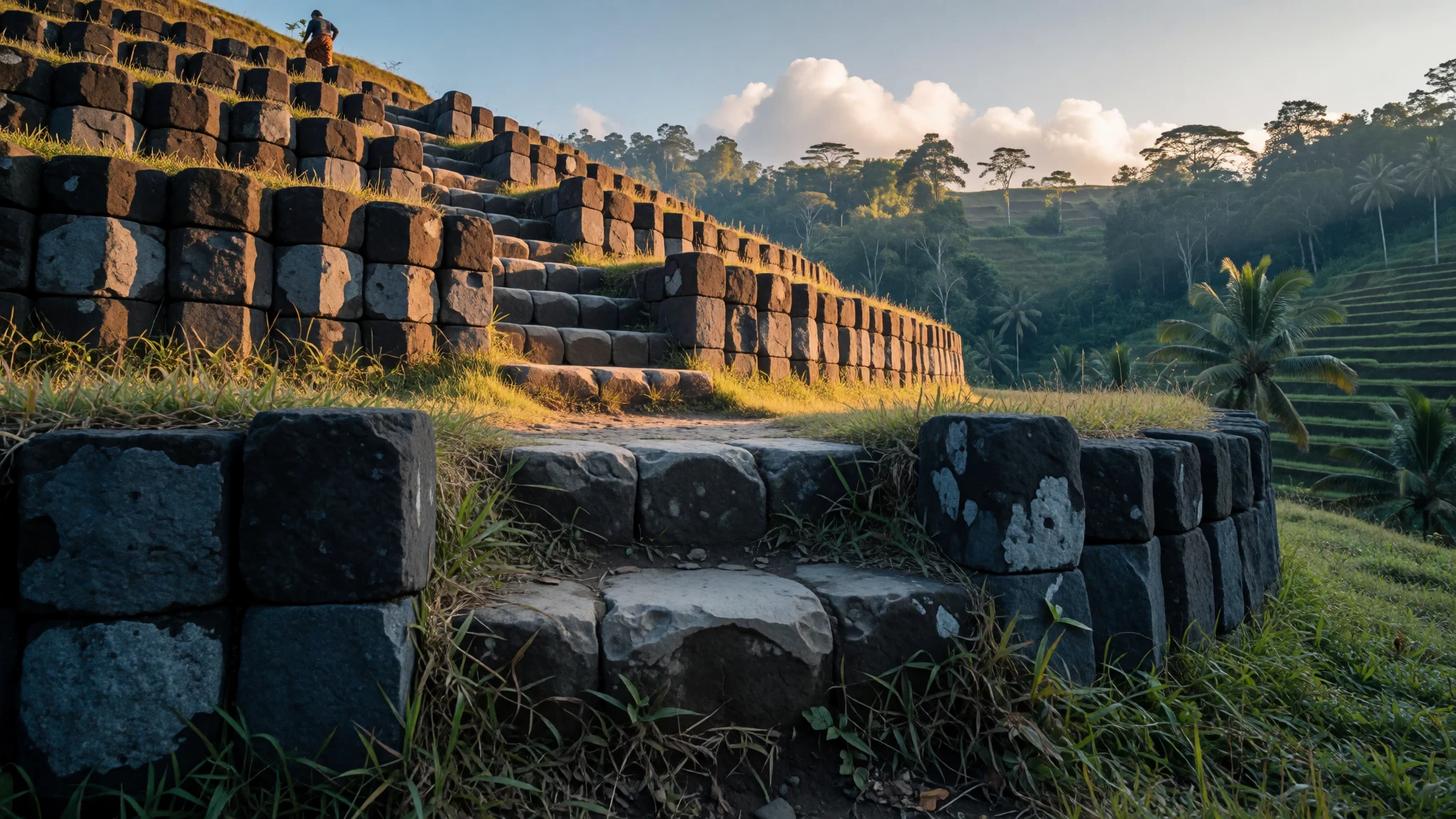
Gunung Padang is a hilltop of stacked stone columns in West Java, reached by a long climb and wrapped in legend.
The place
Gunung Padang sits in Karyamukti, in the highlands of West Java, about 50 km south-west of Cianjur. The site covers an extinct volcano and rises in five stepped terraces, each held in by walls of stone. The lowest terrace is the largest and the top one the smallest, and all five line up along a single north-west to south-east axis. The terraces are artificial: the ground was cut down in some places and filled in others until it was flat. The walls and the scatter of standing stones are made of columns of volcanic andesite, some laid on their sides and some set upright like posts. A central stairway of 370 steps climbs the slope at a steep angle, about 95 m in height gained, and it is the only real way up. The hilltop is at 885 m above sea level, which makes the air a little cooler than the lowlands around Jakarta, though still warm and damp. West Java is one of the most crowded parts of the country, so the quiet of the summit comes as a surprise. Local Sundanese people treat the place as sacred. Visitors tend to come for the stones, the view over tea and forest country, and the sense of a place that has been used for a very long time. Facilities are simple, and the climb is the main effort.
Its story
The story of Gunung Padang has several layers. The written record starts in 1890, when a visitor named De Corte reported the hill to the Dutch authorities. The historian Rogier Verbeek then listed it in his 1891 survey of antiquities in Java, describing terraces joined by rough steps, paved with flat stones and studded with upright andesite pillars. He also noted small mounds that he guessed were graves. The archaeologist Nicolaas Johannes Krom made similar notes in a 1914 report from the Department of Antiquities. After that the site was largely forgotten, until local farmers found it again in 1979. Wikidata dates the site to around the year 500, but that is a rough label for a place whose age is still debated, and readers should treat any firm claim with care. Sundanese tradition offers its own explanation. It says the terraces came from King Siliwangi's attempt to build a palace in a single night. The legend is told with affection and is part of why local people regard the hill as a holy place. The truth is probably less dramatic: a long-used ceremonial site, shaped and reshaped by the people of the highlands. What is certain is that the stones were deliberately chosen, moved and arranged, and that the hill has drawn people to it for a very long time.
What to see
- The 370 steps — Approach to the site, Karyamukti
The stairway is the way in and a sight in itself. It runs straight up the hill at about 45 degrees, and the stone steps can be slippery after rain. Allow time to climb steadily and rest on the way. Looking back down the line of steps gives a good sense of how the hill is laid out.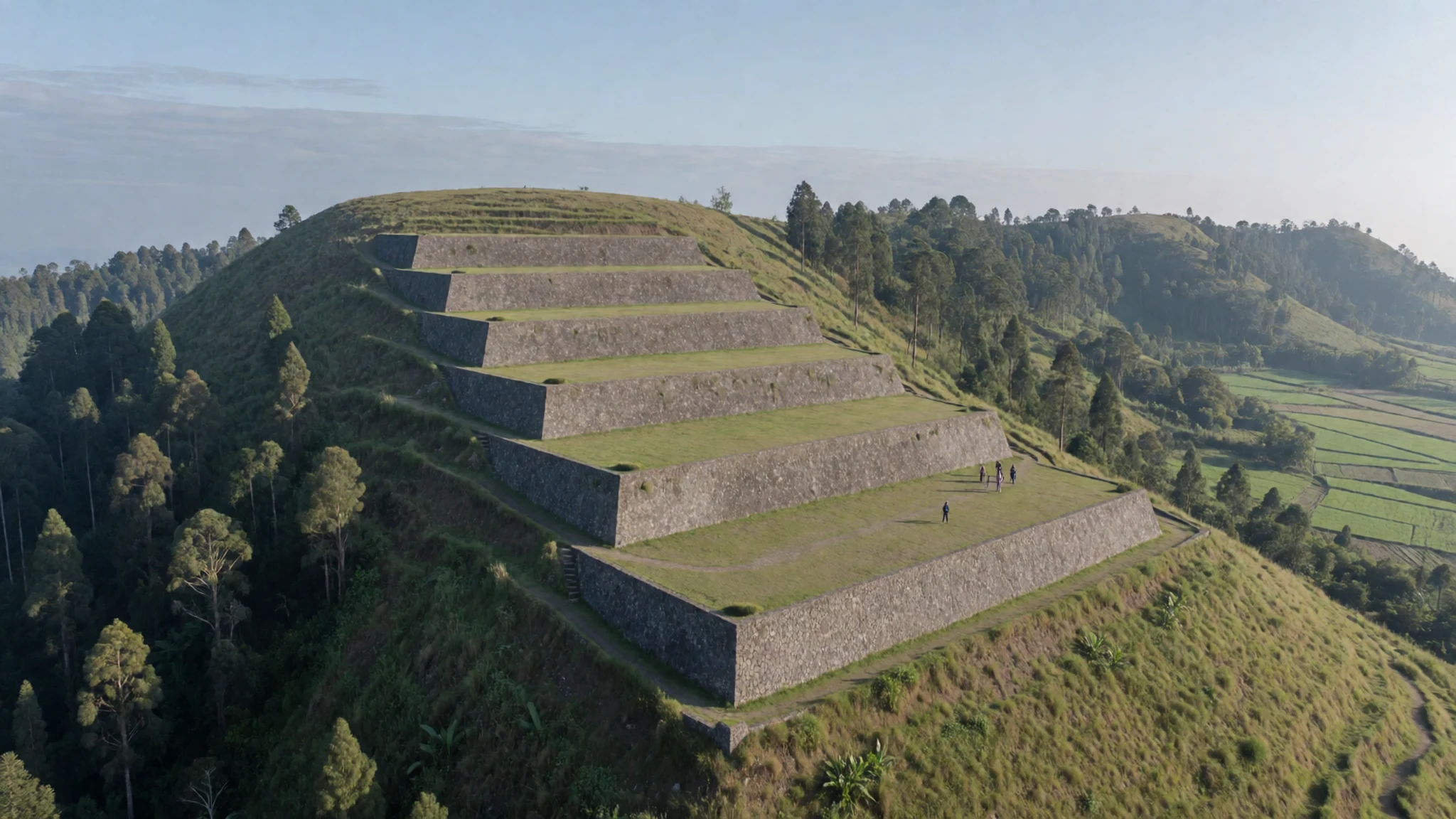
- First terrace — Lower hill
The lowest terrace is the largest and the only rectangular one. Stone columns lie scattered across it, and the retaining wall that holds up the hill is easy to read from here. It is a good place to understand how the platforms were built before the climb continues.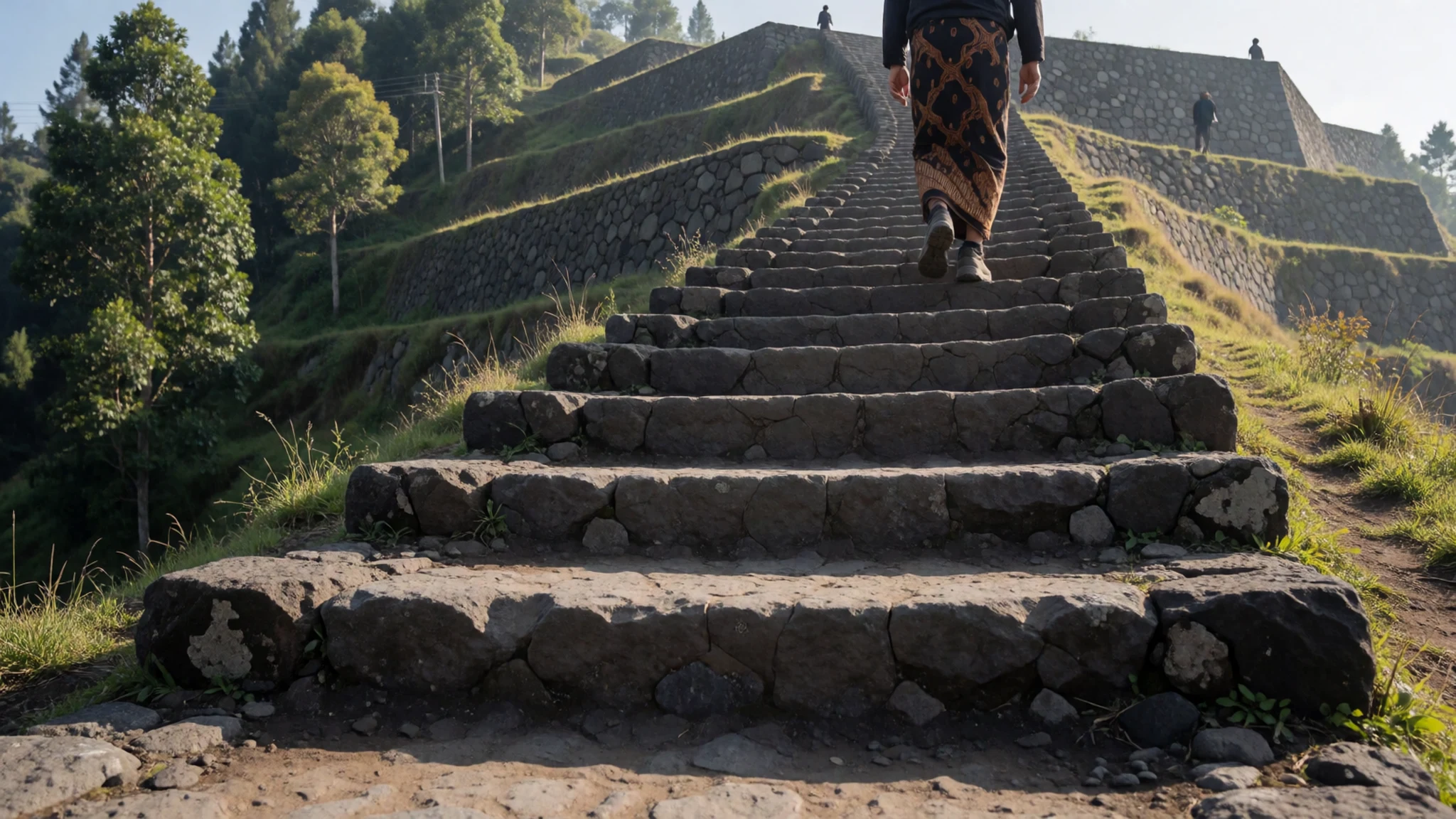
- Third and fourth terraces — Middle hill
Midway up, the platforms narrow and the columns look more deliberately arranged. Some stand upright, others are stacked. Verbeek noted small mounds on the terraces in the 1890s, so look for stone-ringed humps. Trees give some shade here, welcome in the heat of the day.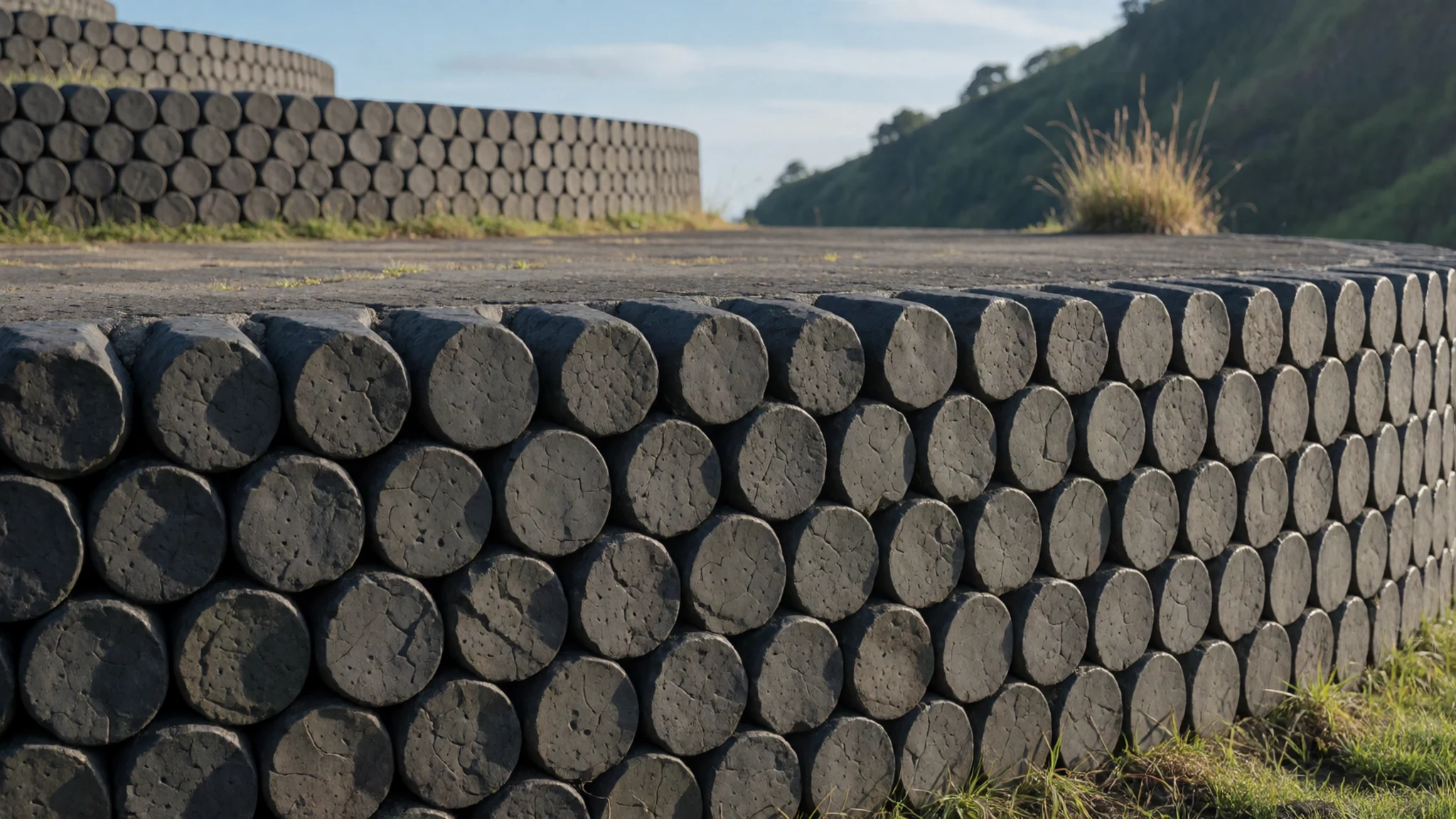
- Fifth terrace — Summit
The summit terrace is the smallest and the most sacred, and people often sit quietly here. Stone pillars stand in groups, and the view takes in green hills in every direction. Early morning light and mist can make it especially atmospheric, though cloud can also close in.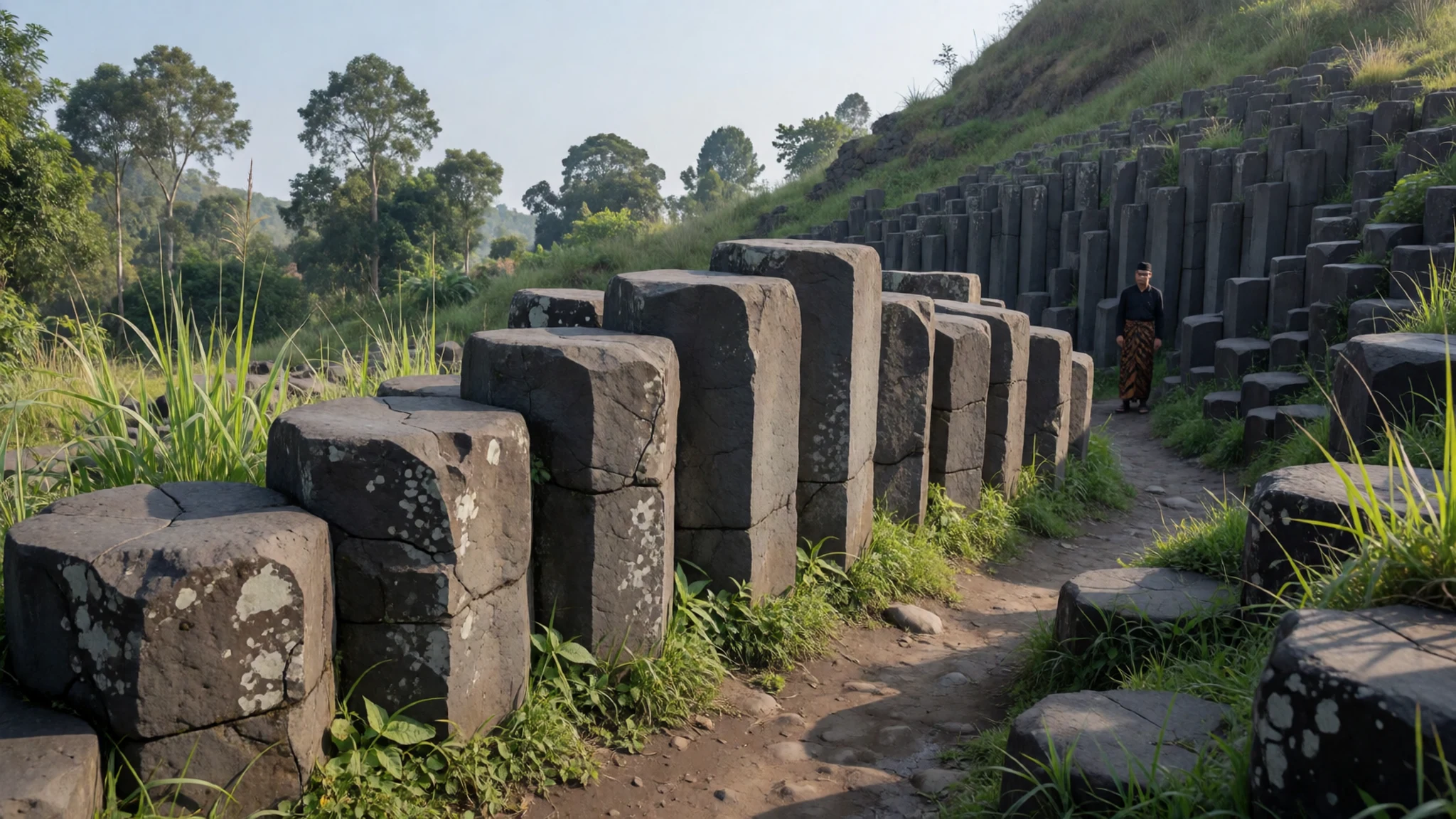
- The site at night — Core zone of the site
The hill is also photographed under the Milky Way, with the dark stones in the foreground. Night visits depend on local arrangements and rules, so ask at the site or check official information before planning one. Clear skies are most likely in the drier months.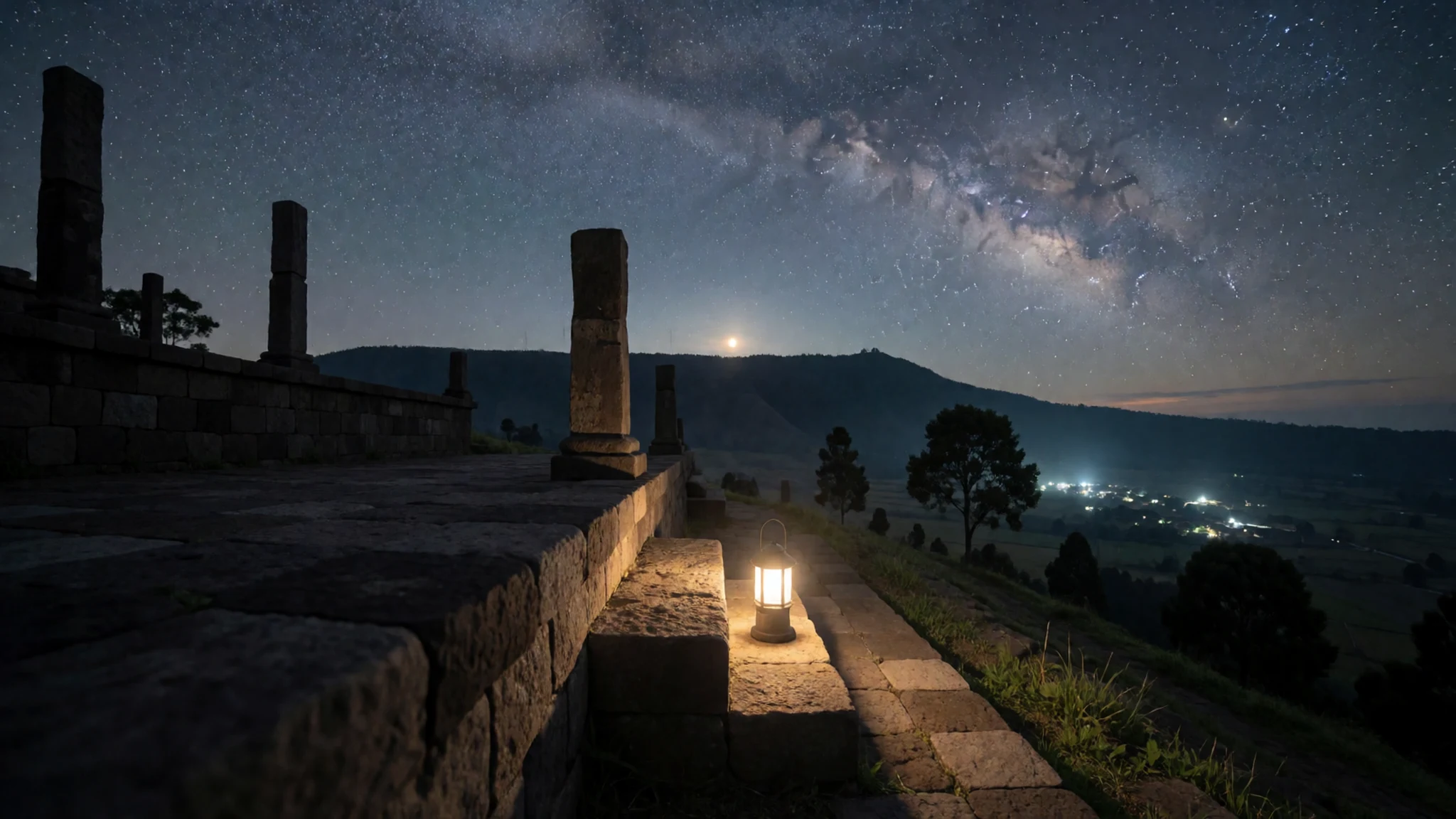
Culture
Gunung Padang is a sacred place for the Sundanese people, and that shapes how the hill is used. Some visitors come as pilgrims, to meditate or pray on the upper terraces, while others come as walkers or students of archaeology. Both groups share the same stones, so quiet and patience matter. The Sundanese legend of King Siliwangi and his palace built in a night is told by locals with real affection, and it is worth asking about it politely if a guide or caretaker is happy to talk. Most people in the surrounding villages are Muslim, and the hill sits within a rural community where modest behaviour is the norm. Greetings are gentle, and a smile and a soft hello go a long way. The site is also a protected archaeological place, which means the stones are fragile. Climbing on the columns, moving them, or carving into them damages something that cannot be replaced. Scientific debate about the site's age goes on, and some visitors arrive with strong views. It is kinder to listen than to argue. Walk slowly, keep voices low on the upper terraces, take your rubbish with you, and do not climb on or move any of the stones, whatever the temptation for a photograph.
What to wear
Traditional Sundanese dress is worth knowing even though it is rarely worn on the hill. Men wear the iket, a batik head cloth folded into a point, with a loose collarless shirt and trousers called pangsi, often in black. Women wear the kebaya, a fitted lace or cotton blouse, with a batik sarong or kain wrapped at the waist. Batik is made by drawing patterns in wax on cotton and dyeing the cloth, and West Java has its own regional motifs. These outfits appear at weddings, festivals and cultural events rather than on an ordinary day. Today most people around Cianjur wear everyday modern clothes: jeans or loose trousers, T-shirts, shirts, and for many women a headscarf and long sleeves. Visitors should dress for a hot, humid climb and a conservative rural community. Wear light, breathable clothes that cover the shoulders and knees, and bring a thin layer for the cooler top and for a sudden shower. Shoes matter most. The steps are stone and can be slick, so choose trainers or walking sandals with a grip, not flip-flops. A hat and a rain jacket are useful, and a small towel helps in the damp heat.
What to eat
- Nasi liwet — Family-run eateries in Cianjur town
Rice cooked with coconut milk, shallots and spices, often served on banana leaf with salted fish, tofu and tempeh. It is a Sundanese comfort dish, eaten communally and easy to find in local eateries in Cianjur.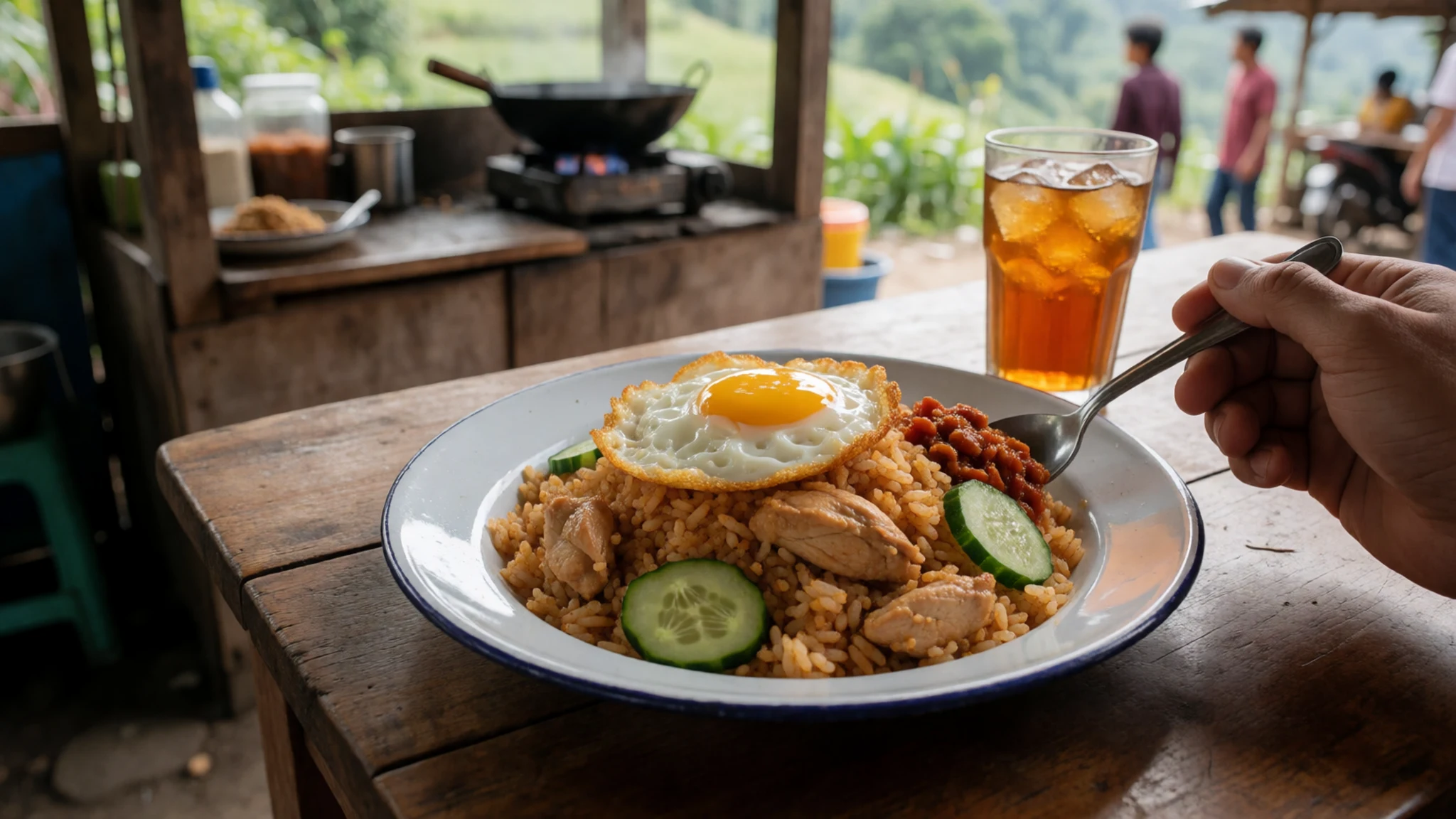
- Nasi tutug oncom — Sundanese rice eateries along the roads to the hill
Rice mashed with fermented oncom, a cousin of tempeh made from soya or other pulses, and seasoned with herbs. Savoury and a little smoky, it is usually served with fried chicken or fish and sambal.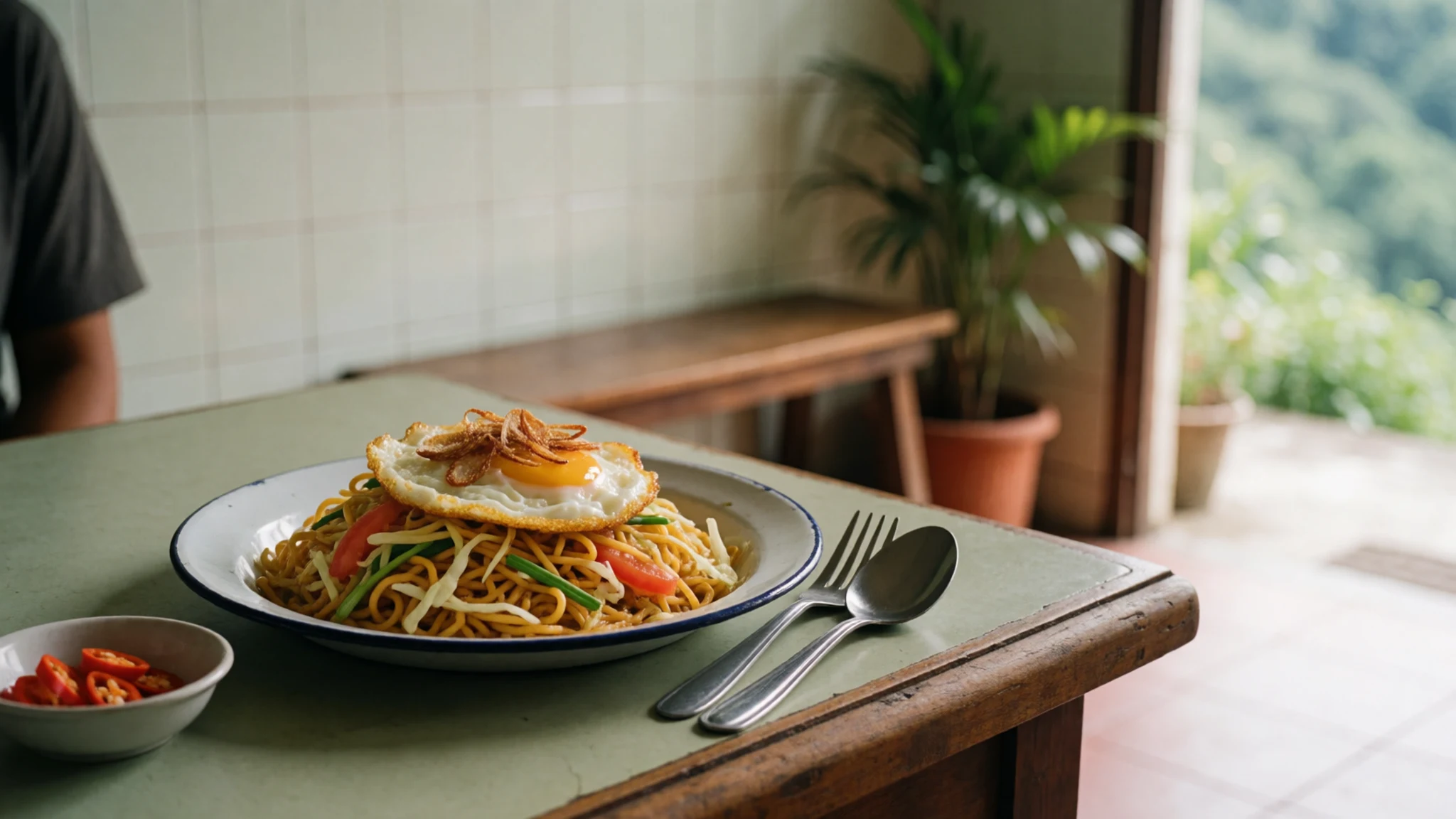
- Pepes ikan — Roadside warung and market stalls
Fish marinated in spices, wrapped in banana leaf and steamed or grilled over coals. The leaf keeps the flesh moist and gives a gentle smoky smell. It is typical of West Java, often served with raw leaves and sambal. - Lalapan with sambal — Any Sundanese warung
A plate of raw or lightly blanched vegetables and herbs eaten with a fiery chilli paste. It is a simple Sundanese staple, served with most meals and a good vegetarian-friendly side. - Cianjur rice dishes — Village eateries near the site and the Cianjur market
The Cianjur area is known for its rice, and plain steamed grains are served with grilled fish, vegetables and sambal. Plain and fresh, it suits the hot climb and is the sort of lunch locals choose.
Plan it
Best time. May to September is the drier season in West Java, so steps and paths are less slippery and views are clearer. Early morning is cooler and often misty. The wetter months bring heavy showers and slick stone, so take care.
How long. 1
Getting there. Fly to Soekarno-Hatta International Airport (CGK) at Tangerang, about 20 km north-west of central Jakarta. From there, travel by road via Cianjur, about 50 km north-east of the site, then take a local vehicle for the final stretch to Karyamukti. Allow a long day, as West Java roads are crowded.
Budget. low
Tips
- Start early, before the heat builds and while the terraces are quiet
- Wear shoes with a good grip, as the 370 steps can be slippery after rain
- Carry water and some cash for small stalls and entry arrangements; check opening and entry details with the local site office
- Hiring a car with a driver from Cianjur or Bandung makes the last leg easier
- Ask locally about weather and any restrictions before travelling
Etiquette
- Keep voices low on the upper terraces, where people may be praying
- Do not climb on, move or carve the stones
- Dress modestly, covering shoulders and knees
Nearby
Sources
- Wikidata Q3120910 (CC0)
- Wikipedia: Gunung Padang (rev 1380618730) (CC BY-SA 4.0)
- Wikivoyage: Western Java (rev 5371717) (CC BY-SA 4.0)
- Photo: Gunung Padang Site, Mohammad Fadli (CC BY 3.0)
- Photo: Situs Megalitikum Gunung Padang Cianjur, RaiyaniM (CC BY-SA 4.0)
- Photo: Gunung Padang 1st terrace, Beeyan (CC BY-SA 2.5)
- Photo: Gunung Padang 4th and 3rd terrace, Beeyan (CC BY-SA 2.5)
- Photo: Gunung Padang 5th terrace, Beeyan (CC BY-SA 2.5)
- Photo: Gunung Padang Bimasakti, Mangeded (CC BY-SA 4.0)
- Photo: Gunung Padang Megalithic Sites 01, Gilangsmntr (CC BY-SA 4.0)
- Photo: Gunung Padang Megalithic Sites 02, Gilangsmntr (CC BY-SA 4.0)


