Baiturrahman Grand Mosque
Baiturrahman Grand Mosque, Indonesia
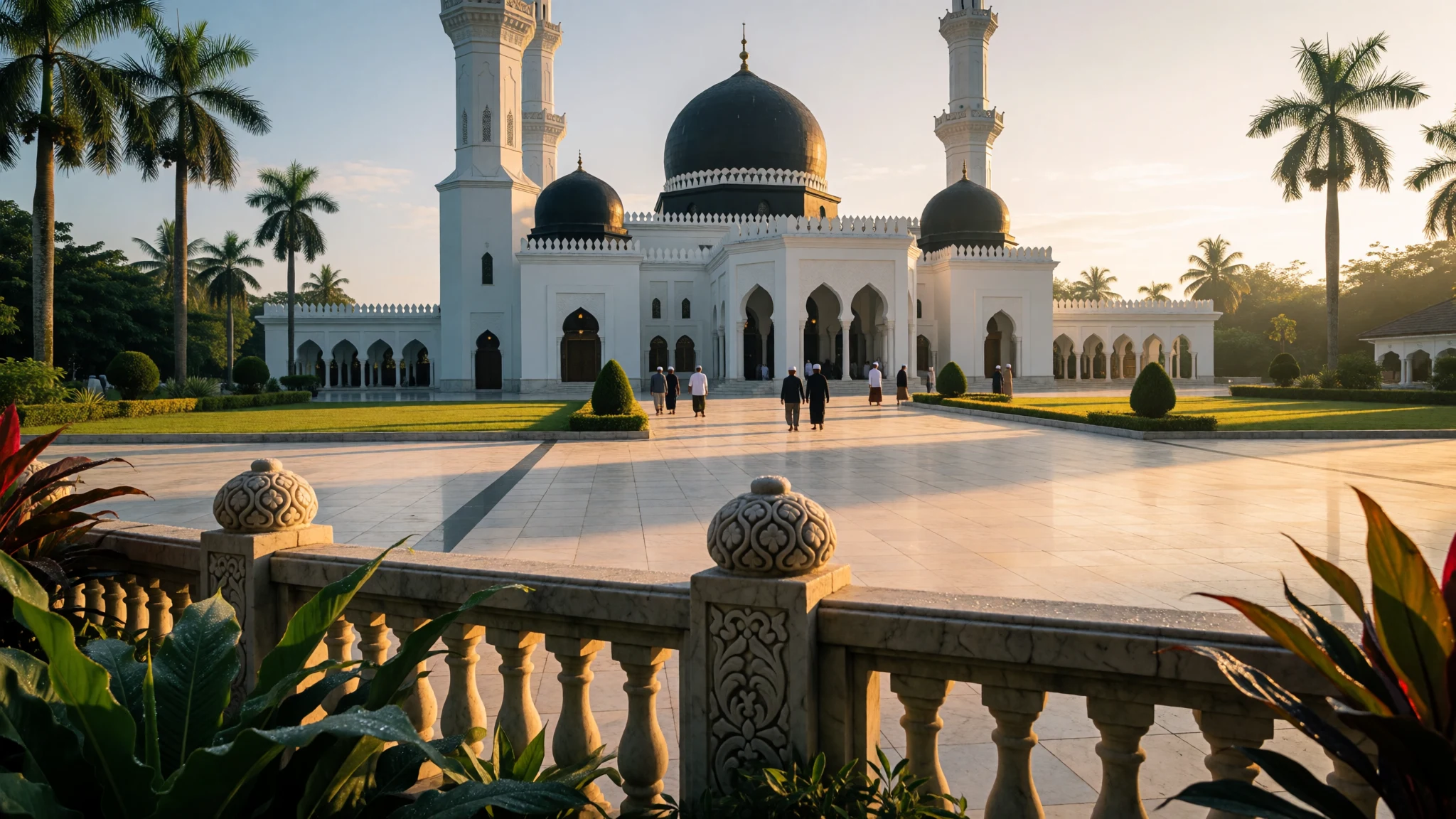
Visit Baiturrahman Grand Mosque to witness a stunning architectural landmark that stands as an enduring symbol of spiritual strength and survival.
The place
Baiturrahman Grand Mosque anchors the urban heart of Banda Aceh, positioned centrally within the province of Aceh in Indonesia. Known locally as Masjid Raya Baiturrahman and Meuseujid Raya Baiturrahman, this prominent religious sanctuary functions as a powerful emblem of faith, heritage, community resilience, and national identity for the local population. Set against an expanse of impeccably maintained lawns, the complex features striking dark domes contrasted against crisp white walls and soaring vertical minarets that define the skyline of the surrounding area. Visitors approaching the precinct encounter vast open courtyards where worshippers gather daily for prayer and reflection. The surrounding district hums with daily pedestrian movement, traditional coffee houses, and quiet alleyways that reflect the distinct culture of the region. Local meteorological conditions follow a tropical rainforest pattern with steady warm temperatures throughout the entire year, accompanied by distinct wet cycles and drier stretches. The geographical setting places travellers at the northern tip of Sumatra, where coastal breezes temper the ambient warmth of the afternoons. Within the wider precinct, visitors find clean ablution stations, serene shaded walkways, and open public spaces that invite quiet contemplation amidst the active daily rhythm of the municipal center. The site serves not only as a place of profound religious devotion for local residents, but also as a historic anchor point that connects the contemporary urban layout with centuries of regional heritage.
Its story
Baiturrahman Grand Mosque has witnessed centuries of profound transformation, conflict, and recovery. The original sanctuary at this location was established during the era of early royal rule by Sultan Iskandar Muda, featuring traditional multi-tiered thatched roofing common to indigenous carpentry of the region. During colonial military campaigns, the compound became a focal point of intense resistance as local defenders engaged invading forces from the shelter of the courtyard. Following a devastating fire triggered during these hostilities, the colonial administration undertook reconstruction as a gesture intended to appease the local populace, laying the foundational stone during the final decades of the nineteenth century. Over subsequent generations, the architectural footprint expanded significantly through successive phases of expansion, incorporating additional domes and towering minarets to accommodate a growing congregation. The resilience of the structure was tested severely when a massive seismic event and subsequent coastal deluge struck the region, leaving the surrounding urban fabric profoundly altered. While surrounding neighbourhoods suffered catastrophic loss, the sanctuary endured with only minor structural fractures and a slightly shifted minaret, subsequently offering temporary sanctuary to thousands of displaced people before reopening for congregational prayer. This survival cemented its legacy in the collective memory of the community, transforming a historic monument into a living testament of endurance and peace following the historic resolution of regional hostilities.
What to see
- Baiturrahman Grand Mosque — Central Banda Aceh
Baiturrahman Grand Mosque anchors the centre of the city with its distinctive black domes, soaring white minarets, and expansive manicured green lawns that welcome thousands of visitors and worshippers daily. - The Aceh Museum — Central Banda Aceh
The Aceh Museum preserves regional heritage by exhibiting traditional weaponry, fine ceramics, exquisite traditional clothing, ornate jewellery, and historical Islamic calligraphy collected from across the province. - Cut Nyak Dien House — Lampisang
Cut Nyak Dien House is a faithful architectural replica commemorating an iconic female revolutionary leader who fought fiercely against colonial forces during historical regional conflicts in the area. - Gunongan and Taman Putroe Phang — Banda Aceh
Gunongan and Taman Putroe Phang feature a unique historic royal pleasure structure and landscaped gardens constructed as a private retreat and bathing area for a royal consort from abroad. - Indonesian Airline Monument — Banda Aceh
The Indonesian Airline Monument stands as a proud public memorial erected to honour the crucial financial and material contributions made by the people of the region toward national independence.
Culture
Baiturrahman Grand Mosque exists within a deeply traditional society shaped by Islamic values and distinct regional customs that distinguish it from other parts of the country. Social interactions are characterised by polite reserve, strong community ties, and a deep sense of shared history. Traditional arts, including rhythmic devotional group performances and intricate hand-woven textiles, remain integral to local celebrations and daily life. Visitors frequently notice the pervasive coffee shop culture, where locals gather for hours over slow-brewed local coffee to discuss community affairs and daily news. Respect for religious traditions and conservative social norms governs public behavior across the province, making modesty essential for all travellers regardless of their personal beliefs. Always dress modestly with covered shoulders and knees, and remove your footwear before stepping onto the carpeted prayer halls.
What to wear
Traditional dress at Baiturrahman Grand Mosque and throughout the surrounding region reflects deep Islamic modesty combined with local heritage textiles. Traditional attire often features hand-woven songket fabrics adorned with gold and silver metallic threads, worn during formal ceremonies, weddings, and religious festivals. Day-to-day wear for local residents typically consists of loose-fitting tunics, trousers, and head coverings for women, alongside comfortable long-sleeved shirts and trousers for men. Visitors should adopt a similarly conservative wardrobe to blend in and show respect for local customs. Travellers need to wear lightweight, breathable garments that cover the shoulders, arms, and legs completely. Women should carry a lightweight scarf or shawl to cover their hair when entering prayer areas or moving through sacred courtyards. Footwear must be easy to slip on and off, as shoes are strictly prohibited inside the main prayer halls and must be left at designated shoe-storage racks outside.
What to eat
- Nasi Gurih — Local coffee shops and morning markets
Nasi gurih is the ultimate local breakfast staple, consisting of aromatic rice cooked in rich coconut milk and served with various side dishes, found in traditional coffee shops everywhere across town. - Mie Aceh — Black and White rumoh kuphi and local noodle stalls
Mie Aceh features thick yellow noodles tossed in a rich, spicy curry broth flavoured with local spices, often prepared with beef, seafood, or goat meat for a deeply satisfying meal. - Acehnese Coffee — Friends caffee and roadside coffee stalls
Acehnese coffee is celebrated for its strong, robust flavor, expertly brewed using traditional cloth filters and served either black or sweetened with condensed milk in bustling neighbourhood coffee houses. - Fresh Fruit Juices — My Juice on Auto Boulevard
Fresh fruit juices are blended to order from tropical fruits using local produce, offering a refreshing and cooling drink to combat the warm afternoon temperatures along the main boulevards. - Local Seafood and Aceh Fare — PaceBene and Istana restaurants
Local seafood and traditional Aceh fare highlight fresh catches from nearby coastal waters, served alongside fragrant spiced dishes in air-conditioned dining rooms and rooftop garden restaurants.
Plan it
Best time. June through August offers drier conditions with less rainfall, making it the most comfortable period for exploring the outdoor courtyards and surrounding streets.
How long. 2–3
Getting there. Fly into Banda Aceh Airport via daily international flights from Kuala Lumpur or domestic connections from Jakarta and Medan, then take a short taxi ride to the centre.
Budget. mid
Tips
- Visit the mosque early in the morning or late in the afternoon to avoid the hottest midday temperatures on the open marble courtyards
- Carry sufficient cash in local currency for small shops, coffee houses, and markets, as card acceptance can be limited
- Dress modestly by covering shoulders, arms, and legs completely before arriving at religious sites
- Remove your shoes promptly at designated areas before stepping onto carpeted sections of the mosque
Etiquette
- Always dress conservatively with covered shoulders and knees in public spaces and religious sites
- Remove footwear before entering the mosque interior and place shoes on the provided racks
- Ask permission before photographing local residents, particularly worshippers during prayer times
Nearby
Sources
- Wikidata Q1548318 (CC0)
- Wikipedia (CC BY-SA 4.0)
- Wikivoyage (CC BY-SA 4.0)