Flinders Ranges
Flinders Ranges, Australia
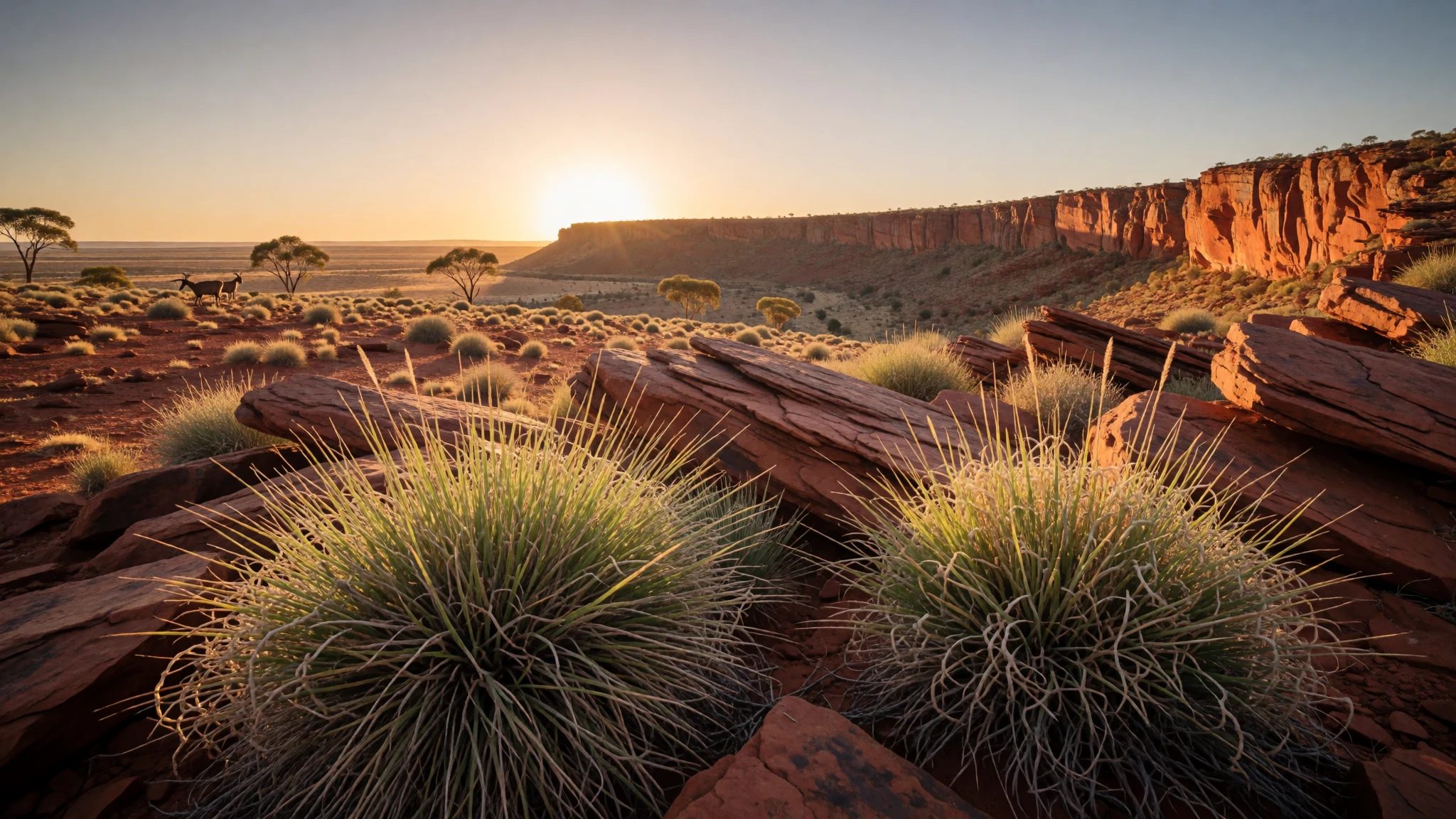
Flinders Ranges is a spare, ancient South Australian landscape of folded ridges, rock art, fossil-bearing hills and the natural stone amphitheatre of Ikara.
The place
The Flinders Ranges run north from the head of Spencer Gulf into the dry heart of South Australia, a long line of folded ridges, gorges and bare hills. The facts give the range an elevation of 553 m, which sounds modest, yet the country reads as properly mountainous because the land around it is so flat and open. Colour does much of the work: the rock turns rust-red at dawn, ochre by noon and violet at dusk. The best-known landmark is Wilpena Pound, called Ikara by the Adnyamathanha, a ring of ridges around a natural amphitheatre with St Mary Peak on its rim. Ikara-Flinders Ranges National Park protects it, alongside several other reserves in the wider ranges. Beneath the scenery lies a geological record that draws scientists as well as walkers. The rocks began as sediment laid down in an ancient sea and were later buckled and cracked. Fossils from the Ediacara Hills gave the Ediacaran Period its name. The climate is semi-arid. Summer afternoons usually pass 38 °C, winters are cool with frosty mornings, and rain is patchy, falling mostly in the colder months. Distances are long and services are thin. The national park has a single resort with the only restaurant and bar inside its boundary, so most visitors plan food, fuel and water well ahead. Nights are very dark and very quiet, which many people remember longer than the views.
Its story
The story of the Flinders Ranges begins with the Adnyamathanha, whose name is usually glossed as 'hill people' or 'rock people', and with their neighbours the Ngadjuri. Their presence here stretches back tens of thousands of years. The Warratyi rock shelter was in use about 49,000 years ago, and painted and engraved rock across the ranges carries the record forward. Adnyamathanha descendants still live in the region. European contact came in the early nineteenth century. A party from Matthew Flinders's voyage aboard HMS Investigator climbed Mount Brown after landing at upper Spencer Gulf. Some decades later Edward John Eyre led a small expedition out of Adelaide in winter, setting up a depot near Mount Arden before pushing east to the Murray River. Squatters were running stock around Quorn by the middle of the century, and the first formal pastoral leases in the central ranges, Wilpena, Arkaba and Aroona, were all developed as sheep stations. Sheep, fences and claimed waterholes changed the country, and Aboriginal people were dispersed from much of their land. The stone ruins of homesteads such as Kanyaka now stand as reminders of how hard that pastoral frontier was, and of who paid for it. Today the story has another layer. Geologists treat these rocks as a layer-by-layer record of early animal life, and a nomination to list several sites in the ranges as World Heritage remains on Australia's tentative list.
What to see
- St Mary Peak — Wilpena Pound, Ikara-Flinders Ranges National Park
St Mary Peak sits on the rim of Wilpena Pound and is the usual goal for fit walkers, who climb to look down into the amphitheatre and out over the plains beyond. It is a long, rocky day walk rather than a stroll, so start early, carry plenty of water and turn back if the heat builds.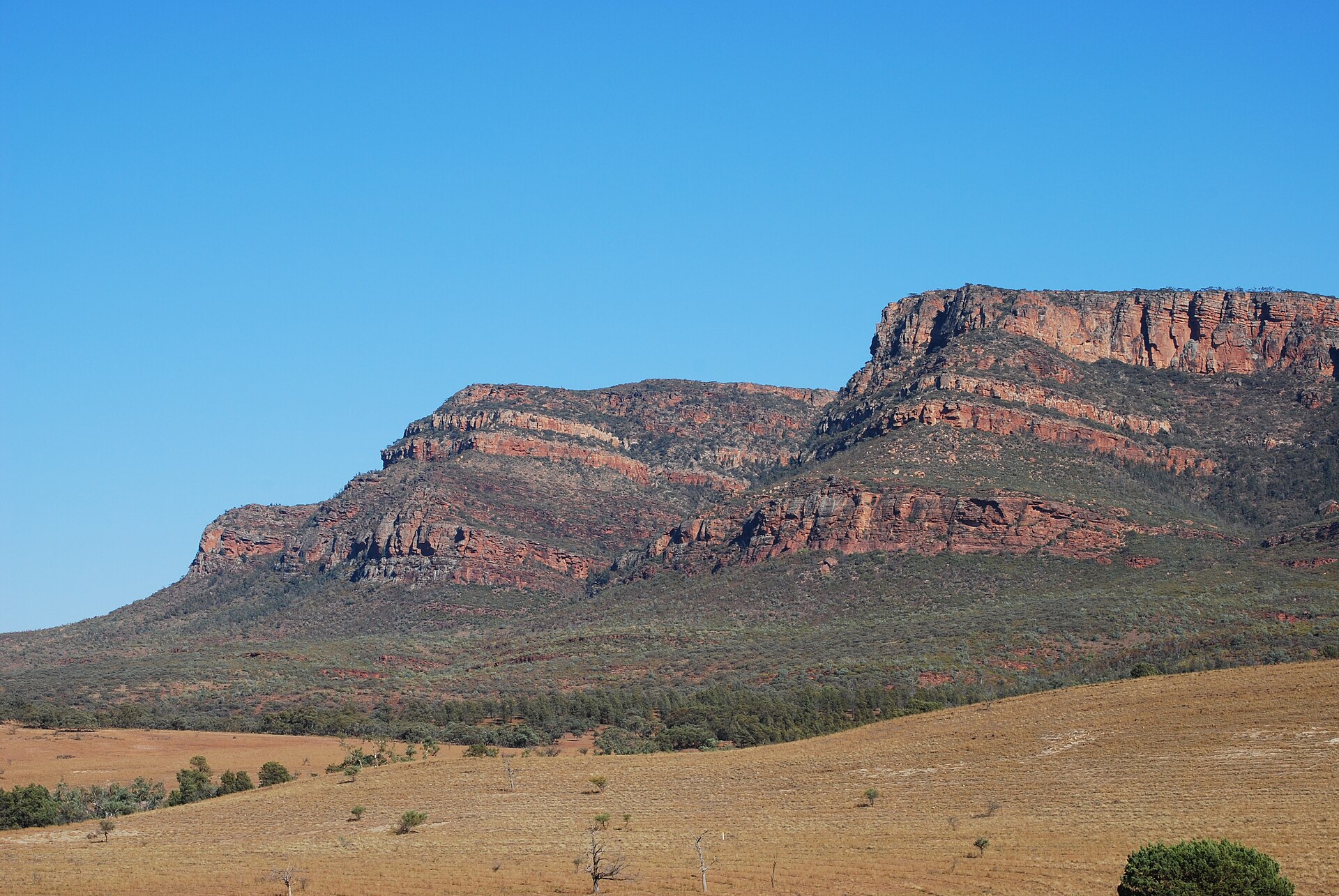
- Sacred Canyon — Southern ranges, near the Wilpena Pound area
Sacred Canyon is a narrow gorge where the walking is along the floor and the interest is overhead, in rock walls carrying old Aboriginal engravings. The path is short and easy, which suits families and slower walkers. It is a significant place, so keep voices low and never touch or scratch the stone. - Arkaroo Rock — Foot of the hills south of Wilpena Pound
Arkaroo Rock is a rock-art shelter with drawings in ochre and charcoal, thousands of years old and important to the Adnyamathanha. A walking track climbs to it from a small car park at the foot of the hills. Allow time to sit quietly and look properly, rather than rush for a photograph. - Old Wilpena Station — Wilpena Pound, beside the main visitor area
Old Wilpena Station is what remains of an early sheep property, with some stone buildings and interpretive signs explaining how pastoralists settled the Pound in the colonial period. The visit is flat and easy, close to the main resort, and gives useful context for the landscape. Little survives, so the signs are worth reading in full. - Ediacaran Golden Spike — Northern ranges, near the Ediacara Hills
The Ediacaran Golden Spike is a marker in the rocks tied to the formal definition of the Ediacaran Period, named after the hills where early animal fossils were found. There is little to see beyond the marker and the banded rock, so it mainly suits geology enthusiasts, who often pair it with a fossil-focused tour. - Cazneaux Tree — Beside the road to Wilpena Pound
Cazneaux Tree is a lone gum named after the photographer Harold Cazneaux, who made a celebrated image of a tree here. It stands close to the road into Wilpena, so it makes an easy stop on the way in, and the light is kindest early in the morning or just before sunset.
Culture
Culture in the Flinders Ranges starts with the Adnyamathanha, for whom Ikara and the surrounding hills are living country rather than scenery. Stories, ceremony and place names are tied to particular rocks, waterholes and gorges, and some knowledge is not shared with outsiders. Rock art such as that at Arkaroo Rock, made with ochre and charcoal, is one visible trace, and guided walks led by Adnyamathanha people, where available, are the better way to hear these stories in the right voice. Alongside it runs a pastoral culture of station families, shearers and small-town pubs, built on sheep, drought and long distances. People wave at passing vehicles, stop to help with breakdowns, and expect visitors to carry their own water and tell someone their route. Homestead ruins and interpretive signs record that history, including the displacement that came with it, and are worth reading with that in mind. Visitors tend to be walkers, campers, geology enthusiasts and photographers, and the mood is quiet and unhurried. Evenings are for campfires, a drink at the resort bar or a long look at the stars. Stay on marked tracks at rock-art and sacred sites, never touch painted or engraved surfaces, and ask before photographing Aboriginal people or their ceremonies.
What to wear
Fashion in the Flinders Ranges has no single costume, and it is worth saying so plainly. Traditionally, Adnyamathanha and Ngadjuri people dressed lightly for a hot, dry climate and used animal-skin cloaks and wraps against winter cold, with ochre body paint for ceremony. Ceremonial dress belongs to the community and is not worn or sold for visitors. Woven cloth is not part of that tradition, so there are no named textiles to look for, though local Aboriginal artists make paintings and crafts that are best bought directly from them. Day to day, people on stations and in small towns wear practical bush clothes: wide-brimmed felt or straw hats, long-sleeved cotton work shirts, tough trousers and elastic-sided boots, with a fleece or wool jumper on cold mornings. Visitors should dress the same way. Pack a wide-brimmed hat, sunglasses, long loose sleeves, sunscreen and closed, sturdy walking shoes or boots for loose stone and spiky grass. Summer is very hot, so light layers and plenty of water matter, while winter mornings can be frosty and need a warm jacket, hat and gloves. No religious dress code applies, though modest, covered clothing is sensible at rock-art and ceremonial places, and flip-flops are a poor choice on any trail.
What to eat
- Kangaroo fillet — Wilpena Pound Resort dining room, the main restaurant inside the park
Kangaroo is lean, dark meat, best served rare and often paired with native pepperberry or a bush-tomato sauce. It is the dish most visitors try for a taste of outback menus, and it suits the dry, spare country around it. - Roast lamb — Country pubs and eateries in the small ranges towns
Sheep built this region's economy, so lamb is a natural order: slow-roasted or grilled, with potatoes and seasonal vegetables. Portions tend to be generous after a day of walking, and the meat usually comes from nearby stations. - Damper — Campgrounds and station stays, often at evening campfires
Damper is a simple bush bread of flour, water and salt, baked in campfire coals until crusty outside and soft within. It is eaten warm with butter or golden syrup, and tastes best after a cold evening outdoors. - Quandong pie — Small-town bakeries and roadside cafés, where stocked
The quandong is a tart red native desert fruit, and it is baked into sweet and slightly sharp pies or served as jam. Availability varies by season and shop, so treat it as a pleasant find rather than a certainty. - Country meat pie — Bakeries in towns such as Hawker or Quorn
A hot meat pie from a country bakery is the classic road-trip lunch: a flaky case with minced beef and gravy, eaten in the car park or at a bench. It is cheap fuel for a long drive.
Plan it
Best time. April–May and September–October for mild days and cool nights; winter is cool with frosty mornings but good for walking; summer afternoons usually pass 38 °C and are hard going.
How long. 3–4
Getting there. Drive from Adelaide, a journey of more than four hours: head north towards Port Augusta, take Flinders Ranges Way to Hawker, then continue for about an hour into the national park. The airstrip at Hawker serves only the Royal Flying Doctor Service, so a car is essential.
Budget. mid
Tips
- Fill the fuel tank at every town and carry more water than seems necessary
- Book park accommodation early, because the resort is the only restaurant and bar in the park
- Start long walks at dawn, before heat and midday sun
- Download offline maps, since phone signal is patchy, and tell someone your route
- Check the official site for current park conditions: https://southaustralia.com/en/places-to-go/flinders-ranges-and-outback
Etiquette
- Stay on marked tracks at rock-art and sacred sites and never touch the rock surfaces
- Ask before photographing Aboriginal people or ceremonies
- Take all rubbish with you and keep to existing campsites
Nearby
Sources
- Wikidata Q745846 (CC0)
- Wikipedia: Flinders Ranges (rev 1384999693) (CC BY-SA 4.0)
- Wikivoyage: Flinders Ranges (rev 5376102) (CC BY-SA 4.0)
- Photo: Flinders Ranges SA 5434, Australia (Matthew Summerton) (CC BY 3.0)
- Photo: Location map of South Australia (Tentotwo) (CC BY 3.0)
- Photo: Wilpena Pound near Rawnsley's Bluff (Peripitus) (CC BY 3.0)
- Photo: Kanyaka homestead (Peripitus) (CC BY-SA 1.0)
- Photo: Flinders Ranges from space (NASA) (Public domain)
- Photo: Arid pastoral land with the Flinders Ranges (Peripitus) (CC BY 3.0)
- Photo: Feral goats at Flinders Ranges National Park (Jane Bailey-Crass) (CC BY 3.0)
- Photo: 'Guardian of the Gap' Flinders Ranges (State Government Photographer) (CC0 1.0)


