Valdez
Valdez, United States
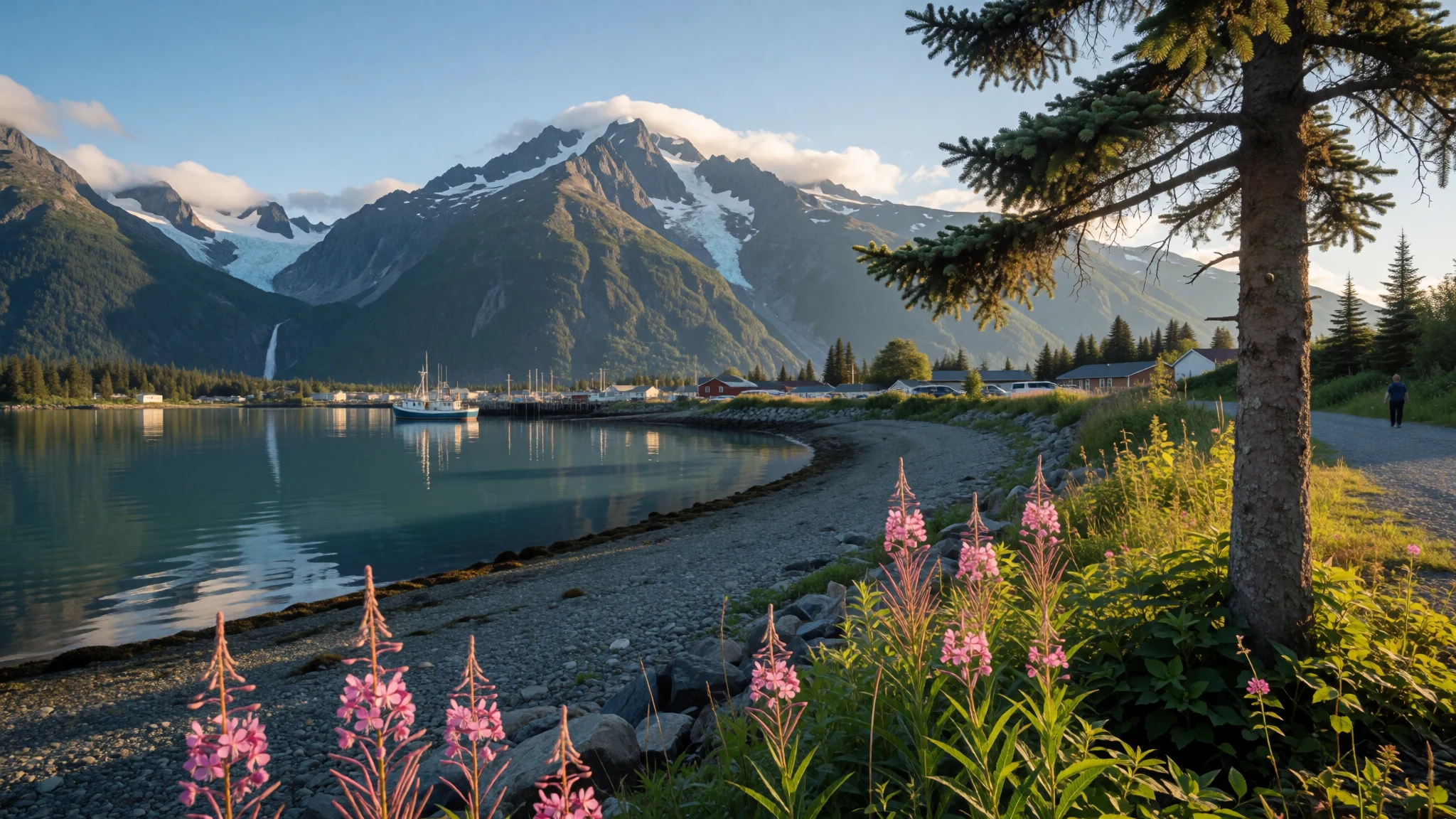
Valdez is a small Alaskan fjord port where glaciers, salmon and the end of the oil pipeline sit within sight of each other.
The place
Valdez sits at the head of Port Valdez, a deep fjord on the eastern side of Prince William Sound in southern Alaska, and about 3,985 people live there. The town lies only 30 metres above sea level, with the heavily glaciated Chugach Mountains rising close behind it. That backdrop is the first thing visitors notice and it never really goes away: streets end in rock, snow and waterfalls rather than in suburbs.
The setting explains the town's work. Valdez is the farthest-north port on the continent that never freezes over, which is why freight bound for Alaska's interior comes ashore here and why commercial and sport fishing boats fill the harbour. It is also the southern end of the Trans-Alaska Pipeline System, and oil from the north is loaded onto tankers at a terminal across the water. The company that runs the pipeline is one of the biggest local employers, so the town's rhythm follows shifts, tides and fishing seasons as much as tourism.
Tourism does matter, and it is almost all outdoors: kayaking in sheltered bays, glacier cruises, whitewater rafting, deep-sea fishing, and heli-skiing on the high ground to the north. Nobody comes for a historic centre. The town was badly damaged in 1964 and what stands now is low-rise, practical and friendly rather than pretty. It suits two or three nights: a walk around the harbour, one proper day on the water, and a sense of how a remote Alaskan economy fits together.
The honest caveats are distance and weather. Valdez is a long way from anywhere, cloud decides whether small planes and boat trips run, and the summer season is short and busy.
Its story
Valdez has both a Spanish name and an Alutiiq one, Suacit, and its history runs in layers. The Spanish layer is brief and precise. In 1790 Salvador Fidalgo, sent north from the Spanish outpost at Nootka, sailed into Prince William Sound looking for signs of Russian activity. He found none, traded with local people, raised a large wooden cross at Orca Inlet to restate Spain's claim, and named the port at the head of the fjord for Antonio Valdés y Fernández Bazán, the naval minister at home.
The town itself grew out of gold. Its founding is dated to 1898, when it served as a landing place for gold-seekers heading inland, and it was incorporated in 1901. Real prosperity came after 1910, when a road to Fairbanks tied the harbour to the interior and made it the natural gateway for goods and people.
Two events in living memory define the modern town. The 1964 Alaska earthquake damaged Valdez catastrophically, and the community was rebuilt rather than abandoned. In 1989 the tanker Exxon Valdez spilled its oil nearby in Prince William Sound, and the town's name travelled round the world attached to an environmental disaster it had not caused. Meanwhile the Trans-Alaska Pipeline made Valdez its terminus, so the same waters that suffered the spill became the loading point for the oil trade.
Today the museum, the pipeline terminal and the harbour are the places where these layers can be read side by side, and residents tend to speak about all of it plainly: gold, quake, spill and oil are simply what happened here.
What to see
- Pipeline Terminal — Across Port Valdez, south-west of town
The Trans-Alaska Pipeline ends at a terminal on the far side of Port Valdez, where oil is pumped aboard tankers. Access to the facility itself may be restricted, so ask locally about public viewpoints. Even from the harbour, the tanker traffic explains better than any sign what the town is for.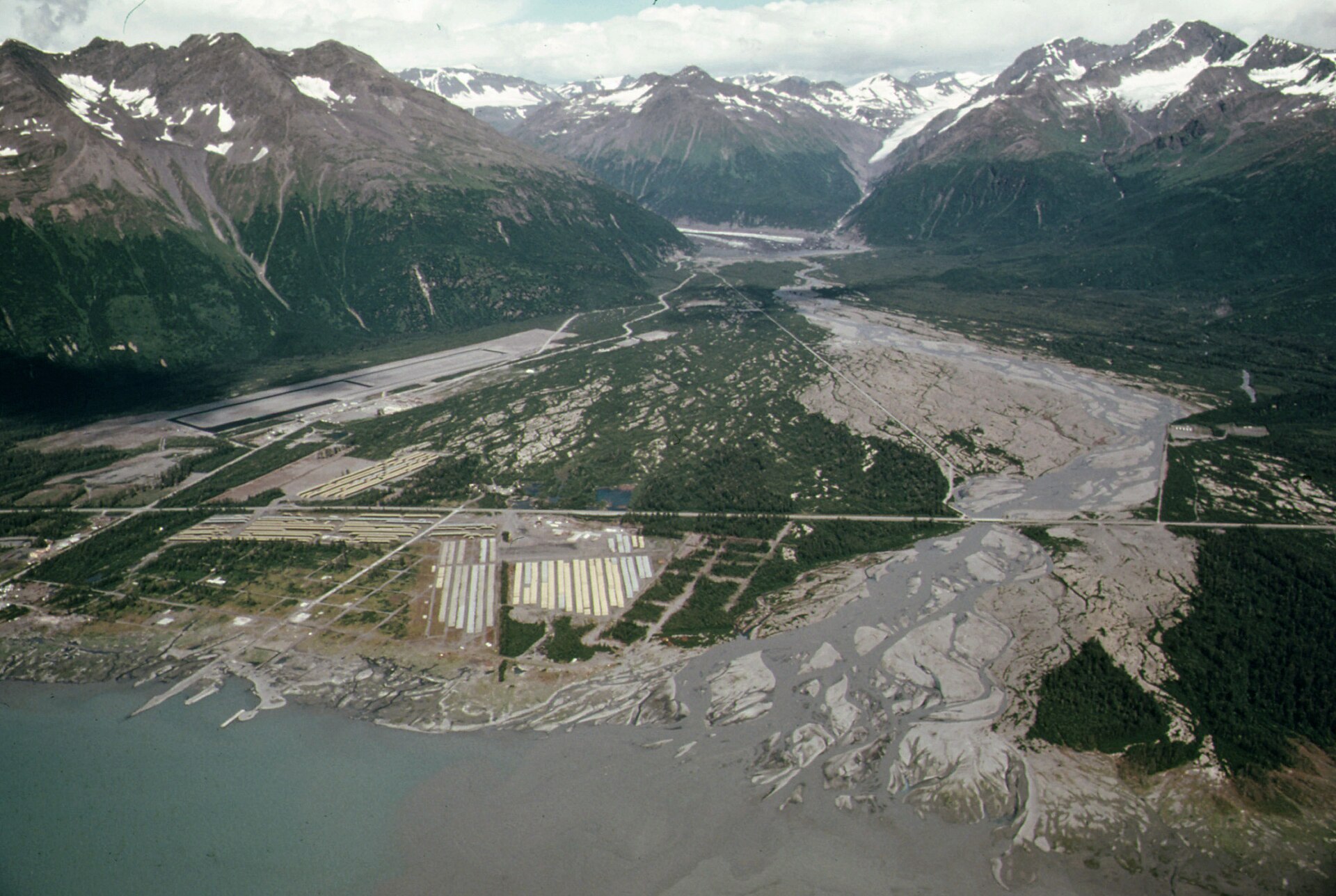
- Valdez Museum — Town centre
The Valdez Museum is the place to see how a gold rush landing, a road terminus, an earthquake and an oil port became one community. Expect local history told with local objects rather than a blockbuster show. Opening times shift with the season, so check the city website before planning around it. - Mineral Creek Trail — North of town, Mineral Creek valley
A gentle walk up the Mineral Creek valley, with steep walls and waterfalls on either side, leads to the W.L. Smith Stamp Mill, built in 1913 to serve the nearby Mountain King Mine. It is the easiest way into the mountains from town, and the groomed trails are used for cross-country skiing in winter. - Shoup Bay by kayak — Prince William Sound, across Port Valdez
Sea kayak operators ferry paddlers across to Shoup Bay, where a day on protected water puts mountains, glaciers and seabird colonies all around. Shoup Glacier feeds the bay, and in the town's early days residents cut ice from it. Book ahead in summer and choose a guided trip if sea kayaking is new to you. - Rafting in Keystone Canyon — Lowe River, Keystone Canyon
Whitewater rafting on the Lowe River runs through Keystone Canyon, a narrow gorge on the road out of town. Trips are sold by local operators; book ahead in summer and ask about water levels on the day. The canyon is a dramatic stretch to drive too, whichever way you are heading. - Thompson Pass — Richardson Highway, north of town
North of Valdez the Richardson Highway climbs to Thompson Pass, where waterfalls and glaciers sit right beside the road. Heli-skiing and snowboarding are run on this high ground, and the town hosted the World Extreme Skiing Championship in the early 1990s. Winter driving here has a treacherous reputation, so check conditions first.
Culture
Valdez is a working town first and a destination second, and its culture follows that order. Fishing seasons, tanker schedules and the weather set the pace, and conversation tends to start with what is running, what is flying and what the pass looks like. Many residents work for the pipeline operator, the port or the fishing fleet, which gives the place a practical, self-reliant character.
The older cultural layer belongs to the Alutiiq people, whose name for the place is Suacit. A totem pole stands in town against the mountain backdrop, and the Valdez Museum is the best starting point for local history, from the gold rush landing through the earthquake to the oil era. The memory of 1964 and 1989 is still part of how people talk about the town: the first a natural disaster that forced a rebuilding, the second a man-made accident that put the name in the world's news. Visitors who raise either subject get further by listening than by asking pointed questions.
Outdoor life is the shared leisure: fishing, skiing, kayaking, hiking and watching marine life from a boat. The harbour is a social space as much as a working one. Evenings are quiet, centred on pubs and a local brewery rather than any nightlife scene.
Ask before photographing people at work on the docks or in the fish-cleaning areas, and keep a long, respectful distance from bears at salmon streams and from any marine animals you meet.
What to wear
Valdez has no single costume worn on its streets, but the clothing story is easy to tell. Traditionally, Alutiiq people on this coast made waterproof parkas from sea-mammal gut, warmer ones from bird skins and furs, and boots and mittens from sealskin, all cut for life in boats and wet weather. Those garments are now seen mostly in museums, at dance performances and at cultural gatherings, where artists keep the sewing techniques alive.
Everyday dress today is functional: fleece, waterproof shells, wool hats, jeans and tall rubber boots. On the docks, fishers wear heavy rain gear, and nobody dresses up for a meal out. Clothes are chosen for the day's weather, not for fashion.
Visitors should pack in layers. Even in summer the air off the fjord and glaciers is cool, and rain is common. Bring a waterproof jacket and trousers, a warm mid-layer, a hat and light gloves, and sturdy waterproof walking boots for trails such as Mineral Creek. Sunglasses and sun cream help against glare off water and ice, and insect repellent is useful on summer walks. Winter visitors need insulated boots, a down jacket, thermal base layers and goggles if skiing. There are no dress codes to worry about at religious sites, and plain, casual clothing is fine everywhere in town.
What to eat
- Copper River salmon — Seafood restaurants and fish shops around the small-boat harbour
Sockeye (red) and Chinook (king) salmon from the Copper River system are the local pride. In season they are grilled, baked or served as fillets with simple sides. Ask what came in that week; supply follows the runs. - Halibut and chips — Casual eateries near the harbour
Halibut, a firm white flatfish caught in the surrounding waters, is most often served in crisp batter with chips. It is a simple, filling lunch after a morning on the water, and portions are generous. - Smoked salmon — Fish processors and harbour-side shops
Smoked salmon is the classic edible souvenir, sold in vacuum packs that travel well. Fish processors and harbour-side shops stock it, and many will pack it for flights. Ask how long it keeps before buying for the trip home. - Marina pub food — Pubs overlooking the marina
Pub fare such as burgers, fish and chips and chowders is the everyday meal in a town this size. Several pubs overlook the marina, so a plate of food comes with a view of the boats and the mountains behind. - Local craft beer — The brewery taproom in town
Valdez has its own craft brewery, and a pint of local beer is a natural end to a day of paddling or hiking. Look for seasonal brews on tap and ask staff what suits fish or a lighter lunch.
Plan it
Best time. June to September for the longest daylight and for kayaking, rafting, fishing and glacier boat trips; May and September are quieter but the weather is less settled. Late winter and spring suit heli-skiing and snowboarding around Thompson Pass, though winter driving on the pass is treacherous.
How long. 2–3
Getting there. Fly from Anchorage to Valdez Airport (about 45 minutes, with views of the Chugach mountains if the weather is clear), or drive the Richardson Highway in a full day. There is no scheduled ferry between Whittier and Valdez, only day boat trips; Valdez is a port of call on the Alaska Marine Highway ferry system.
Budget. high
Tips
- Weather can ground small planes and cancel boat trips, so keep a spare day in the plan
- Book kayaking, rafting, glacier cruises and fishing charters ahead in summer
- Check the city website (https://www.valdezak.gov/) for seasonal museum opening times and local information
- Check road conditions before driving Thompson Pass in winter
- Carry a waterproof layer and a warm hat even on summer day trips
Etiquette
- Ask before photographing people at work on the docks
- Keep well back from bears at salmon streams and from marine wildlife
- Respect any access limits around the pipeline terminal and port areas
Nearby
Sources
- Wikidata Q80037 (CC0)
- Wikipedia: Valdez, Alaska (rev 1384683154) (CC BY-SA 4.0)
- Wikivoyage: Valdez (rev 5357642) (CC BY-SA 4.0)
- Photo: Valdez, Alaska (Jason Grote) (CC BY-SA 2.0)
- Photo: Valdez aerial (Joseph from Cabin On The Road) (CC BY-SA 2.0)
- Photo: Alaska - Valdez - NARA - 23942621 (War Department, Army Air Forces) (Public domain)
- Photo: Alaska pipeline route near Valdez River (CC BY 2.5)
- Photo: Valdez, Alaska Harbor Panorama (Srvora) (CC BY 3.0)
- Photo: Totem in Valdez, Alaska with mountain background (Jami430) (CC BY-SA 4.0)
- Photo: 4-65. Valdez - Unloading water-pipe (Department of Defense, Army) (Public domain)
- Photo: 8-65. Valdez - Boat launch (Department of Defense, Army) (Public domain)


Wildlife
- Brown bear (animal)
The brown bear is a big, shaggy digger: a heavy bear with a muscly hump on its shoulders and broad paws made for turning over earth, its coat anywhere from cream to deep brown. Around Valdez you may meet one at a salmon stream, though the notes give no season or time of day. Keep well back, stay quiet, go with a guide if you can, and never feed a bear.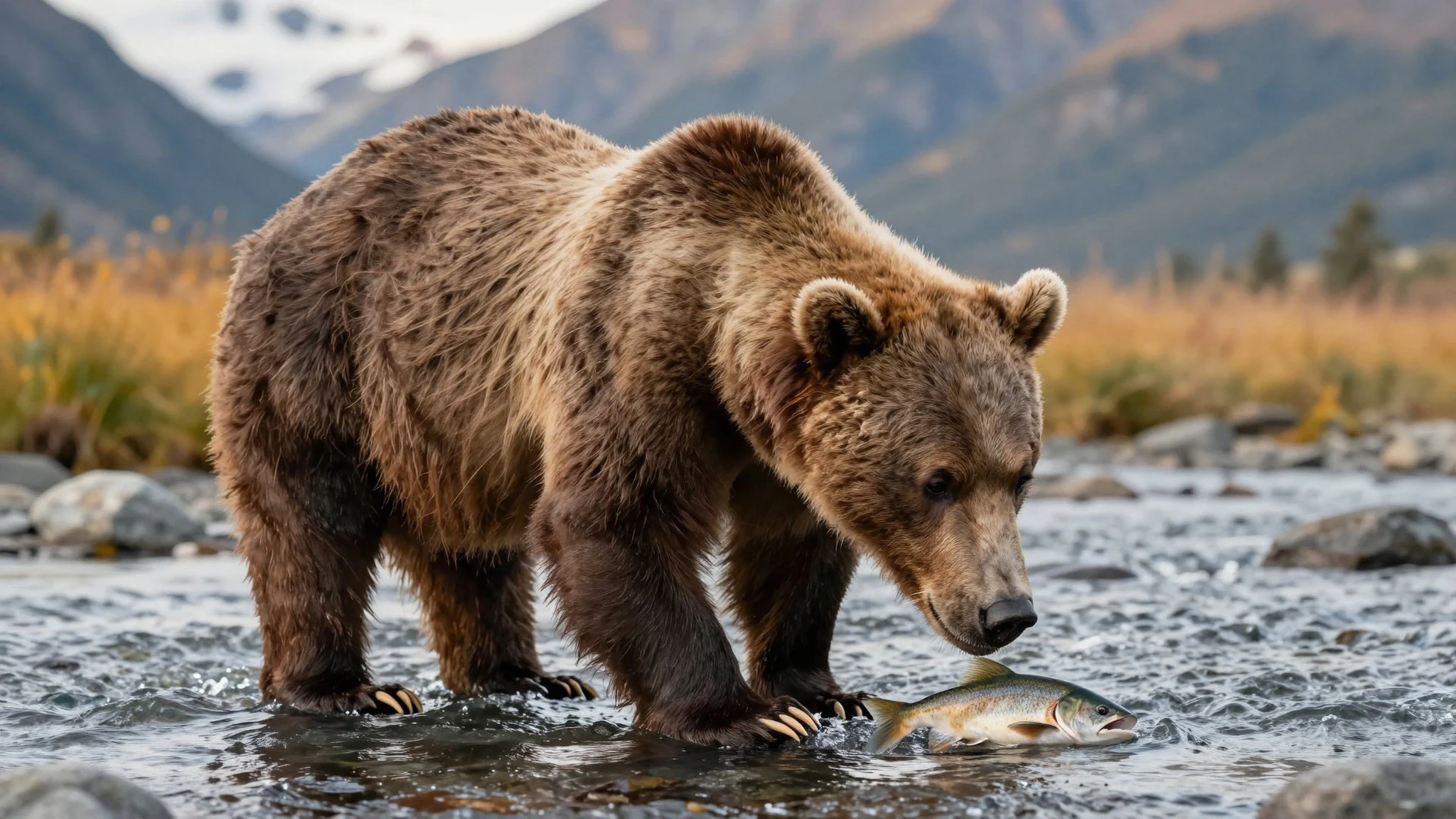
- Pink salmon (animal)
The pink salmon is the smallest of the salmon family, yet the most plentiful, and its Russian name means something like "humpy one". In Valdez, a small Alaskan fjord port, salmon share the view with glaciers and the end of the oil pipeline. The notes give no season or hour for them, so ask a local guide when and where to look. Watch from well back, keep your voice low beside the streams, and never feed any wildlife.