Tajhat Palace
Tajhat Palace, Bangladesh
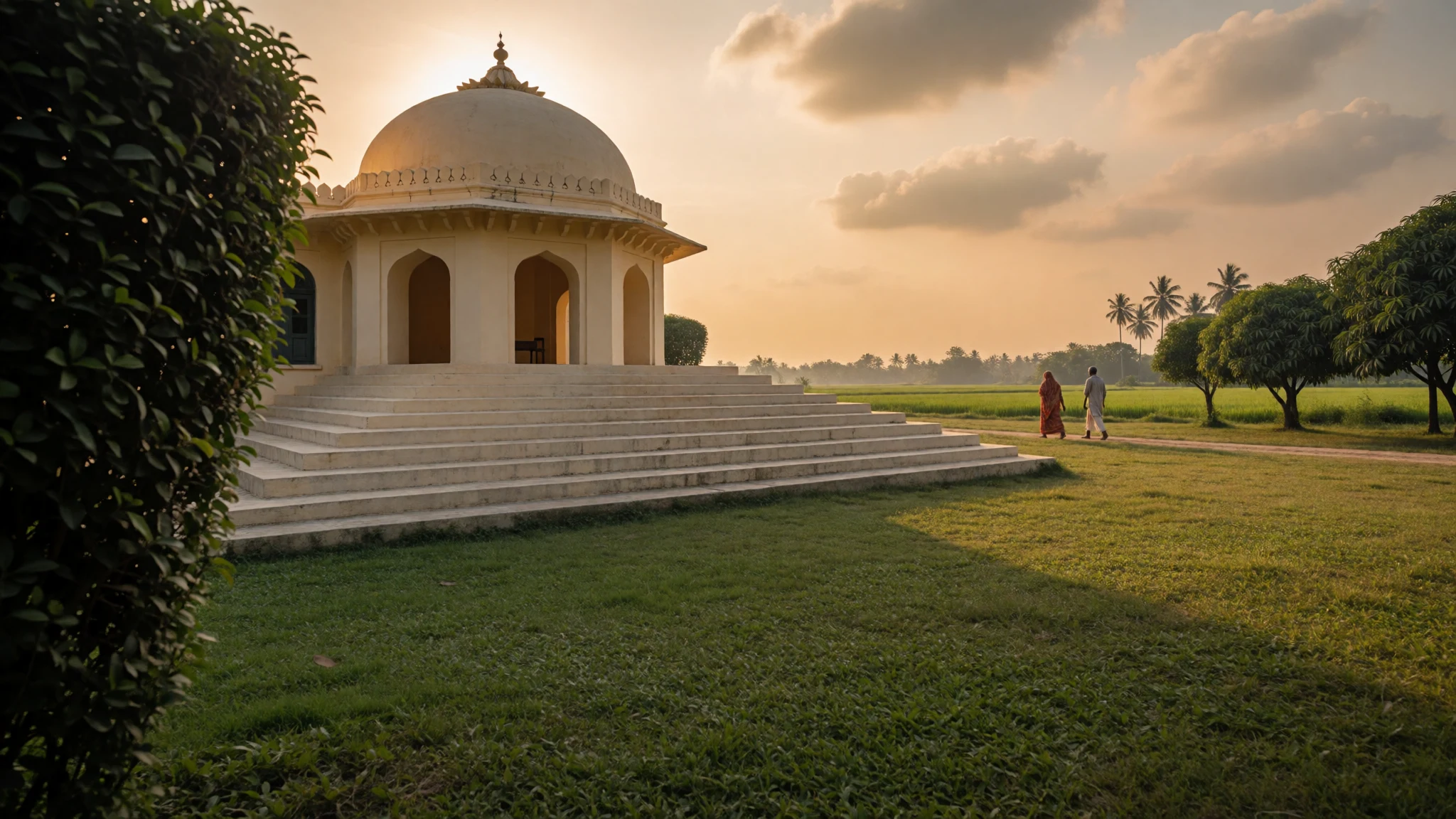
Tajhat Palace is a landlord's grand residence on the edge of Rangpur, now a small museum of manuscripts, terracotta and temple sculpture.
The place
Tajhat Palace (Bengali: তাজহাট রাজবাড়ী) sits on the outskirts of Rangpur, a city in the north of Bangladesh, about six kilometres south-east of the centre. The building is a former landlord's residence, and it now works as the Rangpur museum. That mix of private home and public collection shapes the visit: the rooms are laid out for a family and its guests, and the display cases have been fitted in afterwards.
The setting is quiet compared with the city. Rangpur lies in a flat, green part of the country, where paddy fields, potato plots and sugarcane stretch between villages, and canals and streams thread through them. The palace stands in its own grounds, with a lawn at the front and a more worn, informal yard behind. Photographs show a domed front entrance, wide steps and long arcaded sides, a style that reads as colonial-era Bengal rather than anything fortress-like.
Most visitors come as part of a wider trip through the Rangpur region, often on a day when they are already in the city. Families from town treat it as an outing, so weekends and public holidays can be lively, while weekday mornings are calmer. Expect a humid climate for much of the year, shade that is welcome in the warmer months, and a modest scale: this is a place for a relaxed couple of hours rather than a full day. The museum is the main reason to go inside, but the exterior and grounds are worth time of their own, especially in softer light.
Bengali is the language on most signs and conversation, though the history panel at the entrance is written in both English and Bengali.
Its story
Tajhat Palace was built by Maharaja Kumar Gopal Lal Roy in the early nineteenth century. The name is usually explained through a jewelled crown, or taj, that was a striking part of his appearance, and which gave his estate its title, Tajhat. Like many such stories it is a belief handed down rather than a documented fact, but it fits the way landed families of the period advertised their standing.
For a long time the building stayed a family seat. In the late twentieth century its role changed completely, and it was put to use as a branch bench of the High Court, part of the Supreme Court of Bangladesh. A residence built for display therefore spent several years as a working courthouse, with lawyers and litigants moving through rooms designed for entertaining.
The Department of Archaeology later declared the palace a protected monument, recognising its architectural value. After that, the government moved the Rangpur museum into the upper floor, and the palace took on the identity it has today.
The collection reflects the religious and literary mix of Bengal. Terracotta pieces from the early medieval period share the cases with manuscripts in Sanskrit and Arabic, among them copies of the Mahabharat and the Ramayan, and a Quran linked by tradition to the Mughal emperor Aurangzeb. Elsewhere, black stone carvings of Vishnu fill the back rooms. Together they make a small but telling record of the region's Hindu and Muslim heritage, held inside a house that was itself first a family's pride, then a court, then a museum.
What to see
- The palace front and entrance — Tajhat, south-east Rangpur
The domed front of Tajhat Palace is the image most people take home. Stand back on the lawn to take in the whole frontage, then walk closer to see the steps, arches and plasterwork. Late afternoon light flatters the pale walls, and the crowd thins on weekday mornings. - The museum upstairs — Upper floor of Tajhat Palace
The Rangpur museum occupies the upper floor, reached by a marble staircase. Cases hold early terracotta pieces, old manuscripts and religious sculpture. Labels are modest, so a little background reading helps. Photography is not allowed inside the museum, so leave the camera in the bag and look slowly. - The manuscripts and Vishnu carvings — Museum rooms, Tajhat Palace
Two groups of objects repay a longer look. One is the set of Sanskrit and Arabic manuscripts, including epics and a Quran with a famous imperial attribution. The other is the black stone sculpture, mainly Vishnu, displayed in the rear rooms. Both show how mixed the region's beliefs and literature have been. - The grounds and back yard — Tajhat Palace grounds
Behind the palace the grounds are plainer and more lived-in than the front. Trees give shade, and local families sit or stroll here. The rear view of the building shows its working side, with service wings and weathered plaster, and makes a good counterpoint to the formal front. - Villages around Rangpur — Rangpur Division countryside
Beyond the palace the countryside rewards a slow drive or ride. Villages sit among paddy fields, sugarcane and potato plots, with streams and canals between them. Locals tend to be welcoming to visitors. Kantanagar Temple, north of Dinajpur, is a longer excursion for anyone with time and a driver.
Culture
Tajhat Palace belongs to the cultural world of northern Bengal, where Bengali is the shared language and Islam and Hinduism have long lived side by side. The museum shows this plainly: Quranic and Arabic manuscripts sit within sight of Sanskrit epics and carved images of Vishnu. A visitor does not need to know the texts to feel how layered the region's past is.
The palace also tells a social story. Landed estates like Tajhat's once organised work, trade and ritual across a wide area of countryside, and their families patronised festivals, temples and scholarship. Today the building is treated as public heritage, and local visitors often arrive with relatives, photographing the front steps and lawns as a family occasion.
Everyday life around Rangpur follows the rhythm of farming and the seasons. Rice, potatoes and sugarcane dominate the fields, harvest times shape the year, and tea stalls and small bazaars are where people meet. Hospitality matters here, and visitors are often asked where they are from and whether they have eaten. Foreign travellers are still relatively few in this part of the country, so curiosity is common and usually friendly.
Prayer times and religious holidays can change how busy roads and shops are, and public holidays bring crowds to the palace grounds. Respect for elders, modest dress and a polite greeting go a long way in any conversation.
Do not take photographs inside the museum, and ask before photographing people, especially women and families, in the grounds.
What to wear
Around Tajhat Palace, traditional dress follows Bengali custom. Women wear the sari, most often in cotton for daily use and in silk or finer woven cloth for weddings and festivals, and many also wear the salwar kameez. Men wear the panjabi, a long collarless shirt, with pyjama trousers or a lungi, a wrapped cloth worn at the waist, especially at home and in villages. In winter, shawls and woollen wraps appear, and hand-stitched kantha quilts are a familiar rural textile. The Rangpur region is also known for handwoven floor mats and rugs.
What people wear now is a practical blend. In Rangpur's streets, younger men favour shirts and trousers or jeans, and many women wear salwar kameez with a scarf, or a sari for work and occasions. Festival days bring brighter colours, and Hindu and Muslim communities each have their own formal choices for weddings and religious events.
For visitors, light, loose cotton is best, because the climate is warm and humid for much of the year. Cover shoulders and knees, as this is a conservative area and modest clothes avoid unwanted attention; a light scarf is useful for women. Choose sturdy sandals or shoes that are easy to slip off, since some religious sites ask for bare feet. In the monsoon, carry a compact umbrella or rain jacket, and expect muddy paths on village visits. In winter mornings, bring a thin layer.
What to eat
- Bhorta with rice — Everyday rice eateries in Rangpur town
Bhorta is a mash of vegetables, fish or dried fish, seasoned with raw onion, chilli and mustard oil. It is eaten with plain rice and is a staple of home cooking. Look for it at everyday rice eateries in Rangpur town. - Khichuri — Local eateries and festival stalls near the bazaars
Khichuri is a comforting one-pot dish of rice and lentils, often served with fried vegetables, egg or meat. It is especially popular on rainy days and at gatherings. Small local eateries and festival stalls near the bazaars are where to try it. - Panta bhat — Village-style restaurants, hot months
Panta bhat is rice soaked overnight in water and served cold with salt, onion, green chilli and fried fish. It is a rural favourite for cooling, filling breakfasts in warm weather. Ask for it at village-style restaurants during the hot months. - Pitha — Winter roadside stalls and family kitchens
Pitha are rice-flour cakes, steamed, fried or filled with coconut and date-palm jaggery. They are a speciality of winter, when the new rice harvest and fresh jaggery arrive. Roadside stalls and family kitchens make them fresh in the cooler months. - Tea and a snack — Busy tea stalls near the market
Tea stalls are the social heart of town and village. Sweet milk tea comes with biscuits, singara (a spiced, triangular pastry) or puffed rice mixes. Stop at any busy stall near the market to sit with locals and watch the day go by.
Plan it
Best time. November to February is the most comfortable period, with cooler, drier days and clearer light. March warms up. The monsoon brings heavy rain and humidity, which can make travel slower and muddier, though the countryside is greenest then.
How long. 1–2
Getting there. Fly to Dhaka, then take a domestic flight to Saidpur, the nearest airport to Rangpur, or travel by long-distance rail or bus from Dhaka. From Rangpur city, the palace is a short ride by auto-rickshaw or taxi to the south-east.
Budget. low
Tips
- Check the museum's opening days and times locally before you go, as no official website is listed
- Go on a weekday morning to avoid the weekend family crowds
- Carry cash in small notes, as cards are rarely accepted in the area
- Bring bottled water and sun protection, and a light rain layer in the monsoon
- Hire a local driver if you plan to visit villages or Dinajpur
Etiquette
- Do not take photographs inside the museum
- Dress modestly, with shoulders and knees covered
- Ask before photographing people, especially women and families
Nearby
Sources
- Wikidata Q3661445 (CC0)
- Wikipedia: Tajhat Palace (rev 1371085217) (CC BY-SA 4.0)
- Wikivoyage: Rangpur Division (rev 5270882) (CC BY-SA 4.0)
- Photo: Tazhat Rangpur — Badal Chandra Sarker (CC BY-SA 4.0)
- Photo: Tajhat Palace Rangpur City — Cerium4B (CC BY-SA 4.0)
- Photo: Tajhat Rajbari, Rangpur — Seoul (CC BY 3.0)
- Photo: Close Front of Tajhat Palace — Afifa Afrin (CC BY-SA 4.0)
- Photo: Backyard of Tajhat Palace — Ibrahim Husain Meraj (CC BY-SA 4.0)
- Photo: Tajhat Jomider Bari, Rangpur — Tarik Adnan Moon (CC BY 3.0)
- Photo: Tajhat Palace Front Gombuj — T. M. Masum Billah (CC BY-SA 4.0)
- Photo: Brief history of Tajhat Palace — Afifa Afrin (CC BY-SA 4.0)


