Snoqualmie Falls
Snoqualmie Falls, United States
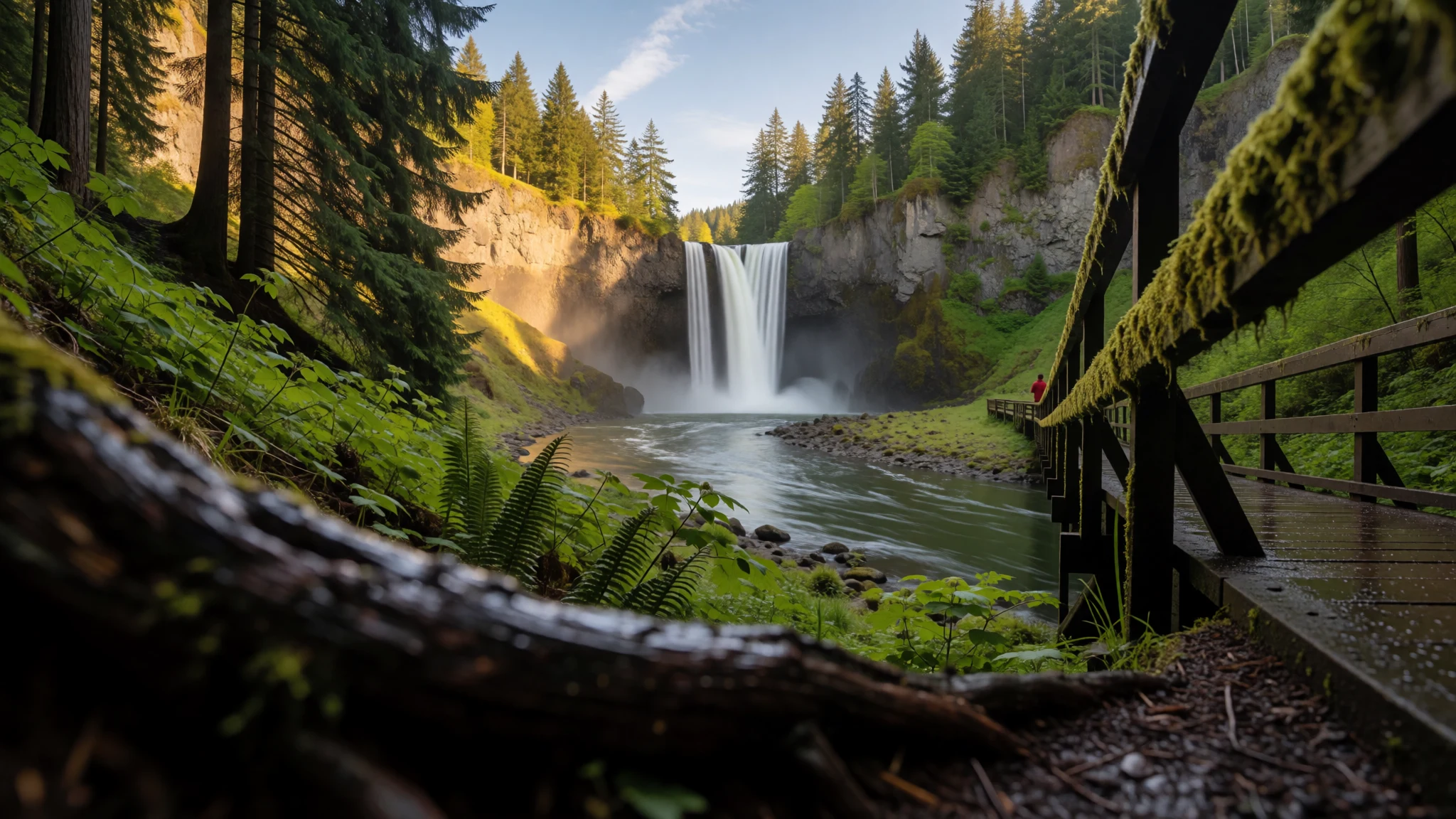
Snoqualmie Falls puts a tall, thundering waterfall within easy reach of Seattle, on land that matters deeply to the Snoqualmie People.
The place
Snoqualmie Falls is an 82 m drop on the Snoqualmie River, in Washington state, east of Seattle and between the small towns of Snoqualmie and Fall City. Its fame is part geography and part television: the falls appeared in Twin Peaks, and more than 1.5 million people visit in a year. The visitor ground is compact, a small park with an observation deck, a lodge with a spa and restaurant, and a gift shop, so busy days feel busy.
Whether the falls look thin or thunderous depends on weather and on plumbing. A large share of the river is routed into power plants, so an ordinary day brings only a partial flow over the edge. After heavy rain or snow followed by warm rain, though, the river can spill across the whole lip and the water hangs like a curtain, throwing up spray dense enough to dazzle and blind. The rainy season, November to March, is the likeliest time for that.
This is a managed landscape rather than a wild one, with a road, a lodge and a viewing platform close to the brink. That makes it easy for families, older visitors and anyone with a few spare hours from Seattle, and it also means the visit is short and shared. Most people stand at the deck, take their photographs and move on within a couple of hours.
For the Snoqualmie People, who have lived in the Snoqualmie Valley since time immemorial, the falls are central to culture, belief and spirituality. That changes how the place reads: it is a living sacred site that happens to have a car park, and the tribe now owns it.
Its story
Snoqualmie Falls has been part of Snoqualmie life far longer than any road or lodge, and its recent history is largely a contest over who controls the land around the water. A brochure from 1900 already carries cutaway drawings of a hydroelectric plant at the falls, so the river has been put to work for well over a century.
The modern ownership story begins in 2007, when the Muckleshoot tribe bought the Salish Lodge beside the falls. They later proposed a hotel, a conference centre and a block of new homes on the land above. Members of the Snoqualmie Indian Tribe objected, chiefly because the site lies close to burial grounds as well as to the falls themselves. In 2015 the tribe launched a campaign called Save Snoqualmie Falls. Even so, in October 2018 the Snoqualmie City Council approved the Muckleshoot scheme, which by then meant a hotel of 182 rooms and up to 210 homes.
The turn came at the end of October 2019, when the Snoqualmie Indian Tribe completed the purchase of the falls, the lodge and spa, the gift shop and a large parcel of land across State Route 202. The deal ended the Muckleshoot plans. Announced the next day, it was presented by the tribe as a way to take back traditional lands and curb careless building.
The lodge is still run by a Seattle hospitality company, Columbia Hospitality, so a visitor sees little change on the ground. What changed is who decides the future of a waterfall known far beyond Washington.
What to see
- The observation deck — Snoqualmie Falls Park
The main viewing platform faces the falls and gives the classic frontal view of the 82 m drop. It is the busiest spot in the park, so weekday mornings are calmer. When the river is high, spray drifts across the deck and lenses need wiping; in dry spells the flow looks visibly thinner.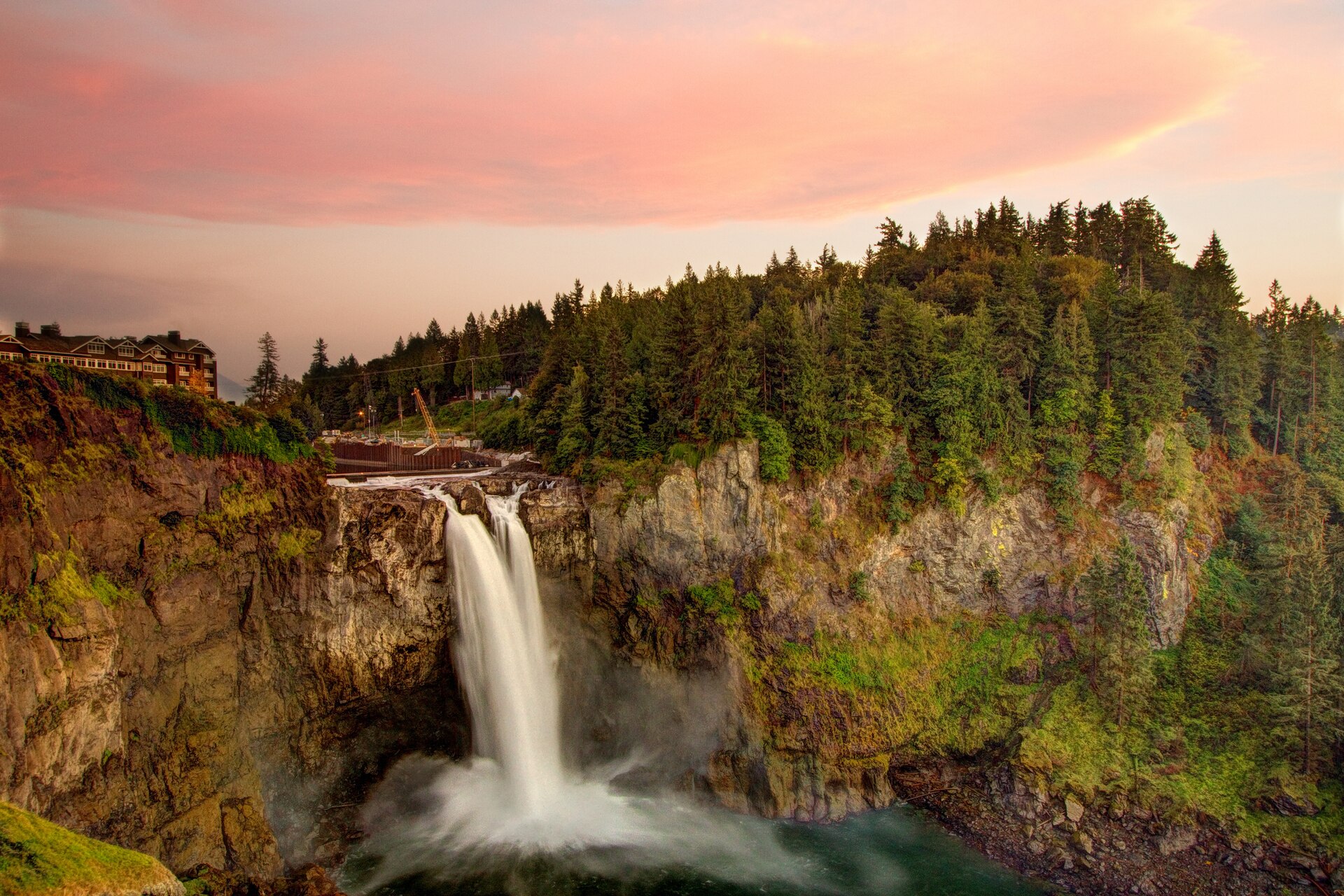
- The brink and upper river — Top of the falls
Paths through the small park lead towards the lip, where the river gathers itself before tipping over. Standing here shows how much water the power plants leave behind on a normal day. A photograph of the brink from 1890 shows the same ledge before any modern development.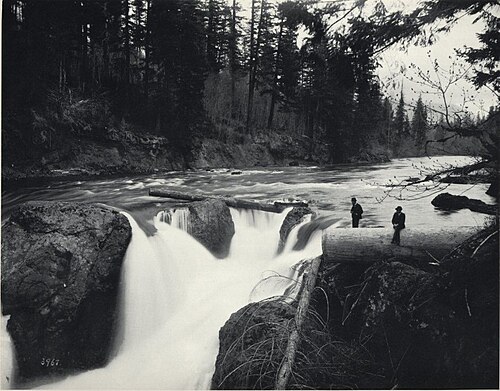
- The hydroelectric plant story — Beside and below the falls
Cutaway drawings from 1900 show generating machinery tucked into the rock beside the falls. It is a reminder that this is a working river: the diversion that thins the falls on dry days is the same one that has long supplied power. Check the official site for any tours or access.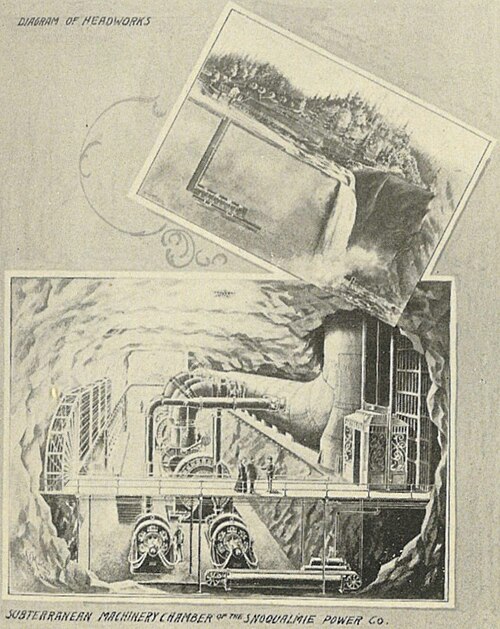
- Salish Lodge and Spa — Cliff top beside the falls
The lodge stands at the cliff top beside the falls and is owned by the Snoqualmie Indian Tribe, with Columbia Hospitality managing it. Visitors who want to linger can look at its restaurant and spa. Booking details change, so check the lodge's official site before planning around a meal. - Panoramic viewpoints — Park edge and viewing areas
A wide-angle view shows how the falls sit in a notch of wooded valley, with the river carrying on downstream. Walking the edges of the park gives different angles as the light and spray change. Mid-March photographs show the falls at full spring volume against bare trees.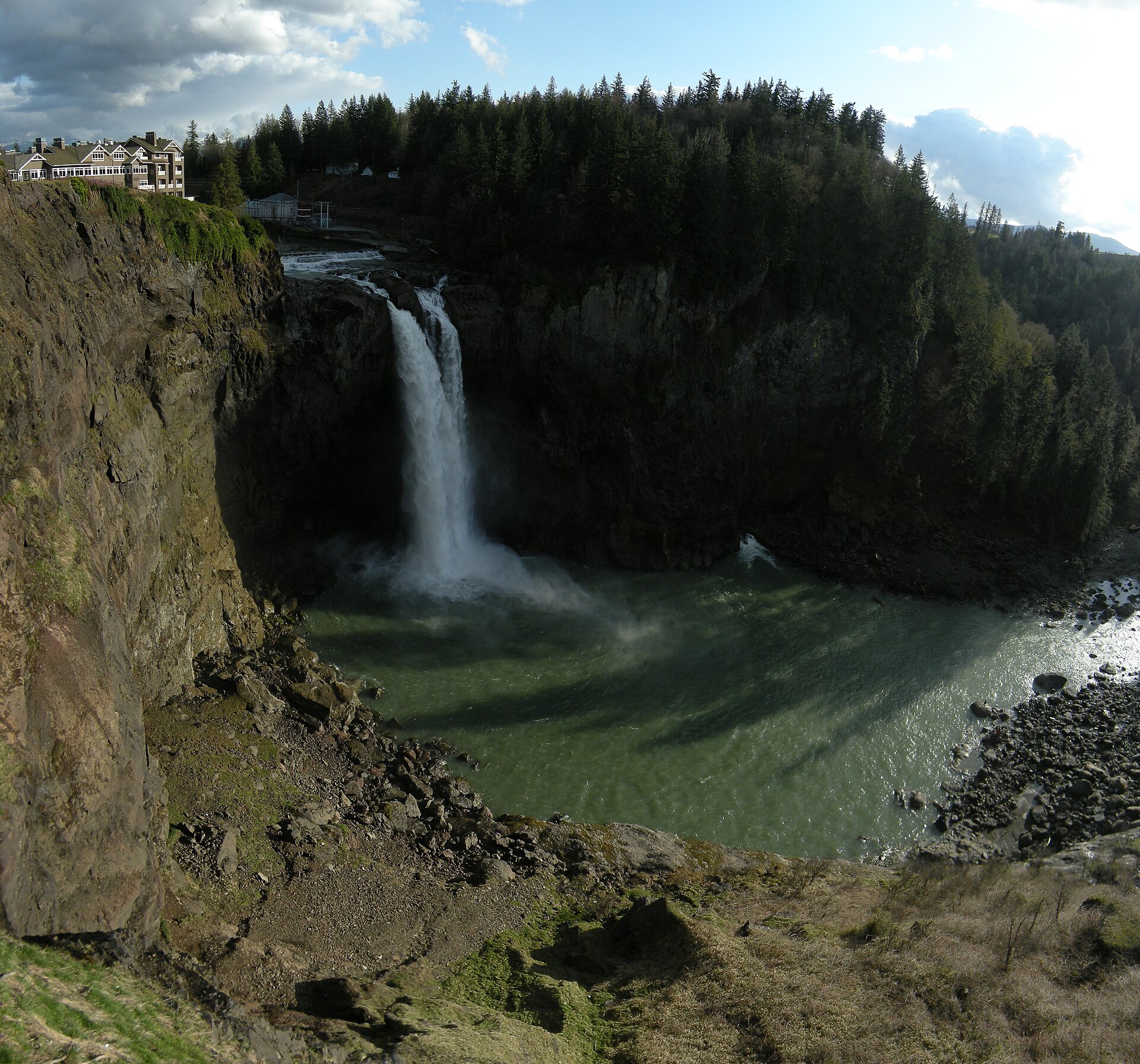
Culture
Snoqualmie Falls is first of all a place of the Snoqualmie People, for whom the falls are bound up with belief, identity and spirituality. Burial grounds lie close by, and the tribe's decision to buy the falls and the land around them in 2019 was framed as reclaiming something that was never really lost. Visitors arrive with other associations, especially Twin Peaks, and the two sit side by side: fans photograph the lodge and the water, while the tribe treats the same view as sacred.
Washington state has a strong public culture around keeping the landscape tidy. Roadside signs warn about littering, and fines for dropping rubbish from a car can be steep, so carrying a small bag for wrappers is sensible. On sunny summer days popular sites fill early, and parking lots can be full by mid-morning. Stopping outside designated areas is common, but it can lead to tickets or towing, so park only in marked spaces. Queues, whether for a car park or a ferry elsewhere in the state, are expected to be orderly, and cutting in is taken as rude rather than clever.
The park is small and everyone shares the same few viewpoints. People generally take their photographs and step aside for the next group. Because the falls are privately owned by the tribe, rules about access can change, and signs at the site are the best guide to what is open.
Treat the falls as a sacred site of the Snoqualmie People: keep to the paths and rails, take your litter with you, and keep your voice low at the viewpoints.
What to wear
Snoqualmie Falls sits in Coast Salish country, where traditional clothing was made from the materials of the forest and river. Woven cedar bark was used for capes, skirts and hats, which shed rain well, and Salish weavers also made blankets from wool, often with distinctive patterns. Today such regalia and weaving are mostly worn and shown at ceremonies, gatherings and cultural events rather than every day.
Everyday dress around Snoqualmie is practical and outdoorsy. Locals wear waterproof jackets, fleeces, jeans and sturdy trainers or boots, because rain is common and the weather can turn quickly. Brand-name outdoor gear is ordinary rather than a statement, and nobody dresses up for a trip to the falls. The lodge and spa may feel smarter, but there is no formal dress expectation for the park itself.
Visitors should plan for water and cool air by the falls, even on a warm day, since the spray makes the viewing area damp and chilly. A light waterproof layer is worth packing in any season, and the rainy months from November to March call for a proper rain jacket and a warm layer underneath. Shoes with a good grip are important, because the paths and platforms can be slick with mist, mud or fallen leaves. There is no religious dress code as at a temple, but the site is sacred to the tribe, so modest, practical clothing and a quiet manner suit it. Bring a hat for sun and a small cloth to keep camera lenses dry.
What to eat
- Smoked salmon — Delis and farmers' markets in Seattle and the valley towns
Salmon is the best-known food of the Pacific Northwest and part of local identity across communities. Smoked salmon is sold all year as a preserved speciality. Look for it in delis, farmers' markets and grocery stores in Seattle and the valley towns, often sliced or in chunks. - Fresh salmon, grilled or baked — Seafood restaurants around Snoqualmie and Seattle
When fresh salmon is in season, it is cooked simply, often grilled or baked on a board with a plain seasoning. Different salmon types arrive at different times of the year, so ask which is running. Any seafood-led restaurant in the area is a fair bet. - Dungeness crab — Waterfront eateries and fish counters near Puget Sound
Dungeness crab is prized for sweet, tender meat and a good amount of it in each shell. It is usually served cracked and cold or steaming with melted butter, and eaten with fingers and a bib. Look for it in coastal-style eateries and at fish counters around Puget Sound. - Oysters, clams and mussels — Oyster bars and seafood counters in Seattle
Washington's cool, clean waters are good for shellfish, and the state is a major producer of farmed clams, mussels and oysters. They appear raw on ice, steamed in broth or fried. Oyster bars in Seattle are the easiest place to try a few varieties side by side. - Geoduck — Specialist seafood restaurants and fishmongers in Seattle
Geoduck is a giant clam that appeals mostly to the adventurous. It is sliced thin and eaten raw or lightly cooked, with a crisp, sweet-briny taste. It is not on every menu, so ask at specialist seafood restaurants and fishmongers rather than expecting it everywhere.
Plan it
Best time. March to May and October are a good balance. The river is often fuller after winter rain and snow, and the falls can reach full curtain form when heavy rain and warm weather coincide, which is most likely in the rainy season from November to March. That season is also wet and cold, so spring and early autumn trade a little volume for easier standing around.
How long. 1
Getting there. Fly into Seattle-Tacoma International Airport (SEA), the region's main hub. From there it is a drive east of Seattle to the falls, between Snoqualmie and Fall City, by hire car or taxi. Check the official site for any shuttle or parking arrangements before travelling.
Budget. mid
Tips
- Go early on a weekday for the quietest views, as the small park fills up quickly on sunny weekends.
- Pack a waterproof layer even in summer, because spray and drizzle make the viewing area damp.
- Check recent weather before you set off: heavy rain followed by warm rain gives the most dramatic flow.
- Park in designated spaces only, as cars left elsewhere can be ticketed or towed.
- Check the official site for current access, trails, lodge and restaurant details rather than relying on older guides.
Etiquette
- Remember that the falls are a sacred place for the Snoqualmie People and keep voices low.
- Stay behind rails and on paths, and take all litter with you.
- Leave viewpoints free for others once you have your photograph.
Nearby
Sources
- Wikidata Q7548048 (CC0)
- Wikipedia: Snoqualmie Falls (rev 1383239195) (CC BY-SA 4.0)
- Wikivoyage: Washington (state) (rev 5400128) (CC BY-SA 4.0)
- Snoqualmie Falls — Meher Anand Kasam (CC BY 3.0)
- Physical location map of Washington, USA — Carport (CC BY 3.0)
- Relief location map of the USA — Uwe Dedering (CC BY 3.0)
- Snoqualmie power plant cutaway, 1900 (Public domain)
- Brink of Snoqualmie Falls, Spring 1890 — Frank Jay Haynes (Public domain)
- Panoramic view of Snoqualmie Falls — Joe Mabel (CC BY 3.0)
- Snoqualmie Falls, 2008 — brewbooks (CC BY-SA 2.0)
- Snoqualmie falls in mid-March — Travisl (Public domain)


