Natchez
Natchez, United States
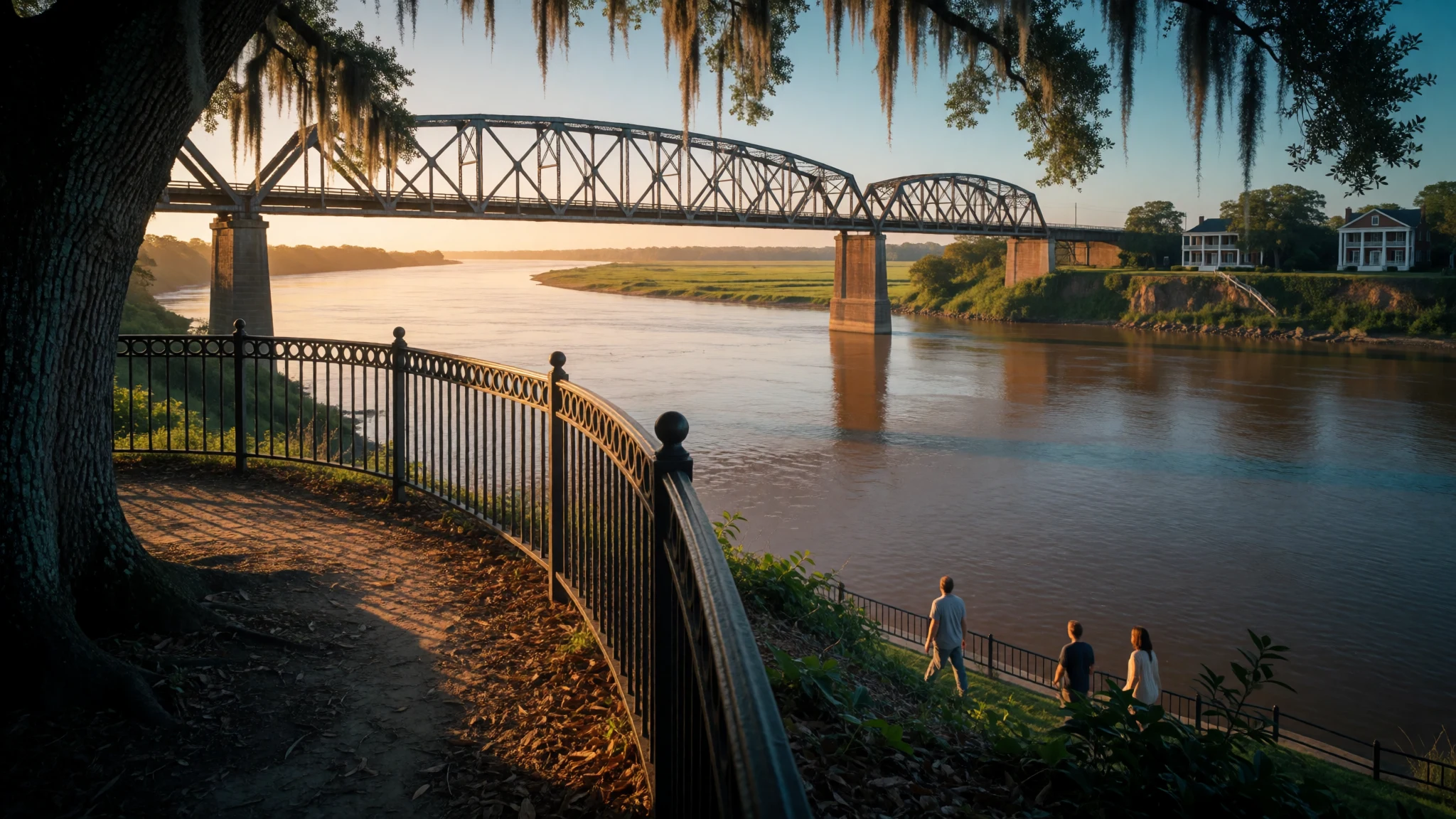
Natchez is a quiet Mississippi river town of columned houses, a bluff above the water and a long, layered history.
The place
Natchez is a small Mississippi river town of a little under fifteen thousand people, set on a bluff about 66 m above sea level on the east bank of the Mississippi. Across the water lies Vidalia, in Louisiana, and the road bridge between them is where the main visitor centre stands. Natchez is the county seat of Adams County and the only city in it. The town grew rich before the American Civil War as a base for cotton planters and river trade, and that wealth still shows in streets of brick houses with tall columns, some of them private homes and some open for tours. The ground shapes the town. The bluff is cut by ravines and natural drains that locals call bayous, so Natchez spreads in pockets rather than a tidy grid. Below the bluff, the riverfront known as 'under the hill' was once the rowdy landing, and it now holds a few restaurants with views of the water. Jackson, the state capital, lies north-east and Baton Rouge lies south, each a couple of hours away by road. The town takes its name from the Natchez people, who lived in this region long before European settlers arrived. The climate is humid subtropical, with long, hot, sticky summers, mild winters and rain through much of the year. The historic centre is easy to walk, but a car helps for houses on the edge of town and for the Natchez Trace Parkway, which starts here. Outside festival weeks the streets are quiet and the pace is slow, which suits unhurried wandering.
Its story
Natchez began in 1716 as a French settlement on the bluff, on land the Natchez people had long called home. French control ended after the Seven Years' War, when the Treaty of Paris of 1763 passed the territory to Britain. The Crown rewarded army officers with land, and veterans mostly from New York, New Jersey and Pennsylvania set up plantations and brought an upper-class way of life with them. Spanish forces took the town in 1779. By 1783, Britain recognised American independence, but Spain, which was not a signatory to the treaty, was unwilling to surrender territories it claimed as a result of conflict. The matter was settled in 1797, when an American officer, Andrew Ellicott, camped on the high ground and raised the United States flag. Natchez then served as capital of the Mississippi Territory and later of the state, until Jackson, being more central, took over in 1822. Through all of this the bluff position mattered, because Native American, European and African peoples met and traded here for two centuries. The cotton fortunes that built the grand houses rested on enslaved labour, and that is worth keeping in mind on any house tour. Natchez was also the southern end of the Natchez Trace, the overland route that ran north to Nashville, in Tennessee.
What to see
- Longwood — Edge of Natchez
Longwood is an eight-sided mansion on the edge of town, begun in 1860 as the Civil War approached. Its domed top and unusual plan are rare in the United States. The interior was never finished, so the visit is partly a walk through an ambitious project that stopped. Check the official site for tour times. - Pilgrimage house tours — Historic centre
The Natchez Pilgrimage opens private houses to visitors in spring, during March and April, and again for a shorter run in autumn. Several houses, including Auburn, Melrose, Monmouth and Magnolia Hall, also take visitors through the year. Each guide has a different tone, so two or three houses in a day is plenty. - Emerald Mound — North-east of Natchez
Emerald Mound is a ceremonial earthwork built by the Natchez people, a short drive north-east of the town. It is a broad, flat-topped hill of grass with a path to the summit. Few people come, so it is quiet, and it gives the region's older history a physical shape that the mansions do not. - Natchez Trace Parkway — Southern end, just outside town
The Natchez Trace Parkway begins at Natchez and runs towards Nashville along an old route that started as a trail and was improved by the national government in the early nineteenth century. Low speed limits and no heavy lorries make for a calm drive. Even a short stretch gives a sense of the surrounding forest. - Under the hill — Riverfront below the bluff
The riverfront below the bluff, known as under the hill, is where Natchez once met the river traffic. Today it has a handful of restaurants and bars, some with glassed-in porches facing the water. Walk down, watch the river slide past, and climb back up before dark if the heat is heavy.
Culture
Natchez has a layered culture shaped by Native American, French, British, Spanish, African and American histories, and the mix shows in its music, its food and the stories locals tell. The most visible tradition is the house-museum culture. Owners open their homes during the Pilgrimage, and a large cast of local performers stages the Historic Natchez Pageant, also called the Tableaux, in elaborate costume, retelling the town's past in a romanticised way. It is best taken as theatre, and read alongside the harder history of cotton and slavery that paid for the houses. Beyond the pageant weeks, everyday life is local and low-key, built around churches, porches, family meals and conversation. The Great Mississippi River Balloon Race, held on the third weekend of October, fills the sky above the river with colour, and a food and wine festival gathers cooks and drinkers for a weekend. Manners are unhurried and friendly. People greet strangers, hold doors and expect a reply, so a short chat is part of any transaction. Restaurant staff rely on tips, and leaving one is customary. History is a living subject here, and residents tend to be willing to talk about it if asked politely. When touring a private home, ask the guide before taking photographs inside and keep hands off furniture and textiles.
What to wear
Natchez has no single traditional costume. The dress most linked with the town is the antebellum gown of the cotton planters' families, with a hooped skirt over petticoats, made up in silk, cotton and lace. It is worn today mainly by performers in the Historic Natchez Pageant and by guides in some houses during Pilgrimage weeks. Everyday clothing is casual and shaped by the heat. Residents wear cotton T-shirts, shorts and sundresses through the long summer, and jeans with a light jacket in the mild winter. Church on Sunday brings out smarter clothes, and festival weekends bring hats and linen. Visitors should pack light, breathable cotton or linen, a sun hat and sunscreen, with a thin layer for air-conditioned houses and restaurants. Comfortable flat shoes suit the uneven pavements, the slopes down to the river and the polished floors of historic houses, where heels can mark old boards. Bring a rain jacket or small umbrella, since showers can arrive in any season. No formal dress code applies in the town, though covered shoulders and knees are courteous in churches and at funerals or services.
What to eat
- Tamales — Small casual restaurants in the town centre
Natchez has a long local habit of tamales, cornmeal parcels with a spiced filling, often served with chili on the side. They make a cheap, filling lunch before an afternoon of house tours. Ask locals which small place they prefer. - Gringo Pie — Casual tamale restaurants in town
Gringo Pie is a local invention of tamales covered in chili and melted cheese, rich and filling. Order it at the informal tamale restaurants and share a plate if the day is hot, since portions are generous. - Boudin — Casual local restaurants and bars
Boudin is a Cajun sausage of pork, rice and seasoning, found on menus here as a nod to Louisiana across the river. Try it as a starter or snack at informal eateries, often with mustard or hot sauce. - Muscadine wine — A local winery, plus food and wine festival weekends
Muscadine is a thick-skinned Southern grape used to make sweet red, rosé and white wines. Natchez has a winery with several varieties to taste, and the local food and wine festival is another good chance. Check the winery's site for tour times. - Sandwiches and home-baked desserts — Lunch-only cafés in the historic centre
Several lunch cafés in the historic centre serve sandwiches and home-baked cakes and pies, and one occupies a building in a playful novelty shape. They are useful midday stops between house tours, and busy at weekends. - Pasta dinners — Small restaurants on the streets south of Main Street
Pasta is a dependable dinner in the old centre, served in small Italian-style restaurants a few streets south of Main Street. It makes a change from fried and Cajun food, and portions are generous.
Plan it
Best time. March–April and October–November. Spring and autumn are milder, and the house tours and the October balloon race fall then. Summers are hot, humid and sticky, and winters are mild.
How long. 2–3
Getting there. Natchez has no major airport, so most visitors fly into Jackson, in Mississippi, or Baton Rouge or New Orleans, in Louisiana, and drive for a couple of hours on US highways. The Natchez Trace Parkway ends here for anyone driving from Nashville. The last leg is by road into the historic centre, and a car is useful once there.
Budget. mid
Tips
- Book rooms and house tours early for the Pilgrimage weeks and the balloon race weekend
- In summer, tour the houses in the morning and rest in the heat of the afternoon
- Carry some cash as well as a card, since small cafés and festival stalls can be cash-friendly
- Check the official site, natchez.ms.us, or the visitor centre for tour times and events
- Drink plenty of water, and keep a rain layer in your bag
Etiquette
- Ask before photographing inside private houses and keep hands off furniture
- Greet people when you meet them, as it is part of everyday manners
- Treat the pageant and tours as theatre and approach the town's history with respect
Nearby
Sources
- Wikidata Q944044 (CC0)
- Wikipedia: Natchez, Mississippi (rev 1377784431) (CC BY-SA 4.0)
- Wikivoyage: Natchez (rev 5412334) (CC BY-SA 4.0)
- Natchez, MS, Convention Center — Billy Hathorn, via Wikimedia Commons (CC BY 3.0)
- Steamboat Natchez at New Orleans, 1998 — Fred Miller, via Wikimedia Commons (CC BY-SA 2.0)
- Katherine Lintot Minor, the Yellow Duchess of Natchez — Unknown painter, via Wikimedia Commons (Public domain)


