Leavenworth
Leavenworth, United States
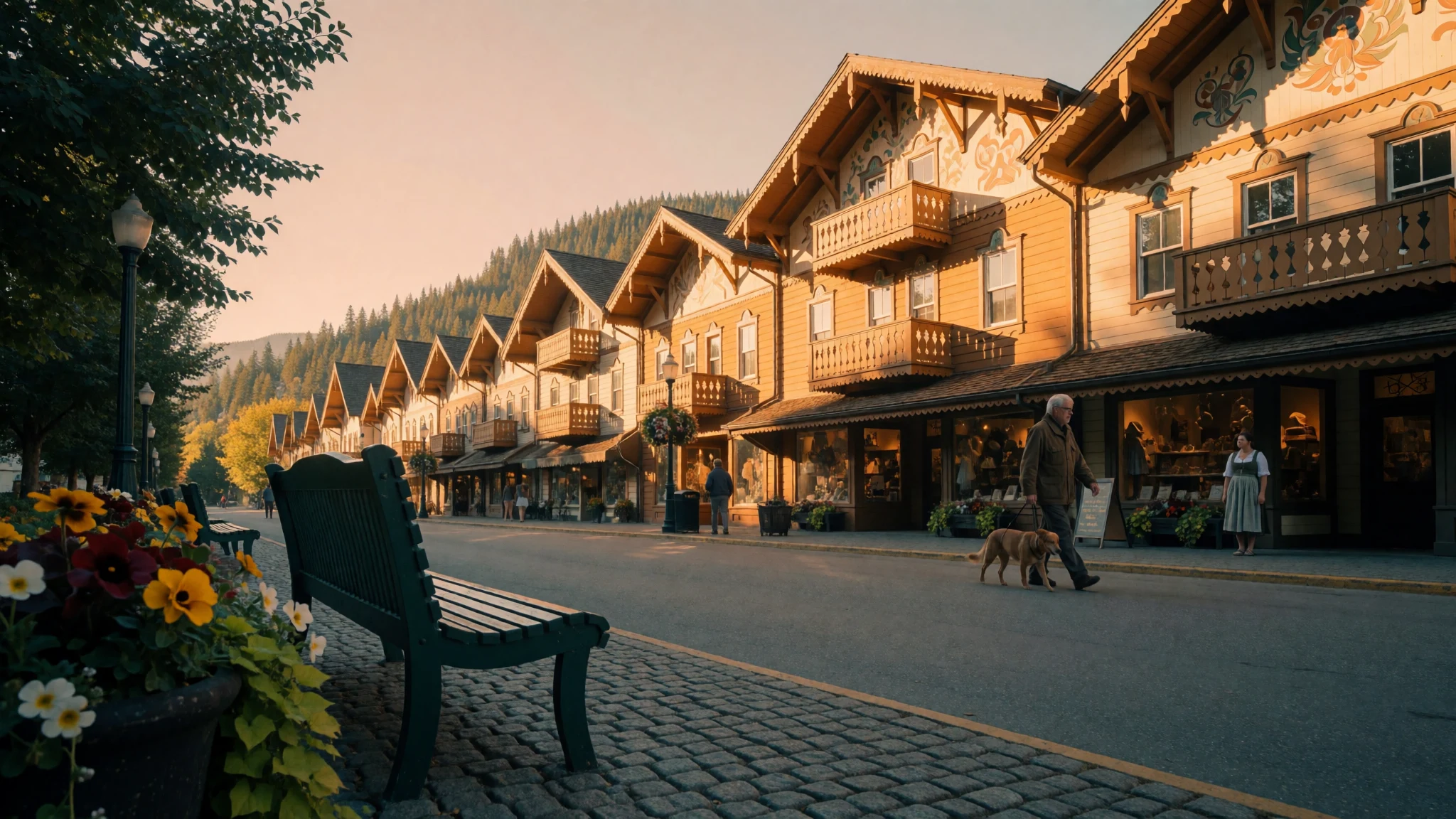
Leavenworth is a small mountain town that rebuilt itself as a Bavarian village, set between river, creek and high Cascade ridges.
The place
Leavenworth is a small city in Chelan County, Washington, home to 2263 people and best known for a town centre styled as a Bavarian village. It lies at 357 metres above sea level on the eastern side of the Cascade Mountains, ringed by high ridges, along the Wenatchee River near the point where Icicle Creek flows in. That setting does much of the work: forested slopes, snow on the tops in winter, and a river running right past the edge of town. The Alpine theme is a civic project rather than an inheritance. It began in the 1960s and now covers shopfronts, lettering, balconies and painted gables along the central streets. Beyond the main blocks the town is more ordinary and American in scale, with wide roads and plenty of parking. Leavenworth sits within the Wenatchee–East Wenatchee metro area and connects to the Seattle region via the Stevens Pass Highway, the same road that brings visitors to the Stevens Pass ski area. That road makes it an easy weekend escape from the coast, so crowds build on weekends and holidays and the central blocks can feel busy and loud. Weekdays and early mornings are calmer. Geologically the district belongs to the North Cascades collage, a patchwork of rock fragments added to the continent during the Cretaceous period, some carrying marine fossils that hint at island origins far to the south. Anyone wanting more than souvenirs and sausages will find it on the river paths, along the creek and in the surrounding hills.
Its story
Leavenworth stands within the traditional territories of the Wenatchi and Yakama peoples, who kept villages along both the Wenatchee River and Icicle Creek and gathered camas and other roots around the meeting of the waters. Both peoples were signatories to the Treaty of Walla Walla in 1855, which promised the Wenatchi a reservation around a fishery at the confluence. The federal government never surveyed it. In the early twentieth century most Wenatchi moved to the Colville and Yakama reservations, although a few families stayed around Leavenworth and nearby Cashmere. Settlers of European descent came later. John Emig and Nicholas Kinscherf staked homestead claims near Icicle Creek in 1885, the year given as the town's founding, and in 1891 other settlers formed a community called Icicle Flats on the south bank of the river. The surveyor Albert Hale Sylvester linked the Icicle name to Nasikelt, which he understood as a native word for a tight gorge. The Bavarian identity is far newer than any of this. It took shape from the 1960s, encouraged by the example of Solvang in California. By the 1990s the enthusiasm had faded, and annual events, among them an Oktoberfest begun in 1998, brought it back. The Washington town of Winthrop later borrowed the idea and adopted a Western theme.
What to see
- Front Street Park — Town centre
Front Street Park is the green heart of Leavenworth and the natural place to pause between shops. Benches and open lawn sit right beside the timbered facades, which makes it a good spot to watch the town at work, and to see how the Alpine styling looks in daylight. It fills up during festivals.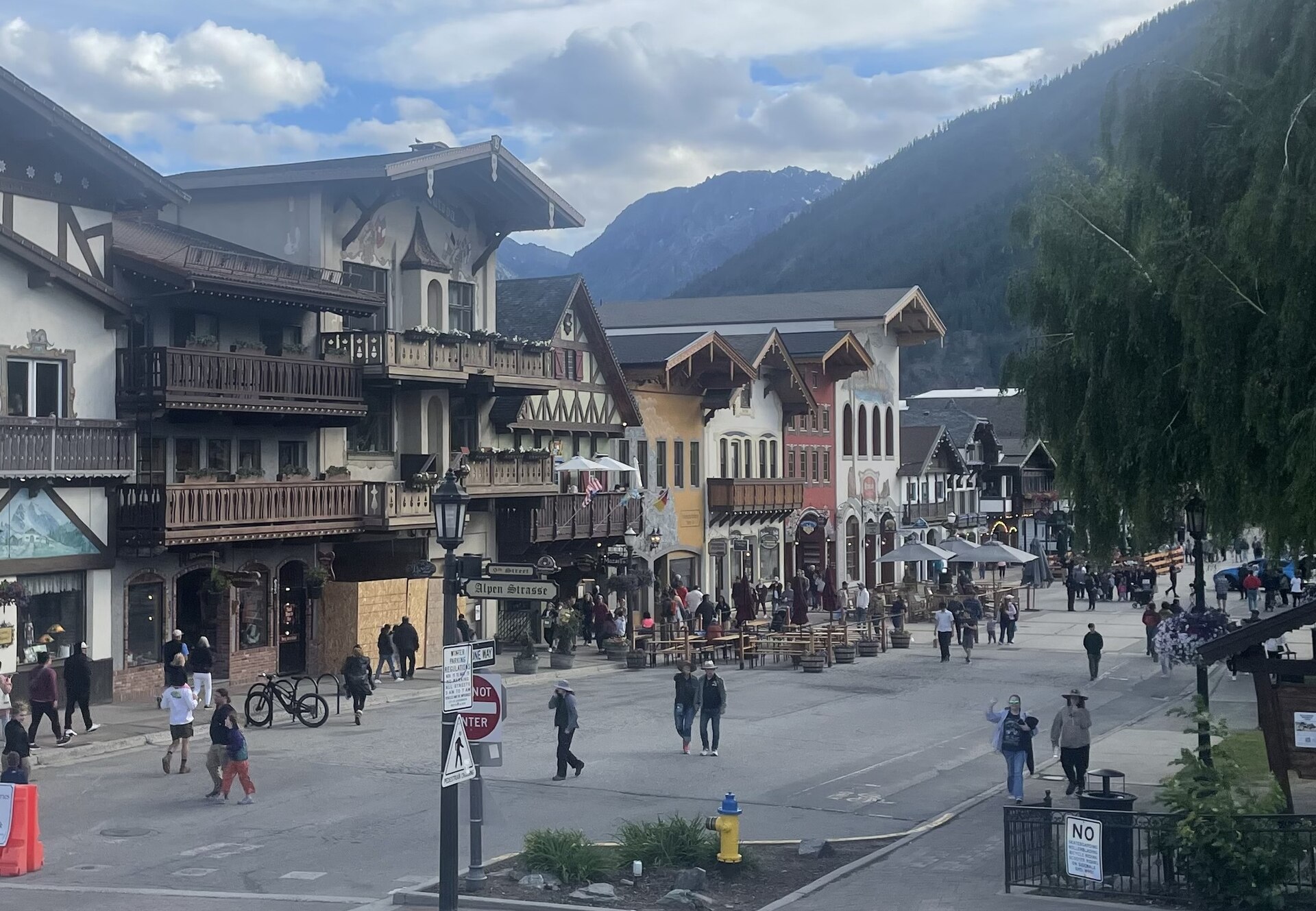
- Nutcracker Museum — Town centre
The Nutcracker Museum is small, but it packs in a huge collection of nutcrackers, from plain working tools of great age to modern figures drawn from films. It suits a wet afternoon or a break from the street crowds, and it fits the town's love of German-style craft. Check the official site for opening times. - Waterfront Park — Riverside, edge of town centre
Waterfront Park offers a quick way out of the Bavarian stage set and into the valley itself. Paths follow the Wenatchee River just beyond the main streets, so a walk here brings you to water, trees and mountain views within minutes. It is calmer than the centre, especially early in the day. - Leavenworth Summer Theatre — West of the town centre
The Leavenworth Summer Theatre stages shows outdoors beneath the mountains, and The Sound of Music is its regular offering, which suits the Alpine setting. Other productions rotate through the season. Performances can sell out, so look at the official listings and book ahead if a particular evening matters. - Leavenworth Reindeer Farm — Just north-east of the town centre
The Leavenworth Reindeer Farm is a family stop where staff explain how the animals are kept, followed by a hands-on visit to the stable. It is aimed at children, and most appealing around the winter festive season, though seasonal refreshments are part of the experience. Booking is sensible; check the farm's own channels.
Culture
Leavenworth is a town that chose its own culture, and the choice is the story. From the 1960s the centre was redesigned along Alpine German lines, with most buildings modelled on Bavarian settlements and shopfronts using stereotypical lettering and names. A design review board approves plans for every new business, including national chains, which is why fast-food outlets and other retailers end up with unusual, gabled looks. Visitors who know Bavaria will notice the differences quickly: the streets are wide and the car parks are large, neither of which is typical of an Alpine village. The enthusiasm for the theme faded by the 1990s and was revived through annual events, including an Oktoberfest begun in 1998. Seasonal festivals now shape the town's calendar, and with them the crowds, the music and the beer tents. It helps to see Leavenworth as a piece of civic theatre, enjoyed with affection by residents and visitors alike, rather than an authentic German settlement. Under it sits an older story, because this is Wenatchi and Yakama country, and the tribes' history is worth seeking out through their own communities and published sources. Be considerate of residents, who live here all year, by keeping noise down in the evening and staying off private property when taking photographs of the Alpine-style buildings.
What to wear
Leavenworth's traditional dress is borrowed, and openly so. The Bavarian costume, known as Tracht, includes the dirndl, a fitted bodice and full skirt in cotton or linen worn over a blouse with an apron, and lederhosen, hard-wearing leather breeches with embroidered braces, often paired with checked shirts and loden, a dense felted wool used for jackets and hats. Many people put these on for Oktoberfest and other festivals, while Wenatchi and Yakama dress and regalia belong to the region's own peoples and are worn at community and ceremonial occasions, so it is best learnt about from tribal sources and not treated as costume. In daily life, residents and weekend visitors alike wear practical outdoor clothing: fleeces, jeans, waterproof shells, caps and hiking boots, with a little more polish for dinner or a show. A visitor needs no special dress code, as there are no religious sites with modesty rules here. Pack layers, because mountain mornings and evenings are cooler than the afternoons, and winter brings snow and ice that call for warm coats, hats, gloves and boots with a good grip. In summer bring a sun hat, sunscreen and comfortable walking shoes for the river paths and trails. Costume is welcome at festivals if you want to join in, but nobody expects it.
What to eat
- Bavarian sausages — Beer gardens and sausage halls in the town centre
Bratwurst and similar sausages are the town's signature plate, usually served with mustard, sauerkraut and a beer. The Alpine-style beer gardens near the centre are the natural place to eat them, and tables fill quickly on festival weekends. - Gingerbread — The gingerbread café near Front Street
Gingerbread and other spiced biscuits are a local sweet, sold from a café built to look like something from a fairy tale. They travel well, so many visitors buy a bag to take away with a hot coffee. - Soft pretzels — Beer halls, bakery counters and festival stalls
Large soft pretzels, salty outside and chewy within, appear at beer halls, festival stalls and bakeries, usually alongside mustard. They are an easy, cheap way to soak up a beer and a good snack for walking the streets. - Pita and light meals — A casual café on the western side of the centre
For a lighter or meat-free meal, a casual café serves American-style pitas, pastries and breakfast until late morning. It is known locally for gluten-free and vegetarian options, which are not always easy to find in a sausage town. - Orchard fruit — Roadside fruit stands along the valley roads
Apples, pears and other fruit grow in the valleys of this part of Washington, and roadside stands sell them fresh in season. Buy them on the drive in or out, since the town itself is tuned more to sausage and sweets than to fruit.
Plan it
Best time. May–June and September–October are the most comfortable months for walking, with the river valley at its most pleasant and festival season, including Oktoberfest, in autumn. Winter brings snow, a festive atmosphere and the Stevens Pass ski area nearby, but mountain roads can be icy. Weekends in any season are the busiest.
How long. 2–3
Getting there. The nearest commercial airport is Pangborn Memorial in Wenatchee, about forty minutes east by road, with Alaska Airlines flights from Seattle. Seattle–Tacoma International is about three hours away over the Cascades and has far more connections. By road, the Stevens Pass Highway runs through town from Seattle. Amtrak's Empire Builder also serves Leavenworth.
Budget. mid
Tips
- Book accommodation well ahead for festival weekends and school holidays, and check the official site, cityofleavenworth.com, for event dates.
- Visit on a weekday or early in the morning to see the town without the crowds.
- In winter, check road and pass conditions before driving over the Cascades, and carry warm clothing.
- Cards are widely accepted in town, but keep a little cash for stalls and small stands.
- Book outdoor theatre and the reindeer farm in advance, as popular dates can sell out.
Etiquette
- Keep noise down in the evening, as people live in the streets around the centre.
- Stay on marked paths along the river and creek, and take litter away with you.
- Ask before photographing people in costume or private property.
Nearby
Sources
- Wikidata Q1025813 (CC0)
- Wikipedia: Leavenworth, Washington (rev 1381232806) (CC BY-SA 4.0)
- Wikivoyage: Leavenworth (Washington) (rev 5409165) (CC BY-SA 4.0)
- Main street in Leavenworth, Washington — Roc0ast3r (CC0 1.0)
- Physical location map of Washington, USA — Carport (CC BY 3.0)
- Relief location map of the USA — Uwe Dedering (CC BY 3.0)
- Bavarian Ritz Hotel (Leavenworth, WA) — Steven Pavlov (CC BY 3.0)
- Leavenworth from above — Farwestern (CC BY 3.0)
- 9th Street (Alpen Strasse) in Leavenworth, Washington — SounderBruce (CC BY-SA 4.0)
- Link Transit bus in Leavenworth, WA — SounderBruce (CC BY-SA 4.0)
- Field of Platanthera dilatata, Esmerelda Basin — brewbooks (CC BY-SA 2.0)


