Lamayuru Monastery
Lamayuru Monastery, India
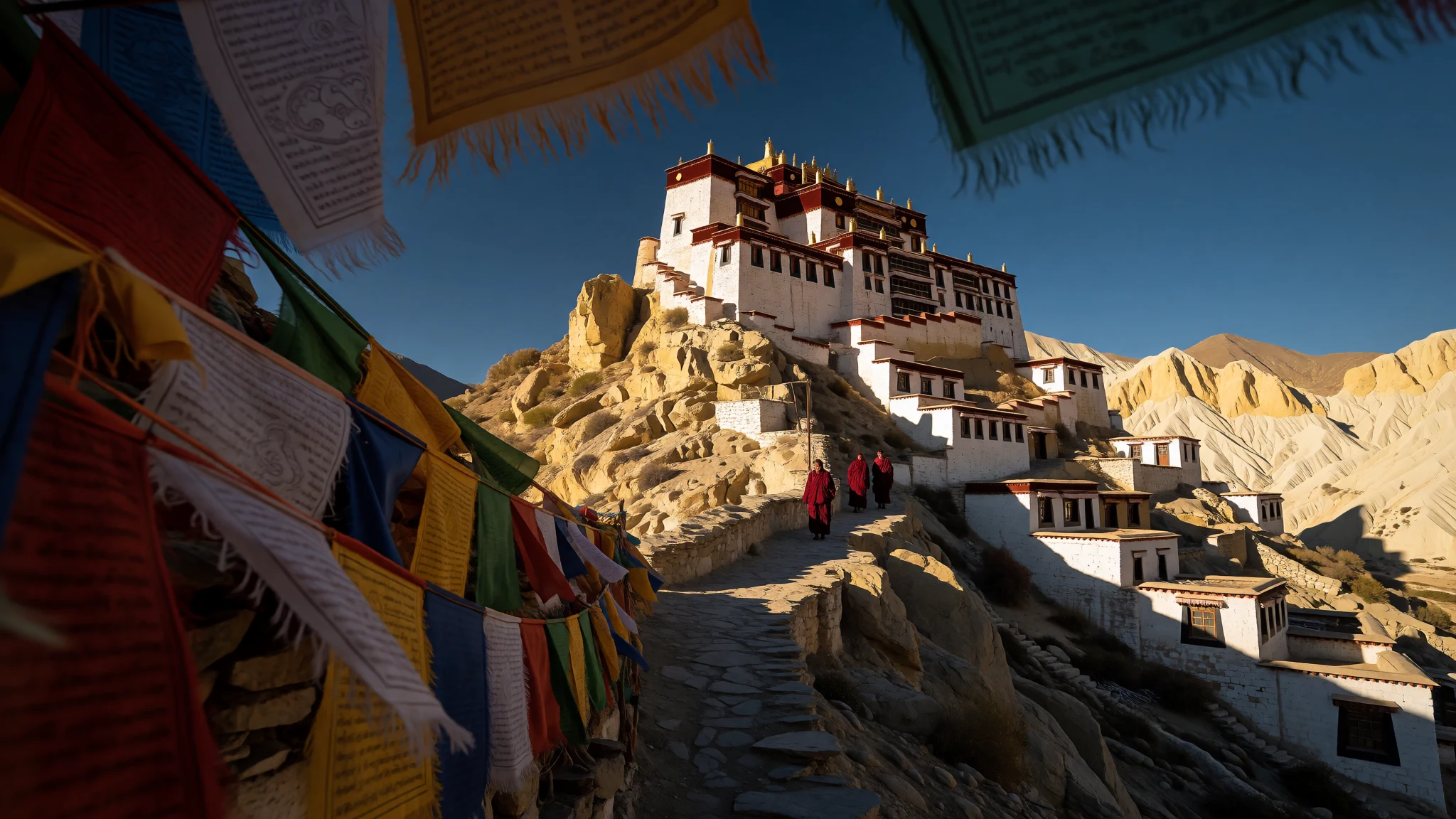
Visit Lamayuru Monastery for its striking lunar landscapes and ancient caves carved into the high Himalayan rock.
The place
Lamayuru Monastery is a striking Tibetan Buddhist complex perched high in the Leh district of Ladakh. It is often called the Eternal Monastery, situated in a landscape so stark and pale that it resembles the surface of the moon. The monastery is built around a series of natural caves, which have served as sanctuaries for meditating monks for centuries. One of the most significant areas is the meditation cave associated with the Mahasiddha Naropa, which remains preserved within the central hall today.
Located along the main highway between Srinagar and Leh, the site sits at a staggering altitude. The air is thin and crisp, and the silence is only broken by the flutter of prayer flags. Because of the extreme height, the sun feels intense even when the temperature is low, and the light makes the surrounding white rock glow with an otherworldly quality. Visitors will find the site peaceful, though it can attract crowds during the peak summer months when the mountain passes are open. It is a place where the architecture seems to grow organically out of the cliffside, blending spiritual purpose with the raw, barren beauty of the high desert.
Its story
The origins of Lamayuru Monastery are steeped in a mix of geological wonder and spiritual legend. Local tradition suggests that the site was originally a centre for the Bon religion, an ancient belief system that predates Buddhism in the region. The name itself carries a connection to the swastika, a symbol of eternity central to Bon culture. Over time, the monastery transitioned to Buddhist affiliation and is now linked with the Drikung Kagyu school.
Legends say that the Indian scholar Naropa used his spiritual powers to dry up a vast lake that once filled the valley, creating the flat expanse we see today and establishing the monastery. The physical history of the site is tied to the influential monk Rinchen Zangpo, who was commissioned by the King of Ladakh to establish numerous gompas across the region. The temple known as Seng-ge-sgang is believed to be one of the oldest surviving structures from this era. Throughout the centuries, the monastery has seen various schools of Tibetan Buddhism pass through its halls, including the Ka-dam-pa and later the Ge-lugs-pa, reflecting the shifting religious tides of the high plateau.
What to see
- Seng-ge-sgang Temple — Lamayuru Monastery complex
Located at the southern end of the monastery rock, this is one of the oldest surviving buildings at Lamayuru Monastery. It is attributed to the builder-monk Rinchen Zangpo and serves as a testament to the early architectural style of the region's first gompas. - Chenrezi Lhakhang — Lamayuru Monastery complex
This sacred hall houses a significant statue of Avalokiteśvara, the bodhisattva of compassion. The interior is filled with traditional Tibetan art and serves as a focal point for both monks and visitors seeking spiritual reflection within the monastery's walls. - The Moonscape Valley — Lamayuru village outskirts
Surrounding Lamayuru Monastery is a unique geological formation of weathered rock and pale deposits. The landscape looks remarkably like the lunar surface, providing a stark, beautiful backdrop that makes the monastery appear to float above a prehistoric sea. - Naropa's Meditation Cave — Lamayuru Monastery central hall
Preserved within the central hall of Lamayuru Monastery, these natural caves were once used by the Indian Buddhist Mahasiddha Naropa. They represent the deep connection between the monastery's physical geography and its history of ascetic meditation and scholarship. - Village Chortens — Lamayuru village
The white Buddhist stupas, or chortens, scattered around the village of Lamayuru and the monastery entrance are sites of daily devotion. They mark the spiritual boundary of the settlement and are traditional spots for walking meditation and prayer.
Culture
The culture surrounding Lamayuru Monastery is deeply rooted in the unique identity of the Ladakhi people. While they share linguistic and religious ties with Tibet, they are a distinct ethnic group. It is important to recognise that Ladakhis are not Kashmiris; the two groups have different histories and ethnic backgrounds, and referring to a Ladakhi as a Kashmiri can be seen as offensive. The social structure here is notably egalitarian, with women often holding visible roles in commerce and daily public life.
Religion is the heartbeat of the community, and the monastery is not just a tourist site but a living centre of faith. Life moves slowly, governed by the rhythms of the seasons and the calls of the monastery horns. Visitors are encouraged to be humble and quiet, acknowledging the sanctity of the space. When visiting religious sites, always walk around the monastery and its shrines in a clockwise direction. Please remember to remove your hat, refrain from smoking, and avoid touching the ancient frescoes inside the temples.
What to wear
At Lamayuru Monastery, traditional dress is defined by the Goncha, a thick, heavy robe made of wool that protects against the biting Himalayan cold. These are often belted at the waist and worn over long tunics. Textiles are typically hand-woven and durable, featuring muted earth tones or deep reds and maroons for those in religious orders. In modern times, many locals blend these traditions with practical contemporary wear, such as fleece jackets, trekking trousers, and sturdy boots, which are essential for the rocky terrain.
For visitors, the priority is layering. The high altitude means temperatures can drop sharply even in summer, and the sun is incredibly piercing. A windproof jacket and warm woollens are essential. When entering the monastery, modesty is key; ensure shoulders and knees are covered. Sturdy, closed-toe walking shoes are a requirement for navigating the steep, uneven paths around the complex, though you should be prepared to remove them before entering the inner sanctums of the temples.
What to eat
- Momos — Village eateries
These steamed dumplings are a local favourite, filled with vegetables or minced meat and served with a pungent, spicy chutney. You can find them at small eateries throughout Lamayuru village. - Thukpa — Local restaurants
A hearty noodle soup that serves as a staple for Ladakhis, containing pieces of mutton and boiled vegetables. It is usually served with a flavourful side chutney in local restaurants. - Skyu — Home-stays
A traditional, heavy pasta dish made with thumb-sized pieces of dough and root vegetables, slow-cooked into a thick stew. This is a comforting meal found in home-stays and local kitchens. - Ladakhi Pulao — Local restaurants
A rich rice dish cooked with mutton stock and seasoned with aromatic spices, then layered with caramelized onions, nuts, and carrots. This is typically served in established restaurants. - Tsampa — Local markets
Roasted barley flour that is often mixed with salt tea and hard cheese. It is a dense, nutritious food frequently used by trekkers and locals for quick energy. - Tigmo — Village cafes
A soft, steamed bread served alongside a flavourful vegetable stew. This combination is a common breakfast or snack found in small village cafes around the monastery.
Plan it
Best time. May–June and September–October are ideal; the mountain passes are open and temperatures are mild. Winter is extremely cold and some roads may be blocked.
How long. 1–2
Getting there. Fly into Leh's Kushok Bakula Rimpochee Airport, then hire a taxi or motorbike for the drive southwest to Lamayuru.
Budget. mid
Tips
- Spend at least 48 hours in Leh to acclimatise before heading to the monastery
- Carry plenty of bottled water to help with altitude sickness
- Bring a high-SPF sunscreen and sunglasses for the intense high-altitude glare
- Keep cash handy as ATMs are rare outside of Leh
- Check for permit requirements if you plan to visit other remote border areas
Etiquette
- Walk clockwise around all stupas and temples
- Do not touch the murals or frescoes inside the monastery
- Remove your hat and shoes before entering the prayer halls
Nearby
Sources
- Wikidata Q2556336 (CC0)
- Wikipedia (CC BY-SA 4.0)
- Wikivoyage (CC BY-SA 4.0)