Lagoa Amélia
Lagoa Amélia, São Tomé and Príncipe
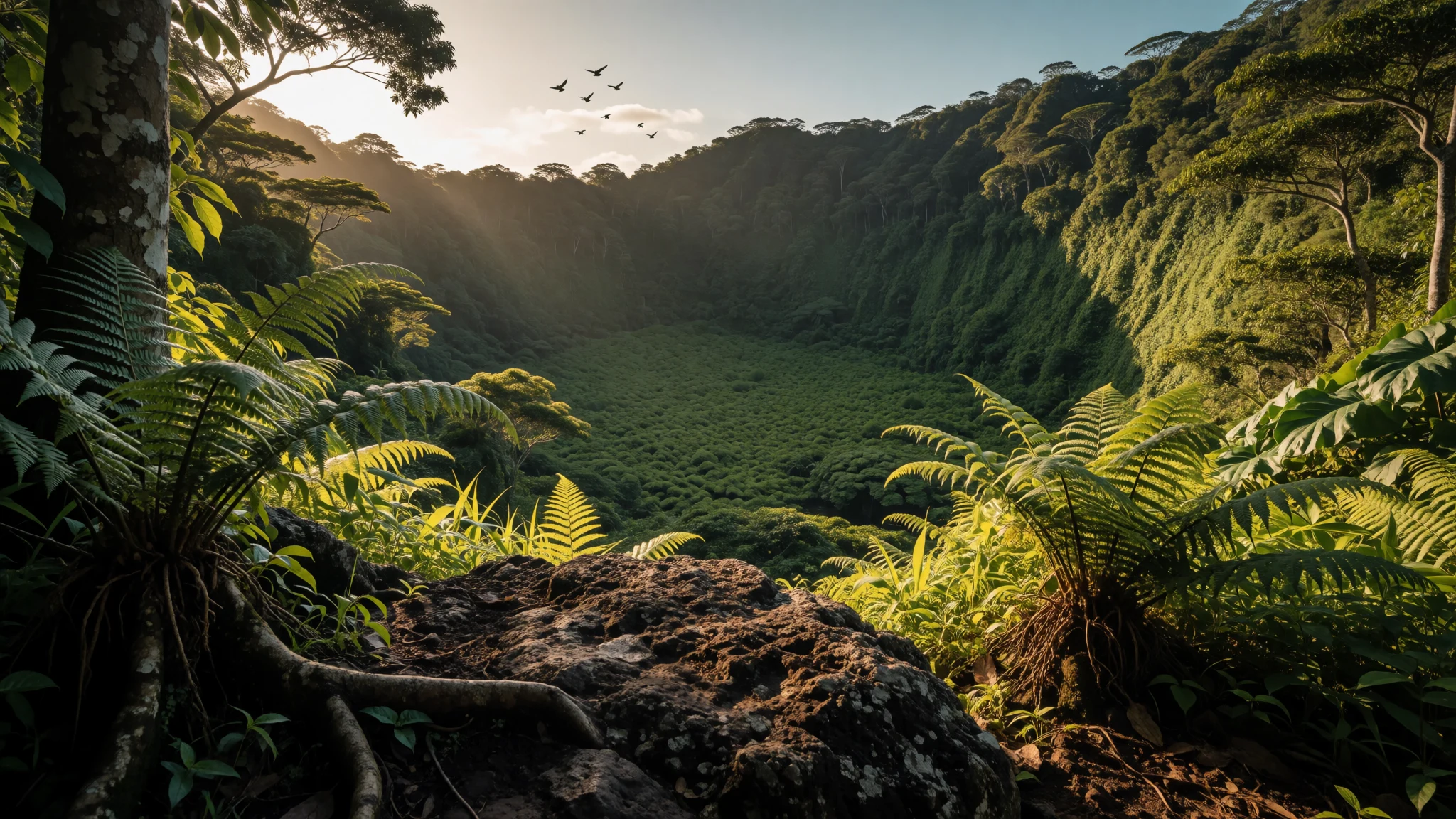
Lagoa Amélia is a vanished crater lake on São Tomé, now a green carpet of plants fringed by giant endemic begonias.
The place
Lagoa Amélia lies in the highlands of São Tomé island, in the Mé-Zóchi district, inland from the capital. Wikidata files it as a mountain, but what draws people is a former crater lake whose surface has been taken over by a thick mat of vegetation, so the water is hidden under a living green floor. Around the edges grow giant begonias, a species found nowhere beyond São Tomé and Príncipe. The setting is the rainforest that clothes most of the island; trees cover nearly the whole country, and old plantation land has steadily gone back to forest. The country sits on the Equator in the Gulf of Guinea, west of Gabon, so the highlands are humid, often cloudy and cooler than the coast, and rain can arrive at any hour. It is a quiet corner. Few tourists reach São Tomé and Príncipe at all, and the lake has little in the way of visitor facilities, so a trip here usually means arranging a local guide and a driver in advance. There are no railings, no café and no ticket office to rely on. What the place offers instead is mud on the paths, mist rolling in by afternoon, birdsong from the canopy, and the occasional moment when the cloud lifts and the crater rim shows itself. The country is often wrongly shortened to 'São Tomé', which is really only the name of the larger of its two main islands, so it helps to say the full name when planning.
Its story
Lagoa Amélia belongs to an island whose human story is short and hard. When Portuguese navigators arrived, São Tomé had no resident population, and the colonisers built a economy on sugar before switching to coffee and cocoa in the nineteenth century. All of it depended on plantation slave labour, and a form of forced labour lingered into the twentieth century. The big estates, called roças, shaped roads, villages and the look of the hillsides for generations. Since then, much of that cleared land has been reclaimed by rainforest, and the highlands around the lake now read as green and almost empty. Cocoa remains the main crop, and it makes up the bulk of the country's farm exports, alongside copra, palm kernels and coffee. The lake itself has a quieter record. Written accounts of how its open water gave way to a plant mat are thin, so honest guides talk about what can be seen today rather than a neat origin story: an old crater basin, slowly covered by growth. São Tomé and Príncipe also has a small place in the history of physics. In 1919, Arthur Eddington took his team to Príncipe to photograph an eclipse as part of a test of Einstein's theory of relativity. Few places so small and remote have been tied to a famous scientific result, and the islands still carry the sense of being far from everywhere.
What to see
- The crater floor of Lagoa Amélia — Mé-Zóchi district, São Tomé island
The old crater lake is covered by a thick mat of vegetation, so from the rim it looks more like a meadow than a lake. The surface can look firm in photographs, but nobody should test it by stepping out; stay on the paths your guide chooses. Cloud often drifts in by midday, so mornings usually give the clearest outlook.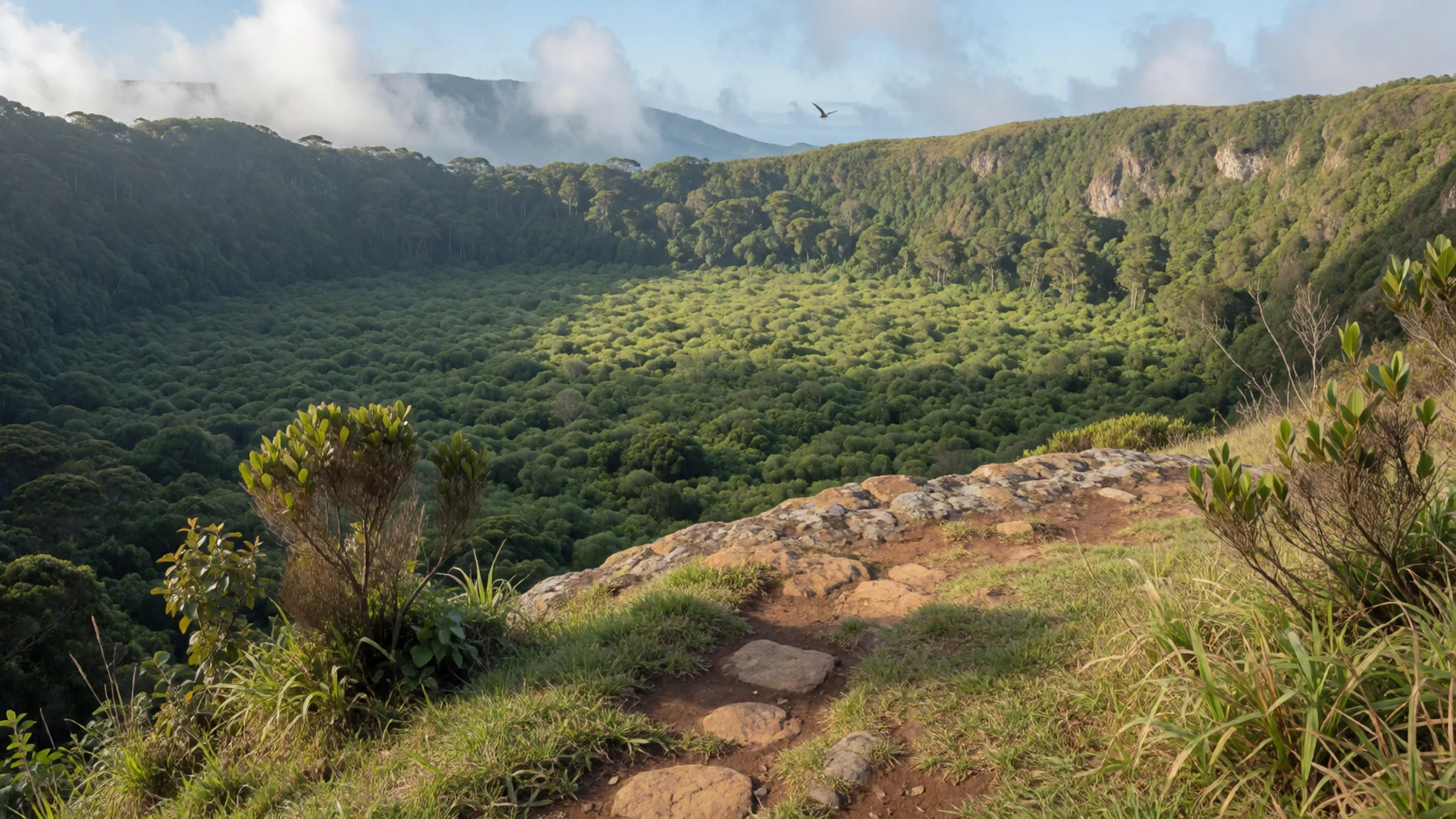
- Giant begonias — Edges of the old lake
Begonia baccata, the giant begonia, grows around Lagoa Amélia and is endemic to São Tomé and Príncipe. It is a tall, shrubby plant with large leaves, quite unlike the small bedding begonias of a British garden or an Indian balcony. Soft overcast light suits it well, and the highlands rarely lack that.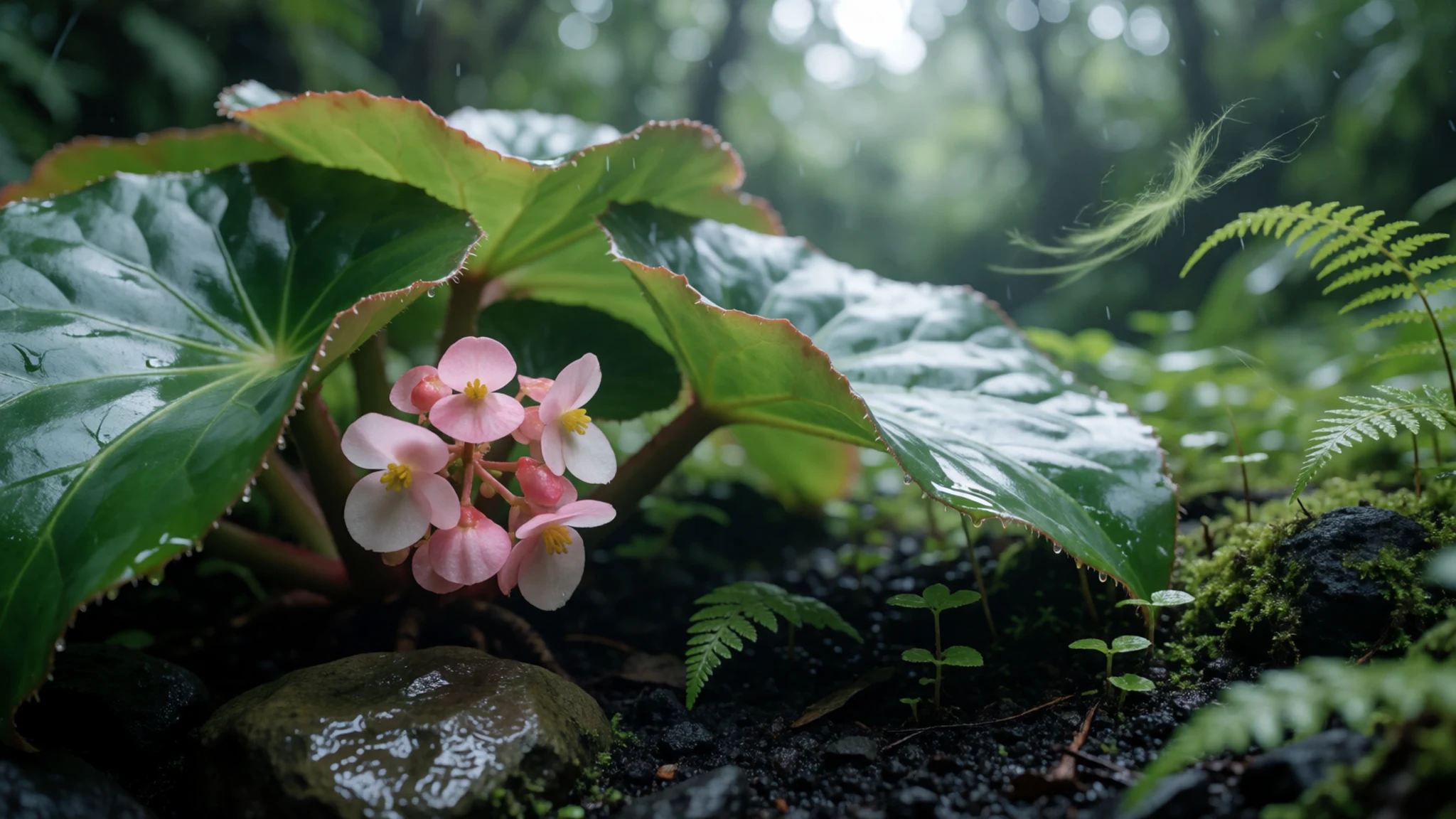
- Obo National Park — Interior of São Tomé island
Obo National Park fills the interior of São Tomé island and is the natural companion to a day in the highlands. Local guides lead bird-watching walks, treks to secluded waterfalls and orchid-spotting trips. Orchids are plentiful on the island, and a patient guide will point out far more than an untrained eye notices on the trail.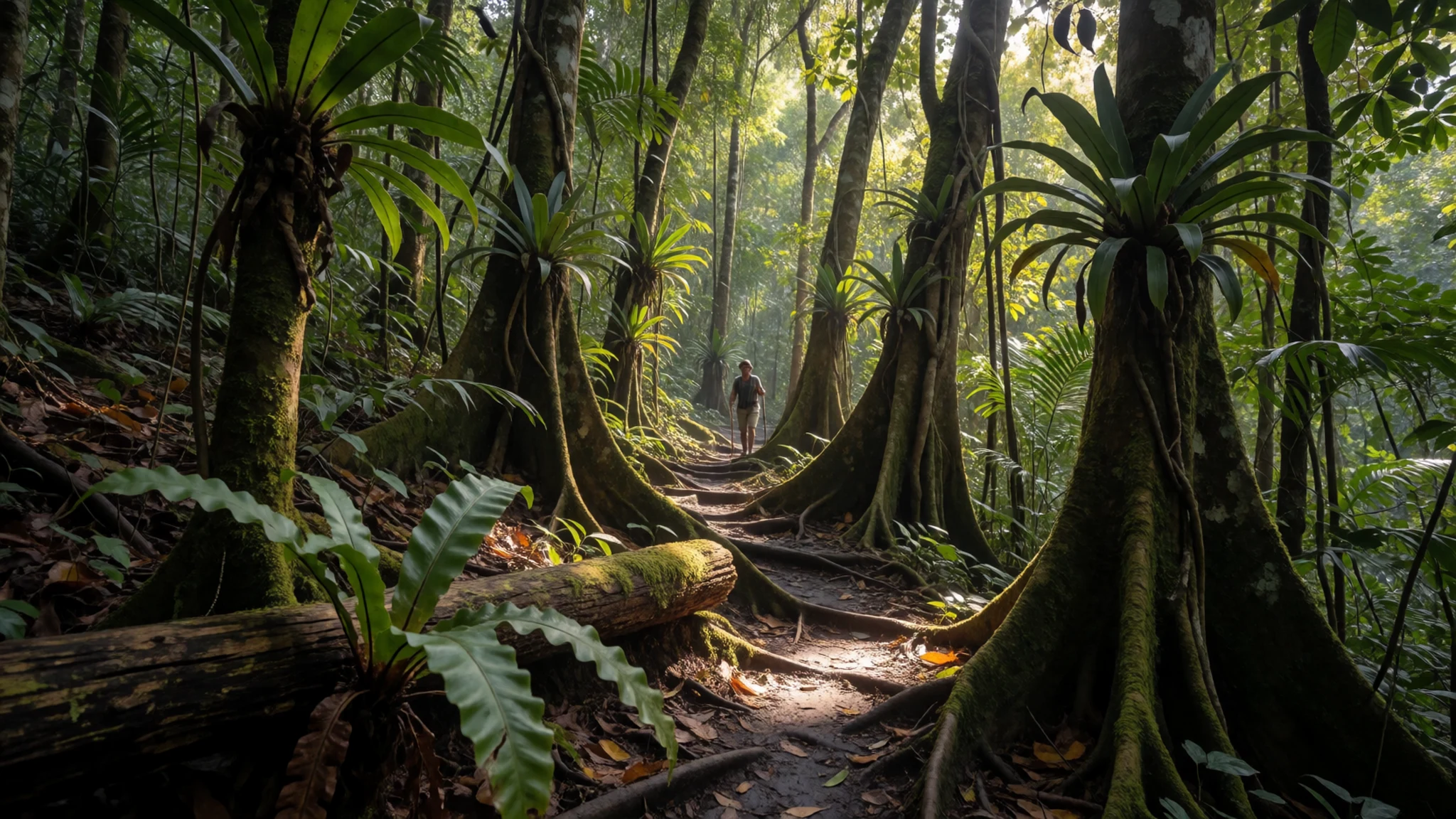
- Pico de São Tomé — Interior of São Tomé island
Pico de São Tomé is the volcanic peak that walkers climb from the island's interior, always best with a local guide. Lagoa Amélia is a gentler outing, so the two suit different appetites. Climbers should start early, carry rain cover and plenty of water, and treat the summit as a full day out rather than an add-on.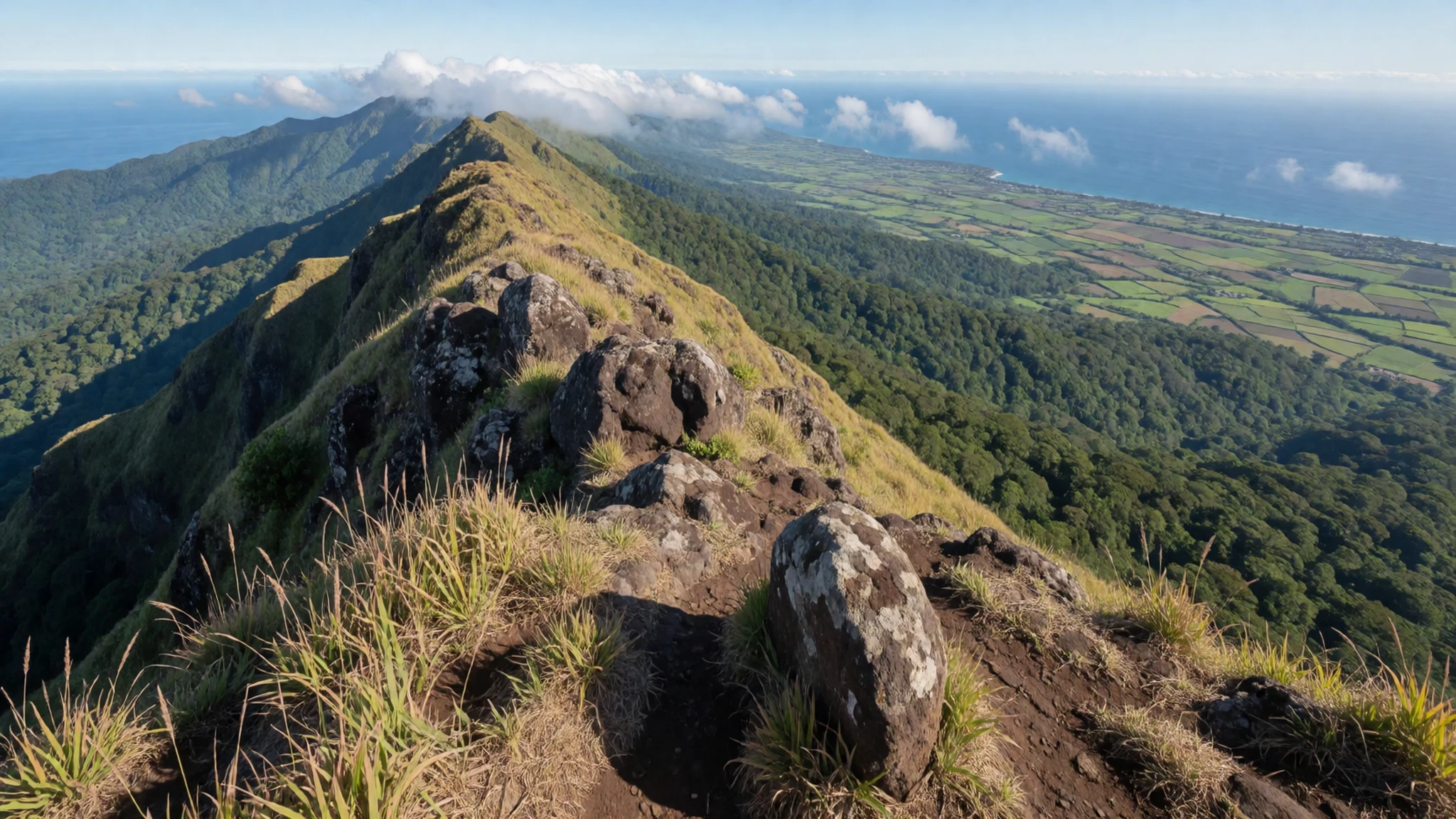
- Boca do Inferno — South coast of São Tomé island
Boca do Inferno, the 'Mouth of Hell', is a blowhole on the south side of São Tomé island. Waves run into an underwater cave and, with no way out, are forced straight up through the rock. It is a coastal contrast to the cool highlands, and works well as a stop on a longer drive round the island.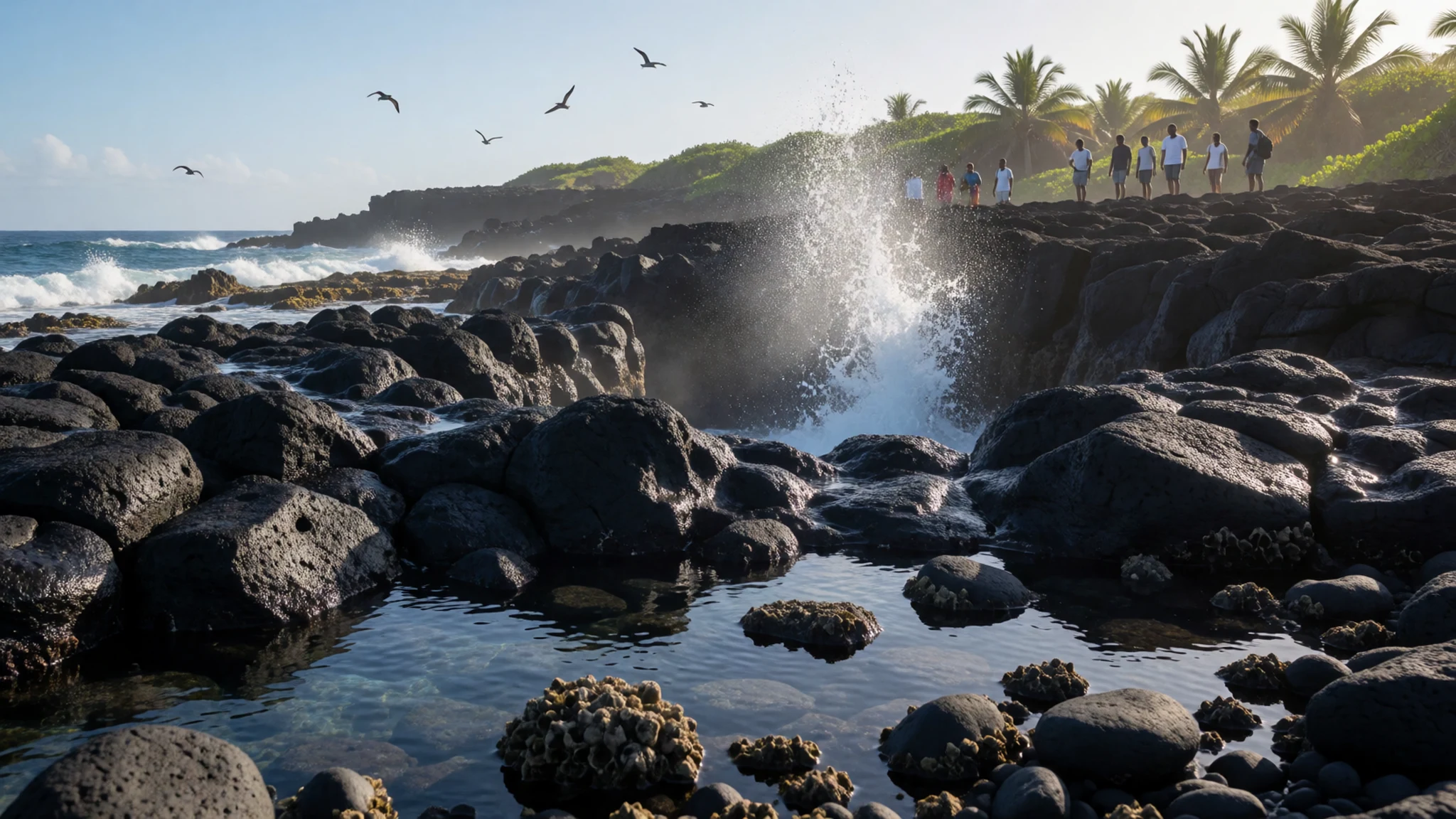
- Eddington's plaque, Príncipe — Príncipe
On Príncipe, the second main island, a plaque commemorates Arthur Eddington and his team, who observed a solar eclipse there in 1919. Their photographs of stars near the sun's edge were used to test Einstein's theory of relativity. It suits travellers with extra days, since the island lies far from São Tomé.
Culture
São Tomé and Príncipe has a culture woven from African and Portuguese threads, and the villages around Lagoa Amélia carry that blend in daily life more than in any museum. Music is the clearest sign. São Toméans are known for the ússua and socopé rhythms, while Príncipe has its own dêxa beat. Portuguese ballroom dancing probably helped shape these styles, which is why the footwork can look oddly familiar to a European eye. Tchiloli is a theatrical tradition in which a tragic tale is acted out with costume, music and movement, and the danço-Congo mixes the same ingredients in a different spirit. Portuguese is the language of everyday talk and signs, and a few words of it go a long way in the highlands, where English is unlikely to be spoken. Football is the sport that fills village pitches and bar conversations, so a question about the local team is an easy way to start talking. The plantation past is also part of the picture. Cocoa estates and their workers' quarters still stand across the island, and many families in the highlands trace their story to them, so it pays to ask about history with curiosity rather than as entertainment. Ask before photographing anyone, especially farm workers and children, and offer a polite 'bom dia' before you raise the camera.
What to wear
Lagoa Amélia is a rural highland spot, and the dress around it is practical rather than ceremonial. São Tomé and Príncipe has no single national costume that visitors will see worn daily. The clearest traditional clothing belongs to performance: tchiloli players wear theatrical costume for their staged dramas, and dance groups dress up for festivals. In everyday life, women often wear wrapped printed cotton cloths, as across much of Portuguese-speaking Africa, though local advice on specific patterns is better than guesswork. What people actually wear now is simple and mixed: T-shirts, football shirts, shorts, light dresses, and rubber sandals or boots for muddy work on the farms. In the capital, clothes are a little smarter for church, offices and evenings out. A visitor heading to the lake should dress for warm, damp forest. Lightweight, quick-drying layers work best, with a proper rain jacket, a hat and a thin fleece for cloudy highland mornings. Walking shoes with good grip matter more than anything, because paths can be slick, and long trousers help against scratchy undergrowth. The island's one dangerous animal is the black cobra, so closed shoes are sensible, and sandals are better saved for the beach. Modest dress is expected in villages and churches, with swimwear kept for the coast.
What to eat
- Grilled fish with breadfruit — Seaside grills and fishing villages along the coast
Fish is the staple of the São Toméan table, and the usual partner is breadfruit, boiled or roasted until soft. Expect hot spice on the side. It is simple, filling food that suits a muddy day in the highlands.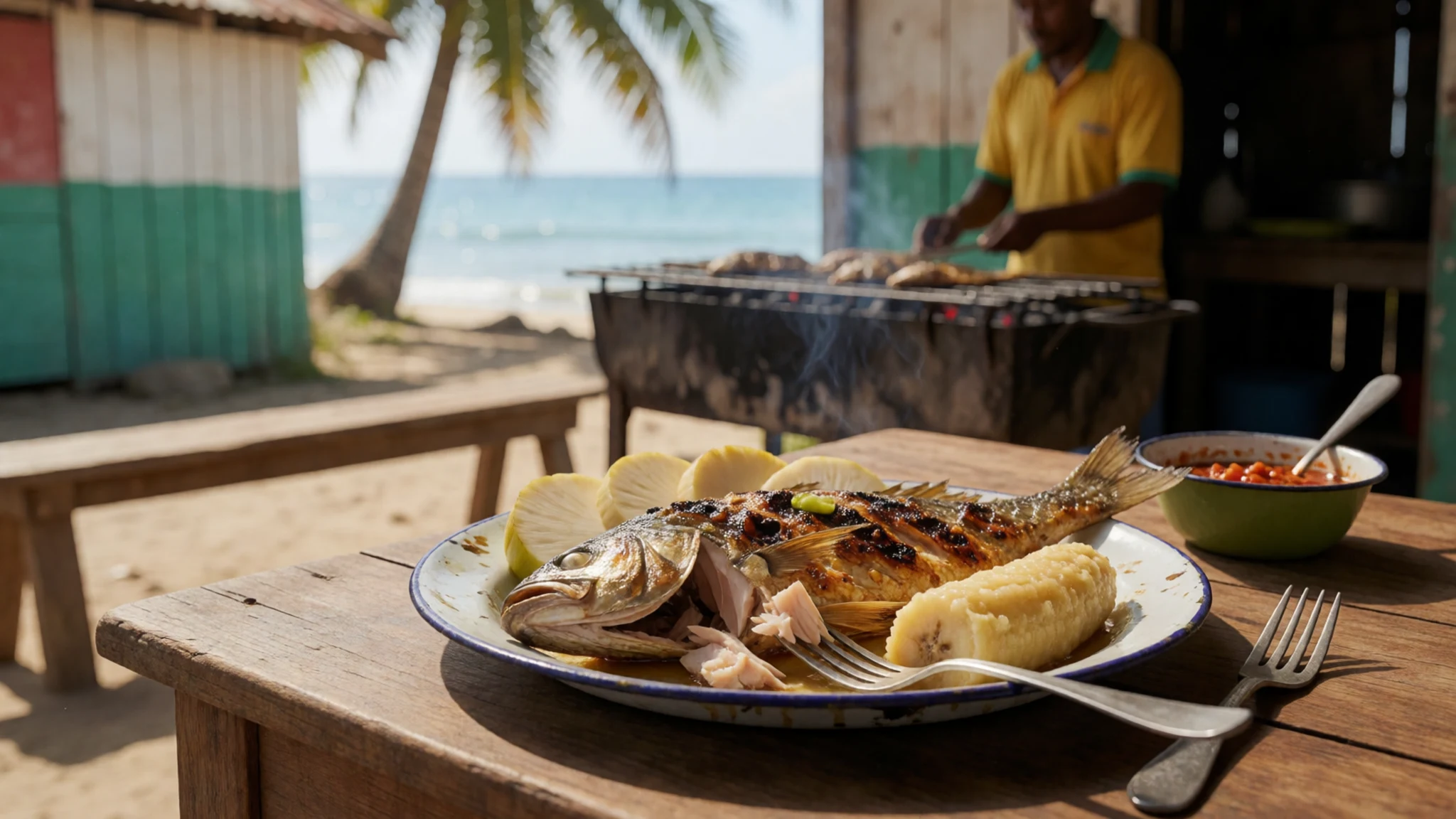
- Mashed cooked banana — Home-style eateries in towns and villages
Cooked and mashed banana turns up beside fish and stews as a soft, mild base for strong flavours. Visitors from India may think of it as a cousin of the starchy plantain dishes found along the southern coast.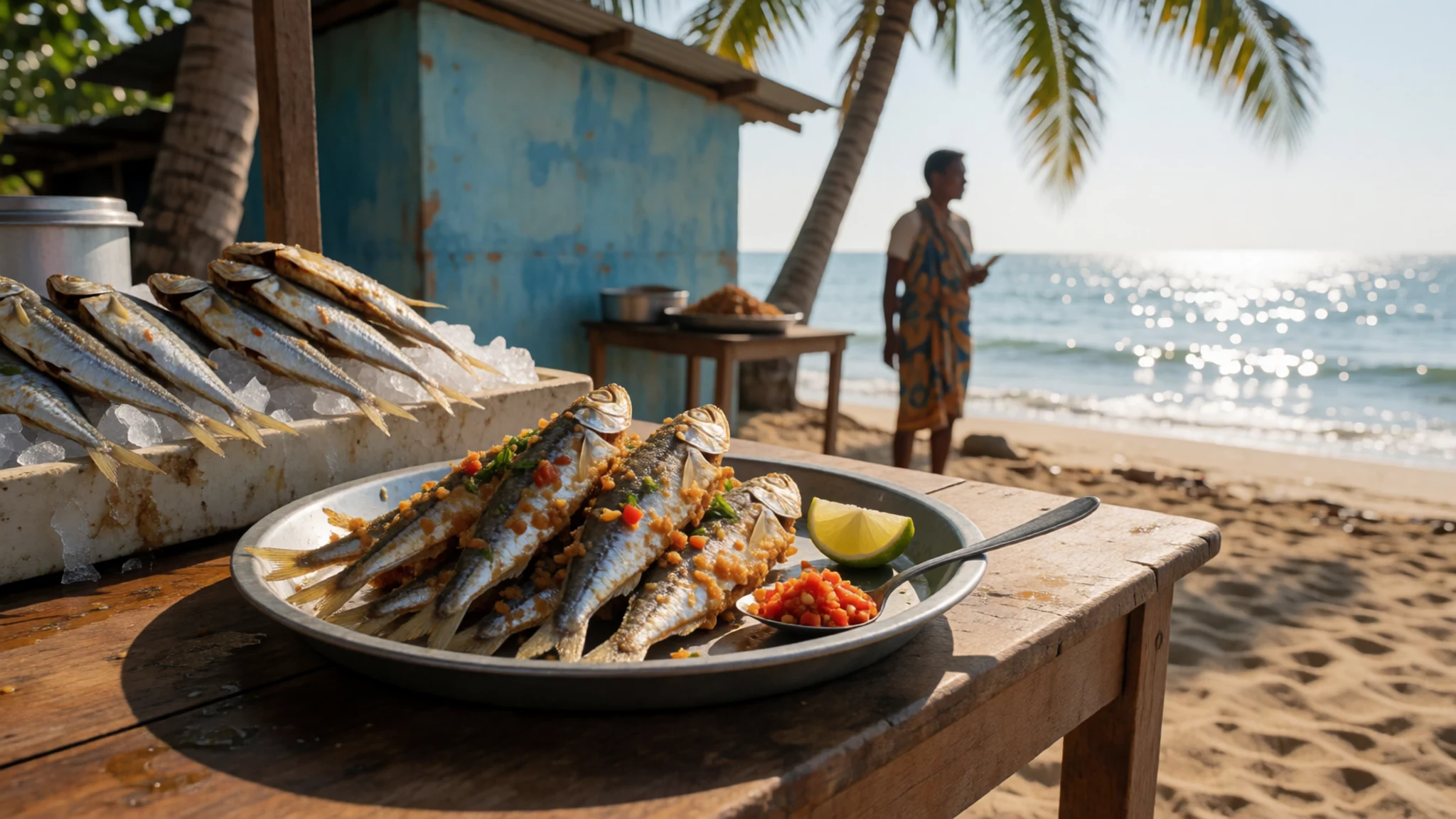
- Flying fish — Coastal eateries and beach grills, in season
Flying fish appear on menus at certain times of the year, so availability depends on the season. Ask locally whether they are running. When they are, grilled or fried fresh from the day's catch is the way to try them. - Buzios, the land snails — Home kitchens and small inland eateries
Buzios are large land snails, eaten especially by people inland who cannot always afford fish or meat. They are an honest taste of highland home cooking, rich in protein and often cooked with peppery spice. - Tropical fruit — Roadside stalls and the market in the capital
Papaya, mango, pineapple, avocado and bananas grow plentifully on the islands and are a big part of what people eat. Fruit bought at the roadside after a hike tastes better than anything from a buffet.
Plan it
Best time. June to September is generally the drier part of the year on this equatorial island, which makes highland paths less slippery and gives the best chance of clear views. Rain and cloud are possible in any month, so a waterproof layer is needed whenever you go.
How long. 2–3
Getting there. The only way into the country is by air, to São Tomé International Airport at the capital, São Tomé city. The last leg is a road journey up into the Mé-Zóchi highlands, best arranged with a local driver and guide.
Budget. mid
Tips
- Book a local guide and driver in advance; the lake has few facilities and paths are not signed
- Start early, as cloud and rain tend to build later in the day
- Wear closed shoes with grip and watch where you put your hands, since the black cobra lives in parts of the island
- Check entry rules before booking, as visa-free access depends on nationality and Indian and British travellers should confirm current requirements
- Carry some cash and do not count on cards outside the capital; take care with scams aimed at tourists in the main city
Etiquette
- Ask before photographing people, and greet first
- Stay on the paths your guide picks and avoid stepping onto the plant mat
- Carry rubbish out with you
Nearby
Sources
- Wikidata Q31587713 (CC0)
- Wikipedia: São Tomé and Príncipe (CC BY-SA 4.0)
- Wikivoyage: São Tomé and Príncipe (rev 5324699) (CC BY-SA 4.0)
- Ji-Elle, Tapis végétal, Lac de cratère Amélia (CC BY-SA 4.0)
- Ji-Elle, Begonia baccata (1) (CC BY-SA 4.0)
- Ji-Elle, Begonia baccata (2) (CC BY-SA 4.0)
- Ji-Elle, Begonia baccata (3) (CC BY-SA 4.0)
- Ji-Elle, Begonia baccata (4) (CC BY-SA 4.0)
- Ji-Elle, Begonia baccata (5) (CC BY-SA 4.0)
- Ji-Elle, Begonia baccata (6) (CC BY-SA 4.0)
- Ji-Elle, Begonia baccata (7) (CC BY-SA 4.0)


