Khan Tengri
Khan Tengri, Kyrgyzstan
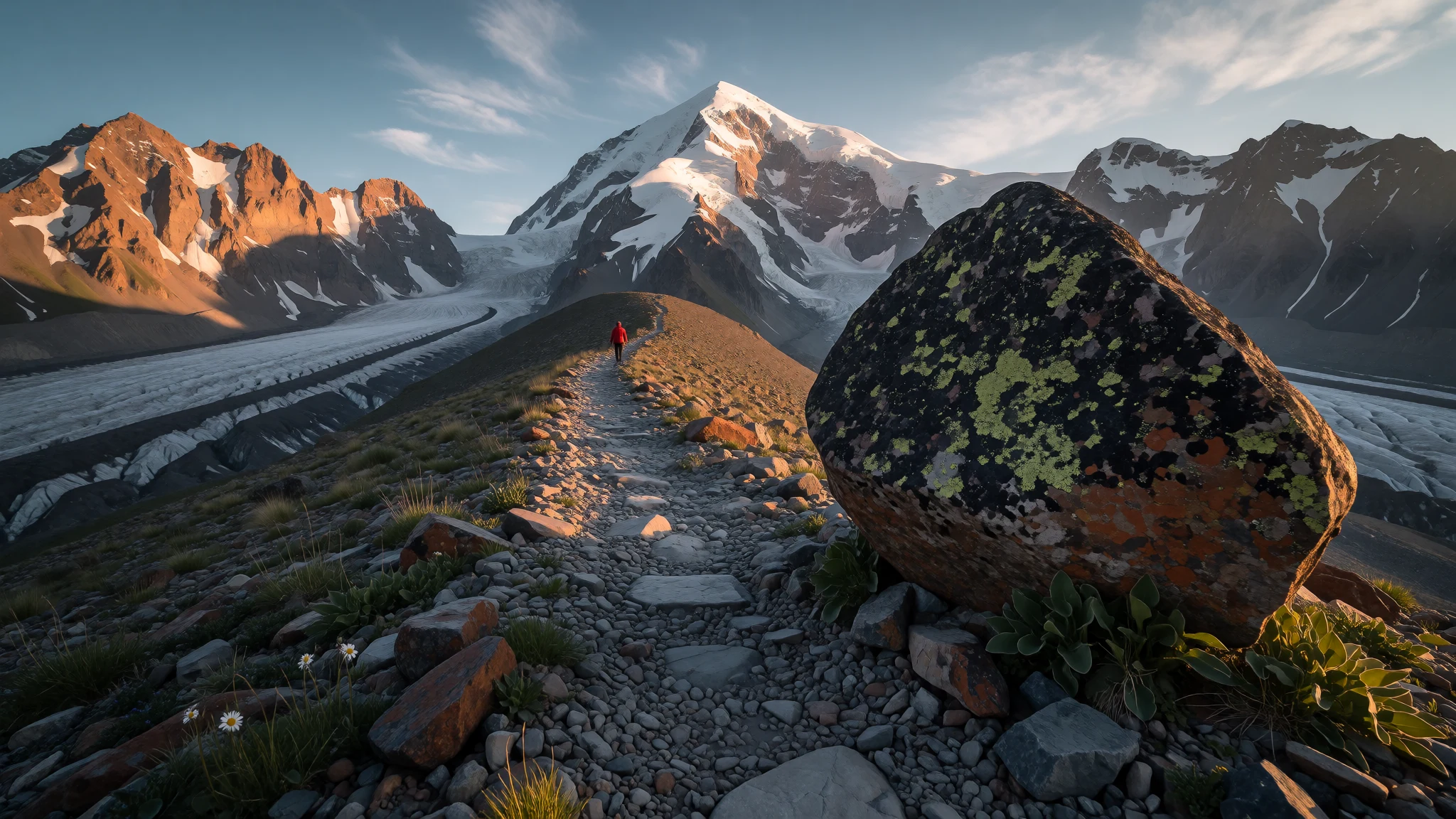
Khan Tengri rises where Kyrgyzstan, Kazakhstan and China meet, a remote Tian Shan peak that rewards glacier trekkers and climbers.
The place
Khan Tengri rises in the Tian Shan, the range that runs across Central Asia, right where Kyrgyzstan, Kazakhstan and China meet. On the map it lies east of Lake Issyk Kul, but the lake is a long way from the foot of the peak, with valleys, moraine and the broad Engilchek glacier in between. The rock summit is a few metres lower than the ice cap that crowns it, and with the ice the height comes to 7010 m. That is why mountaineers file it among the seven-thousanders. Within its own range only Jengish Chokusu, formerly called Peak Pobeda, stands higher. Khan Tengri is the high point of Kazakhstan and the third highest summit in Kyrgyzstan. It is also the northernmost mountain of its height class, and that latitude shows: seasons are short and the weather is harsher than on comparable peaks farther south. The surrounding district is almost entirely mountain, with only a thin share of valley floor. This is not a casual destination. Few visitors ever stand directly under the summit pyramid. Most come to trek the glaciers and lakes of the approach, sleeping in tents or simple lodgings, with helicopters or long overland drives from Karakol doing the heavy lifting. Weather, border permits and cost all shape a trip, and the summit itself is work for experienced climbers with an established operator.
Its story
Khan Tengri entered European knowledge in 1857, when the Russian geographer Pyotr Semyonov became the first outsider on record to set eyes on the Tengri Tag range and its dominant peak. For decades afterwards the mountain was assumed to be the roof of the Tian Shan. That changed in 1943, when a survey showed that Jengish Chokusu, a few hundred metres taller, stood nearby. The first climb had come earlier, in 1931, when a Ukrainian team under Mikhail Pogrebetsky approached from the Kyrgyz side and finished along the west ridge. The northern, Kazakh-side route was first climbed by M. Kuzmin's team in 1964. In Soviet times the summit was one of the peaks a climber had to top to win the Snow Leopard title, which kept a steady stream of mountaineers coming. Anatoli Boukreev made a solo speed ascent in 1990, and a Kazakh team completed the first winter ascent in February 1992. The mountain has also been unforgiving. Toni Dürnberger, an Austrian expedition leader, died on the descent in August 1992 after reaching the top. In 2004 an avalanche on the Pogrebetsky route, the most used line on the mountain, killed more than a dozen climbers. Today the peak appears on Kyrgyzstan's 100 som banknote, a sign of how firmly it sits in the national imagination.
What to see
- Khan Tengri north face — Central Tian Shan, Kyrgyz–Kazakh–Chinese border region
The north wall of Khan Tengri is the view that makes the journey feel worthwhile: a steep pyramid of rock and ice standing clear above the surrounding ridges. Most visitors admire it from base camp or from the glacier approach rather than climbing it. Clear mornings give the best light.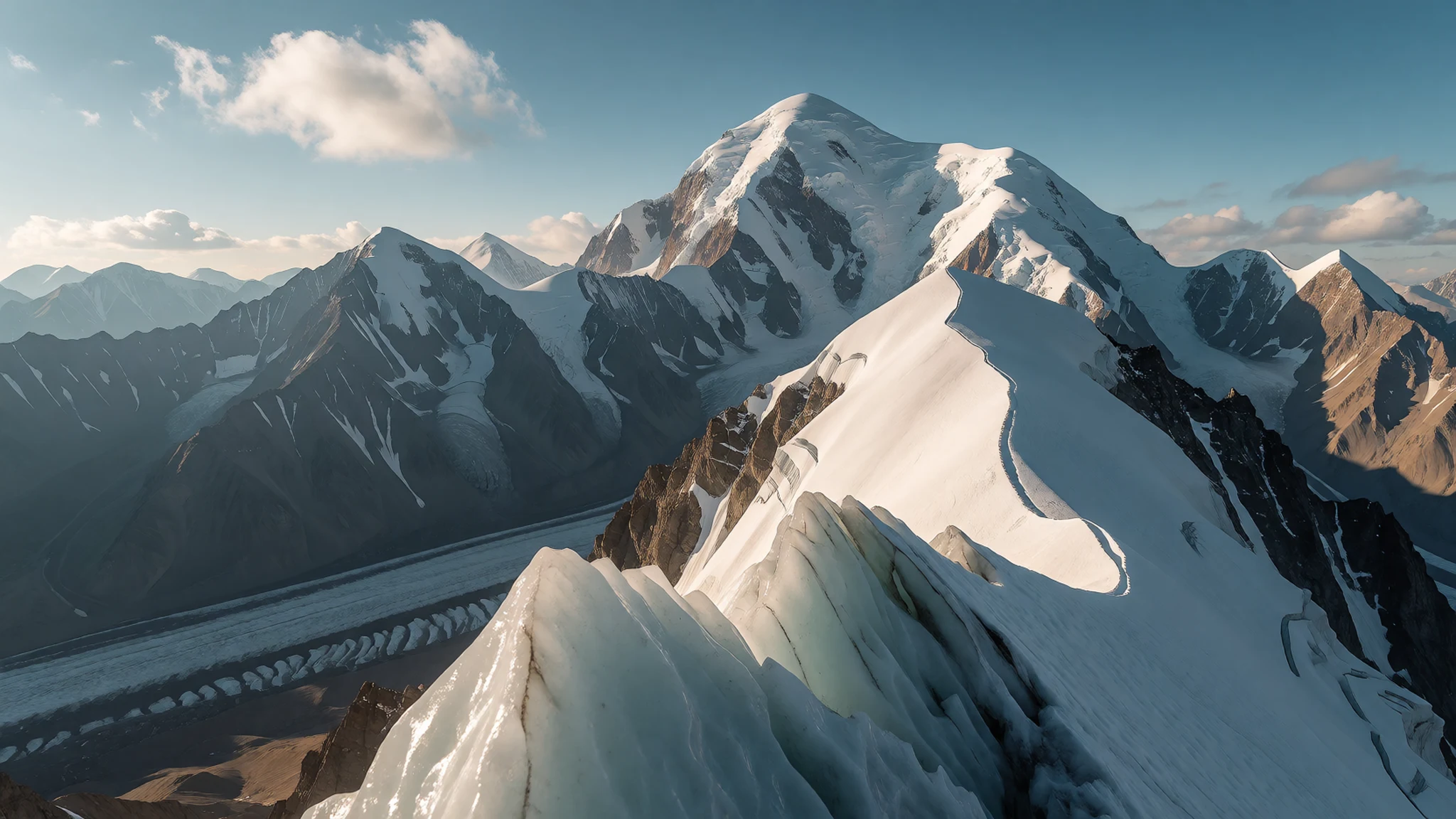
- Engilchek Glacier — Central Tian Shan
The Engilchek glacier is a long river of ice and rubble that runs west of the peak. Even people with no plan to climb find it impressive. Walking its edges shows crevasses, meltwater channels and moraine ridges at close range. It is serious terrain, so go with a guide.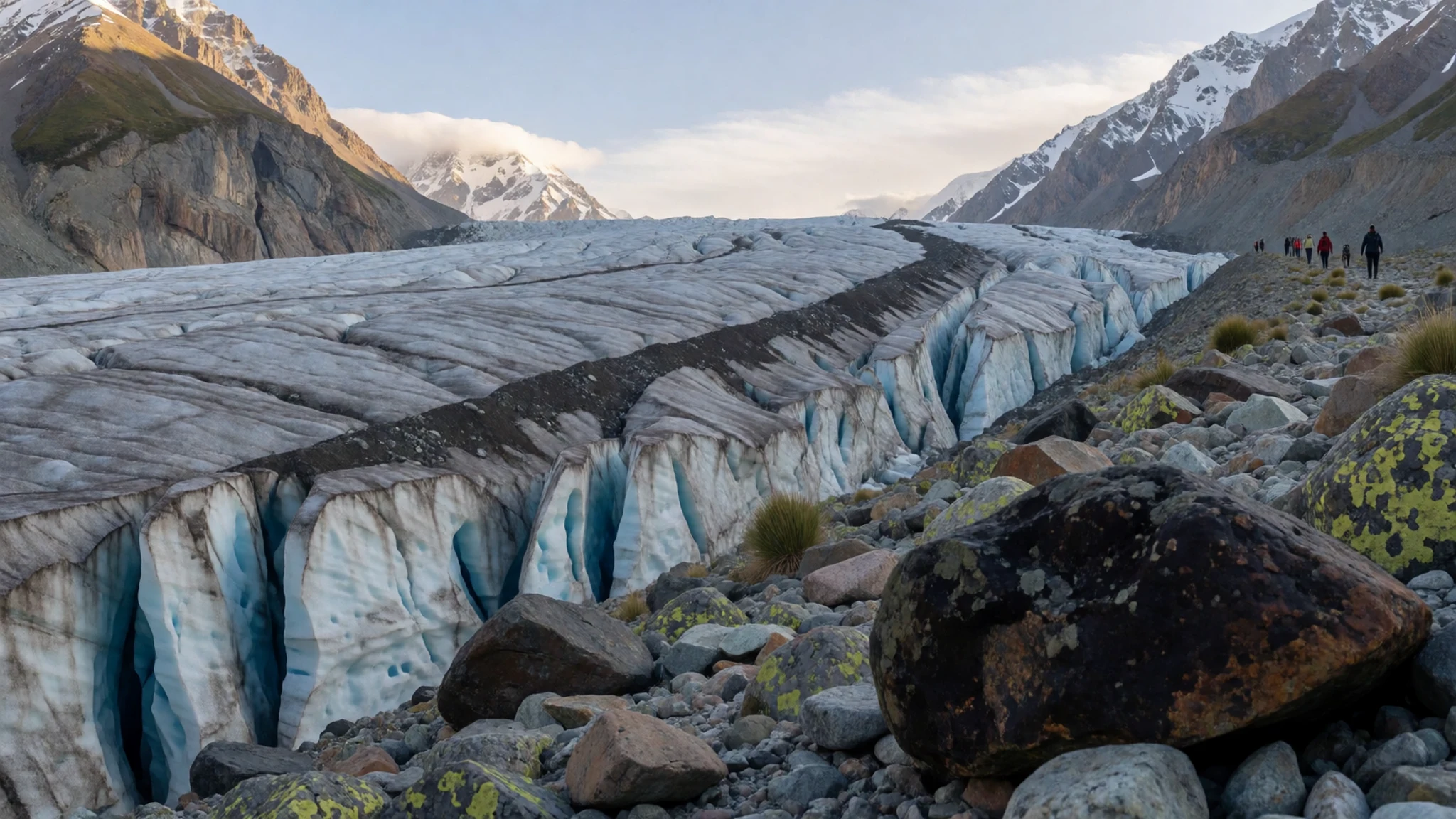
- Merzbacher Lake trek — At-Jailoo to Merzbacher Lake
Merzbacher Lake is reached on a medium-to-difficult trek that starts from the At-Jailoo pasture and takes about a week with rest days. The route climbs from summer grazing land towards high moraine country. Expect long days, changeable weather and the need for a competent guide or organised group.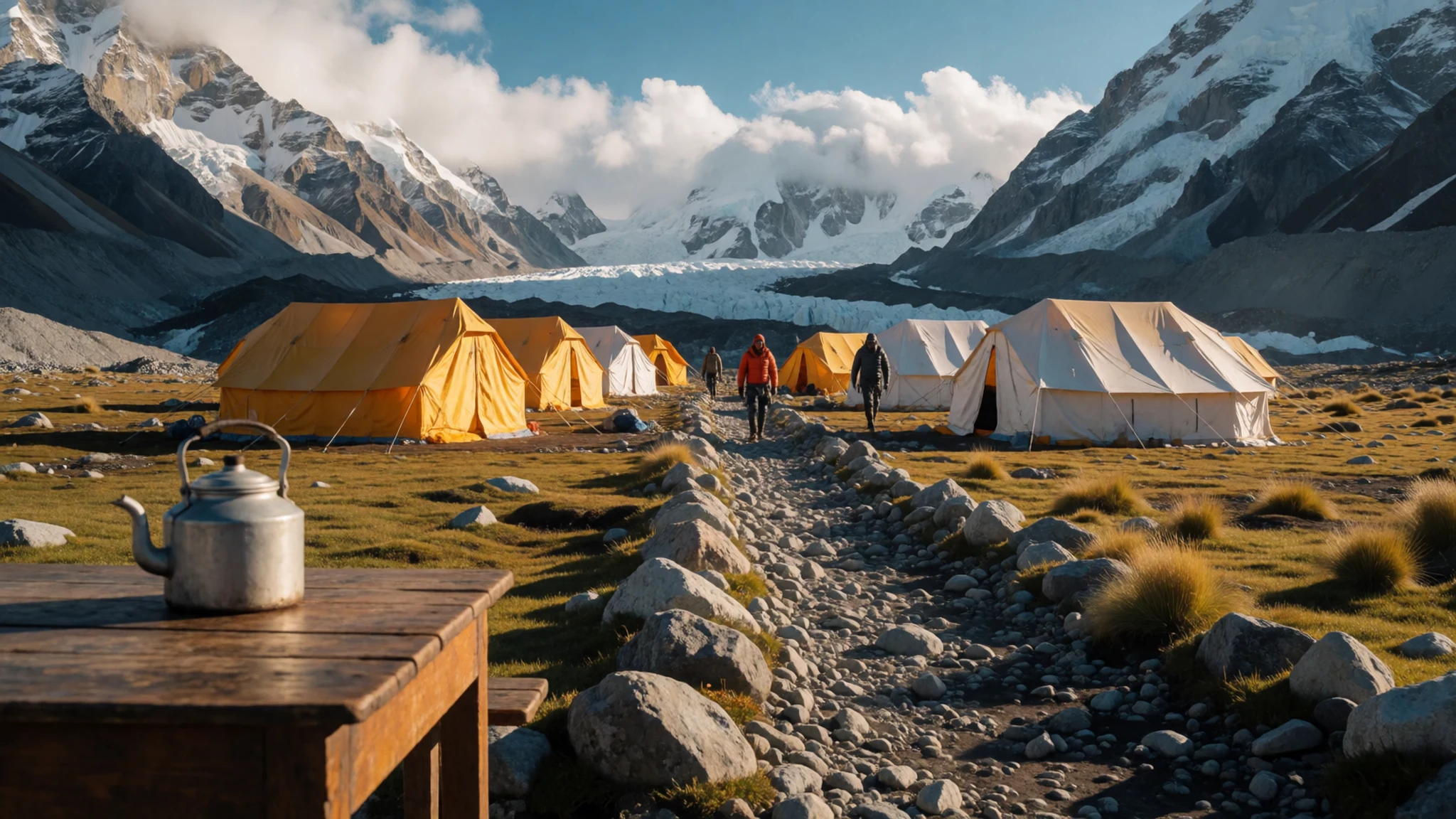
- Engilchek village — Engilchek valley
Engilchek village is a former mining settlement whose population shrank sharply after the tin mine closed. It feels half-emptied, with Soviet-era buildings and a sense of being at the end of the road. Locals tell of a 'devil's grave' nearby, linked in story to a crashed UFO.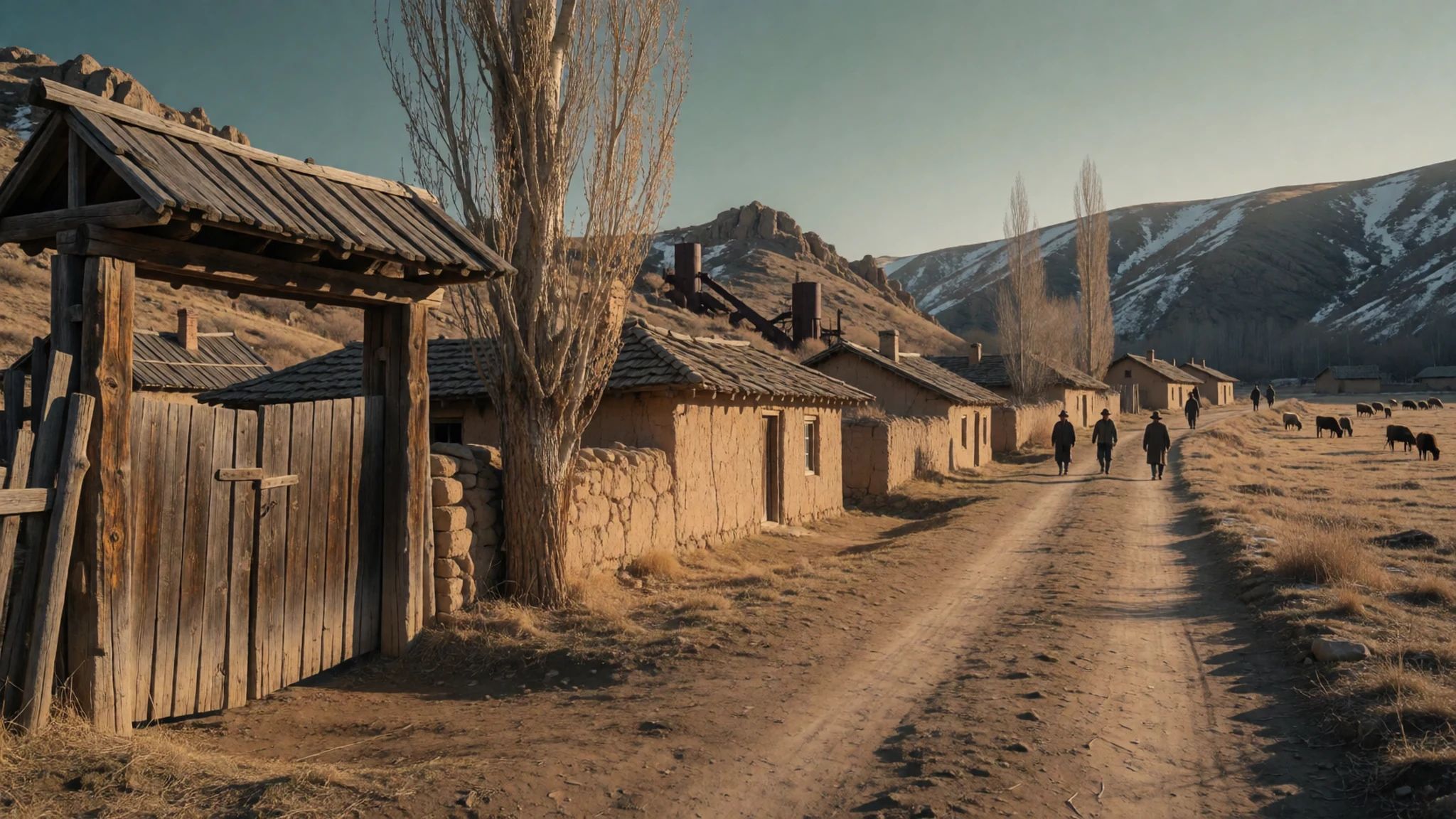
- Engilchek South Base Camp — South of the Engilchek glacier
The South Engilchek base camp sits on the glacier's southern side, in the middle of the northern Tian Shan, and is run by the operator Ak-Sai. Climbers gather here for acclimatisation and weather windows. Trekkers can also visit, which gives a good sense of expedition life without committing to a summit bid.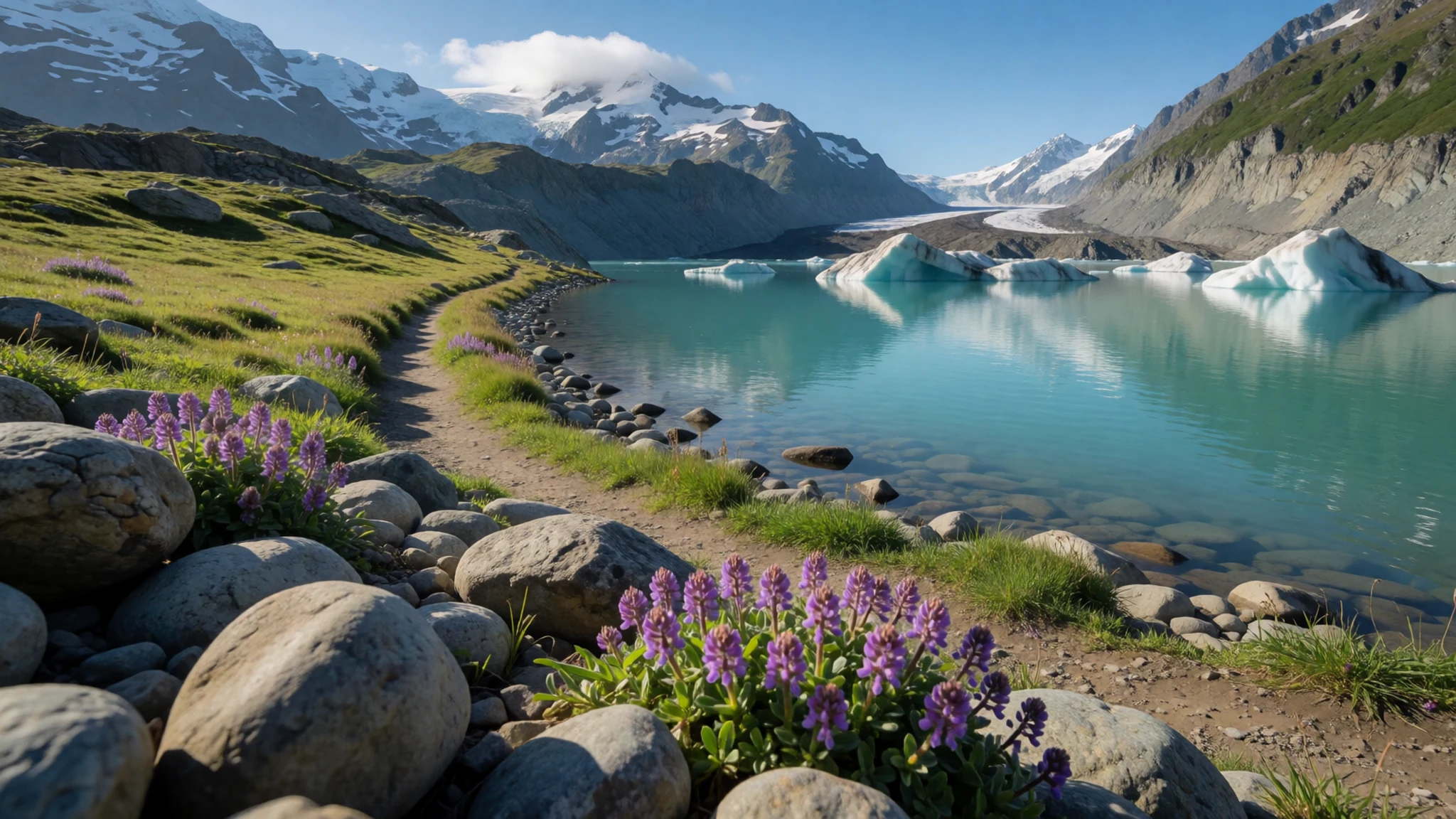
Culture
Khan Tengri takes its name from Tengri, the sky deity of old Turkic belief, and the mountain still carries a sense of something larger than a climbing objective. The people of the nearby valleys are mostly Kyrgyz, with a long tradition of herding on high summer pastures known as jailoos. Families move livestock up in warm months and live in felt-covered yurts, where hospitality is taken seriously: guests are fed, given tea, and expected to sit and talk. Bread, dairy products and fermented mare's milk are part of that welcome. There is also a strong mountaineering culture, inherited from the Soviet period, when climbers from across the union came to the Tian Shan to earn badges and test themselves. Expedition operators in Karakol and Bishkek still draw on that knowledge, and many guides come from climbing families. Old mining settlements such as Engilchek preserve another layer of history, with their Soviet-era buildings and a mix of Kyrgyz, Russian and other communities. Religion is mostly a quiet, personal matter, with Islam blended with older customs, and visitors will notice small shrines and graves along tracks. Border zones are taken seriously by officials, so paperwork and patience matter more than bravado. When invited into a yurt or home, take your shoes off at the threshold and accept the first cup of tea or piece of bread you are offered, even if only to taste it.
What to wear
Khan Tengri sits in Kyrgyz country, where traditional dress draws on the herding life. The best-known piece is the kalpak, a tall white felt hat, often with dark embroidered edging, worn by men at festivals and weddings. A chapan, a long quilted coat, once kept riders warm. Women's festive outfits include velvet or silk dresses and, among older women, the elechek, a white headwrap. Felt, wool and silk are the main materials, and felt carpets with bold patterns, called shyrdak, brighten yurts. In everyday life, people in the valleys and in Karakol wear ordinary modern clothes: jeans, jackets, trainers, and sturdy boots for farm work. Older women often favour long skirts and headscarves, and the kalpak appears at celebrations rather than at work. Visitors should dress for mountains, not towns. At altitude and on glaciers that means layers: a thermal base, a fleece, a windproof and waterproof shell, warm gloves, a hat and sunglasses with good protection. Boots must be sturdy and broken in, and climbers need technical footwear from their operator's kit list. In villages and homes, covering shoulders and knees is polite, especially for women. Pack sunscreen and lip balm, because glare and thin air burn quickly even when the air feels cold.
What to eat
- Beshbarmak — Village guesthouses and traditional eateries in Karakol
Beshbarmak is boiled meat served over wide noodles with onion broth, the classic dish for guests and celebrations. It is eaten communally and often by hand, and is most easily found in family homes, village guesthouses and traditional eateries around Karakol.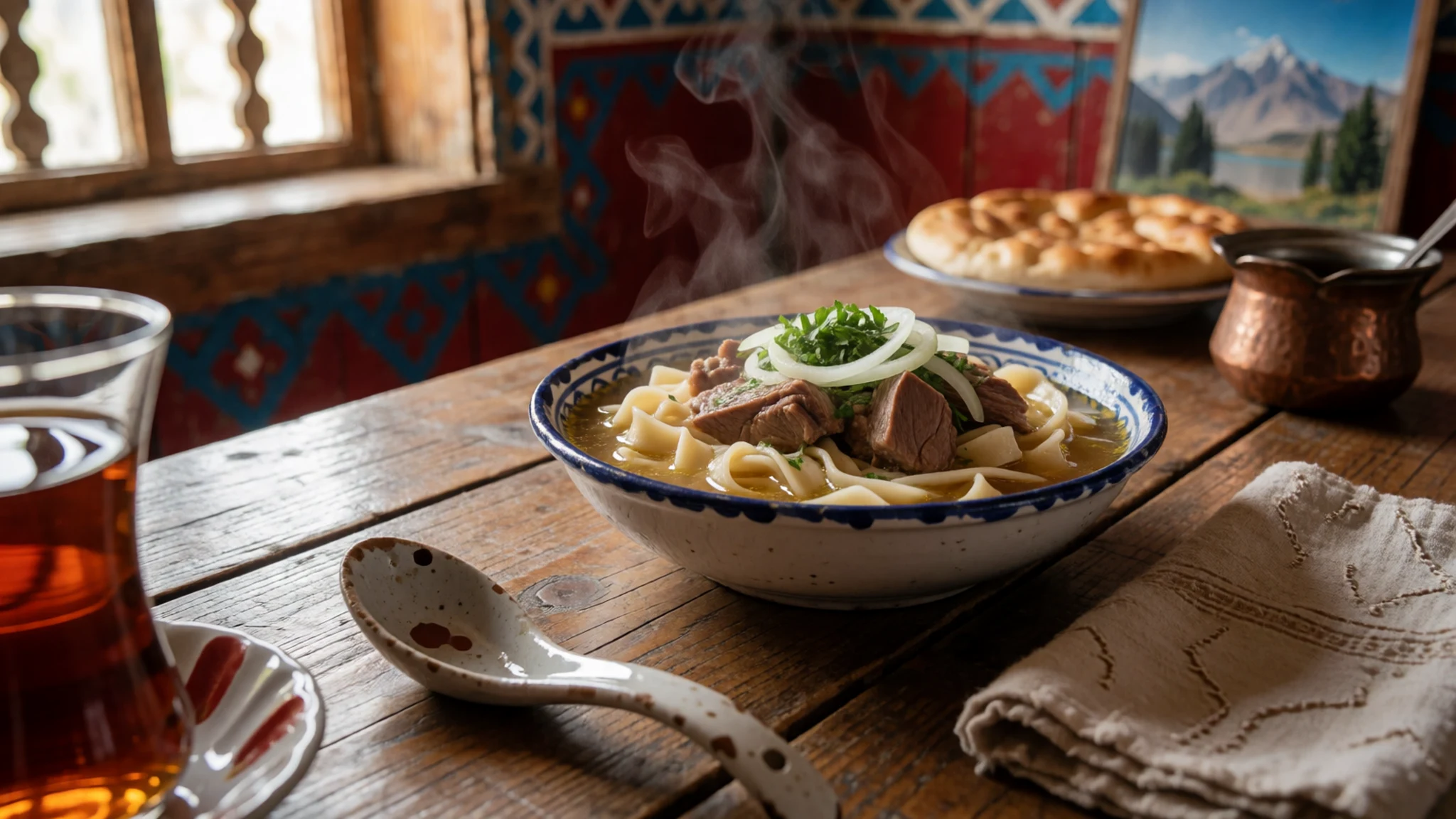
- Laghman — Karakol bazaar and roadside cafés
Laghman is a bowl of hand-pulled noodles with vegetables and meat in a savoury sauce, sometimes served as a soup. It is filling, cheap by local standards and ideal after a day outdoors. Look for it in bazaars and small roadside cafés.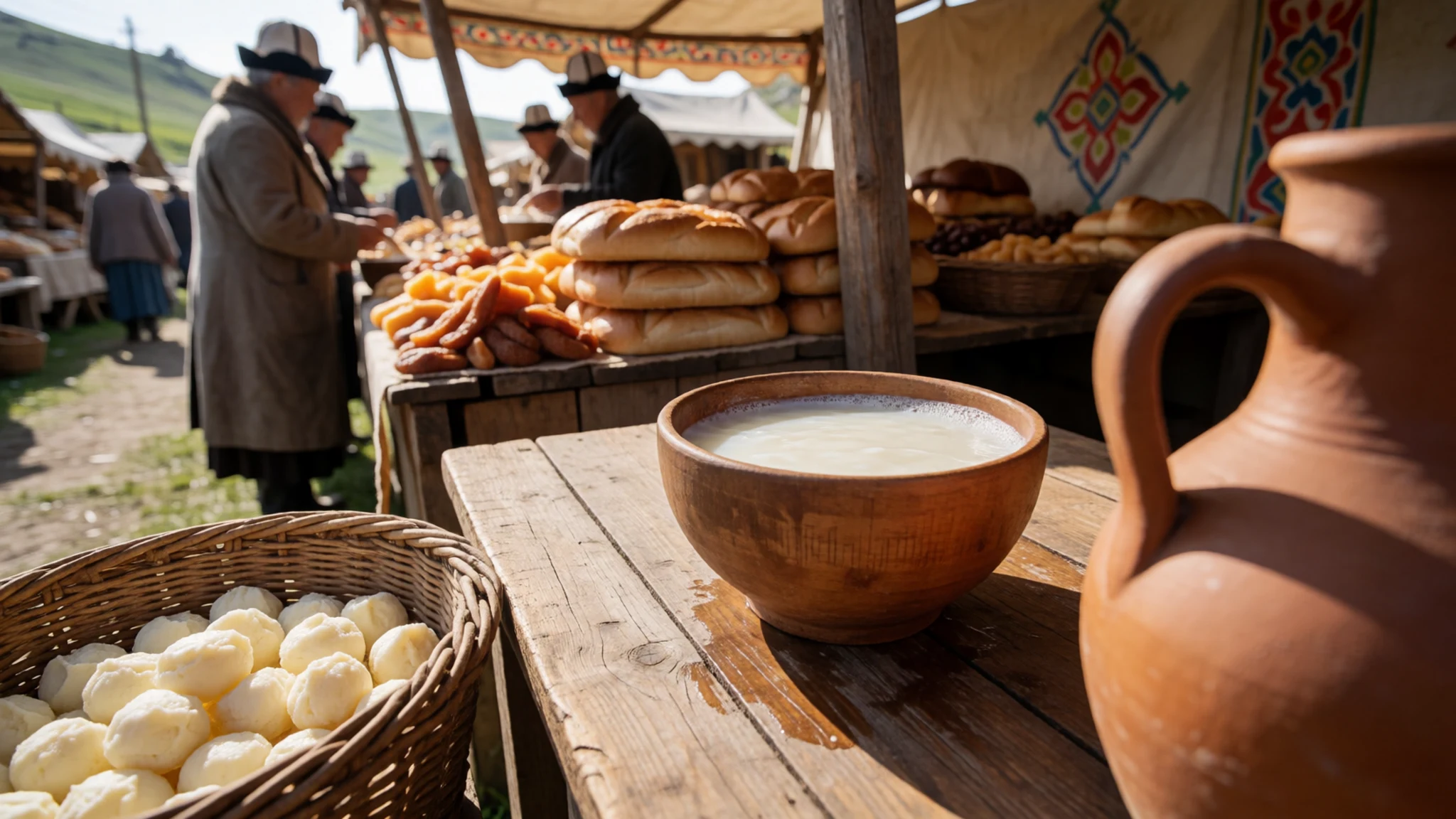
- Manti — Small eateries and home kitchens in Karakol
Manti are steamed dumplings filled with minced meat and onion, eaten with sour cream or a spicy sauce. They are a reliable meal in town and a favourite in family kitchens, often made in big batches for gatherings. - Boorsok — Bazaar stalls and yurt stays
Boorsok are cubes of fried dough, sometimes served warm with jam, honey or cream, and a fixture of hospitality. They keep well, so they also turn up as snacks for the trail, sold at markets and offered with tea. - Kymyz — Summer pastures and yurt camps
Kymyz is lightly fermented mare's milk, sour and slightly fizzy, a summer drink of herding families. Taste it at a yurt camp on a jailoo, where it is served from large bowls. A small sip is polite if the flavour is strong.
Plan it
Best time. July and August are the usual months for treks and expeditions, when the glacier approaches are most workable. Khan Tengri's northern latitude means a short season and severe weather outside that window, so do not plan an independent trip in winter.
How long. 7–10
Getting there. Fly to Bishkek, Kyrgyzstan's capital, then continue towards Karakol near Lake Issyk Kul; treks and flights to base camp are usually organised from Karakol. The last leg is by helicopter or a long overland drive and glacier walk. Border-zone permits are needed, and operators normally arrange them, so check current rules with them.
Budget. high
Tips
- Book an operator well ahead, since permits, helicopter seats and base camp places need advance planning
- Allow spare days for weather delays, especially around helicopter flights
- Acclimatise gradually, and take altitude sickness seriously
- Carry cash for villages and bazaars, as cards are patchy once you leave towns
- Treat or filter all water on the trail and at camp
Etiquette
- Take your shoes off before entering a yurt or home
- Ask before photographing people, especially women and older residents
- Respect border-zone rules and carry your documents at all times
Nearby
Sources
- Wikidata Q211529 (CC0)
- Wikipedia: Khan Tengri (rev 1369306943) (CC BY-SA 4.0)
- Wikivoyage: Ak-Suu (rev 5241011) (CC BY-SA 4.0)
- North Wall of Khan Tengri — Frederic Heymes (CC BY-SA 2.0 fr)
- Asia relief location map — Uwe Dedering (CC BY 3.0)
- Relief map of Kyrgyzstan — NordNordWest / Виктор_В (CC BY 3.0)
- Relief map of Kazakhstan — NordNordWest / Виктор_В (CC BY 3.0)
- China relief location map — Uwe Dedering (CC BY 3.0)
- 100 som of Kyrgyzstan (2002) — National Bank of the Kyrgyz Republic (Public domain)
- 夏特冰川路途佳景 — lwtt93 (CC BY 2.5)
- Routes of Explorers in the Western Tian-shan (Fig. 99) (Public domain)


