Bishkek
Bishkek, Kyrgyzstan
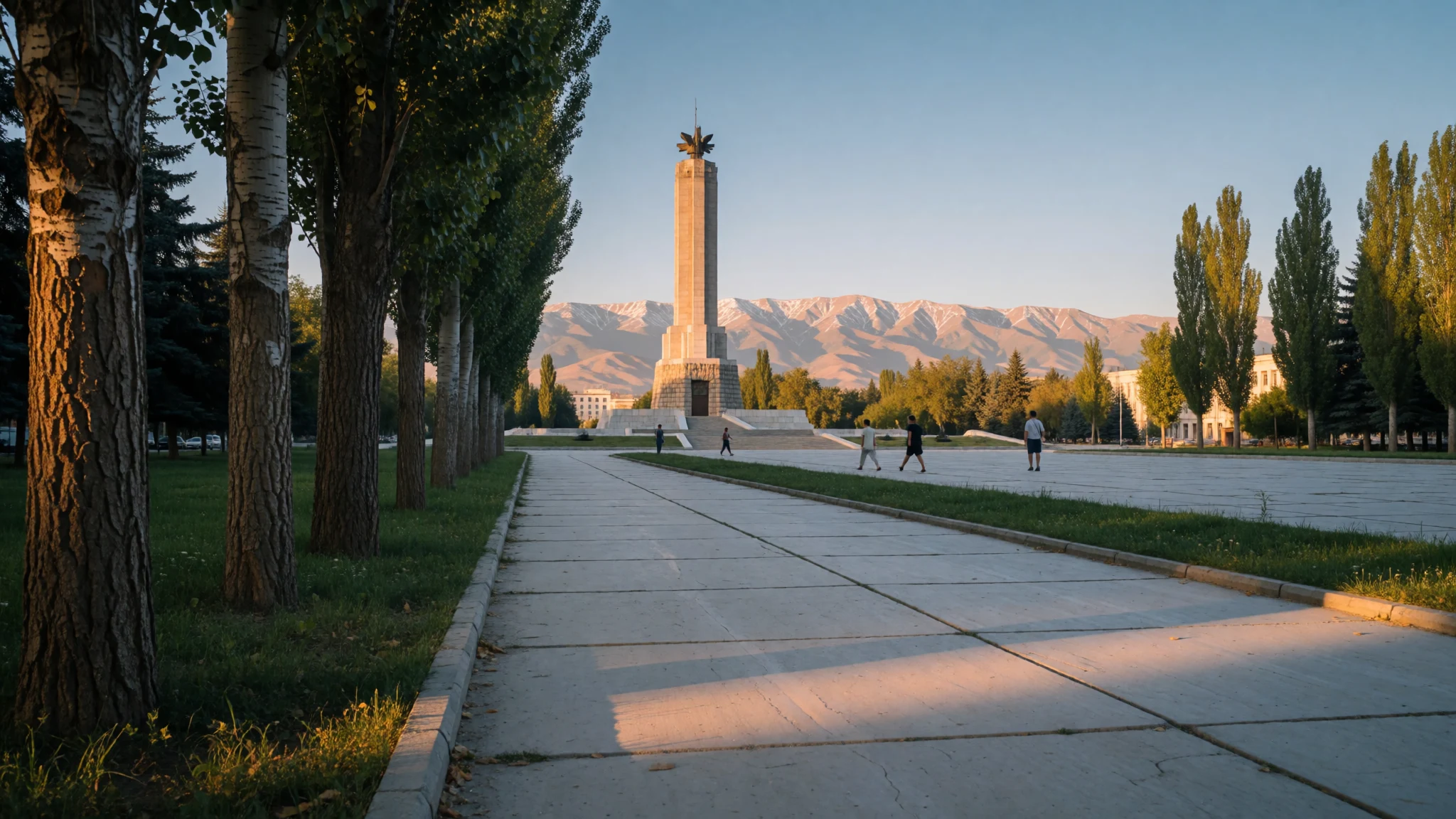
Bishkek is a green, easygoing Soviet-era capital with good museums and food, and a quick way into Kyrgyzstan's mountains.
The place
Bishkek is the capital of Kyrgyzstan, a city of about 1.2 million people on the flat northern edge of the Tian Shan, at an elevation of 750 metres. Kazakhstan lies close by to the north, and the Chüy valley spreads out around the city as farmland and open steppe. To the south the Ala-Too range rises above the rooftops, and on clear days its snow-streaked ridges work as a compass: the mountains are south, and the streets tilt gently uphill in that direction.
The centre follows a grid, a legacy of Russian and Soviet planning, with long straight avenues, wide pavements and deep shade from poplars and elms. Parks and squares come often, and the pace is unhurried compared with most capitals. Soviet apartment blocks stand beside glass offices, mosques and low houses with painted gates, while shared minibuses called marshrutkas carry much of the daily traffic.
Bishkek works better as a base than as a showpiece. Museums, galleries, markets and cafés fill a short stay comfortably, and then the mountains take over, with gorges and alpine valleys a short drive from the centre. Summers are warm and dry, and winters bring cold and snow, so the city changes character through the year. Russian is still widely spoken alongside Kyrgyz, which shows on shop signs and menus. Anyone expecting a historic old town will not find one; what the city offers is a lived-in, leafy capital with friendly food and an easy way into the country. The city administration's website, https://bishkek.gov.kg/, carries official notices.
Its story
Bishkek began as a caravan stop on a branch of the Silk Road that crossed the Tian Shan, and some accounts credit Sogdian traders with the first settlement. The recorded story starts in 1825, when the khan of Kokand raised a mud fort here, called Pishpek, to police the routes and draw tribute from nearby Kyrgyz tribes. The garrison did not go unchallenged: forces of Ormon Khan, ruler of the Kara-Kyrgyz Khanate, seized it briefly in 1844.
Russian power came next. In 1860 an army under Colonel Apollon Zimmermann flattened the fort, and in 1868 a Russian settlement, keeping the name Pishpek, was founded on the same ground as part of Russian Turkestan. It grew as a garrison and trading post, with a street grid and rows of planted trees that still define the centre.
The twentieth century brought new names. When the Kara-Kirghiz Autonomous Oblast was created in 1925, Pishpek became its capital. In 1926 it was renamed Frunze, after the Bolshevik commander Mikhail Frunze, who had been born in the town. It became capital of the Kirghiz Soviet Socialist Republic in 1936, and the name Frunze lasted until 1991, when independence brought the present name.
Genetic studies of plague victims have also pointed to the region around Bishkek as a possible origin of the Black Death in the fourteenth century, a reminder of how busy these trade routes once were.
What to see
- Ala-Too Square — Central Bishkek
Ala-Too Square is the ceremonial heart of Bishkek, a wide paved space that carried Lenin's name until independence. Festivals and political rallies both gather here, and the Erkindik (Freedom) Monument stands within it. Shade is scarce, so in summer it is better early in the morning or in the evening.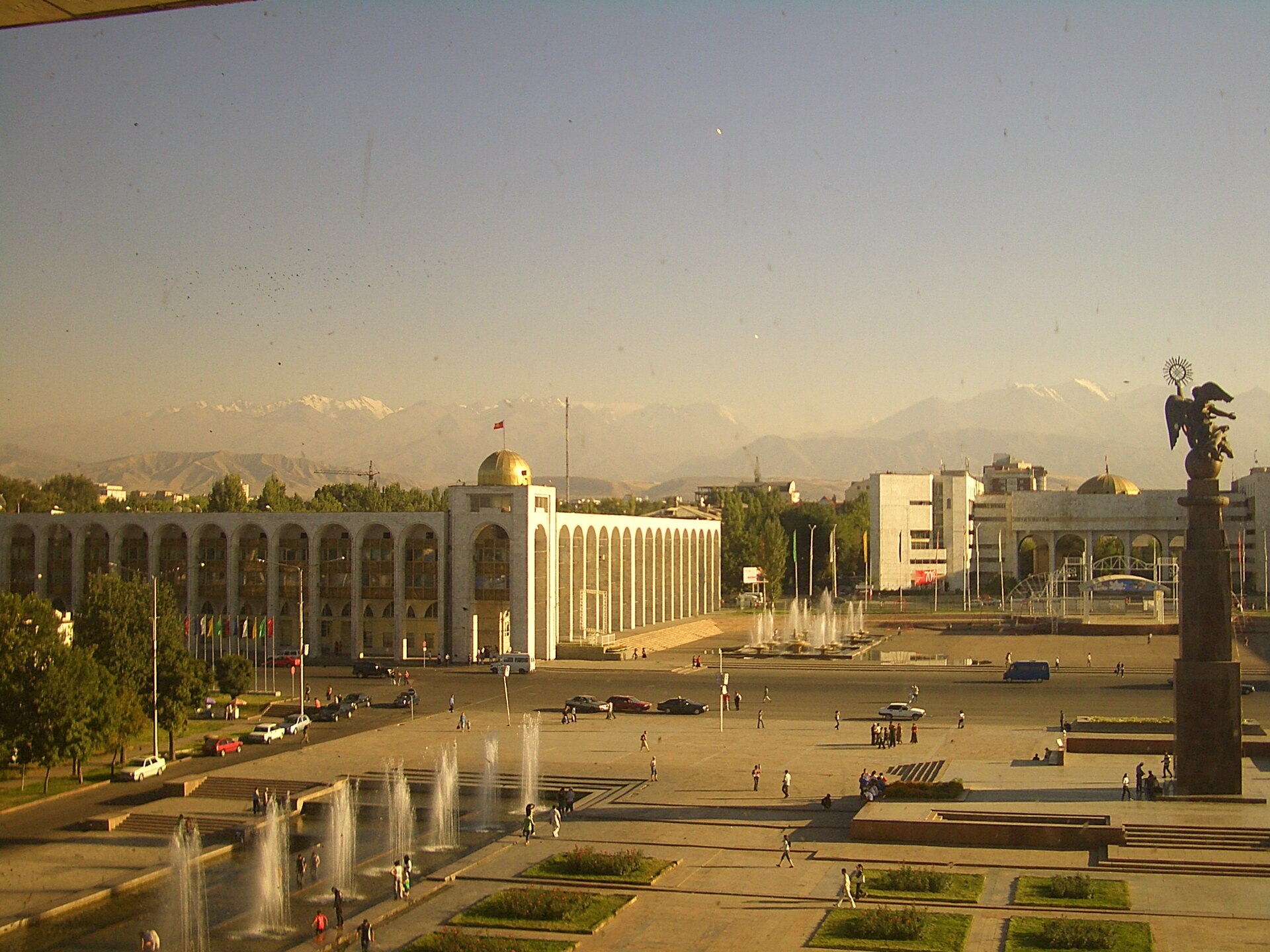
- National Historical Museum — Ala-Too Square
The National Historical Museum at Ala-Too Square tells the region's story in layers, from prehistory through the Russian and Soviet periods up to the culture of the Kyrgyz people on the upper floor. It suits a rainy or very hot afternoon. Check the official site or ask locally for opening times. - M V Frunze Museum — East of the centre
The Frunze Museum in Bishkek honours Mikhail Frunze, the general born in the town whose name the city carried for most of the Soviet era. It is a small, focused visit that shows how the period remembered its local heroes, and it pairs well with a walk through the nearby streets. - Russian Orthodox Cathedral — North-west of the centre
The Cathedral of the Holy Resurrection in Bishkek has a white and blue exterior that stands out among the trees. Inside, scaffolding has been reported while the dome frescoes are restored, so conditions may differ. Cover shoulders and knees, and keep voices low during services.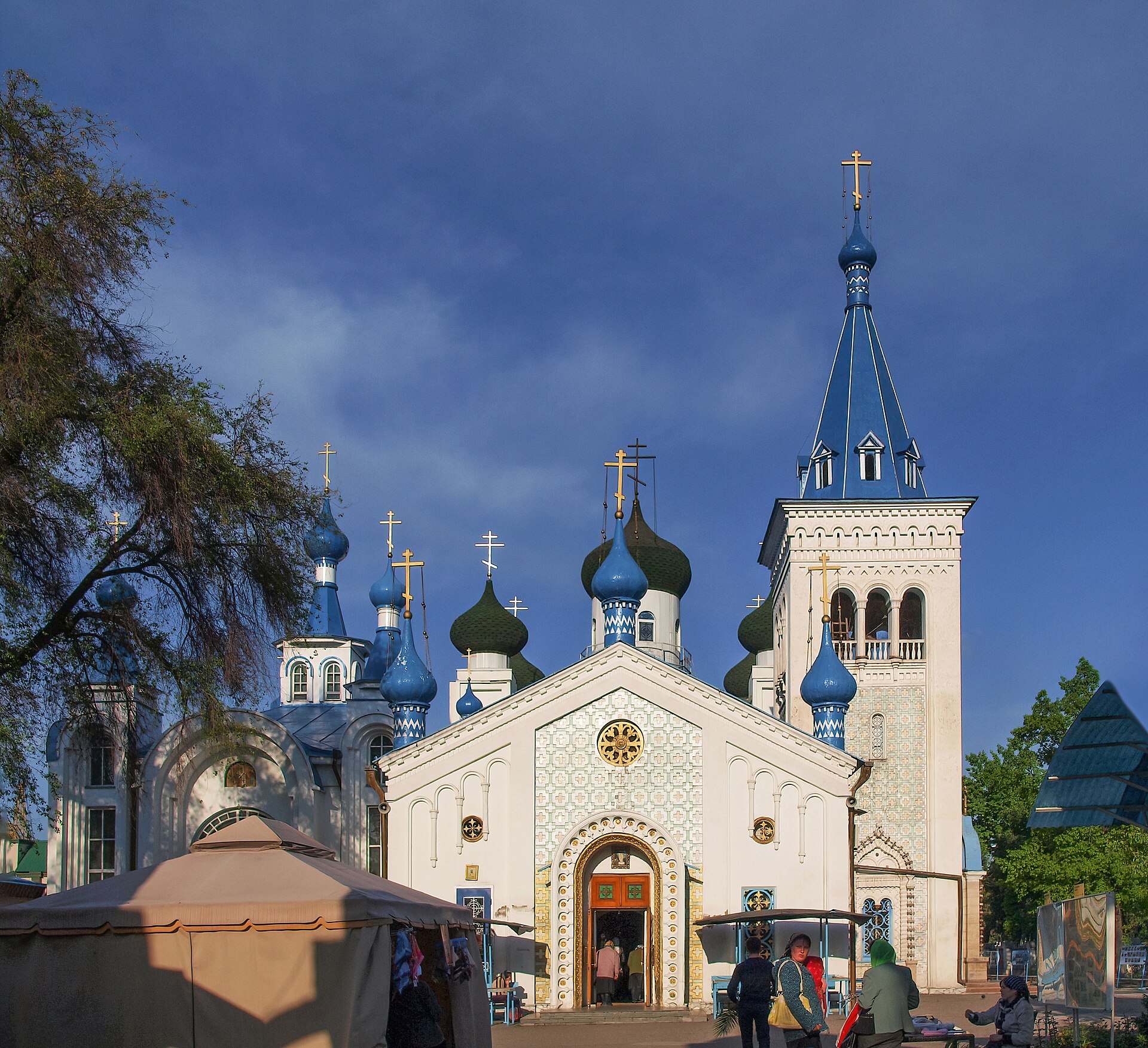
- Gapar Aitiev Fine Arts Museum — Near Ala-Too Square
The Gapar Aitiev Fine Arts Museum in Bishkek collects local painting in three strands: realist portraits and landscapes, Soviet scenes of tractors working the steppe, and modern art. The middle strand is the most revealing, since it shows how official culture pictured the countryside. - Victory Square — East Bishkek
Victory Square in Bishkek holds a monument and an eternal flame for those who died in the Second World War. It is a wide, quiet place for an evening stroll, and couples often come here for wedding photographs. Dress respectfully near the flame and avoid loud behaviour.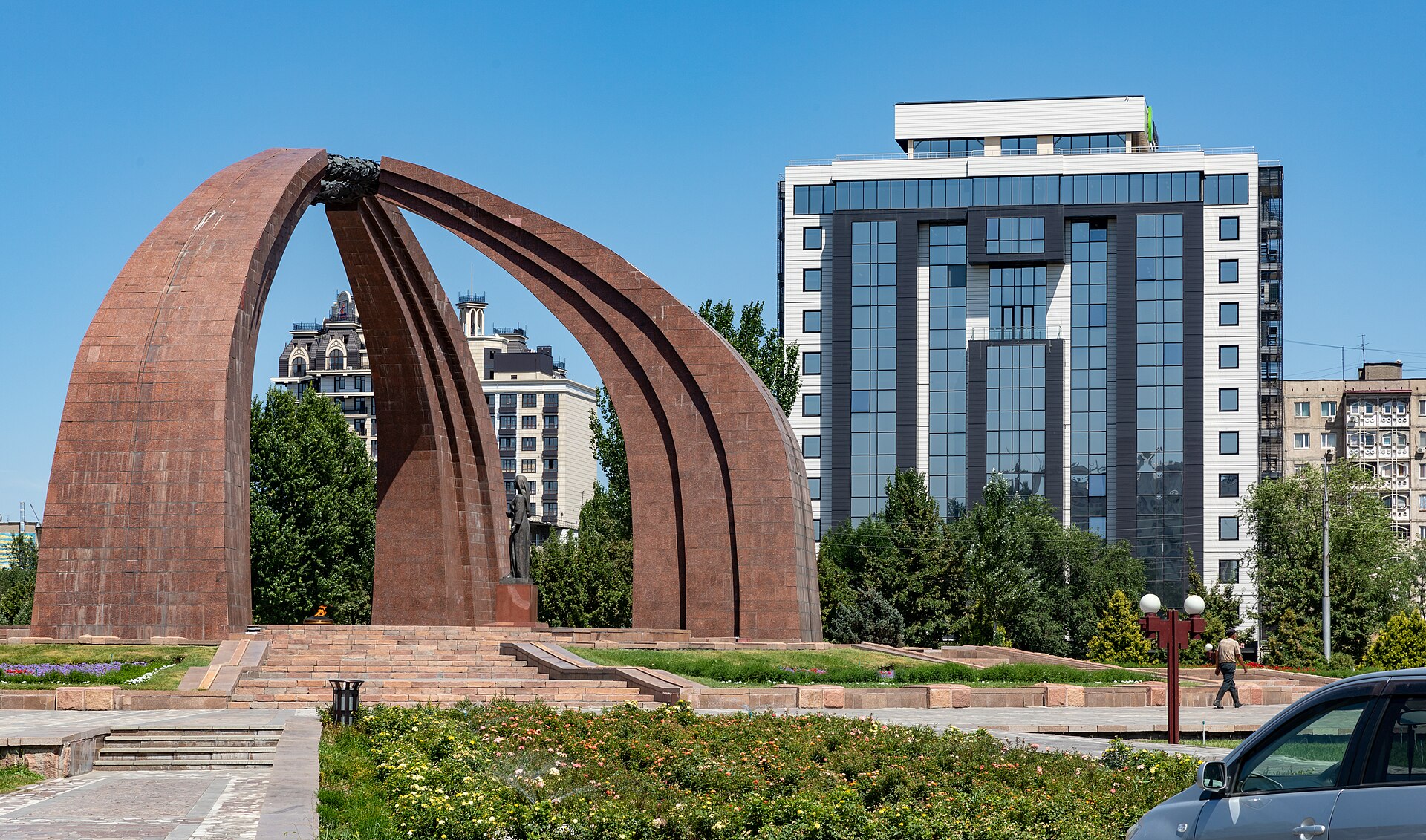
Culture
Bishkek is the cultural centre of Kyrgyzstan, home to the National Library, the national broadcaster and a cluster of museums, and its public life mixes Kyrgyz, Russian and other Central Asian threads. Most residents are Sunni Muslim, with a sizeable Russian Orthodox community and a Catholic administration for the country, so the call to prayer, church bells and Soviet-era monuments share the same streets. Daily religion is relaxed, and social life revolves more around family, tea and shared meals. The press reflects the mix: English-language and Russian-language papers appear alongside Huimin bao, which is printed in the Dungan language. Football is a popular pastime, and Dolen Omurzakov Stadium is the ground that can host international matches.
Nomadic heritage runs under everything. Yurts, felt, horsemanship and the epic poetry of the Manas tradition appear at festivals and in museums, and hospitality is a point of pride: a guest invited to a table should expect bread, tea and sweets to keep arriving. Russian often serves as the common language between communities, and a few words of Russian or Kyrgyz are received warmly. Take your shoes off at the doorway of any home, and cover shoulders and knees before entering a mosque or church.
What to wear
Bishkek's traditional dress comes from the Kyrgyz nomadic past, and it is worn mainly for weddings, national holidays and festivals. The best known piece is the ak kalpak, a tall white felt hat with dark trim, worn by men on formal occasions. Felt, made from sheep's wool, is the central textile, shaped into hats, boots, coats and the patterned shyrdak carpets sold in tourist shops. Women's festive wear includes embroidered velvet waistcoats and, in older styles, the elechek headdress, while padded chapan coats belong to the countryside and cold weather.
On the street, most people dress in a modern, fairly smart style: jeans, jackets, trainers and office wear, with plenty of fashion bought from the huge clothing stalls of Dordoy Bazaar. Headscarves are common but not universal, and short sleeves and summer dresses are seen widely in the capital, although dress is more conservative in villages.
Visitors should plan for strong swings in weather. Summer calls for light cotton, a hat and sunscreen; winter needs a proper coat, hat and boots with grip for icy pavements. Comfortable walking shoes matter on uneven kerbs. Carry a scarf or shawl and wear sleeves and long trousers or skirts for mosques and churches. For day trips into the mountains, bring layers and waterproofs, since conditions change fast.
What to eat
- Laghman — Neighbourhood canteens and family cafés across the city
Laghman is a bowl of hand-pulled noodles in a savoury sauce of meat and vegetables, sometimes served as a soup. It is an everyday lunch in Bishkek and a good test of any café, particularly ones that locals queue for. - Samsa — Bakeries, market stalls and street kiosks
Samsa are flaky baked pastries filled with spiced mutton or beef and onion, often still hot from the oven. They make a quick, cheap snack between museums, and are best eaten fresh, straight from the baker. - Manty — Traditional Kyrgyz and Central Asian restaurants
Manty are large steamed dumplings stuffed with chopped meat and onion, usually served with sour cream or a simple sauce. They are filling and mild, so they suit anyone new to the cuisine. - Plov — Lunch canteens and bazaar food courts
Plov is rice cooked with carrot, onion and meat in one heavy pot, a dish shared across Central Asia. In Bishkek it is a staple at lunch and at celebrations, often arriving as a heaped plate to share. - Beshbarmak — Restaurants serving national cuisine and family celebrations
Beshbarmak is the festive dish of boiled meat laid over flat noodles with an onion broth on the side. Its name means five fingers, a nod to how it was once eaten. It appears at weddings and gatherings. - Shawarma — Street kiosks and small eateries around the centre
Shawarma, or doner-style meat wrapped in flatbread with salad and sauce, is the city's standard street meal. Good versions are busy and quick, with the meat carved to order. It suits late evenings after the markets close.
Plan it
Best time. May–June and September for warm, settled weather and clear views of the Ala-Too range. July and August are hot, and winter is cold with snow, though the city stays open year-round.
How long. 2–3
Getting there. Fly to Manas International Airport, the city's airport. From there, public buses and shared minibuses run into the centre in daytime, and a bus company also serves central stops, though schedules change often. The main airport bus takes bank cards but not cash, so confirm before boarding. Taxis booked by app are an easy alternative.
Budget. low
Tips
- Carry a bank card and some cash, since payment rules vary between buses, markets and cafés
- Confirm minibus routes and last services locally, because many stop running in the early evening
- Avoid the midday sun in summer and use the shaded avenues and parks
- Allow time for day trips into the mountains, and check the weather before leaving
- Carry bottled or filtered water and ask your accommodation about tap water
Etiquette
- Remove shoes at the doorway when visiting a home
- Cover shoulders and knees at mosques and churches
- Ask before photographing people, especially at markets and religious sites
Nearby
Sources
- Wikidata Q9361 (CC0)
- Wikipedia: Bishkek (rev 1380854173) (CC BY-SA 4.0)
- Wikivoyage: Bishkek (rev 5395201) (CC BY-SA 4.0)
- Photo: Bishkek's City business center (CC0 1.0)
- Photo: City Hall, Bishkek (CC BY-SA 4.0)
- Photo: Victory Square, Bishkek (CC BY 2.5)
- Photo: Ala Too Square, Bishkek (CC BY-SA 1.0)
- Photo: Alma-Ata NK-43 (1948) (Public domain)
- Photo: Russian Orthodox cathedral in Bishkek (CC BY 3.0)
- Photo: Dordoy Bazaar clothing (CC BY-SA 1.0)
- Photo: American University of Central Asia, Bishkek (2005) (CC BY-SA 2.5)


