Jellyfish Lake
Jellyfish Lake, Palau
Jellyfish Lake in Palau lets swimmers float on the surface among thousands of harmless golden jellyfish in a sea-fed lake hidden inside an island.
The place
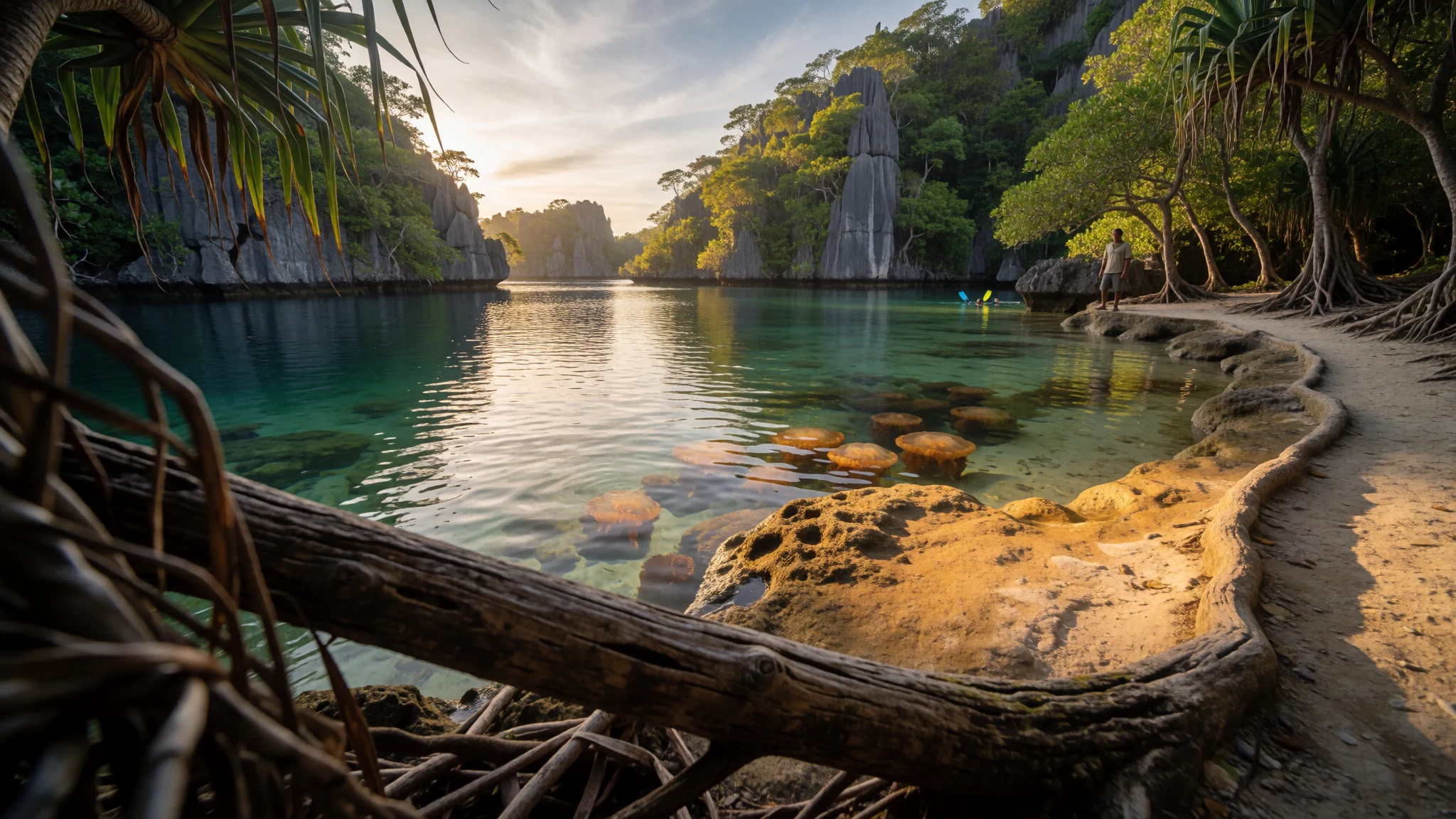
Jellyfish Lake lies on Eil Malk, one of the Rock Islands, a crowd of limestone knolls capped in dense green that fills Palau's Southern Lagoon between the town of Koror and the island of Peleliu. Nearly all of these islands have no residents, and the water around them shifts from pale turquoise to deep blue within a few boat lengths. Eil Malk's lake is not a lake in the freshwater sense. It is a marine lake, a pocket of sea held inside the island and linked to the lagoon only by cracks and tunnels in old reef limestone laid down in the Miocene. The Palauan name, Ongeim'l Tketau, translates as Fifth Lake. Many other marine lakes are scattered across the Rock Islands, but this is the only one currently open to visitors. The water inside is calm, slightly murky green near the edges and warm at the surface. Trees lean over the shore and the bottom drops away quickly into darkness. The deeper water carries no oxygen, which is one reason scuba diving is not permitted, so everyone goes in on the surface with mask, snorkel and fins. The visit has a fixed shape. Boats leave from Koror and take about 45 minutes to reach Eil Malk. A short trail climbs from a small beach over the island's ridge and drops to a wooden landing at the lake edge. Beyond the landing, golden jellyfish drift in the thousands, sometimes thickening into clouds, sometimes thinning to a handful near the shore. Most trips allow around an hour in the water, so the experience is brief but vivid, and it depends heavily on the day's light and on how the jellyfish are behaving.
Its story
Jellyfish Lake began as a piece of open sea. When the ancient reef under Eil Malk rose and hardened into limestone island, a basin inside it was left holding seawater, topped up ever since through narrow channels in the rock. Over a very long span the animals in that basin became cut off from the lagoon outside. Few species made it in and fewer still thrived, so the lake's community is a thin version of the lagoon's. Among the survivors is the golden jelly, Mastigias papua etpisoni. With the lagoon's usual hunters kept out, it has changed, and today it looks and behaves differently from relatives a short boat ride away. Its stinging cells are weak and seldom trouble human skin, though a faint prickle is possible. Its colour comes from algae living in its tissues, which feed on sunlight, and that explains the daily routine. Each morning the jellies stream towards the sunlit side of the lake, and as the sun moves they swing across the water, steering around the shadows thrown by trees on the shore. The rules for visitors follow from the lake's chemistry and fragility. Scuba bubbles can lodge under a jellyfish's bell and harm it, and the oxygen-free layer that starts at about 15 metres holds hydrogen sulphide, which a diver can absorb through the skin with deadly results. Access has also been closed at times when jellyfish numbers fell, so the lake's story is still being written, and a visit depends on its condition that season.
What to see
- The jungle trail over Eil Malk — Eil Malk, Rock Islands
From the landing beach, a short, steep path climbs through damp forest and drops to the lake. It can be slippery after rain and rough on bare feet, so sturdy water shoes help. The walk is brief but it sets the mood, because the lake is hidden until the last turn.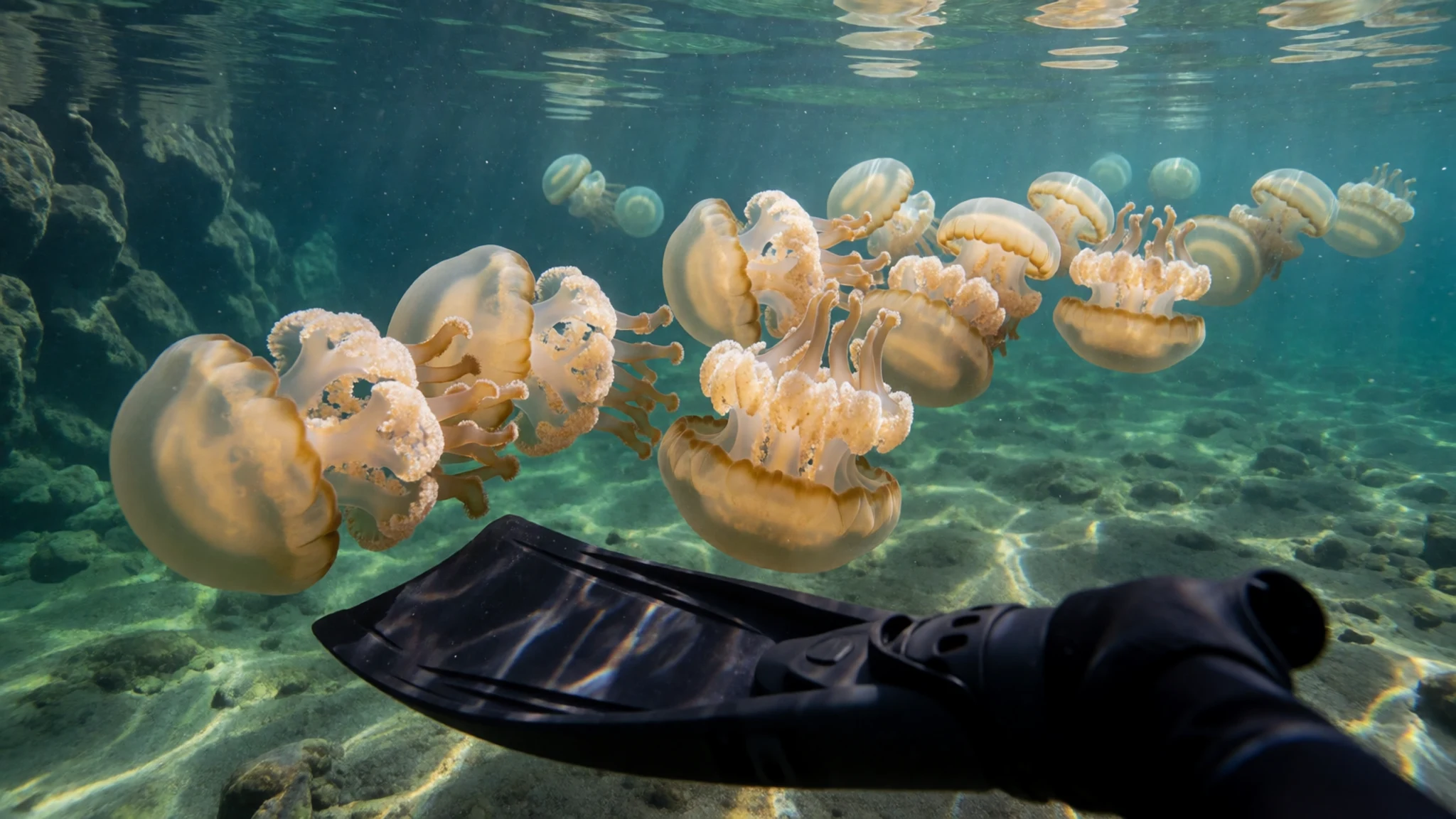
- Snorkelling among the golden jellies — Jellyfish Lake
This is the reason for the trip. Swimmers float face-down while soft, amber-coloured bells pulse past arms and masks. Moving slowly is the trick, since splashy kicking sends the jellies away. Even close contact usually feels like little more than a gentle brush against the skin.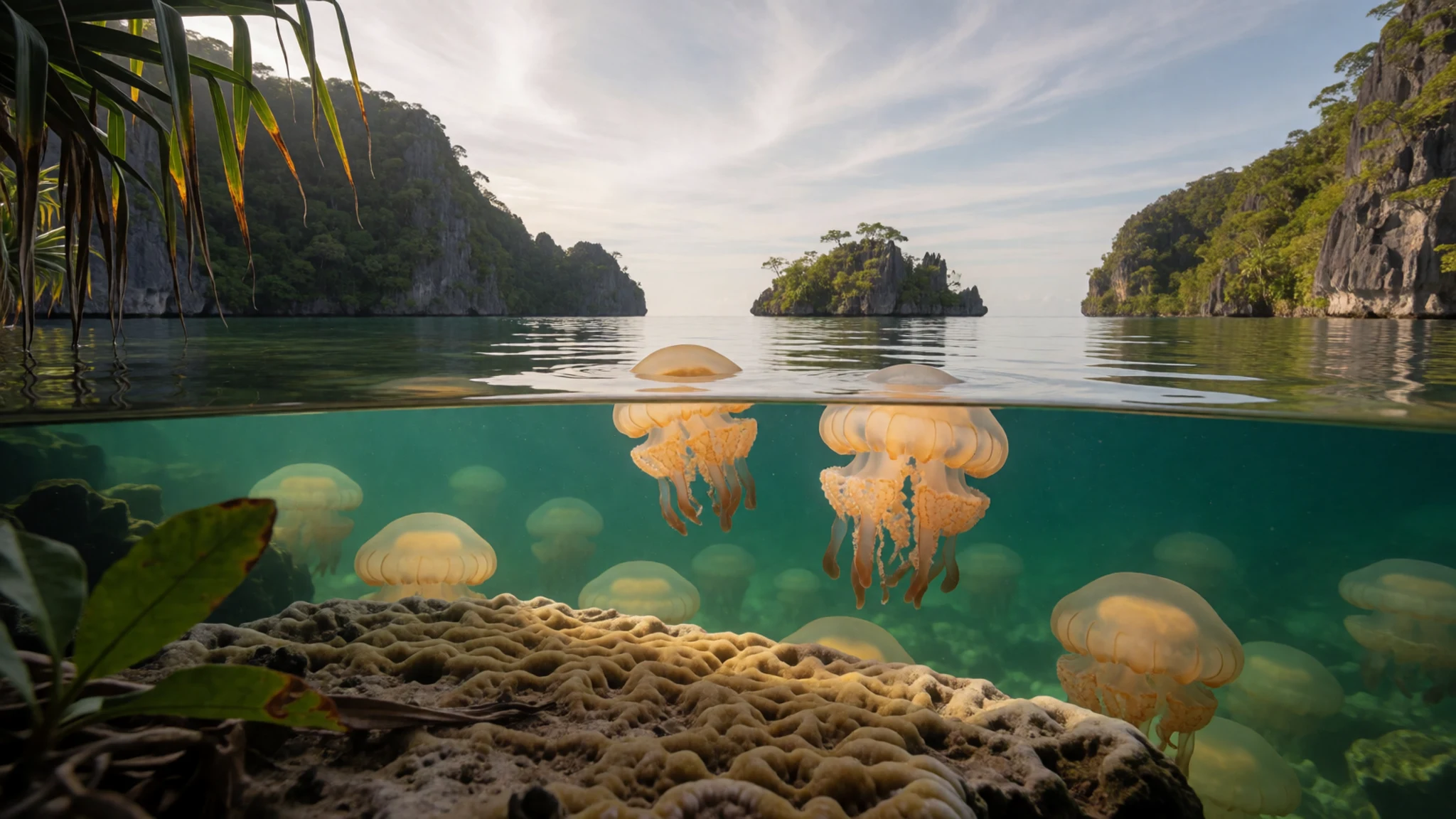
- The field of floating jellies — Jellyfish Lake
On a good day the surface fills with jellies sweeping towards the sun, and the water seems to glow from within. Looking down shows layer upon layer of bells fading into darkness. The density changes by the hour, so a second swim later in the trip can look completely different.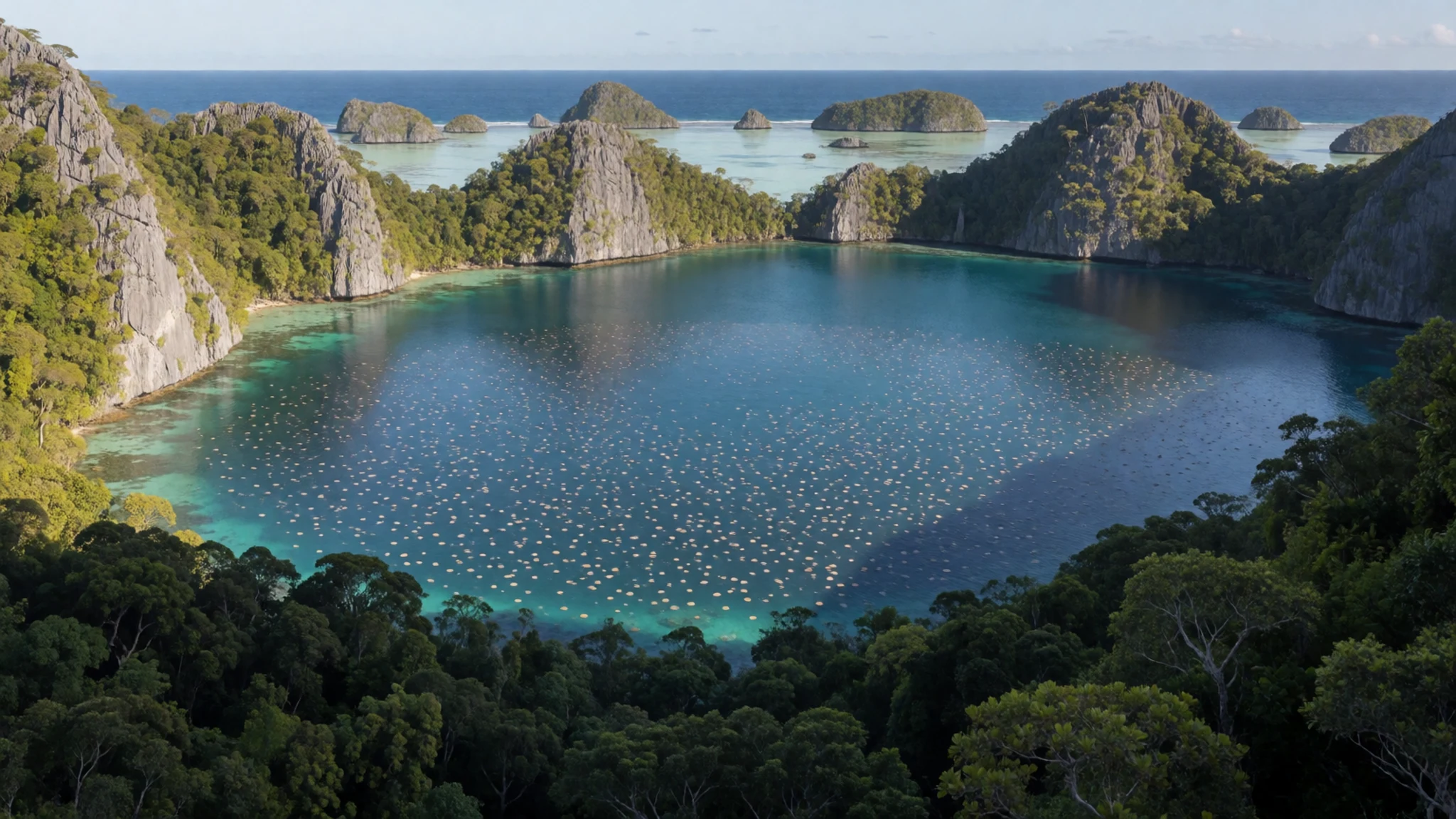
- Above and below the surface — Jellyfish Lake
Half-submerged photography shows how the lake works: forest and sky overhead, drifting jellies below, with little between them but a thin line of water. Keeping a camera at the waterline gives the clearest sense of scale, and a wrist strap saves it from sinking.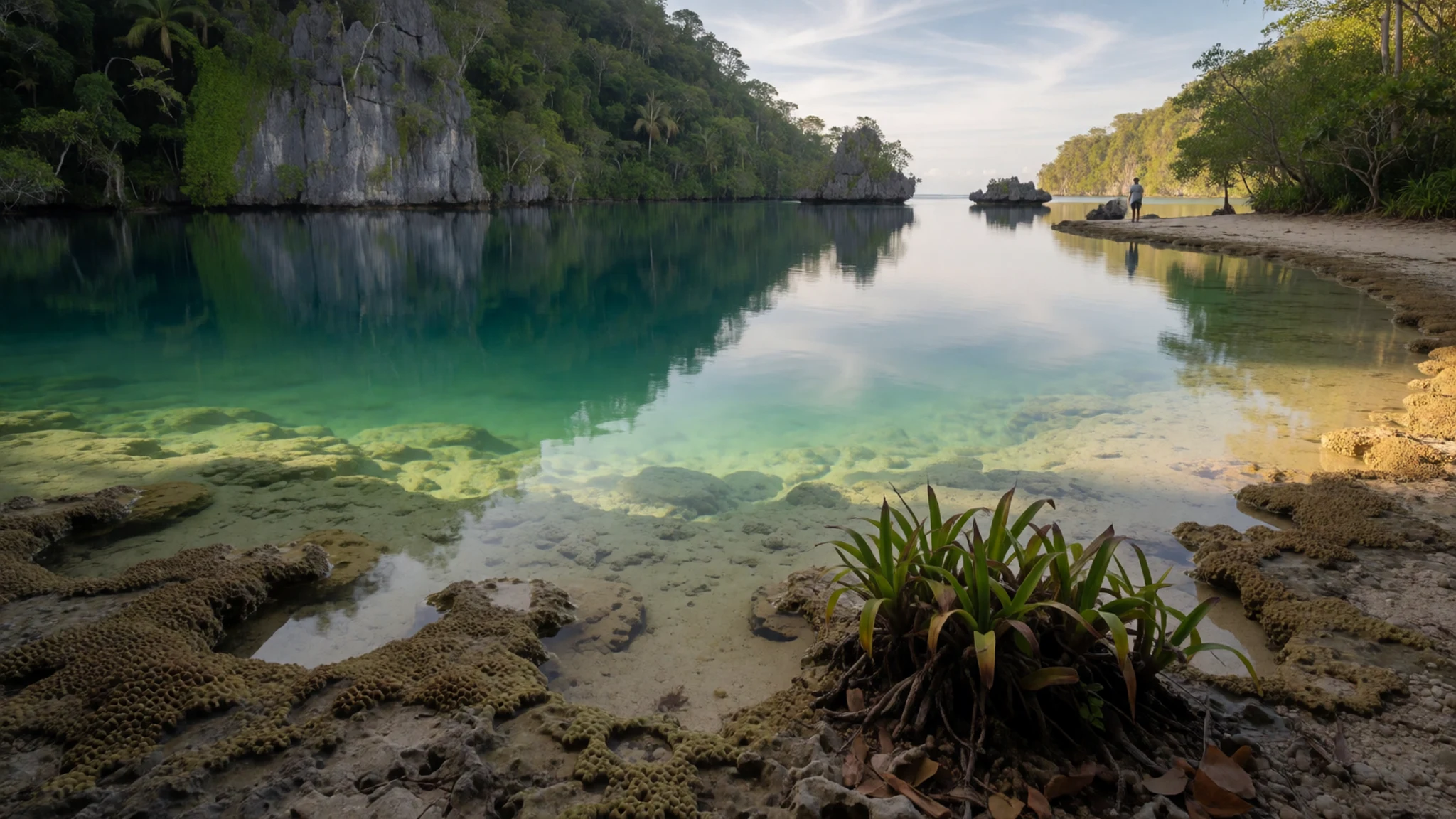
- The Rock Islands from the boat — Southern Lagoon, between Koror and Peleliu
The boat ride from Koror is part of the day. Mushroom-shaped limestone islets, green to the waterline and undercut by the sea, slide past in an almost uninterrupted line. The aerial photograph shows how small the lake is against the lagoon, a dark patch sealed within the island.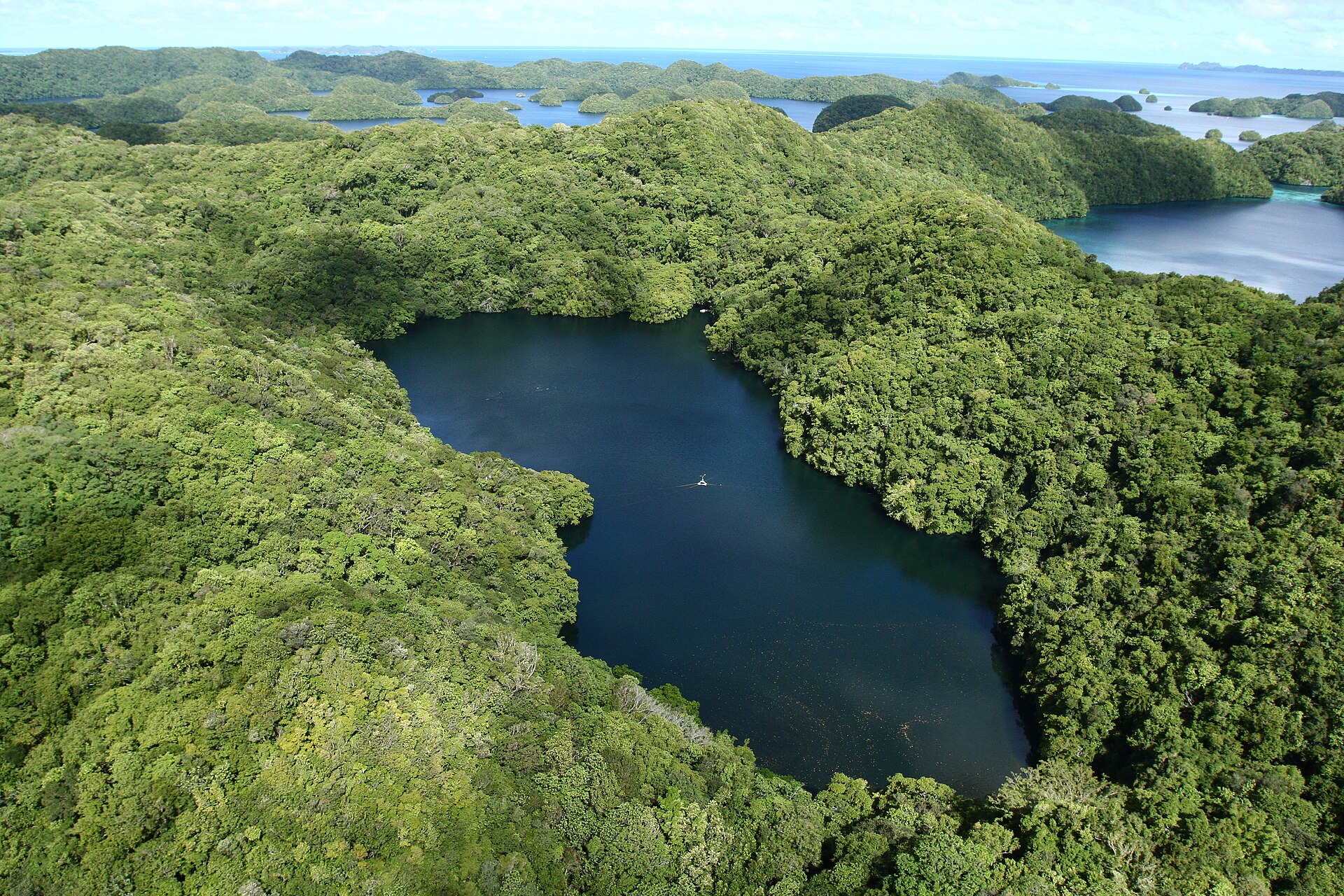
Culture
Jellyfish Lake sits in a country where the sea shapes daily life, and the Palauan name, Ongeim'l Tketau, is a reminder that these marine lakes were known and counted long before they were marketed. Today the lake is one of the main draws of the Rock Islands, and the system around it reflects that. Visitors need a pass for the Rock Islands and the lake, trips run through licensed operators based in Koror, and there are firm rules about what may and may not happen in the water. These are not red tape for its own sake. The lake is small, its jellyfish are specialised, and a bad season shows how quickly numbers can change. Guides in Palau are generally relaxed but serious about those rules, and a briefing before the walk is normal. Respect for the place also means respect for the neighbours: Koror is a working town, and the islands beyond are largely uninhabited and quiet. People tend to speak softly on the trail, and the lake itself is treated as something to be shared with its inhabitants, not owned. It also helps to know that Palauan and English are both widely spoken, so a few polite words in Palauan, offered as a greeting, are usually welcomed. Photography is encouraged, but the animals are the point, not the backdrop. Do not touch, grab or chase the jellyfish, do not stand on the lake bed, and follow your guide's instructions on what to wear and carry into the water.
What to wear
Dress at Jellyfish Lake is simple, but Palau's wider dress traditions give useful context. Traditional Palauan clothing relied on plant fibres, including woven leaves and grass worn as skirts, and such pieces now appear mainly at ceremonies, dance performances and cultural festivals rather than in everyday life. Details vary by occasion, and visitors who want to see them are best placed at a cultural event or museum in Koror. Day to day, people in Palau wear what suits a hot, humid island: cotton shirts, shorts, light dresses, sandals and caps, with smarter clothes for church and office. Rash vests and board shorts are common on boats. For the lake, a visitor should wear swimwear under a quick-drying top, with a long-sleeved rash vest to protect shoulders from sun and from the occasional brush of a jellyfish. Water shoes or sturdy sandals matter more than anything else because the trail is steep, rocky and slick, and the landing is wooden. Fins are usually supplied by operators but ask beforehand, and bring a mask that fits properly, since a leaking mask spoils the view. In Koror and villages, shoulders and knees covered is polite, and a light shirt or sarong is enough for a church or community building. Pack a hat, a towel and a dry bag, since boat spray reaches everything.
What to eat
- Fresh tuna sashimi — Eateries and seafood restaurants in Koror
Raw reef and open-water fish, sliced thin and served with soy and wasabi, reflects the strong Japanese influence on eating in Palau. Look for it at casual eateries and seafood places in Koror, where the catch often arrives the same day.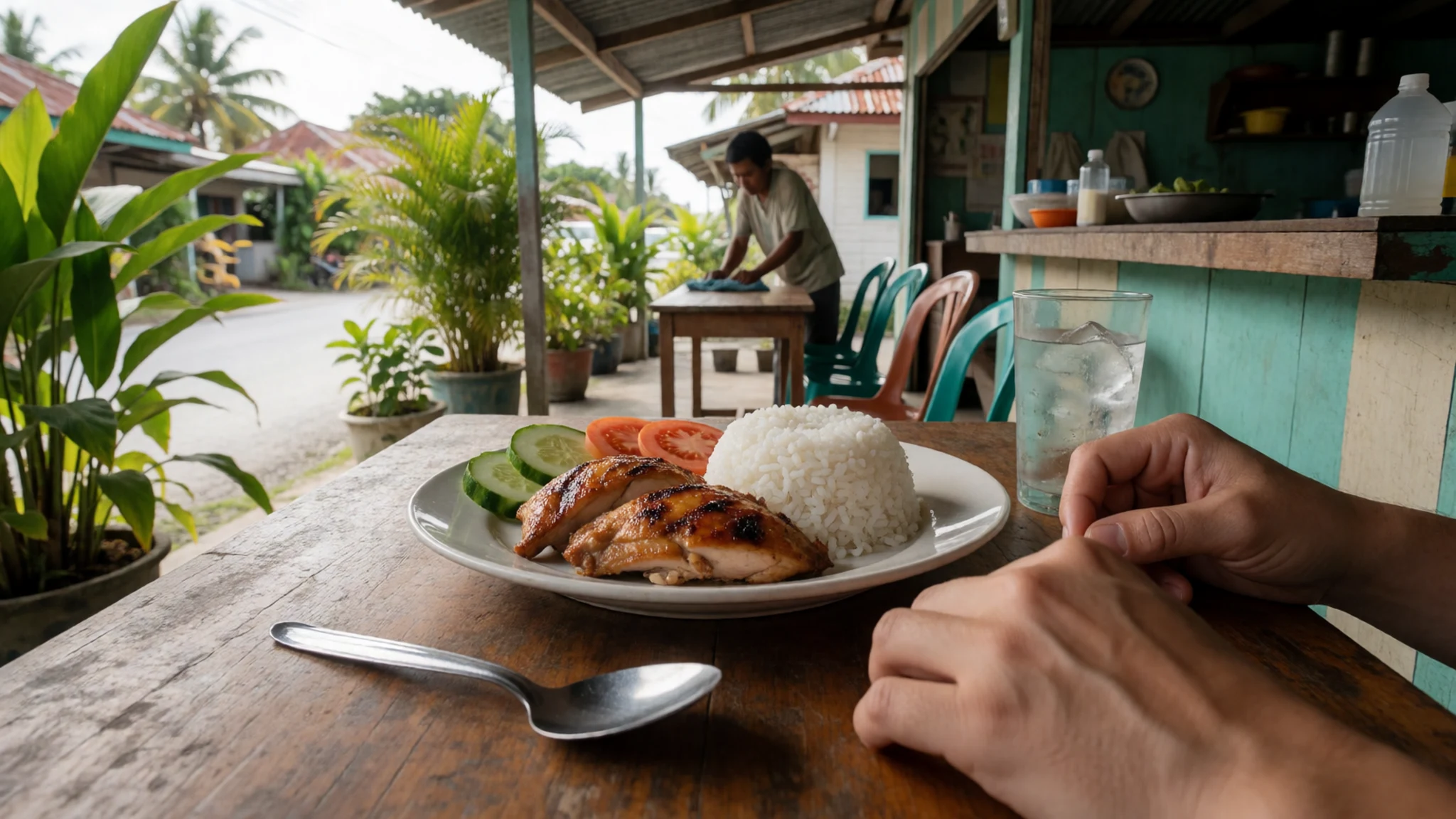
- Taro (kukau) — Local markets and home-style eateries in Koror
Taro is a traditional starchy staple, boiled or steamed until soft, with a mild, slightly nutty flavour. It turns up beside fish and in community feasts, and is a good way to taste the older food of the islands.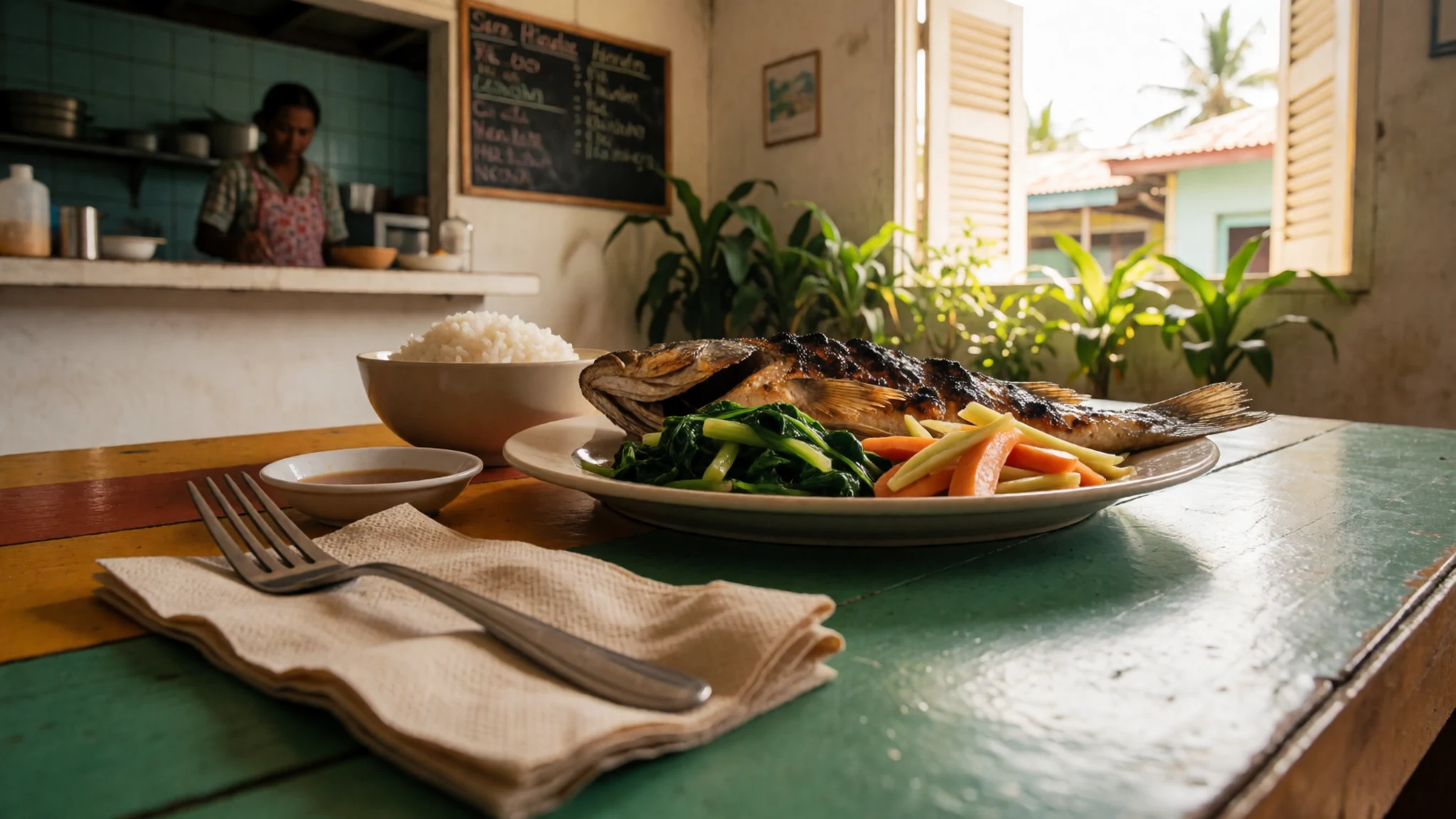
- Cassava and tapioca — Family-run eateries and community events
Cassava, another root staple, is served boiled or in sweet puddings made with coconut milk. It is filling, plain and satisfying after a morning of snorkelling, and good with fish. - Grilled reef fish with rice — Picnic lunches on Rock Islands tours
A whole or filleted fish grilled over heat and served with rice is the standard lunch on many boat trips to the Rock Islands. It tastes of char and sea salt and is usually eaten on a beach. - Fresh coconut — Roadside stalls and markets around Koror
Green coconuts are cut open to drink the cool, lightly sweet water, then scraped for the soft flesh. After a hot walk to the lake and back, it is the most welcome refreshment on offer.
Plan it
Best time. Palau is warm all year and rain can come in any month. The drier stretch, roughly February to April, usually gives calmer seas and brighter light for the boat ride and the swim, though weather varies, so check the forecast before booking.
How long. 2–3
Getting there. Fly to Palau's international airport on Babeldaob, then travel by road to Koror, the usual base. From Koror, licensed tour boats take about 45 minutes to Eil Malk, and a short trail leads to the lake.
Budget. high
Tips
- Book through a licensed Koror operator and confirm the lake is open, since access has been closed when jellyfish numbers fall
- Get the required Rock Islands pass before boarding and check current rules and fees with the official Palau tourism authority
- Take a morning trip, when the water is calm and the light is good for seeing the jellies
- Ask your operator about sunscreen rules and wear a rash vest instead
- Carry water, a dry bag and some cash for small purchases in Koror
Etiquette
- Do not touch, chase or grab the jellyfish, and swim slowly
- Do not scuba dive in the lake; it is not permitted and can be dangerous
- Follow your guide's briefing on the trail and keep to the marked path
Nearby
Sources
- Wikidata Q263422 (CC0)
- Wikipedia: Jellyfish Lake (rev 1373995790) (CC BY-SA 4.0)
- Wikivoyage: Palau (CC BY-SA 4.0)
- Photo 01: Jellyfish Lake aerial (March 2008), Lukas (CC BY 2.5)
- Photo 02: Mastigias papua comparison, Dpallan / CT Snow / Davefoc (CC BY 3.0)
- Photo 03: Mecherchar with jellyfish lake, USGS (Public domain)
- Photo 04: Snorkeling with Jellyfish, tata_aka_T (CC BY 2.5)
- Photo 05: Above and below Jellyfish Lake, CT Snow (CC BY 2.5)
- Photo 06: Field of floating jellies, Shinji (CC BY 2.5)
- Photo 07: Jellyfish Lake (panoramio), FoxyStranger Kawasaki (CC BY 3.0)
- Photo 08: Jellyfish Lake aerial, focus on jellyfish, Lukas (CC BY 2.5)


Wildlife
- Golden jellyfish (animal)
The golden jellyfish is a soft, drifting creature that carries tiny sunbathing algae inside its body, rather like a living greenhouse. In Jellyfish Lake it does not simply wander aimlessly: each day it travels sideways across the water, making a glowing, golden pattern. Ask your guide where the pulsing crowd has gathered today. Watch calmly and quietly, keep a respectful distance, remember that it carries stinging cells, and never feed it.