Issyk-Kul
Issyk-Kul, Kyrgyzstan
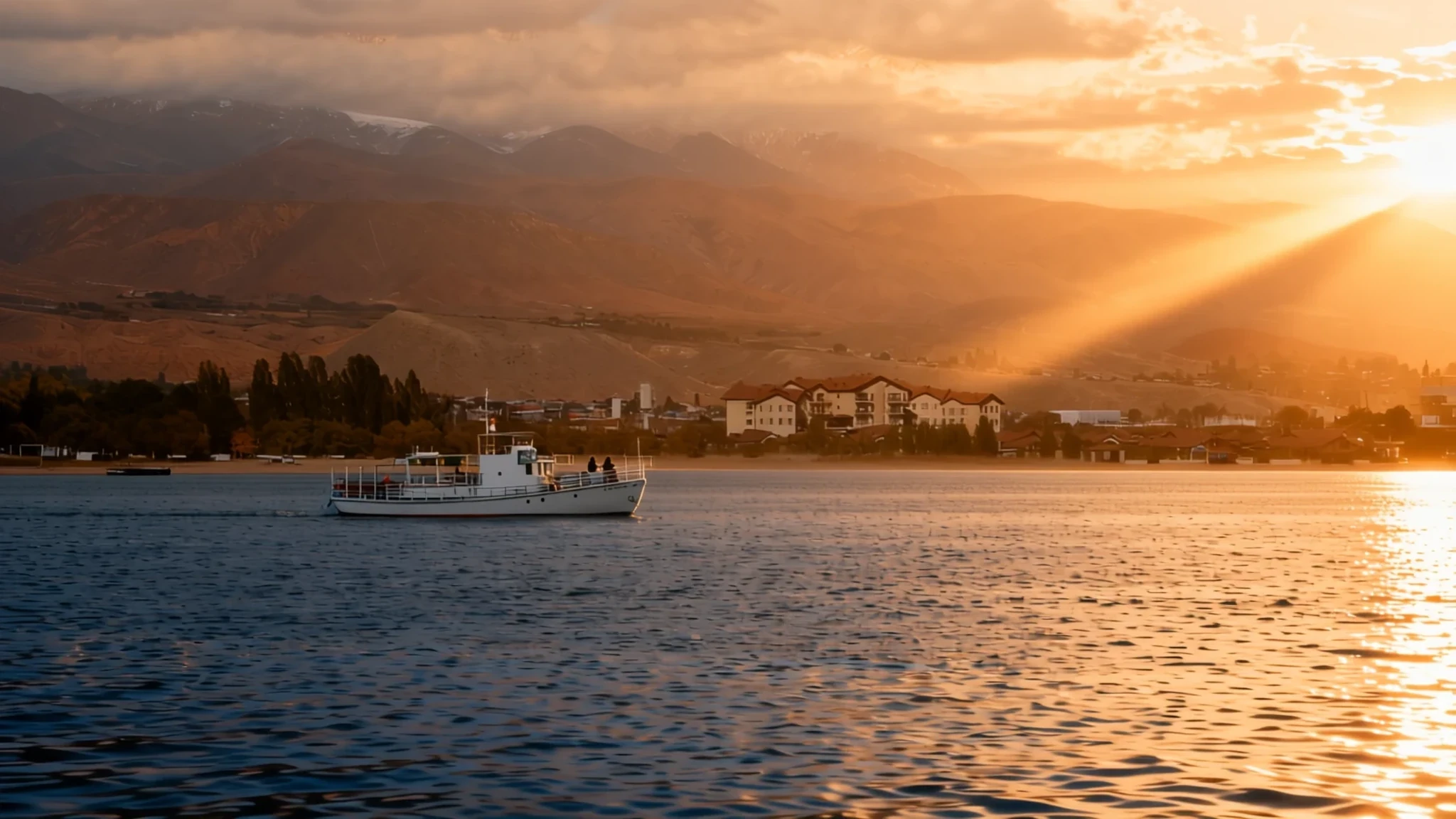
Issyk-Kul is a high mountain lake in Kyrgyzstan, ringed by the Tian Shan, where yurts, orchards and a long sandy shore meet.
The place
Issyk-Kul sits in a high basin of eastern Kyrgyzstan, a closed lake with no outlet to the sea, held between the Kungey Ala-Too to the north and the Teskey Ala-Too to the south. The northern range drops toward resorts and villages; the southern range is steeper and quieter, with a thinner scatter of settlements. The water is slightly saline and turns a deep blue when the wind rises. Kyrgyz speakers call it Ысык-Көл, a name usually glossed as hot lake, because the water is saline enough that it rarely freezes.
The shore changes from end to end. At the western end the lake narrows toward the town of Balykchy, where the main road from Bishkek arrives and the water is shallower and reedier. Along the north, poplars, apple orchards and Soviet-era sanatoriums sit behind a beach of pale sand and pebbles. Cholpon-Ata is a busy lakeside town on that shore, with a promenade, a petroglyph museum and a horizon of snow-streaked rock. Eastward the shore bends to Karakol, a grid of low wooden houses and a market that feeds both the lake and the valleys behind it. The south coast is a different journey: fewer swimmers, more shepherds, and gorges that cut back into the Teskey Ala-Too toward passes used by herders and, in season, trekkers.
Wind shapes a day on Issyk-Kul. In the warm months the beaches fill with families from Bishkek and Almaty; outside that season the sanatoriums empty, the yurt camps come down, and the basin returns to pasture and livestock.
Its story
Issyk-Kul has stood on routes between the steppe and the inner ranges for as long as those routes have been walked. Caravans did not cross the water; they followed the shore, moving horses, felt and grain between the valleys of the Tian Shan and the cities beyond either end. The petroglyph fields above Cholpon-Ata, animals and hunts and sun-like signs pecked into dark boulders, are an early visible trace of people who used these pastures long before a written chronicle.
Medieval geography knew the lake well enough for it to appear on maps made far away. The Catalan Atlas of 1375 draws Issyk-Kul and a short inscription, evidence that the basin had a place in a world map compiled on the Mediterranean. Closer to the shore, gravestones cut for a Nestorian Christian community, among them a stone dated 1312, record a faith that travelled the same roads as silk and horses and then faded from the region. The stones are easy to overlook beside a modern beach.
In later centuries the north shore became a place of rest as well as passage. Imperial Russian and then Soviet authorities built sanatoriums here for summer rest. Karakol grew as the administrative town at the eastern end, a wooden city with a Dungan mosque, a Russian Orthodox cathedral and a market supplied by farmers and herders together. After Kyrgyzstan became independent the sanatoriums fell on hard times, and hotels and small guesthouses are only now being refurbished, while herders still take livestock up toward the passes.
What to see
- North shore beaches — North shore, Balykchy to Cholpon-Ata
Issyk-Kul's north shore is the swimming side of the lake. Between Balykchy and Cholpon-Ata the water meets a pale beach backed by poplars, orchards and a line of sanatoriums and guesthouses. Families come for the sand, the promenades and a view straight across to the Teskey Ala-Too. Afternoon wind roughens the surface, so the calmest swimming is early.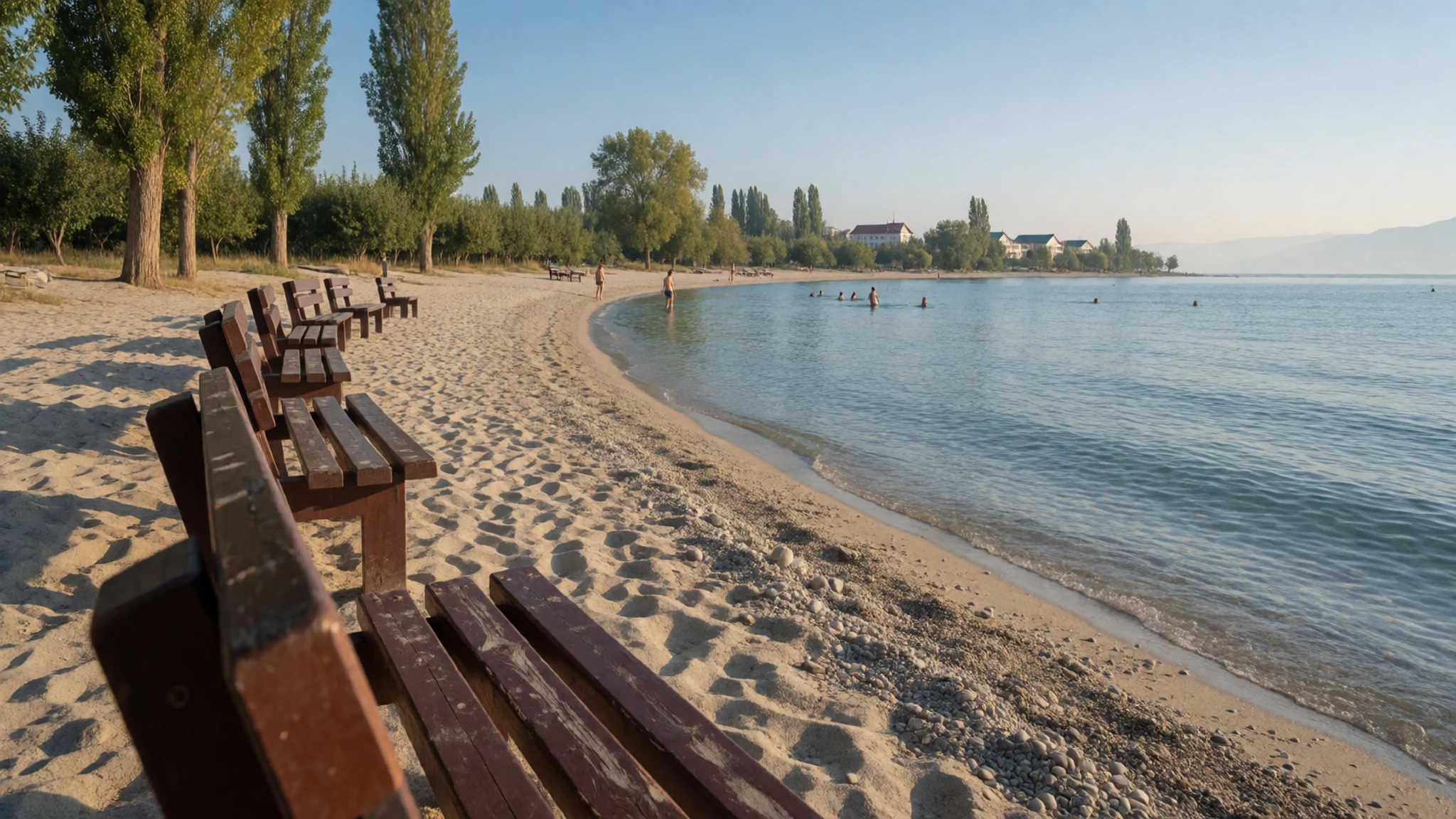
- Cholpon-Ata petroglyphs — Cholpon-Ata
Cholpon-Ata, on Issyk-Kul's north shore, keeps an open-air field of petroglyphs on the stony slope above the town. Animals, hunters and round sun-like marks are pecked into dark boulders scattered through the grass, with the lake visible below on a clear day. A small museum on the site explains the stones without fencing the whole hillside, so walking the field is part of the visit.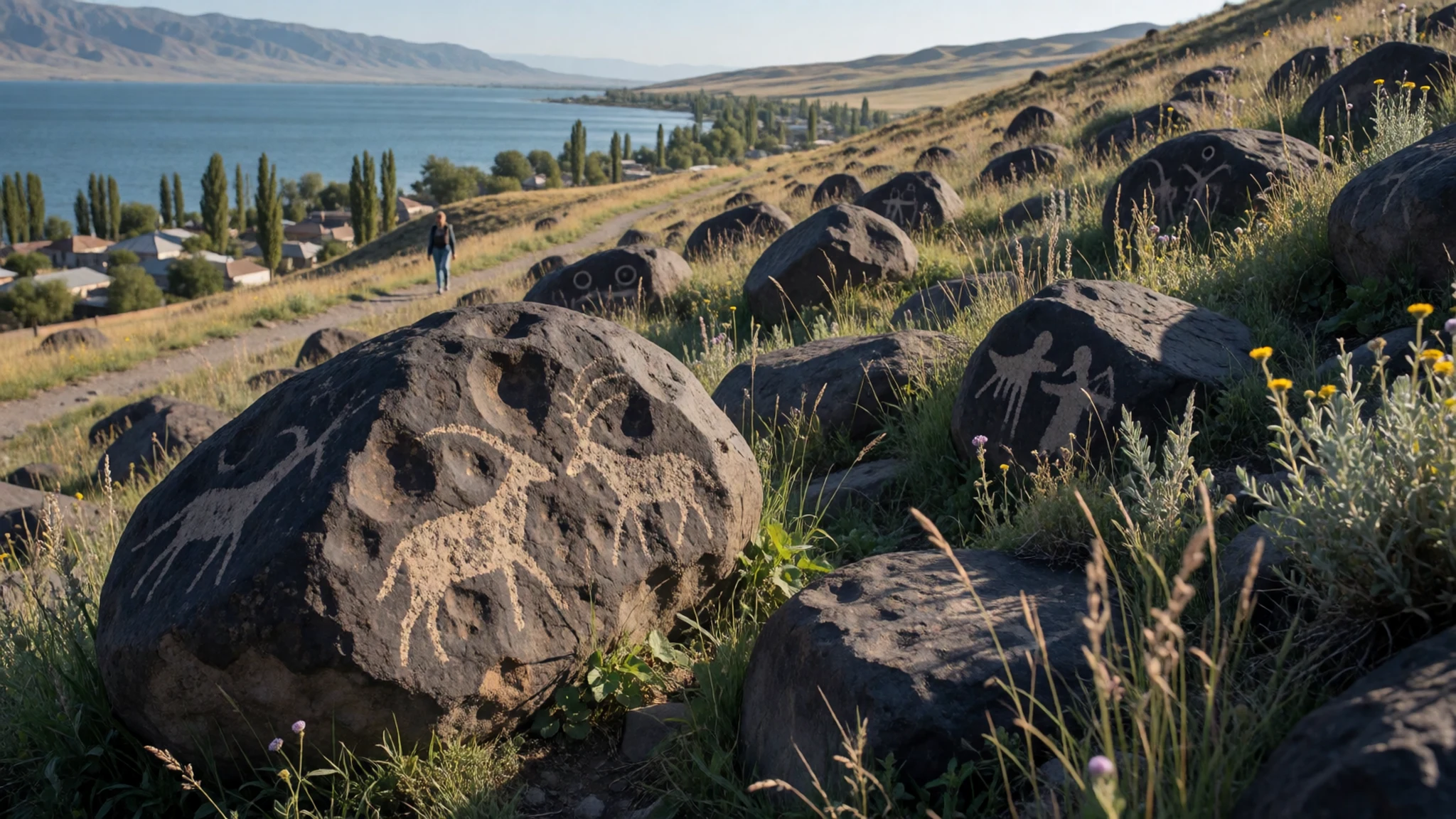
- Southern shore — South shore, Tamga and Barskoon
Issyk-Kul's southern shore is the quieter circuit, running under the Teskey Ala-Too with fewer beaches and more villages. The road passes orchards and the mouths of gorges that climb toward summer pastures. Swimming spots exist, but the draw is the mountain wall and thinner traffic. Tamga and the valleys near Barskoon make useful stops for a day in the side canyons.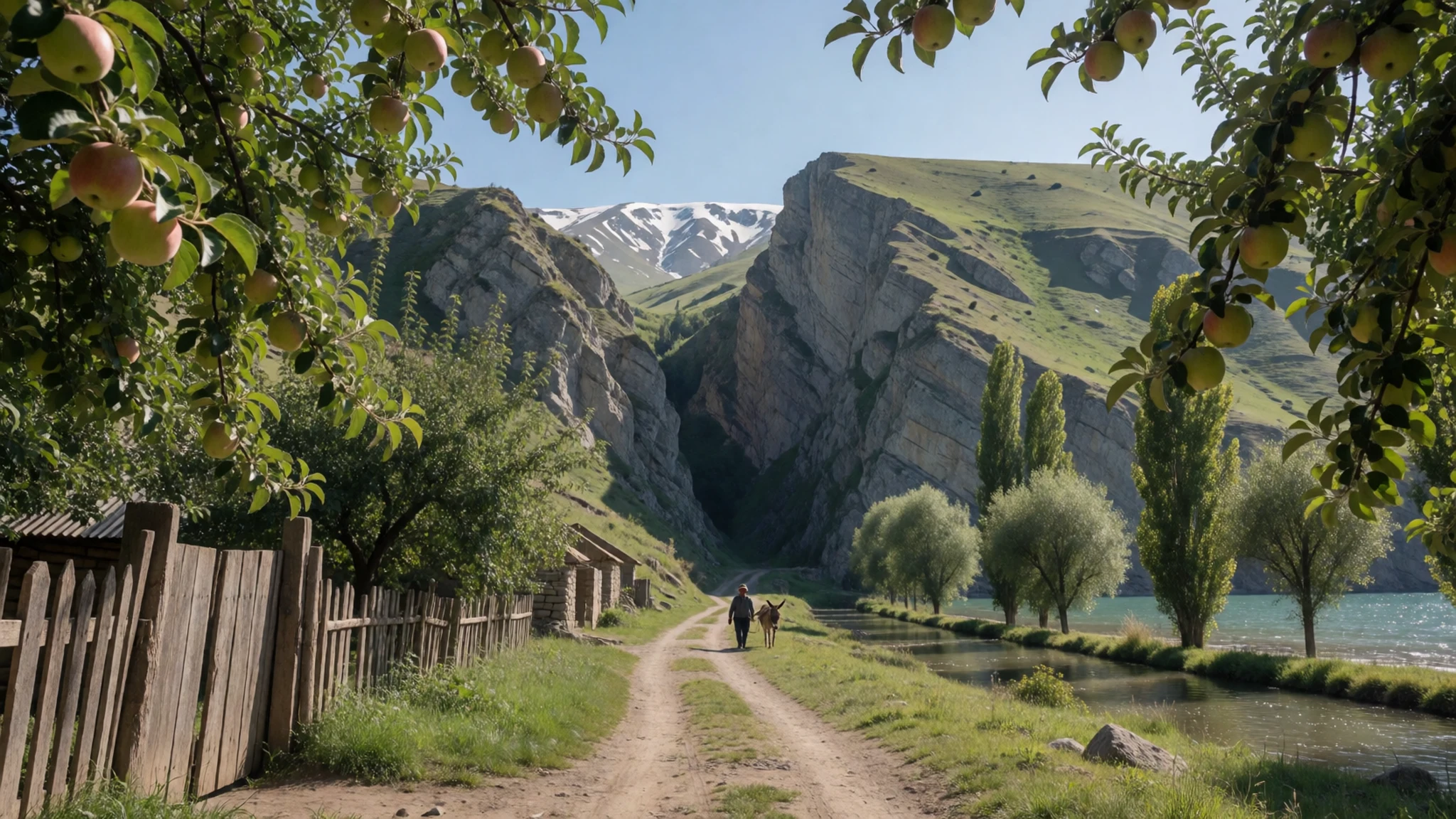
- Karakol — Eastern end of the lake
Karakol stands at the eastern end of Issyk-Kul, a low wooden town that serves the lake and the mountain valleys behind it. The grid of streets, the Orthodox cathedral and the Dungan mosque give the centre a layered look: Russian timber building beside a Chinese-style mosque built by Dungan families. Roads from the town lead toward alpine valleys and hot springs.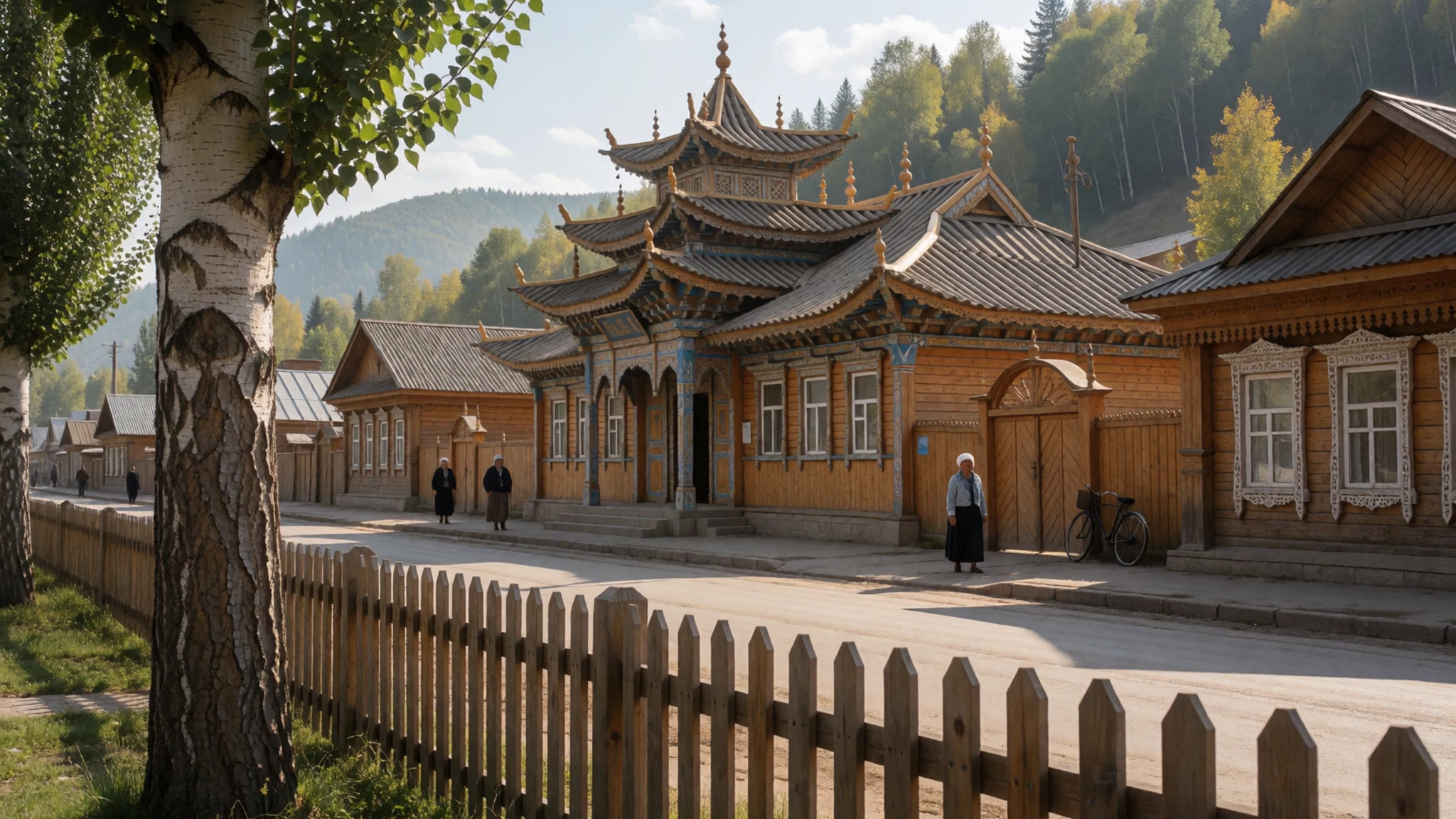
- Nestorian gravestones — Lakeside museum displays
Issyk-Kul's shore holds medieval gravestones left by a Nestorian Christian community that lived along these trade routes. A recorded stone dated 1312 carries a cross and an inscription. The Catalan Atlas of 1375 draws the lake with a short note, a sign that the basin was already known far to the west. The open beach does not explain them; a museum display in the lakeside towns does.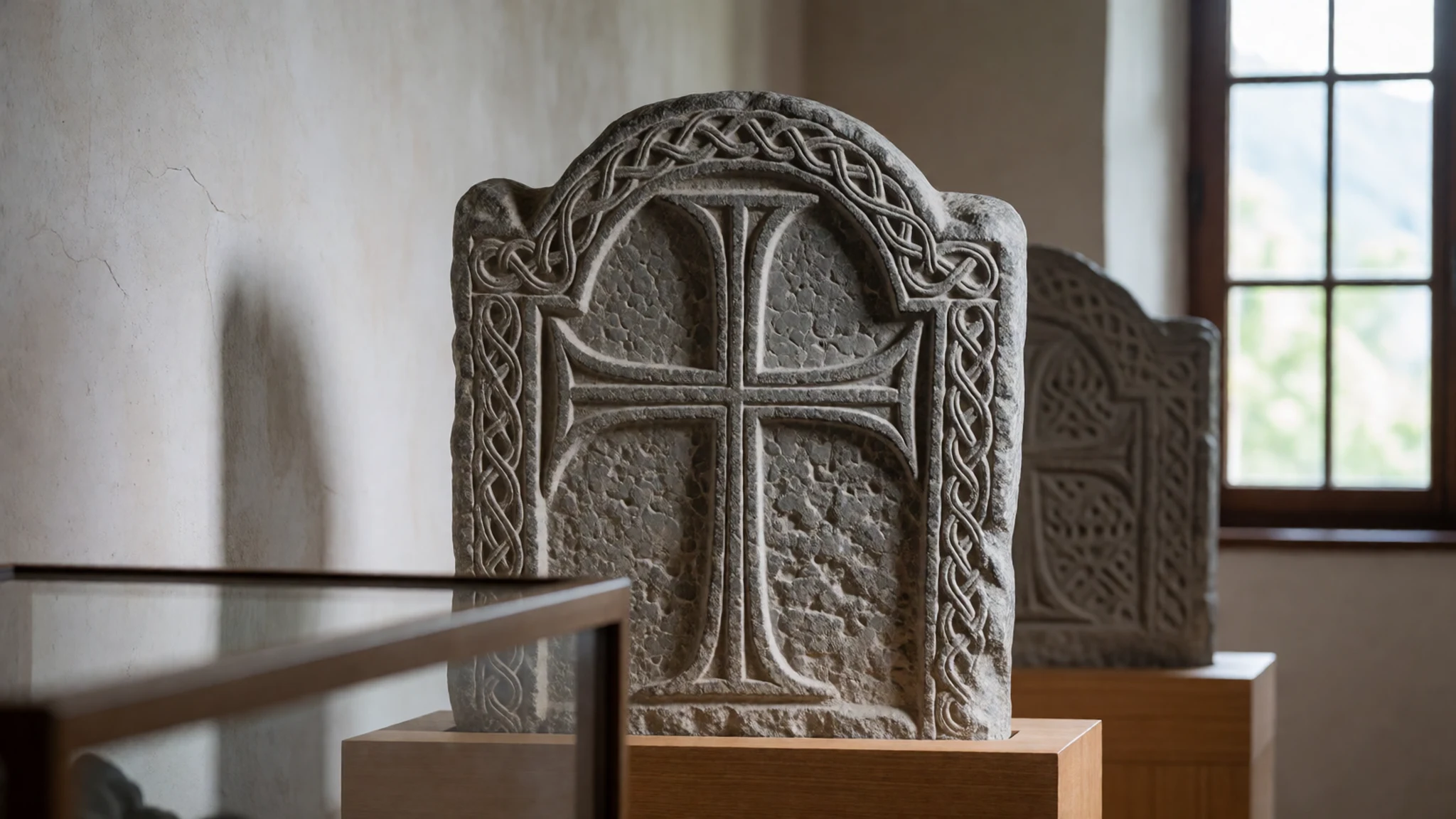
Culture
Issyk-Kul is Kyrgyz pasture culture set beside a holiday shore. The year still turns on livestock. Families move to jailoo, the high summer pasture, when the grass comes in, and the felt yurt is a working house of bent wood and woollen bands, raised for the season and taken down when the animals leave. On the lake that life meets a resort habit from the Soviet decades that never really ended. Sanatoriums, mineral-water cures and long family holidays are how many people from Bishkek, and from across the Kazakh border, still use the north shore.
Hospitality sets the terms of a visit. Tea arrives before questions, bread is not wasted, and a guest who shares a yurt or a family table will be pressed to eat past comfort. Courtesy is in the small gestures: the bowl is taken with the right hand, or with both, and nobody steps across a cloth spread on the floor for food. Speech is direct and warm rather than formal, and a little Russian goes far in the towns, while Kyrgyz is the language of the pasture and of ceremony. Around petroglyph boulders and graveyards the mood shifts; they are places people pass with care, not playgrounds.
At Issyk-Kul, ask before photographing people inside a yurt or at the animal market, and take off your shoes before a felt floor or a mosque.
What to wear
Issyk-Kul dresses for wind, wool and a long bright day, because the basin is herding country that happens to hold a lake. The white felt kalpak, a men's brimless hat with a turned-up black rim, is the garment visitors notice first. It is worn for festivals, for riding and, by many older men, as ordinary headgear. Women often wear a headscarf, and both men and women still put on the chapan, a padded or quilted robe, when the evening wind comes off the water. Beneath those shapes are the textiles of the jailoo: shyrdak and ala-kiyiz, felt carpets with paired curling motifs.
In the towns the daily wardrobe is practical and current. Jeans, track jackets, caps and trainers fill the bazaar lanes of Karakol and Cholpon-Ata, with a kalpak or a heavy coat brought out for weather and for ceremony. The north-shore resorts add beach clothes in the warm months: swimming costumes on the shingle, a shirt pulled over them once the promenade starts. A visitor should pack in layers. Midday sun on the pale shore is fierce, the afternoon wind is cold, and a walk into a gorge behind the lake can mean mud and loose stone. Covered shoulders and knees are the right choice for the Dungan mosque and the Orthodox cathedral. Slip-off shoes spare everyone fuss wherever a carpet or a felt floor begins, and a light scarf helps with dust.
What to eat
- Beshbarmak — Yurt camps on the north shore and eateries in Karakol and Cholpon-Ata
Beshbarmak is the dish served when Issyk-Kul hospitality is serious: wide noodles, horse meat or mutton, and onion broth, eaten from a shared platter. It turns up at family gatherings, yurt camps along the north shore, and simple eateries in Karakol and Cholpon-Ata.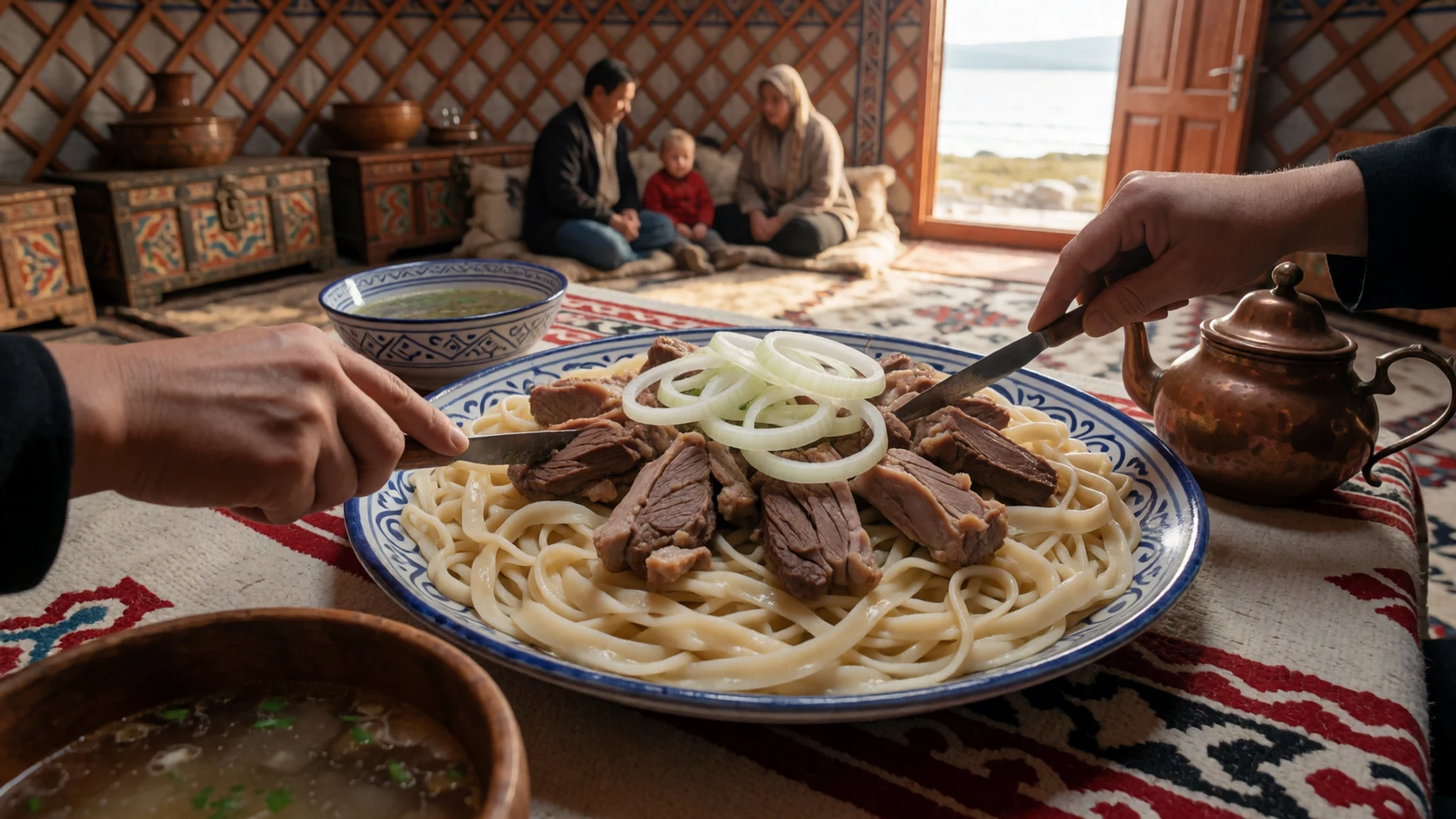
- Lagman — Bazaars in Karakol, Cholpon-Ata and Balykchy
Lagman is the everyday noodle bowl of Issyk-Kul's towns: pulled strands in a peppery broth with mutton and vegetables. Stalls around Karakol's bazaar and the smaller markets of Cholpon-Ata and Balykchy serve it from late morning onward, often beside samsa fresh from a tandoor.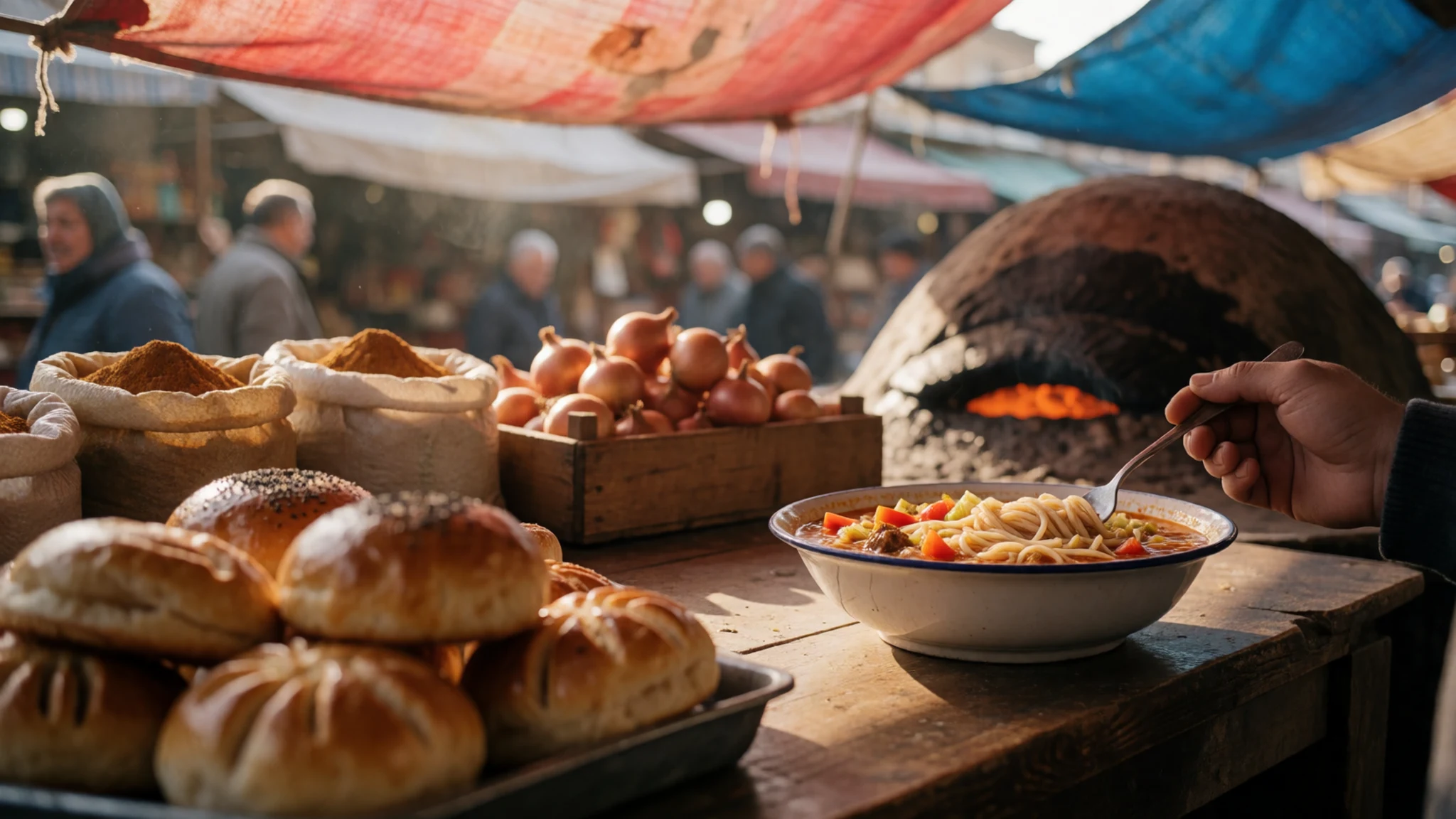
- Kymyz — Yurt camps and roadside stands near the summer pastures
Kymyz, fermented mare's milk, is the pasture drink of Issyk-Kul, mildly sour and slightly fizzy, offered in summer when the herds are up. Yurt camps on both shores and roadside stands near the jailoo tracks sell it by the bowl. A small bowl is enough at first. - Boorsok — Tea tables in yurts and bazaar stalls in Karakol
Boorsok are the little fried dough pieces that appear at every Issyk-Kul table where tea is poured, from a yurt breakfast to a bazaar stall in Karakol. They are torn and shared, not plated as a main dish, and they arrive with jam, kaymak or honey. - Ashlyan-fu — Karakol central market
Ashlyan-fu is Karakol's cold dish, a Dungan recipe of Issyk-Kul's east end: starch noodles in a vinegary, chilli-sharp sauce with herbs. Stalls in the central market serve it at midday in the warm months, when hot lagman is unwelcome.
Plan it
Best time. Issyk-Kul is most comfortable in July and August, the hottest months, when days pass 30 C, nights stay near 9 C and the beaches and yurt camps are open. May is the wettest month and still near freezing at night, and from October the nights fall below freezing. Winter nights drop near −30 C, with only a short, cold day above freezing.
How long. 3–4
Getting there. Reach Issyk-Kul from Manas International Airport outside Bishkek, then by road through the Chu valley to Balykchy at the western end. Marshrutkas and shared taxis run the north shore to Cholpon-Ata and Karakol. The south shore is a longer, quieter loop by road. Check the airline and the bus station for the day's departures; timetables change.
Budget. low
Tips
- Book a north-shore guesthouse ahead for mid-summer, when families from Bishkek and Almaty fill the beaches.
- Start long drives early, before the afternoon wind and the weekend traffic both build.
- Carry cash for marshrutkas, markets and yurt camps, which often cannot take a card.
- Drink bottled or boiled water; the lake is for swimming.
- Take a warm layer on a south-shore or gorge day, even in the warm months.
Etiquette
- Ask before photographing people at the market or in a yurt.
- Take off your shoes before a felt floor, a home or a mosque.
- Accept the first bowl of tea; a refusal can read as a slight.
Nearby
Sources
- Wikidata Q184540 (CC0)
- Wikipedia: Issyk-Kul (CC BY-SA 4.0)
- Wikivoyage: Issyk-Kul (CC BY-SA 4.0)