Hocking Hills
Hocking Hills, United States
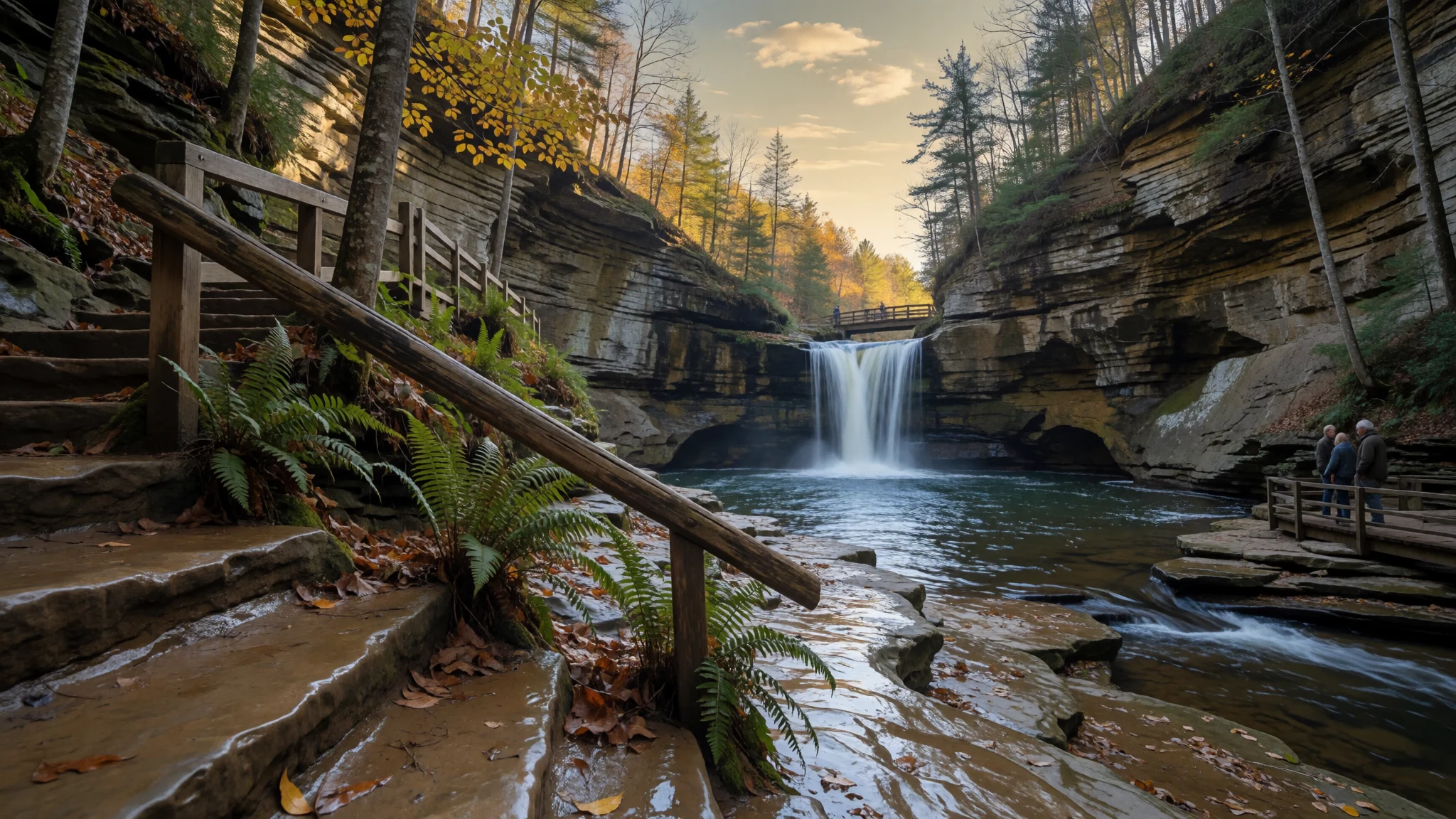
Hocking Hills is where flat Ohio folds into sandstone gorges, waterfalls and wide, shallow caves, all reachable on short, easy woodland walks.
The place
Hocking Hills State Park sits in Hocking County, in the hill country of south-eastern Ohio, and it surprises anyone who expects the state to be flat farmland. Here the ground folds into wooded gorges cut through pale sandstone, with waterfalls dropping over ledges and wide caves hollowed into the cliff walls. These are recess caves rather than deep tunnels: overhangs where soft rock has weathered away beneath a harder cap. The park is not one block of land but six separate areas strung along a road corridor, each with its own short trail: Old Man's Cave, Ash Cave, Cedar Falls, Rock House, Cantwell Cliffs and Whispering Cave. The neighbouring Hocking State Forest and the nearby gorge of Conkles Hollow add further walking. Together the trails run to over 25 miles (40 km), and they are open from dawn to dusk every day of the year, holidays included. The daylight rule is about the cliffs, not red tape. Much of the path surface is bare sandstone, which turns slick when wet, and the drops are real. Visitors come for day hikes, camping, climbing and horse riding, and the visitor centre, ranger station and main campground cluster around Old Man's Cave. Towns nearby supply the rest: Logan to the north has the welcome centre, Lancaster is the larger shopping town, and Athens, a university town, lies to the south. Most people drive in from Columbus. Autumn weekends are busy; a weekday in spring is quieter, and the waterfalls run best after rain.
Its story
Hocking Hills owes its shape to sand. More than 330 million years ago the region lay under a sea, and over a very long time currents laid down thick beds of sand and gravel that hardened into sandstone. When the water withdrew, rain, streams and groundwater went to work on the soft rock, carving gorges, undercutting cliffs into recesses and leaving waterfalls wherever a stream tumbles over a harder ledge. The last big reshaping came about 10,000 years ago, as glaciers melted back to the north. An ancient river called the Teays was buried under silt, and the Hocking River, which had flowed north, was turned round. The name itself is older than Ohio. Shawnee and Delaware speakers described the river with a word meaning bottle, usually explained by a narrow, straight stretch of creek above a waterfall, like the neck of a bottle. Human history is layered here too. Settlers in a neighbouring county once reported a black handprint on a cliff of the same sandstone, a hint that people sheltered in these rocks long before tourists did. Old Man's Cave takes its name from Richard Rowe, a nineteenth-century recluse who made his home in the gorge. By 1870 the gorge was drawing sightseers, and the State of Ohio bought it to protect it in 1924. That purchase was later joined with five other state-owned areas to form the park as it is known today.
What to see
- Old Man's Cave — Central park, near the visitor centre
The gorge around Old Man's Cave is the park's busiest area and the best first stop. A trail steps down past upper and lower falls, rock tunnels and a deep recess said to have sheltered the hermit. The sandstone steps are bare and slippery after rain.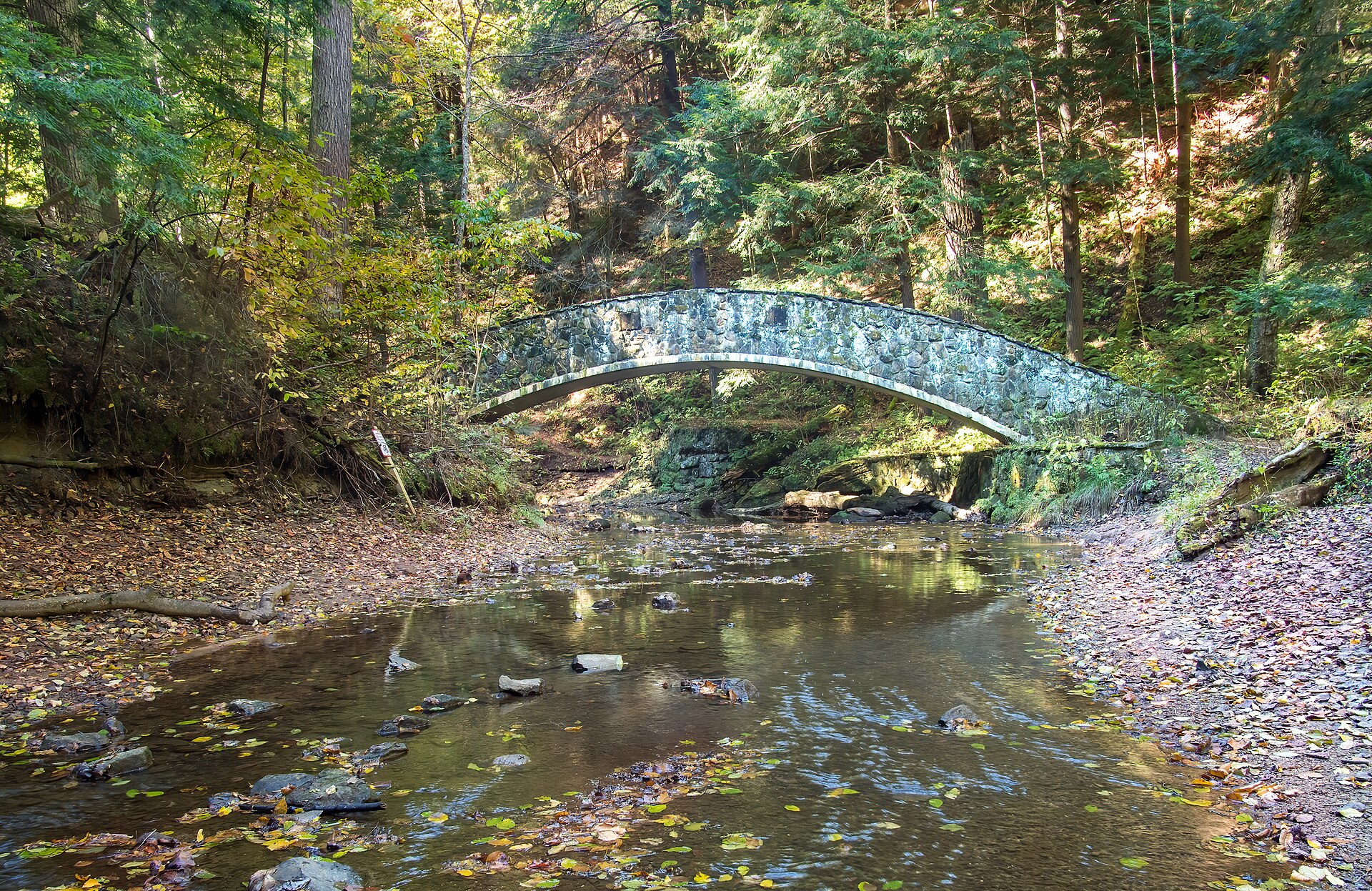
- Ash Cave — Southern end of the park
Ash Cave is a vast, open recess in the cliff, wide enough to feel like a natural amphitheatre. A flat, easy path leads to the back, where a thin waterfall falls in wet weather. It suits families and anyone short on time or energy.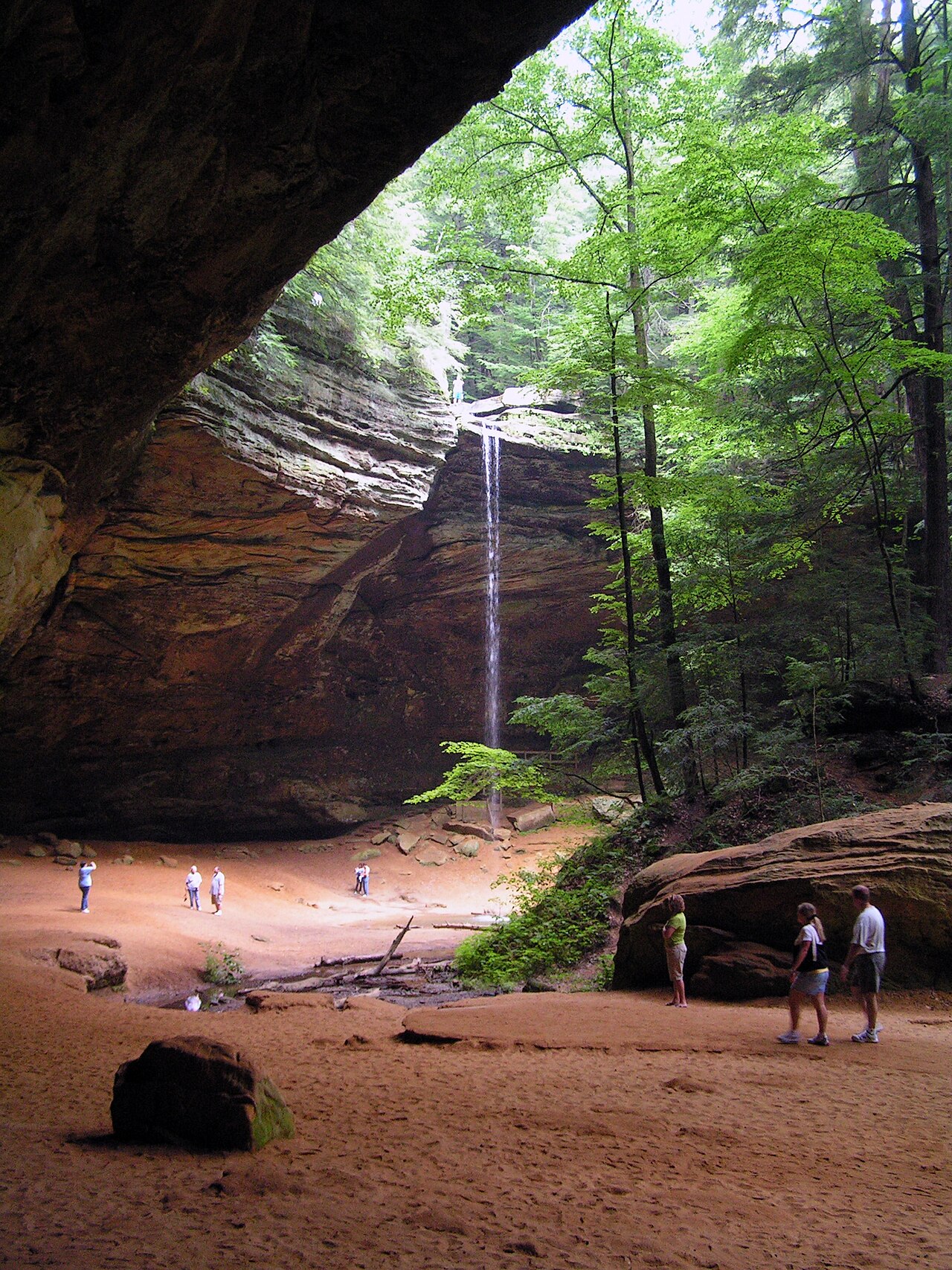
- Cedar Falls — Between Old Man's Cave and Ash Cave
Cedar Falls is a broad, graceful waterfall in a hemlock-shaded gorge, fed by a stream that drops over a sandstone lip into a pool. The walk is short but includes steps, and the water is best after spring rain. Keep to the marked trail; the banks are fragile. - Rock House — Northern part of the park
Rock House is the odd one out: a long, tunnel-like cavity high in a cliff face, with window-like openings looking out over the trees. Reaching it means a steady climb on steps and rock. Inside it is cool and dim, even on a hot day.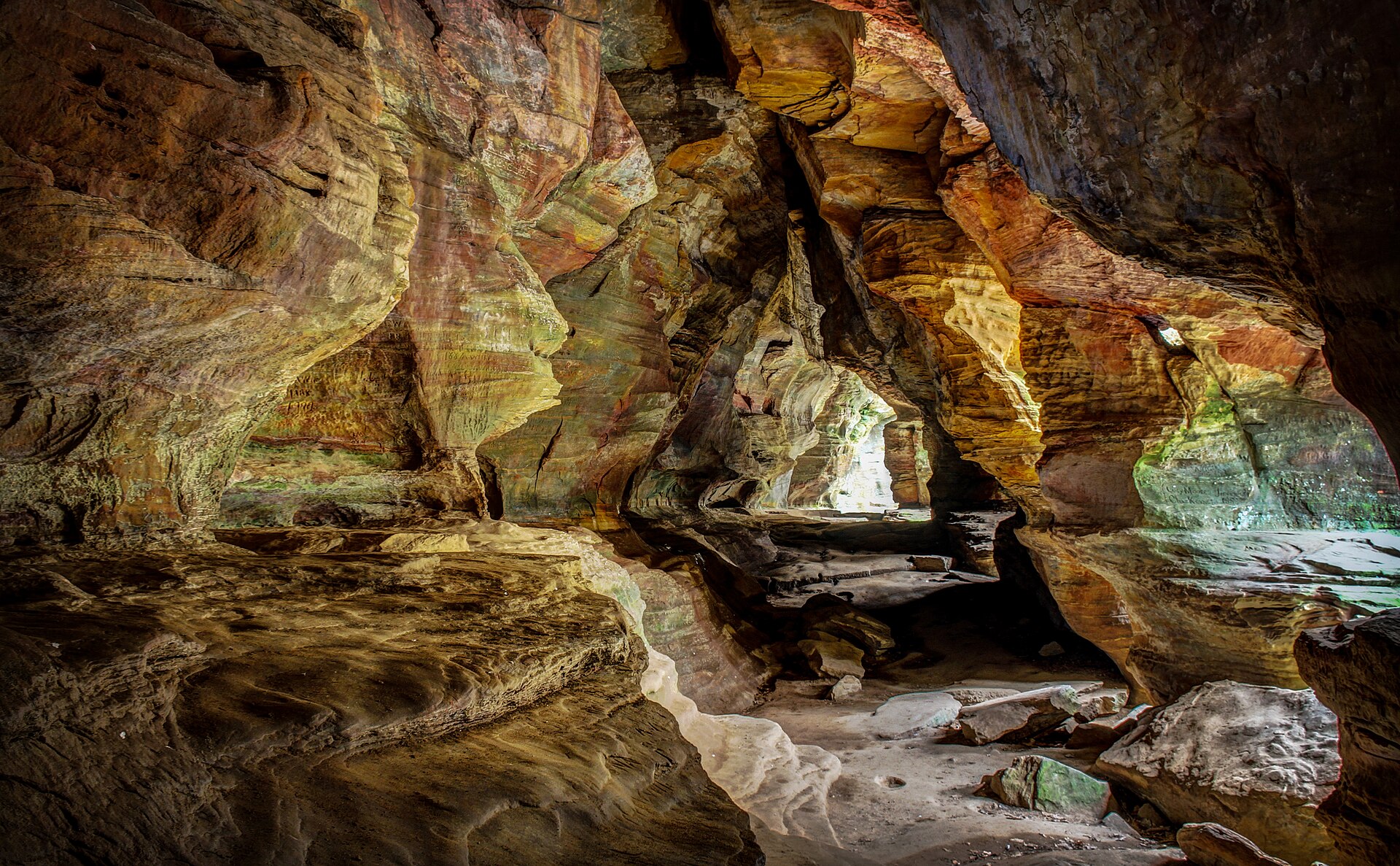
- Conkles Hollow — North-west of Old Man's Cave
Conkles Hollow is a narrow, steep-sided gorge with a gentle floor trail that suits most walkers, and a more demanding rim trail above for those with sturdy shoes and a head for heights. Cliff edges here are unforgiving, so stay on the marked paths. - Cantwell Cliffs — Far northern end of the park
Cantwell Cliffs is a quieter corner with a rock-walled gorge, a tight stone stairway and a recess at the head of the valley. The trail is short but has some scrambling, so it rewards a little care. It draws fewer crowds than the central sites.
Culture
Hocking Hills has no single local culture so much as a layered one. The Shawnee and Delaware languages gave the river its name, and that bottle image still frames how the region's story is told. Later settlers and farmers brought Appalachian habits of self-reliance, and the hermit Richard Rowe became the area's best-loved piece of folklore, which is why the park's most visited gorge carries his name. Since the 1920s the main identity has been conservation: the land was bought to be kept, and visitors are expected to treat it that way. Rangers take trail rules seriously, particularly at the busiest gorges, because the cliffs are dangerous and the plants underfoot are easily trampled. Weekends here mean family picnics, campfires, photographers waiting for soft light and school groups on guided walks. In nearby towns, community life is local and low-key: county fairs, small museums, church suppers and festivals such as Logan's annual Washboard Festival. It is a place where people greet strangers on narrow trails and step aside to let others pass. Autumn colour and winter ice bring their own crowds of photographers, and the park still feels like a shared backyard for the surrounding counties more than a remote wilderness. Stay on the marked trails, keep well back from cliff edges, and never climb on the rock formations or jump into the pools, because both the stone and the plants suffer and rangers do issue fines.
What to wear
Hocking Hills has no single traditional costume tied to the park. The Shawnee and other Native peoples of the Ohio valley have their own regalia and textile traditions, worn at ceremonies and gatherings rather than on the trail. Settler communities in Appalachian Ohio relied on practical wool, cotton and denim for farm and woodland work, and that plain, hard-wearing spirit survives in local style. Today people here dress for weather and work: jeans, flannel shirts, fleeces, caps and sturdy boots, with sports kit and rain jackets common on the trails. For visitors the key point is footwear. Sandstone steps and wet rock are slippery, so wear shoes with good grip, ideally walking shoes or light boots, and avoid sandals or smooth soles. Layers suit the changeable weather: a light waterproof for spring rain, a warm fleece for autumn mornings and a hat and gloves for winter, when icy patches can linger in shaded gorges. Summer is warm and humid, so breathable clothing, a sun hat and insect repellent help. There are no strict modesty rules, as the park is a casual outdoor setting, but everyday walking clothes are all that is needed. Pack a small rucksack for water, a rain layer and a spare pair of socks, because streams and spray find their way into shoes. A walking pole helps on steep, stepped sections.
What to eat
- Hot dogs and ice cream at the visitor-centre stand — The concession stand by the Old Man's Cave visitor centre
The seasonal concession near Old Man's Cave serves plain American staples, cold drinks and ice cream. It is a convenient, no-fuss trailside stop between walks, though it only opens during the busier months. - Cooked breakfast at a lodge restaurant — Inns and lodges along the park road, including near Cedar Falls
Local inns and bed-and-breakfasts serve generous morning plates of eggs, bacon, pancakes and fruit, which suit an early start on the trails. Some also run restaurants and bars for lunch and dinner. - Buckeye candies — Sweet shops and gift stores in Logan and the surrounding villages
A buckeye is a ball of peanut butter fudge dipped in chocolate, left with a small round of peanut butter showing so it resembles the nut of Ohio's state tree. They are a popular local sweet to take home as gifts. - Apple butter — Farm stands and craft shops in the countryside around the park
Slow-cooked, spiced apple spread is a long-standing Appalachian farm preserve. It is best spread on toast or biscuits and is easy to carry home. Autumn is the season to look out for it. - Sweet corn — Roadside farm stands in the surrounding hills
In late summer, roadside stalls sell freshly picked sweet corn from local farms, usually boiled or grilled and eaten with butter. It is simple, seasonal and best bought the day it is picked.
Plan it
Best time. April–May for fresh greenery and full waterfalls, and October–November for autumn colour. Summer is warm and humid with the busiest car parks, while winter brings quiet trails and ice that can close sections.
How long. 2–3
Getting there. Fly into Columbus and drive south-east for roughly an hour to Logan, the gateway town. Public transport is very limited, so a hire car is the practical choice. The last leg is a country road running through the six park areas, with the visitor centre at Old Man's Cave.
Budget. mid
Tips
- Arrive early on autumn and summer weekends, as car parks at Old Man's Cave and Ash Cave fill up
- Book cabins and campsites well ahead for October, and check the official site for trail closures
- Carry water and a rain layer, as phone signal can be patchy in the gorges
- Allow a weekday if possible; Cantwell Cliffs and Rock House are quieter than the central sites
Etiquette
- Stay on marked trails and well away from cliff edges
- Never climb on rock formations or wade where signs forbid it
- Carry out all rubbish and keep noise low in the narrow gorges
Nearby
Sources
- Wikidata Q5875771 (CC0)
- Wikipedia: Hocking Hills State Park (rev 1371978465) (CC BY-SA 4.0)
- Wikivoyage: Hocking Hills State Park (rev 5404130) (CC BY-SA 4.0)
- Photo: Ash Cave, Hocking Hills State Park, Ohio (Ramseybuckeye) (Public domain)
- Photo: Relief location map of the USA (Uwe Dedering) (CC BY 3.0)
- Photo: Rock house, Hocking Hills, Ohio (See1,Do1,Teach1) (CC BY 2.5)
- Photo: Ash Cave, spring 1937 (Don O'Brien) (CC BY 2.5)
- Photo: Old Man's Cave area (Rhododendrites) (CC BY-SA 4.0)
- Photo: Ash Cave complex in Hocking Hills State Park (Dustin M. Ramsey) (CC BY-SA 2.5)
- Photo: A sign for Hocking Hills, Ohio near the welcome centre in Logan (TheGinger68) (CC BY-SA 4.0)
- Photo: Old Man's Cave Upper Falls (See1,Do1,Teach1) (CC BY 2.5)


