Grand Prismatic Spring
Grand Prismatic Spring, United States
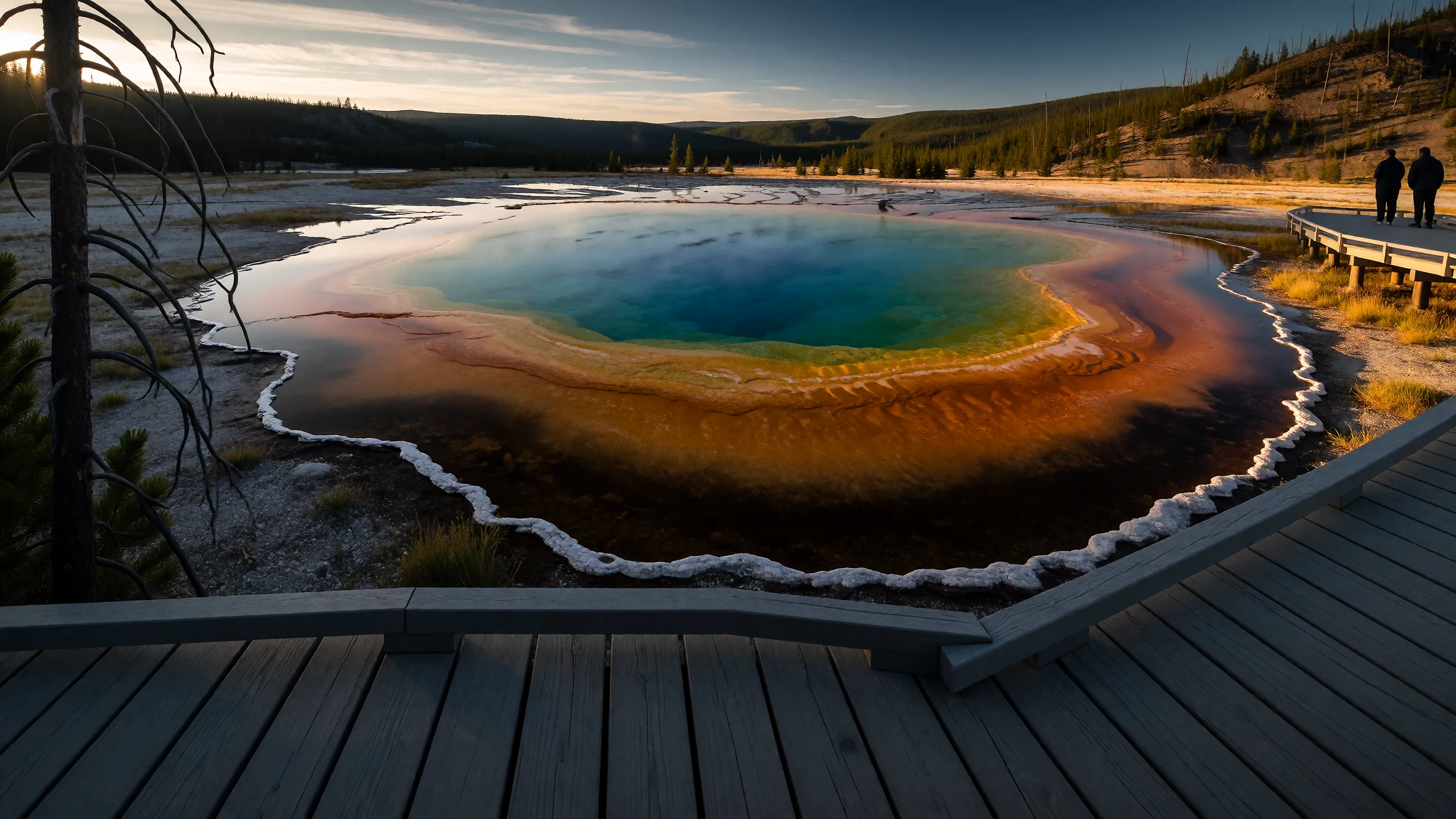
Grand Prismatic Spring is a steaming pool in Yellowstone whose centre is deep blue and whose rim glows orange and red.
The place
Grand Prismatic Spring lies in the Midway Geyser Basin of Yellowstone National Park, in the Wyoming corner of the United States. While it is the biggest hot spring in the park, globally it ranks third, trailing only New Zealand's Frying Pan Lake and Boiling Lake in Dominica. Size is not what people remember, though. The pool is ringed with bands of colour: a deep blue heart, then green, yellow and orange, and a rusty red at the margins. Heat-loving microbes lay down most of those bands, each favouring its own water temperature. In cool or still weather the spring gives off so much steam that the colours blur into mist and the boardwalk half disappears. On a clear, windless afternoon it looks more like a painted target than a pond.
The setting is open, pale and slightly eerie. Mineral-white ground, bare trunks near the vents and a steady smell of sulphur make the basin feel like another planet, while wildlife often grazes along the nearby Firehole River. Wyoming is the least populated US state, so Yellowstone sits far from any big city. Most people arrive by car after long, empty drives, and the spring is one stop on a larger loop of the park rather than a destination of its own. It is busy in July and August, and the car park fills well before lunch.
Its story
Grand Prismatic Spring was known to the Indigenous peoples of the Yellowstone plateau long before it appeared in print, but the written record begins with outsiders. In 1839 four trappers working for the American Fur Company crossed the Midway Geyser Basin and noted a boiling lake, almost certainly this spring, which they put at about 90 m across. In 1870 the Washburn–Langford–Doane Expedition passed through and described a geyser close by, later named Excelsior. The following year the Hayden Geological Survey of 1871 gave the spring its present name, chosen for the way its colours run through most of the rainbow.
The colours are biological as much as mineral. Water rises from deep underground, and at the centre it is too hot for anything to live, so the blue is simply clear, deep water scattering light. As the water spreads outward it cools, and mats of microbes take hold in bands. Their pigments shift with the seasons: summer sun pushes the mats towards orange and red, while the weaker light of winter leaves them greener. Runoff then streaks the rim with rust-coloured channels across the mineral terrace.
The spring has changed little in the account of visitors, but the way people see it has. The first explorers could only stand beside it and be struck by the steam. Today a boardwalk keeps feet off the fragile crust, and a raised trail on the hillside shows the whole pattern from above, which is the view that explains the name.
What to see
- Midway Geyser Basin boardwalk — Midway Geyser Basin, Yellowstone National Park
The boardwalk loops past the spring's edge and gives the close-up view: heat on the face, steam rolling across the planks, colour showing only in gaps. Go early or late if possible, as the walkway is narrow and slow when crowded. Steam can hide everything on cold mornings.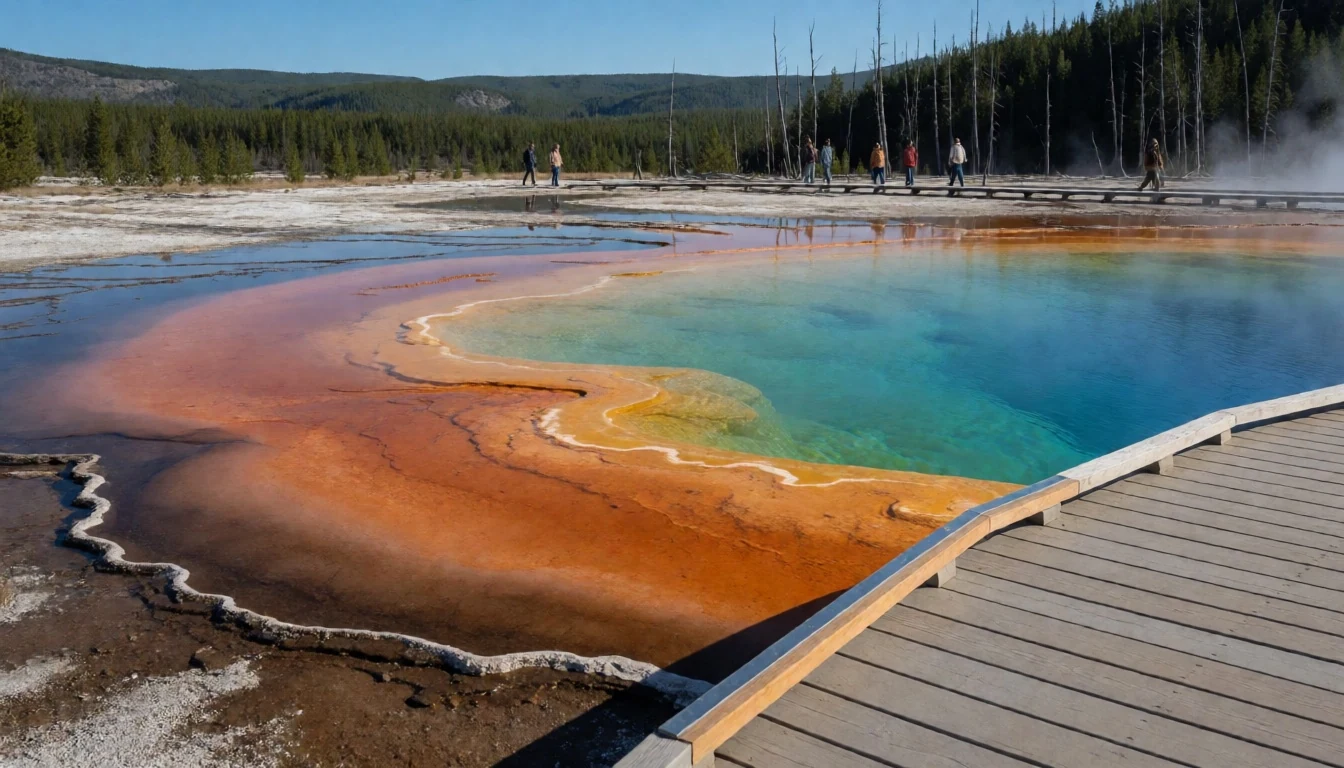
- Grand Prismatic Overlook — Hillside south-west of the spring
A short uphill walk from the nearby Fairy Falls trailhead leads to a platform above the basin. From here the rings of colour read as a single design, which the boardwalk cannot show. Late afternoon light is kind, and the car park for the trailhead is small, so patience helps.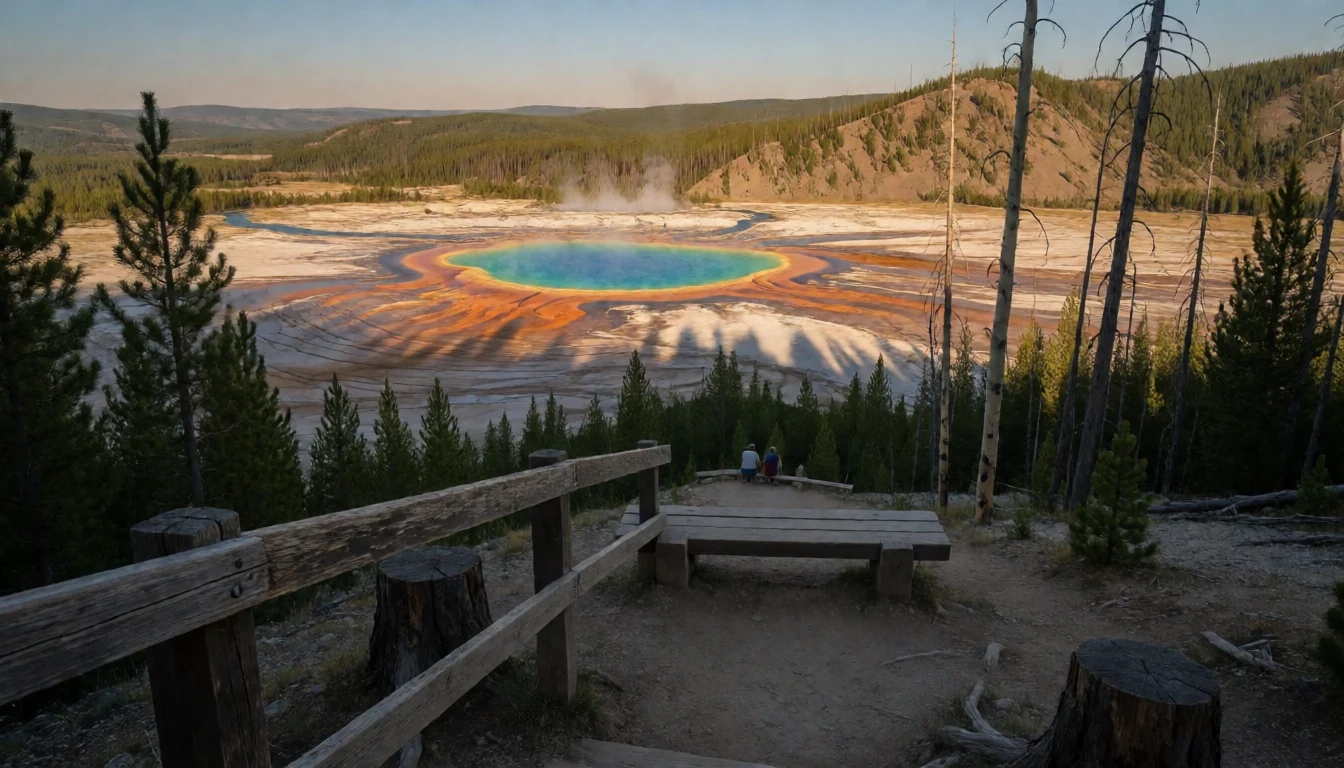
- Excelsior Geyser Crater — Midway Geyser Basin
Beside the spring is a huge steaming crater, the remains of the geyser noted by the 1870 expedition. It now behaves as a churning, steaming pool, and a deep blue colour runs into the river below. It is worth a few minutes for the sheer volume of vapour.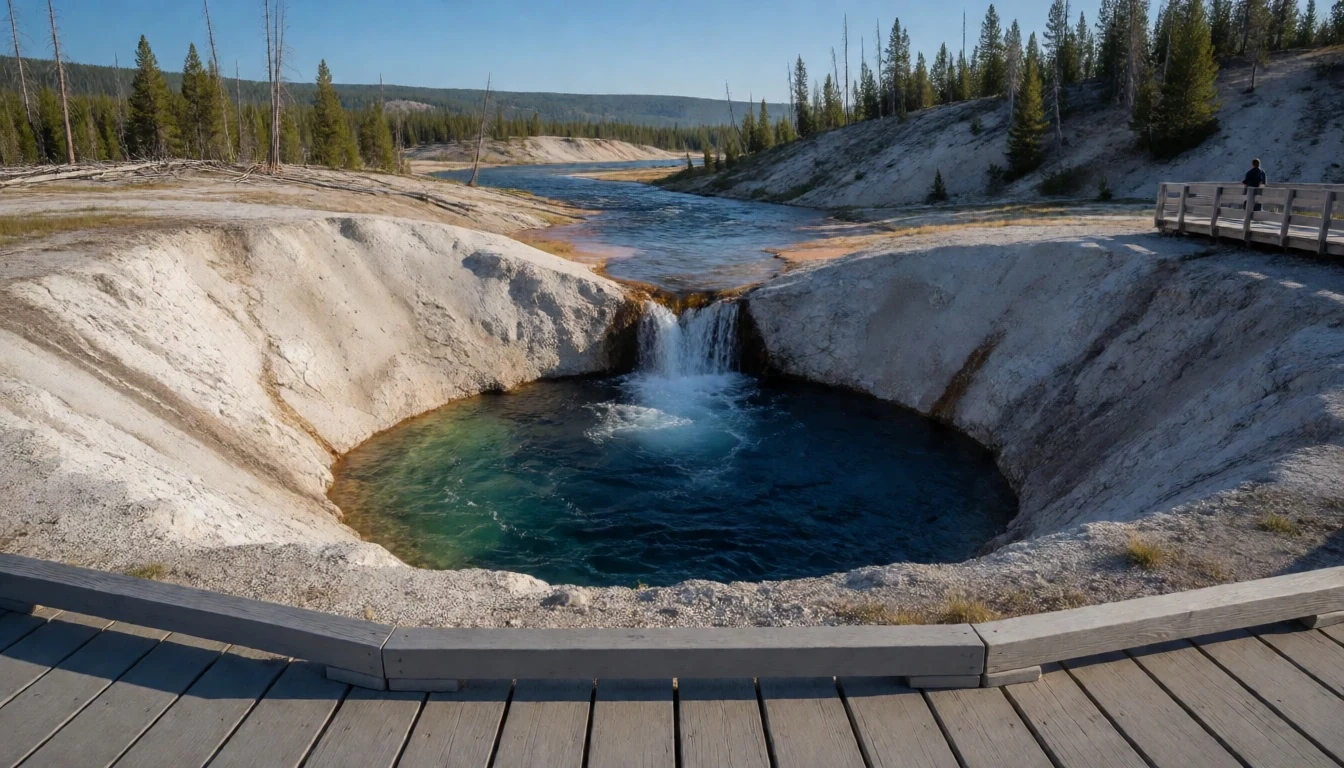
- Turquoise Pool and Opal Pool — Midway Geyser Basin
Close to the main spring, these smaller pools show how much the colour depends on depth and microbes. One is clear blue-green and glassy, the other more cloudy and mineral. They are quicker to see, usually less crowded, and make good photographs when steam is thick elsewhere.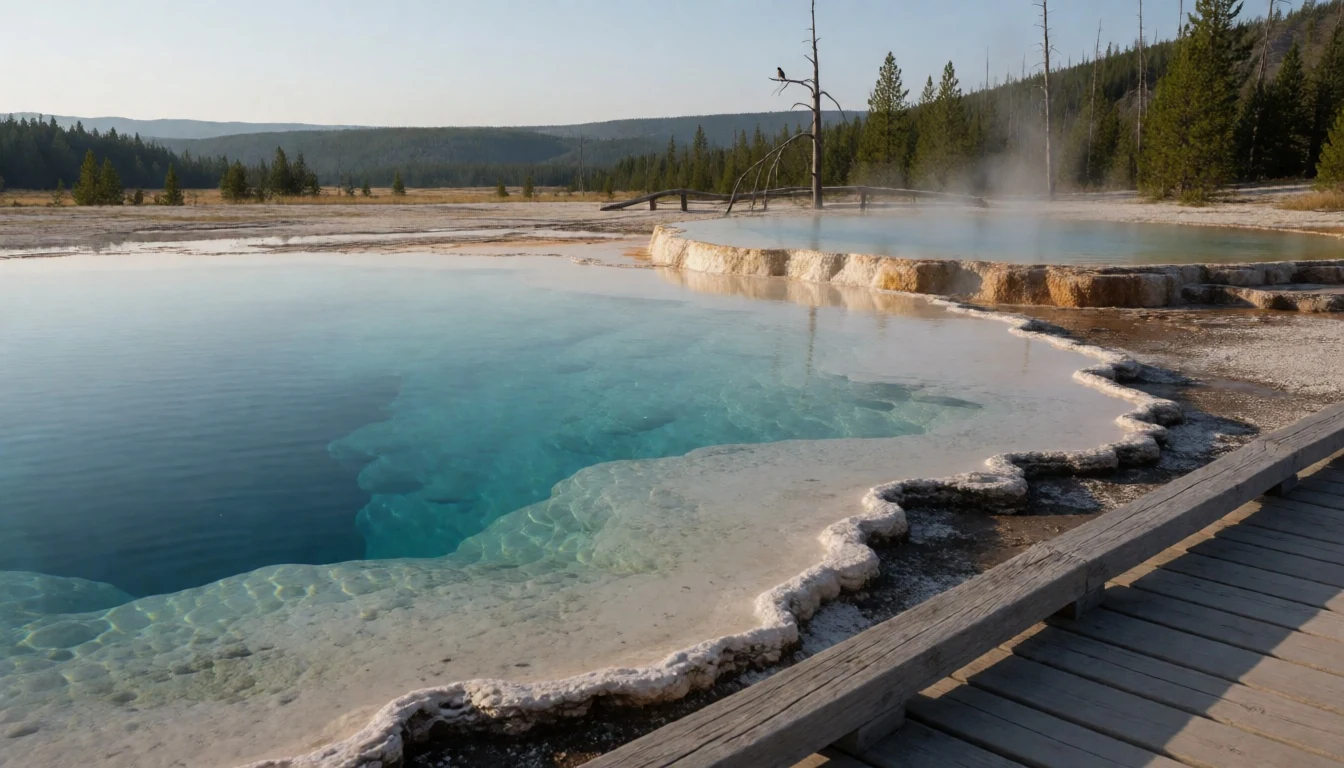
- Firehole River — Alongside the basin
The river runs beside the basin and carries away the hot runoff, so its banks show a thin line of steaming water meeting cooler flow. Wildlife such as bison and elk graze nearby. It is a good place to pause and watch, at a safe distance from the animals.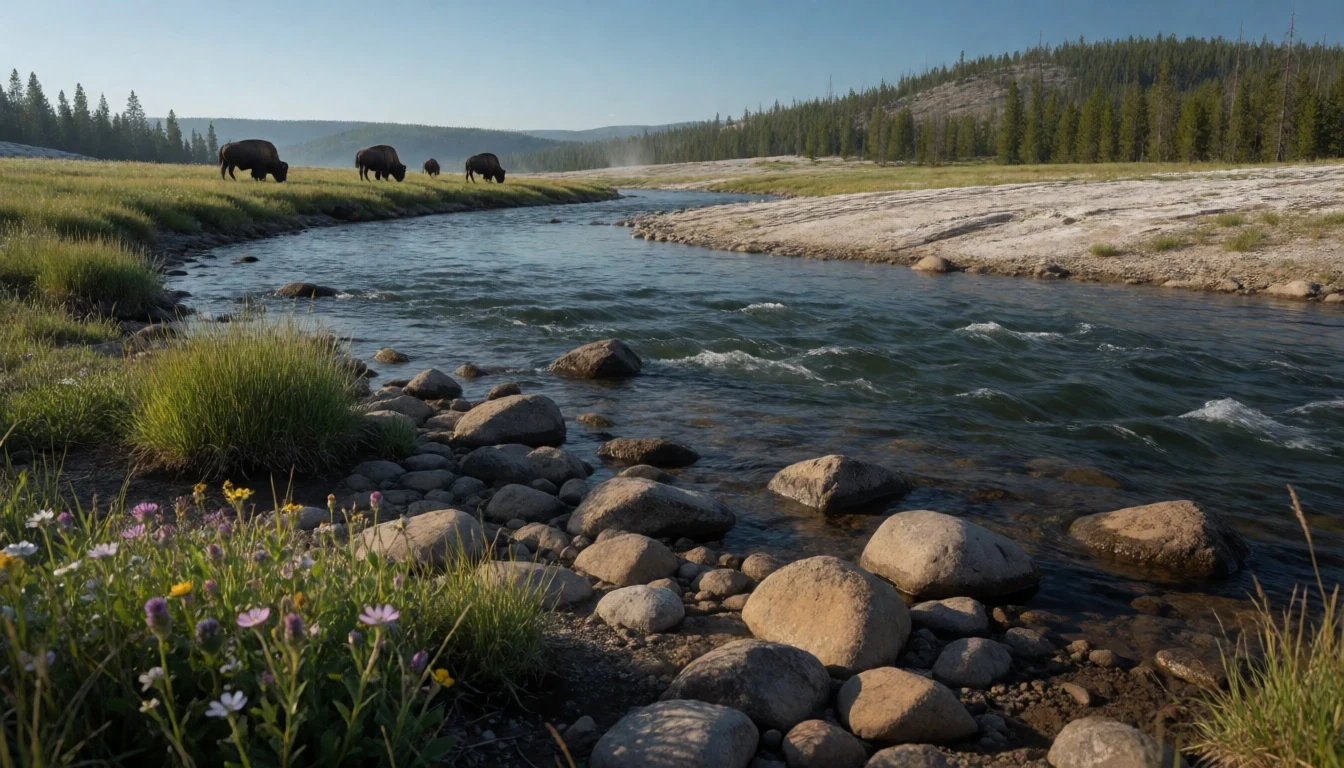
Culture
Grand Prismatic Spring sits inside a protected national park, and the first thing a visitor notices is how rule-bound the ground is. The crust around the pools is thin and the water beneath it is very hot, so the park keeps people on boardwalks and trails. Rangers and signs repeat this constantly, and it is taken seriously. The wider land has a long human history: Indigenous peoples hunted, travelled and held ceremonies across the Yellowstone plateau for many generations before explorers wrote it up, and several tribes still count the area as part of their homeland.
Wyoming's ranching and outdoor culture shapes the feel of the nearby towns. People are friendly and plain-spoken, distances are long, and a day out usually means a truck, a thermos and a plan for bad weather. Visitors share the park with a lot of wildlife, and a quiet, patient manner suits it best. Bison look slow and are not; giving them space is part of local common sense rather than a courtesy.
The spring is also a place people go to look rather than to do. Conversation drops as the steam clears and the colour appears, and most visitors take a few photographs and then simply stand. Stay on the boardwalk, never step onto the crusted ground beside the spring, and keep well back from any wildlife on the path.
What to wear
Grand Prismatic Spring has no single local costume, but the region has a clear clothing history. The Indigenous peoples of the Yellowstone area traditionally made clothing from tanned hides such as deer, elk and bison, often decorated with beadwork, quillwork and fringe, and wore it for daily life, ceremony and dance. Many tribal members still wear such garments at powwows and community events. Ranching added its own look in the nineteenth century: wool shirts, denim, leather boots and felt hats, shaped by horse work and cold winters.
What people wear now is practical and unfussy. Around Yellowstone you will see walking boots, quick-dry trousers, fleeces, caps and sunglasses, and in nearby Wyoming towns jeans, boots and a plain jacket pass for smart. Cowboy hats are still worn, mostly by people who work outdoors rather than for show.
For a visit, dress for weather rather than for any code of modesty; the boardwalk has no dress rules. Mornings can be cold even in summer, so bring layers, a windproof jacket and a hat, and a light waterproof for sudden showers. Sun at this altitude is strong, so add sunscreen and sunglasses. Wear sturdy, closed shoes with grip, since wet planks are slippery and the overlook trail climbs a dusty slope. Steam leaves clothing damp, so quick-drying fabrics help.
What to eat
- Bison burger — Cafés and grills in gateway towns outside the park
Bison is the meat most associated with the region, and it is leaner and slightly sweeter than beef. A burger is the easiest way to try it. Look for one at a town café or roadside grill on the way into Yellowstone.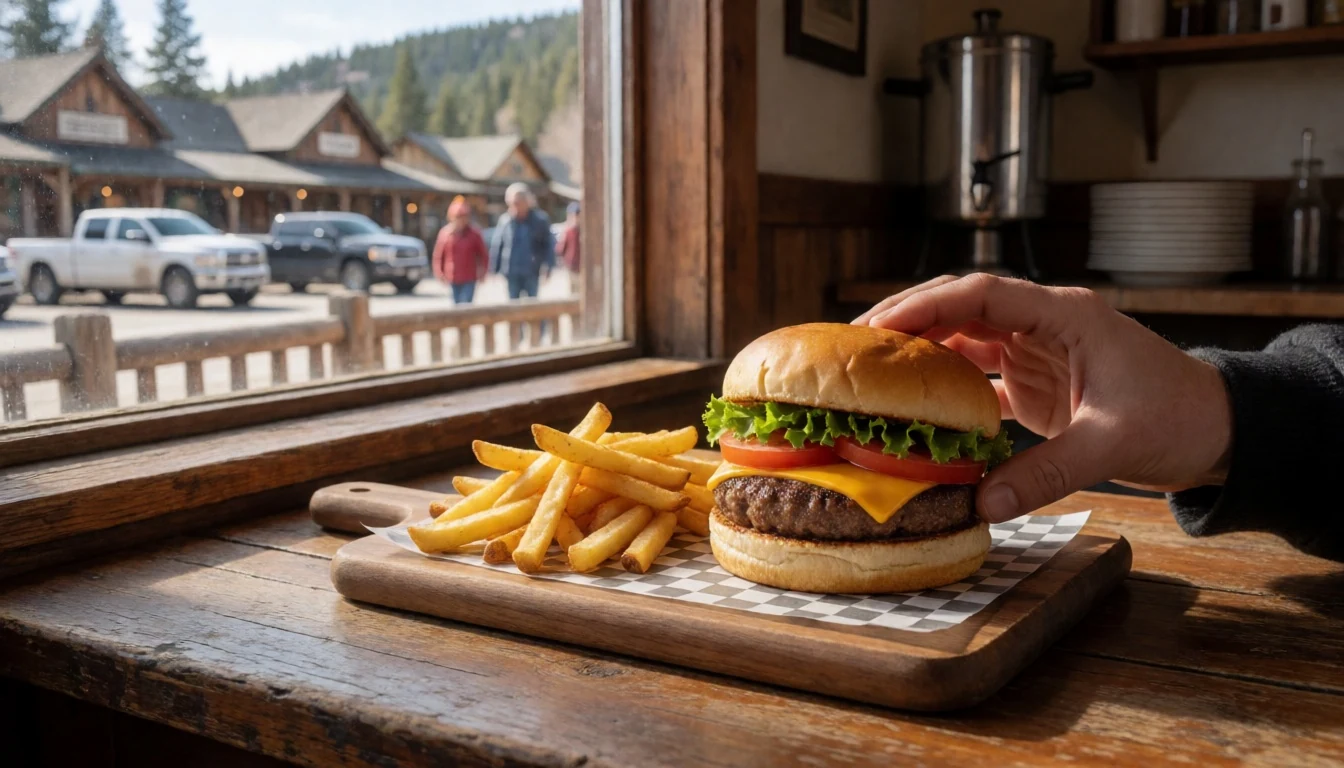
- Elk steak — Steakhouses in Jackson and other Wyoming towns
Elk is a staple on Wyoming steakhouse menus, usually served simply with potatoes or vegetables. It tastes deeper than beef and benefits from not being overcooked. It is a good evening dish after a day in the park.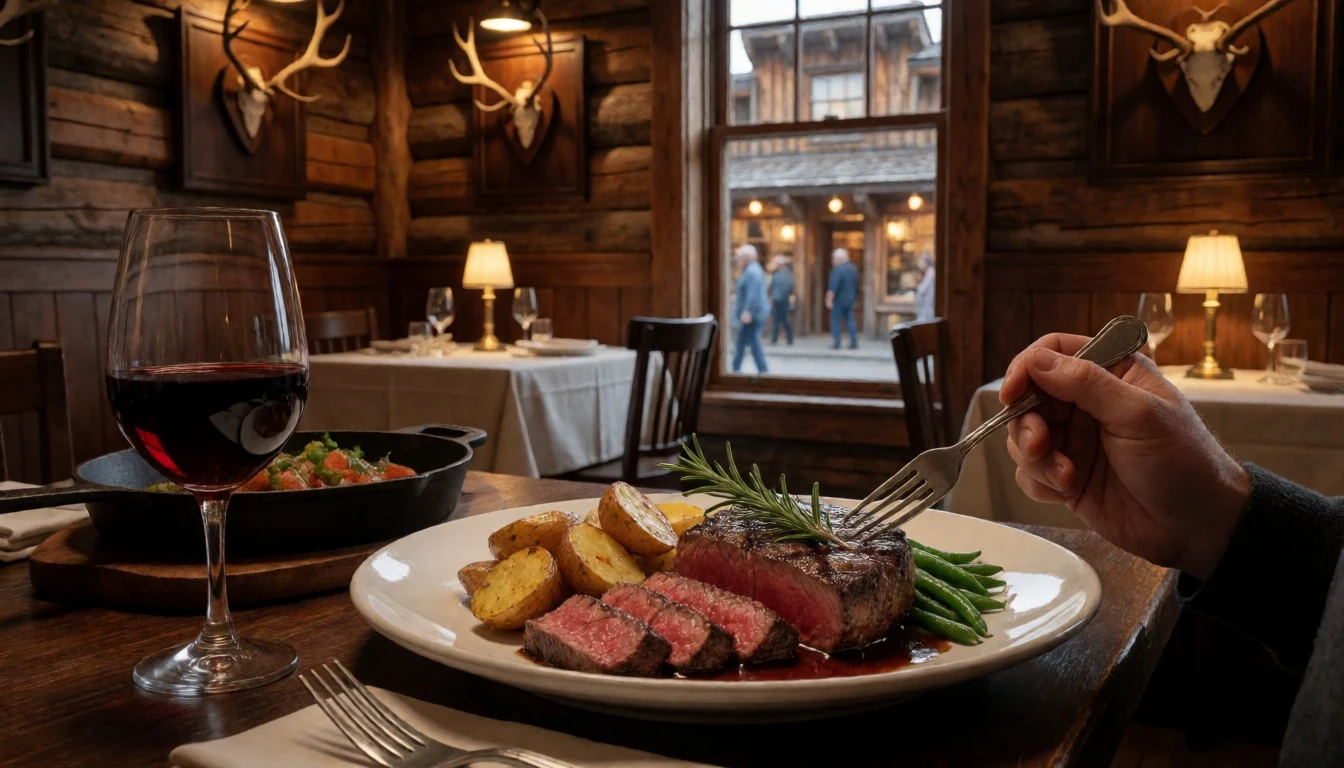
- Pan-fried trout — Local restaurants and lodge dining rooms near the park
Rivers across Wyoming hold trout, and local menus often serve it pan-fried with butter and lemon. It suits a light lunch after a morning of walking. Ask whether it is local and in season. - Huckleberry pie or ice cream — Bakeries, general stores and ice-cream counters in park-edge towns
Wild huckleberries grow in the mountains, and the tart purple fruit turns up in pies, jams and ice cream across the region. It is a sweet, slightly sharp reward after a cold morning at the spring. - Craft beer at a Wyoming brewpub — Brewpubs and saloon-style bars in Jackson, Cody and other towns
Wyoming has several craft breweries and brewpubs, and a cold local beer is a pleasant end to a long drive. The saloon-style bars found in most towns are casual, friendly and usually unfussy on drinks.
Plan it
Best time. May–June and September–October. Late spring brings long days and fewer crowds, though snow can linger into May in higher parts of Wyoming. July and August are the busiest and warmest months. By late October the weather turns cold quickly, so check road and boardwalk conditions before travelling.
How long. 1
Getting there. Jackson Hole Airport is the nearest large Wyoming airport, with flights from hubs such as Denver and Salt Lake City. From there, drive north through Grand Teton National Park into Yellowstone and follow the main park road to the Midway Geyser Basin. A car is the practical way to arrive; check the National Park Service Yellowstone pages for road status.
Budget. mid
Tips
- Arrive early in the morning or late in the afternoon, as the car park and boardwalk fill up by midday in summer.
- Keep your fuel tank full and carry water and snacks, since towns are far apart and weather can change fast.
- Walk the overlook trail for the full view of the colours, and bring layers because it is cooler than it looks.
- Check the National Park Service Yellowstone pages for current road, boardwalk and entry information before you go.
Etiquette
- Stay on the boardwalk and never touch the water or step onto the crust.
- Keep well away from bison, elk and other wildlife.
- Keep voices low and allow others space for photographs on the narrow walkway.
Nearby
Sources
- Wikidata Q1422831 (CC0)
- Wikipedia: Grand Prismatic Spring (rev 1378678444) (CC BY-SA 4.0)
- Wikivoyage: Wyoming (rev 5259374) (CC BY-SA 4.0)
- Photo: Dietmar Rabich, Grand Prismatic Spring 2022 (CC BY-SA 4.0)
- Photo: Carsten Steger, aerial view from the south (CC BY-SA 4.0)
- Photo: Vmm1234!, Grand Prismatic Springs in July (CC BY-SA 4.0)
- Photo: Supercarwaar, Grand Prismatic Spring, Yellowstone NP (CC BY-SA 4.0)
- Photo: Eddiewexler, Late afternoon view from Grand Prismatic Spring Overlook (CC0 1.0)
- Photo: Karel Stipek Austria, Grand Prismatic Spring in Midway Geyser Basin (CC BY 4.0)
- Photo: Tigerzeng, A corner of Grand Prismatic Spring (CC BY-SA 4.0)
- Photo: Algae at Yellowstone Park (CC BY-SA 2.0)


Wildlife
- American bison (animal)
The American bison, sometimes called the American buffalo, is a great shaggy grazer native to North America, rather like a giant cow from a storybook. Bison graze in the countryside near Grand Prismatic Spring. Do not be fooled by their unhurried look, because they are not as slow as they seem, and locals know that giving them room is simply sensible. Keep well back, speak softly, never offer food, and consider walking with a knowledgeable guide.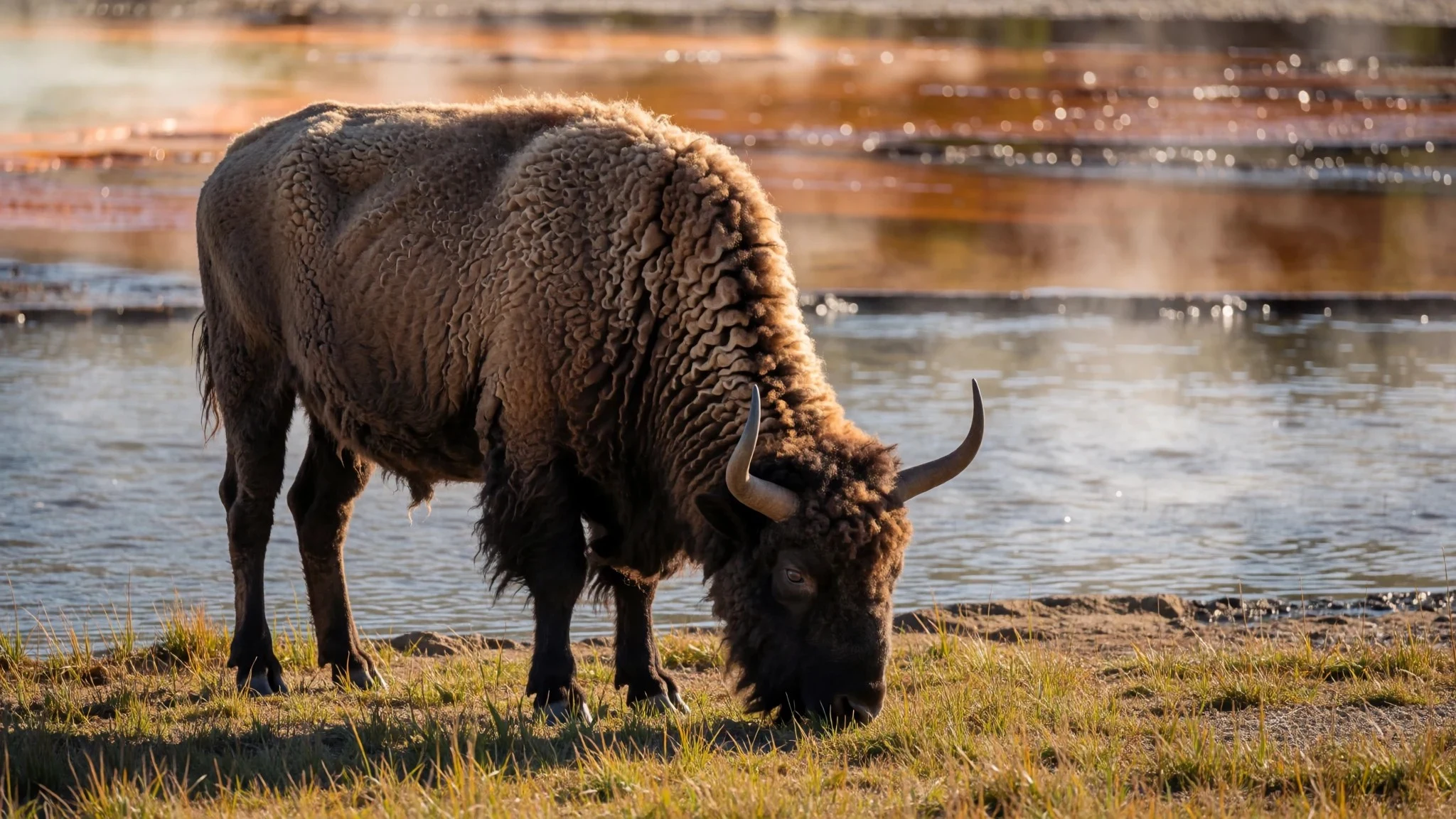
- Elk (animal)
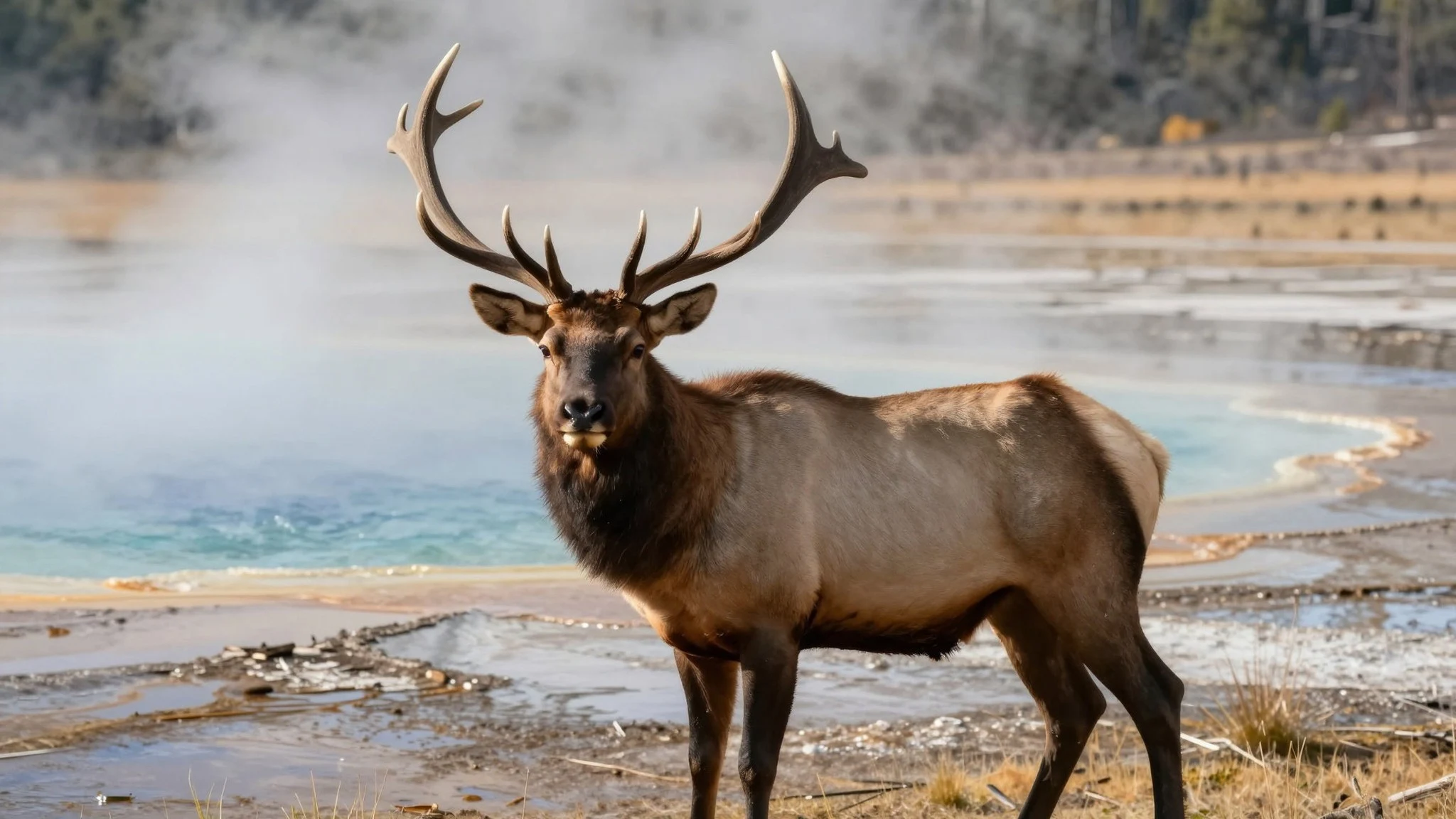
The elk, also known as the wapiti, is a very large deer, the second biggest in its family and among the largest land animals where it lives. Elk graze close to Grand Prismatic Spring, sharing the grassland with bison. Watch from a respectful distance, keep your voice low, and let the animals feed undisturbed. Never offer them food, and consider going with a guide who can help you watch wildlife calmly and safely.