Ghost Ranch
Ghost Ranch, United States
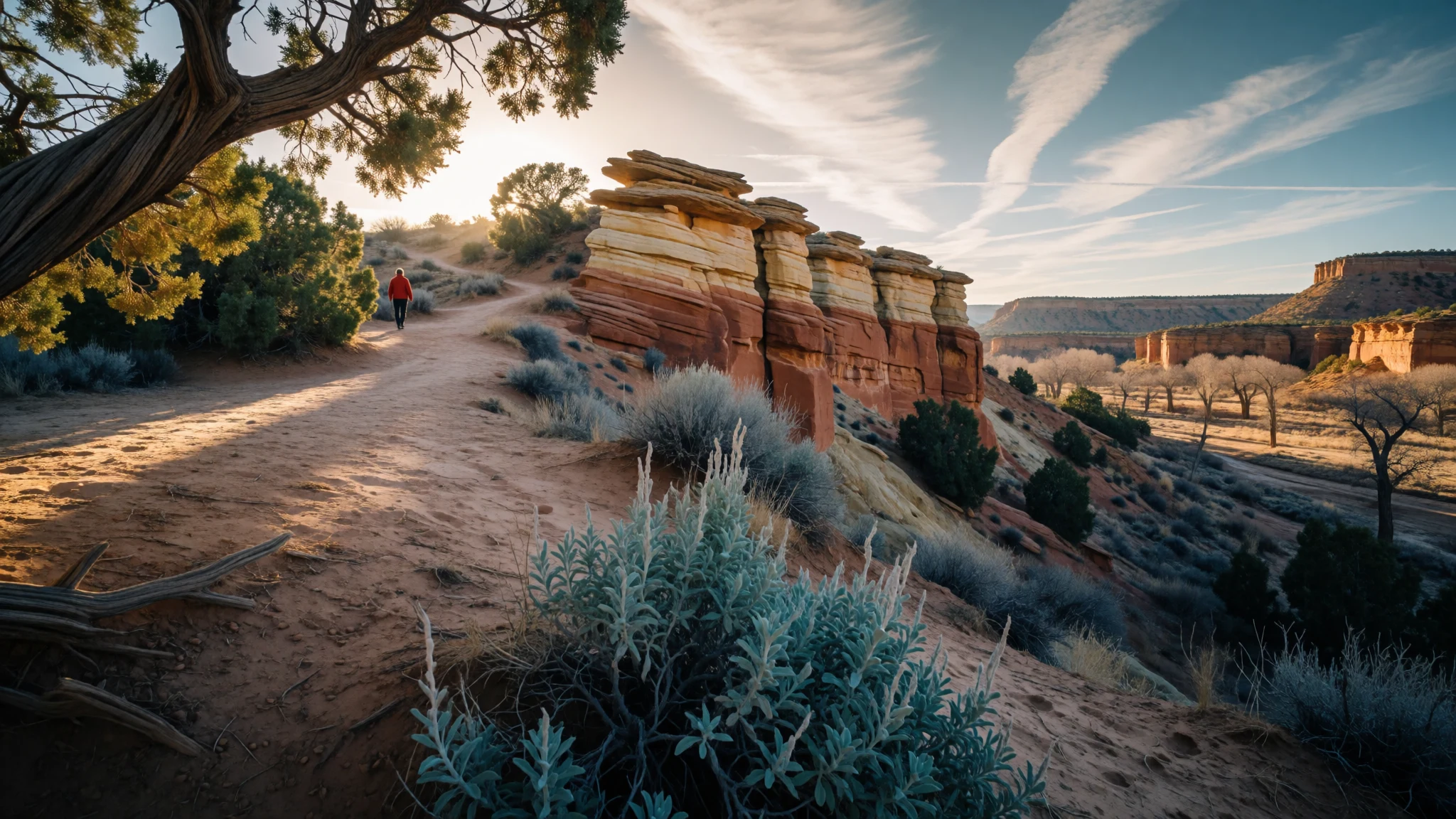
Ghost Ranch is a red-cliff desert retreat in northern New Mexico, where Georgia O'Keeffe painted and a thousand Triassic dinosaurs turned up.
The place
Ghost Ranch is a retreat and education centre in Rio Arriba County, north central New Mexico, with Abiquiú as the nearest community and Santa Fe a long morning's drive away. It dates as a retreat from 1949 and is owned by the Presbyterian Church (USA), which leases it to a foundation that runs the courses, lodging and trails. People come for workshops, quiet, hiking and the landscape itself: banded red and yellow cliffs, flat-topped mesas, juniper and sage scrub, and a sky that changes by the hour. A small stream, the Rito del Yeso, threads through the canyons and keeps water flowing through dry spells. The ranch is also a regular film location, and a cabin built for a 1991 comedy still stands as a stage-set curiosity against genuine desert. Two reputations meet here. One is artistic: Georgia O'Keeffe made a summer home and studio in the area and painted its cliffs, bones and trees again and again. The other is scientific: the ranch holds a dense Triassic fossil record from a time when this region lay near the equator and had a warm climate with heavy seasonal rains. Coelophysis, a small meat-eating dinosaur, is the star, with the remains of nearly a thousand individuals estimated to lie in a single quarry. A visit can mix an artist's eye with a palaeontologist's curiosity, and the scale of the land does most of the talking. Expect big skies, strong sun and long distances between things.
Its story
Ghost Ranch lies within Piedra Lumbre, Spanish for "Shining Rock", a land grant made in 1766 by the Spanish crown to Pedro Martin Serrano. The canyon's later reputation owes much to a local legend from the 1880s, when the Archuleta brothers, cattle thieves, settled in it. The cliffs hid them from view but let them watch the whole valley for approaching riders. They are said to have driven stolen herds at night towards Box Canyon, walking the animals through streams so no tracks remained. Rumours spread of guests who stayed with the brothers and were never seen again. The tale then turns darker: after a deal, one brother claimed to have buried the gold, and the other killed him, then held the dead man's wife and daughter until they would reveal where it lay. Frightened of the canyon's reputed spirits yet braver than their captor expected, the two slipped away by night through the Chama Valley and told the locals about the surviving brother. The science is better documented. Fossil bones were noticed here as early as 1885, and in 1947 the palaeontologist Edwin H. Colbert recorded more than a thousand well-preserved Coelophysis skeletons in a quarry. In 2007 the Hayden Quarry produced remains of Dromomeron romeri, a relative of the earliest dinosaurs. In 1976 the ranch was named a National Natural Landmark.
What to see
- The red cliffs and mesa views — Main ranch grounds
The banded cliffs around Ghost Ranch change colour from pale yellow to deep rust as the light moves, and they are the picture most visitors came for. The main ranch grounds give easy views, while marked trails climb for wider outlooks. Early and late hours are cooler and kinder to photographs.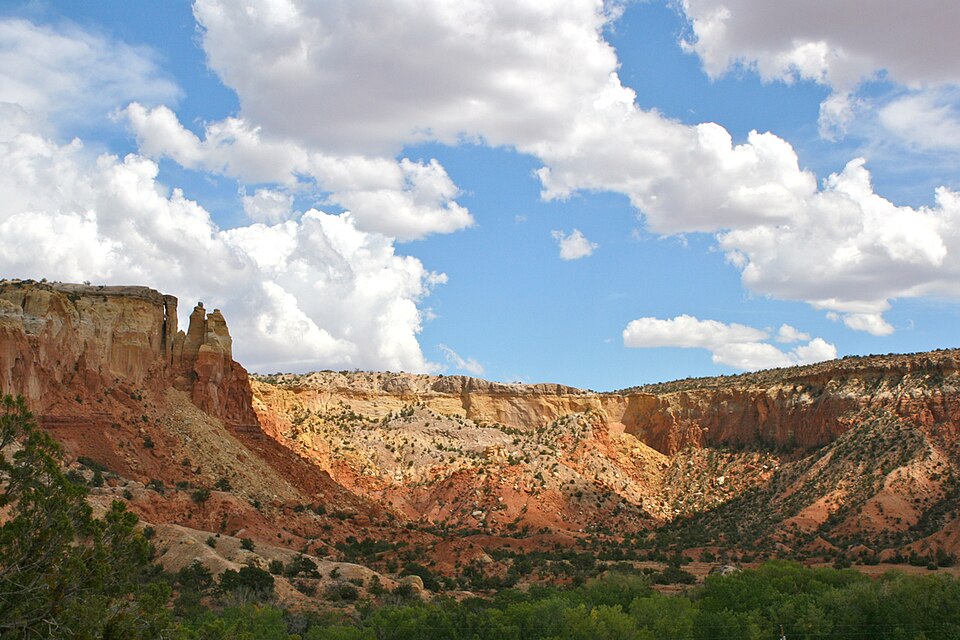
- Gerald's Tree — Trails on the ranch
A lone, weathered tree on the ranch appears in a 1937 painting by Georgia O'Keeffe, though the painter worked from a different angle from the one most walkers meet. Standing at it is a good way to compare her canvas with the real, drier and stranger landscape.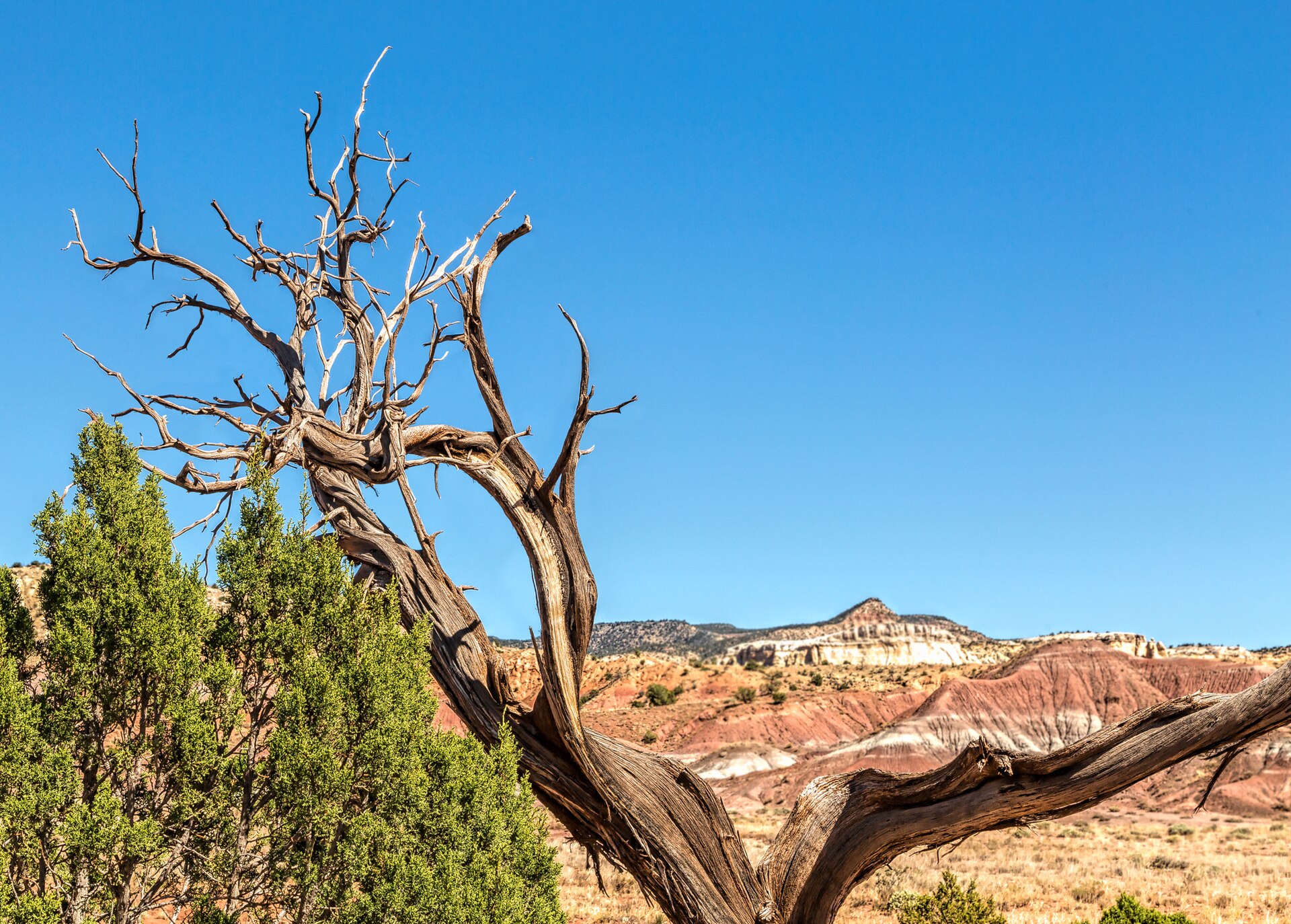
- Ruth Hall Museum of Paleontology — Ranch grounds
This small museum on the ranch explains the Triassic finds, including casts of skulls from animals such as Daemonosaurus. It suits a short, shaded stop between walks, and makes the Coelophysis story concrete. Opening arrangements change, so check the official site before planning around it.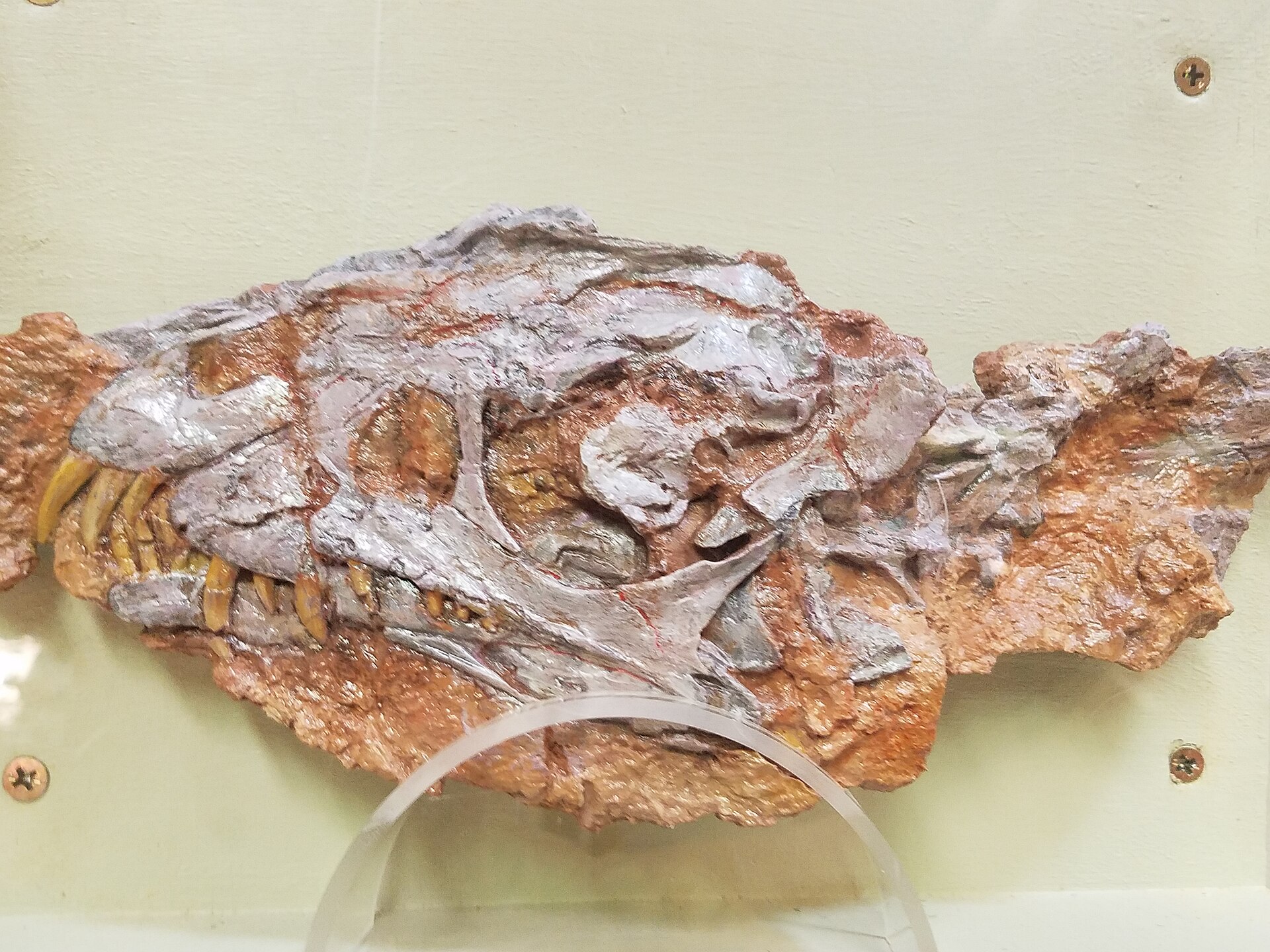
- Rito del Yeso and the canyon walks — Canyon trails
The Rito del Yeso is the modest stream that carved the canyon and gave the area its reliable water. Walks along and above it show the layered rock, cottonwoods in the damp ground and the dry scrub beyond. Carry water; shade is scarce away from the stream. - The film-set cabin — Ranch grounds
A wooden cabin built for a 1991 comedy stands against the cliffs and looks like a movie version of the Old West, which is exactly what it was. It makes an easy photograph and a reminder that the ranch has often doubled as a film location.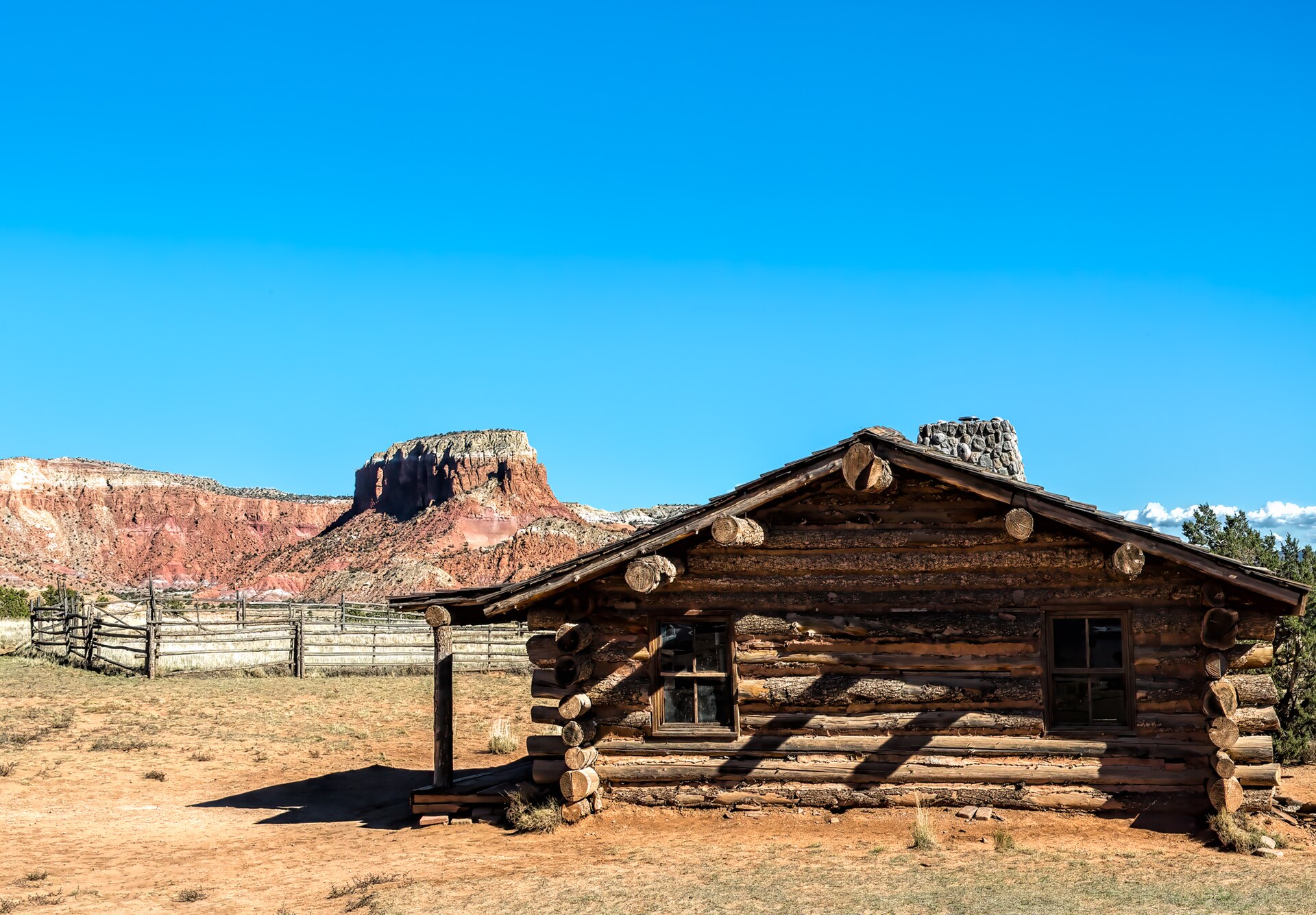
Culture
Ghost Ranch sits in a part of New Mexico where Native American, Spanish and later American histories overlap, and the ranch itself reflects that layering: a Spanish-era land grant, a church-owned retreat, and an artist's adopted home. New Mexicans take real pride in their state's separate identity and do not always welcome comparisons with Texas, Arizona, Colorado or Mexico. Art runs through daily life in the north of the state, from Santa Fe and Taos to small rural galleries with a folk-art streak, and Georgia O'Keeffe's work is part of how the region sees itself. Many Native American communities in the state have a complicated relationship with outsiders and with the federal government, shaped by history and by present-day hardship, so curiosity works best when paired with humility. The ranch's religious ownership gives it a calm, contemplative tone: many guests are on courses or quiet retreats rather than sightseeing. Local legend and ghost stories are told with a smile, but the landscape is treated seriously as shared heritage. Fossils, rocks and bones belong to the place and to science. Leave every fossil, bone and stone where you find it, and keep to marked trails and quiet hours so that people on retreat and the fragile desert ground are both left undisturbed.
What to wear
Around Ghost Ranch, traditional dress comes from the Pueblo, Navajo (Diné) and Hispanic communities of northern New Mexico. Pueblo women's dress includes the manta, a wrapped woollen garment, and embroidered cloth for feast days; Navajo weavers make wool blankets and rugs, and silversmiths set turquoise into rings, bracelets, squash-blossom necklaces and concho belts. Ribbon shirts and velvet blouses appear at dances, weddings and ceremonies, and are worn with real pride rather than as costume. Day to day, people here wear what suits a high, dry climate: jeans, boots, wide-brimmed hats, cotton shirts and fleeces for cold mornings. Artists and retreat guests dress casually, and nobody expects smartness. A visitor should dress for sun, wind and rough ground. Choose a hat, sunglasses, long light sleeves and sunscreen, and add a warm layer, because desert evenings cool fast and winters can be cold. Sturdy closed shoes or hiking boots suit the loose, rocky trails far better than sandals. If you visit a pueblo or attend a ceremony nearby, dress modestly, with covered shoulders and knees, and treat jewellery and textiles in craft shops as handmade work: ask before handling, and ask before photographing makers or their stalls.
What to eat
- Red or green chile stew — Family-run eateries in Abiquiú and the small towns on the road from Santa Fe
New Mexican cooking is built on chile, spelt that way locally, and served as a red or green sauce or stew. It is usually milder than its reputation but can still surprise. Ask for "Christmas" to get both. Try it in family-run eateries in Abiquiú and nearby towns. - Enchiladas with chile — Local diners and roadside cafés near Abiquiú and Española
Corn tortillas are layered, not rolled, in the northern New Mexican style, with cheese, onion and chile sauce, often topped with a fried egg. They are filling after a morning on the trails and are usually served with beans and rice. - Posole — Home-style restaurants and community feast tables in northern New Mexico
Posole is a warming stew of hominy, dried maize treated to swell and soften, usually cooked with pork and red chile. It is a classic for cold days and feast times, so it appears more often on winter and festival menus. - Sopaipillas — Traditional New Mexican restaurants in Santa Fe and the surrounding villages
These puffed, hollow pastries are fried until golden, then served warm with honey drizzled inside, or stuffed with meat and beans as a savoury course. They are a regular finish to a meal and a good test of whether an eatery makes its own. - Carne adovada — Cafés and family restaurants along the high road between Santa Fe and Taos
Pork is marinated for hours in red chile and garlic, then slow-cooked until tender. It is served with beans, potatoes or tortillas. The sauce carries the heat, so ask staff how spicy a dish is before ordering.
Plan it
Best time. May–June and September–October, when days are warm and walkable and the evenings cool. July and August bring heat and afternoon storms, and winter nights are cold, though clear days can be rewarding.
How long. 2–3
Getting there. Albuquerque is the state's main commercial airport; Santa Fe has limited connecting flights. From either, drive north-west to Abiquiú and on to the ranch. A car is essential, as public transport is minimal and distances are long.
Budget. mid
Tips
- Check the official site, ghostranch.org, for lodging, programmes, tours and museum arrangements before you travel
- Walk early or late: midday sun on open rock is harsh and shade is rare
- Carry more water than seems necessary, and a sun hat and sunscreen
- Fill the fuel tank and download maps first, as phone signal can be patchy in the canyons
- Watch the sky in summer: afternoon storms can arrive quickly and make dirt tracks slippery
Etiquette
- Stay on marked trails and leave fossils, bones and stones in place
- Respect quiet hours and retreat spaces, as many guests are on courses
- Ask before photographing local people, craftspeople or any ceremony
Nearby
Sources
- Wikidata Q587888 (CC0)
- Wikipedia: Ghost Ranch (CC BY-SA 4.0)
- Wikivoyage: New Mexico (CC BY-SA 4.0)
- Ghost Ranch redrock cliffs — Artotem (CC BY 2.5)
- Ghost Ranch redrock cliffs, clouds — Larry Lamsa (CC BY 2.5)
- A different view of Gerald's Tree — Sheila Sund (CC BY 2.5)
- Abiquiu ghostranch — Marc Davis (CC BY 2.5)
- Daemonosaurus skull cast, Ruth Hall Museum — Fanboyphilosopher (CC BY 4.0)
- Faux Old West — Sheila Sund (CC BY 2.5)
- Ghost Ranch 2002 pic01 — Svobodat (CC BY-SA 4.0)
- Ghost Ranch 2002 pic02 — Svobodat (CC BY-SA 4.0)


