Fisher Towers
Fisher Towers, United States
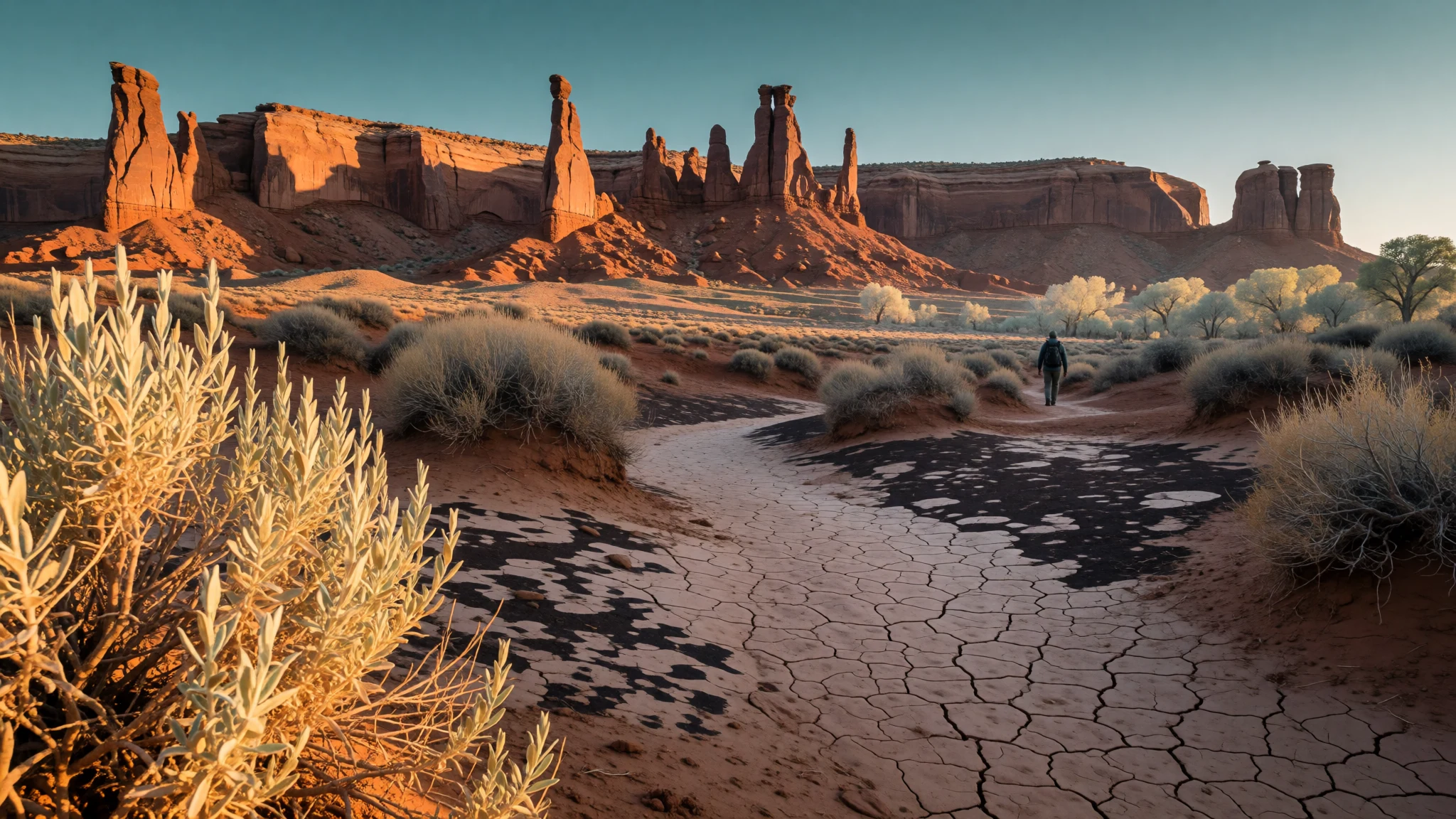
Fisher Towers is a wall of mud-crusted red spires near Moab, Utah, that glows at sunset and tempts hikers and climbers alike.
The place
Fisher Towers stand in the high desert of Grand County, Utah, about 26 km north-east of Moab and a short distance from the Colorado River. The rock is red Cutler sandstone, capped in places by darker Moenkopi sandstone, and the surfaces are coated in dried red mud that gives the spires a dripped, melted-candle look. Three long fins of rock run from the north-east, where they merge into a mesa, out to the south-west and into an open valley. Each fin is between 300 and 610 m long, and roughly 300 m of empty ground separates one from the next. Every fin carries several towers, and a number of them have names. The northern fin is anchored at its eastern end by King Fisher, then dips before rising again at Ancient Art, which has four separate summits, one of them the twisted pinnacle called the Corkscrew. The middle fin divides cleanly into Echo Tower in the east and Cottontail in the west. About 300 m north of the main group, one more tower is only half free of the mesa, a reminder that the whole formation is still being carved out of the cliff. Castleton Tower, another desert spire, shows on the horizon about 9.7 km to the south-west. The usual approach is along Fisher Towers Road, which leaves the highway that follows the river, and the setting is quiet, dry and very open.
Its story
Fisher Towers takes its name from a miner who lived near the rocks in the 1880s, though the story that matters most is far older and slower. The towers are made of sandstone laid down in layers, with a harder cap sitting over softer rock beneath. Water, frost and wind have worked at the mesa for a very long time, stripping away the weaker material and leaving the fins and spires standing. The process has not finished. The half-released tower to the north shows the stage the others passed through, and in the distant future the ones now standing will themselves wear down. The red mud crust that coats the rock is part of the same story, since rain washes fine sediment down the faces and it dries into that rough, stuccoed skin. The place built a reputation among two groups of visitors. Photographers came for the colour, especially around sunrise and sunset, when the red deepens against a dark sky. Climbers came for the routes on the towers, among them the Corkscrew on Ancient Art. Climbers tend to describe the rock as soft and crumbly compared with harder desert sandstone, so ascents here ask for patience and care rather than speed. For most people the towers are a walk, a view and a long look at slow geology.
What to see
- King Fisher — Northern fin, eastern end
King Fisher dominates the eastern end of the northern fin, close to the mesa wall. From the trail it reads as a broad, heavy block rather than a needle, and its mud-streaked face changes tone as the sun moves. It is a good first landmark for getting your bearings. - Ancient Art and the Corkscrew — Northern fin, western end
Ancient Art is the tower with four separate summits, and the twisted pinnacle known as the Corkscrew is the one that draws the eye. Climbers are often visible on its slender top, which gives a useful sense of scale. Binoculars or a zoom lens repay the effort here.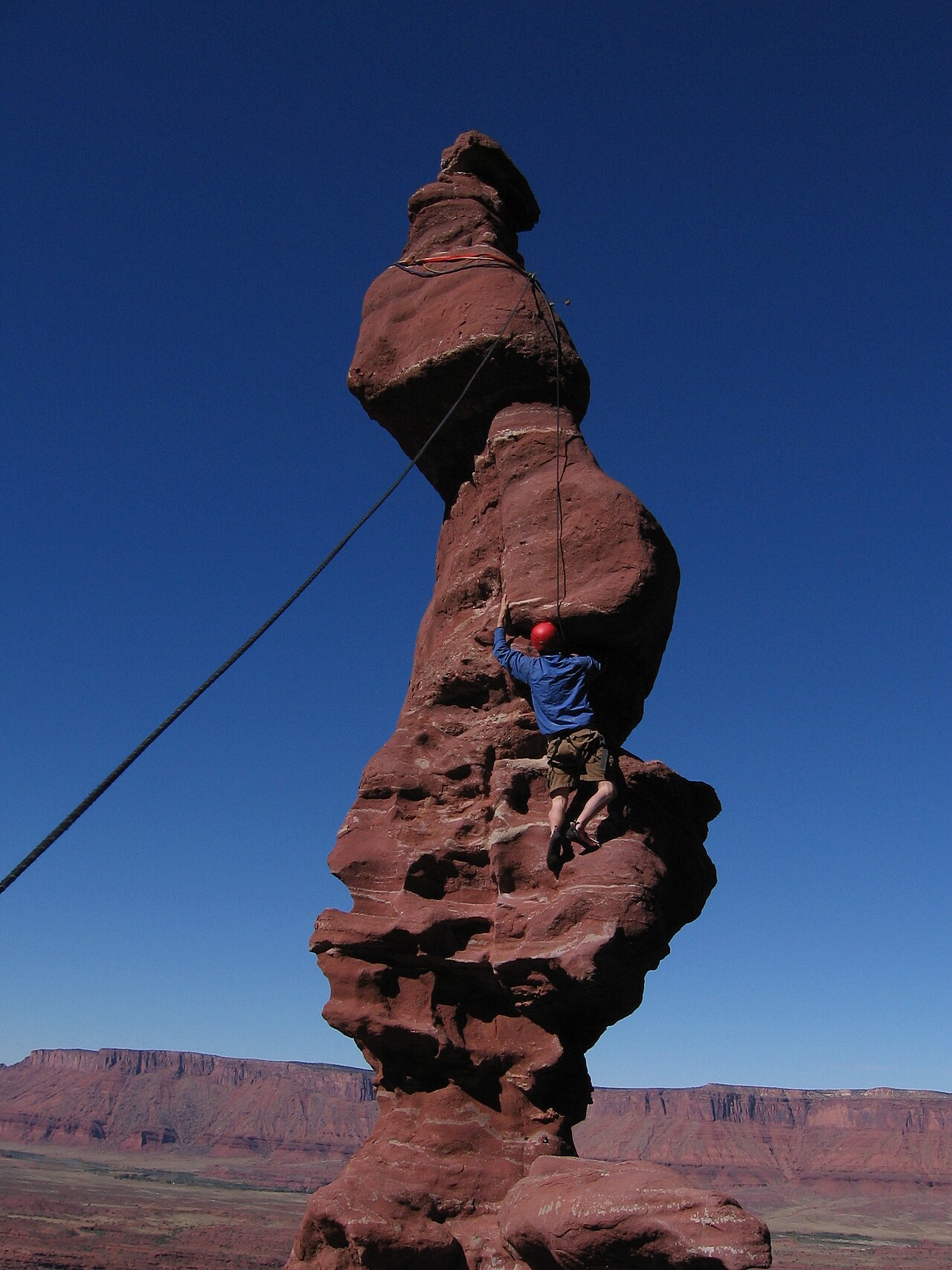
- Echo Tower and Cottontail — Middle fin
The middle fin splits into two distinct towers: Echo Tower to the east and Cottontail to the west. Seen from the north, Echo Tower sits beside Ancient Art and the two together make the classic composition of the area, with the valley floor spreading out beyond.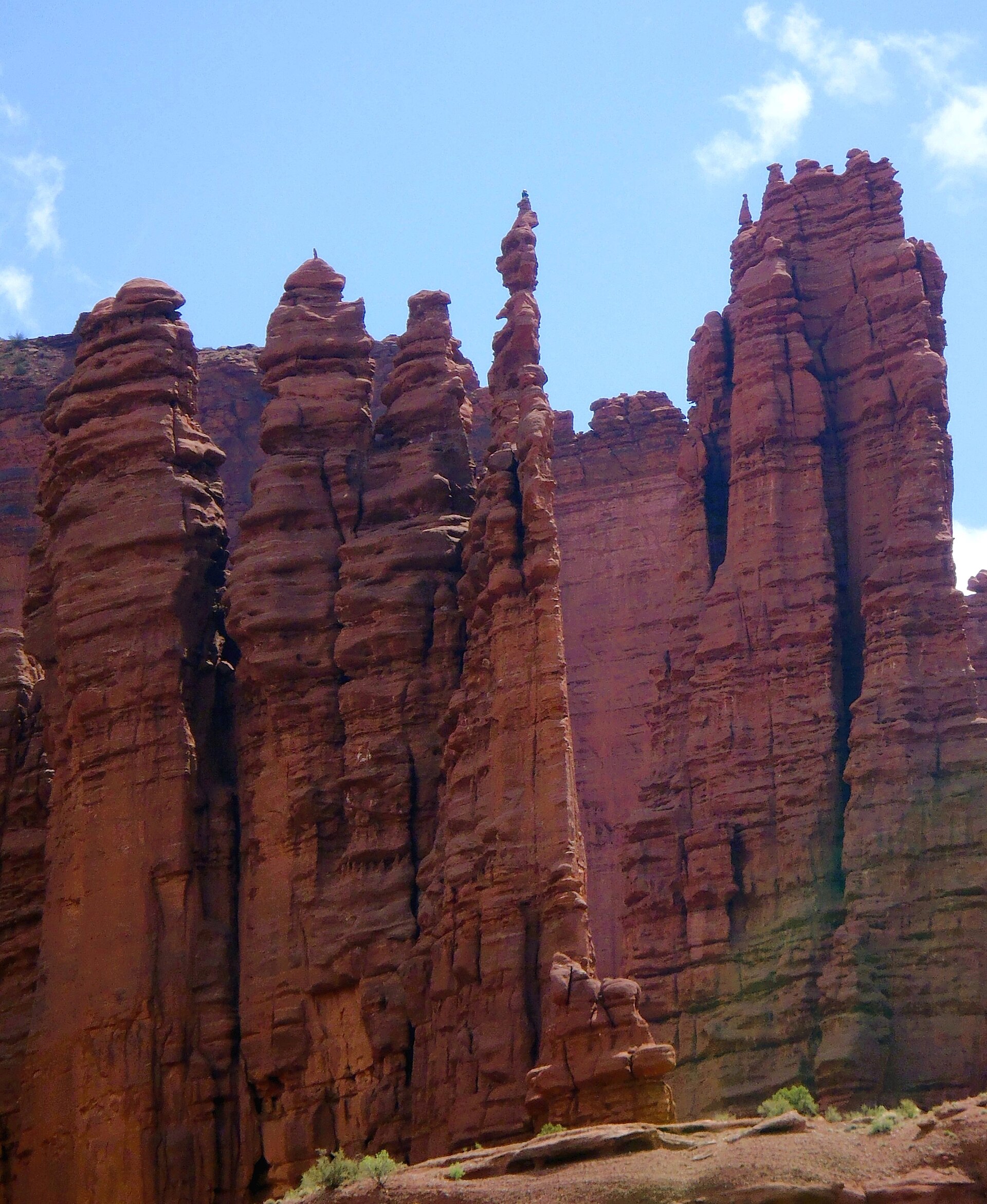
- The Titan — Main group of towers
The Titan is one of the named towers among the fins and a favourite subject for photographers, who return to it in different seasons and light. Its sheer, ribbed sides show clearly how the mud-coated sandstone sheds and gathers colour after rain.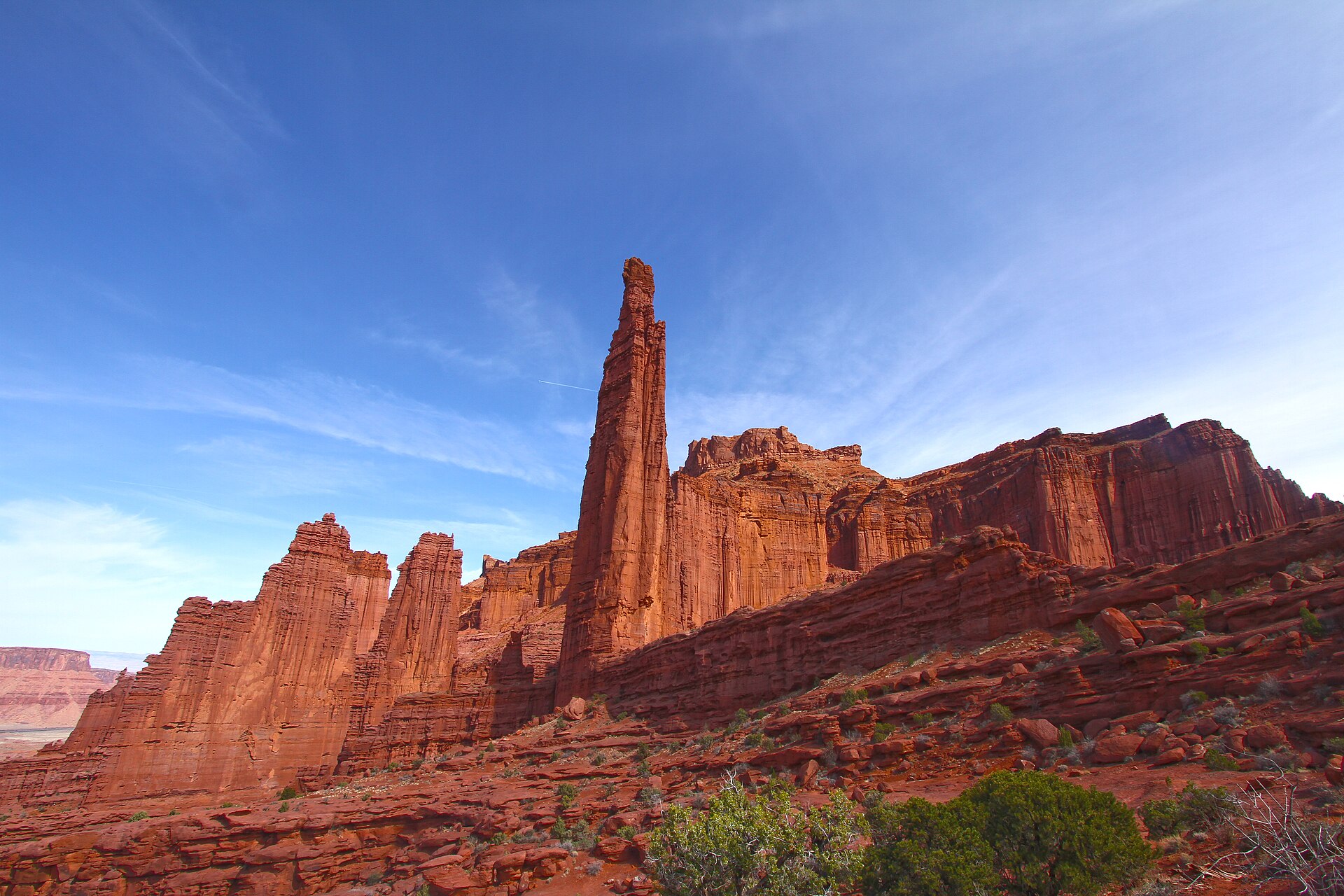
- Sunset along the fins — Trail and viewpoints along Fisher Towers Road
Fisher Towers is best known for its evening light, when the red rock turns deep orange and the valley below falls into shadow. The sunset view from the trail or the road gives the whole formation at once, with the three fins stepping out into the desert.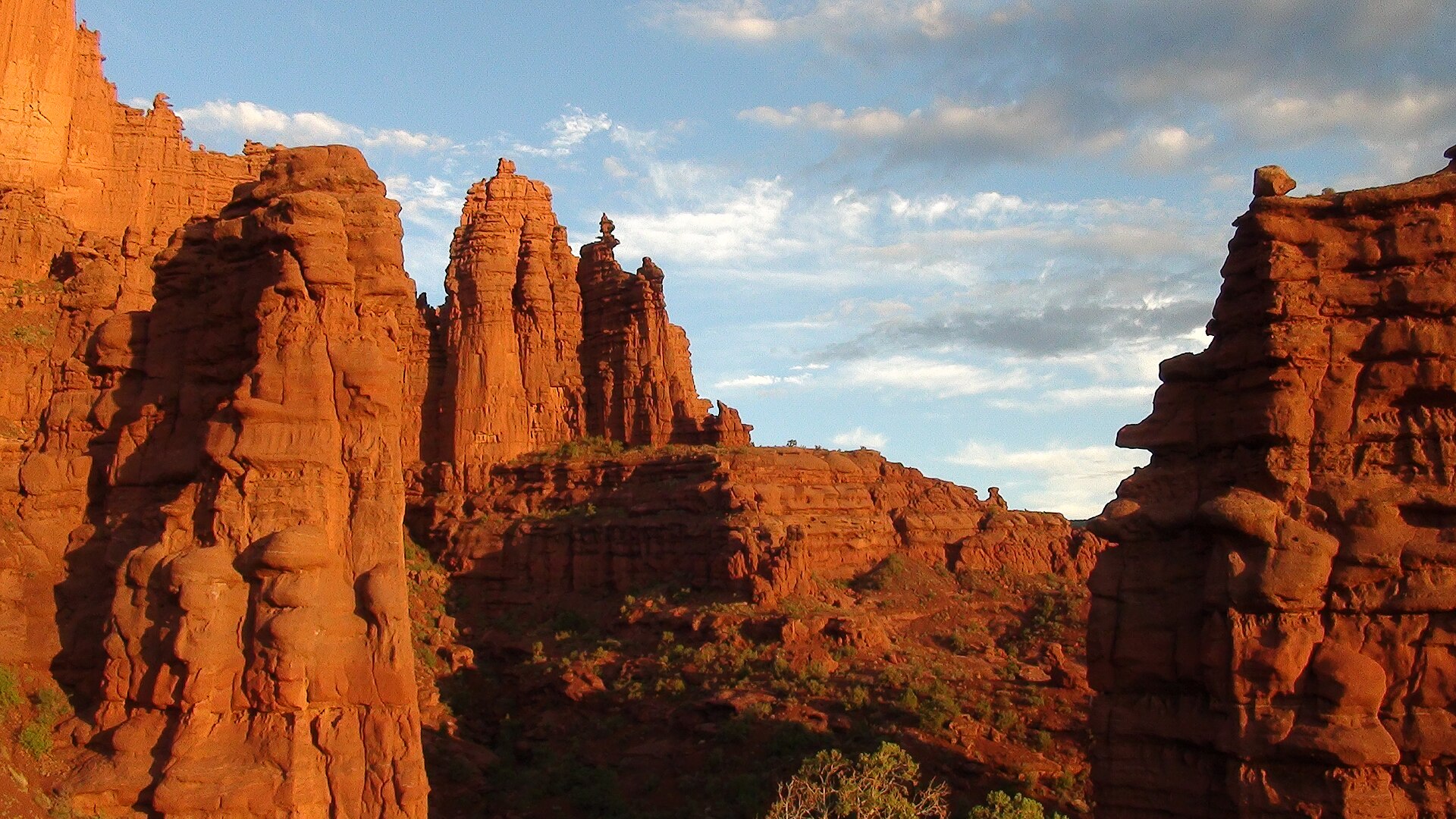
- The emerging tower to the north — North of the main formation
A short distance north of the main group, one tower has only partly separated from the mesa, and it is clearest in the distant view from the north. It is worth finding for what it explains: this is how the other spires looked before erosion cut them free.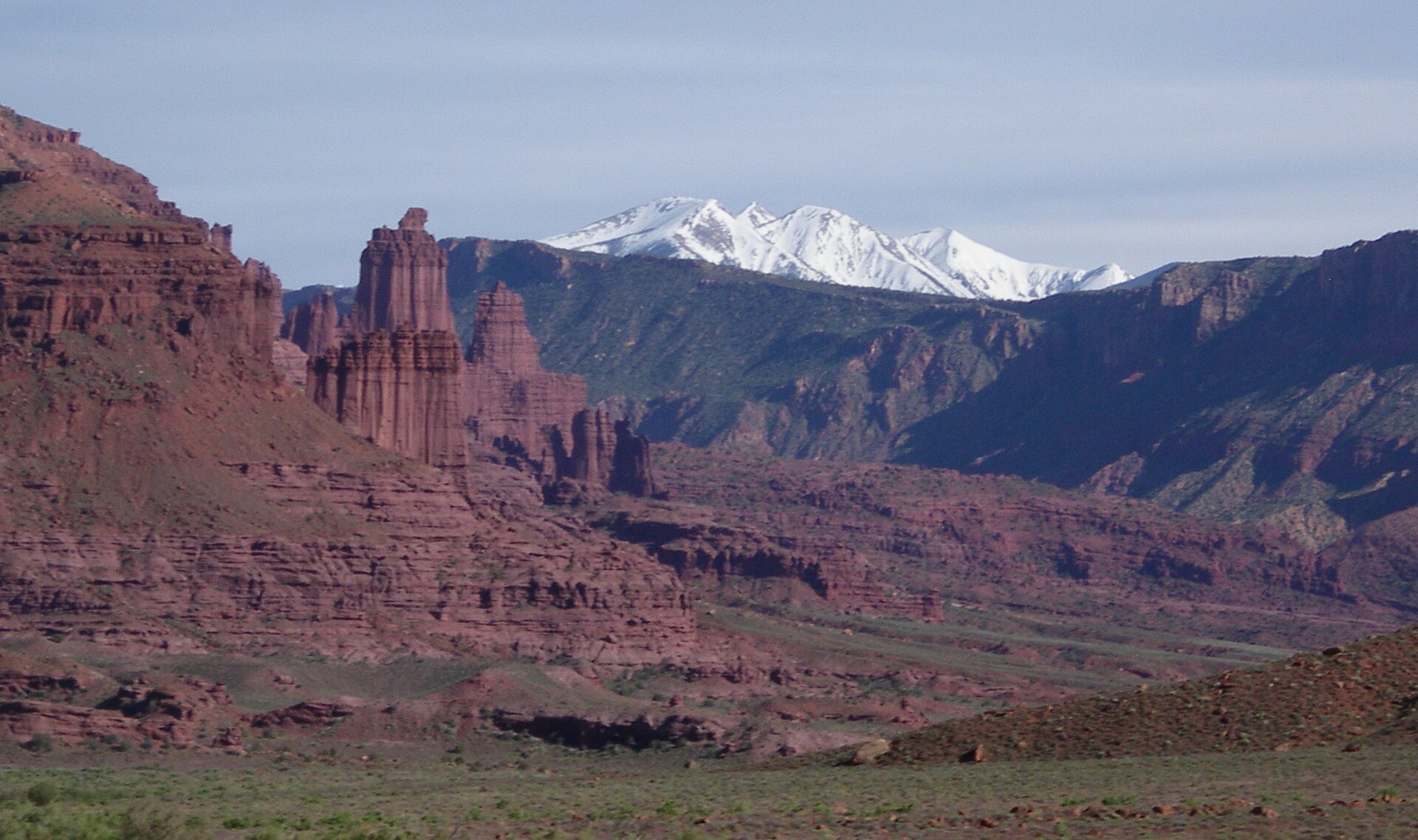
Culture
Fisher Towers sits in country that people have used and travelled for a very long time, long before any miner gave the rocks his name. Native nations, including the Ute, have deep ties to the canyon lands of south-eastern Utah, and the red rock country is part of a wider cultural landscape rather than an empty backdrop. The modern culture around the towers is an outdoor one, shaped by Moab, the nearest town, which fills with hikers, climbers, cyclists and photographers through the milder months. Climbing has its own customs here. Climbers share the towers with walkers, and a rope hanging from a spire is a working route, not a decoration. Conversations at the trailhead are often about conditions, rock quality and the weather, and most people are generous with advice. Utah as a whole has a strong religious character, with a large Latter-day Saint population, and visitors will notice that coffee shops, alcohol and Sunday opening hours can differ from what they expect elsewhere. Liquor is sold through state-run stores, so anyone planning an evening drink in Moab should check what is available rather than assume. Along the trails, the desert crust of living soil is easily damaged and takes years to recover. Stay on the marked path and keep to rock or sand when you step off it, and do not climb, scramble on or touch the fragile mud-coated towers themselves unless you are an experienced climber on an established route.
What to wear
Fisher Towers has no dress tradition of its own, so the useful picture comes from the peoples and ranching culture of the region. The Ute, whose homelands include this part of Utah, are known for buckskin clothing and detailed beadwork, now worn mainly at ceremonies and powwows. Navajo communities to the south are known for velvet blouses, woven wool blankets and silver-and-turquoise jewellery, usually worn on formal and celebratory occasions. Ranching left its own wardrobe: denim, wide-brimmed hats and leather boots, which are still everyday wear in small desert towns. What people wear now in Moab is practical outdoor clothing. Expect quick-dry shirts, lightweight trousers or shorts, sun hats, trail shoes and a lot of sunglasses, with a fleece or jacket for cool mornings. Dress is relaxed and nobody expects formality at the towers. A visitor should plan for strong sun and big temperature swings. Summer days are very hot and shade is scarce, so light long sleeves, a brimmed hat and sun cream matter more than style. Spring and autumn mornings can be cold, so bring a warm layer. Footwear matters most: the trail crosses rocky, uneven ground, so wear sturdy closed shoes with a good grip rather than sandals. There are no religious sites at the towers, but in nearby Utah towns modest, ordinary clothing is the safe choice outside the trails.
What to eat
- Fry sauce — Casual eateries and burger counters in Moab
Fry sauce is a pink Utah dip of mayonnaise and ketchup, often with a little pickle relish stirred in. It arrives with chips at many casual eateries and burger counters in Moab and across the state, and locals use it on far more than chips. - Pastrami cheeseburger — Local fast-food chains in and around Moab
A Utah oddity: a cheeseburger piled with sliced pastrami. It is exactly as heavy as it sounds, and a decent choice after a long hot walk. It appears mainly at local fast-food chains rather than in the fancier kitchens. - Utah scones — Family restaurants and breakfast cafés in Moab
Utah scones are nothing like the British kind. They are large, deep-fried pastries, closer to frybread, served warm with butter and honey and sometimes eaten at breakfast. They suit a morning before an early start at the towers. - Local honey — Roadside stalls, farm shops and cafés in the Moab area
Utah is called the Beehive State, and honey is a real local product. It turns up on scones, in drinks and on breakfast plates, and jars make a simple edible souvenir for the journey home. - Summer stone fruit and Green River melons — Roadside fruit stands and farmers' markets along the highways
In summer, peaches, cherries and other stone fruit appear at farm stands, and Green River melons come from the middle of the state. They are juicy, cheap-feeling trail food, good for dry desert heat, and best bought from the stall rather than a supermarket.
Plan it
Best time. March to May and September to October, when days are warm enough for walking and the light is good for photographs. Summer is very hot with little shade, and winter can be cold with occasional snow.
How long. 1–2
Getting there. Fly to Salt Lake City International Airport (SLC), the main hub, then drive south-east to Moab, which takes several hours. The California Zephyr train stops at Green River, though you will still need a car for the last leg. From Moab, Fisher Towers is about 26 km to the north-east, reached by Fisher Towers Road off the river highway.
Budget. mid
Tips
- Carry far more water than seems necessary, as there is none at the towers and shade is scarce
- Walk early in the morning in warm months, or time the visit for sunset light, and carry a torch for the return
- Fuel up and buy food in Moab, since services near the towers are very limited
- Check weather before going, as flash floods and mud can make the access road and trails difficult
- Mobile signal is patchy, so download a map and tell someone your plans
Etiquette
- Stay on the marked trail to protect the fragile desert soil
- Give climbers space and keep noise low near the base of the towers
- Take all rubbish with you
Nearby
Sources
- Wikidata Q5454847 (CC0)
- Wikipedia: Fisher Towers (rev 1367921991) (CC BY-SA 4.0)
- Wikivoyage: Utah (rev 5404380) (CC BY-SA 4.0)
- Fisher Towers from distant north — OMCV (Public domain)
- Fisher Towers at sunset — Greg Schaefer (CC BY 3.0)
- The Titan — Jesseg8r (CC BY-SA 4.0)
- Climber on the Corkscrew — Greg Schaefer (Public domain)
- Fisher Towers area, near Moab, Utah — Murray Foubister (CC BY-SA 2.0)
- Kaylee the Dog on Fisher Towers hike — Bureau of Land Management - Utah (Public domain)
- Ancient Art - Echo Tower — Mia & Steve Mestdagh (CC BY-SA 2.0)
- Ancient Art - Fisher Towers — Bureau of Land Management - Utah (Public domain)


