Eureka Springs
Eureka Springs, United States
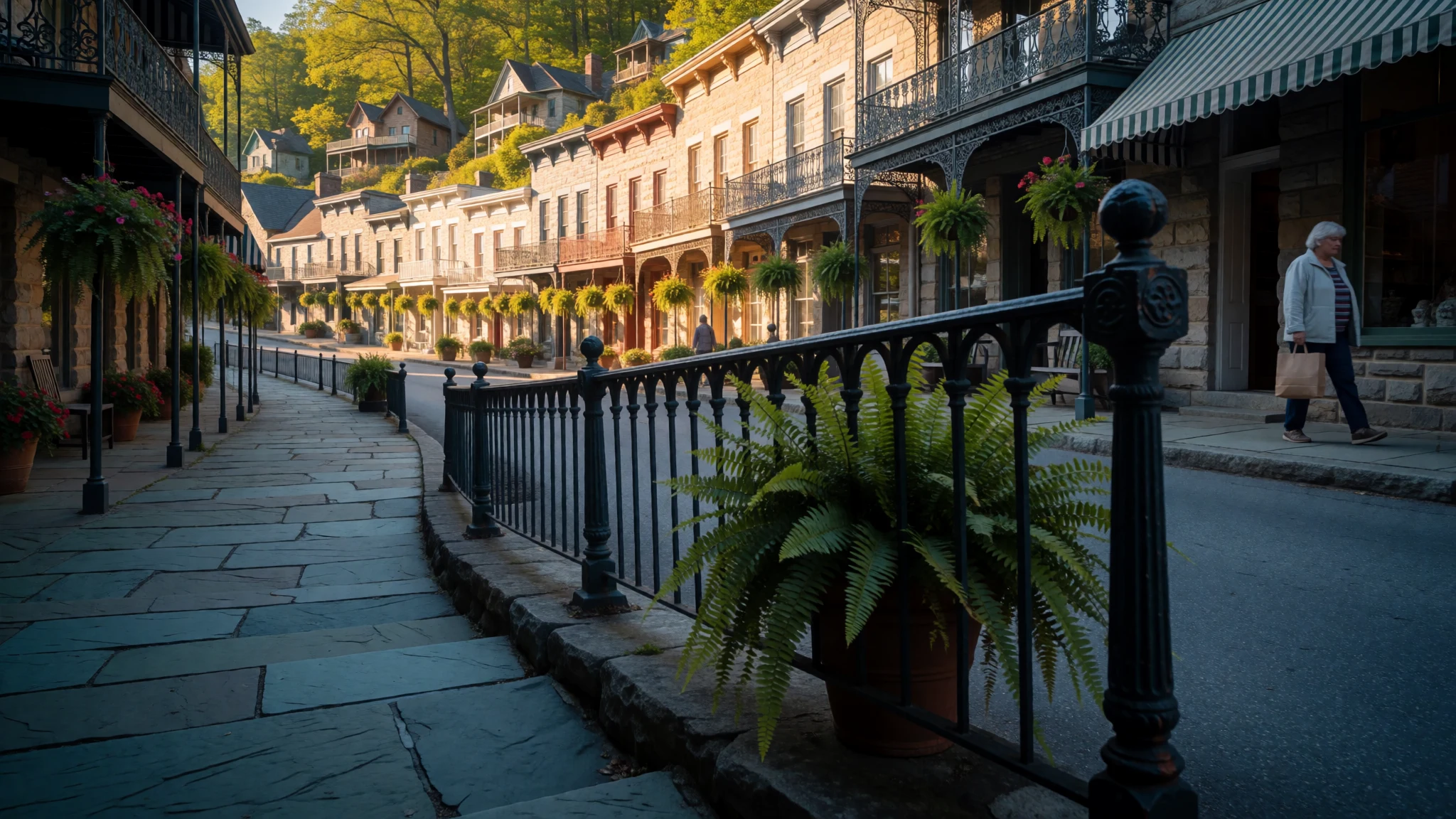
Eureka Springs is a Victorian spa town of stone cottages and stairstep streets, tucked into the Ozark hills and still run on its own eccentric terms.
The place
Eureka Springs sits in the Ozark Mountains of northwest Arkansas, close to the Missouri border, at an elevation of 384 metres. It is a small place, with a population of about 2,200, yet it is one of the two county seats of Carroll County. The whole town is built on slopes, and that shapes everything about it. Streets do not run in grids here. They curl around hillsides, climb sharply, double back and sometimes end at a flight of steps, which is how the town earned the nickname Stairstep Town. Older names included the Magic City and Little Switzerland of the Ozarks. Most of the buildings are Victorian, many of them in local stone, and the historic commercial centre has an unusually complete run of them. Cottages and larger manors cling to the hillsides above the main street, and the loop of road that circles the old town is the usual way to see it. The entire city was placed on the United States National Register of Historic Places as a historic district, and a national heritage body has named it a distinctive destination. In practice that means a walkable, slightly theatrical town of galleries, small shops, music venues, bed-and-breakfasts and old spring sites. It is busiest at weekends and around festivals, and quieter on weekdays outside the main seasons. Cars are less useful than good shoes: parking is tight, and many of the best corners can only be reached on foot.
Its story
Eureka Springs began as a health resort, but people lived in this part of the Ozarks long before anyone bottled its water. Archaeological finds show Paleoindian peoples in the region thousands of years ago, and later inhabitants shaped tools from the chert found in the local hills. By the time the United States acquired the territory, the area belonged to the ancestral lands claimed by the Osage Nation, who hunted across much of northern Arkansas. Delaware and Shawnee communities also lived nearby until federal removal policy pushed tribes further west. The Osage gave up northern Arkansas to the United States in 1825, and the land was opened to settlers, though few came until after the Civil War. A popular tale says Indigenous leaders shared healing water with outsiders. Historians have found no documentary or archaeological support for it, and there is no evidence that Osage or other Native groups credited the springs with medicinal powers. That story grew up among visitors in the later nineteenth century, when the spring water was marketed as a cure. The town itself dates from 1880, and its early boom produced the stone buildings and zigzag streets that remain. Visitors came in search of cures, and the spa trade soon turned into a broader resort economy of hospitality, entertainment and, much later, arts and festivals. The hills dictated the layout, and the Victorian townscape survived mostly because later development passed it by.
What to see
- The Historic District and Spring Street — Downtown loop
The old town, known locally as the loop, is the main reason to come. Spring Street runs down through stone-built Victorian shops, and side lanes lead up to cottages, steps and small galleries. Allow time to wander without a plan, and expect gradients that make flat-soled shoes sensible.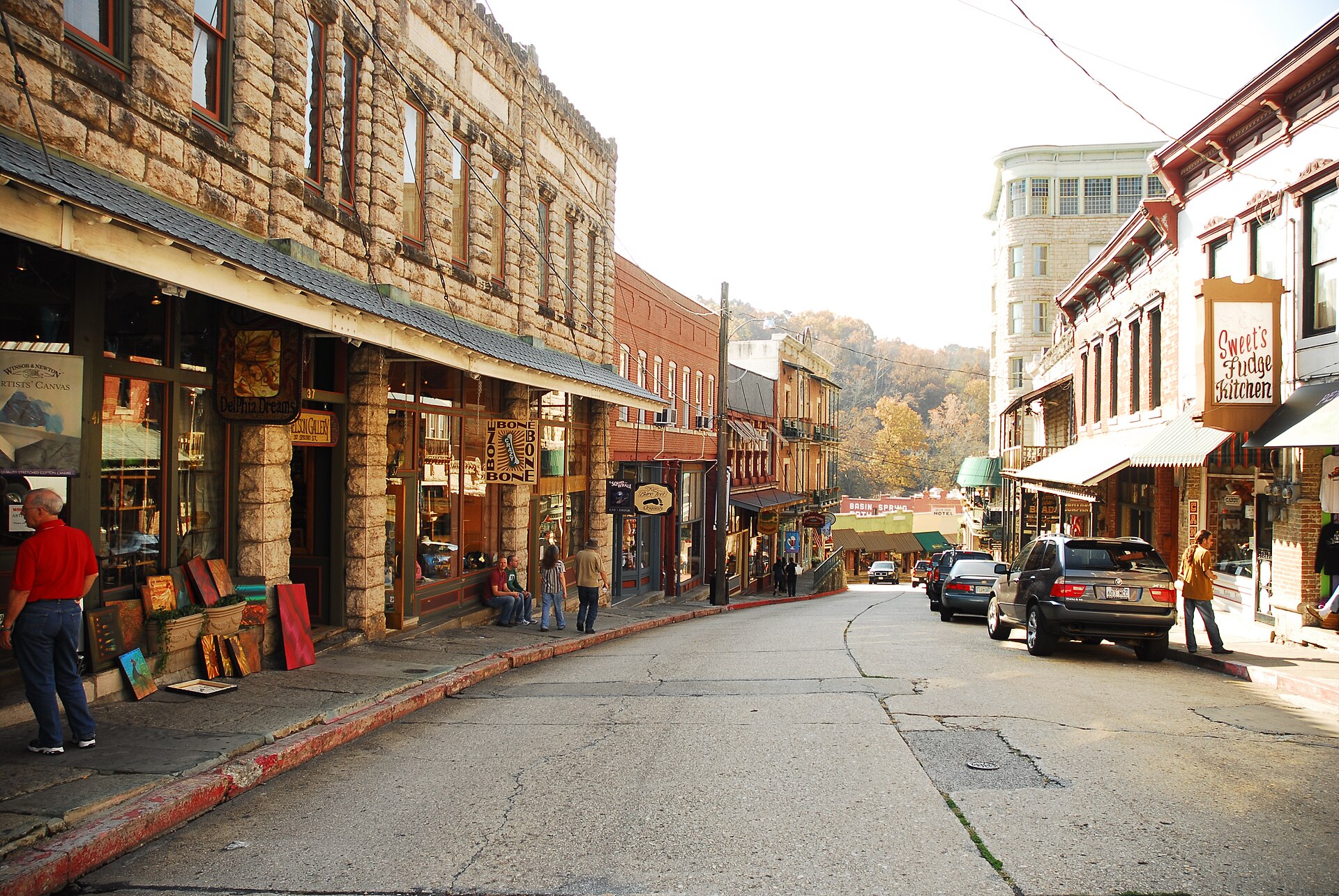
- Christ of the Ozarks — Magnetic Mountain, east of town
A seven-storey statue of Christ with outstretched arms stands on a hilltop and can be seen from the historic district. It is on the grounds of the Great Passion Play site, and it is open at all hours and free to visit. The views over town are good.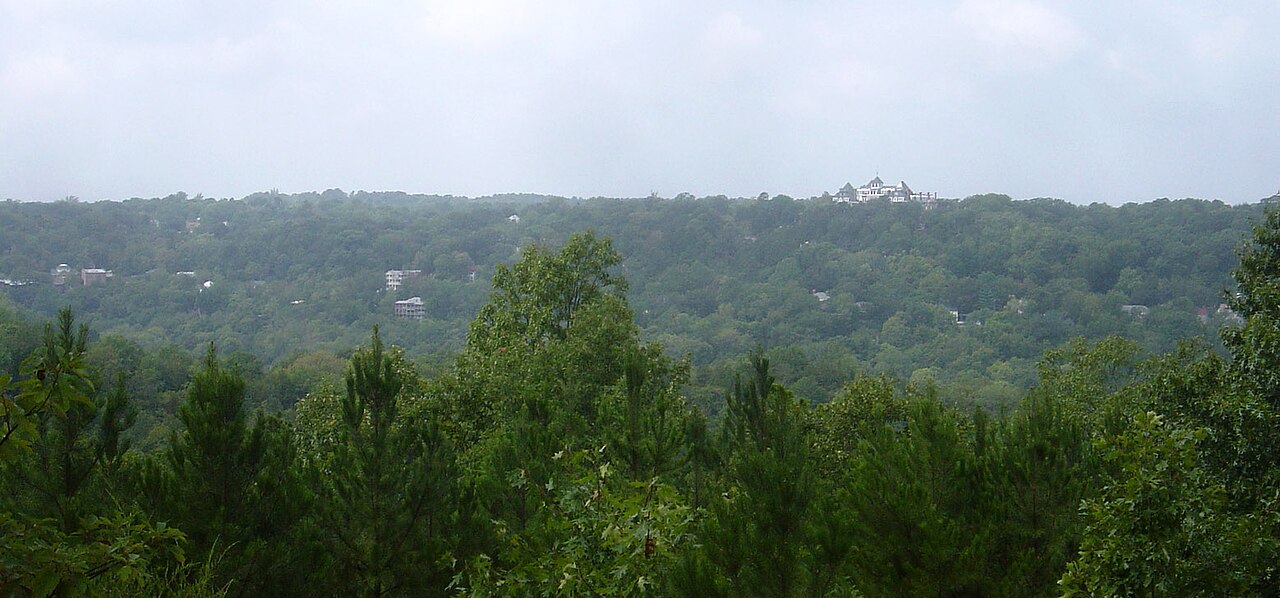
- Thorncrown Chapel — Woods west of town
Designed by E. Fay Jones, an apprentice of Frank Lloyd Wright, this chapel is built of glass and timber and set among trees. Light filters through the frame so the woods feel part of the room. It is a short drive from the centre. Check the official website before travelling.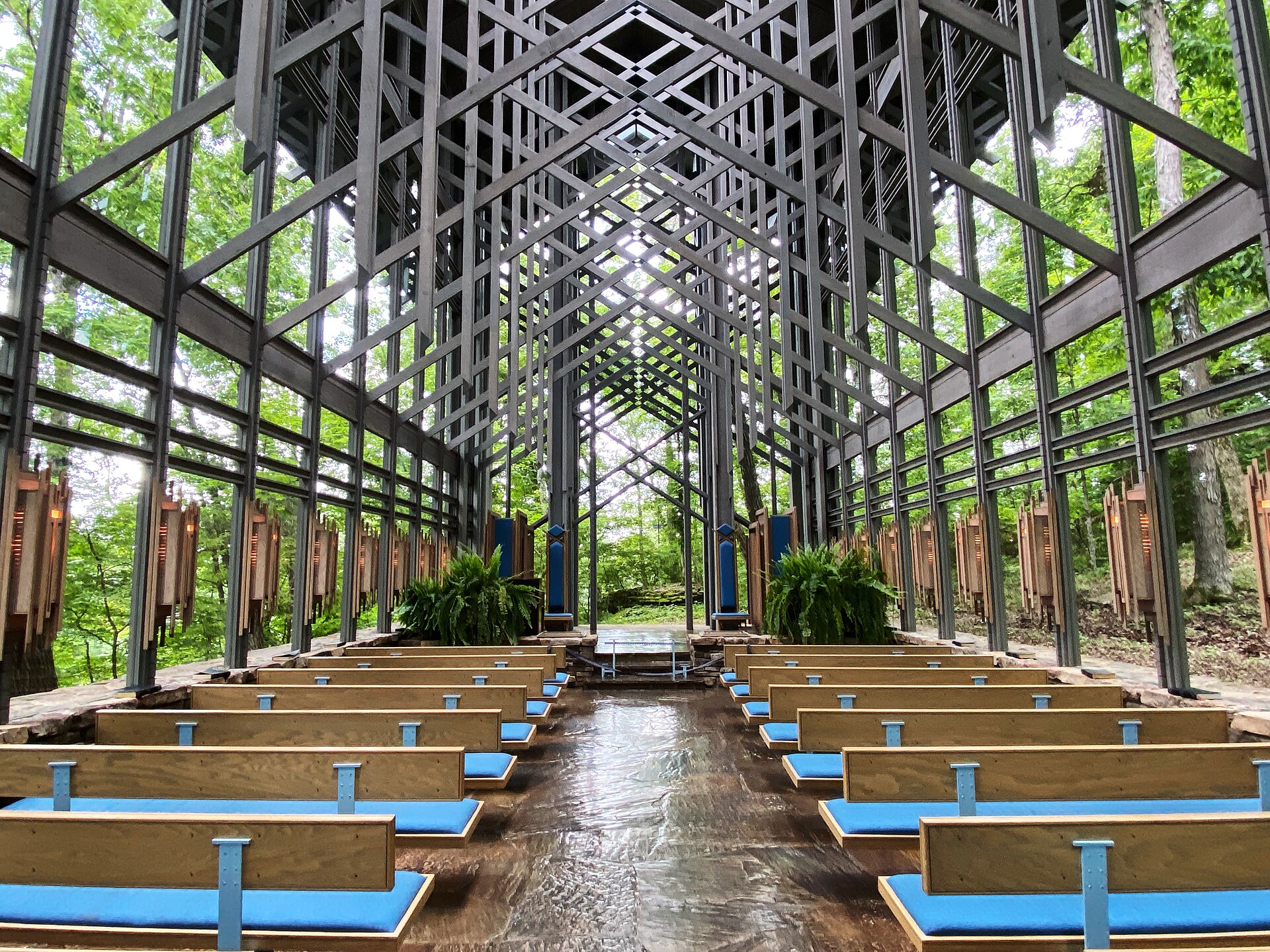
- Eureka Springs and North Arkansas Railway — Depot, near downtown
This heritage railway runs scenic excursions from its depot in town. The trip is short, going only a couple of miles to a turning point and back, so it suits families and railway enthusiasts better than anyone wanting a long ride. Check timetables on the official channels before planning around it. - The Great Passion Play — Magnetic Mountain, east of town
An outdoor dramatisation of the Passion story is staged in a large amphitheatre, with a season running from late April to late October. It is a significant draw for many pilgrims and tourists. Anyone interested should check dates, tickets and weather on the official site, since performances depend on the season.
Culture
Eureka Springs has a culture of festivals, and the calendar is the best guide to the town's character. Halloween is among its busiest times, with a zombie parade on the weekend before the day itself and a horror film festival in late October. Spring brings the May Festival of the Arts, a month of exhibitions and performances in the galleries and small venues. An autumn food and wine festival fills restaurants and streets. In winter the town hosts Eureka Gras, a New Orleans-style Mardi Gras with parades and masquerade balls, which begins on King's Day in January and ends on Mardi Gras itself. The town also has a long-standing reputation as welcoming to gay and lesbian visitors, with several Diversity Weekends through the year and a week of Pride events in June. Beyond the calendar, the place has a strong artisan streak: small galleries, craft shops, live music and an easygoing, slightly offbeat attitude. Religion is also visible, through the chapel in the woods and the large hilltop statue and open-air play. The two worlds sit side by side without much friction. Weekends, especially in October, can be crowded, and rooms fill early. Visitors who come midweek tend to see a quieter, more local side of the place. Please ask before photographing residents, performers or people in costume, and keep voices down on the hillside streets after dark, since many homes stand right beside them.
What to wear
Eureka Springs has no single traditional costume, so its dress history is that of the Victorian resort era the town still celebrates. In the late nineteenth century, visitors to spas would have worn the fashions of the day, with cotton, wool and lace for ladies' day dress, and tailored wool suits for men. Those styles survive today mainly as costume rather than daily wear. People put them on for festivals such as the Eureka Gras masquerade balls, and for the Halloween events when zombie and horror costumes take over the streets. Everyday clothing is casual and practical: jeans or shorts, T-shirts, sun hats, hiking sandals and boots, with a layer of fleece or a light jacket when evenings cool. Local artists and shopkeepers often add a personal flourish, such as handmade jewellery or vintage jackets. For visitors, comfortable footwear matters more than anything else, because the streets are steep, uneven and paved with stone in places. Choose shoes with a good grip and avoid smooth soles or high heels. Pack for the season, with light breathable clothes and sun protection for summer, and warmer layers and rain cover for autumn and winter. Dress codes are relaxed in restaurants and galleries. At Thorncrown Chapel or the Passion Play, tidy and modest clothing is a courteous choice, though no formal dress is needed.
What to eat
- Italian home-style pasta — Restaurants in old houses on the Historic Loop
Pasta and other Italian dishes are served in restaurants set inside converted old houses along the Historic Loop. The setting suits a long evening meal, and the wine lists are decent. Book ahead at weekends, since seating in small historic rooms is limited. - American and Indian dishes — A cafe on North Main Street
One cafe on Main Street serves a mixed menu of American and Indian food, with live music at weekends. For visitors from India or the UK, it is a familiar option, though the flavours are adapted to local tastes. Check the opening days before going. - Steak in a cabin setting — Steakhouse in a cabin setting
A steakhouse in a log-cabin style building offers grilled steak and other hearty Ozark-style plates. It suits a cooler evening after a day of walking the hills. Reserve ahead in busy months such as October. - Cafe lunch in an underground room — A cafe on South Main Street
A cafe on South Main Street has an atmospheric lower-level dining room, which makes it a pleasant cool spot at midday. Expect sandwiches, soups and other simple lunch plates. It is a good stop between gallery visits. - Diner breakfast — Diners and cafes around the downtown loop
Small diners and cafes around the downtown loop serve a traditional American breakfast of eggs, biscuits and gravy, bacon and strong coffee. It is filling, so it suits a morning of steep walking. Mornings are quieter than weekend lunch hours.
Plan it
Best time. Late April–May and October–early November are the most pleasant, with mild weather for walking the steep streets, spring greenery or autumn colour in the Ozark hills, and festivals in both seasons. Late October is the busiest time because of Halloween events. Summer is warm and busier at weekends, and winter is quieter, with Eureka Gras in the colder months.
How long. 2–3
Getting there. The nearest major airport is Northwest Arkansas Regional Airport (XNA), reached by a slow, winding drive through the Ozark hills. Tulsa International (TUL) and Springfield/Branson Regional (SGF) are further away. Eureka Springs is remote and has no rail service, so driving is the practical choice. From Springfield or Branson in Missouri, drive south on the main highway and then west. Both roads at the town are two-lane, with hills and curves.
Budget. mid
Tips
- Book rooms several weeks ahead, and earlier for October weekends and festival dates
- Wear sturdy flat shoes, since the streets are steep and stairs are common
- Visit on weekdays if possible for quieter streets and easier parking
- Allow extra driving time, as the hill roads are slow and winding
- Check the official website, eurekasprings.com, for events, show dates and train times
Etiquette
- Ask before photographing residents, performers or people in costume
- Keep noise down in residential streets at night
- Dress modestly and quietly when visiting the chapel or religious sites
Nearby
Sources
- Wikidata Q79824 (CC0)
- Wikipedia: Eureka Springs, Arkansas (rev 1375869145) (CC BY-SA 4.0)
- Wikivoyage: Eureka Springs (rev 5401815) (CC BY-SA 4.0)
- Photo: Eureka Springs collage (CC BY 3.0)
- Photo: Looking down Spring Street towards Basin Park (CC BY 3.0)
- Photo: Powell Clayton (Public domain)
- Photo: Eureka Springs downtown (CC BY 2.5)
- Photo: Eureka Springs from an observation tower (CC BY 3.0)
- Photo: Church in Eureka Springs (CC BY 3.0)
- Photo: Thorncrown Chapel interior (CC BY-SA 4.0)
- Photo: View from Magnetic Mountain (CC BY-SA 2.5)


