Enchanted Rock
Enchanted Rock, United States
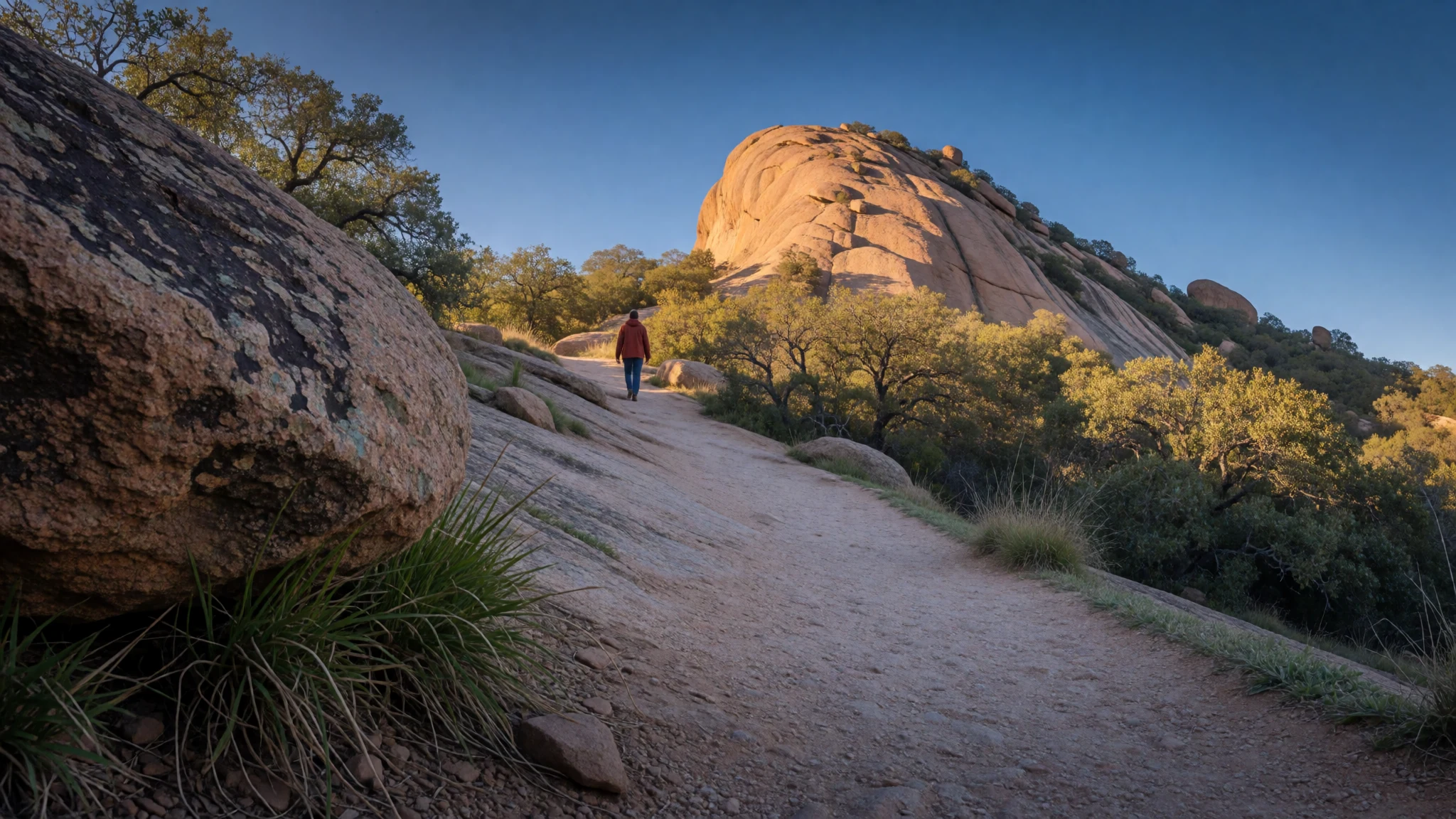
Enchanted Rock is a bare pink granite dome in the Texas Hill Country, an easy scramble to wide views over oak and scrub.
The place
Enchanted Rock rises from the Texas Hill Country as a bare dome of pink granite, about 27 km north of Fredericksburg on the line between Gillespie and Llano counties. Its summit stands at 556 m above sea level, roughly 130 m above the plain, and it looks bigger than those numbers suggest because nothing nearby competes with it. Geologists call a lone, weathered mass like this a monadnock. What shows is only the top of a much larger body of granite that cooled underground and was uncovered as the softer rock around it wore away. The state natural area around the dome is protected, and the rock itself has been a National Natural Landmark since 1971. The ground is rugged and sparse: thin soil in pockets, shallow pools in hollows, lichen, hardy scrub, and oaks tucked into the folds. The way to the top is a steady walk up bare slope rather than a technical climb, and most reasonably fit people manage it. Neighbouring summits and a small cave ask a little more of the legs. Most visitors come for the day, though there are camping spots, including primitive ones. One honest warning: the park often fills its car park and closes the gate by late morning at weekends, so an early start, a phone call ahead and a backup plan all help. Summer heat on exposed granite with no shade is severe, and the pale rock reflects it.
Its story
Enchanted Rock has drawn people for a very long time. Archaeologists have found evidence of human visits going back at least 11,000 years, and spear and arrow points from the earliest Texans turn up in the land upstream and downstream of the dome. The Tonkawa told of spirits haunting the rock, and that belief gave the place the name it still carries. Later, German-speaking settlers arrived in the Fredericksburg area, and one of them, the painter Hermann Lungkwitz, made a view of the rock that survives today as a public-domain image. The granite itself is far older than any story told about it: it formed in the middle Precambrian, more than a billion years ago, when molten rock pushed into older schist deep below the surface. Erosion then stripped away the limestone and sedimentary layers above, leaving the dome standing proud. Conservation now rests partly on volunteers. A nonprofit group works alongside the Texas state parks authority, and it leads guided walks up the summit trail on selected Saturdays in the cooler months. The rock has also had a darker modern chapter. Spray-painted graffiti has appeared on the summit more than once in recent years, and in Texas such vandalism is a felony that can bring a jail sentence and a heavy fine. Rangers take it seriously, because paint on granite cannot simply be washed away.
What to see
- Summit Trail — Enchanted Rock State Natural Area
The main route runs straight up the bare dome from the car park, with no switchbacks, just a steady incline over rough granite. Allow time to stop and look back over the oak country. At the top, the flat rock is wide enough for a picnic, and the wind is usually welcome.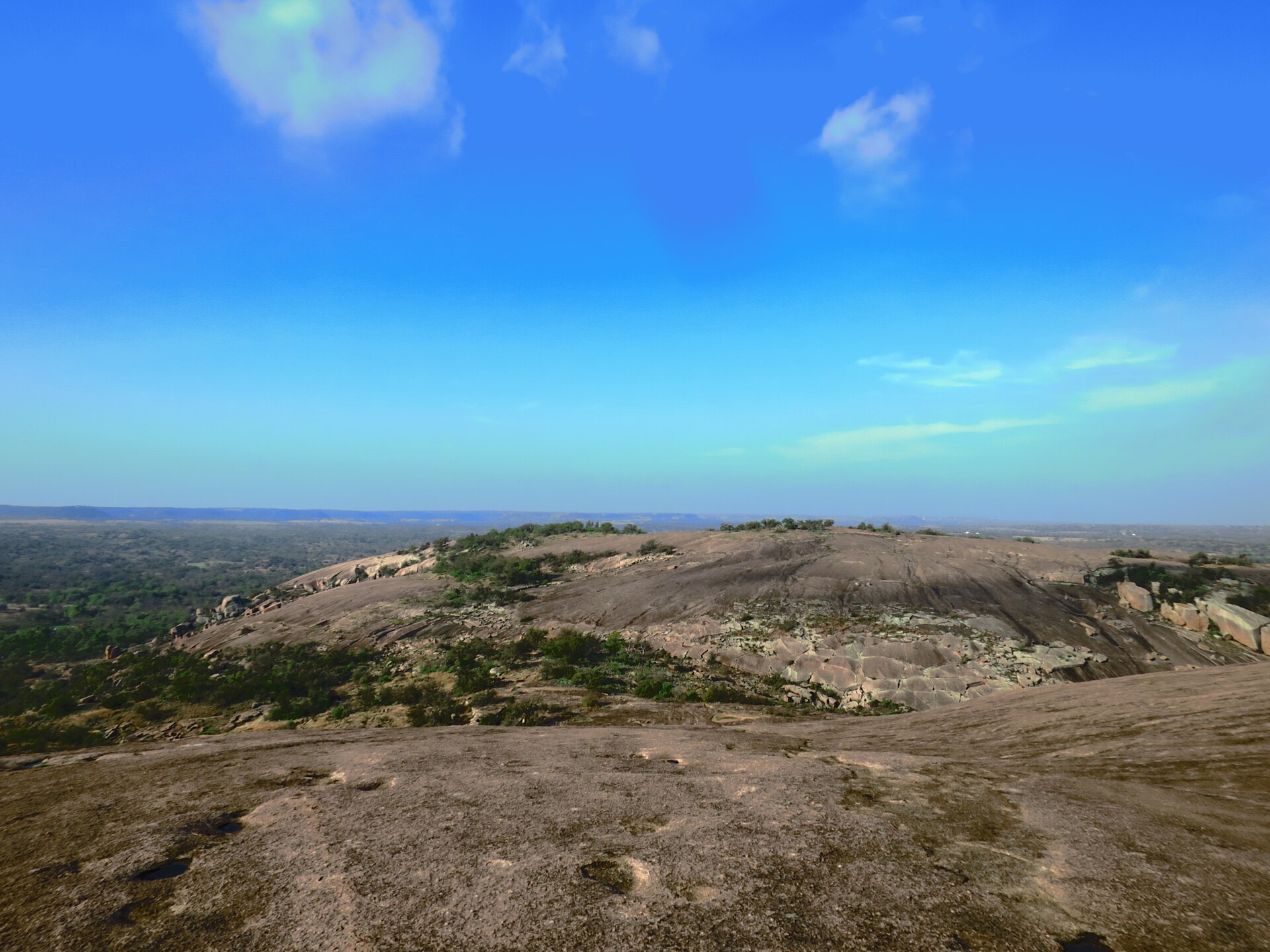
- Exfoliation slabs — Lower slopes of the dome
Look closely at the surface and the granite is peeling in huge curved sheets, like layers of an onion. This is exfoliation: rock that formed under pressure expands once it is exposed, and the outer skin cracks away. The slabs are best seen low on the dome, where the curves are easiest to follow.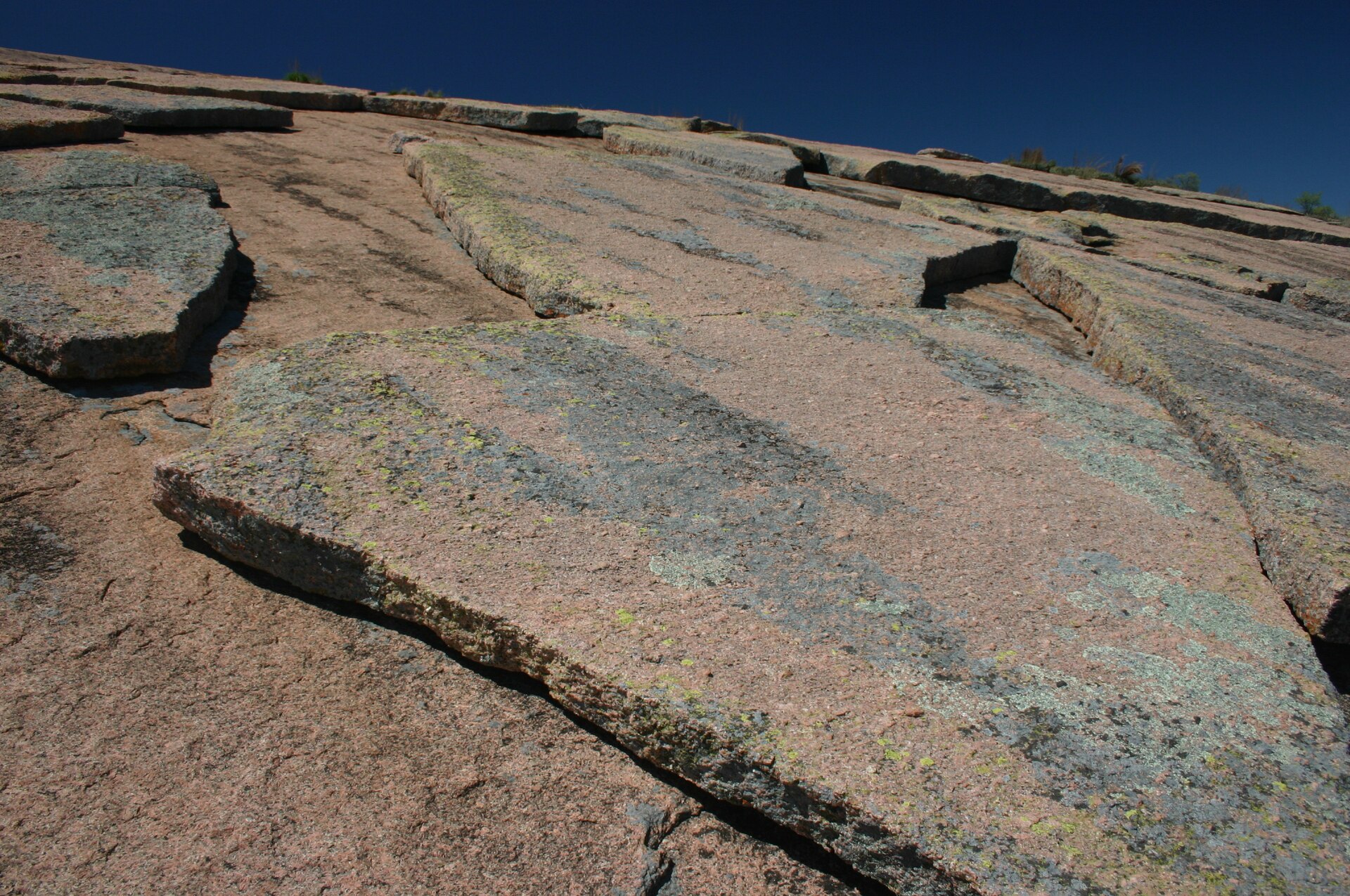
- Little Rock — Beside the main dome
The smaller dome beside the main one gets a fraction of the traffic and rewards a short scramble. It makes a good alternative when the summit is crowded, and it gives a clear side-on view of the larger mass. Footing is the usual rough granite, so wear shoes with grip.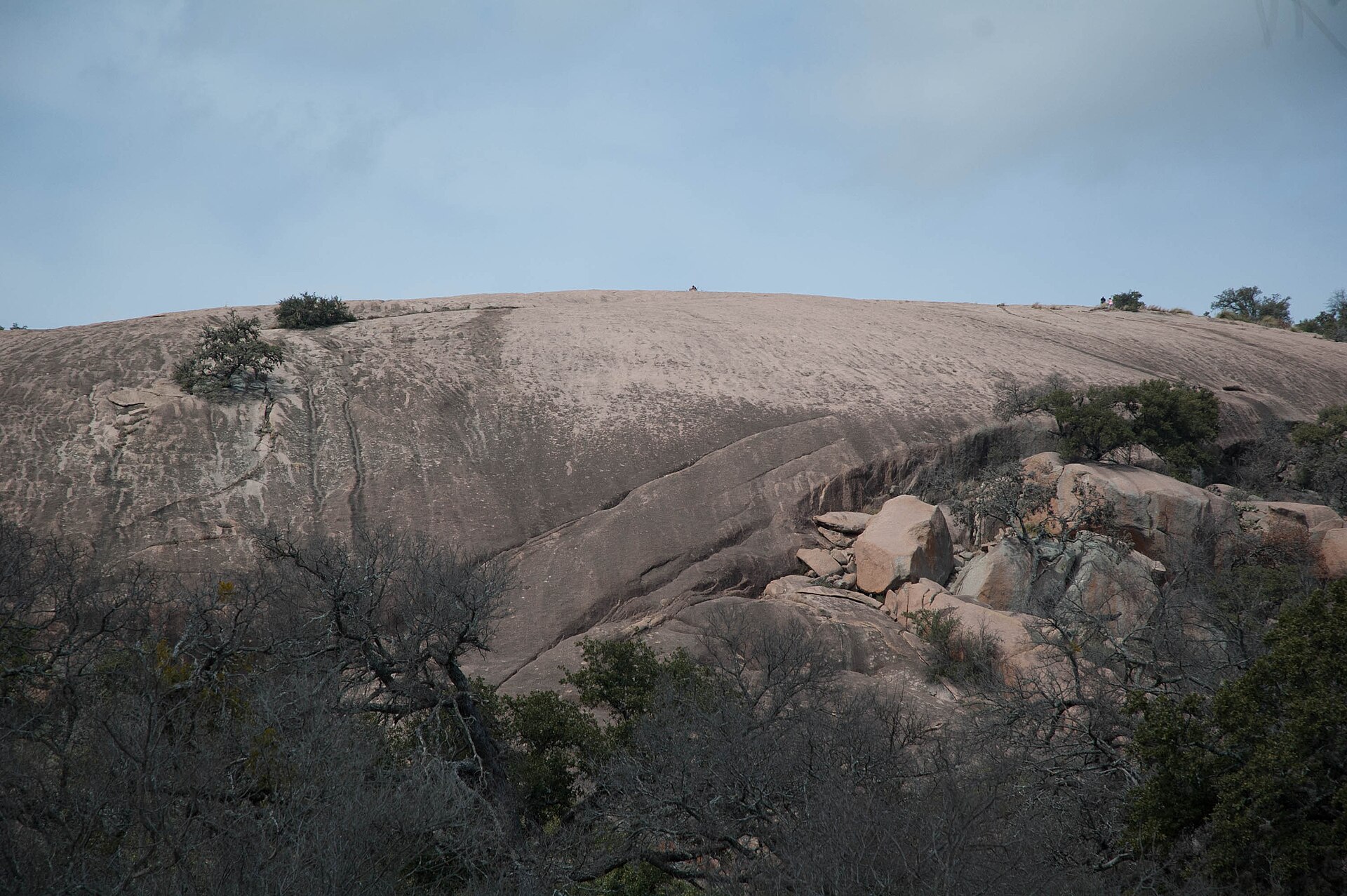
- Base camp viewpoint — Trailhead area
Before climbing, spend a few minutes at the foot of the trail, where the whole dome fills the view. In late afternoon the granite takes on a warm pink glow. It is also the best place to judge the slope and decide whether the heat and your energy suit a full climb.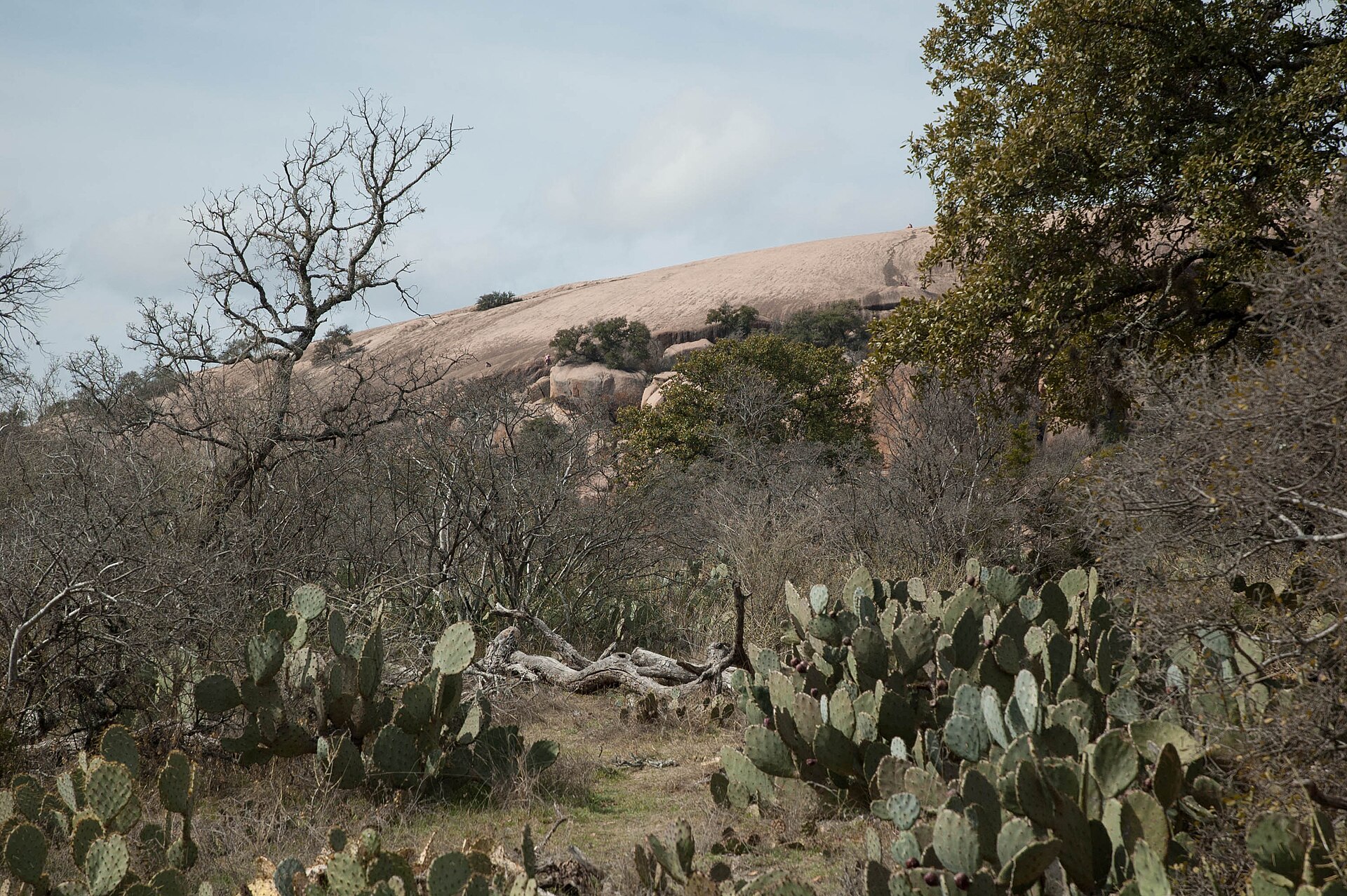
- Summit pools and plants — Top of the dome
Shallow hollows in the granite collect rainwater and hold tiny, fragile communities of sedum, lichen and moss. After rain they can look like miniature gardens. They are worth a slow look, but stepping into them damages growth that took years to establish, so keep to bare rock.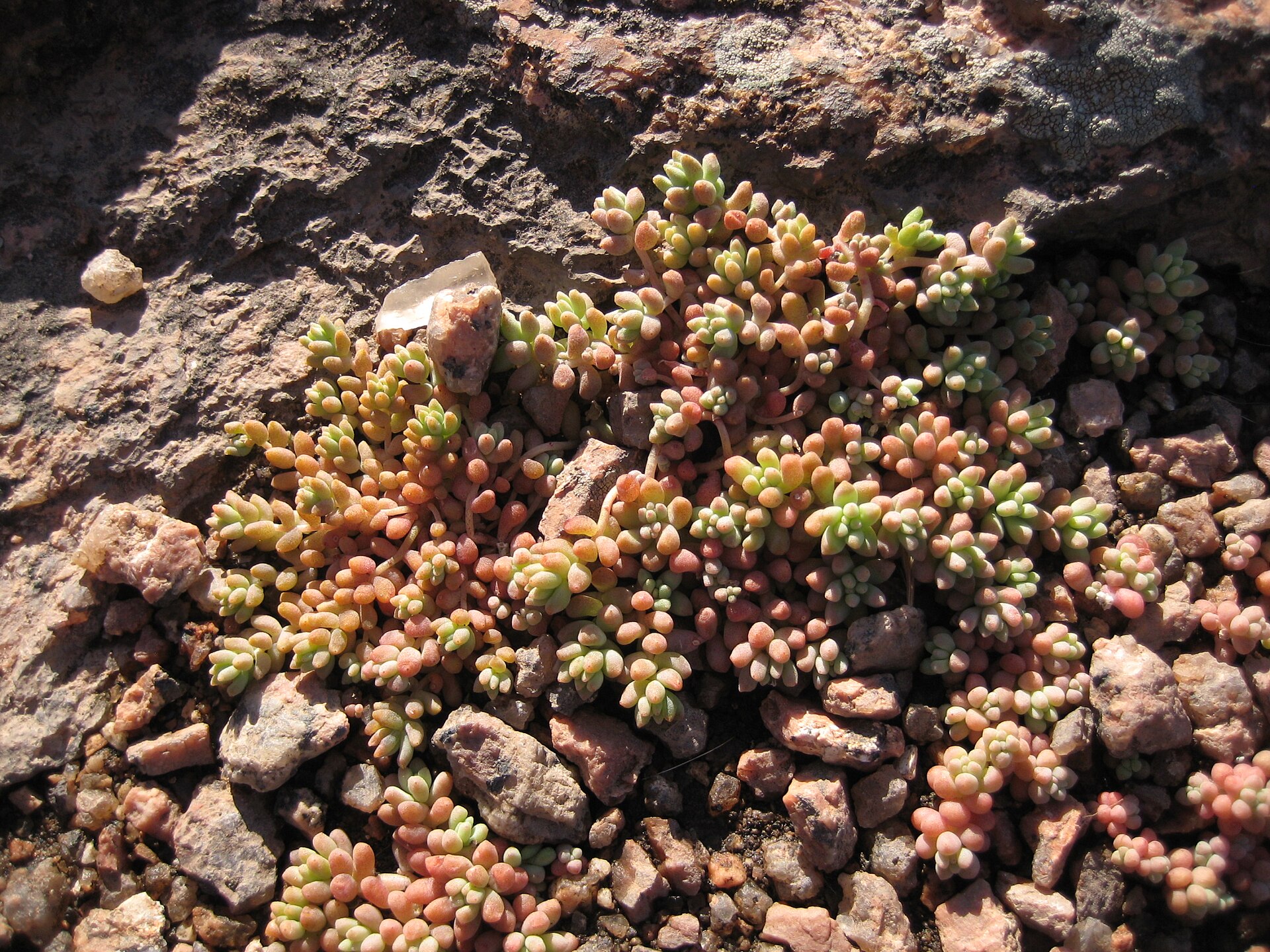
Culture
Enchanted Rock sits where several layers of Texas culture meet. The Tonkawa regarded the dome as haunted by spirits, and later storytellers added tales of eerie night noises coming from the stone. Whatever one thinks of the legends, the sense of an old and watched-over place is easy to feel when the summit is quiet at dawn. The surrounding Hill Country has strong German roots, visible in the stonework, bakeries and festivals of Fredericksburg, and in the paintings made by settlers who came to document the landscape. Today the rock is treated as a shared outdoor classroom. Volunteers support rangers by guiding walks, teaching geology and helping with trail upkeep, and a yearly climbing competition raises money for the site's care while stressing safety and respect for the rock. Rock climbing is part of local life, and so is camping under dark skies. Because archaeological remains lie within the natural area, state and federal rules protect arrowheads, tools and anything else that might be old; picking up a find is an offence, however small it looks. Rangers also have the authority to inspect natural resources and act to protect them. When visiting Enchanted Rock, stay on marked routes, leave plants, stones and any artefacts exactly where they are, never write or scratch on the granite, and keep dogs off the summit trail, where pets are not allowed.
What to wear
Enchanted Rock has no single costume of its own, so this reading follows the people who have lived around it. The Tonkawa and other Plains peoples historically wore clothing of tanned animal hide, with moccasins and robes suited to open country and cold winters, and ceremonial pieces were often decorated with beads or quills. German settlers in the Fredericksburg area brought woollen and cotton work clothes, and a few communities still wear heritage dress at festivals. Today, locals dress for practicality: cotton shirts, jeans or shorts, broad-brimmed hats, and boots that can be anything from hiking soles to cowboy leather. On the rock itself, people mostly wear sports kit, with sun-protective shirts and caps common in summer. A visitor should dress for exposed, treeless granite. In the warmer months, choose light, loose, long-sleeved layers, a wide hat and sunglasses, because there is almost no shade above the tree line of the scrub. In winter and early spring, mornings can be cold and windy on top, so carry a fleece or windproof layer. Footwear matters most: choose closed shoes or trail boots with a grippy sole, as the granite is smooth in places and treacherous when wet. No special modesty rules apply, though neat, ordinary outdoor clothes suit the nearby town as well.
What to eat
- Texas barbecue brisket — Barbecue joints in Fredericksburg
Slow-smoked beef brisket, sliced thick and served with pickles, onion and white bread, is the standard Hill Country meal. Smokehouses and roadside barbecue joints in and around Fredericksburg are the usual places to find it, often selling out by mid-afternoon. - Breakfast tacos — Cafés and takeaway counters near the park road
Soft flour tortillas filled with eggs, potato, beans, cheese or sausage make a good fuel stop before an early climb. Small cafés and takeaway counters in the area serve them, and they travel well in a daypack. - German-style sausage and schnitzel — Main Street, Fredericksburg
Fredericksburg's German heritage shows on menus as bratwurst, sausage plates and breaded schnitzel with sides like red cabbage or potato salad. Look along the main street of the town for restaurants and beer gardens that serve them. - Hill Country peaches — Roadside fruit stands around Fredericksburg
In early summer, local orchards sell peaches that are eaten fresh, baked in cobblers or served with ice cream. The season is short, so ask at roadside fruit stands for what is currently ripe rather than expecting them year-round. - Fruit kolaches and pastries — Bakeries in Fredericksburg
Sweet yeasted pastries, filled with fruit or cheese, and German-style cakes appear in town bakeries. They are a gentle reward after a hot walk and easy to pack. Arrive early, because the best selection is usually gone by lunchtime.
Plan it
Best time. March–April and October–November, when days are mild enough for a comfortable climb. Summer is very hot on the bare granite, with no shade, and winter mornings can be cold and windy.
How long. 1–2
Getting there. Fly to Austin or San Antonio and hire a car, as the park is best reached by driving. From Fredericksburg, head north-west for the short drive to the park gate, following the signs on the ranch road.
Budget. low
Tips
- Arrive early: the park often reaches capacity at weekends and can close the gate by late morning, so call ahead or have a backup plan
- Check the official Texas Parks and Wildlife page for current fees, opening conditions and camping bookings before you travel
- Carry plenty of water, a hat and sun protection, as there is no shade on the dome
- Wear shoes with good grip, and avoid climbing when the granite is wet
- Guided summit walks run on selected Saturdays in cooler months, so check the schedule if you want a geology-led visit
Etiquette
- Stay on marked routes and keep off fragile plant pools on the rock
- Leave plants, stones and artefacts where you find them, and never mark the granite
- Keep dogs off the summit trail, where pets are not allowed
Nearby
Sources
- Wikidata Q260281 (CC0)
- Wikipedia: Enchanted Rock (rev 1377307933) (CC BY-SA 4.0)
- Wikivoyage: Enchanted Rock State Natural Area (rev 3501636) (CC BY-SA 4.0)
- Aerial photo of Enchanted Rock State Park — Shane Torgerson (Public domain)
- Aerial view of Enchanted Rock — Jmbuytaert (CC BY-SA 4.0)
- Geological exfoliation of granite dome rock — Wing-Chi Poon (CC BY-SA 2.5)
- Sedum growing on top of Enchanted Rock — Liveon001 (CC BY 3.0)
- View of the summit of Enchanted Rock — Urban Versis 32 (CC BY-SA 4.0)
- Little Rock View — Jackpaylor (CC BY-SA 4.0)
- View of Enchanted Rock from base camp — Jackpaylor (CC BY-SA 4.0)
- Enchanted Rock near Fredericksburg — Hermann Lungkwitz (Public domain)


