Dunn's River Falls
Dunn's River Falls, Jamaica
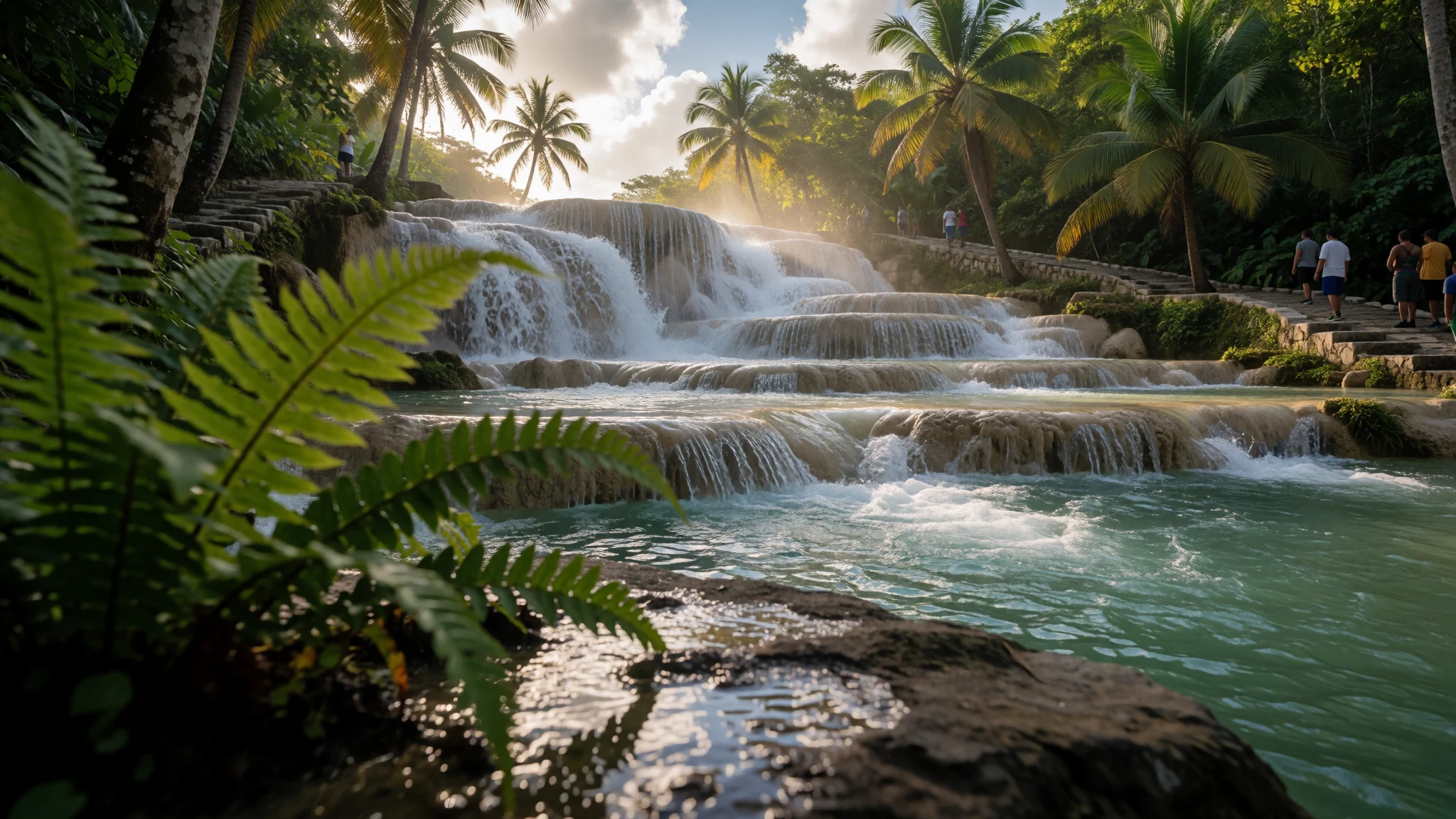
Dunn's River Falls is a climb up a living limestone cascade, hand in hand, with the Caribbean waiting at the bottom.
The place
Dunn's River Falls is a limestone cascade on Jamaica's north coast, in the parish of St Ann, where a short river drops over a series of wet shelves and pools before meeting the Caribbean. The water arrives clear and cool across rock that has been smoothed into steps, so the usual way to know the place is to walk up it rather than to watch it from a dry path. Guides keep parties in a chain, hand to hand, because the stone is slick and the flow never really stops. Between the drops sit shallow basins where people pause, catch their breath and look back towards the sea. The park around the river is a thin strip of coastal forest and maintained paths, with the highway and the resort town of Ocho Rios close enough that music, traffic and tour coaches belong to the soundscape. On a bright morning the light comes off the water in hard flashes; after rain the river swells, the holds grow harder and the spray thickens. Vendors and wood-carvers work the edges of the visit, and the beach at the river mouth is the natural start of the walk, sand underfoot before the slow climb on wet stone begins. Dunn's River Falls is a public pleasure as much as a landform: organised, busy and shaped by the people moving through it. The reward is ordinary and physical, the grip of a stranger's hand, the noise of the river and the sea waiting at the bottom.
Its story
Dunn's River Falls belongs to a coast that has always been defined by water running off limestone into small bays. The rock is the old coastal stone of Jamaica, and the river keeps to a single line, cutting shelves where the flow breaks and bowls where it rests. People were on this shore long before a park existed. The Taíno knew the island's rivers as sources of fresh water and as landmarks along a coast of fishing bays, and the Spanish who came later found so many cascades here that they named the settlement for them. That name, worn by English speech into Ocho Rios, still confuses newcomers who hear a number in it and look for a matching set of rivers. The climb visitors come for shares the parish with many smaller streams. Under British plantation rule St Ann was estate country, with the falls lying between the hills and the anchorages. In the modern parish the red earth of the bauxite industry shows on the ridges behind the town, conveyors crossing the roads, while the coast turned towards visitors. Dunn's River Falls changed with that turn. A river mouth where people bathed became a guided route, a gate and a fleet of coaches from the lodgings and from the ships. The chain of climbers became a picture Jamaica sends abroad. The picture is fair to the walk and unfair to the longer story: Taíno presence, a colonial parish, a mining hinterland and a town that now earns its living by receiving strangers. The water does not pose. It falls, as it did before any of those chapters, over the same pale stone into the same sea.
What to see
- The guided climb — The falls, St Ann
At Dunn's River Falls the climb is a guided chain, each person holding the next so a slip stays a stumble. The route follows the water over rounded limestone, through short drops and into basins where the party can stand. Water shoes grip where bare feet slide on algae. Everyone is soaked from the opening foothold, and the sea appears when the chain stops and looks back.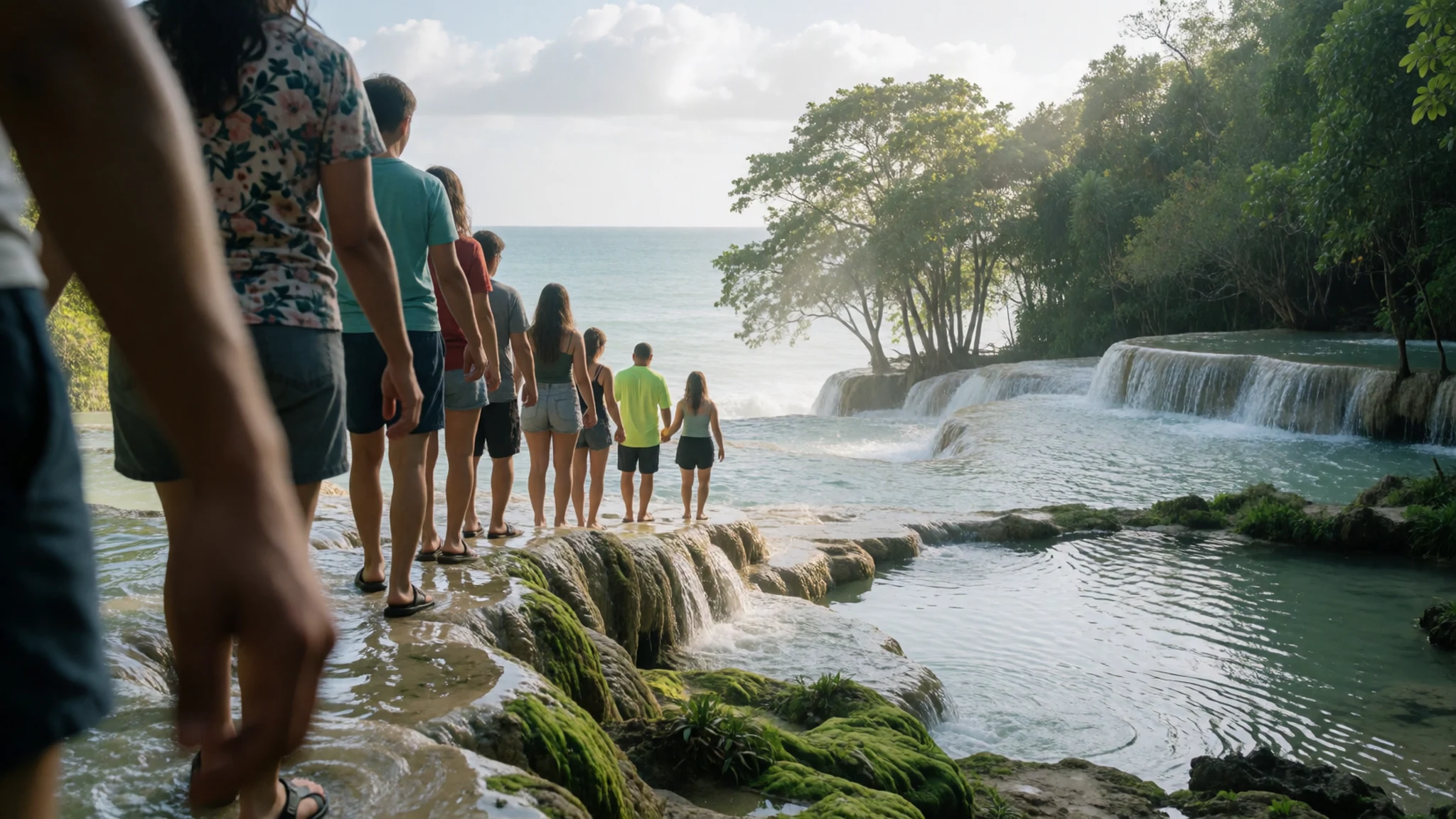
- The terraces and pools — Mid-cascade, St Ann
The middle of Dunn's River Falls is a staircase of pale terraces, each shelf pouring into a basin deep enough to stand in. The rock is smooth where hands and water have worked it, and rougher where the guide leads the chain aside. The pauses set the rhythm: cold water at the waist, spray on the face, then the next white step.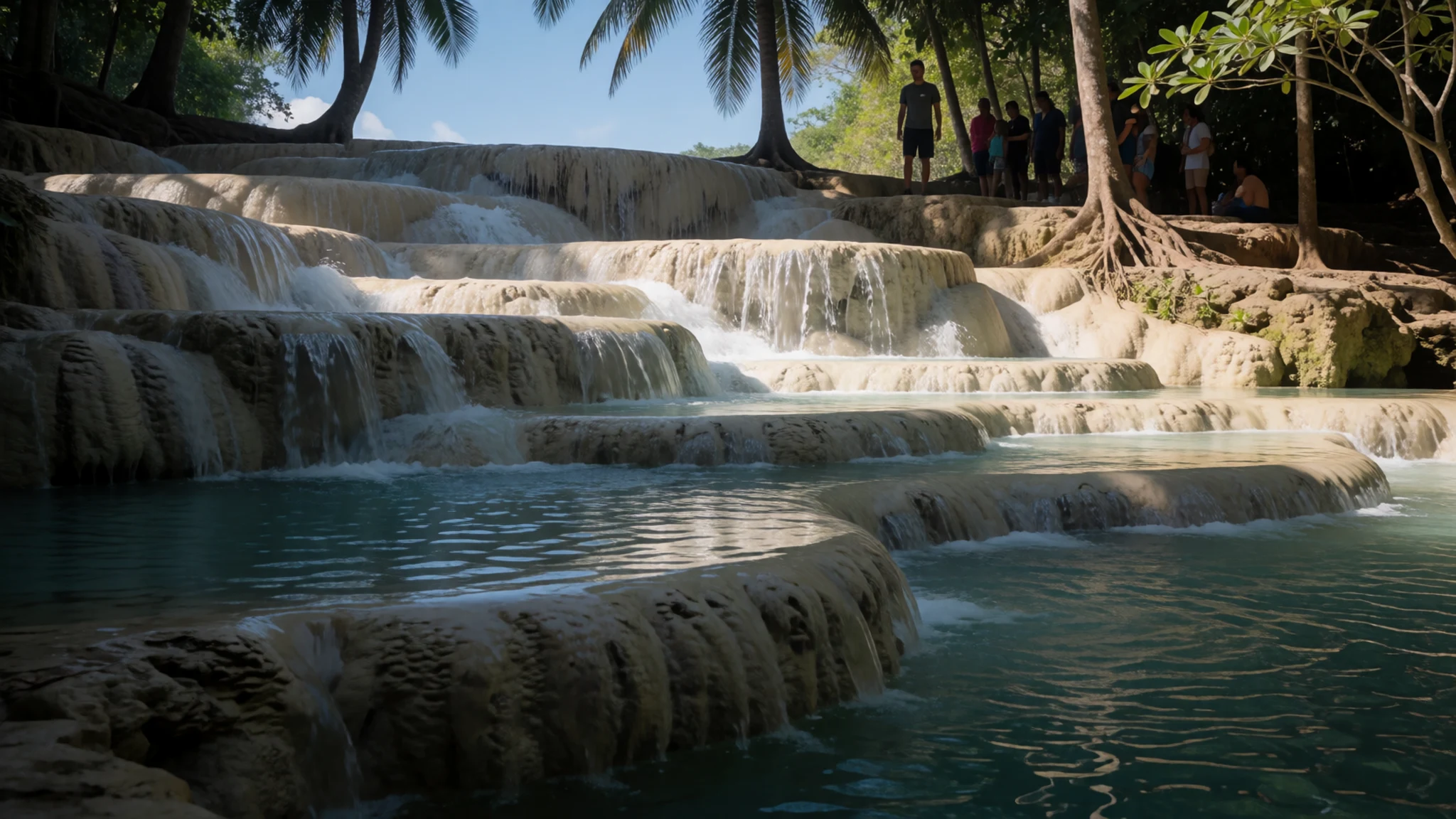
- The beach at the mouth — Beach at the river mouth
Dunn's River Falls finishes on a small beach where the river spreads across sand and into the Caribbean. Climbers gather here before the chain starts and come back here to rinse the river off in warmer sea water. River and sea meet in a muddy, lively strip. On ship days the sand fills with towels and groups. Early, it belongs to walkers and the sound of the cascade.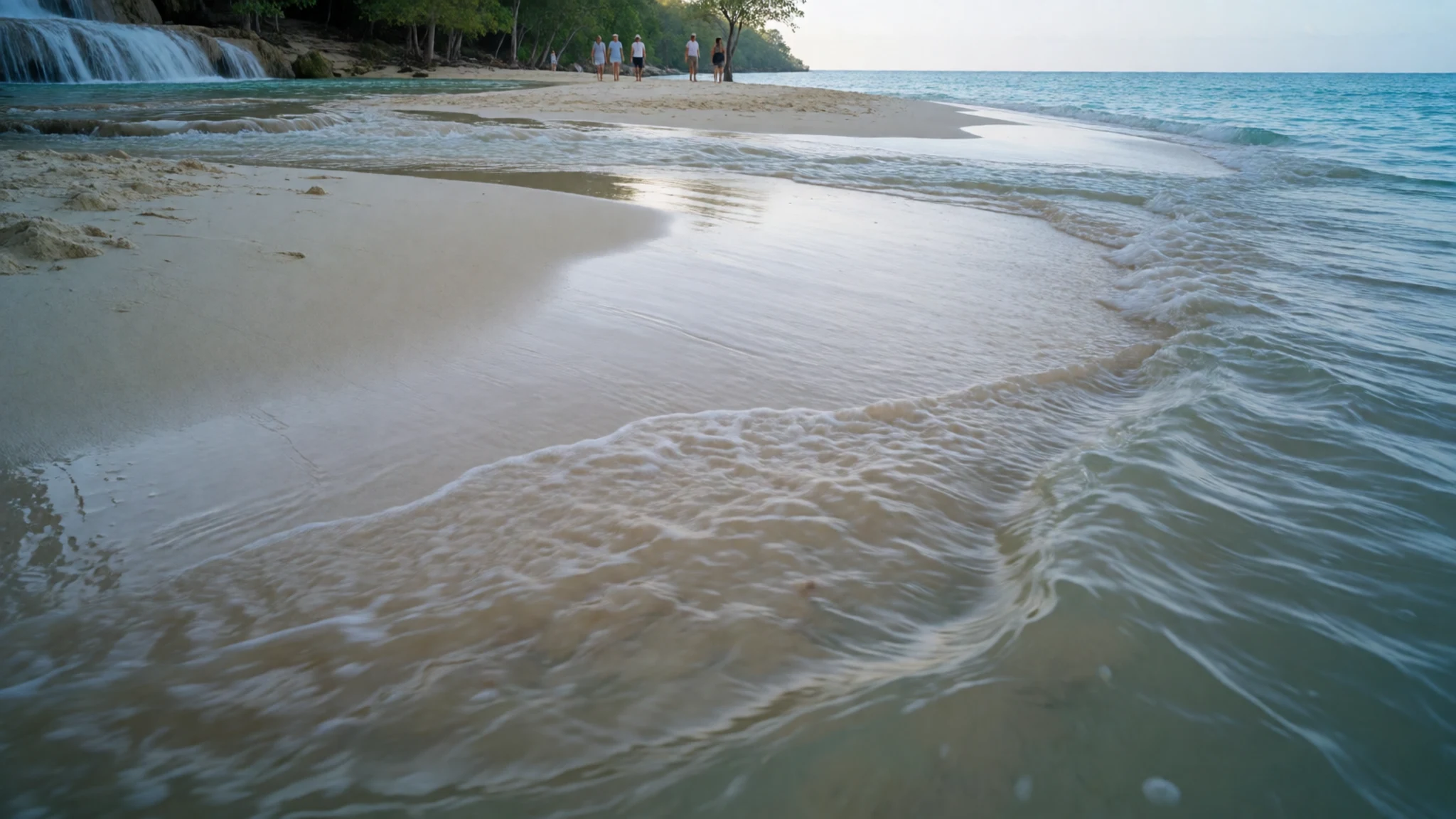
- The wood-carvers — Stalls by the falls entrance
Around Dunn's River Falls, wood-carvers work in the open, under a tree or a stall near the entrance to the park. They cut birds, fish, masks and bowls from local hardwood, while someone watches, so the object and the making are offered together. It is old coastal craft set against a tour timetable. Buying is a choice, and the craft stands either way.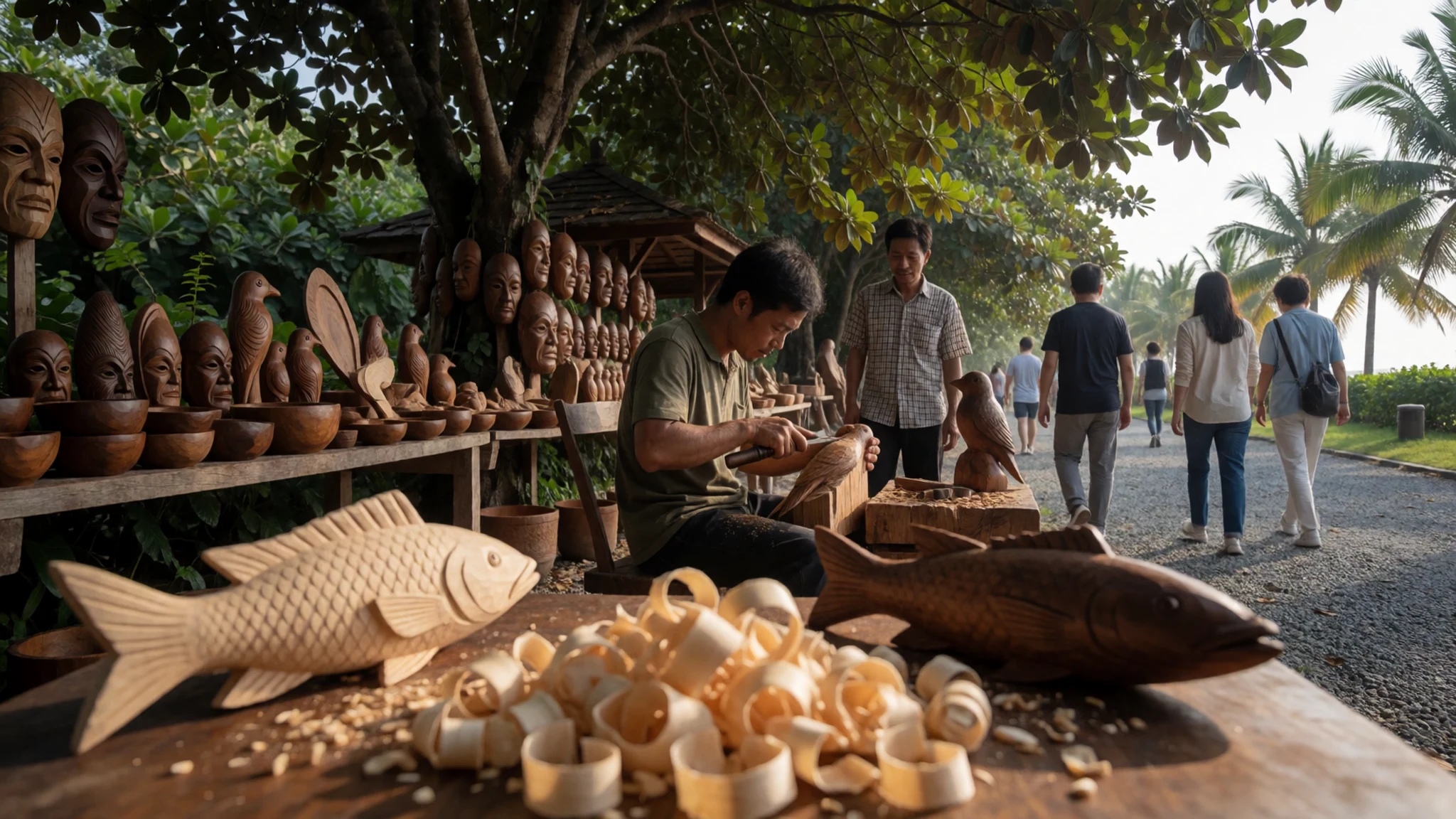
- The park paths — Park between the highway and the sea
The park framing Dunn's River Falls is a narrow band of coastal trees, paths and railings between the highway and the sea. Coaches turn at the entrance, music drifts from the road, and the shade is planted rather than wild. The trees break the sun before and after a climb, and the paths let anyone see the water without joining the chain.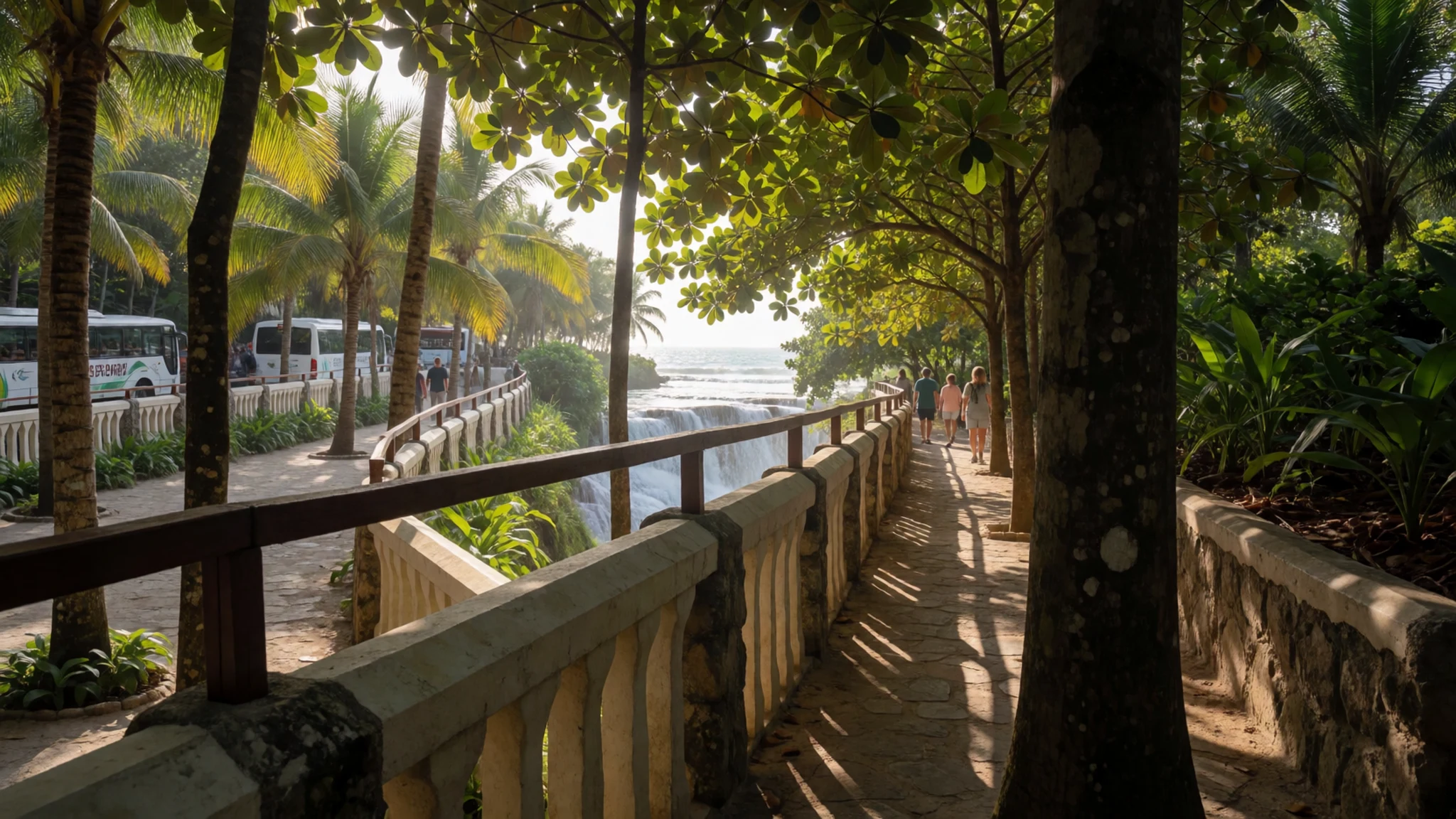
Culture
Dunn's River Falls sits inside a Jamaican way of treating the shore as a shared, talkative place. The climb itself is social. Strangers take each other's hands, guides call the route in English and in Patwa, and laughter moves along the chain faster than caution does. Tourism is a livelihood on this coast, so welcome and performance sit close together: a song from a passing minibus, a carved bird held up at the gate, a parish story told for as long as a group will listen. Step away from the entrance and St Ann is still a parish of churches, bakeries, small farms and school uniforms, with the bauxite works on the hills as a reminder that the hinterland is industrial as well as green. Sunday clothes outside a parish church, and flour on the counter of an Ocho Rios patty shop, are as much the local culture as the climb. At Dunn's River Falls, keep to the guide's line, take the hand you are offered, and ask before photographing a vendor or any climber outside your own party.
What to wear
Dunn's River Falls is no place for formal cloth, but Jamaica's textile traditions still explain what people wear when they are not in the water. The national dance and festival dress uses the Madras bandana print, a bright plaid cotton, tied as a headwrap and gathered into full skirts for quadrille and festival dance, with a tam or a fitted bodice. Men's formal national dress includes the kariba, a tailored bush-jacket suit worn for ceremonies rather than for the beach. Day to day on the north coast the cloth is lighter: cotton vests, shorts, linen shirts, school uniforms in town, and carefully pressed outfits for church. Around Ocho Rios the resort streets add swimwear, cover-ups and sandals as ordinary dress, not only as beach kit. A visitor at Dunn's River Falls needs shoes that grip wet limestone, a swimsuit or quick-drying shorts, and a shirt that can be soaked without complaint. A dry change and a hat matter once the climb is over. Shoulders and shoes should be decent when leaving the sand for a church or a sit-down eatery; the falls themselves will ruin anything that cannot go in the river.
What to eat
- Jerk chicken — Roadside jerk stands on the Ocho Rios approaches
Jerk chicken is the north-coast staple, meat rubbed with pimento, thyme and Scotch bonnet and cooked over a smoky pan. Near Dunn's River Falls it turns up at roadside jerk stands on the Ocho Rios approaches, where the smoke is the advertisement and the meat is chopped to order.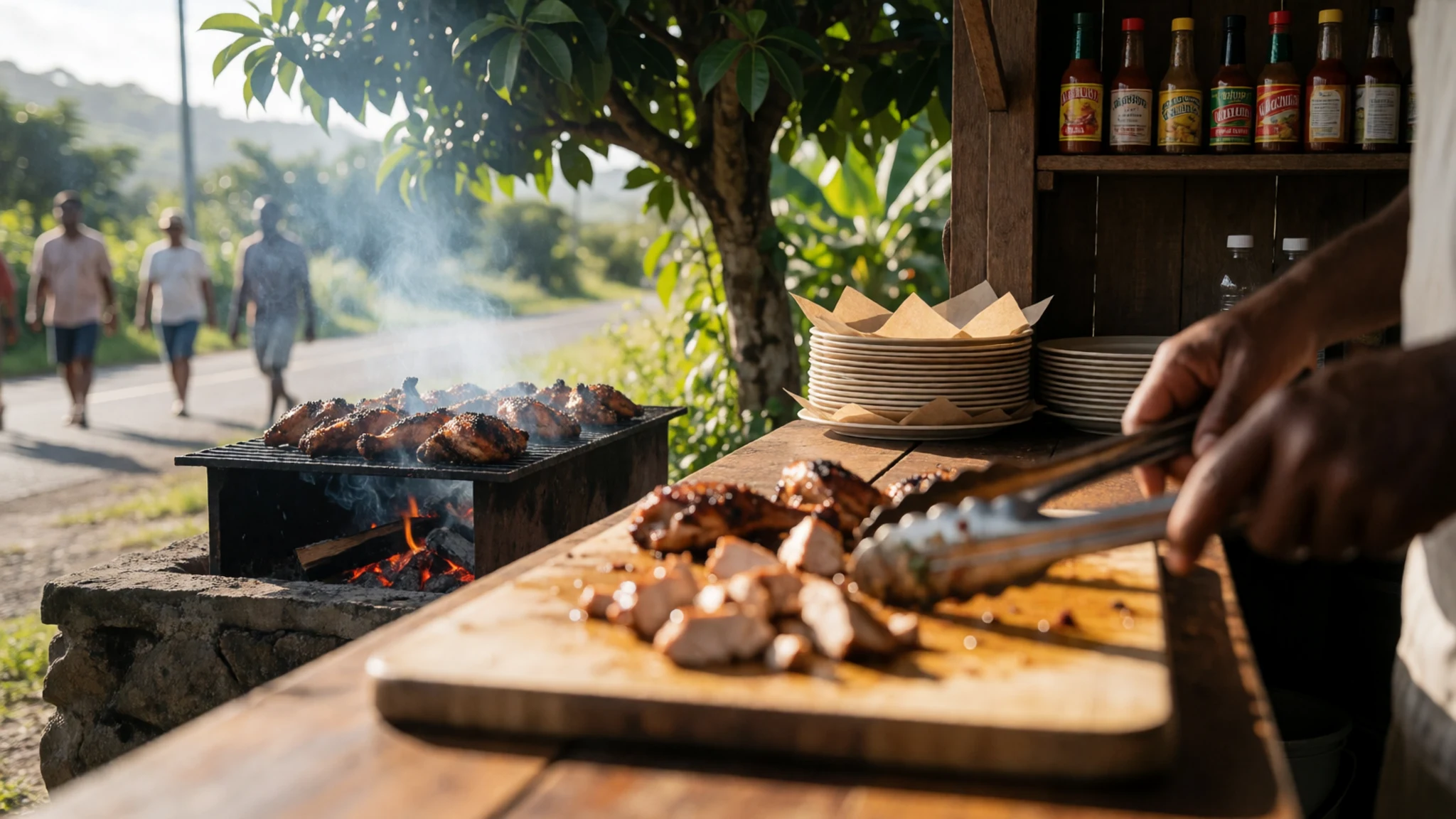
- Jamaican patty — Patty shops in Ocho Rios
The Jamaican patty is a spiced beef, callaloo or saltfish filling folded into a turmeric-yellow crust and baked until the shell flakes. In Ocho Rios, patty shops near Dunn's River Falls sell them as the ordinary portable meal, often still warm from the counter.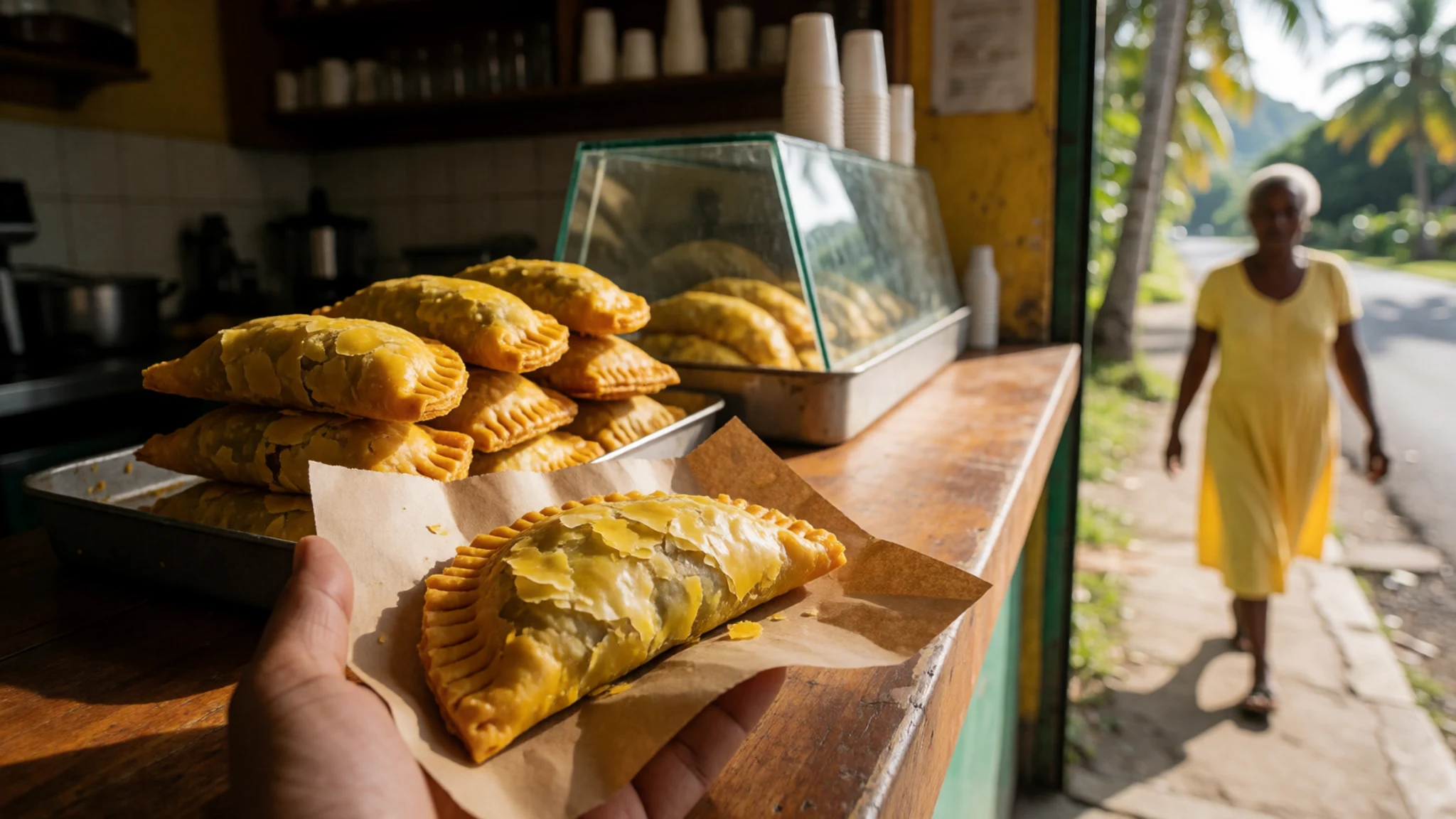
- Ackee and saltfish — Cookshops and breakfast rooms in Ocho Rios
Ackee and saltfish is Jamaica's familiar breakfast, the golden ackee fruit cooked down with flaked salted cod, onion, thyme and Scotch bonnet. Cookshops around Ocho Rios, and breakfast rooms near Dunn's River Falls, plate it with boiled dumpling or bammy. - Escovitch fish with festival — Beach stalls and cookshops between the falls and the Ocho Rios waterfront
Escovitch fish is a fried snapper soused in a hot vinegar dressing of onion, carrot and Scotch bonnet, and festival is the sweet fried dumpling that comes with it. Beach stalls and cookshops between Dunn's River Falls and the Ocho Rios waterfront serve them as a pair. - Rice and peas — Cookshops in Ocho Rios
Rice and peas, coconut-stewed rice with red kidney beans, thyme and garlic, is the anchor of a Jamaican plate. Near Dunn's River Falls it comes from cookshops in Ocho Rios beside brown stew chicken, oxtail or curry goat.
Plan it
Best time. December to April is the drier stretch on Jamaica's north coast, with easier rain odds for a climb at Dunn's River Falls. May into November is wetter, and showers can swell the river and slick the rock; the falls are still climbed then, only with more spray and the odd soaked afternoon.
How long. 1–2
Getting there. Most long-haul flights arrive at Sangster International Airport in Montego Bay, then follow the north-coast road east to Ocho Rios. A smaller airport at Boscobel, east of town, is the closer landing for some services. Dunn's River Falls sits on the edge of Ocho Rios, a short ride from the cruise pier and the beach lodgings.
Budget. mid
Tips
- Join a guided chain rather than scrambling the rocks alone.
- Start early, before coaches and cruise groups fill the steps.
- Wear grip shoes and clothes you are willing to soak, and pack a dry change in a waterproof bag.
- Carry a little cash for carvers and roadside snacks; a soaked card is no use on the climb.
- If rain has swollen the river, take the guide's advice about whether the chain should go up.
Etiquette
- Follow the guide's route and keep hold of the chain.
- Ask before you photograph vendors or climbers outside your party.
- Do not leave litter on the terraces or the beach; the river runs straight into the sea.
- Cover up when you leave the sand for a church or a sit-down eatery.
Nearby
Sources
- Wikidata (CC0)
- Wikipedia (CC BY-SA 4.0)
- Wikivoyage (CC BY-SA 4.0)