Darvaza
Darvaza, Turkmenistan
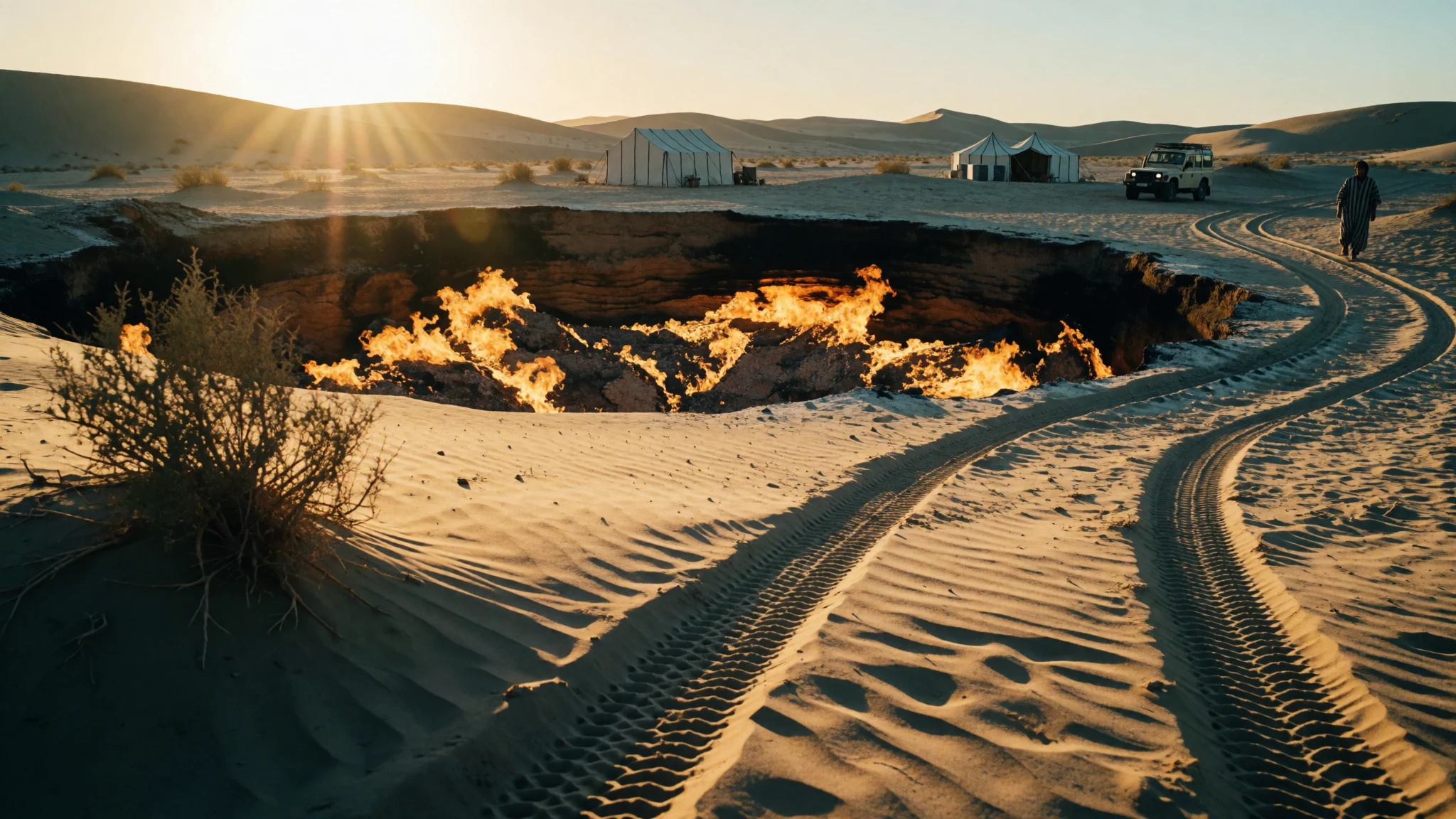
Darvaza is a gas fire burning in a desert collapse, worth the long night drive for the strange orange light on the Karakum.
The place
Darvaza sits in the Karakum, the great desert of central Turkmenistan, in Ahal Province north of the capital. The name is also written Derweze; both refer to the same sparse country where a collapsed gas field has been alight for decades. People do not come for a city. They come for a pit of scorched ground with flames working in the bowl, a low roar when the wind eases, and, after dark, a light strong enough to colour the sand far around the rim.
In daylight the crater looks raw and practical: blackened edges, heat dancing above the hole, and a web of tyre tracks on pale dust. Shade is almost absent, and the summer sun on this ground is severe. Once the sun drops, the same hole becomes the landscape. Flames move between yellow and deep orange, the sky fills with stars, and other lights are usually just a few camp lamps and a vehicle on the track.
Two quieter collapses share this stretch of desert with the fire: one holds opaque turquoise water, and one is a mud crater that bubbles and sighs. The village that lent the site its name is a thin settlement on the desert road rather than a place to linger. Anyone staying the night sleeps in a tent or a yurt set back from the rim, where the earth is firmer and the heat is uncomfortable rather than unsafe. Wind, fine dust and a sharp evening chill are the normal conditions, even on a day that felt hot at noon.
Its story
Darvaza's fire began as a drilling accident that nobody closed. Crews boring for gas under the Karakum lost the floor beneath the rig: it fell away into a cavern, and the pocket vented into open air. The gas was lit so that a poisonous cloud would not sit over the desert, and the expectation was that the pocket would exhaust itself quickly. The pocket did not. Flames took the collapse and remained.
The year usually attached to that collapse is 1971, the date given in the caption of a photograph of the site, and the telling has worn smooth with repetition: a survey team, a sudden sink, a flame set for safety. What holds is the outcome. Darvaza became a standing fire in a country whose fortune lies in gas underground, and an image known far beyond the desert.
Around the site the story is told with pride and with a wince. The crater is a sight people bring guests to see, and it is also a leak — fuel leaving the earth as heat and light, with no pipe on it and no end in view. There has been talk, more than once, of putting Darvaza out, for safety and for the sake of the resource, yet the bowl has stayed alight and the camps have stayed on the sand behind it. The tale a visitor can trust is plain: a human mistake that hardened into a landmark, still unfinished, still hot, still pulling people to the edge of a fire that was meant to be brief.
What to see
- Darvaza gas crater — Karakum, Ahal Province
The Darvaza gas crater is the burning collapse itself, nicknamed the Door to Hell. Flames move in a bowl of blackened earth and throw orange light across the sand after dark. By day the pit looks harsher and more ordinary: scorched walls, a hot updraft, and no fence between the track and the drop. Daylight shows the scale; full dark shows why people stay.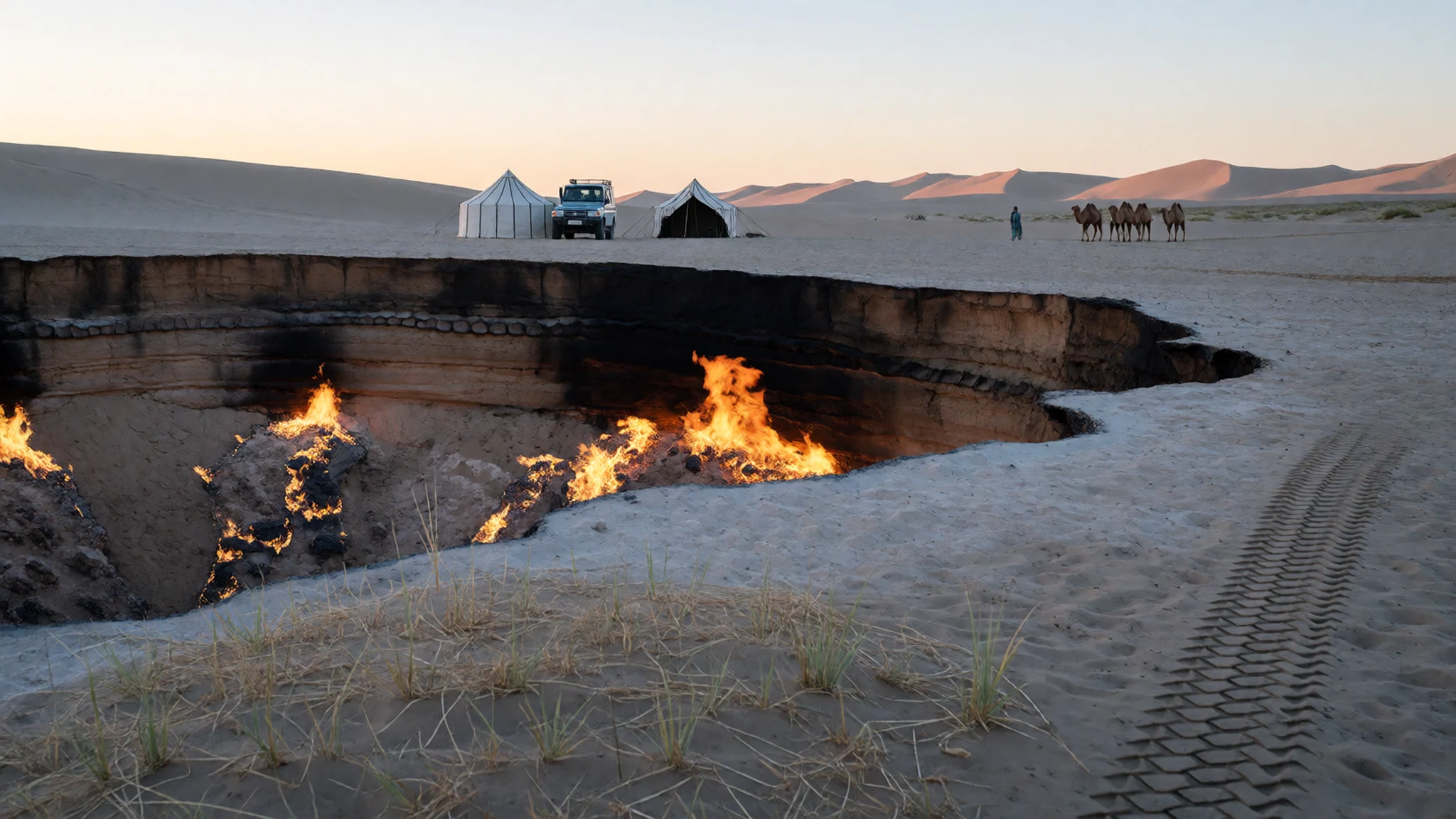
- The rim and the camps — sand just back from the crater rim
The Darvaza rim is where the night is actually spent. Tents and the odd yurt sit back from the edge, on ground that is merely dusty rather than hollow, with the fire as a fixed lamp. The surroundings are empty Karakum: pale sand, tyre tracks, and a huge sky. After midnight the temperature falls hard, and the roar of the pit carries further when the wind rests.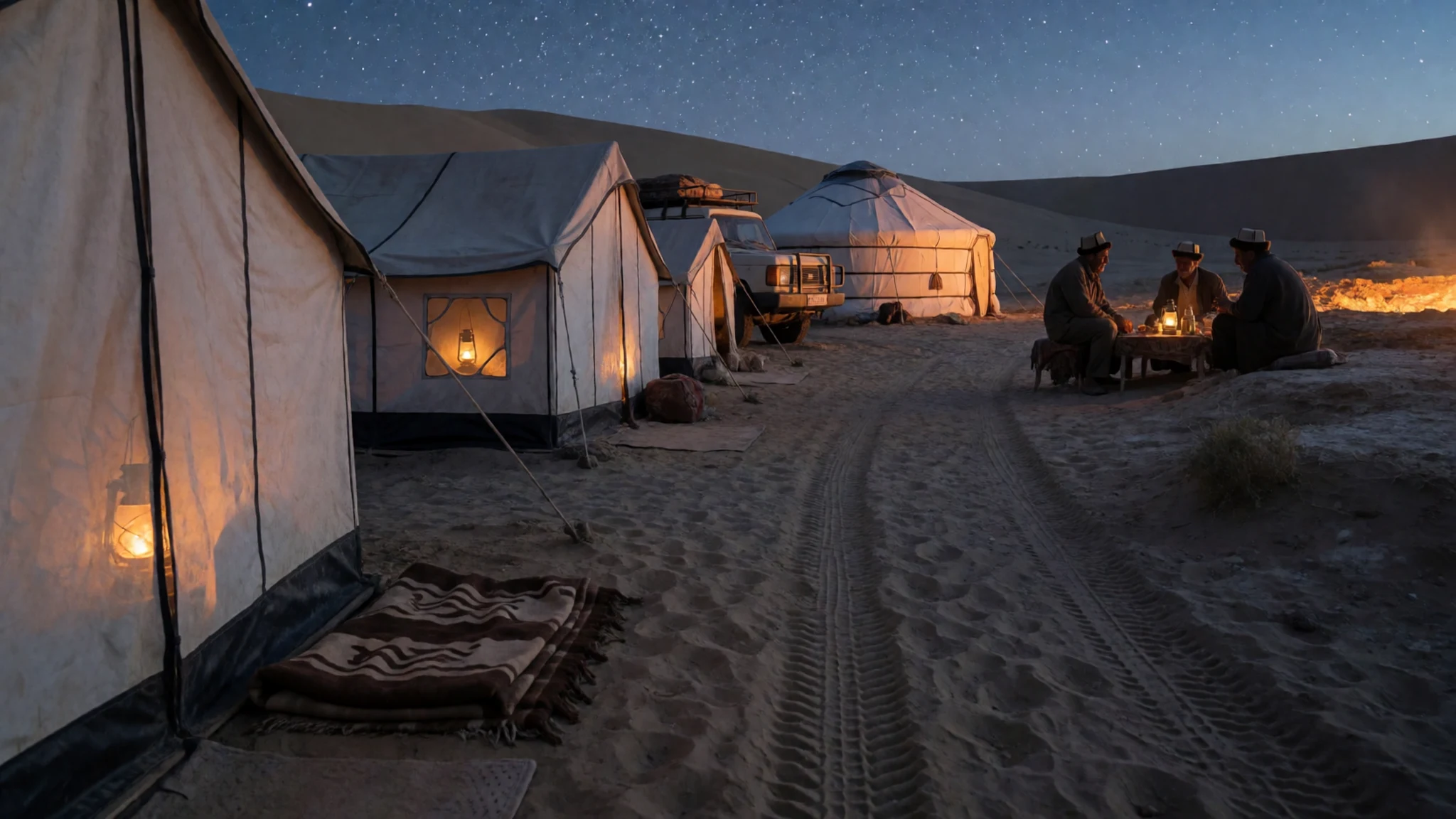
- Turquoise crater — open desert near the gas crater
The turquoise crater near Darvaza is a separate collapse holding still, milky-blue water, a short drive from the fire across open desert. There is no flame and little sound. The colour looks almost unreal against pale sand, with mineral stains on the banks. Daylight is the time to go; the pool has nothing of the fire's drama and all of its oddness.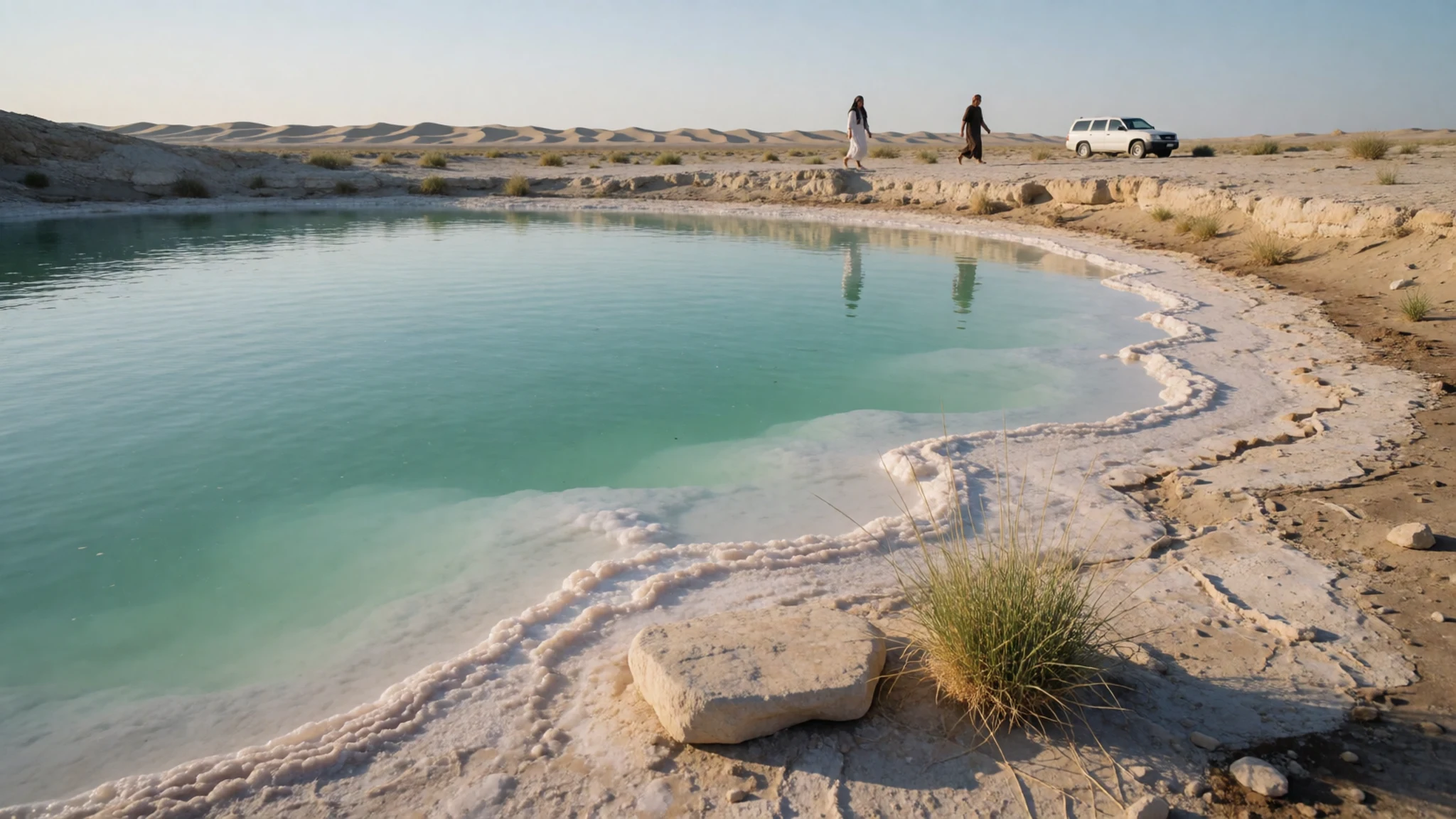
- Mud crater — open desert near the gas crater
The mud crater at Darvaza is another of the collapses, a low bowl of wet earth that bubbles and lets gas out without a flame. It sits in the same desert scatter as the fire and the turquoise pool, and it smells more strongly of the underground than the burning pit does. Most people stay only briefly: there is no vista, only the slow working of the ground.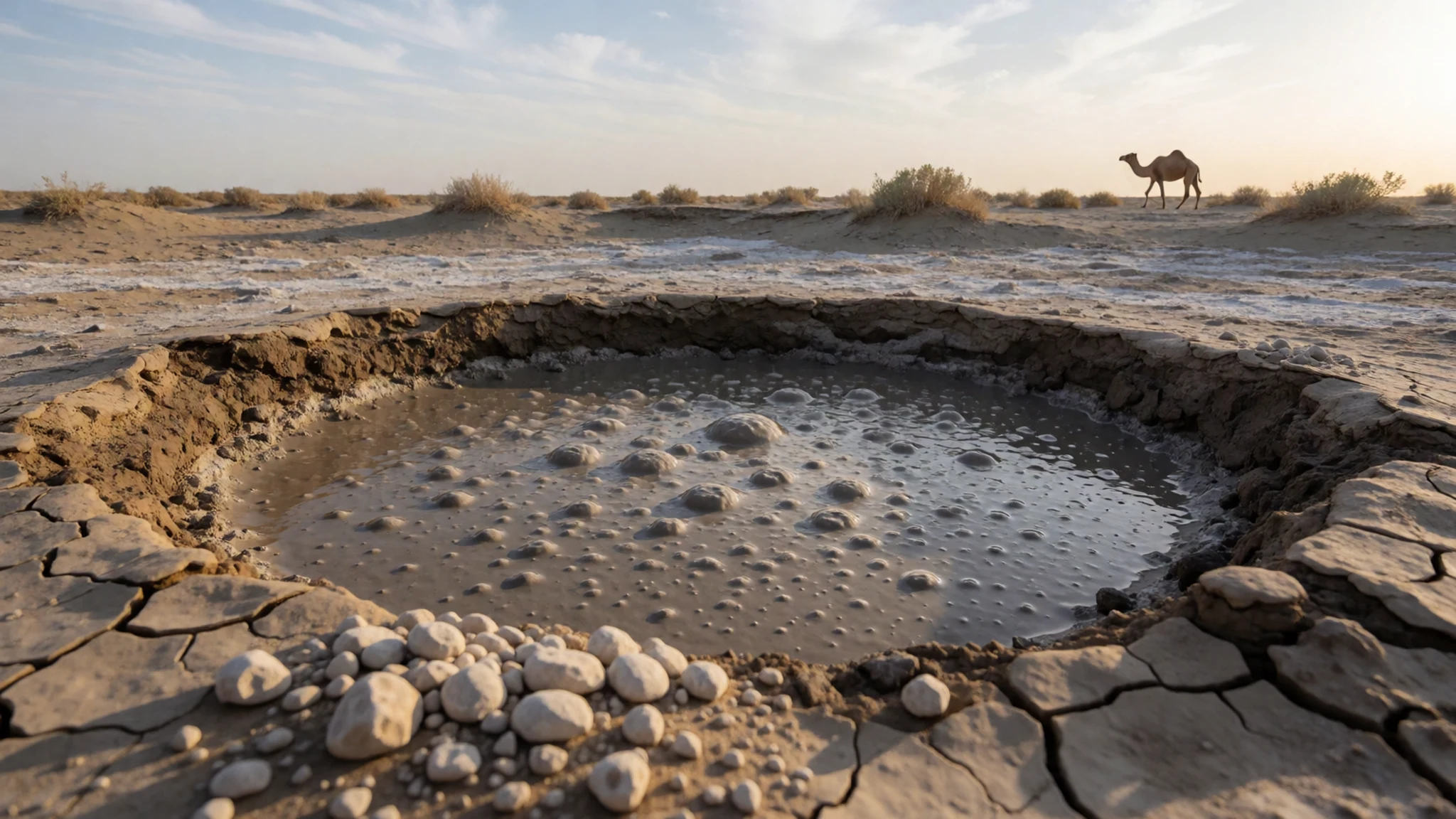
- The desert road — Ahal road into the Karakum
The road to Darvaza crosses Ahal and then the Karakum, a long run of flat desert with almost no settlement once the last villages fall behind. This is the approach that makes the fire feel remote: heat, dust, and a horizon that barely changes until the pit appears. There is no town at the end of it, only the crater, the camps and the dark.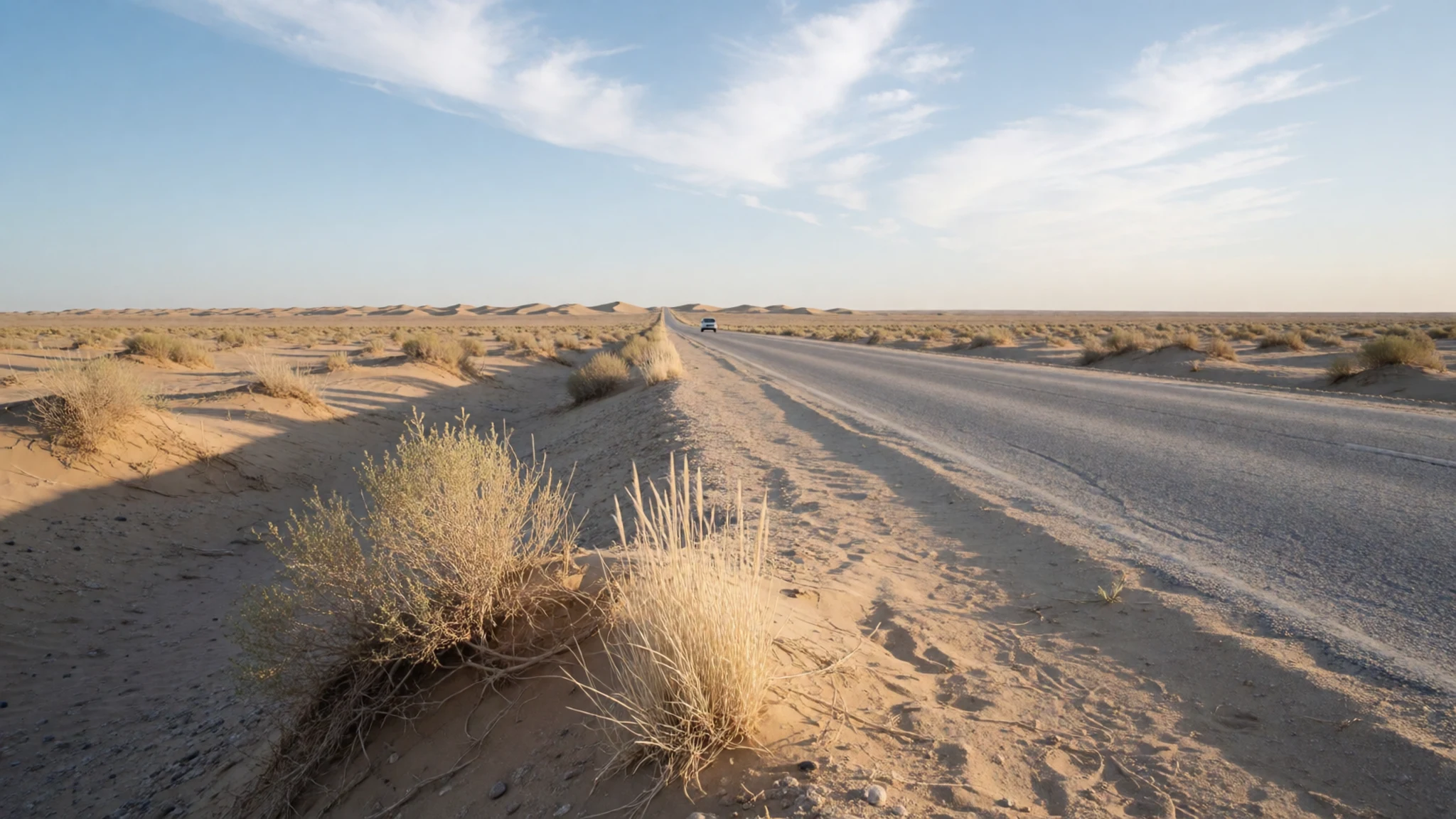
Culture
Darvaza sits inside a Turkmen idea of hospitality that was shaped by desert travel long before the crater burned. A guest is given tea first, usually green tea in a bowl, and the refill comes before the bowl is empty; waving off that first bowl can sound like a refusal of the person, not of the drink. Conversation is unhurried, and business — the driver, the camp, the hour of leaving — waits its turn. The yurt, the ak öý or white house, remains the picture of a proper welcome even when the camp is a line of tents hired for the night. People are proud to show the fire and a little uneasy about it: gas is the country's living, and here it leaves the ground as a useless flame. Soviet memory still frames how the pit opened, told plainly, without romance. The village is small, and families are not an exhibit. At Darvaza, stay well back from the crumbling rim, take nothing from the desert and leave nothing on it, and if you are invited into a yurt remove your shoes at the threshold and ask before you photograph anyone.
What to wear
Darvaza is desert country, and the clothes that belong to it were made for sun, wind and cold at once. Men of the region still own the telpek, a heavy sheepskin hat with a shaggy crown that shades the eyes and keeps heat in after dark, and for ceremonies a long robe — chapan or don — in wool or quilted cotton, sometimes striped, worn over a plain shirt and loose trousers. Women's formal dress runs to long silk or velvet gowns and an embroidered skullcap, the tahya, with silver jewellery; the embroidery tradition, keşde, covers collars, caps and household cloth in dense red and dark geometric work. Everyday city dress, the sort seen on the way out of Ashgabat, is ordinary modern clothing. Out here the telpek and a headscarf survive because they work. A visitor should copy the practical layer, not the costume: long sleeves and trousers in pale cotton, a scarf against sun and dust, boots or closed shoes for hot sand and the yurt step, and a real coat for the night, when the fire warms only the side turned towards it.
What to eat
- Palaw — camp kitchens and chaikhana tea-houses on the Ahal road
Palaw at a Darvaza camp is rice cooked with carrot and mutton, sometimes chickpeas, set down in a shared platter on a low table. Camp kitchens serve it, and so do chaikhana tea-houses on the Ahal road back towards Ashgabat.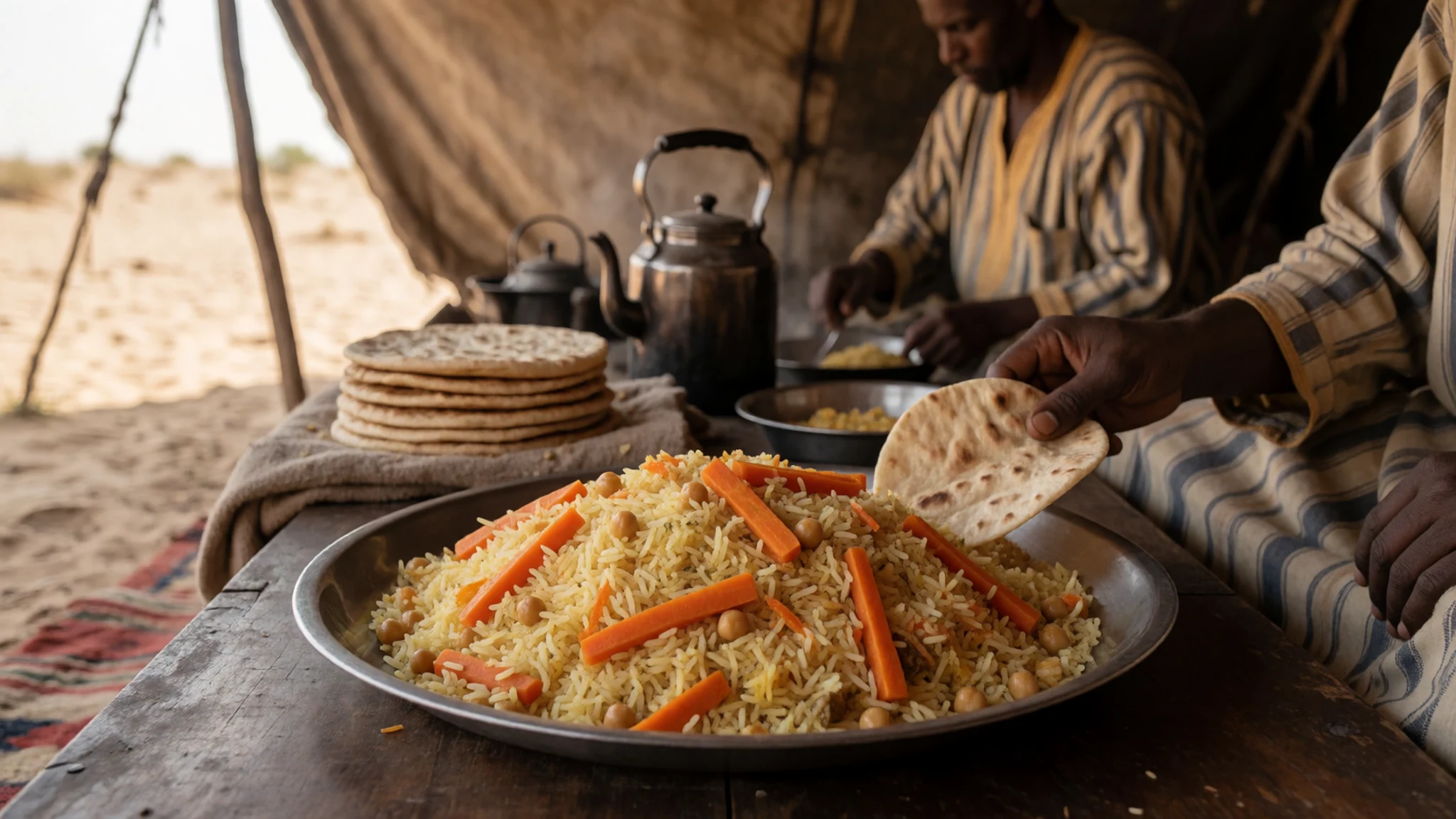
- Shashlyk — camp grills and roadside stands on the desert highway
Shashlyk at Darvaza is lamb or mutton cut small and grilled over coals, eaten with raw onion and flatbread while the fire in the pit does the competing light. Camp cooks grill it in the evening, and roadside stands on the desert highway do the same at midday.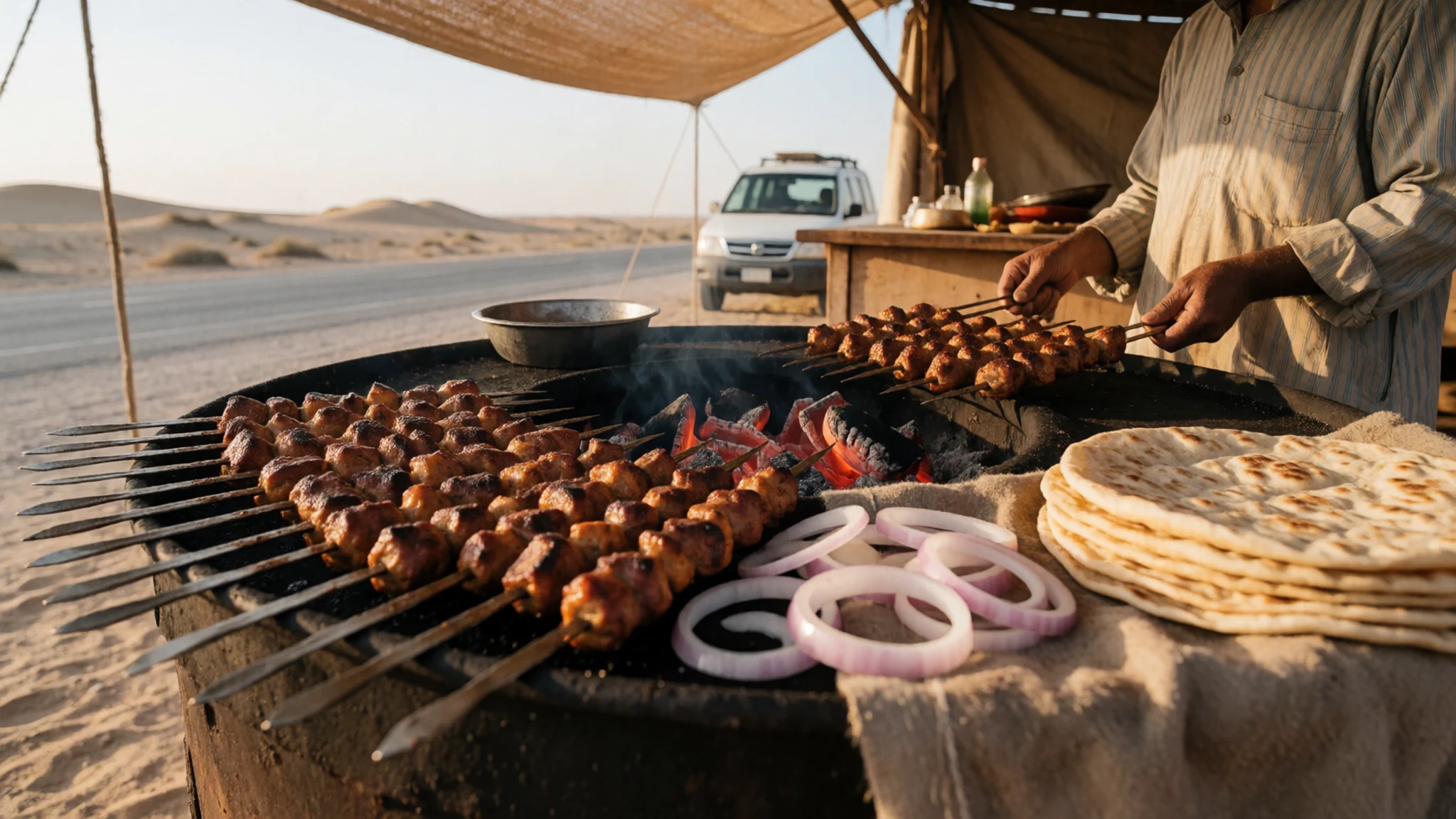
- Dograma — simple eateries in Ahal and family-style camp tables
Dograma is torn flatbread in meat broth with onion, and at Darvaza a camp or a village table serves it when the day has been long and hot. Simple eateries in Ahal and family-style spreads are the places it belongs. - Gutap — Ashgabat bazaars and camp breakfasts
Gutap is a fried stuffed flatbread, often pumpkin or spinach, and it is the hand food to carry out of Ashgabat towards Darvaza. Bakers in the city bazaars sell it in the morning, and a camp breakfast sometimes has a cousin of it beside the tea. - Gök çay — camp kettles and chaikhana stops on the way
Green tea is the constant at Darvaza, poured into small bowls and topped up all evening beside the crater. Every camp keeps a kettle going, and so does every chaikhana on the way. Declining the first pour is the only form of it that causes awkwardness. - Çörek — camp tables and village shops on the Ahal road
Çörek is the round, glazed bread of Turkmen tables, and at Darvaza it does the work of a plate: torn, not sliced, and used to pick up palaw and meat. Camps bake or bring it, and village shops on the Ahal road sell it by the piece.
Plan it
Best time. March, April, October and November, when the Karakum day is most comfortable and the night at the Darvaza rim is cold but manageable. High summer brings severe heat and almost no shade. Winter nights on the open sand are bitter. The flames show best after full dark in any month.
How long. 1–2
Getting there. Ashgabat is the gateway to Darvaza. A driver covers the last leg, a desert track north across Ahal into the Karakum, unlit and easy to lose after dark. The village has a landing strip for small cargo aircraft and is served by the Içoguz station on the Trans-Karakum Railway. Confirm the current rules for travel beyond the capital before setting out, and let a local operator arrange the car.
Budget. high
Tips
- Carry more drinking water than a city day would need; the desert does not refill a bottle.
- Bring a warm layer and a windproof shell for the Darvaza rim after sunset.
- Agree the car and the camp in Ashgabat beforehand; neither can be counted on at the crater.
- Keep cash for tea, bread and small stops along the road.
- Walk the ground in daylight before trusting it after dark.
- Signal fades on the way; save maps and share a return time while still in the city.
Etiquette
- Stay back from the rim; the edge crumbles and there is no barrier.
- Remove shoes before stepping into a yurt.
- Ask before photographing people; the flames are expected, families are not a sight.
- Carry rubbish away. The desert does not clear a camp.
Nearby
Sources
- Wikidata Q868328 (CC0)
- Wikipedia — Darvaza gas crater (CC BY-SA 4.0)
- Wikivoyage — Darvaza (CC BY-SA 4.0)