Ashgabat
Ashgabat, Turkmenistan
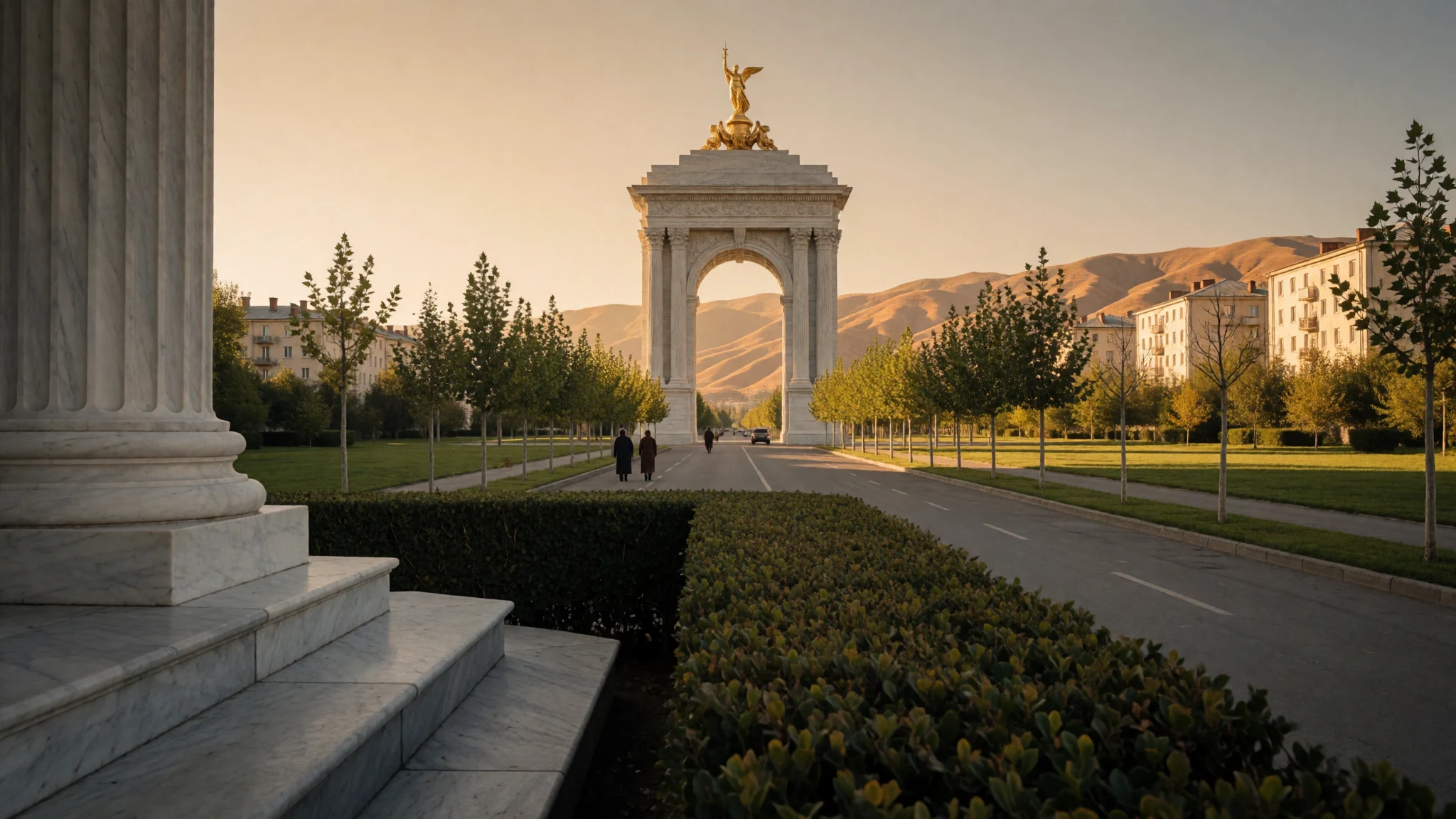
Ashgabat sets white marble avenues against the Kopet Dag, a desert capital of ceremony, bazaars and long empty light.
The place
Ashgabat occupies a long strip of irrigated ground where the Kopet Dag drops to the Karakum. The mountains close the southern horizon; north of the last canals the desert takes over. The city the visitor sees is almost entirely pale stone: ministry blocks, apartment rows and ceremonial monuments clad in white marble, set behind vast lawns, fountains and avenues wide enough that a lone car looks lost.
The ceremonial south, around Independence Park and the Berzengi quarter, is the Ashgabat of postcards — rows of white towers, gold finials, flags, and water jets timed to music. Streets are clean, shaded in places by belts of trees, and often strangely quiet. North and west, older neighbourhoods and the working bazaars are denser: lower buildings, more dust, more people, and the ordinary noise of a Central Asian city that the marble core edits out.
Ashgabat’s climate is extreme in the way of a desert piedmont. Summers burn; the marble throws heat back at street level, and midday movement slows. Winters are cold, and snow does settle on the avenues and on the Kopet Dag behind them. Spring and autumn are the kind months, with clear air and a wind off the hills. Water is the city’s quiet obsession: every green strip is piped, and the fountains run even when the desert beyond the ring road is bare.
What defines Ashgabat is the contrast, held in one view from Neutrality Road. From there the mountains rise southward over a white skyline. Along the avenue the scale is political — distance, emptiness, control. In a market lane the scale collapses to melons, carpets and tea. Both are the capital; neither cancels the other.
Its story
Ashgabat grew from a Teke Turkmen oasis where the Kopet Dag meets the Karakum, a halt on routes between the Iranian plateau and the desert towns of Transcaspia. The name is usually traced to a Persian phrase for a city of devotion; in Turkmen it is Aşgabat. Under the Russian Empire the oasis became a garrison and a rail town, seat of a frontier province, and a grid of low houses was laid between the hills and the sand.
That older Ashgabat was shattered by an earthquake that struck at night and brought most of the city down. Survivors rebuilt on a Soviet plan: wider streets, concrete housing, factories and parks, with the Russified name Ashkhabad on maps. It stayed a provincial capital, hot and dusty, set apart from the Silk Road cities further east, valued for its railway, its garrison and the gas fields beginning out in the desert.
Independence made the provincial capital a national stage. Saparmurat Niyazov and later Gurbanguly Berdimuhamedow rebuilt the centre in white marble — ministries, monuments and official residences organised around permanent neutrality, the country’s chosen foreign policy, written into avenues and arches. Portraits, gold statues and a renamed round of public symbols filled the new city. Trade, clan ties and Teke village life carried on at the bazaars and in the foothill settlements, outside the monumental plan.
Ashgabat today holds both inheritances: a city destroyed and replaced, and a capital built to be seen. The marble is real and the quiet is real. So is the life behind the façades — gas wealth, close political control, and a Turkmen culture older than any grid laid over the oasis.
What to see
- Neutrality Road — central to southern ceremonial axis
Neutrality Road is Ashgabat’s main ceremonial axis, a long straight avenue the city itself calls Bitaraplyk şaýoly. White façades step back behind trees and lawns, and the Kopet Dag closes the view. The avenue shows the capital’s scale in one line: few crossings, little shade at midday, and a quiet that feels planned. Mornings are the kinder hours, before the marble starts to radiate heat.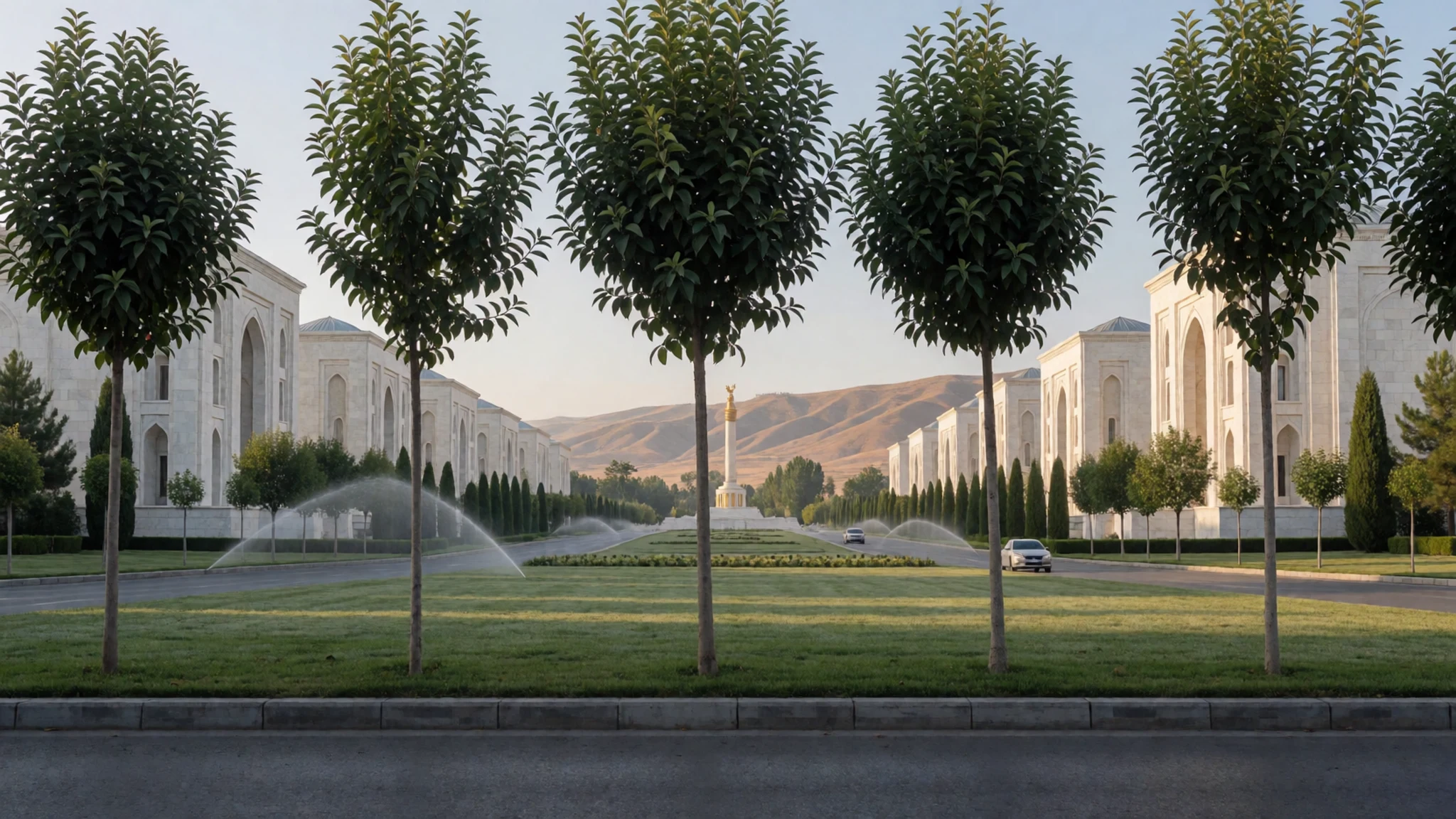
- Independence Park — southern ceremonial centre
Ashgabat’s southern ceremonial ground gathers Independence Park, ranks of white monuments and the long fountain basins that face the mountains. The architecture is formal and repetitive on purpose: axes, plinths, gold details, and lawns kept too perfect for a picnic. The point is the skyline rather than any one building. Late light warms the marble; at midday the plazas are exposed, bright and almost empty.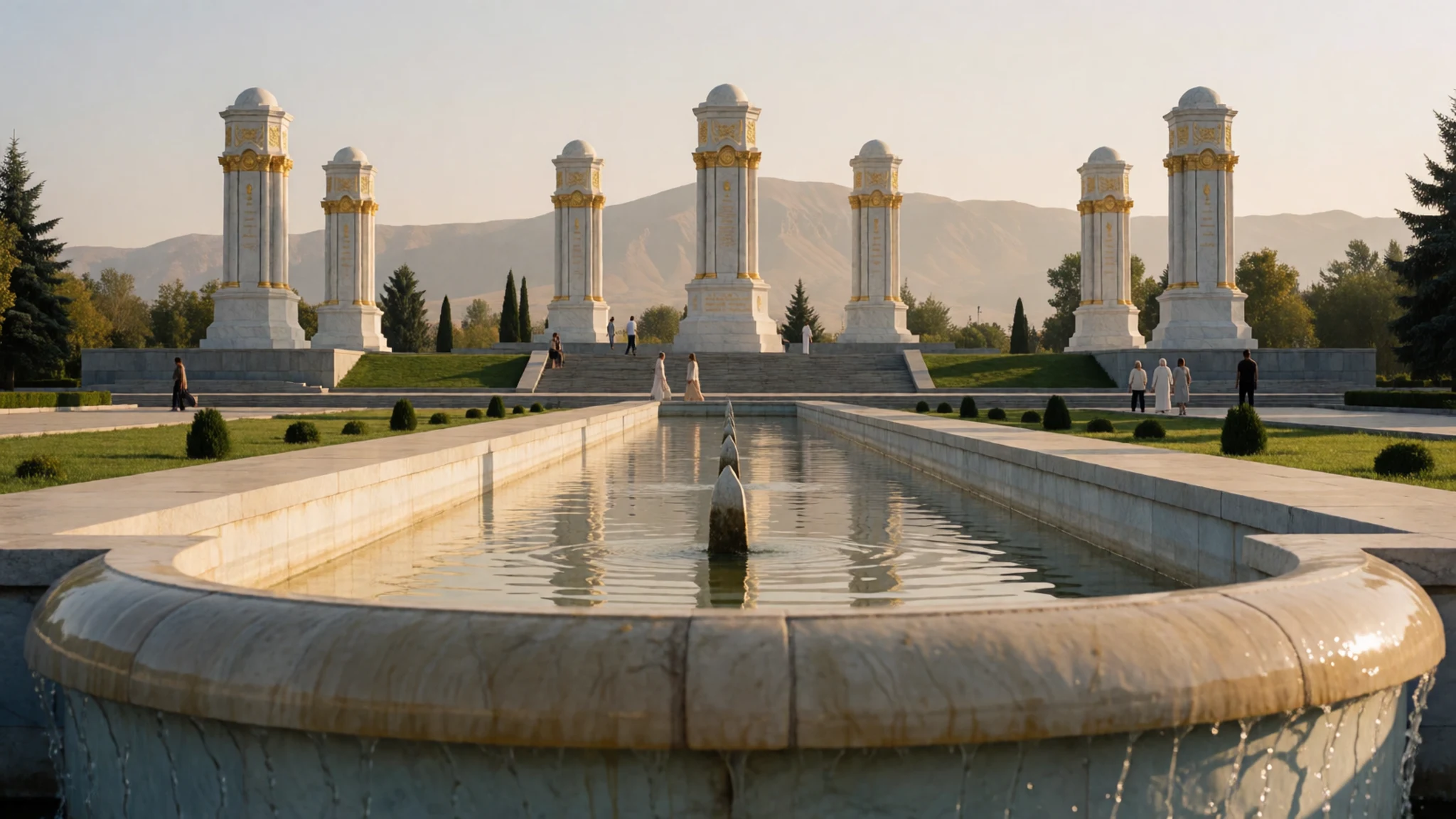
- Altyn Asyr bazaar — northern edge of the city
Tolkuchka, officially Altyn Asyr, is Ashgabat’s large open-air bazaar on the northern edge of the city, where the marble plan runs out. Carpets, camels, melons, telpek hats, car parts and household goods share the same dusty lanes. This is the capital’s working public room: bargaining, clan news, and food eaten standing up. Mornings are the right hours, while the produce is fresh and the sun is still kind.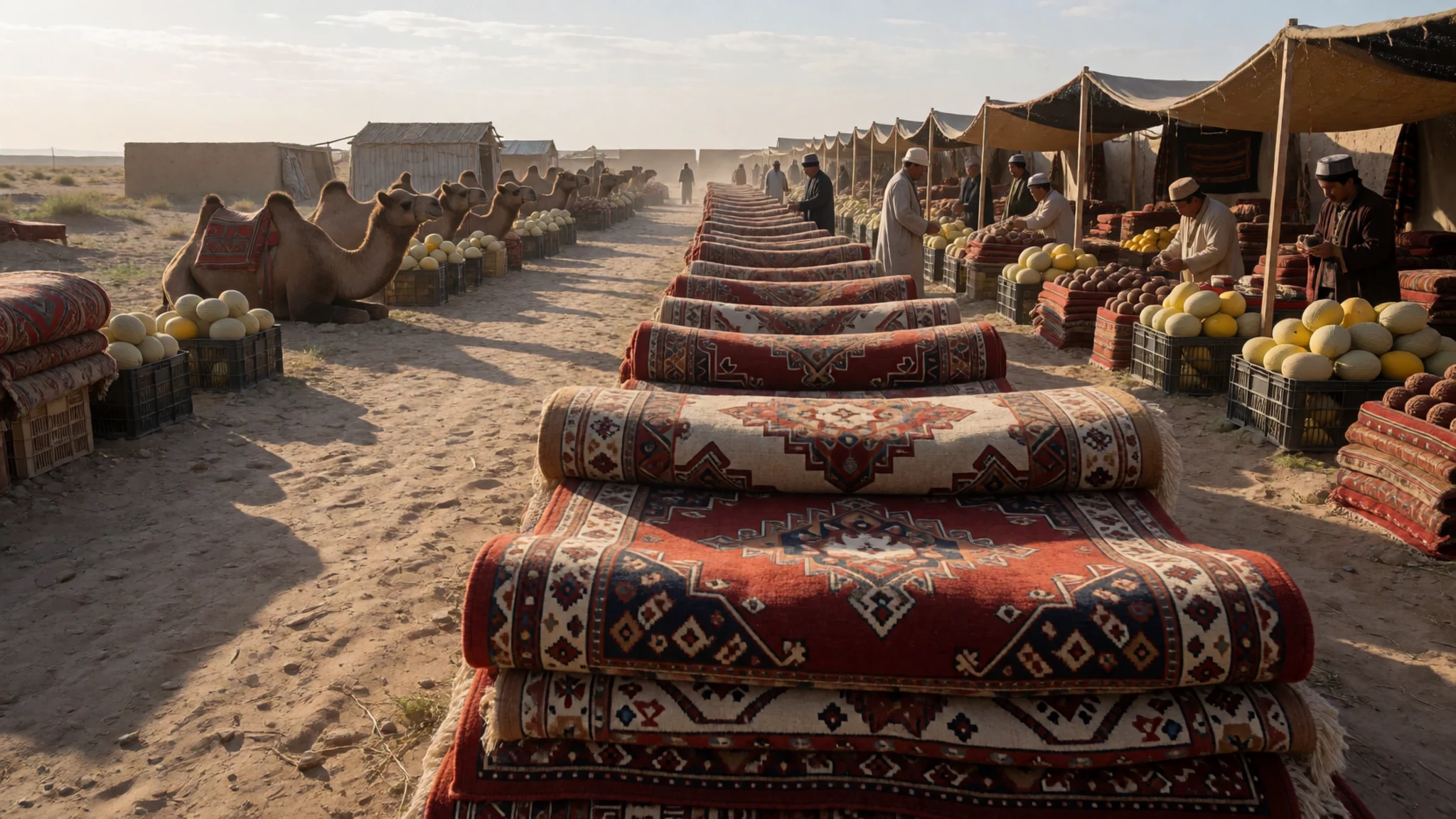
- Türkmenbaşy Ruhy Mosque — Geok Depe, west of the city
The Türkmenbaşy Ruhy Mosque stands at Geok Depe, 50 km west of Ashgabat, a white complex built as shrine to the first president’s family as much as a place of prayer. The scale is national: a huge hall, a paved court and minarets seen from the approach road. It is a working mosque and a political monument at once. Shoulders, legs and hair are covered; shoes come off at the door.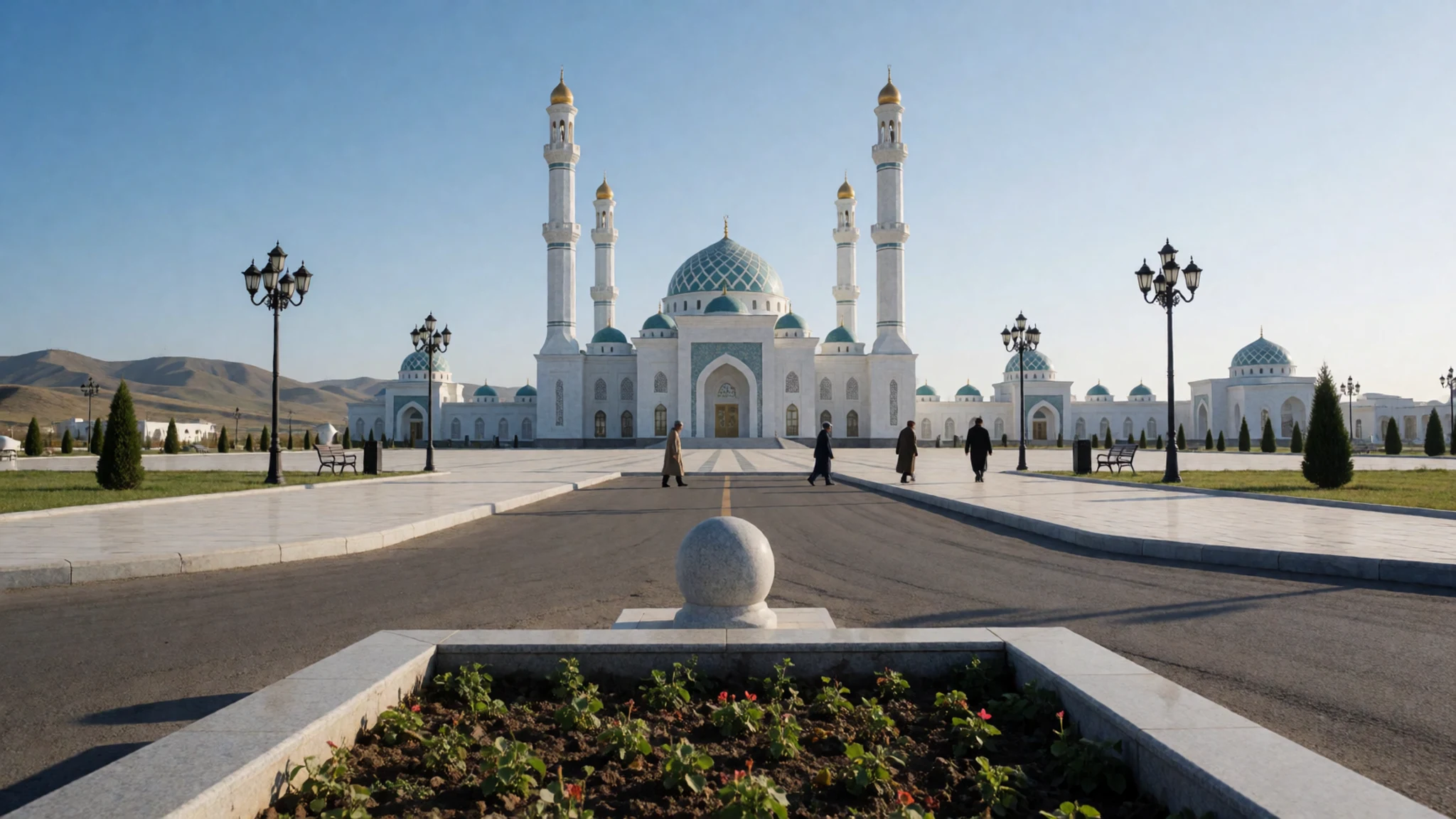
- Halk Hakydasy — southwestern foothills
Halk Hakydasy is Ashgabat’s memorial ground on the southwestern side of the city, under the Kopet Dag. One complex gathers monuments to the earthquake dead, to those lost in war, and to the independence story the state prefers to tell. The tone is solemn, the paving wide, the hills close. It shows why this capital builds memory in marble: grief, victory and the nation, set on the same axis.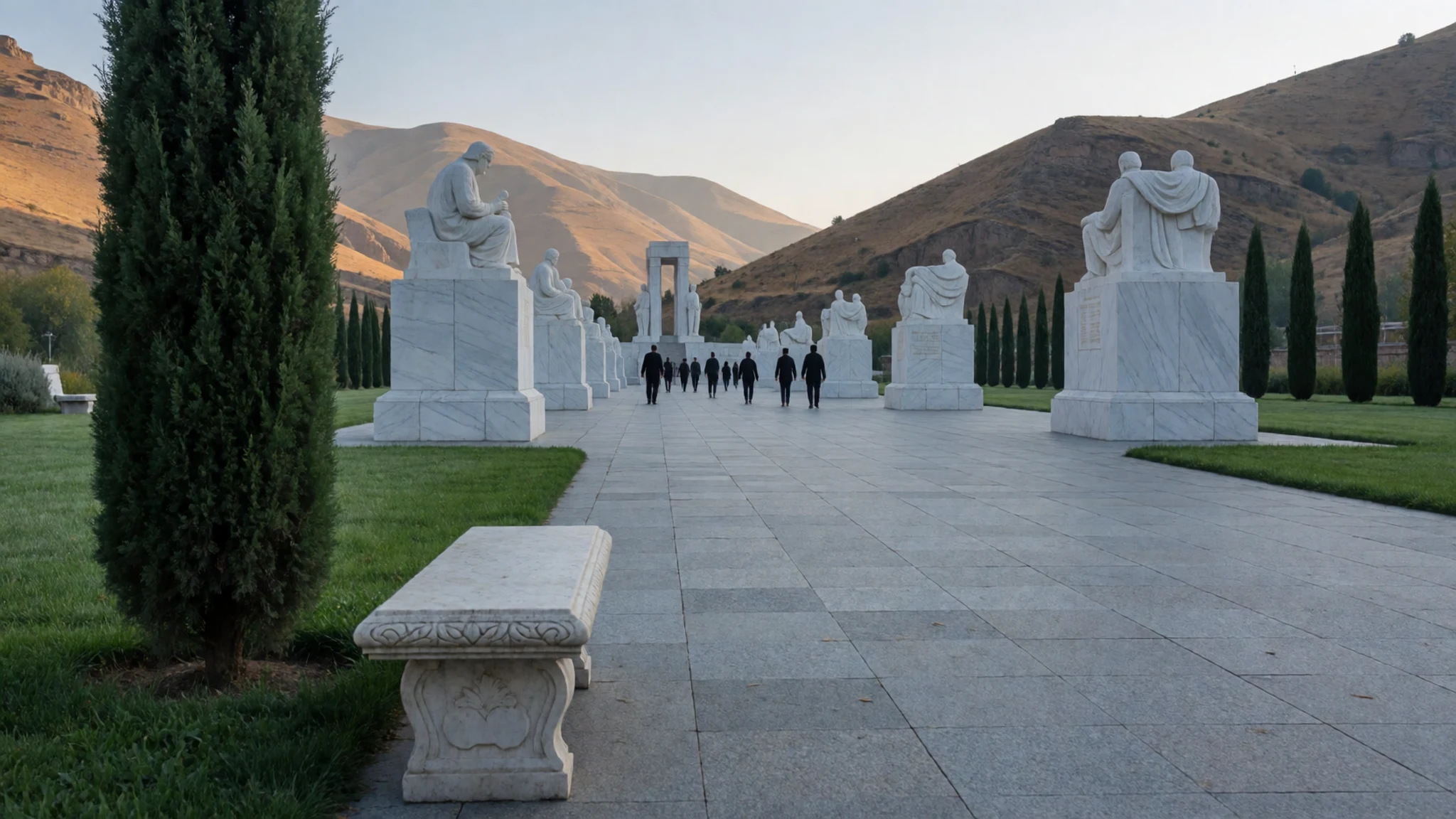
Culture
Ashgabat’s public culture is Turkmen first, and heavily shaped by the state. The Teke, whose homeland is the Ahal region around the capital, set much of the city’s customary style: carpet patterns, the cult of the horse, respect for elders, and a separation between the street and the family courtyard. Persian, Russian and Soviet layers remain in language, food and the older street plan, but official life presents a single national story.
Ceremony is a local art. National days fill the avenues with parades, mass dance and embroidered dress; the rest of the year the same spaces are quiet. Neutrality is more than a slogan here — it is a civic religion of arches, doves and white stone. Poetry still matters: Magtymguly and the classical Turkmen bards are public names, not classroom footnotes. Islam is widely held and generally quiet, Sunni and practical, alongside a personality cult that has softened but not vanished from monuments and portraits.
Family obligation, hospitality and a caution about politics structure ordinary encounters. Guests are fed; elders are greeted first; argument in public is rare. The capital can feel watched, and residents are careful about cameras, officials and unguarded talk with foreigners.
Visitors to Ashgabat should dress modestly, ask before photographing people or official buildings, and remove shoes when entering a mosque.
What to wear
Ashgabat still knows its traditional dress, even if the avenue is full of dark suits. For women the customary outfit is a long silk or velvet dress, the koynek, worn over narrow trousers called balak, with dense embroidery — keşde — in maroon, red and gold at the neck and cuffs. A headscarf frames the face. Men’s ceremonial dress includes a long quilted coat and the telpek, the huge curly sheepskin hat that marks a Turkmen man in parade and in the carpet trade. Hand-knotted wool carpets, with tribal gul motifs, are the textile the city treats as national art; silk for dress and wool for the hat and the rug.
On an ordinary weekday the marble centre looks international: men in jackets despite the heat, women in long modest dresses or tunics, headscarves common but not universal, jeans among the young. Traditional costume comes out for weddings, state holidays and the bazaar’s carpet rows, not for the office.
Visitors fit in by staying modest and practical. Ankle-length or loose trousers, covered shoulders and a scarf for mosques match local norms and the religious sites. Summer needs pale, breathable cloth and a hat against glare off the stone; winter needs a real coat, because the Kopet Dag wind is cold and snow is possible. Comfortable closed shoes beat sandals on vast paved plazas. Flashy sportswear and bare legs read as foreign, and not in a useful way.
What to eat
- Palaw — canteens and celebration halls around the bazaars
Palaw is Ashgabat’s festive rice, cooked with meat, onion and carrot until the grains stay separate and fragrant. It is the dish that marks a proper welcome at family gatherings. Canteens and celebration halls around the bazaars serve it with bread and green tea.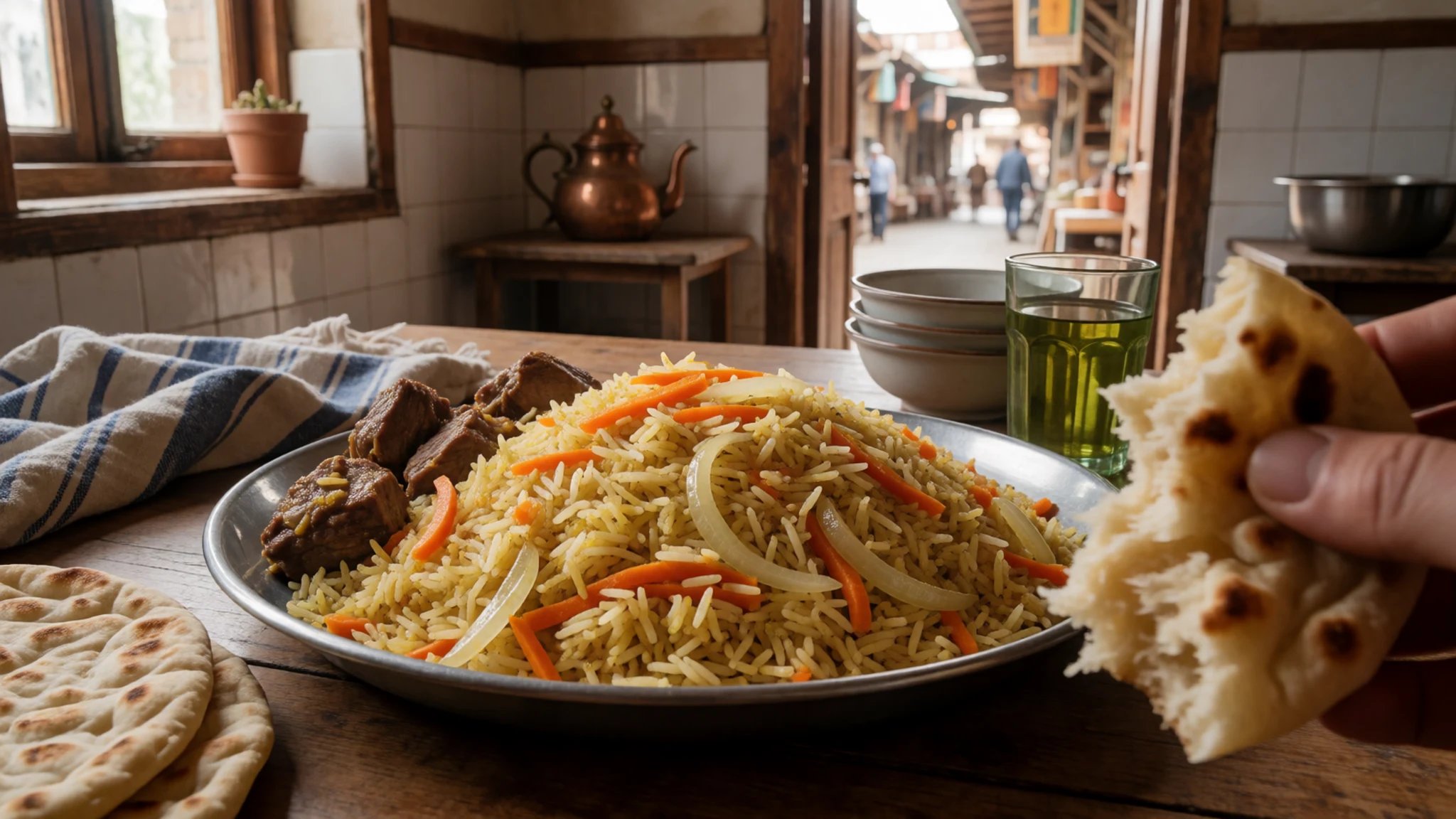
- Ichlekli — Tolkuchka and the central Russian bazaar
Ichlekli is a Turkmen meat pie that Ashgabat households and bazaar cooks both claim: a thin dough round filled with minced meat and onion, fried or baked until the crust blisters. Stalls at Tolkuchka and the central Russian bazaar sell it hot, wrapped for the walk.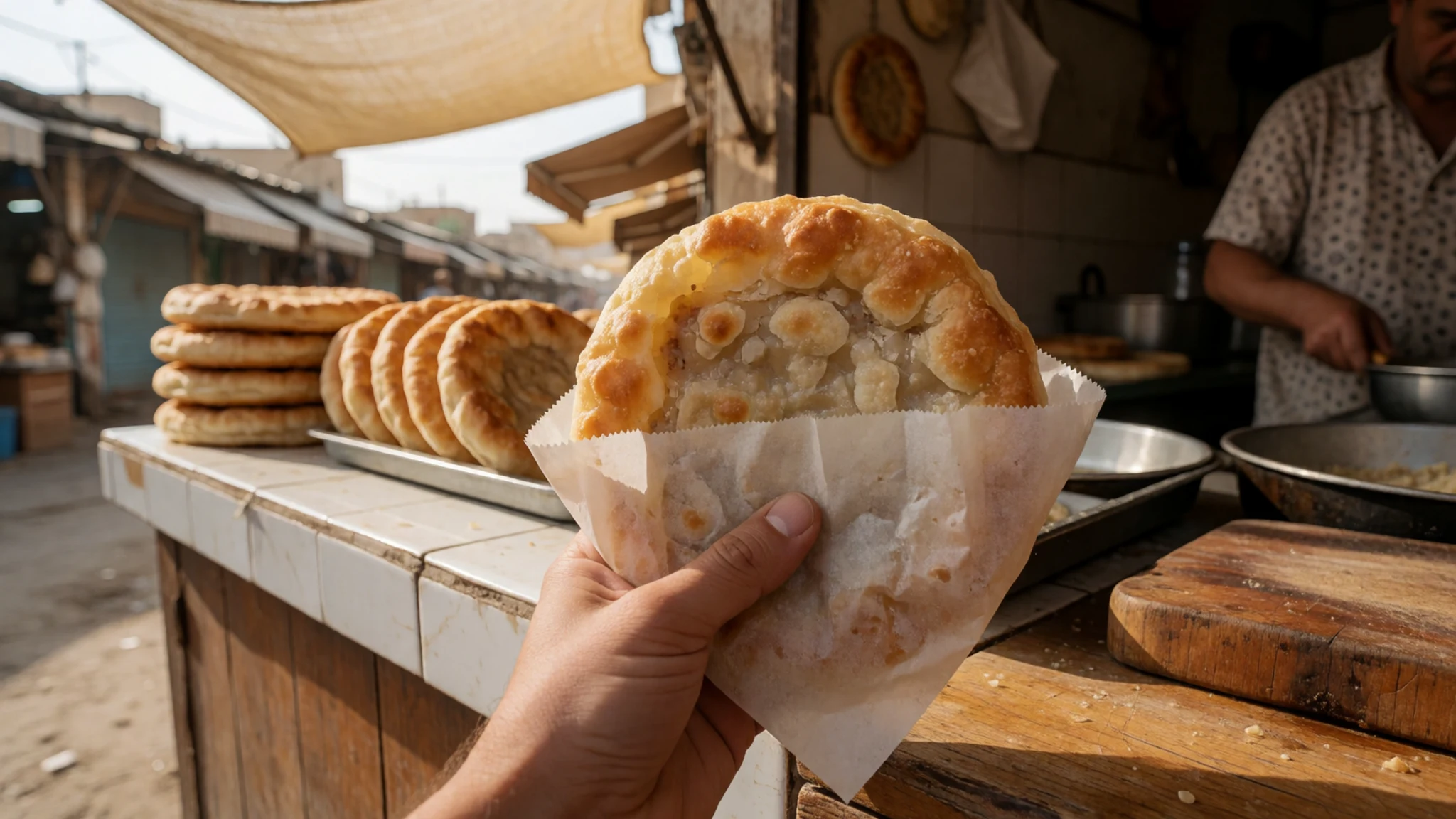
- Shashlik — bazaar grills and roadside fire-pits beside the ceremonial centre
Shashlik, skewers of lamb or beef grilled over coals, is the street food Ashgabat shares with the rest of Central Asia. The plate is simple: meat, raw onion, flatbread and green tea. Bazaar grills and roadside fire-pits beside the ceremonial centre serve it through the day. - Gutap — the Russian bazaar and neighbourhood markets
Gutap is a fried stuffed flatbread, a Turkmen cousin of the filled breads sold across the region. The filling is spinach, sorrel or pumpkin, folded into a thin dough and cooked until spotted. Bakers’ counters in the Russian bazaar and neighbourhood markets stack them for breakfast. - Dogroma — bazaar dining rooms and simple eateries
Dogroma is a shepherd’s dish found in Ashgabat homes and simple eateries: dry bread torn into rich meat broth, with onion and sometimes soured milk alongside. It is heavier than it looks and deeply local. Bazaar dining rooms serve it more readily than the marble quarter.
Plan it
Best time. Ashgabat rewards a visit in March, April, October and November, when days are warm and nights turn cool. Summer heat on the desert plain is severe, and winter can bring cold wind and snow off the Kopet Dag.
How long. 2–3
Getting there. Ashgabat International Airport, then a taxi or pre-arranged transfer into the city. Most visitors have no useful international rail link; overland crossings, including from Iran, need permits arranged ahead. Check the official consular guidance before booking.
Budget. high
Tips
- Sort the visa and any required invitation before travel, and read the official consular guidance because the rules change.
- Begin with the outdoor avenues in the morning, when summer heat off the marble is still bearable.
- Carry cash. Card payments often fail outside large official lodging.
- Leave ministries, police and military sites unphotographed unless a guide has cleared it.
- Drink bottled or boiled water, and keep a warm layer for fierce indoor cooling and for the winter wind.
Etiquette
- Remove shoes before entering a mosque, and keep shoulders and legs covered.
- Ask before photographing people, and do not point a camera at officials or government buildings.
- Greet elders first, and avoid public criticism of national leaders or symbols.
Nearby
Sources
- Wikidata Q23438 (CC0)
- Wikipedia: Ashgabat (CC BY-SA 4.0)
- Wikivoyage: Ashgabat (CC BY-SA 4.0)