Caddo Lake
Caddo Lake, United States
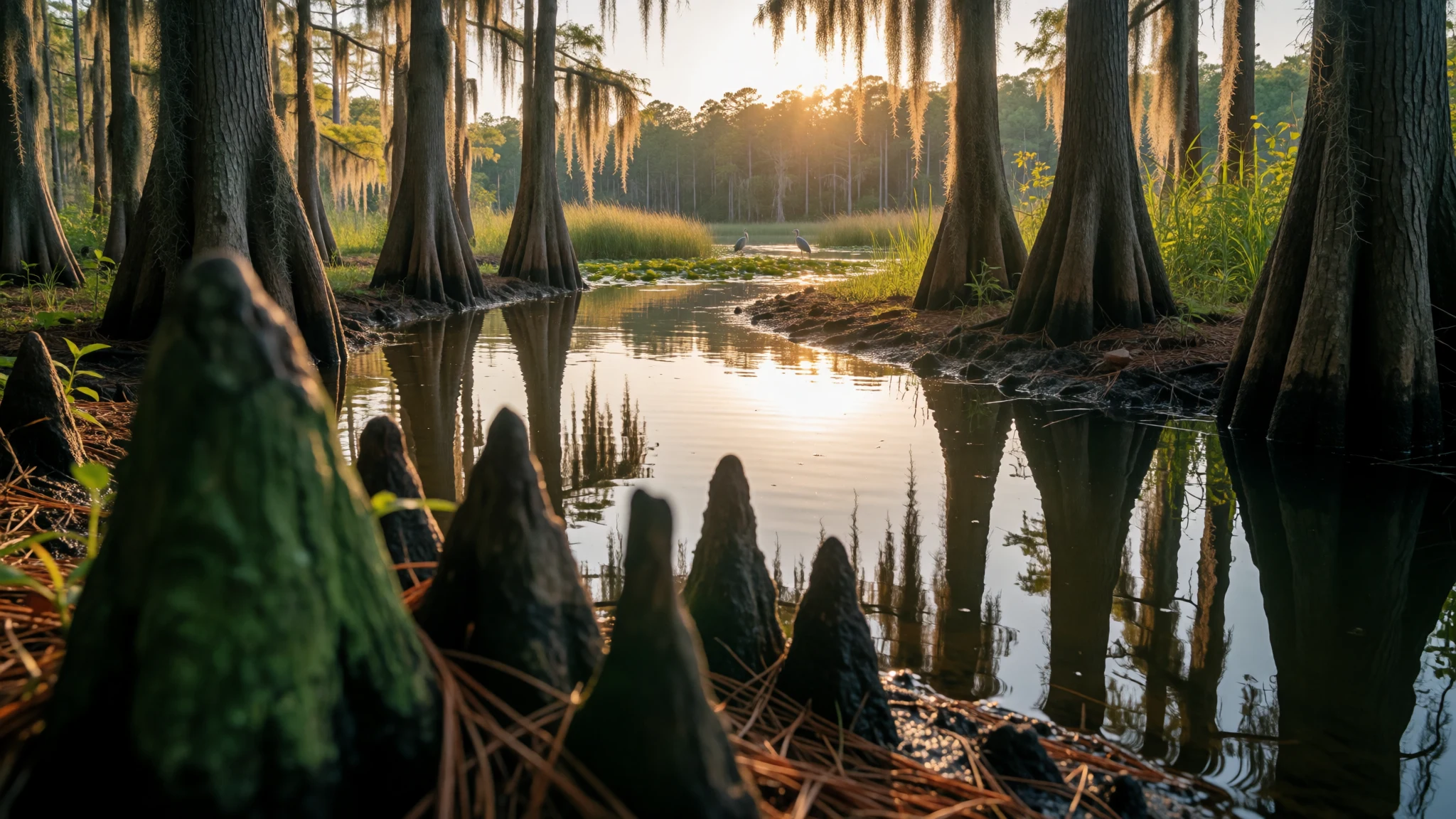
Caddo Lake is a flooded cypress forest on the Texas–Louisiana border, best explored slowly by small boat through still, moss-draped channels.
The place
Caddo Lake sits on the border between Texas and Louisiana, spread across Harrison and Marion counties on the Texas side and Caddo Parish on the Louisiana side. It is part lake and part bayou, and it behaves more like a maze of waterways than an open sheet of water. Bald cypress trees stand in the shallows, hung with moss, and the channels between them are narrow enough that a small boat can lose sight of the shore within minutes. The surface lies about 49 m above sea level, in the pine woods of East Texas, far from any coast. The wetland covers around 10,300 ha and is protected under the Ramsar Convention, the international treaty for wetlands. It is also an unusual water body for Texas, where natural lakes are rare, though a dam built in the early twentieth century has altered it. The name comes from the Caddo, the Native American people who lived here until they were forced out in the nineteenth century, mostly towards Indian Territory. Today the lake is a quiet place for paddling, fishing and birdwatching rather than a resort. Facilities are modest, the towns are small, and the real draw is the stillness. Summer is hot and sticky, as across the southern states, and the water and trees hold the humidity close. The cooler months are gentler, and the bare cypress of winter has a stark look of its own.
Its story
Caddo Lake was used by Native Americans for hundreds of years before steamboats arrived. The Caddo people lived around it until the United States pushed most of them west in the nineteenth century. Steamboats then turned the lake into a trade route, and ports such as Jefferson and Port Caddo in Texas, and Mooringsport in Louisiana, prospered on the traffic. The boom did not last. Captain Henry Miller Shreve, and later the Army Corps of Engineers, cleared log jams from the lake and the Red River. With the jams gone, the lake changed shape and its level fell by more than 3 m, which made passage by riverboat difficult and ended the prosperity of the East Texas ports. A second industry followed. Oil was found beneath the lake, and in 1911 the Gulf Refining Company completed Ferry Lake No. 1, the first oil platform built over water anywhere in the world. Derricks spread across the lake and strained its fragile ecosystem. When richer fields opened at Kilgore and elsewhere in Texas, the oil companies moved out and left the lake to recover. Its present calm is the product of that sequence: ports that faded, a water level that dropped, and a landscape of cypress and channels that is now valued for what grows in it rather than what was taken from it.
What to see
- The cypress channels — Caddo Lake State Park and the Texas side of the lake
The core of Caddo Lake is the flooded cypress forest, best seen from a canoe, kayak or small guided boat. Trunks flare at the waterline, moss hangs from the branches, and the channels twist so much that a map matters. Go slowly and early, and expect to hear frogs and birds more than people.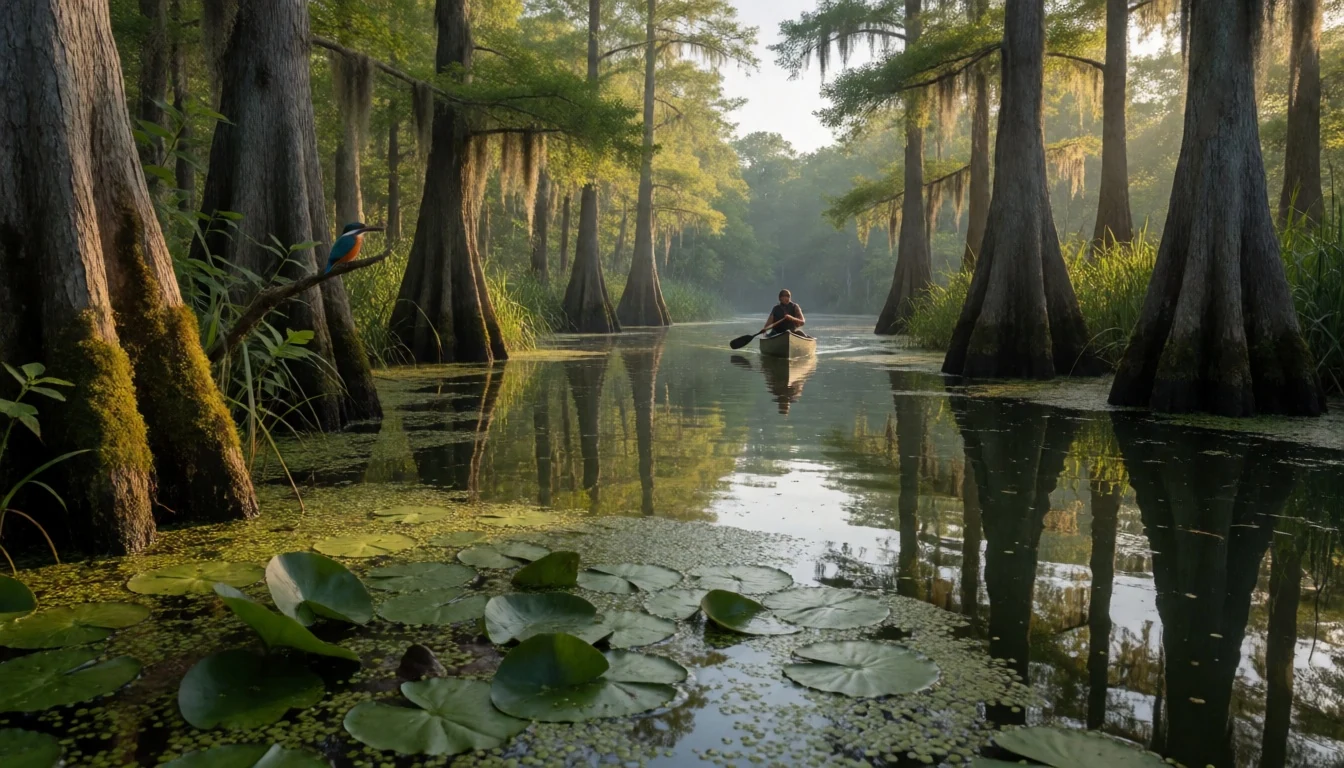
- The old steamboat channel — Towards Jefferson, Texas
A broad channel on the lake once carried steamboats towards the port at Jefferson, until falling water levels closed the route to big boats. Paddling or motoring along it gives a sense of the old river trade. The open water feels very different from the tight cypress mazes elsewhere on the lake.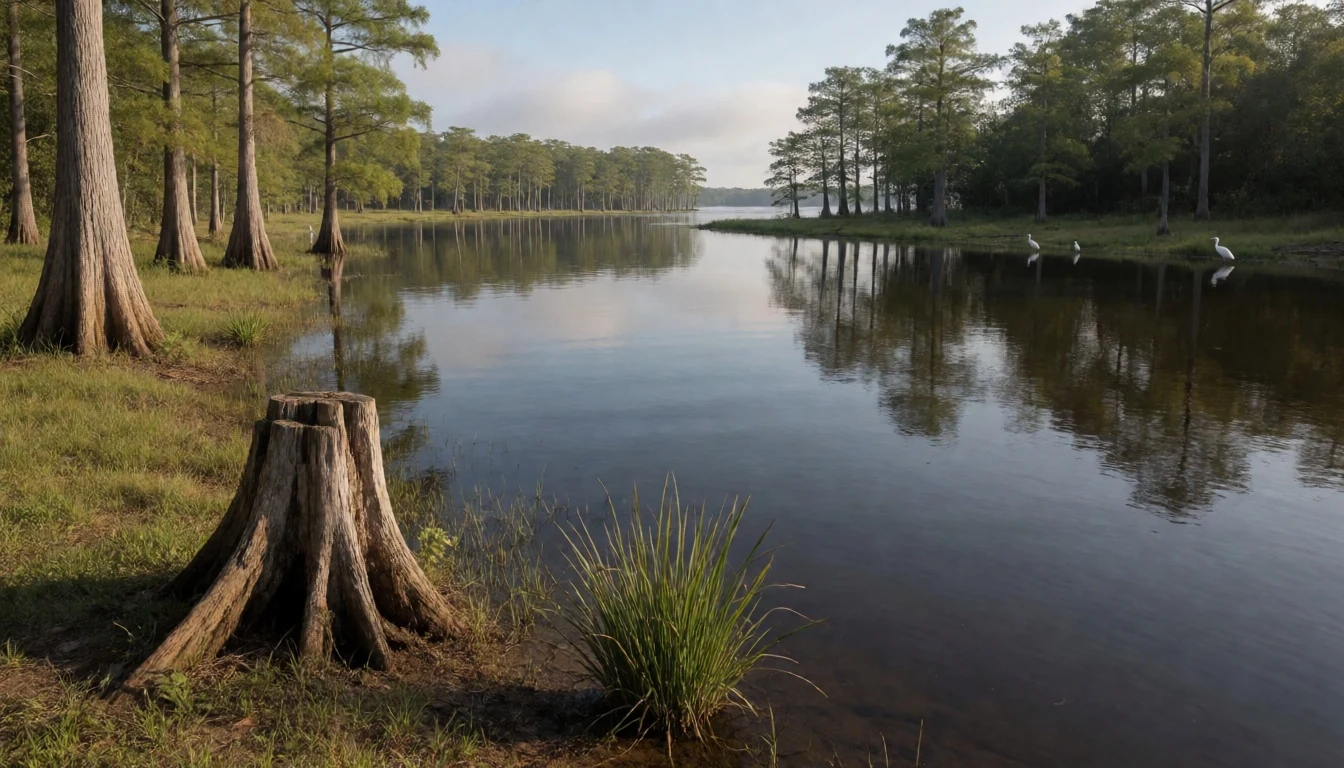
- The lake in winter — Across the lake
Winter strips the cypress of their needles, and the lake turns grey, russet and quiet. Fewer boats are out, the air is cooler and the sky shows through the branches. It suits photographers and anyone who dislikes humidity, though some days are cold and wet, so pack layers.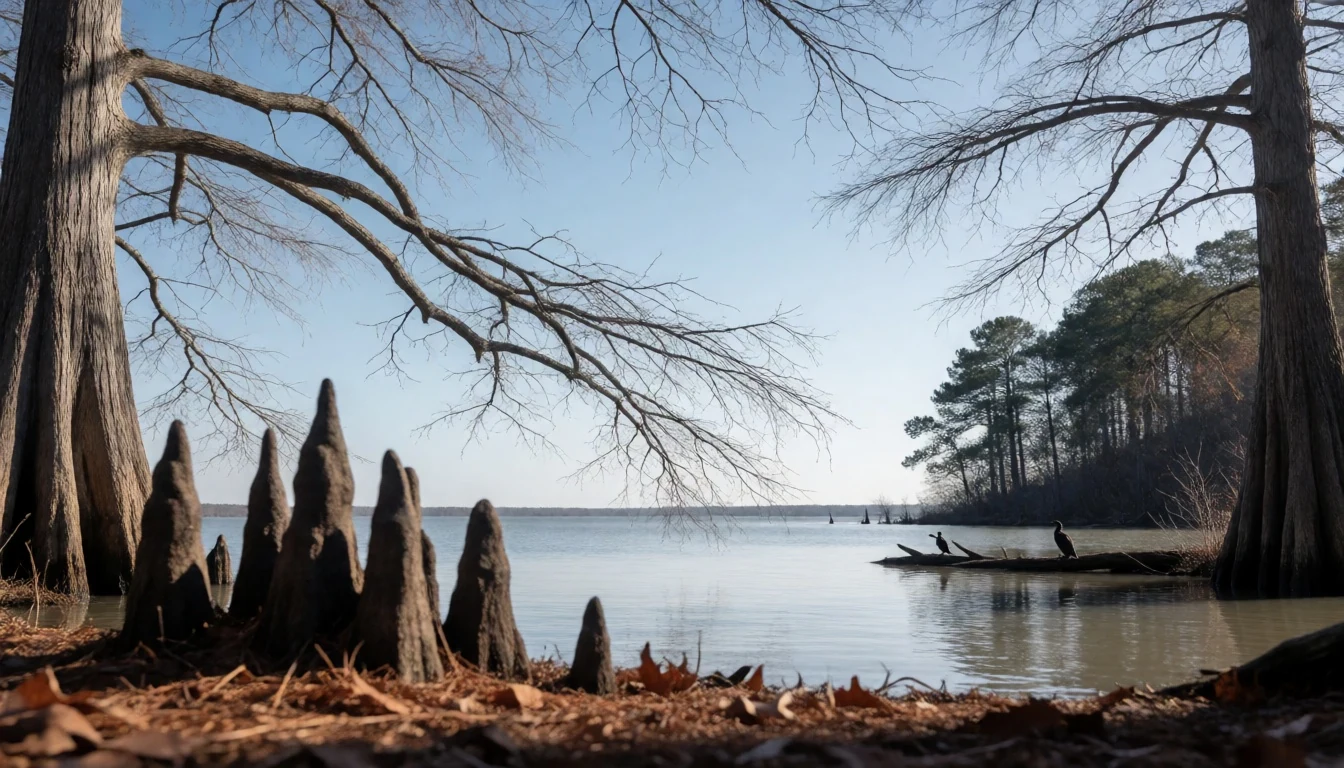
- Potters Point and the north shore — North shore of the lake
Potters Point on the north shore appears in an early geological survey of the lake, which recorded wave-cut bluffs and landslide terraces along the banks. It is a reminder that the shoreline here is soft and changing. Check locally which parts of the shore are open to visitors before heading out.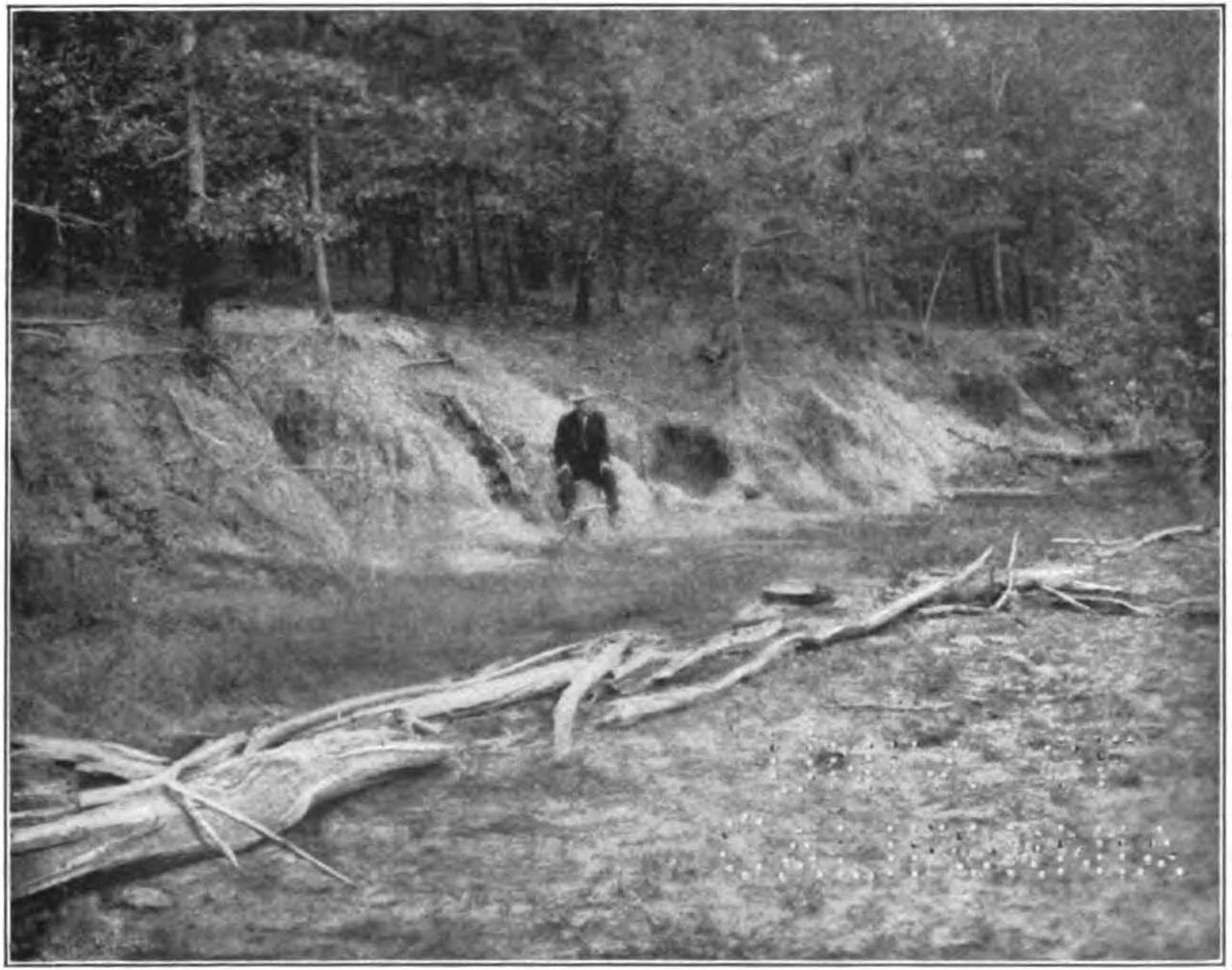
- Natchitoches — North-central Louisiana
Natchitoches is a small north Louisiana town whose historic district has architecture recalling New Orleans's French Quarter, and it served as the backdrop for the film Steel Magnolias. It makes a pleasant half-day away from the water, with cafés and walking streets. Allow time for the drive and check what is open.
Culture
Caddo Lake lies where East Texas and north Louisiana meet, and the culture of the area is rural Southern. Hospitality is real and it runs both ways: friendliness is offered freely, and politeness is expected in return. The pace of life is slower than in much of the United States, and conversation at a fish camp or a shop counter tends to begin with the weather or the water level. Fishing, boating and hunting shape local life, and many people know the channels by heart. The lake takes its name from the Caddo, who lived here for generations before being forced west. The Caddo Nation continues today, and its own cultural resources, rather than a visitor's guesswork, are the right place to learn how the Caddo describe their history. Away from New Orleans, this part of the South is generally more conservative than the big coastal cities, so it is wise to let locals raise politics or religion first. Hurricane Katrina remains a painful subject for many people in Louisiana; asking is not wrong, but some would rather not talk about it. Fishing guides and boat operators are often the best source of local stories, and they tend to share more when treated as hosts rather than as service staff. Greet people with a friendly hello on docks and in shops, and keep your voice low on the water so you do not disturb birds or other paddlers.
What to wear
Caddo Lake has no single regional costume, so the story of traditional dress here begins with the Caddo people, whose ceremonial regalia is made and worn by tribal members at gatherings and is theirs to describe; the Caddo Nation's own cultural pages are the place to learn the names, materials and occasions, and this reading does not guess at them. Everyday dress around the lake is practical and rural Southern: jeans or work shorts, cotton shirts, baseball caps and rubber boots, with plenty of camouflage and waterproofs in fishing and hunting season. People dress up a little for church or family gatherings, but nobody expects visitors to look smart. For a visit, think heat, water and insects. In warm months, wear light, loose long sleeves and trousers in quick-drying fabric, with a wide-brimmed hat and sunglasses, because the humidity is heavy and shade is patchy on open water. Closed shoes with grip, or sports sandals that can get wet, suit boat landings that are often muddy and slippery. Carry a light rain jacket all year, and add layers in winter, when the wind across the water is cold. Bring insect repellent, and wear a life jacket whenever you are in a boat. Smarter clothes are only needed for a restaurant in a town such as Natchitoches, and even there casual is normal. There are no dress codes for the lake itself.
What to eat
- Crawfish — Seafood restaurants and fish camps in north Louisiana and East Texas
Crawfish, boiled in a spicy pot or cooked into sauces, is a Louisiana staple that can seem exotic to visitors from elsewhere. It is eaten by hand and can be messy. Seasonal boils are most common in spring, so ask locally what is on. - Étouffée — Cajun and Creole eateries in Natchitoches and across Louisiana
Étouffée is rice under a thick, smothered gravy of shellfish, most often crawfish. It is rich and gently spiced, and a comforting first taste of Cajun cooking after a day of paddling in damp heat. - Gumbo with cornbread — Home-style restaurants and diners on both sides of the state line
Gumbo is a dark, savoury stew served over rice, and cornbread on the side is there for soaking up the broth. Both are Southern comfort food, and every kitchen has its own version, so trying more than one is worthwhile. - Fried alligator — Fish camps and casual restaurants near the water
Alligator turns up on menus around Louisiana, most often as fried bites with a dipping sauce. The meat is mild and a little chewy, closer to chicken or fish than most people expect, and worth trying once. - Beignets — Coffee houses and cafés in Natchitoches or, for the classic version, New Orleans
Beignets are deep-fried fritters buried under powdered sugar and served hot from the fryer. They are a Louisiana classic for breakfast or an afternoon coffee, and the sugar travels, so eat them away from dark clothes.
Plan it
Best time. March–April and October–November, when temperatures are milder and the paddling is comfortable; summer is very hot and humid, and winter is cooler and quieter, with the cypress bare.
How long. 2–3
Getting there. Fly to Shreveport, Louisiana, the nearest airport with commercial service, then hire a car for the last leg to the lake on either the Texas or the Louisiana side. Public transport to the lake itself is thin, so plan to drive; New Orleans and Baton Rouge have larger airports but are a much longer drive away.
Budget. mid
Tips
- Book boat tours or paddle hire ahead for spring and autumn weekends
- Get on the water early: mornings are cooler, calmer and better for wildlife
- Carry water, sun protection and insect repellent, as shade is patchy and the air is humid
- Take an offline map, because the channels look alike and phone signal may fade
- Check the state park and local operators for current opening and boat rules before you travel
Etiquette
- Keep voices low and give birds and other wildlife plenty of space
- Wear a life jacket whenever you are on the water
- Take all rubbish home and stay in marked channels
Nearby
Sources
- Wikidata Q1627906 (CC0)
- Wikipedia: Caddo Lake (rev 1372433844) (CC BY-SA 4.0)
- Wikivoyage: Louisiana (rev 5401791) (CC BY-SA 4.0)
- Caddo Lake with Bald Cypress trees — Jay Carriker (CC BY-SA 2.5)
- Relief map of Texas — Nzeemin (CC BY 3.0)
- Relief location map of the USA — Uwe Dedering (CC BY 3.0)
- Caddo Lake during winter — Jay Carriker (CC BY-SA 2.5)
- Caddo Lake channel — Jay Carriker (CC BY-SA 2.5)
- Bulletin 429 Plate X A, Caddo Lake — G. D. Harris (Public domain)
- Bulletin 429 Plate X B, landslide terrace — G. D. Harris (Public domain)
- Bulletin 429 Plate XI B, Potters Point — G. D. Harris (Public domain)


