Black Hills
Black Hills, United States
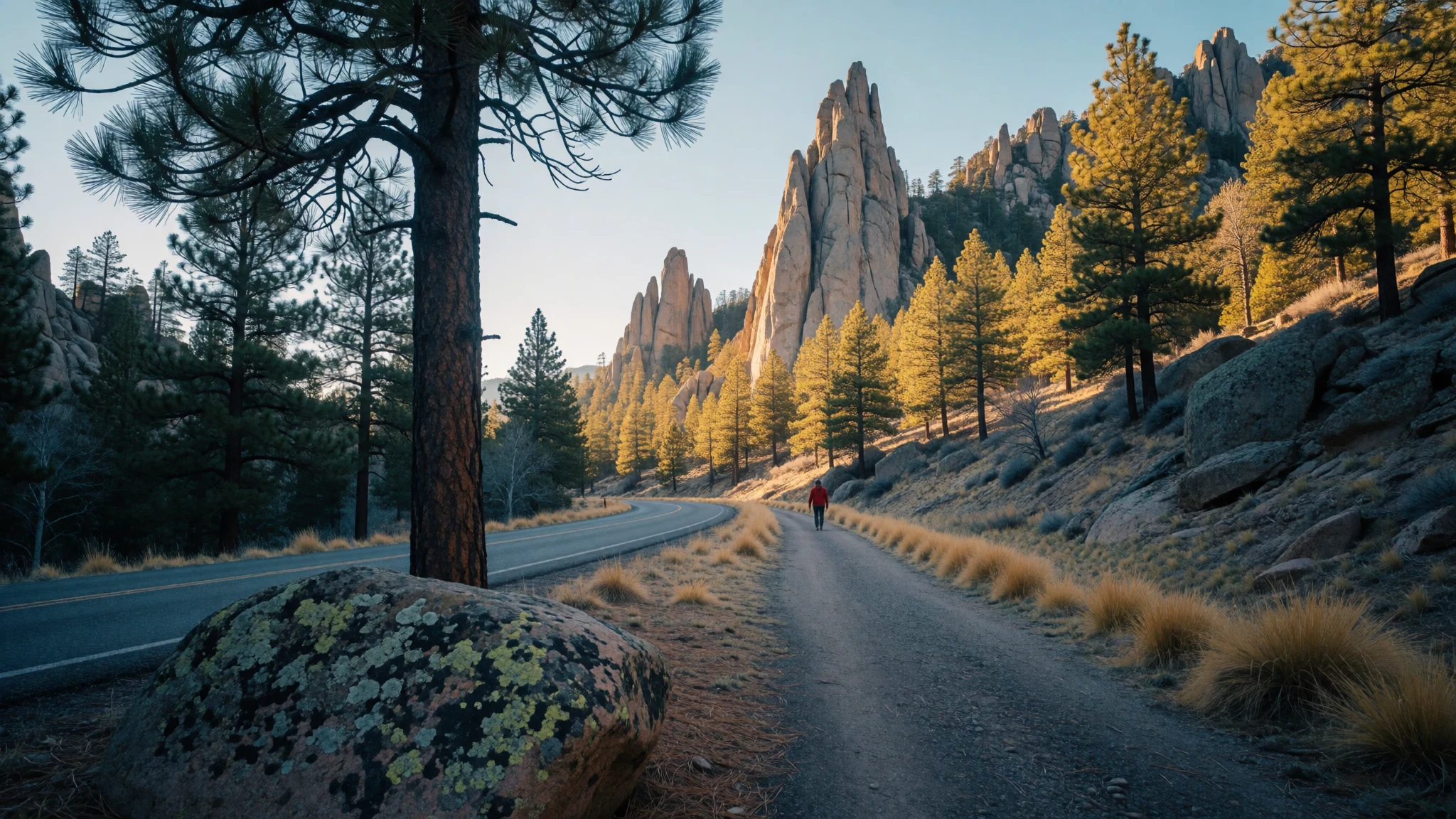
The Black Hills are a dark, pine-covered island of granite above the plains, sacred to the Lakota and full of caves, carvings and winding roads.
The place
The Black Hills rise from the Great Plains of western South Dakota and a corner of eastern Wyoming, a dark island of pine and spruce in a sea of grass. Seen from far off, the forested slopes look almost black, which explains the English name; the Lakota name is Pahá Sápa. Geologically the range is an outlier of the Rocky Mountain system. Old rock was pushed upward in a broad dome, and streams then stripped away the higher layers, leaving granite spires, rounded summits and steep, wooded valleys. Black Elk Peak is the high point at 2,207 m. Much of the land lies within Black Hills National Forest, with Custer State Park and a scatter of small towns tucked between the ridges. The hills are also a living sacred landscape for the Lakota and for other Plains nations, and that sits uneasily beside the roadside attractions, gold-rush museums and summer motorbike traffic. Since the late twentieth century, tourism and hospitality have taken over from mining and logging as the backbone of the local economy. Rapid City is the usual gateway on the eastern edge. Distances are bigger than they look on a map and the roads twist slowly, so a day of sightseeing covers less ground than most people expect. The forest, the rock and the quiet early mornings are the real draw, more than any single attraction.
Its story
The Black Hills have a human story that stretches back a very long way. Stone tools found here, dated by carbon methods, point to people living in the area as early as 11,500 BC. Over the centuries many nations moved through or settled the hills, among them the Ponca, Arikara and Mandan, followed by Kiowa, Plains Apache and Shoshone. By the early 1800s the Cheyenne and Arapaho were established, with a smaller number of Lakota alongside them. By 1850 the Lakota were the majority. Following their 1776 victory over the Cheyenne, these groups claimed the hills and integrated them as a cultural cornerstone, referring to them as Wamakaognaka e'cante, which translates to the core of all existence. French explorers, the La Vérendrye brothers, probably passed close by in 1743. As American settlers pressed west along the Oregon Trail, the 1851 Treaty of Fort Laramie tried to keep the peace. In 1868 a second treaty set aside the Great Sioux Reservation and promised that the Black Hills would stay free of non-indigenous settlement. That promise broke after Custer's expedition of 1874 reported gold. Miners poured in, war followed in 1876, and the Lakota were moved onto five smaller reservations in western South Dakota. About 9 million acres of former Lakota land were sold off. The dispute over the Black Hills has never been fully settled, and many Lakota still regard the land as taken unjustly.
What to see
- Mount Rushmore — Keystone area, central Black Hills
Four presidential faces are carved into a granite cliff above the pines near Keystone. It draws large crowds, so mornings and evenings are calmer. The monument sits on land the Lakota hold sacred, and many visitors pair it with a visit to a Native-led cultural site to hear that side of the story. - Crazy Horse Memorial — Near Custer, southern Black Hills
A mountain carving of the Lakota leader on horseback is still being worked on, blast by blast, near Custer. The campus also holds a museum and cultural centre devoted to Native American art and history. It is a good first stop for understanding the hills as an indigenous homeland. - Needles Highway and Sylvan Lake — Custer State Park
This road through Custer State Park squeezes between tall granite needles, passing through very narrow rock tunnels, so large vehicles may not fit. Sylvan Lake, a short drive on, is a calm pool ringed by boulders and good for an easy walk in the morning light.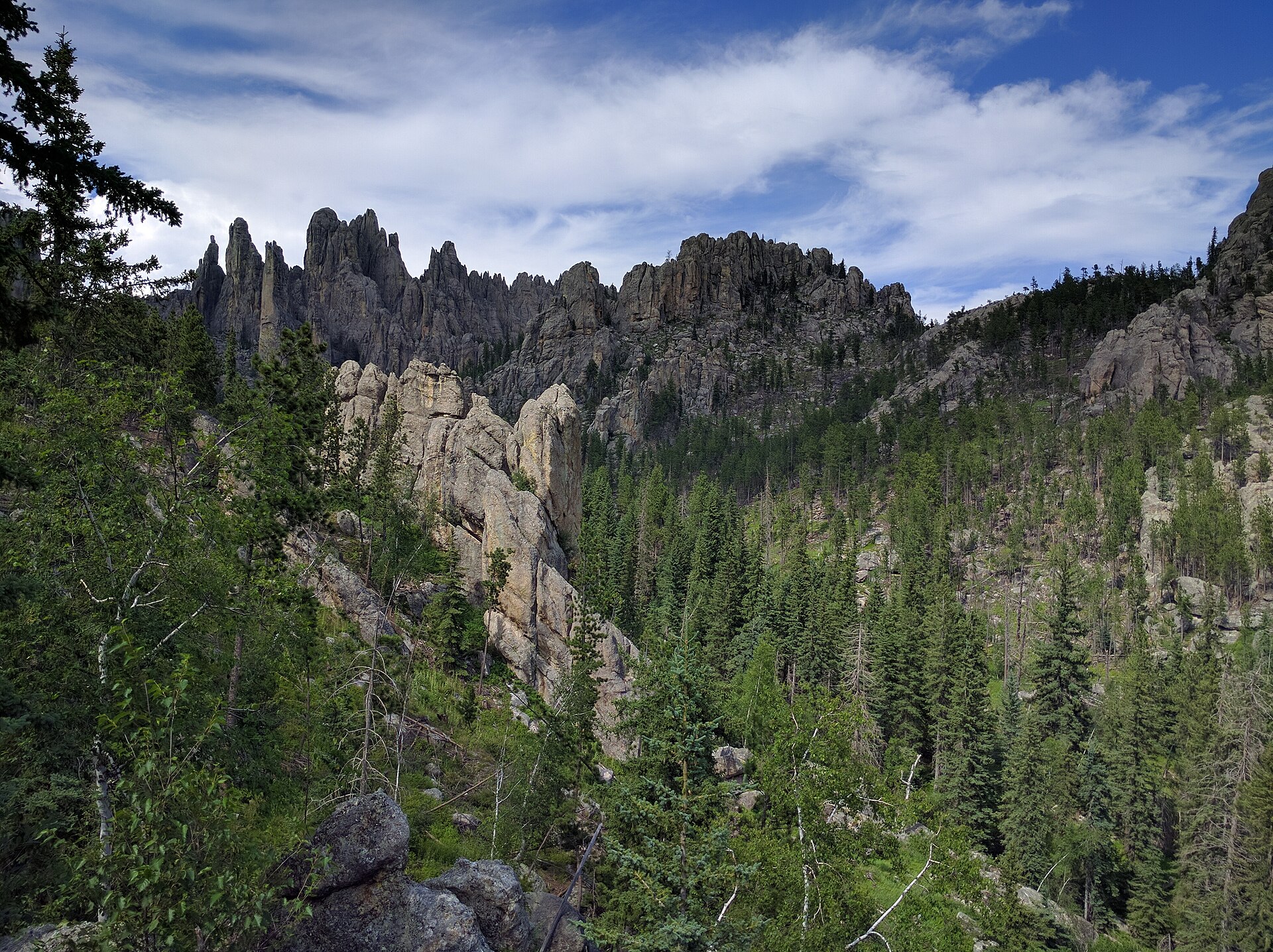
- Black Elk Peak — Black Elk Wilderness, near Custer State Park
The high point of the range is reached on foot along forest trails, finishing with a stone tower and a wide view over the hills and out to the plains. The peak was formerly called Harney Peak. Start early, carry plenty of water and watch the sky, as afternoon storms can build fast.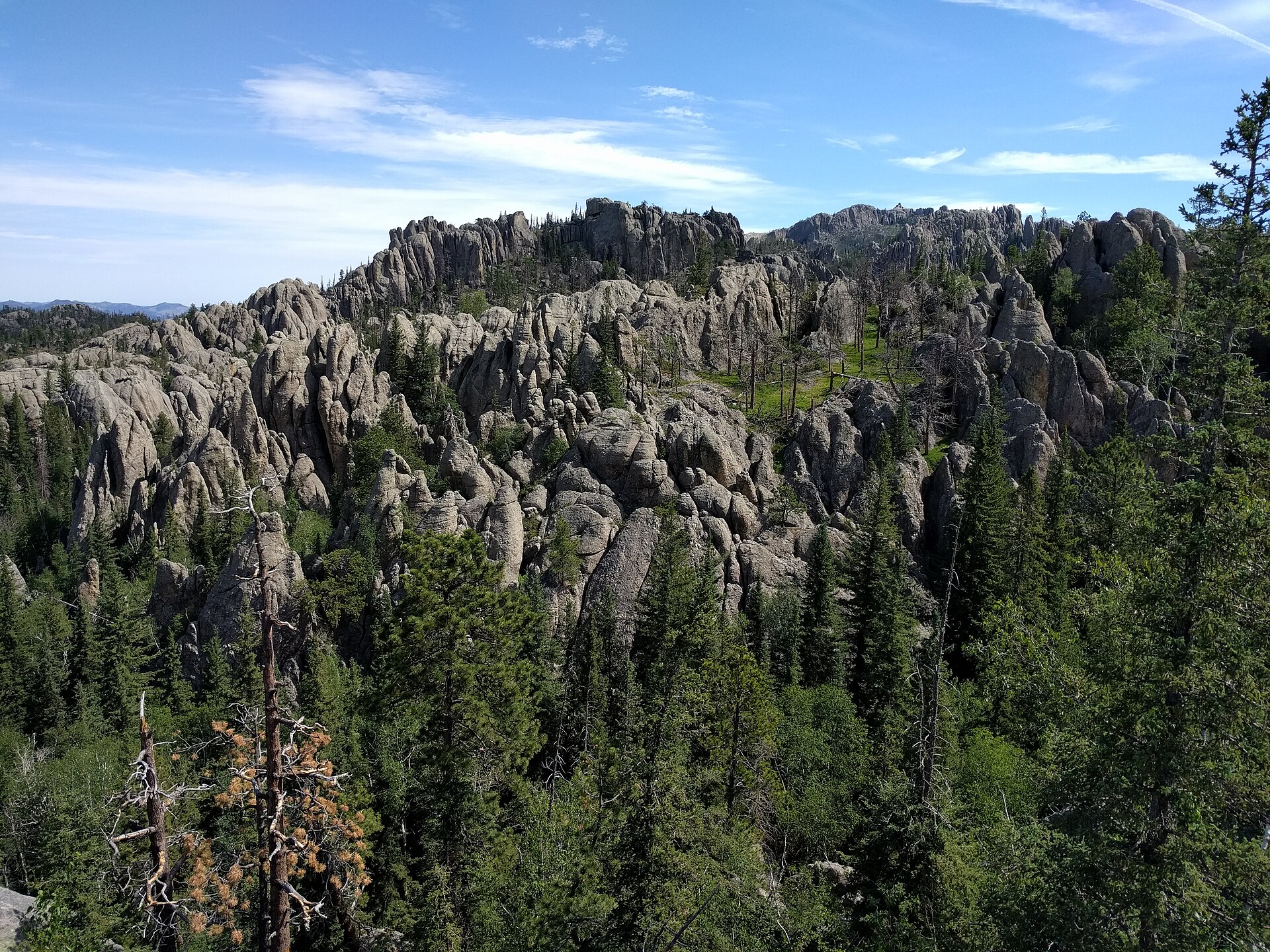
- Jewel Cave and Wind Cave — Southwestern Black Hills
Caves run under much of the Black Hills. Jewel Cave has at least 320 km of surveyed passages, with more found every year, while Wind Cave takes its name from the air that breathes in and out of its small opening. Both are visited on guided tours, so check the official site before travelling.
Culture
Black Hills culture begins with the Lakota, for whom Pahá Sápa is a place of prayer, vision-seeking and ceremony rather than scenery. Other Plains nations, including the Cheyenne and Arapaho, also hold particular spots in the hills as sacred. The land is not simply a past story; it remains the subject of active political and legal argument, and Lakota people are the best guides to what it means. Alongside that runs the gold-rush heritage of the 1870s, which gave the region its saloons, its frontier legends and figures such as Wild Bill Hickok and George Armstrong Custer. Towns such as Deadwood still lean on that history for their museums, festivals and tourist trade. Modern life in the hills is a mix of ranching, forestry, small-town hospitality and a strong motorbike culture in summer. Visitors will find Native art and craft on sale at cultural centres, along with talks and demonstrations that are worth the time. It helps to treat the Black Hills as a place with two living histories at once, and to listen to both. Museums and memorials give an outline, but the fuller picture comes from Native-run tours, shops and events. Where you find prayer cloths or tobacco ties on trees or near rock formations, leave them untouched and do not photograph any ceremony.
What to wear
In the Black Hills, traditional Lakota dress is mostly kept for ceremony, dance and public occasions such as powwows. It draws on buckskin and tanned hide, decorated with porcupine quill work and, more recently, glass seed beads in geometric patterns, along with eagle feathers worn only with specific meaning and permission. Women's dresses and men's regalia vary by family and occasion, and each piece may carry personal or community significance. Everyday dress in the hills is practical and plain: jeans, work shirts, boots, ball caps and fleece jackets, with cowboy hats and boots more common on ranches and in smaller towns. Summer brings a crowd of motorcyclists in black leathers. Visitors should dress for the weather and the terrain rather than for the occasion. Good walking shoes or light boots are best for granite trails, and layers handle cool mornings, hot afternoons and sudden storms. A hat, sunscreen and a light waterproof are sensible in summer, and warm layers are needed from autumn. Dress is relaxed at monuments and in restaurants, though modest clothes are polite at a powwow or any Native ceremony you are welcome to attend. Do not treat dance regalia as a costume to photograph without asking.
What to eat
- Bison burger — Diners and park cafés in Custer, Keystone and Rapid City
Bison is lean and slightly sweeter than beef and is common on menus across the region. It is easy to find at diners in Custer, Keystone and Rapid City, and at cafés inside the state parks, usually served with chips or fries. - Frybread and Indian taco — Powwows, Native-run stands and cultural centre cafés
Frybread is a puffed, golden flatbread that is central to Plains Native cooking. An Indian taco is topped with beans, meat, lettuce and cheese. It is sold at powwows, cultural centres and roadside stands, and is a filling lunch. - Chislic — Bars and pubs in towns such as Rapid City and Deadwood
Chislic is a South Dakota bar snack of small cubes of grilled or fried red meat, often lamb or beef, served on toothpicks. It is salty, simple and goes well with a cold beer after a long drive. - Rainbow trout — Lodge restaurants and small-town eateries near the streams
Cold streams in the hills hold trout, which turns up pan-fried or grilled in local restaurants and lodge dining rooms. Menus are often short and seasonal, so ask what has arrived that day. - Kuchen — Bakeries and café counters in small towns
Kuchen is a custard-filled fruit pastry brought by German-speaking settlers and now the official dessert of South Dakota. Peach and cherry are common versions. Look for it in bakeries and café counters, and take a slice for a trail snack.
Plan it
Best time. June and September–October are the best bets. Early summer has long days and green hills, while September and early October bring cooler air, thinner crowds and autumn colour. July and August are busiest and can bring thunderstorms, hail and the occasional tornado, as the area lies near tornado alley, so check forecasts daily.
How long. 3–4
Getting there. Fly to Rapid City Regional Airport (RAP), on the western side of South Dakota, then hire a car; the hills begin a short drive west. There is no intercity passenger rail in the state, though Jefferson Lines runs buses along the main interstate corridors. A car is essential once you are in the hills.
Budget. mid
Tips
- Rent a car and book it early for summer, as the hills are hard to see without one
- Start hikes and monument visits early to avoid both crowds and afternoon storms
- Carry water and layers, since weather can change quickly between the plains and the high ground
- Check the official sites for cave tours, park entry and opening times before you go
- Fuel up in the larger towns, as petrol stations thin out on the scenic loops
Etiquette
- Treat sacred sites, prayer offerings and ceremonies with respect and do not touch or photograph them
- Stay on marked trails and give wildlife, including bison, plenty of room
- Ask before photographing Native people or their regalia
Nearby
Sources
- Wikidata Q250937 (CC0)
- Wikipedia: Black Hills (rev 1370224817) (CC BY-SA 4.0)
- Wikivoyage: South Dakota (rev 5337530) (CC BY-SA 4.0)
- Photo: Needles Highway 05, Runner1928 (CC BY-SA 4.0)
- Photo: Relief location map of the USA, Uwe Dedering (CC BY 3.0)
- Photo: Black Hills from Harney Peak, Navin75 (CC BY-SA 2.0)
- Photo: Badlands NP 2006-09-03, KimonBerlin (CC BY-SA 2.0)
- Photo: Prairie cabin, Runner1928 (CC BY 3.0)
- Photo: Inyan Kara mountain, Runner1928 (CC0 1.0)
- Photo: Black Elk Peak hike 03, Runner1928 (CC BY-SA 4.0)
- Photo: Sylvan Lake 2017, Grahampurse (CC BY-SA 4.0)


