Phajoding Monastery
Phajoding Monastery, Bhutan
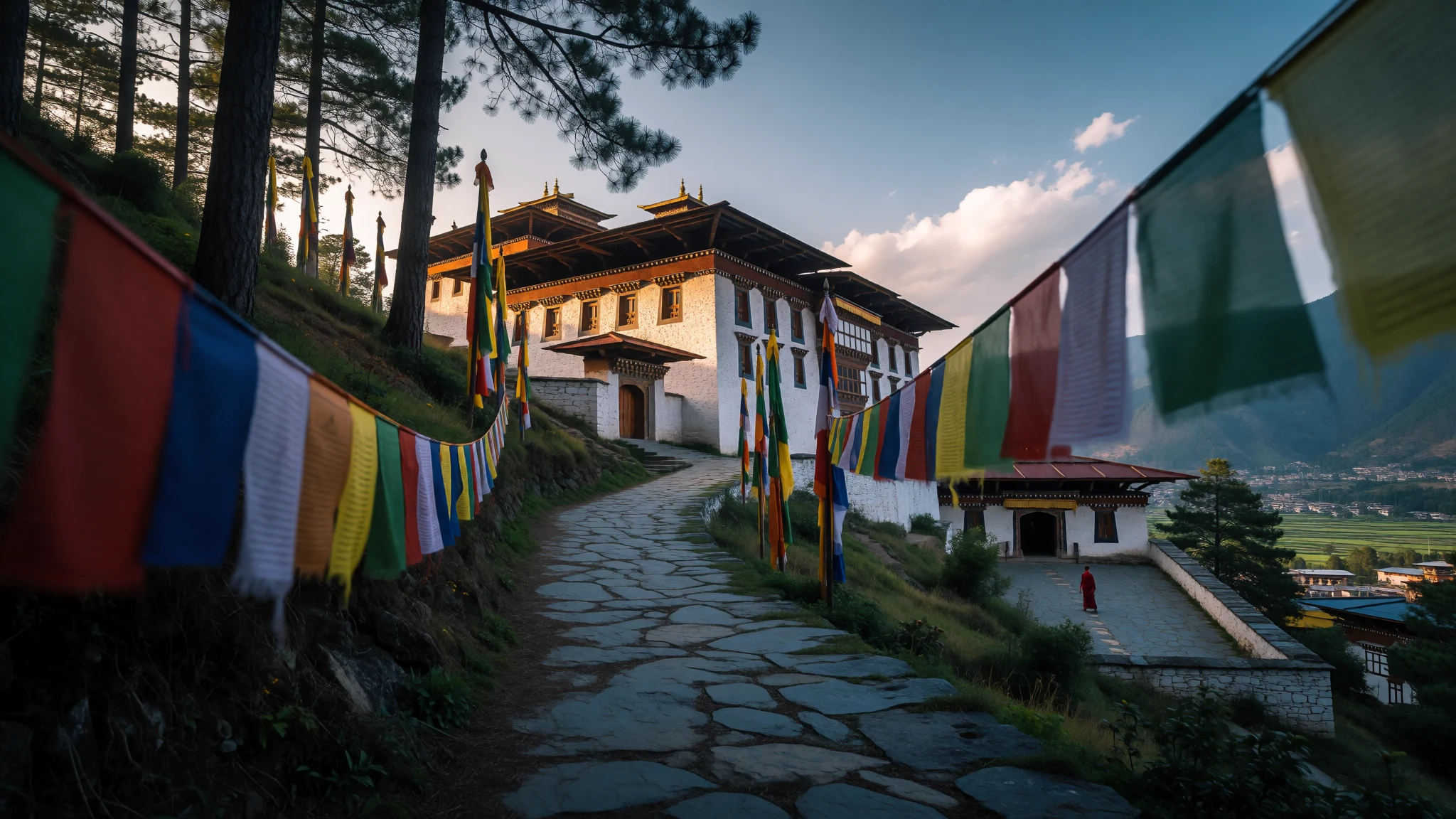
Phajoding Monastery is a restored Drukpa Kagyu monastery on the slopes above Thimphu, reached by a steep walk and home to about 80 young monks.
The place
Phajoding Monastery stands on a mountainside above Thimphu, the capital of Bhutan, where the traffic and noise of the city give way to pine forest, prayer flags and wide sky. It belongs to the Drukpa Kagyu school of Tibetan Buddhism, the tradition that shaped religious life across much of Bhutan. Most visitors arrive on foot, and the climb is part of the experience. It is a sustained uphill walk at altitude, not a stroll, and the weather can change quickly on the slope.
The monastery is a working community rather than a museum. About 80 young monks live and study here, so the temples, courtyards and living quarters are in daily use, with chanting, lessons and chores shaping the rhythm of the day. The buildings are mostly whitewashed walls under dark timber roofs, set into the hillside so that every doorway looks out over the valley below.
Phajoding also works as a waypoint. Higher trails lead on to other hermitages and ridge viewpoints, which makes the monastery a natural base for a longer hill walk. Even for those who stop here, the reward is quiet: wind in the prayer flags, the smell of juniper smoke, and Thimphu laid out small and far below. Cloud often fills the valley in the morning, then lifts to reveal the city. Expect cool air at any time of year, and a much slower pace than in the capital below.
Its story
The story of Phajoding Monastery begins in the 13th century with Phajo Drugom Zhigpo, a Tibetan lama who travelled into Bhutan and spread the Drukpa Kagyu teachings there. His work helped establish the school that still dominates Bhutan's monastic life, and Phajoding is counted among the places that carry his legacy.
Most of the buildings seen today date from 1748. They were raised by Gyelwa Shakya Rinchen, the ninth Je Khenpo, the title given to the senior religious figure who heads Bhutan's central monastic body. Under his direction the monastery became richly decorated, with painted walls, sacred images and furnishings that made it one of the notable religious sites of its time.
The following centuries were less kind. Remote, hard to reach and expensive to maintain, the complex suffered from neglect, and timber, roofs and paintings deteriorated. In 2010 the World Monuments Fund listed it as an endangered cultural monument, which brought international attention to its condition.
The response came through a conservation project funded by a grant from the Government of India and carried out by Bhutan's Division for Conservation of Heritage Sites. The work took several years and focused on repairing structures and protecting the surviving art rather than rebuilding for show. The result is a monastery restored to something close to its former standing, and again occupied by young monks, which keeps the buildings in daily use and so in better care.
What to see
- The main temple halls — Phajoding Monastery
The central temples hold the monastery's statues, altars and painted walls, much of it dating from the 18th-century building phase and conserved in the recent restoration. Look at the ceiling beams and door frames as well as the images. Interiors are dim, so let your eyes adjust before looking closely. - Murals and sacred images — Inside the temples
Painted wall panels and gilded statues are the reason the monastery was once counted among the richly decorated in the country. Restorers worked to stabilise the pigments rather than repaint them. Ask a monk or guide about the figures shown, since the symbolism rewards a short explanation. - The monks' courtyards — Monastery grounds
The open courtyards are where daily life shows most clearly: young monks crossing between classes, practising instruments or sitting in the sun. Watch from the edge and keep voices low. If prayers or debate are under way, the sound carries across the whole slope. - The climb from Thimphu — Hillside above Thimphu
The approach is a highlight in itself, rising through forest and past prayer flags as the city shrinks behind. Allow generous time, carry water and stop often, since altitude slows most walkers. Trail conditions vary with rain, so ask locally before setting out. - Viewpoints over the valley — Slopes around the monastery
From the terraces and the slope around the buildings, Thimphu's valley opens out below, with ridgelines fading into the distance on clear days. Mornings usually give the sharpest light before cloud builds. Higher trails continue to neighbouring hermitages for walkers with energy and a guide.
Culture
Phajoding Monastery sits within the living Buddhism of Bhutan, where the Drukpa Kagyu school shapes festivals, education and the calendar of ordinary households. Here the practice is daily and unhurried: morning prayers, study, offerings of butter lamps and water, and the turning of prayer wheels by anyone passing. The young monks are students as well as practitioners, and a visit often catches them between lessons.
Prayer flags are the most visible sign of belief on the hillside. Each flag carries printed prayers that are meant to be carried by the wind, which is why they are hung high and left to fade rather than being taken down. Stone cairns and small shrines along the trail mark the route as a pilgrim path, and walkers pass them with the shrine on their right, clockwise, as is the custom.
Bhutan treats its monasteries as sacred places first and sights second, and that attitude is felt here. Silence is valued, photography indoors is usually restricted, and the senior monks are treated with great respect. Visitors who arrive curious and quiet are generally welcomed warmly, often with tea or a few words of explanation.
Etiquette: remove your shoes and hat before entering any temple hall, walk clockwise around shrines, and ask before photographing monks or taking any picture inside the temples.
What to wear
Phajoding Monastery lies in a country where traditional dress is still part of public life. Men wear the gho, a knee-length robe folded and belted at the waist, and women wear the kira, an ankle-length wrapped dress fastened at the shoulders and held by a belt. They are woven from cotton, wool or silk, often in checks and stripes, and the finest kira carry intricate hand-woven patterns that take weeks to complete. At monasteries and formal occasions, men add a sash called a kabney and women a narrow cloth called a rachu. The monks themselves wear maroon and saffron robes.
In daily life, people in Thimphu often wear the gho or kira for work, school and official business, then change into jeans, fleeces and trainers for evenings and weekends. On the hillside, practical outdoor clothing is the norm, and the monks' maroon robes are usually layered with warm jackets in cold weather.
Visitors should dress for a mountain climb first and a place of worship second. Wear sturdy walking shoes or boots with good grip, and bring warm layers, a waterproof shell, a hat and sun protection, since the weather can shift within an hour. For the temples, cover shoulders and knees, avoid shorts and sleeveless tops, and carry socks, since shoes come off at the door and floors can be cold. A scarf is useful for warmth and for modesty.
What to eat
- Ema datshi — Any local eatery in Thimphu
Bhutan's everyday dish of chillies cooked in a soft, salty cheese sauce, served with rice. It can be very hot, so ask for a milder version. Find it at almost any Thimphu eatery before or after the walk to Phajoding. - Red rice — Restaurants across Thimphu
A nutty, slightly chewy rice grown in the valleys of Bhutan, usually served alongside stews and vegetable dishes. It is filling and suits a day of hill walking. Expect it at most restaurants and home-style eateries in Thimphu. - Momo — Small eateries and street stalls in Thimphu
Steamed dumplings filled with meat, cabbage or cheese, served with a chilli dip. They make a good, portable meal before a climb and are easy to find in the capital. Vegetarian versions are common, so ask for them if preferred. - Butter tea (suja) — Monasteries, homes and traditional eateries
A salty, buttery tea churned and served hot, offered widely in Bhutanese homes and monasteries. It takes some getting used to but is warming at altitude. Visitors are sometimes offered a cup after a temple visit, and sipping slowly is polite. - Thukpa — Noodle eateries around Thimphu's centre
A warming noodle soup with vegetables or meat, found across the Himalayan region and popular in Bhutan on cold days. It is a sensible choice after coming down from the monastery, when the evening air turns cool.
Plan it
Best time. March–April and October–November, when skies are usually clearer and the trail is more comfortable; the monsoon months bring rain and cloud, and winter can be cold and icy at height.
How long. 1–2
Getting there. Fly to Paro International Airport, then travel by road to Thimphu. From the city, a short drive takes you to the trailhead on the hill above, and the last leg to Phajoding is on foot.
Budget. mid
Tips
- Start early, so the climb is done before afternoon cloud and rain
- Carry water, snacks and layers, since facilities at the monastery are limited
- Allow time to acclimatise in Thimphu before the climb, as altitude affects most people
- Check the official tourism rules for visas, permits and daily fees before booking
- Hire a local guide if unsure of the trail, especially after rain
Etiquette
- Remove shoes and hats before entering temple halls
- Walk clockwise around shrines and prayer wheels
- Ask before photographing monks, and do not photograph inside the temples without permission
Nearby
Sources
- Wikidata Q7180206 (CC0)
- Wikipedia: Phajoding Monastery (rev 1374999317) (CC BY-SA 4.0)
- Wikivoyage: Thimphu (CC BY-SA 4.0)