Mahone Bay
Mahone Bay, Canada
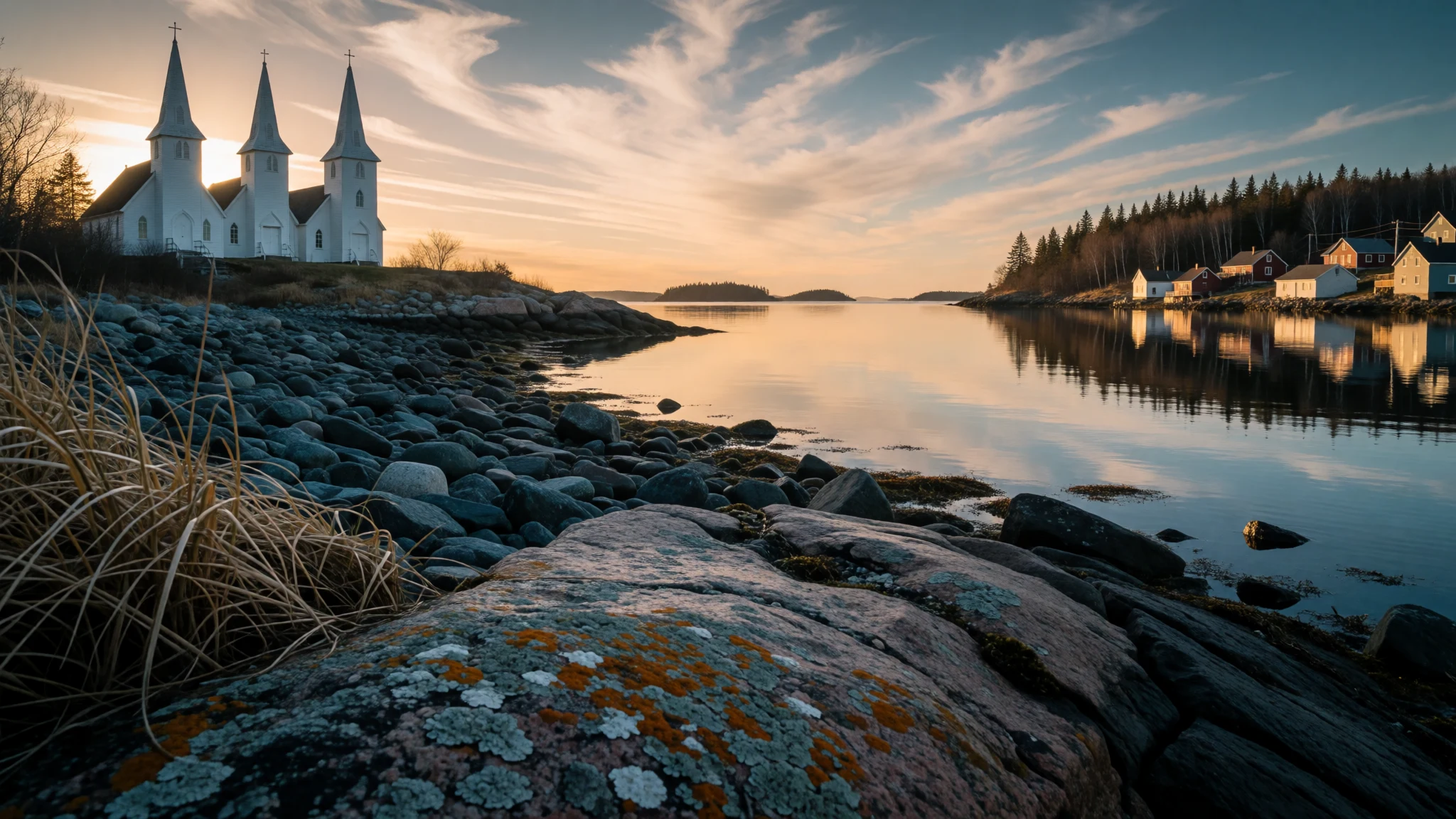
Mahone Bay is a small Nova Scotia harbour town where three church steeples, wooden-boat history and calm water fit into an unhurried day or two.
The place
Mahone Bay is a small town on the northwest edge of the bay of the same name, on Nova Scotia's South Shore in Lunenburg County. About 1,064 people live there, so the whole centre can be walked in a morning. Its fame rests on one view: from across the harbour, three church steeples stand in a row above the water, and the scene has appeared on postcards and calendars for the province. The churches are St James' Anglican, St John's Evangelical Lutheran and Trinity United. Behind the view lies a working past. The town grew up on wooden boatbuilding, and the local museum tells that story in detail. Today the main street is lined with independent shops, cafés and galleries, many aimed squarely at visitors, and some close for the winter, so the feel changes sharply between high summer and January. In recent years the town has also attracted small businesses and newcomers, which gives it a more lived-in character than a pure tourist set. The water matters as much as the streets. The bay is sheltered, scattered with islands and used by sailors, and a short charter or a paddle gives a different angle on the same skyline. Halifax is the nearest large city, and most visitors arrive by car, treating Mahone Bay as one stop on a South Shore drive that includes Lunenburg. A day or two is enough for the harbour, the churches and a walk in the woods.
Its story
Mahone Bay sits in Mi'kma'ki, the territory of the Mi'kmaq, whose presence on this coast reaches back many thousands of years, to the retreat of the glaciers. Indian Point, just outside the town, was a summer settlement where families used the sheltered water and the plentiful food around it. In winter they moved inland along the rivers that run into the harbour. Mi'kmaw people still live in the area today. European settlement came in the middle of the eighteenth century. British officials advertised in German-speaking lands, parts of France, Switzerland and the Netherlands, offering land, a year of food and some livestock to Protestants willing to cross the Atlantic. Those 'Foreign Protestants' reached Halifax and were then sent on to Lunenburg, planned as the main settlement. Farm lots were laid out across the peninsula, and the Mahone Bay area was settled by German, Swiss and Montbéliard families. The facts block gives 1754 as the founding date. The early years were tense. During the wars between Britain and France, Mi'kmaw and Acadian raiders attacked settlers on the peninsula, including an assault on islands just off the town and an attack on two family homes in the village itself. Peace and trade followed, and the sheltered harbour, with plenty of timber on its shores, turned the community towards building boats. That craft shaped the town for generations, and the three steeples above the water belong to the same settler story.
What to see
- The three churches across the harbour — Harbour front, town centre
Mahone Bay's best-known sight is the row of St James' Anglican, St John's Evangelical Lutheran and Trinity United, seen from the water's edge. Early morning and calm days give the clearest reflections. Bring patience in summer, when photographers queue for the same spot. The churches are also worth a look up close.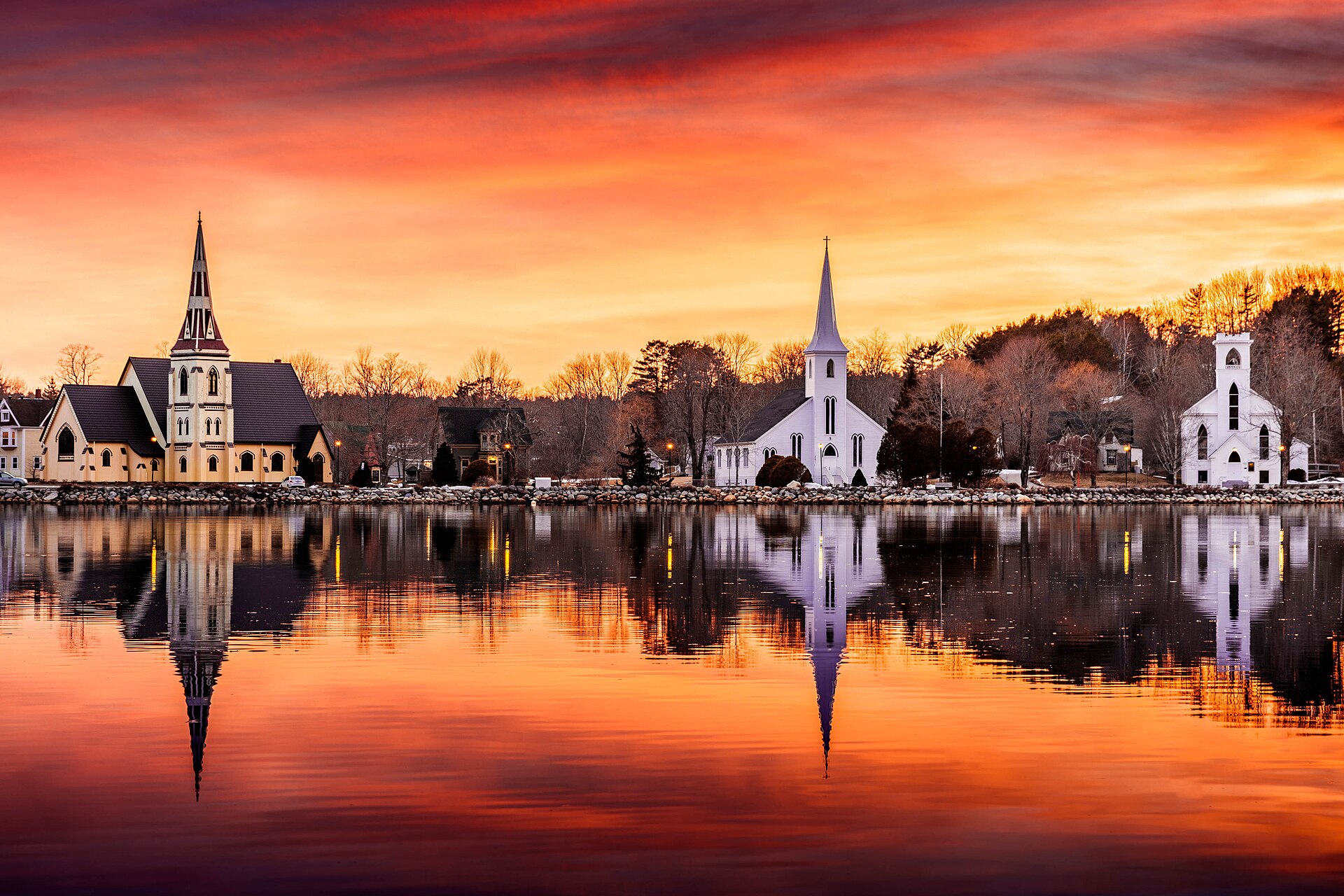
- Town centre and main street — Main street, town centre
Mahone Bay's compact centre is built around its waterfront, with painted wooden buildings housing craft shops, galleries, bookshops and cafés. It is an easy, flat stroll. Many businesses are seasonal, so a winter visit can mean closed doors, but the harbour views are free all year.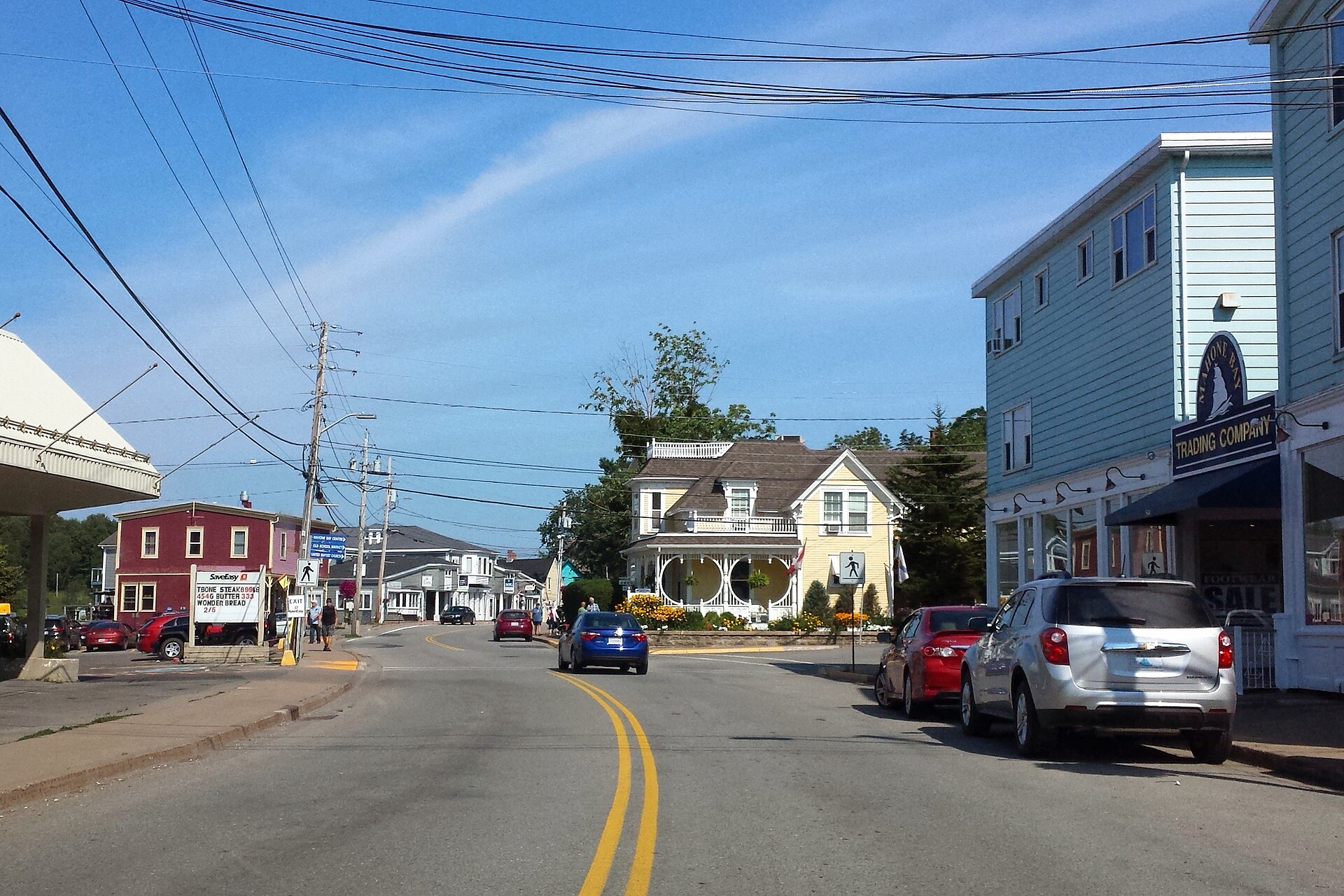
- Mahone Bay Museum — Town centre
The museum explains the town's wooden boatbuilding past, the trade that once drove its economy. It is a good first stop for context before walking the waterfront. Opening days vary by season, so check the town's official site, townofmahonebay.ca, before planning around it. - Dynamite Trail — Between Martin's River and the town
This shared-use woodland and lakeside path runs about 10 km between Martin's River and Mahone Bay. It suits walkers and cyclists who want a few quiet hours away from the shops. Surfaces can be wet after rain, so wear shoes with grip and carry water. - Sailing charters on the bay — Waterfront, Mahone Bay
Sail and See offers private sailing charters on Mahone Bay, which is the best way to understand why the town grew here. From the water the islands and the church skyline fall into place. Book ahead in summer, and check the operator for current details.
Culture
Mahone Bay's culture is layered. The Mi'kmaq have lived on this coast for thousands of years, and their community continues in the surrounding area. On top of that sits the heritage of German, Swiss and Montbéliard Protestant settlers, who arrived in the eighteenth century and left behind the Lutheran, Anglican and United congregations whose steeples define the harbour. Boatbuilding is the third strand: the town's identity is tied to wooden vessels, and the museum and the occasional local event keep that craft in view. Daily life today is quiet and small-scale. With about a thousand residents, the town runs on neighbourly habits, independent shops and the rhythm of the seasons, busy from early summer into autumn and noticeably calmer in winter, when some businesses close. A French-style bakery on the main street is a reminder that the region's influences are broader than any single story. English is the language of everyday life. The churches are still places of worship, not only scenery, and services and community events take place in them throughout the year. Visitors will find that locals are happy to chat, particularly about boats, weather and the best time to photograph the harbour. Respect for the churches, quiet behaviour near services and a willingness to buy from local makers all go down well. When visiting a church, keep your voice low, do not photograph worshippers during a service, and ask before stepping inside if a service seems to be under way.
What to wear
Mahone Bay has no single regional costume, so traditional dress here means the Mi'kmaw tradition. Mi'kmaw regalia is known for beadwork, ribbon appliqué and decorated garments, and it is worn today at ceremonies, powwows and cultural gatherings rather than on the street. The German, Swiss and French-speaking settlers who founded the town did not leave a distinctive local costume, though their farming and seafaring clothes were practical wool and canvas. What people actually wear now is plain and weather-minded: jeans, fleeces, waterproof jackets, wool jumpers in cooler months and sturdy boots or trainers. Boat shoes and caps are common on the harbour in summer, and nobody dresses up for the shops or cafés. Visitors should pack for changeable coastal weather. Layers work best: a light waterproof, a warm mid-layer, and a hat and sunscreen for bright days on the water, where wind off the bay can feel cool even in summer. Comfortable shoes with decent grip suit both the town's pavements and the woodland trail, which can be damp. There is no strict dress code, and churches here do not require special clothing, though tidy, modest clothes are polite if you go inside during a service. In winter, add warm socks, gloves and a proper coat, and expect some shops to be closed.
What to eat
- Bakery bread and pastries — A French-style bakery café near the main street
Mahone Bay has a French-style bakery and café on the edge of the centre, a good start for coffee, bread and sweet things. Morning is best, when the shelves are full. Eat on the move or take a picnic to the harbour. - Seafood chowder — Waterfront restaurants and eateries in town
A bowl of creamy chowder with fish and shellfish is a staple of Nova Scotia's coast and a sensible order on a cool, windy day. Ingredients vary with what is landed locally, so ask what is in it. - Lobster roll — Harbour-side cafés and casual restaurants
Lobster in a soft buttered roll is a standard South Shore lunch. It is simple, filling and best in the warmer months, when supply is steadier. Expect it to be a pricier choice than other lunches. - Local craft beer — A brewery taproom close to the centre
A small brewery operates in town, with a taproom serving beers made nearby. It is a relaxed place to sit after a walk, and food is usually available. Check the brewery's own page for current hours. - Bistro supper of local fish — A bistro in the town centre
Evening meals at Mahone Bay's bistros often lean on seafood and seasonal produce, served in small dining rooms. Tables fill up on summer weekends, and some places close in winter, so reserve ahead or have a back-up.
Plan it
Best time. June to October is the most practical window: the shops, cafés and boat trips are open and the days suit walking and sailing. Many businesses shut for the winter, so a visit from late autumn to spring can feel very quiet.
How long. 1–2
Getting there. Fly to Halifax Stanfield International Airport, where rental cars are available; Mahone Bay is about 85 km southwest of Halifax by road. Take Highway 103 and leave at exit 10 or 11. A car is the most efficient way to arrive; check for current bus options if you do not drive.
Budget. mid
Tips
- Arrive early in the morning for the church view, when the water is calmer and the crowds are thin
- Check opening times in advance, as many shops and restaurants are seasonal, and the town's official site is townofmahonebay.ca
- Book sailing charters and summer weekend dinners ahead
- Carry a waterproof layer and water for the Dynamite Trail, which can be damp
- Combine the visit with Lunenburg and the rest of the South Shore rather than staying only a few hours
Etiquette
- Keep noise down in and around the churches, especially during services
- Do not photograph worshippers or private homes without asking
- Support local makers and respect posted seasonal closures
Nearby
Sources
- Wikidata Q1885050 (CC0)
- Wikipedia: Mahone Bay, Nova Scotia (rev 1386078282) (CC BY-SA 4.0)
- Wikivoyage: Mahone Bay (rev 5410199) (CC BY-SA 4.0)
- Photo: The Churches of Mahone Bay, NS — Shawn M. Kent (CC BY-SA 4.0)
- Photo: Mahone Bay NS 1 — P199 (CC BY 3.0)
- Photo: Admiralty Chart No 343, Lunenburg to Mars Head, 1866 — United Kingdom Hydrographic Office (Public domain)
- Photo: Cape Split Nova Scotia — Shawn Kent (CC BY 3.0)
- Photo: Churches in Mahone Bay, Nova Scotia — Dennis Jarvis (CC BY-SA 2.0)
- Photo: DSC_7575 — B*lly Frank (CC BY 2.5)
- Photo: Mahone Bay South Shore Nova Scotia - Week 5 (DSC06634) — Nicole Bratt (CC BY-SA 2.0)
- Photo: Mahone Bay South Shore Nova Scotia - Week 5 (DSC06643) — Nicole Bratt (CC BY-SA 2.0)


