Keukenhof
Keukenhof, Netherlands
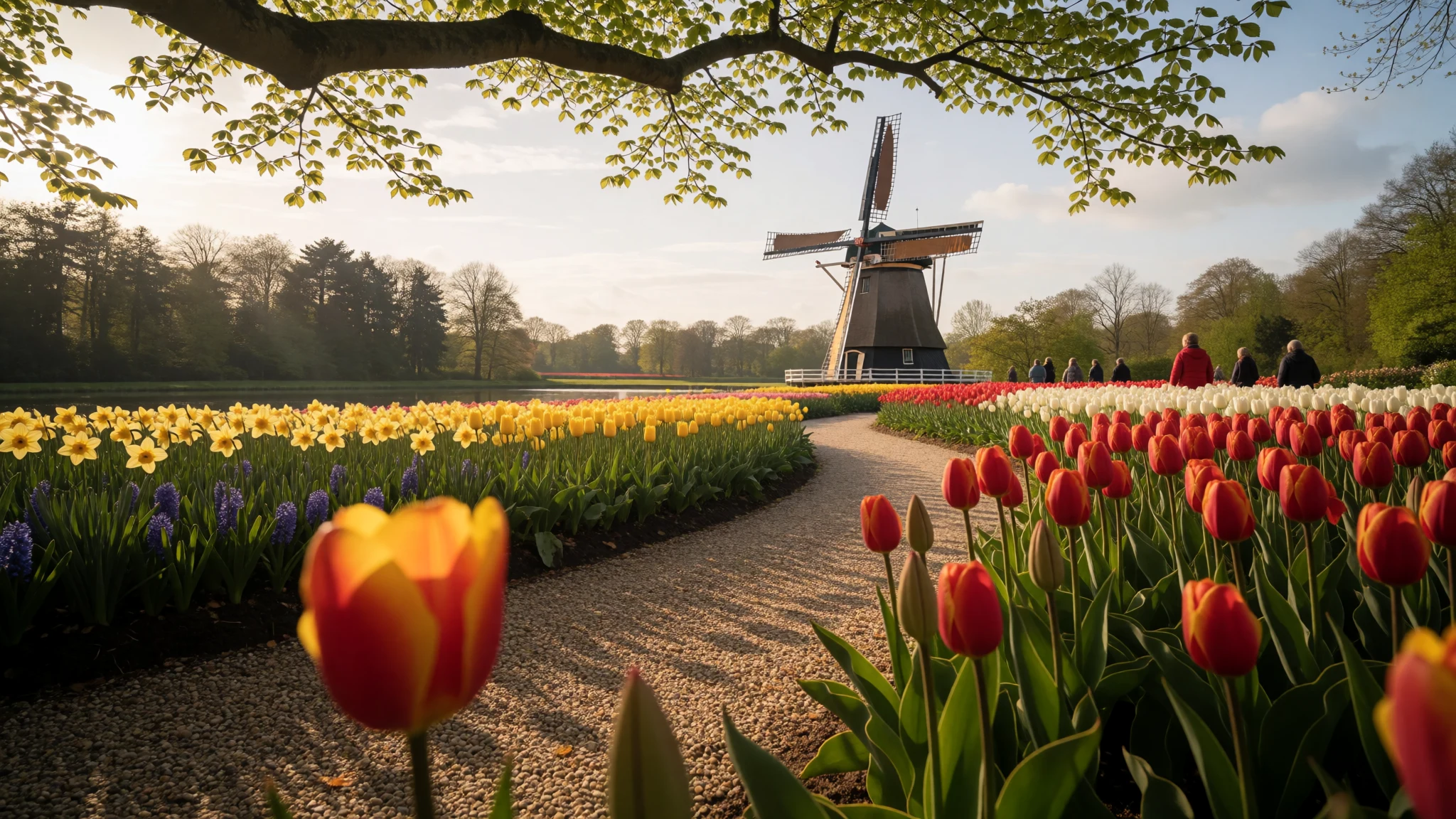
Keukenhof is a spring garden in the Dutch bulb country, planted in bold blocks of tulips, daffodils and hyacinths.
The place
Keukenhof sits in the bulb-growing country of South Holland, inland from the North Sea dunes, on the edge of the town of Lisse. It is a show garden rather than a wild park: beds are drawn in clean blocks of colour, paths curve between them, and the planting is made for a single spring season. Tulips lead the planting, yet daffodils, hyacinths, crocuses and later flowers keep the colour changing from the first open days into late spring. Water, lawn and mature trees break the geometry, so the grounds never read as one flat field.
The garden exists to show what Dutch growers breed, and that purpose still shapes a visit. Beds are labelled as a nursery labels stock, so a walk is also a catalogue of named cultivars. Kasteel Keukenhof, the estate's country house, stands among the trees and recalls the long years when this was a private landscape. A windmill on the grounds ties the flower show to the older working world of polders and ditches, even though the public exhibition is a much newer use of the land.
On a bright weekend the paths fill and every bed draws a knot of people; the pleasure is shared. A weekday morning feels looser. Spring here is mild and restless: sun, a cold breeze and a shower can follow one another, and the flowers look different under each. The soil is the sandy earth of the bulb belt, which is why this district became the trade's shop window. The public bulb show is not open the year round. The point is the short bulb season; when that ends, the beds are cleared and the show closes.
Its story
Keukenhof takes its name from a kitchen garden. In the late medieval Low Countries the estate helped feed a noble household at nearby Teylingen, and keuken plus hof, kitchen and court, stuck as the place name. That origin is domestic and practical, not ornamental: herbs, produce and a household's needs, on land that later generations would turn over to flowers.
The country house now called Kasteel Keukenhof belongs to a later chapter, when a wealthy Amsterdam family made a small estate here and set a house among woods and water. The grounds stayed private for a long time, a landscape around the castle while the fields beyond joined the bulb district. Lisse and its neighbours became the Bollenstreek, the bulb belt, where sandy soils suited tulips and the other spring bulbs the Dutch trade made its own.
The public garden is younger than the castle and younger than the name. After the Second World War, growers and the town of Lisse opened the estate as a spring exhibition so that buyers and ordinary visitors could see cultivars in flower, outdoors, rather than only as dry bulbs in a catalogue. That idea still explains the layout. Keukenhof is a show organised by the trade, renewed each year, not a preserved historic garden frozen in one design.
The wider story of the tulip sits behind the beds: a flower that arrived in European horticulture from the east, became a Dutch passion, and then a Dutch export. Walking Keukenhof is walking the calm, commercial end of the tale, colour as a crop, arranged so that a visitor can tell one variety from the next, on the same land that once supplied a kitchen.
What to see
- The bulb beds — the main show gardens
The bulb beds are why most people come to Keukenhof. Varieties sit in solid blocks of colour, so the eye reads stripes and ribbons rather than a mixed border. Tulips lead, with daffodils, hyacinths and smaller bulbs through the weeks of the show. A slow circuit suits the paths: the pleasure is comparing one bed with the next.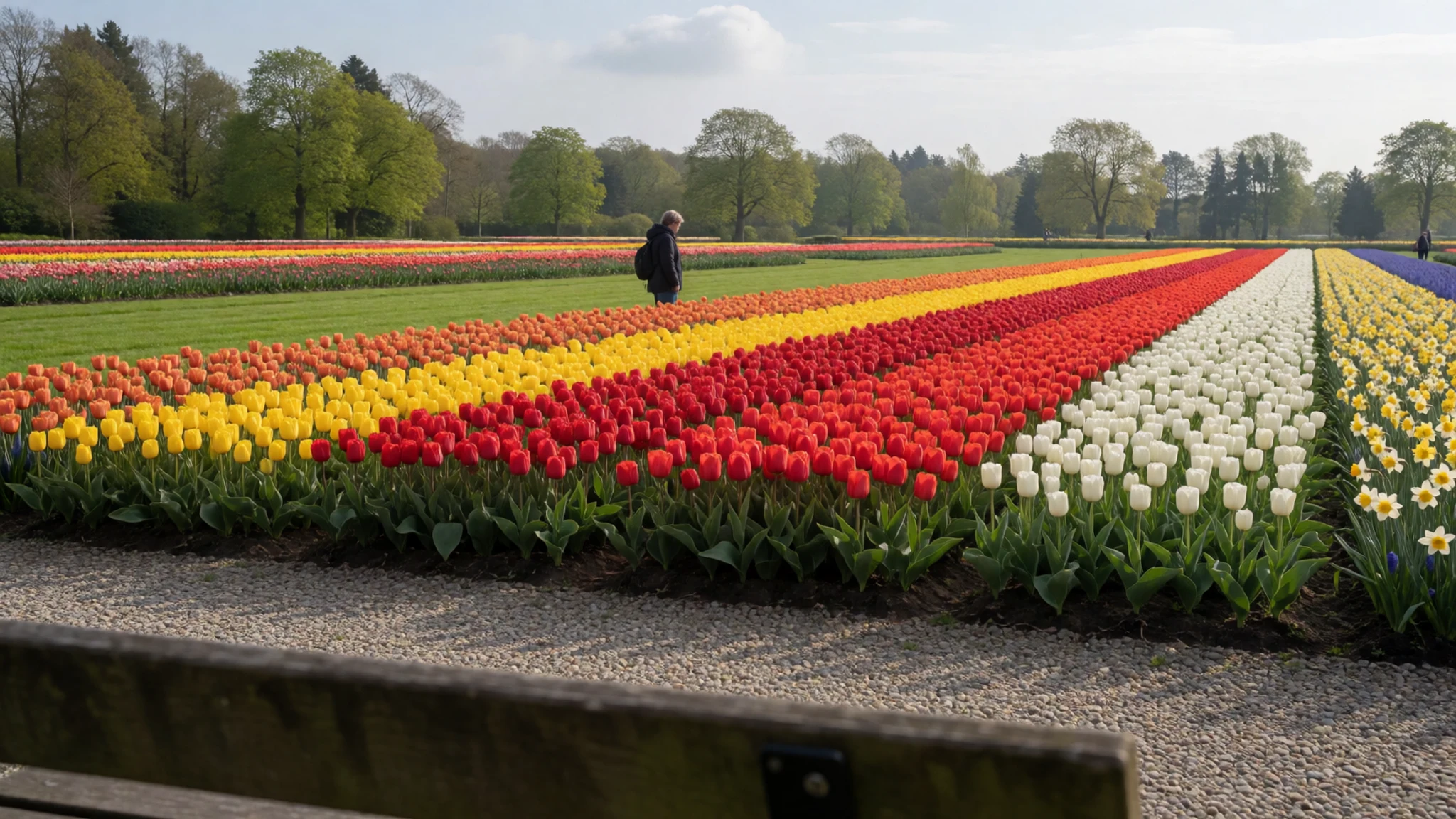
- Kasteel Keukenhof — the estate centre
Kasteel Keukenhof is the brick country house facing the gardens from across the way, older than the flower show beside it. Trees and water set it apart from the coloured beds, which form their own layout without the house as centre. It reads as a house for an estate rather than a palace. The house lies opposite the show, not among the paths, a reminder of the private landscape before the public season.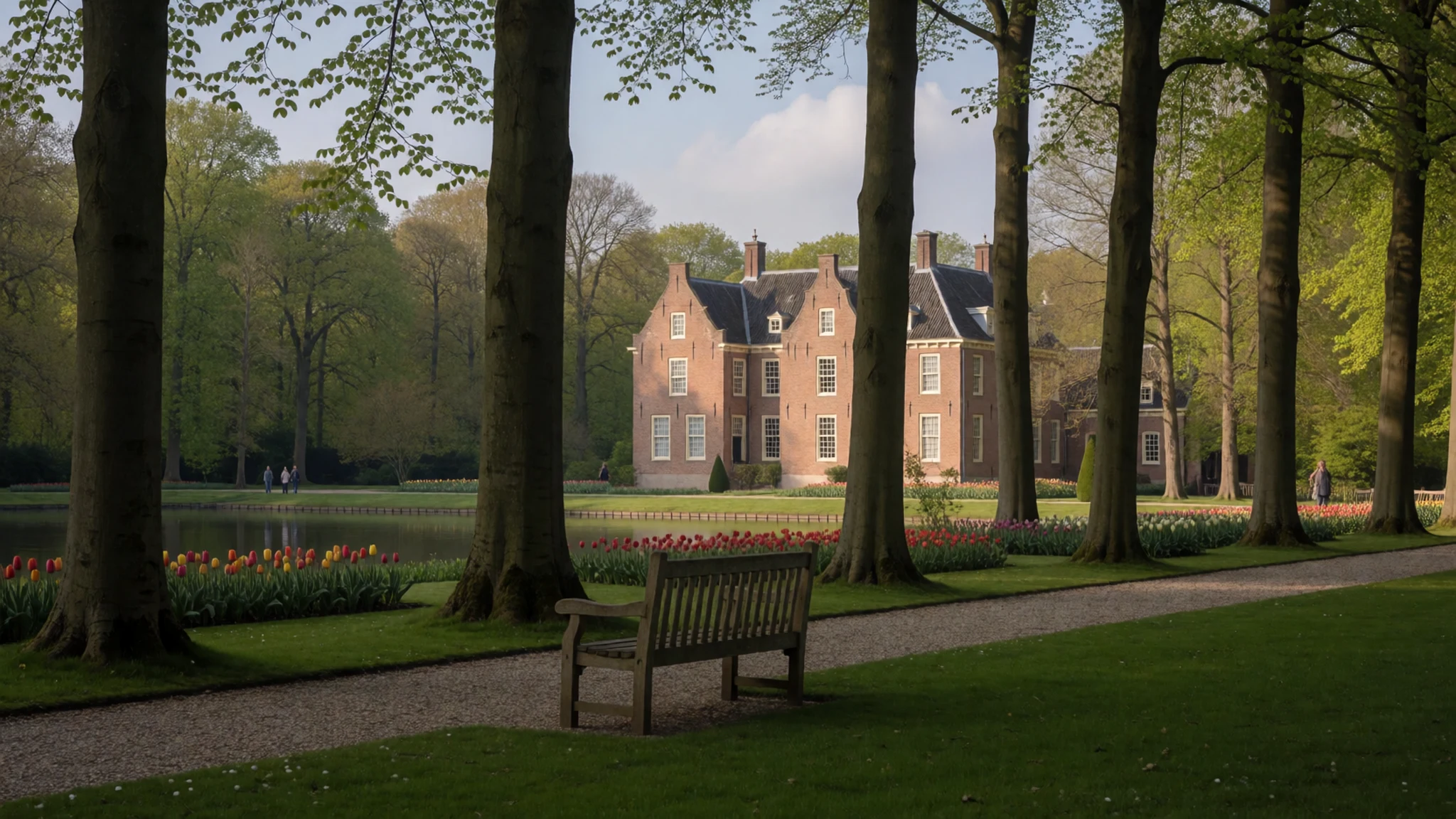
- The windmill — the grounds
The windmill at Keukenhof stands among the beds as a symbol of the Dutch lowlands. Mills once pumped and ground across this watery country, and a mill beside tulips joins the flower trade to that older task of holding land back from water. It is a natural pause on the circuit, a vertical shape against flat colour. On a windy spring day the sails give the gardens their movement.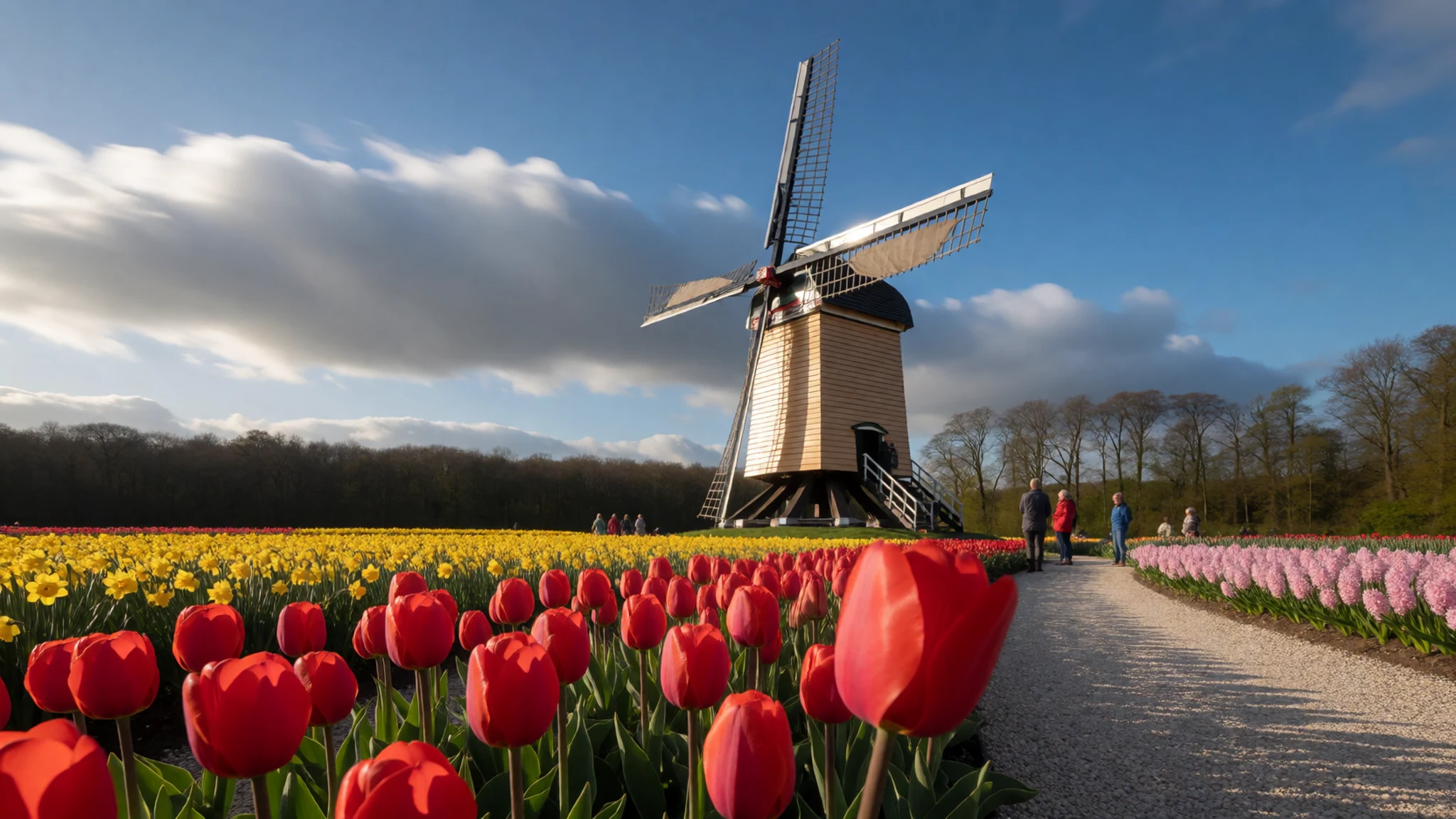
- The long view — open viewpoints in the gardens
From the open rides and the panoramic viewpoints, Keukenhof reads as one composition: blocks of colour, dark trees and strips of water fitted together. A panoramic stop is worth taking before a return to single beds, because the plan of the garden shows itself at a distance. Crowds thin at these points, and the scale becomes clear: a whole estate turned over to spring flowers.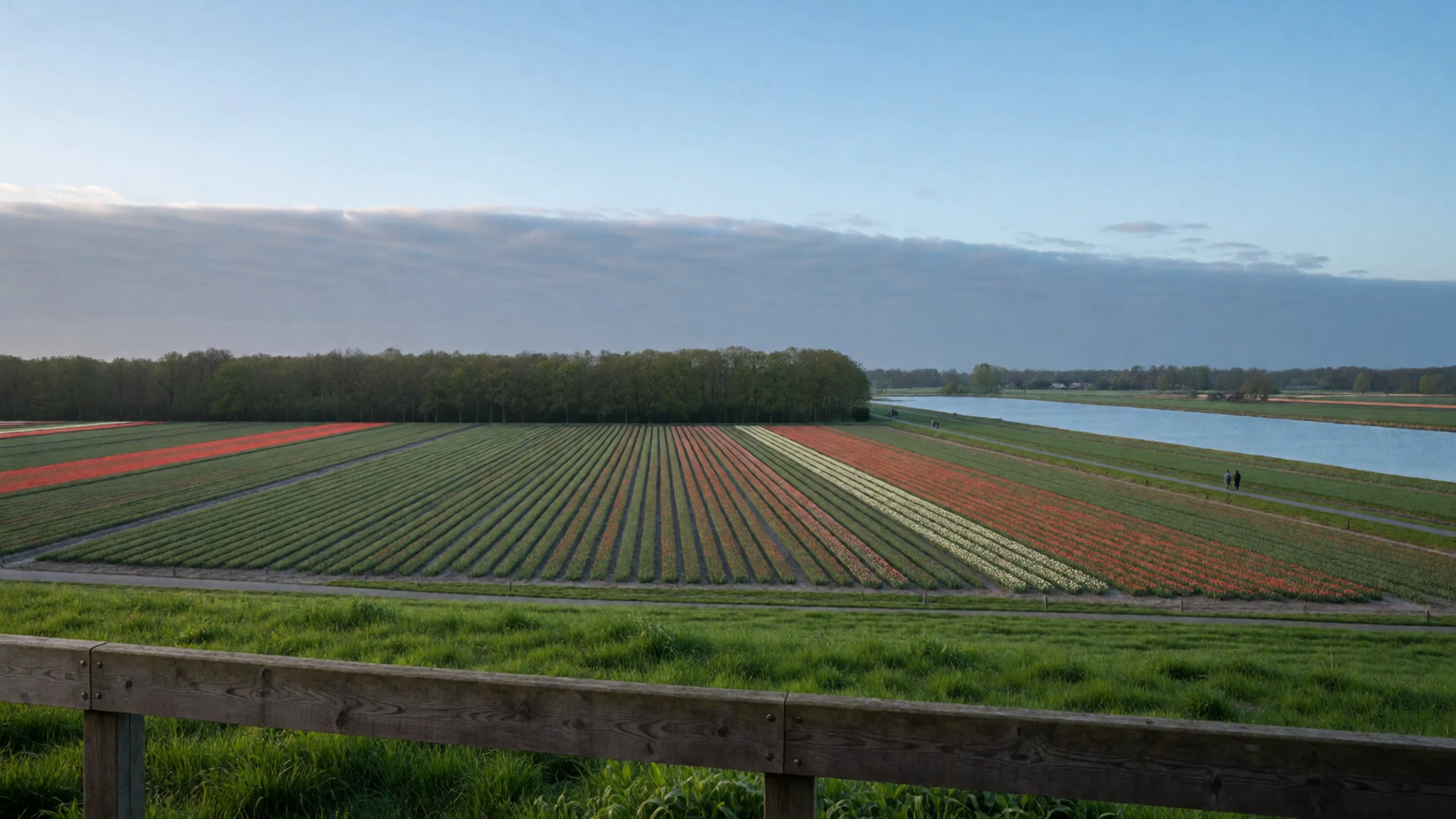
- Woods and water — the older estate woodland
Away from the main show beds, Keukenhof keeps woods, lawn and water from the older estate. These stretches are where the pace eases after the colour, the castle standing across from the park rather than in the woods. Bulbs appear under trees as well as in formal blocks, so the garden has a softer register beside the graphic one. Tree cover earns its place on a wet day, and water doubles the beds in sun.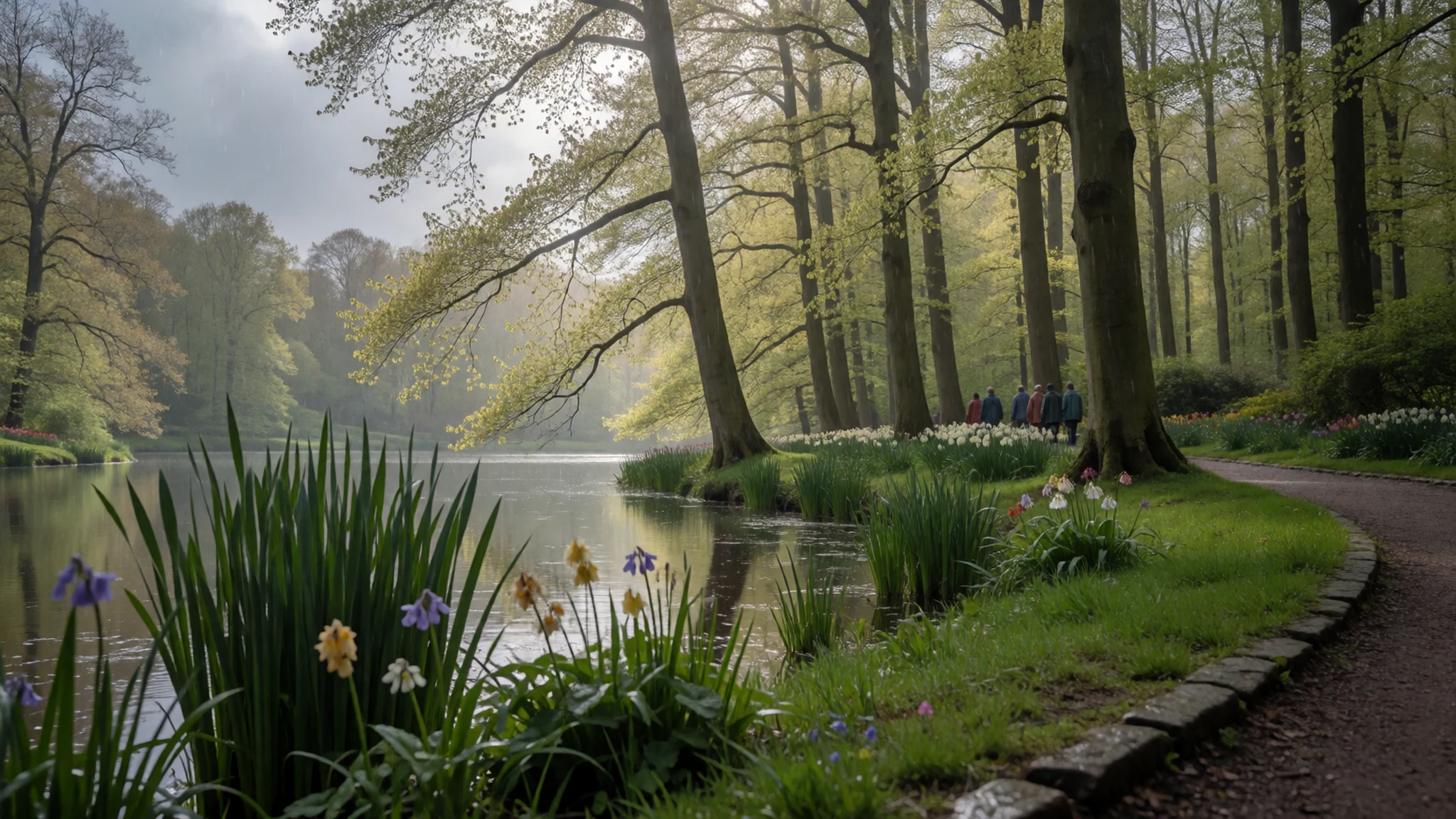
Culture
Keukenhof is the public face of a culture that treats flowers as both a craft and a national image. In the Bollenstreek, bulbs are a livelihood: families and firms breed, plant, lift and sell them, and the spring landscape between the towns is striped with commercial fields as well as show beds. The garden is where that work is translated for visitors, with named varieties set out so the difference between one tulip and another can be seen in bloom.
The season also belongs to local festivity. The bulb district's flower parade, the Bloemencorso, sends floats covered in flowers through the towns in spring, and Keukenhof sits in the same calendar and the same pride. Dutch enthusiasm for the tulip is older than the park, a borrowed flower that became an export and a symbol, but the tone at the gardens is practical rather than solemn. People come to look, to photograph and to name what they like.
For all the colour, the habit is orderly. Paths are for walking, beds are for looking, and the Dutch expectation in a busy public garden is patience and a bit of queueing when a viewpoint fills. Leave the flowers unpicked and stay off the beds; they are a living display, not a picnic meadow.
What to wear
Keukenhof does not demand traditional dress, but the Netherlands it sits in still has a costume history worth knowing. Regional farm and fishing dress, lace caps, dark full skirts, aprons, shawls and wooden klompen, survives mainly at festivals, in museums and in the photographs visitors expect. In the bulb villages the older working clothes were practical rather than theatrical: layers against a damp wind, and clogs that could stand wet sand and mud. Cloth was wool and cotton, built for weather, not for a parade, though parade costume in the flower district can be as bright as the floats.
What people wear to Keukenhof now is ordinary Dutch spring dress. Locals and day-trippers arrive in jeans or chinos, knitwear, light coats and trainers or ankle boots. A fine weekend brings brighter jackets and the occasional full traditional costume worn on purpose for pictures, especially when a group has come for a festival day.
A visitor should plan for changeable weather and a lot of walking on flat, sometimes muddy paths. Layers, a light waterproof and comfortable closed shoes matter more than style; sandals and pale suede suffer in a shower. There is no shrine-style modesty rule and no need to cover the head. A scarf helps in the sea wind, and a bag that leaves the hands free makes crowded paths easier.
What to eat
- Stroopwafels — stalls and cafés in the gardens, and bakeries in Lisse
At Keukenhof, thin syrup waffles bought warm, so the caramel centre softens, are the Dutch sweet most people pair with coffee. Stalls and cafés in the gardens sell them, as do bakeries in Lisse. They are best eaten soon, before they cool and stiffen.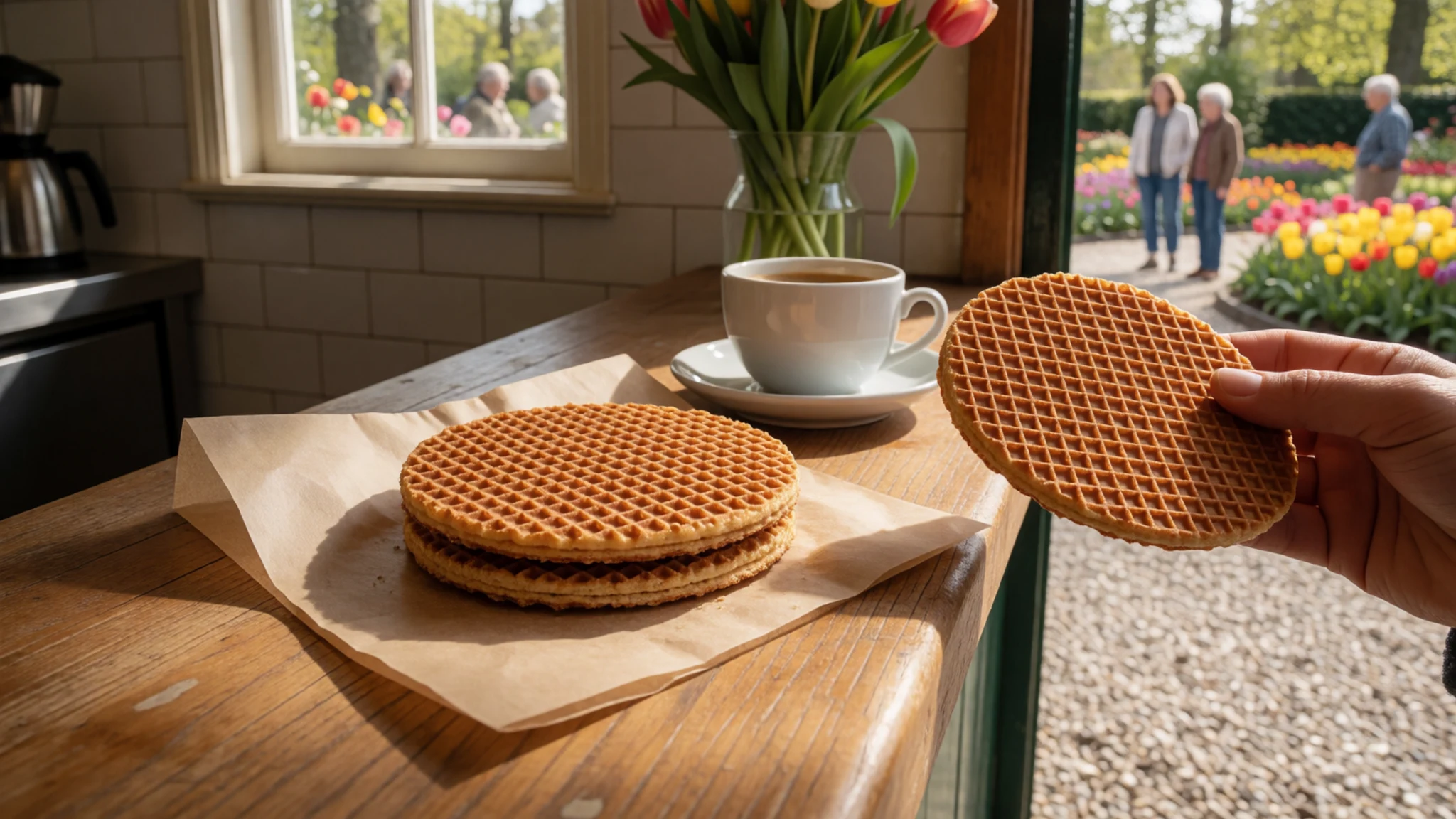
- Haring — a market stall in Lisse or Noordwijk
Keukenhof's cafés are general, so raw salt herring with chopped onion is a stall food rather than a garden-café plate. Eat it standing at a market stall in Lisse or in Noordwijk, on the coast. With onion, it is a salty snack between the beds and the sea.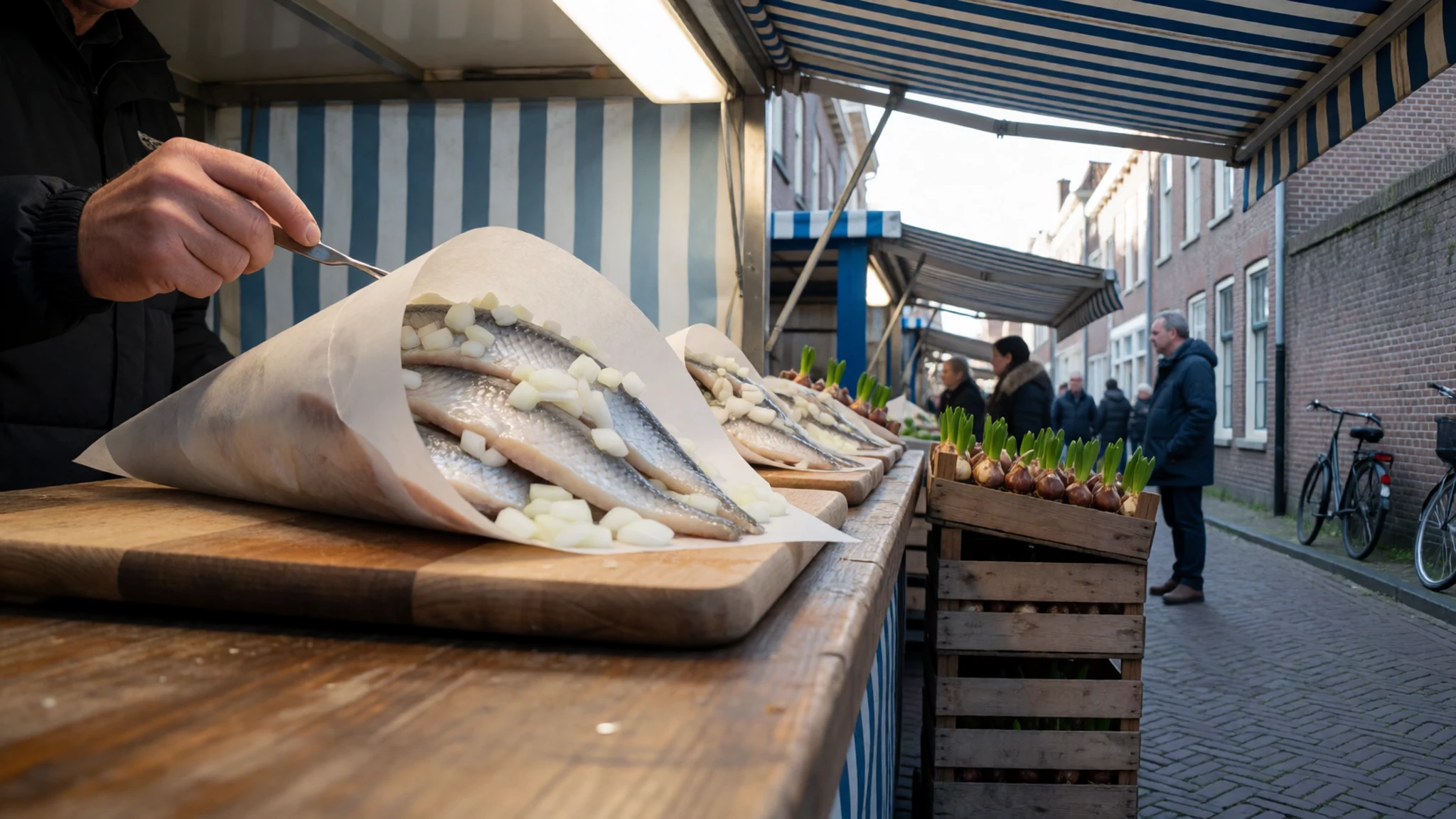
- Bitterballen — garden cafés at Keukenhof and cafés in Lisse
Bitterballen at Keukenhof are the small fried croquettes, soft ragout inside and mustard beside them, that cafés serve when a shower sends people indoors. Brown cafés in Lisse offer the same plate. A shared portion suits a cool visit. - Poffertjes — snack stalls in the gardens and market stalls in Lisse
Poffertjes at Keukenhof are tiny pancakes from a dimpled pan, finished with butter and icing sugar. Snack stalls in the gardens serve them, and so do market stalls in Lisse. Sweet and small, they are easy to eat outdoors between the beds. - Appeltaart — garden cafés at Keukenhof and bakeries in Lisse
Appeltaart at Keukenhof is a deep, spiced apple cake with whipped cream, the café answer to a cold wind off the beds. Garden cafés plate it in season, and bakeries in Lisse do the same. One slice is plenty after a long walk around the flowers.
Plan it
Best time. Keukenhof opens for the spring bulb show from mid-March to mid-May, while the beds are in flower. April is the middle of that season, when tulips overlap earlier daffodils and hyacinths. August is both the hottest and the wettest month, while May is the most comfortable, with mild days, nights above freezing and lighter rain than high summer. Outside these months the public show is shut, yet private events and festivals still use the grounds, and the castle park remains open through the year.
How long. one to two
Getting there. Amsterdam Airport Schiphol is the nearest major airport. In season, buses reach the Keukenhof gate from Schiphol on routes 58 and 858, from Leiden on 54, and from Haarlem on 50 or 51; Amsterdam itself has neither a through coach nor a rail service, so travellers change at Schiphol, Leiden or Haarlem. Check the official site for the current pattern.
Budget. mid
Tips
- Check the official site for this season's open dates, and arrange entry before a weekend or a public holiday.
- Come early on a sunny day, because the main paths grow crowded later in the morning.
- Wear shoes for damp paths and carry a light waterproof.
- Cards are widely accepted; bring a little cash for small outdoor stalls.
Etiquette
- Stay on the paths, and do not step into the beds or pick the flowers.
- Ask before you photograph another visitor at close range, especially a child.
- Pause briefly at popular beds, then move on, and let wheelchairs and prams through.
Nearby
Sources
- Wikidata (CC0)
- Wikipedia (CC BY-SA 4.0)
- Wikivoyage (CC BY-SA 4.0)