Harpers Ferry
Harpers Ferry, United States
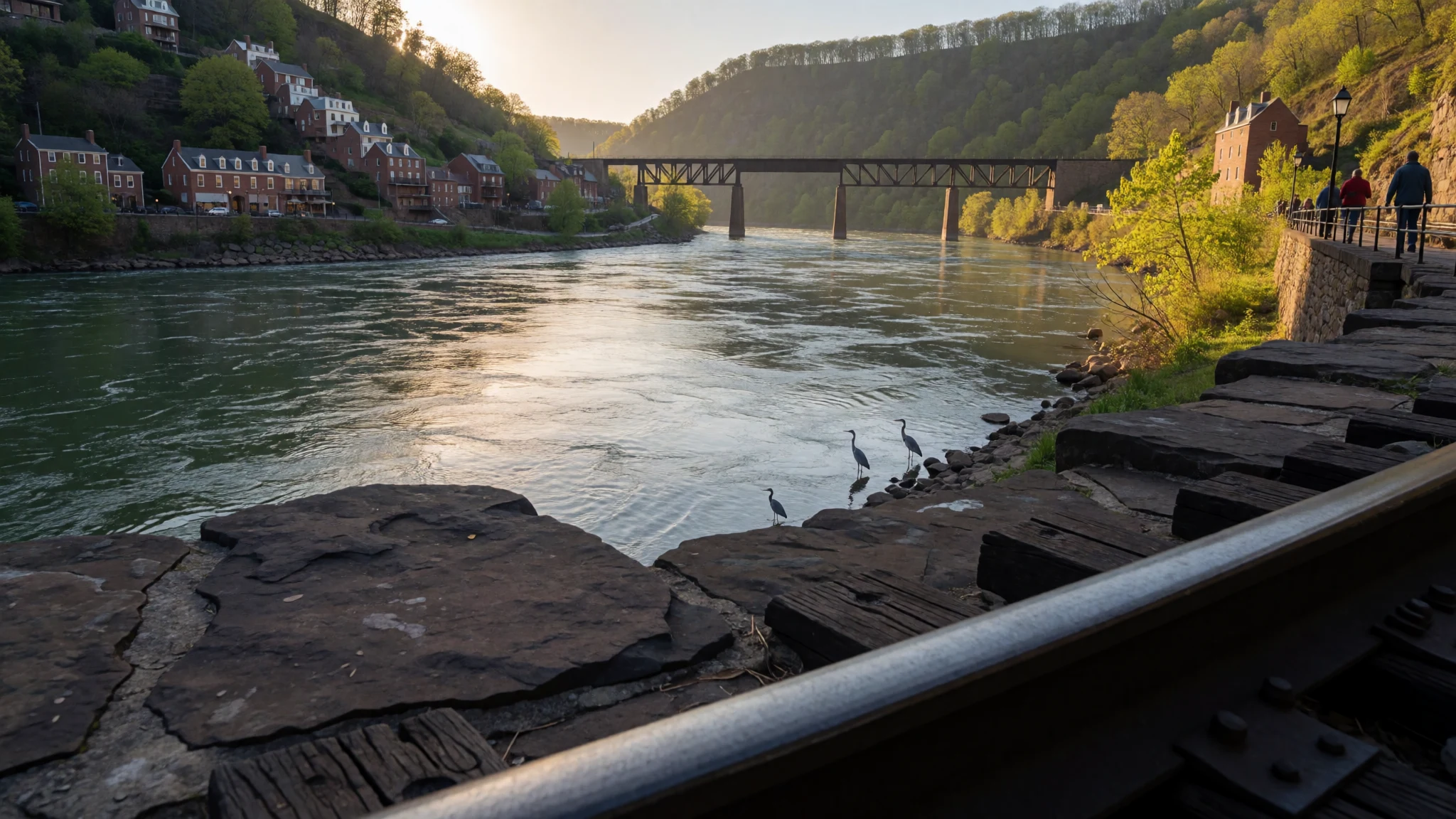
Harpers Ferry packs a river meeting, John Brown's raid, Civil War ruins and the Appalachian Trail into one small, walkable West Virginia town.
The place
Harpers Ferry is a small West Virginia town on a spit of land where the Potomac and Shenandoah rivers join, within sight of both Maryland and Virginia. Only 269 people lived here at the last census, and the town sits about 149 metres above sea level, low among steep wooded ridges. That setting explains most of the place. The rivers once powered mills and an armory, the railway squeezed along the valley floor, and the hills now give hikers their views.
The old riverside quarter, Lower Town, has been rebuilt and is looked after by the National Park Service, after war left it in ruins and floods did further damage. Its sloping streets hold restored shop fronts, small museums, a few eateries and the sound of trains crossing the bridge above. Higher up, the town turns residential, with a church, a cemetery and the former campus of Storer College, set up for Black students after the Civil War.
Two long walking routes meet here. The Appalachian Trail runs through town, with its conservancy headquarters on the edge of the centre, and the towpath of the C&O Canal arrives along the Potomac. Backpackers and cyclists share the same cafés, so a village of this size can feel busy with muddy boots and big packs. The National Park Service also runs a national training centre in the town.
Weekends from spring to autumn bring the crowds, and parking near Lower Town is limited, so most visitors leave the car at the visitor centre and ride the shuttle bus down. Summers are hot and humid, while winter is quiet.
Its story
Harpers Ferry owes its name to Robert Harper, a Pennsylvania-born builder and millwright. On his way to build a Quaker meeting house further up the valley, Harper saw how much waterpower the two rivers offered. He bought out the ferry claim of Peter Stephens, a squatter who had been ferrying people across the Potomac here since 1733, and in 1751 he bought the land itself from Lord Fairfax, its real owner. Virginia's assembly licensed his ferry in 1761 and formally created a town two years later. Harper died in 1782 and is buried in the town's cemetery.
A federal armory and the arrival of the railway turned the place into an industrial town. In 1859 the abolitionist John Brown led a raid on the armory, hoping to ignite a rebellion against slavery. It failed within days, but it hardened feelings across the country, and the small engine house where his men made their stand became known as John Brown's Fort.
Once the Civil War began, the town's position at a river crossing and at the mouth of a valley meant that armies kept fighting over it, and it changed hands several times. By the war's end Lower Town lay in ruins, and floods later swept away much of what remained. Formerly enslaved people found shelter in camps here during the conflict, and afterwards Storer College opened for Black students. The town lost its apostrophe in 1891, when a national board on place names tidied the spelling. Tourism, rather than manufacturing, now pays the bills.
What to see
- Lower Town and the National Historical Park — Lower Town
The park runs the restored Lower Town, where shop fronts, exhibits and period rooms line a few sloping streets. A slow morning suits it. Signs and park staff explain the armory years, the war and the floods. The visitor centre sits higher up, and a shuttle bus links the two. - John Brown's Fort — Lower Town
John Brown's Fort is the small brick engine house where Brown and his followers made their stand during the 1859 raid. It draws steady visitors, and the story is still argued over. Nearby exhibits set out what Brown planned, why some saw him as a hero and others as a fanatic, and how the raid pushed the country towards war.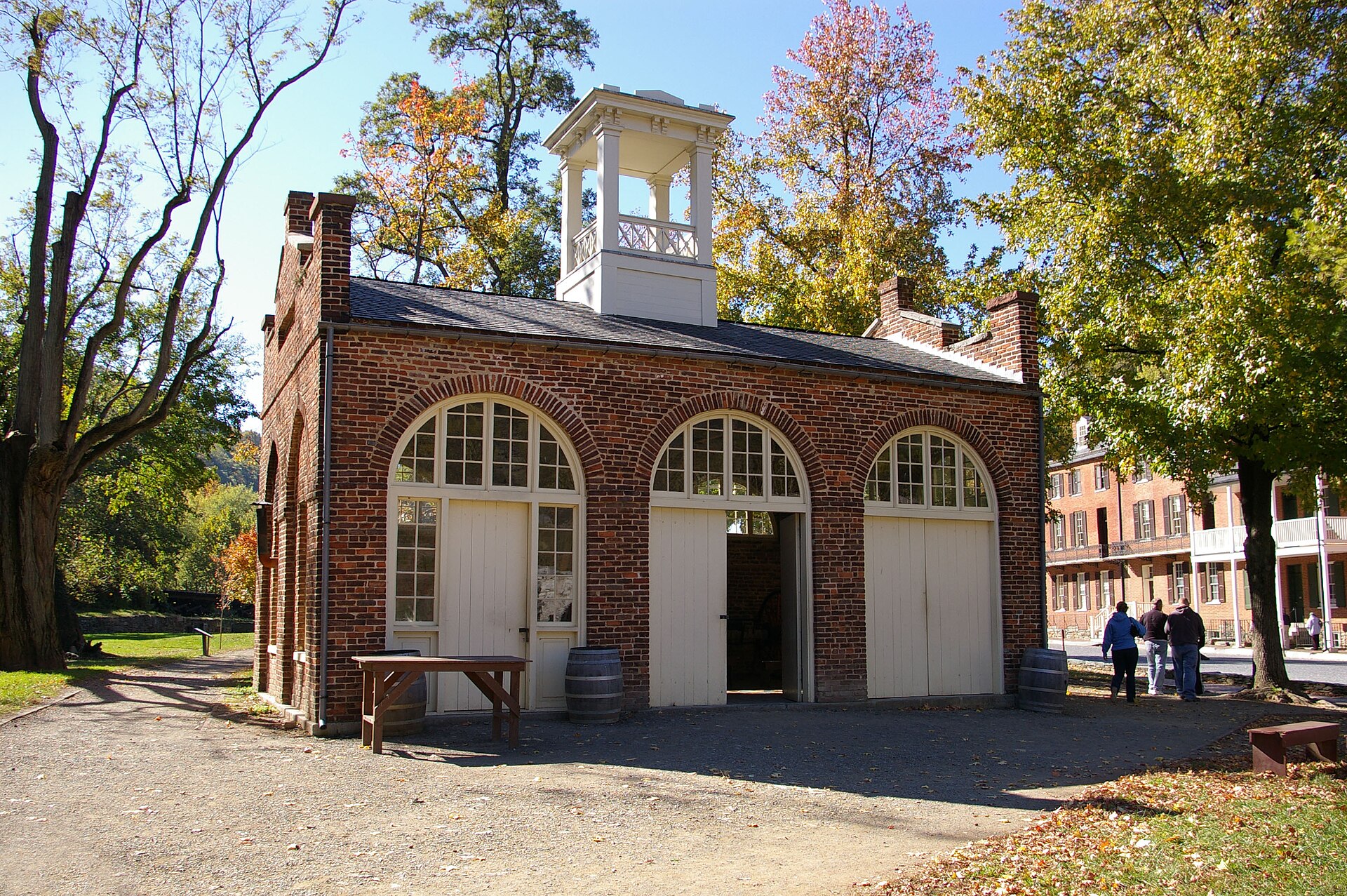
- Jefferson Rock — Upper town
Jefferson Rock is a short climb from Lower Town, a stack of rock slabs on a ledge above the houses, reached by a stepped path through the older streets. Thomas Jefferson visited Harpers Ferry in 1783, and the viewpoint carries his name. Both rivers, the railway bridge and the ridges fit into one view.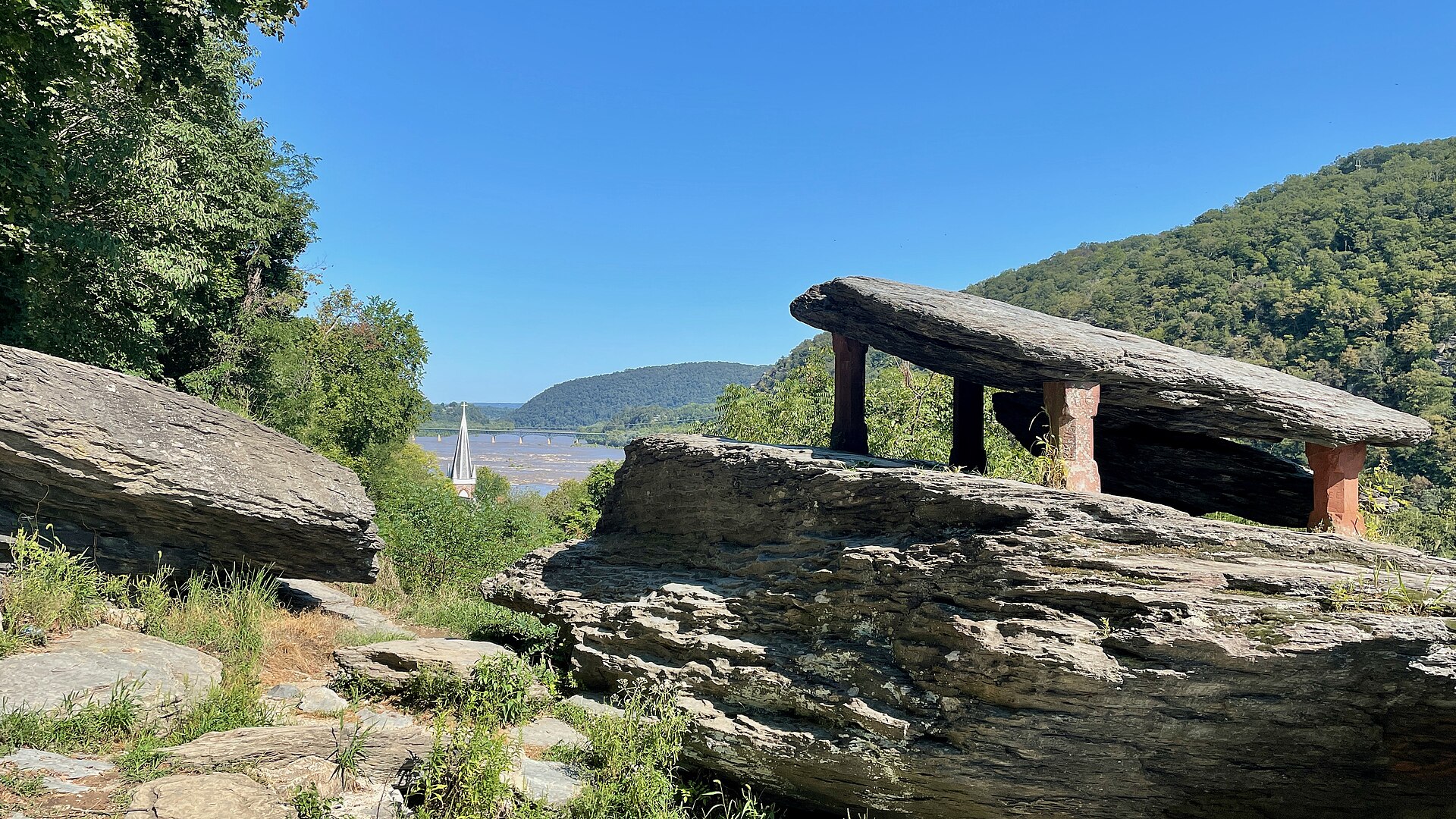
- Maryland Heights overlook — Maryland side of the Potomac
Across the Potomac on the Maryland side, a steep trail climbs to the overlook that gives the classic panorama of the town, with the Shenandoah on the left and the Potomac on the right. Sturdy shoes and plenty of water matter, because the climb is hard work in summer heat.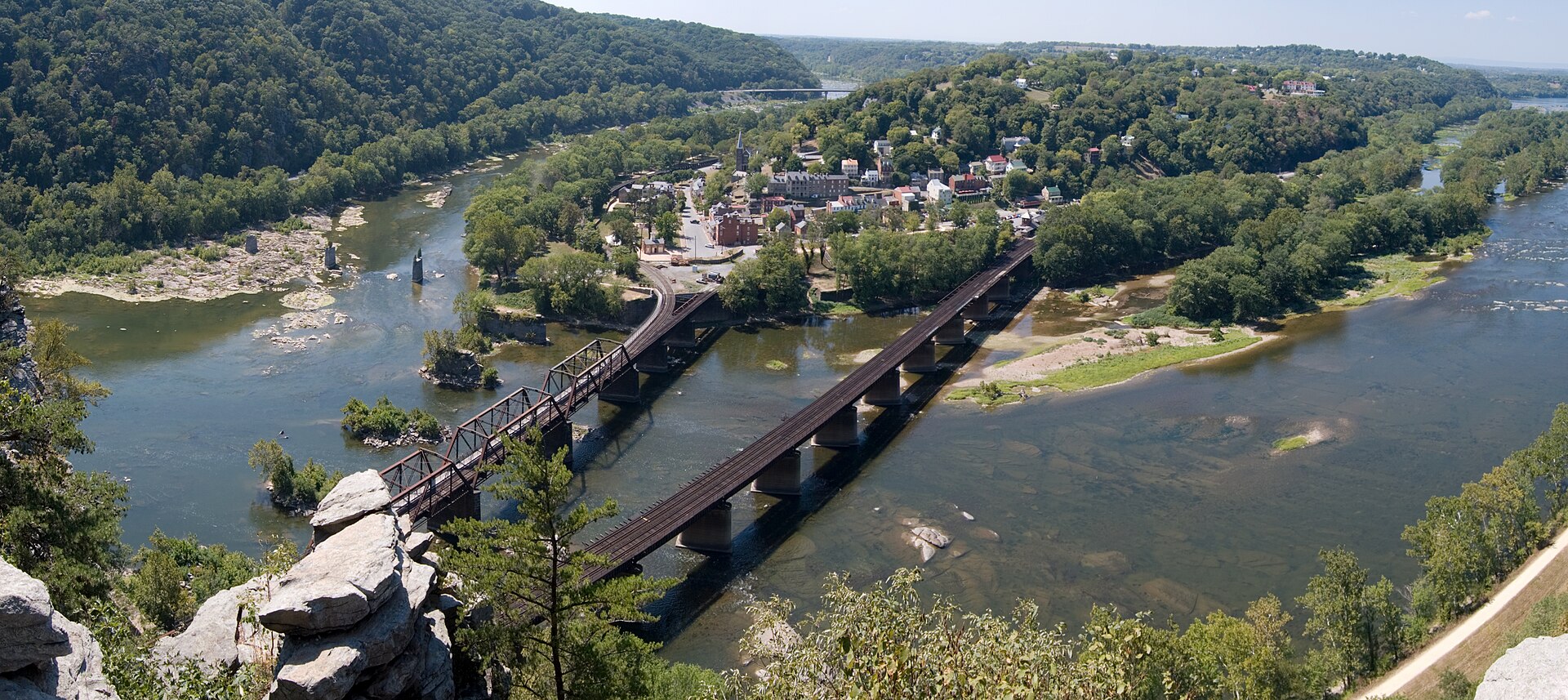
- Appalachian Trail Conservancy headquarters — Edge of the centre
The trail's headquarters sits at the western edge of the town, close to the trail's midpoint. It accepts parcels for hikers, with a suggested donation, and thru-hikers traditionally stop here for a photograph. It is a good place to watch people finishing or starting long walks and to hear how their trips are going. - Rafting, tubing and zip lines on the rivers — Riverbanks around the town
Outfitters near town run rafting, tubing, kayaking and canoe trips on both rivers, with gentle to moderate rapids, and one offers a zip-line course above the Potomac. Tubing the Shenandoah is a slow, easy drift. Check each outfitter's website for seasons, age limits and prices before planning a day around it.
Culture
Harpers Ferry's culture is largely a culture of memory. This is a town where Americans still argue about slavery, rebellion and who deserves to be called a hero, and the displays do not hide the argument. John Brown is read as a martyr by some and as a violent extremist by others. Alongside his story sit that of Storer College, a school for Black students opened after the war, and that of the formerly enslaved people who sheltered in the camps here, so the past is not told only through soldiers and armouries.
A second culture belongs to the trail. Harpers Ferry hosts the Appalachian Trail Conservancy, and hikers swap advice on blisters, resupply and weather with a mix of tiredness and delight. Many carry their whole lives on their backs and look it, and locals are used to them. Rafters and cyclists from the C&O towpath add to the outdoor mood, which spills into the eateries in the evenings.
The National Park Service keeps much of Lower Town as an open-air museum, so the town feels more like a set of rooms to walk through than a living high street. Weekdays outside the summer are calm, weekends livelier, and the soundtrack is trains, river noise and the occasional church bell.
At the John Brown and Civil War sites, keep voices low and behaviour respectful, since many people come to reflect on slavery and war, and do not climb on walls, cannon or ruined foundations.
What to wear
Harpers Ferry has no regional costume in the way a Himalayan village does, and its dress history is mostly one of working clothes and uniforms. In the armory and mill years, men wore wool trousers, cotton or linen shirts and heavy boots, women wore long cotton or wool dresses with aprons, and Quaker families of the wider valley favoured plain, dark, undecorated cloth. Those styles now appear mainly at living-history events, where re-enactors wear the blue wool of Union soldiers or the plainer grey and brown of Confederate ones.
Day to day, people wear outdoor clothing. Hiking boots, quick-dry trousers, fleeces and rain jackets are close to a local uniform, because so many visitors are walkers, rafters or cyclists. Park rangers wear a green-and-grey uniform with a flat-brimmed hat, and townspeople dress casually.
Visitors should dress for weather and terrain rather than for any code. Summer is hot and humid, so breathable cotton or synthetic layers, a sun hat and water are sensible; spring and autumn need a light jacket; winter needs a proper coat and gloves. Streets and paths are steep, with uneven stone, so wear shoes with grip, and trail shoes for Maryland Heights. Long trousers help against brambles, ticks and poison ivy at trail edges. For the rivers, bring quick-dry clothes and sandals that strap on or water shoes. Museums and memorials have no special dress rules, though covered shoulders feel respectful at the solemn sites.
What to eat
- Sub sandwich or gyro — Delis around Lower Town
Casual delis in and around Lower Town sell long sub sandwiches, gyros, burgers and pasta, and are popular with park staff at lunchtime. A filling sub is the easy choice before a river trip or a climb to a viewpoint. - Pepperoni roll — Bakeries, delis and shops in the area
The pepperoni roll is a West Virginia classic: a soft bread roll baked around pepperoni, eaten warm or cold. It travels well in a rucksack, which makes it a useful trail snack. Ask at local bakeries and delis what has been baked that day. - Cooked breakfast — Cafés on the upper town streets
Small cafés in town serve eggs, bacon, pancakes and coffee through breakfast and lunch. Locals and hikers fill them early, so a weekend morning can mean a short wait for a table, which is part of the atmosphere. - Burger and a cold drink — Casual pubs and grills in town
After a day on the water or trail, casual pubs and grills do burgers, fries and local beer. Portions are generous, service is relaxed and muddy boots are normal. Evenings from spring to autumn tend to be the busiest. - Comfort-food supper with a cocktail — Washington Street, upper town
Rustic dining rooms in the upper town serve hearty plates with cocktails, a step up from sandwiches. This suits an evening after the museums close. Weekend tables can fill, so check the restaurant's own website about booking.
Plan it
Best time. April–May and October, when the weather is mild and the ridges are green or turning colour. June to August is hot and humid, which suits rafting and tubing but tires walkers. Winter is cold and quiet, with some businesses open shorter days.
How long. 2
Getting there. There is no airport in the town; the nearest major airports are Washington Dulles and Baltimore/Washington International, both a drive away. MARC commuter trains run from Washington Union Station on weekdays, and Amtrak long-distance trains also call, so check current timetables. By car, take the interstate to Frederick in Maryland, then head west on the US highway towards the town, and park at the visitor centre for the shuttle bus down to Lower Town.
Budget. mid
Tips
- Park at the visitor centre and take the shuttle bus, because parking in Lower Town is limited
- Arrive early at weekends from spring to autumn to beat the crowds and the heat
- Check the town website (http://www.harpersferrywv.us/) and the National Park Service pages for opening hours, fees and any closures
- Book rafting, tubing or zip-line trips directly with the outfitter, and check river conditions on the day
- Carry water and wear sturdy shoes for the hill paths and Maryland Heights
Etiquette
- Keep voices low and show respect at the John Brown and Civil War sites
- Stay on marked trails, carry out your rubbish and give way to uphill hikers on narrow paths
- Do not climb on walls, cannon or ruined foundations
Nearby
Sources
- Wikidata Q985289 (CC0)
- Wikipedia: Harpers Ferry, West Virginia (rev 1386064268) (CC BY-SA 4.0)
- Wikivoyage: Harpers Ferry (rev 5403716) (CC BY-SA 4.0)
- Mark Fickett, Harpers Ferry from Maryland Heights panorama (CC BY 3.0)
- Zeete, Robert Harper gravesite, Harper Cemetery (CC BY-SA 4.0)
- View from Jefferson Rock, wood engraving, Gleason's Pictorial (Public domain)
- Zeete, Jefferson Rock looking east (CC BY-SA 4.0)
- William Cullen Bryant, Harpers Ferry before the railroad (Public domain)
- Harpers Ferry in 1859, by 'our special artist' (Public domain)
- MamaGeek, John Brown's Fort (CC BY 3.0)
- Contraband camp at Harpers Ferry (Public domain)


