Doi Suthep
Doi Suthep, Thailand
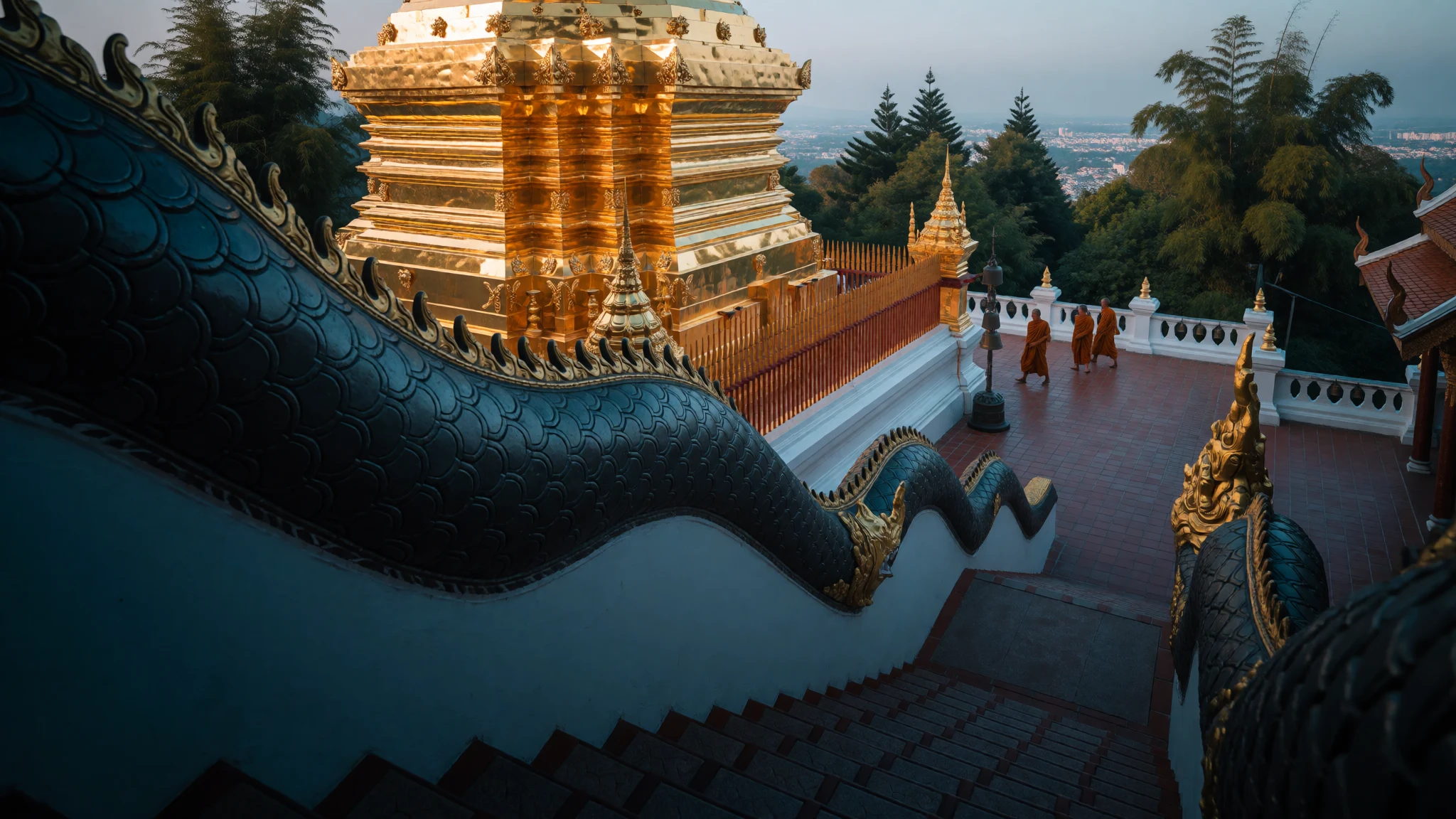
Doi Suthep puts a gilded Lanna temple above Chiang Mai, with a long naga stair, valley views and cool mountain air.
The place
Doi Suthep is the wooded mountain immediately west of Chiang Mai, and the name covers both the ridge and the temple that stands on the upper ridge. The approach leaves the plain and enters Doi Suthep–Pui National Park, where evergreen and mixed forest still shade the road and the streams that feed the city. The climb is a series of bends rather than a long trail: most people arrive by songthaew, taxi or private car, and step out at a lower terrace already above the rooftops. Wat Phra That Doi Suthep occupies that shoulder. A stair guarded by naga balustrades rises to a cloister of gilded columns around the central chedi; a funicular runs beside the stair for anyone who would rather not walk it. From the outer terrace the Ping valley and the grid of Chiang Mai sit to the east, and on a clear morning the ridges to the south line up in successive blues. Bells line the rail. The compound is a working monastery: monks live here, and local people come to make merit alongside visitors who have come for the view. The mountain is more than the terrace. A white-elephant shrine on the road up retells the founding legend, and the palace gardens sit nearby in the trees. Mornings are the generous hours, before coaches fill the lower court. Doi Suthep works as a short trip from the city because the forest, the stair and the gold chedi are gathered on that same shoulder of the hill.
Its story
Doi Suthep enters Lanna memory through a relic story that people on the mountain still repeat. A monk named Sumanathera is said to have discovered a relic of the Buddha while he was living in Sukhothai, and the relic gave signs that it wished to travel. He carried it north to the court of King Kue Na. The king, the story continues, set the relic on a white elephant and left the choice of ground to the animal. The elephant walked out of Chiang Mai, climbed the western ridge, circled a shoulder partway up and lay down. It died on that spot, and the court took the death as an instruction to build. A chedi was raised there and, as Lan Na prospered, was enlarged and covered in gold. The ridge already had a hermit's name. Suthep is tied to an ascetic who was believed to have kept the mountain before the elephant climbed it, so the relic did not so much found a sacred place as confirm it. The tower itself is a northern reliquary: a stepped, many-sided chedi, closer in spirit to other Lan Na stupas than to a Khmer prang. The legend also explains a practical oddity. A monastery of this importance stands far above the city that feeds it, because the story says the relic chose the height and the king obeyed. Merit-making at Doi Suthep is still framed that way: people climb, offer, and walk the gallery as if the site were decided elsewhere.
What to see
- Wat Phra That Doi Suthep — summit terrace
Wat Phra That Doi Suthep is the working Lanna monastery at the heart of the mountain. The gilded chedi stands inside a cloister, and the outer terrace looks east over Chiang Mai. Monks live in the compound. Through the day the court is shared by people making merit and visitors who have come up mainly for the air. The gallery is calmer early.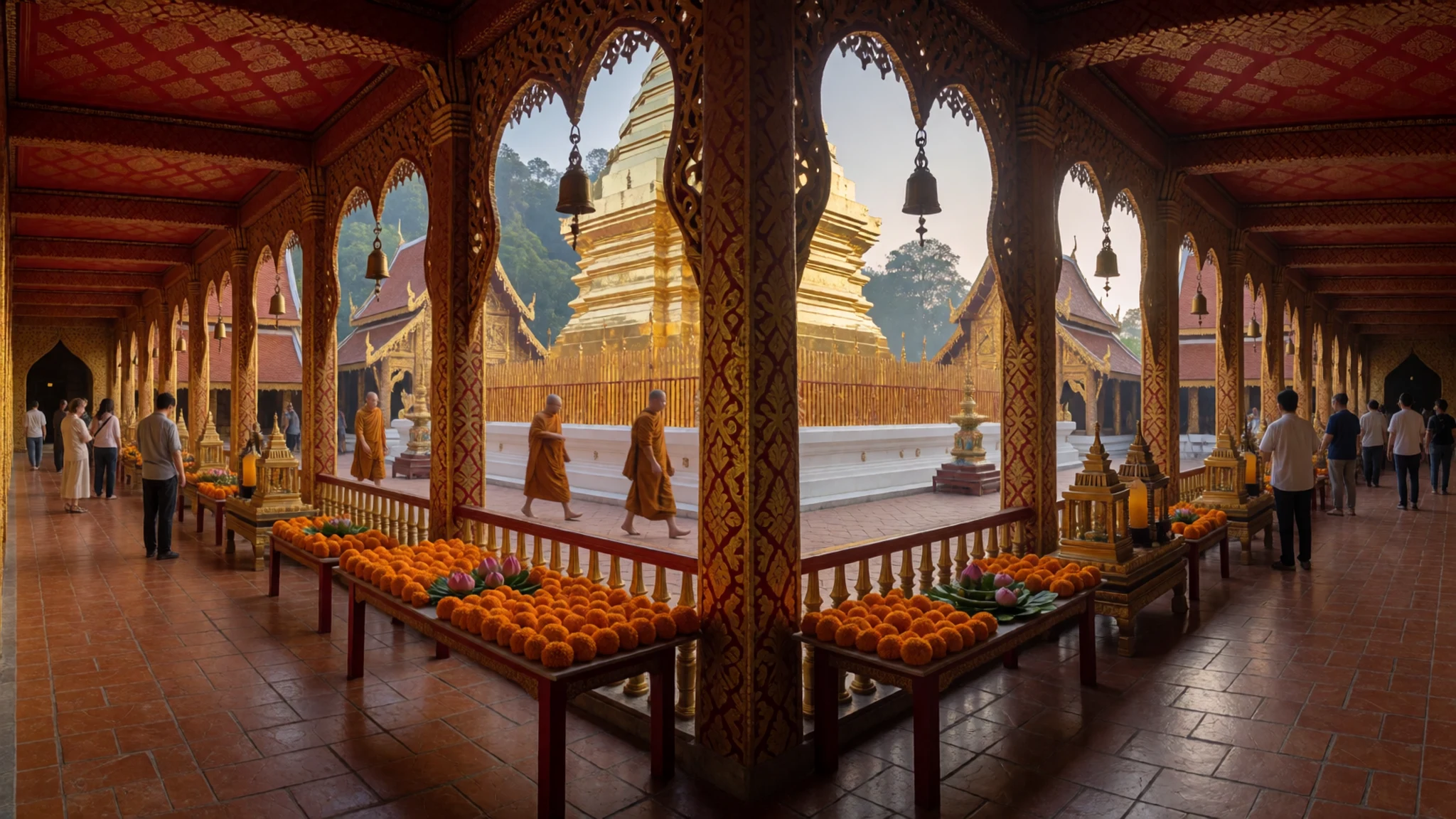
- Naga staircase — lower terrace
The naga staircase is the climb from the lower terrace of Doi Suthep to the temple court, with serpent balustrades on either side. Most people remember it for the effort and for the mosaic scales in the sun. A funicular runs alongside for anyone who would rather not walk, and both ways meet at the cloister. In the rain the stone is slick.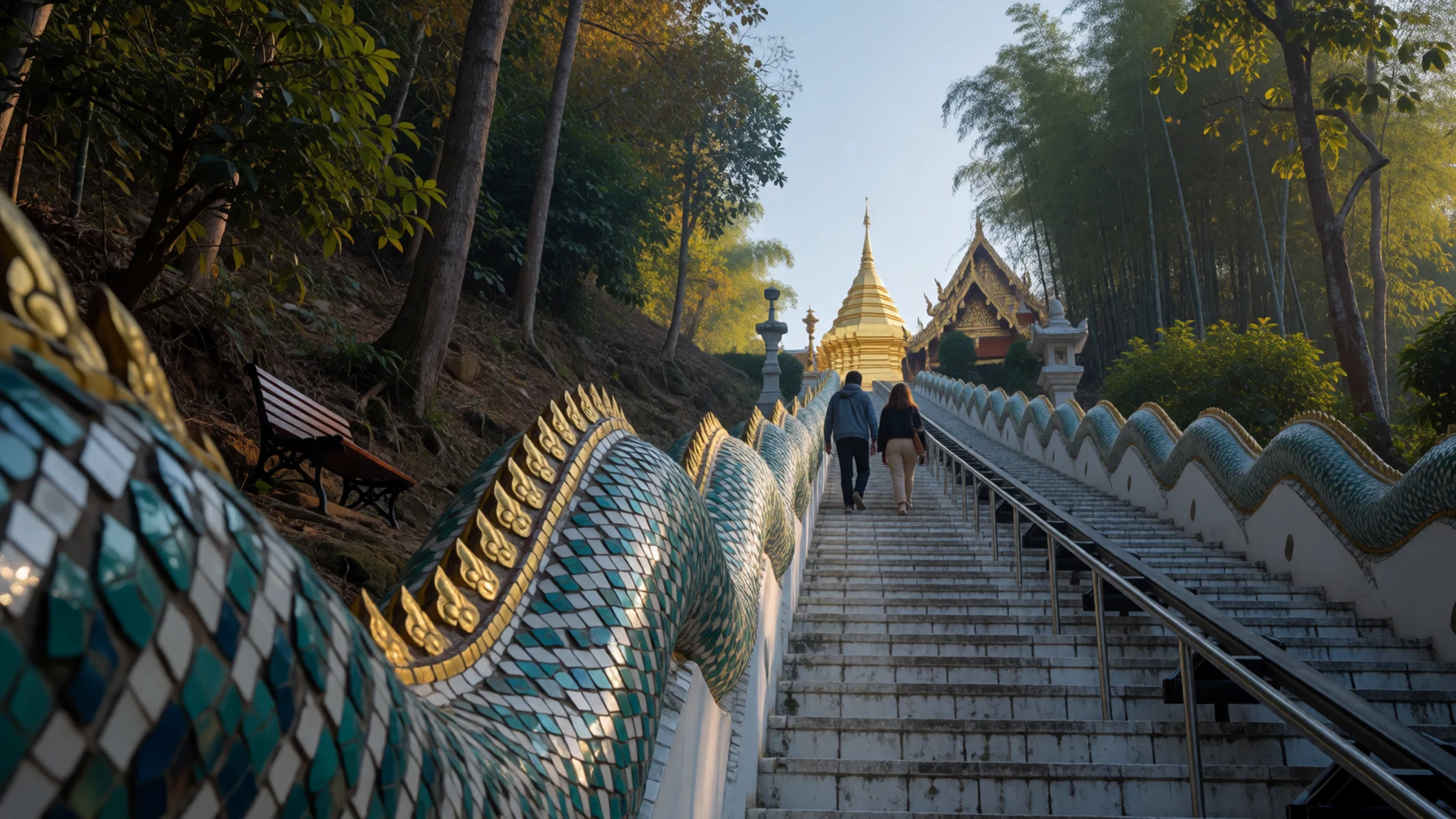
- Valley terrace — outer terrace
The outer terrace of Doi Suthep is the place to stop walking and look east. Chiang Mai spreads along the Ping, with the old city somewhere in the pale grid and newer districts reaching toward the far ridges. Morning light is the clear hour; by afternoon in the wet season the ridge often has its head in cloud and the plain turns milky.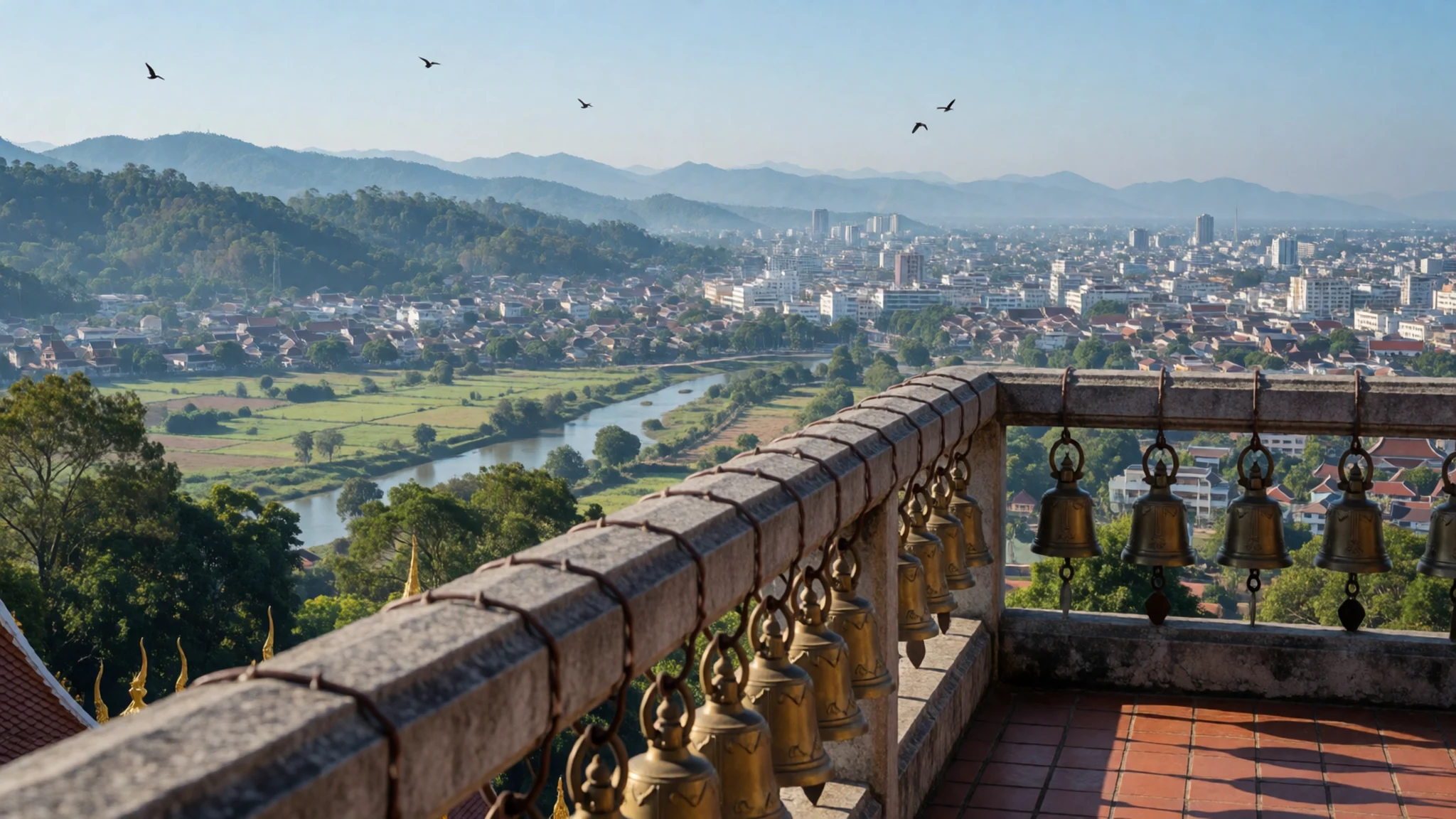
- White Elephant Shrine — mountain road below the temple
The White Elephant Shrine on the road up Doi Suthep puts the founding legend in plain sight. In the story a white elephant carried the Buddha relic out of the city, climbed until it could go no further, and died where the chedi would stand. The shrine is easy to pass in a hurry toward the temple, yet it is the tale the rest of the mountain is built on.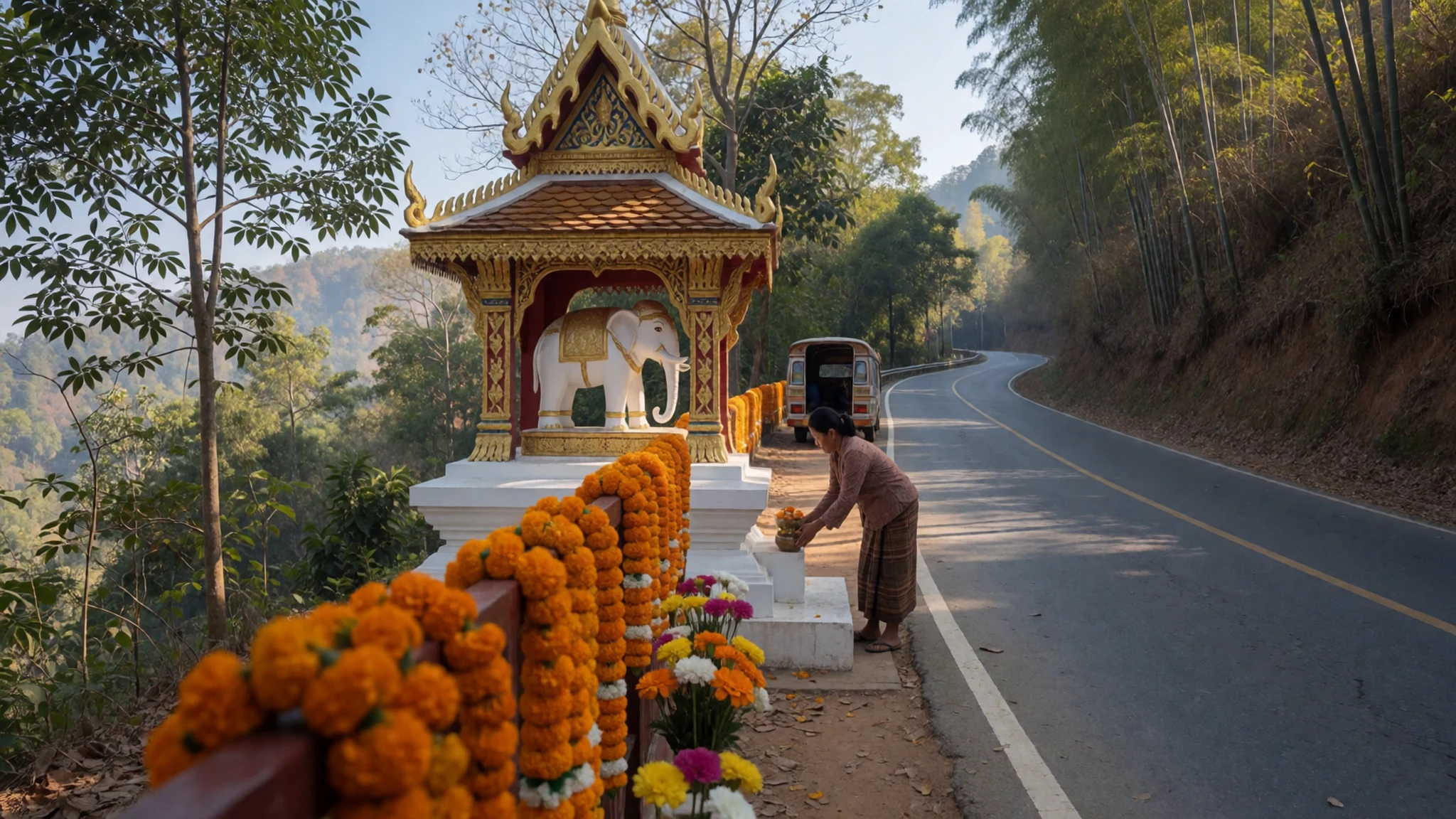
- The chedi — inner cloister
The chedi of Doi Suthep is the reliquary the whole terrace is arranged around, a stepped northern tower finished in gold leaf. Inside the cloister, columns and a gallery circle the base, and the smaller shrines along that walk are where most offerings are actually made. The form is many-sided and tiered, in the Lan Na family of stupas.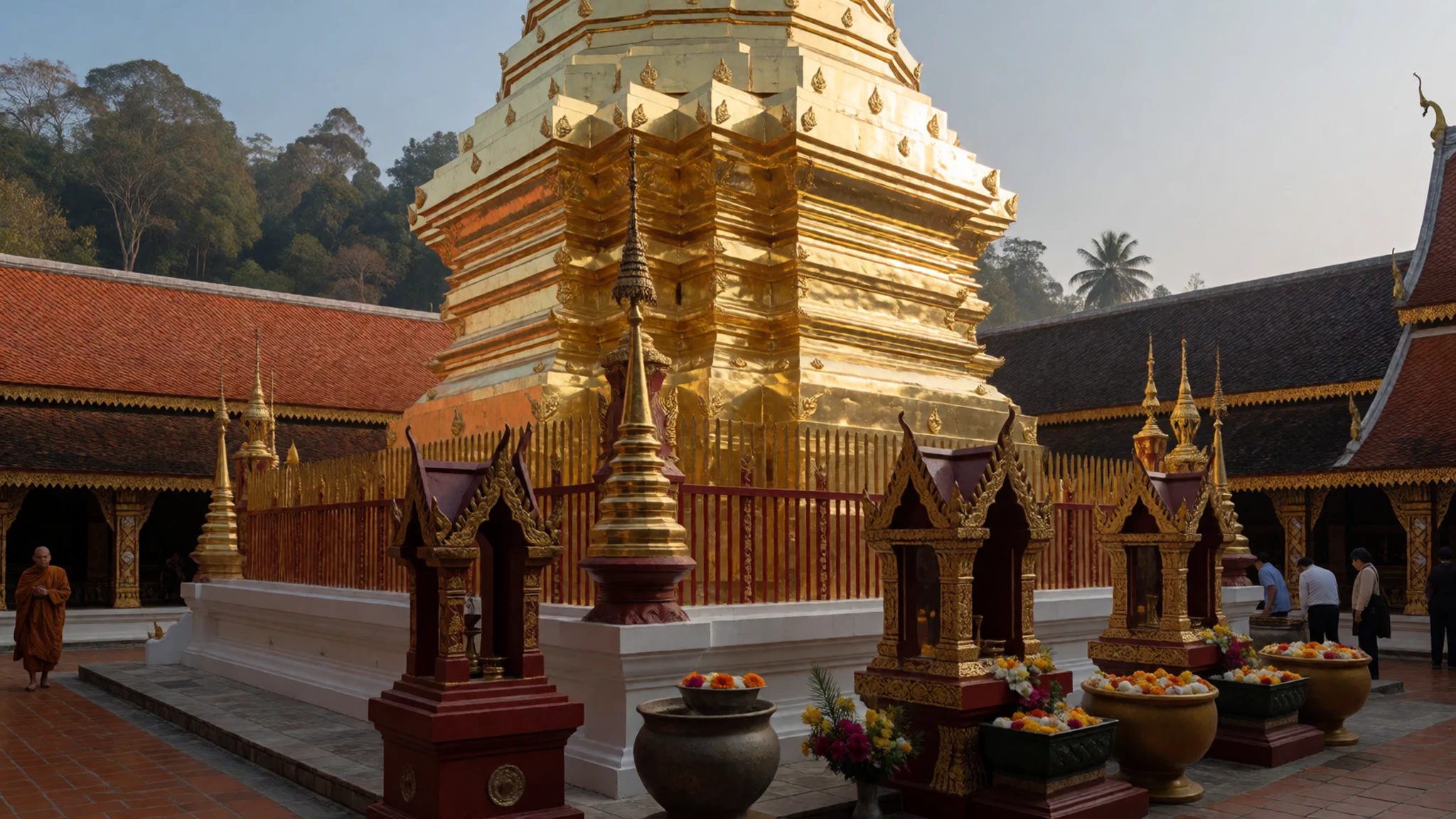
Culture
Culture at Doi Suthep is ordinary northern Thai Buddhism practised partway up the mountain, not a performance laid on for the terrace. People come to make merit: they offer flowers, incense and gold leaf, walk the gallery so the chedi stays on the right, and pour water while they dedicate the act. Monks receive alms and chant; the mountain is their home as well as a visitor's outing. The white-elephant legend sits underneath this. It tells locals why the relic is here, and why climbing counts. Lanna custom shows in the architecture and in small gestures. The chedi is a northern form. Shoes come off at thresholds. Heads stay lower than the Buddha images. Women do not hand things directly to monks; a cloth or a male companion carries the offering the last step. Conversation drops inside the cloister. The forest around the compound is part of the same respect: Doi Suthep–Pui is a park and a watershed, and rubbish on the stair is treated as a real offence by people who use the mountain all year. Shoulders and knees stay covered. At Doi Suthep, remove your shoes where the steps rise and the sandals are already lined up, and ask before you photograph a person who is praying.
What to wear
Dress at Doi Suthep has a ceremonial side, an everyday side, and a visitor's problem: what the north still wears for ceremony, what Chiang Mai wears on an ordinary day, and what makes sense on a temple stair. For festival and merit-making, northern Thai clothing is built around the pha sin, a wrap skirt, often with a teen jok hem of brocade or discontinuous supplementary weft, and a sabai or blouse above it. Silk and good cotton are the textiles that matter; the old Lanna palette runs to indigo, crimson and shot gold. Men may wear a formal shirt with chong kraben or plain trousers. On a normal day the city below is in t-shirts, jeans, school uniforms and office shirts. The temple sees both. Residents coming to make merit often choose modest, lighter clothing in pale colours, and some wear white. Visitors who treat the terrace like a viewpoint arrive in singlets and short shorts and spend the visit looking underdressed beside everyone else. A visitor is better with shoulders and knees covered, a scarf if the shirt is thin, and shoes that slip off easily. The stair is hot, then slick in rain, and the terrace cooler than the plain, so a light layer earns its place.
What to eat
- Khao soi — old-city noodle shops, and stalls by the temple car park
Khao soi is the northern curry-noodle bowl after Doi Suthep: egg noodles in a coconut and turmeric curry, with pickled mustard greens, shallots, lime and a handful of crisp noodles on top. The fuller bowls are in Chiang Mai; stalls by the temple car park sell a simpler version.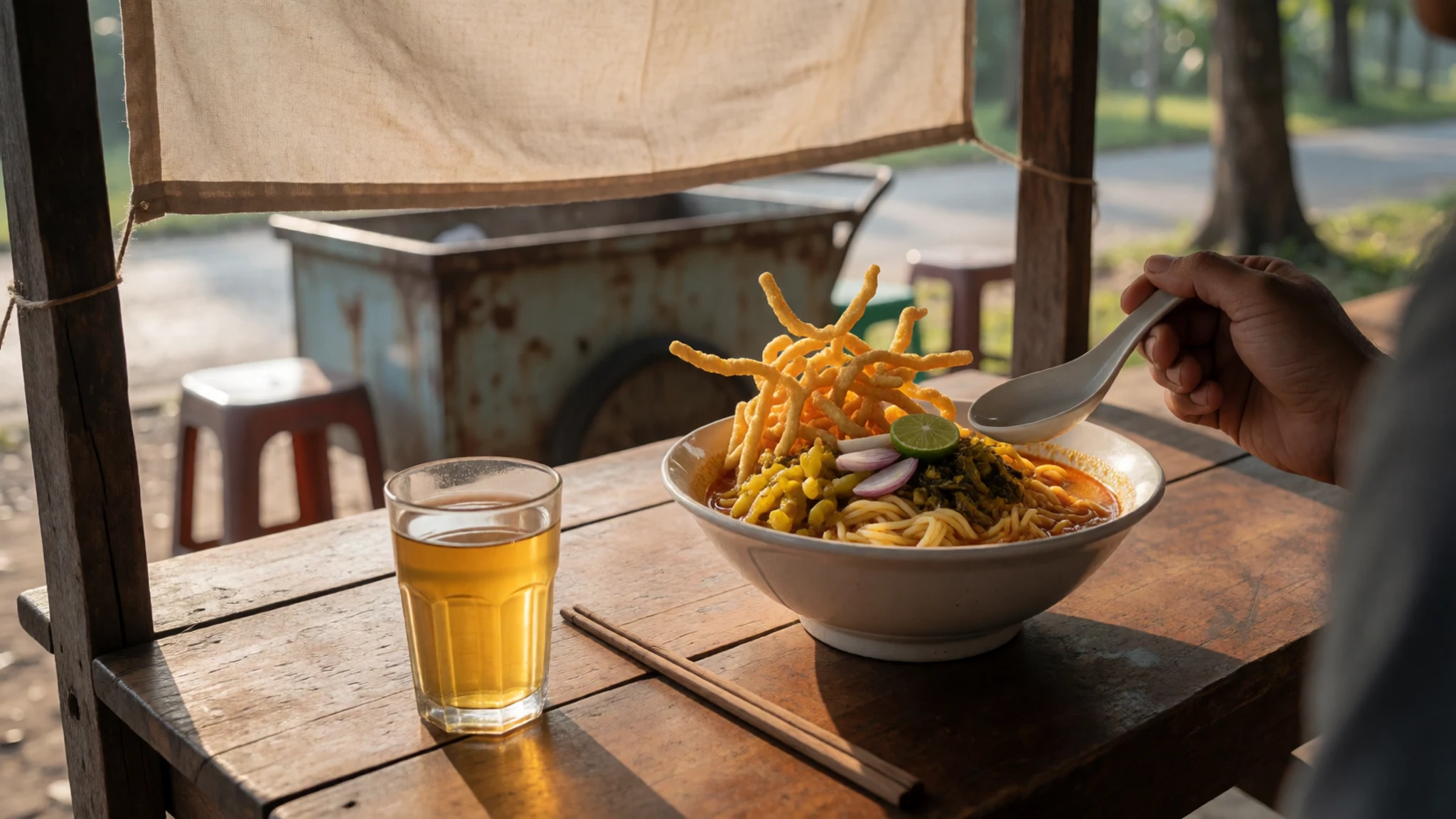
- Sai ua — the road down the mountain, and evening markets in Chiang Mai
Sai ua is the grilled northern sausage, herbal and hot, cut from a coil and eaten with sticky rice, herbs and chilli. Lemongrass and kaffir lime leaf do the flavouring. Stalls on the road down from Doi Suthep sell it, and so do the evening markets in Chiang Mai.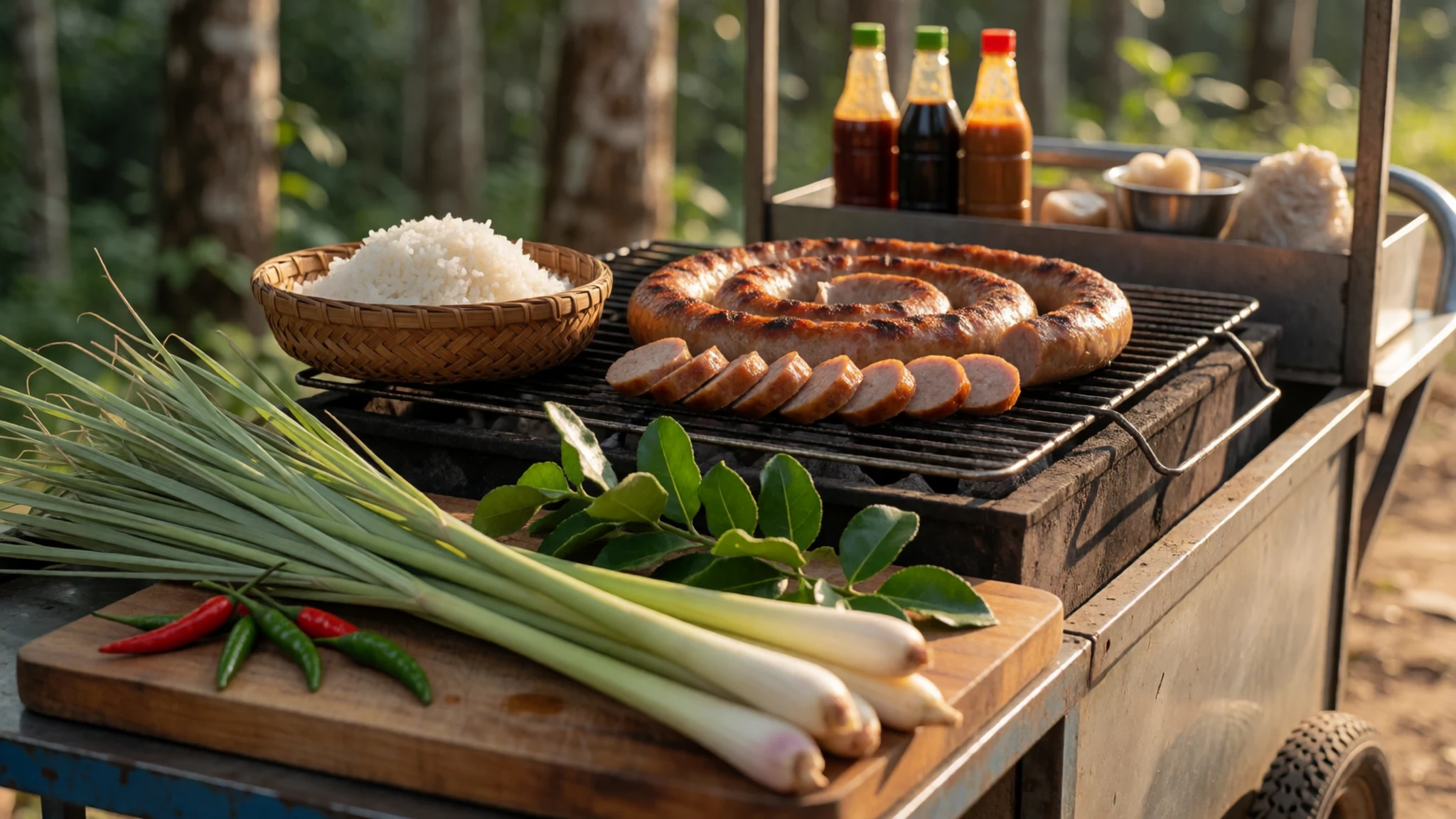
- Nam phrik num — northern kitchens and morning markets in Chiang Mai
Nam phrik num is a northern relish of roasted green chilli, garlic and shallot, eaten with sticky rice, pork crackling and vegetables. It looks milder than it tastes. The place for it is a northern kitchen or a morning market in Chiang Mai, not the terrace of Doi Suthep. - Khanom jeen nam ngiao — old-city noodle shops in Chiang Mai
Khanom jeen nam ngiao is rice noodles in a pork and tomato broth stained with cotton-flower, sour and a little hot, with chicken blood curd in the traditional bowl. It is breakfast and lunch food in Chiang Mai and a satisfying bowl after a morning on Doi Suthep.
Plan it
Best time. November to February is a comfortable window on Doi Suthep: clearer air, a cooler terrace and a stair that is not slick with rain. March to May is hazy and hot even on the mountain, though still easier than the plain. June to September brings afternoon cloud, wet stone and a view that sometimes stops at the railing, August the wettest month.
How long. half a day, or a full day if the gardens and a walk are included
Getting there. Fly into Chiang Mai International Airport, then take a songthaew, taxi or car for the last leg, a winding climb through the forest to the temple car park on Doi Suthep. There is no rail line up to the temple.
Budget. mid
Tips
- Begin early, before coach parties fill the lower terrace of Doi Suthep.
- Use the funicular if the stair is too much, and carry cash for it.
- Bring water; shade on the stair is patchy and the terrace is exposed.
- In the wet months the steps are slick and cloud can erase the view.
- Check official notices before adding the palace gardens, which close when the family is in residence.
- Carry rubbish back down; the mountain is both monastery and watershed.
Etiquette
- Remove your shoes where the floor steps up and sandals are already lined up.
- Keep shoulders and knees covered.
- Do not touch a monk if you are a woman, and do not point your feet at the chedi.
- Ask before you photograph anyone who is praying.
- Keep your voice low inside the cloister.
Nearby
Sources
- Wikidata (CC0)
- Wikipedia (CC BY-SA 4.0)
- Wikivoyage (CC BY-SA 4.0)