Cathedral Grove
Cathedral Grove, Canada
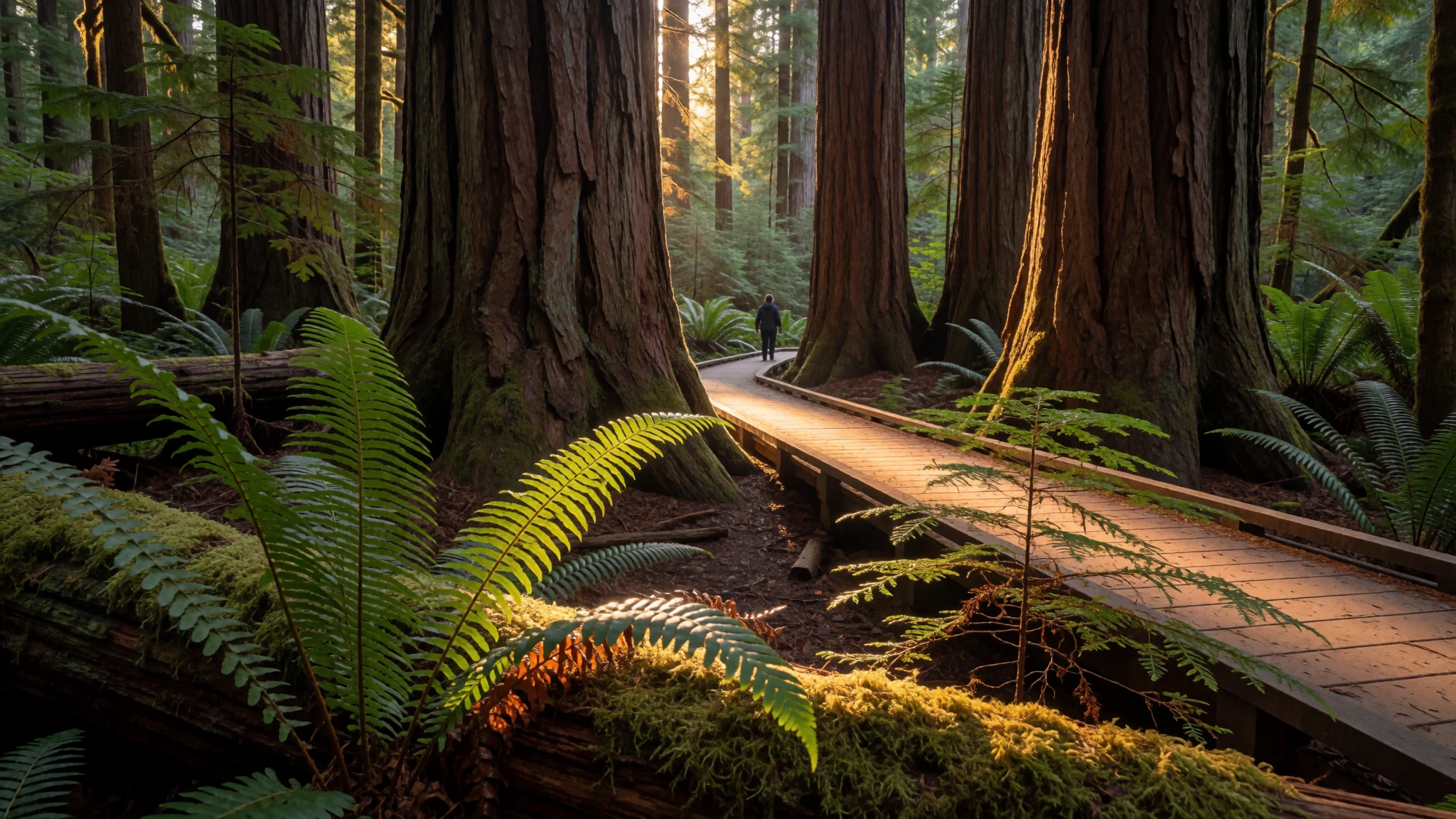
Cathedral Grove is a short roadside walk among towering ancient Douglas firs on Vancouver Island, easy to reach and best before the crowds arrive.
The place
Cathedral Grove stands within MacMillan Provincial Park, in the middle of Vancouver Island, British Columbia. The park sits between Qualicum Beach on the east coast and the mill town of Port Alberni inland, about 25 km from the first and 16 km from the second. The main island road and a railway line both run through it, and the western shore of Cameron Lake forms its edge. The park also protects the delta where the Cameron River reaches the lake. The grove proper covers 157 hectares and is made up of very old Douglas firs, with western redcedar and a floor of ferns, moss and fallen logs slowly turning to soil. The effect is of vertical lines: trunks too broad to hug, a canopy far overhead, and a green hush below. What sets the place apart is how little effort it takes. Many old-growth stands on the island lie at the end of long logging roads, but here a roadside car park and a loop of boardwalk are all that stand between a traveller and the forest. That ease has a cost. The grove is busy in summer and at weekends, parking fills early, and the paths are short enough that crowds bunch up at the best-known trees. The walks are mostly flat and suit children and older visitors, though roots and wet boards can be slippery. Canadians put the grove on a shortlist of national wonders in 2007, and the park itself dates from 1947. It works best as a stop of an hour or two on a longer island drive.
Its story
Cathedral Grove, in MacMillan Provincial Park, was used and valued long before it had a name or a fence. Western redcedars here carry scars where bark was stripped in the traditional way, and these culturally modified trees show that First Nations people worked this forest for centuries before European settlers came. The name itself is credited to Viscount Willingdon, Governor General of Canada, who is said to have coined it in 1928. Motorists and sightseers were already stopping here in those years, long before any legal protection, and ordinary people began writing to the provincial government asking that the trees be saved. The land and timber belonged to private owners, one of them H.R. MacMillan, who had been British Columbia's first chief forester and later headed a large logging company. He resisted for years. Then, in 1944, he donated 136 hectares of his company's timber holdings to the public. Three years later, in 1947, the area became a provincial park. The protection covered the grove but not the valley upstream. Logging there continued through the later part of the century and left clear damage along the Cameron River, which is why the park's edges look so different from its core. The story is partly about generosity, since the gift was real, and partly about pressure: a long public campaign persuaded an owner to hand over what a company might otherwise have logged. What visitors walk through today is what that campaign managed to keep.
What to see
- The Big Tree — Cathedral Grove, MacMillan Provincial Park
The Big Tree is the Douglas fir that most visitors come to see, reached by a short walk from the car park. Its trunk is far too wide to reach around and its bark is deeply furrowed. Expect a queue for photographs at busy times; early mornings and weekdays leave room to stand back and look up.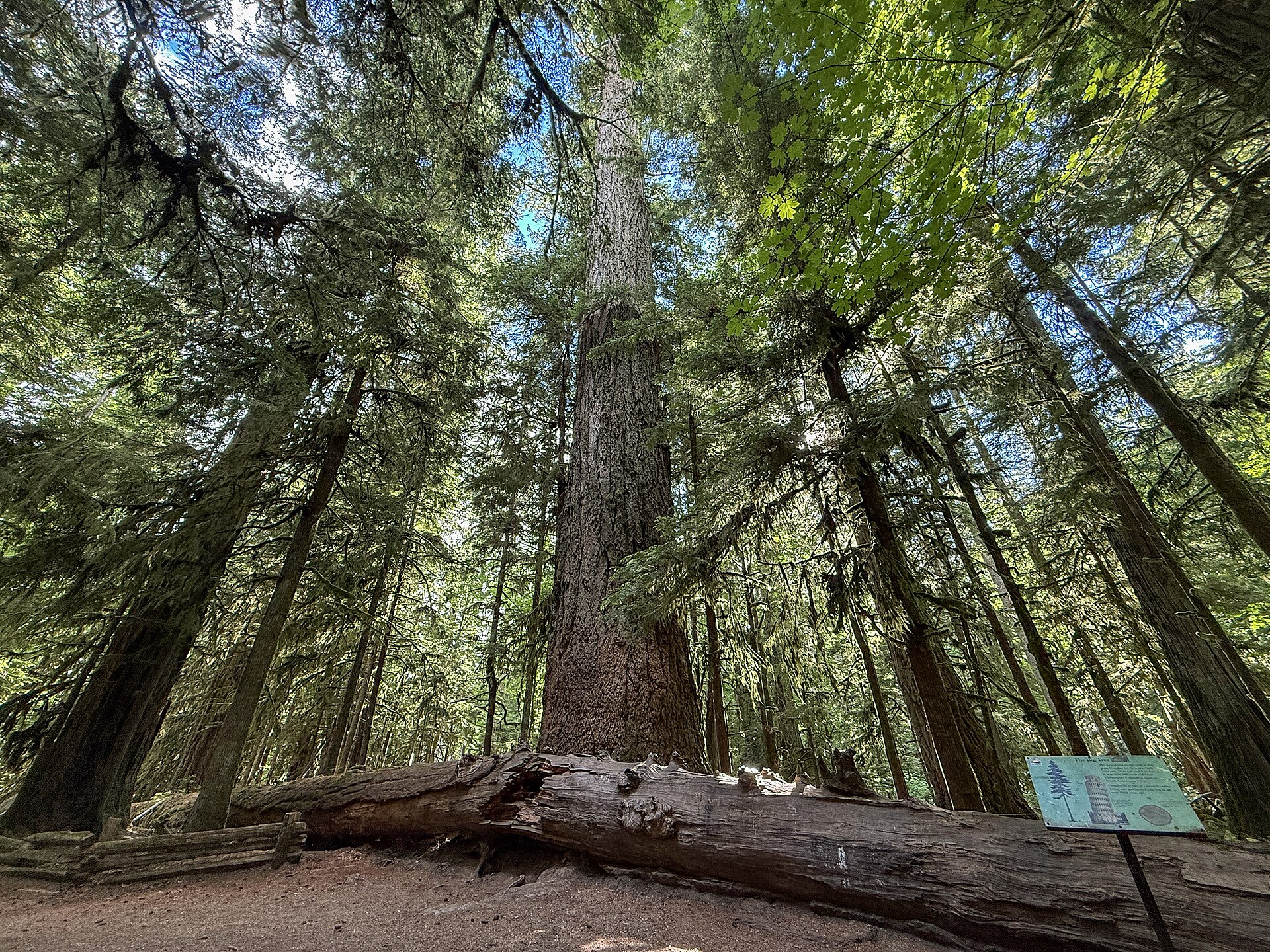
- Old Growth Trail — Cathedral Grove, MacMillan Provincial Park
The Old Growth Trail is the main loop through the grove, a short walk on boardwalk and packed earth beneath Douglas fir and redcedar. Fallen trunks lie where they dropped, wrapped in moss and sprouting young trees. Look at the ground as well as the canopy, because the rotting logs are where the next forest begins.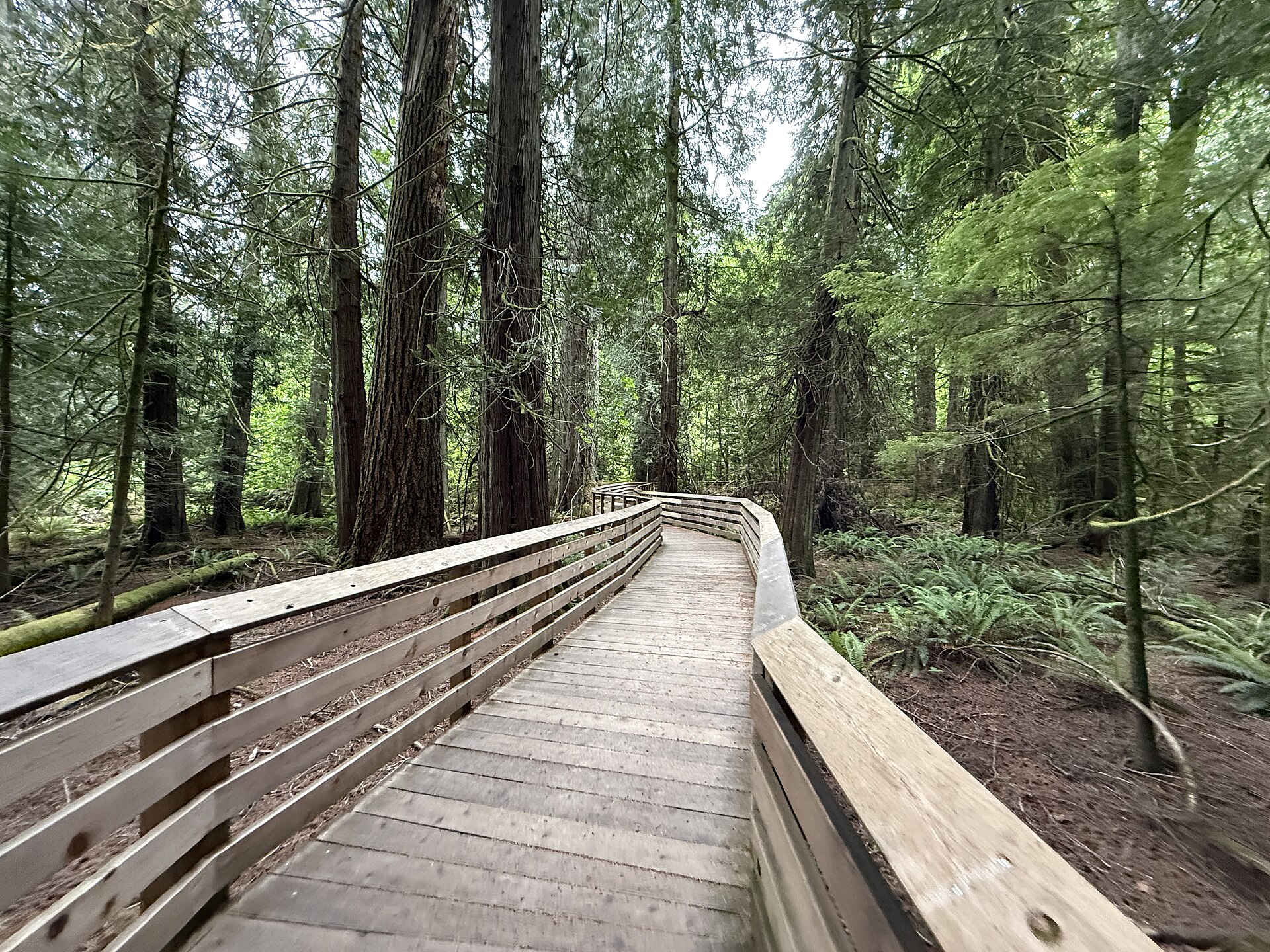
- Living Forest Trail — Cathedral Grove, MacMillan Provincial Park
The Living Forest Trail starts from its own signed entrance and offers a second, usually quieter route through the park. Information boards explain how an old forest renews itself, from seedlings on fallen logs to slow decay. It suits anyone who has finished the main loop and wants fewer people and more explanation.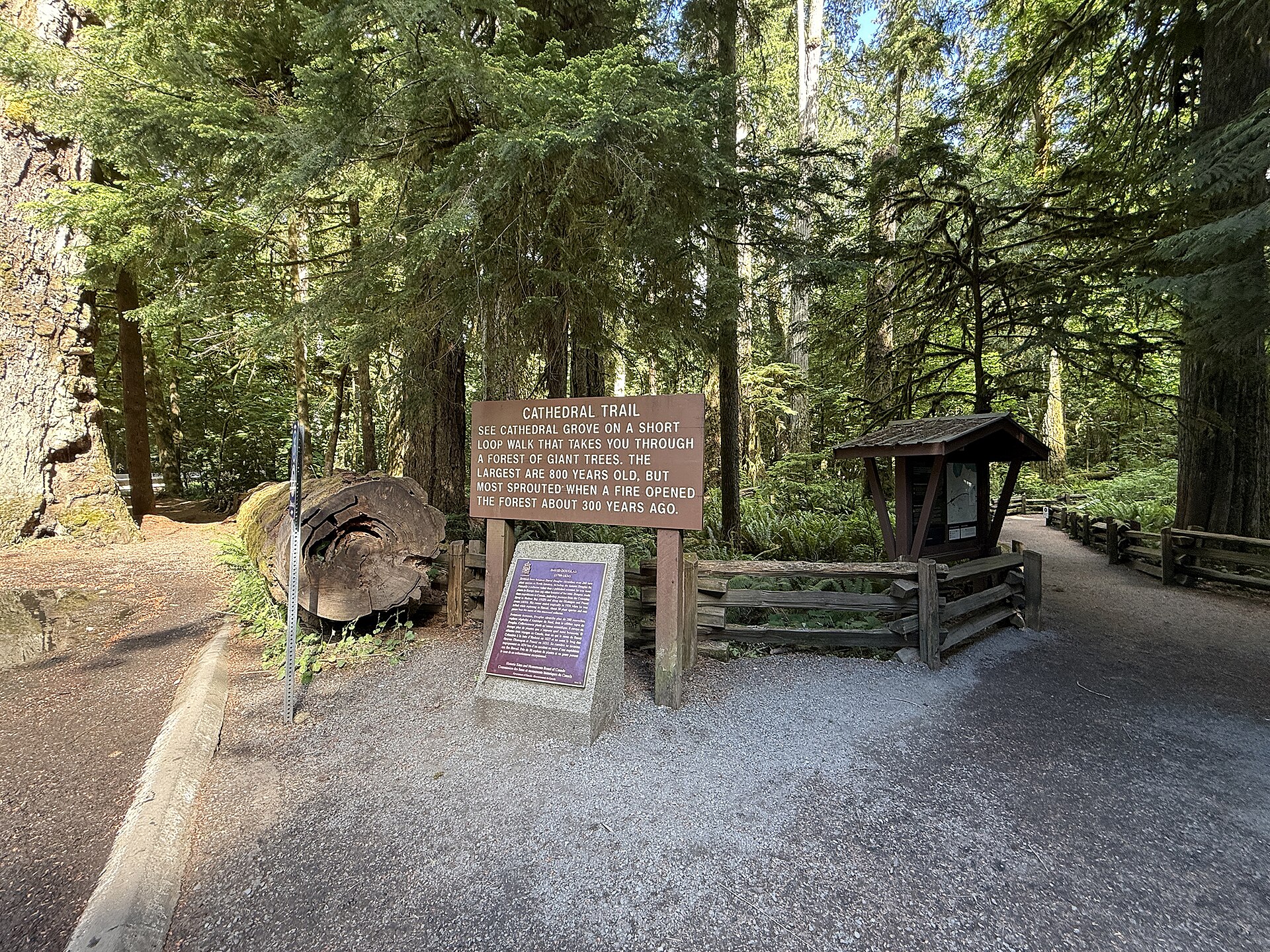
- Cameron Lake shore — Western edge of Cameron Lake, beside the park
Cameron Lake borders the park, and its shore is a bright counterpoint to the dim forest. The water is open, with hills rising behind, and the edge makes a good place for a picnic or a rest after the walk. Check the BC Parks website for current facilities and any access notices. - Cameron River delta — Within MacMillan Provincial Park
The Cameron River runs into the lake inside the park, building a delta of gravel and shallows that is protected along with the grove. Access is less obvious than the boardwalks, so look for signs. Upstream logging has left visible scars, so the contrast between protected and cut land is easy to read.
Culture
Cathedral Grove sits on Vancouver Island, where First Nations have lived for thousands of years, and the forest has a long human history rather than a purely wild one. Redcedars with stripped bark show that people harvested here, and the area is believed to have had ceremonial use. Along this coast, abundant salmon once supported settled communities with complex social structures, and cedar was central to daily life, from houses and canoes to clothing and rope. Today the island's Indigenous cultures remain very much alive, and visitors who want to learn more should look for First Nations-run cultural centres, galleries and tours elsewhere on the island rather than expect interpretation inside the grove. The grove also carries a more recent culture: the idea that a stand of trees can be a public possession. The name reflects the awe early motorists felt among the trunks, and the park exists because of public petitioning and a landowner's gift. Visitors tend to treat it with something close to churchlike restraint, with slow steps, low voices and a lot of looking up. Canadians generally wait their turn on narrow boardwalks, so a patient pause at a busy tree is normal and appreciated. Keep to the boardwalks and marked trails, do not climb on or scrape the roots and fallen logs, and keep your voice low so the grove stays quiet for everyone.
What to wear
Cathedral Grove lies in the homeland of coastal First Nations, whose traditional clothing drew on cedar. Woven cedar-bark capes and conical hats kept off the rain, and ceremonial regalia such as button blankets, made from wool cloth decorated with designs, is still worn at gatherings and celebrations. Coast Salish knitters on Vancouver Island are known for the thick hand-knitted Cowichan sweater, made from heavy undyed wool in bold patterns and worn in cool, damp weather. These are seen mainly at cultural events, in galleries and in shops selling Indigenous-made work, not as everyday dress. What people actually wear around the grove is outdoor gear: fleece, waterproof jackets, jeans or walking trousers, caps and sturdy trainers or boots. Nobody dresses up, and plain, practical clothes are the norm across the island. A visitor should dress in layers. Under the canopy it is cooler and damper than in the open, even on a bright day, and a light waterproof is worth carrying in any season. Choose shoes with good grip, because boardwalks and roots stay wet and slippery, and bring a hat and sunglasses for the lakeshore. There is no dress code and no modesty requirement, though visitors from warmer climates will want a warm top even in summer. Insect repellent is sensible in still weather.
What to eat
- Nanaimo bar — Bakeries and cafés in Nanaimo, on the drive from the ferry
The Nanaimo bar is a no-bake square with a crumbly chocolate-coconut base, a custard-flavoured middle and a hard chocolate top. It is the island's best-known sweet, named for the nearby city, and sold in nearly every bakery and café along the route to the grove. - Wild salmon — Harbour-side restaurants and fish shops in Port Alberni and Qualicum Beach
Salmon is the signature fish of the province and has fed coastal communities for centuries. Look for it grilled, smoked or baked on a cedar plank at harbour-side eateries and fish shops, and ask which species and catch is on offer that day. - Geoduck — Seafood restaurants on Vancouver Island and in Vancouver
Geoduck is a very large burrowing clam, a regional specialty that appears sliced raw as sashimi or cooked in soups and stir-fries. The texture is crisp and the flavour sweet and briny, so it suits adventurous eaters at seafood restaurants. - Island oysters — Shellfish stands and seafood eateries along the east coast of the island
Oysters are grown in the sheltered waters off the island's east coast and are sold fresh at roadside shellfish stands and in seafood eateries near Qualicum Beach. They are eaten raw with lemon or grilled, and make a good lunch after the walk. - Chinese dishes in Richmond — East Asian malls and the seasonal night market, Richmond, near Vancouver
Richmond, south of Vancouver, is known for its East Asian malls and affordable Chinese restaurants. Dim sum, noodles and street snacks are all easy to find, and the night market runs from April to October. It is a useful stop before the ferry.
Plan it
Best time. May–June and September–October are the best choices: the forest is green, the crowds are thinner than in July and August, and the weather is usually mild. Winters on the island's west side are wet, so pack rain gear whenever you go.
How long. 1
Getting there. Fly into Vancouver International Airport (YVR) or Nanaimo airport, then take a ferry to Vancouver Island and drive west towards Port Alberni; check the ferry operator's website for sailings. The grove is directly beside the main road, between Qualicum Beach and Port Alberni, so the last leg is a short walk from the car park.
Budget. low
Tips
- Go early in the morning or on a weekday, since parking fills quickly in summer and at weekends
- Check the official BC Parks site at https://bcparks.ca/macmillan-park/ for current access, facilities and notices before you set out
- Wear shoes with grip and carry a light waterproof, because boardwalks and roots stay wet
- Bring your own water and snacks, and combine the grove with a rest at Cameron Lake or a meal in Port Alberni or Qualicum Beach
Etiquette
- Stay on the boardwalks and marked trails to protect roots and soil
- Keep voices low and wait your turn at the best-known trees
Nearby
Sources
- Wikidata Q751854 (CC0)
- Wikipedia: MacMillan Provincial Park (rev 1374832401) (CC BY-SA 4.0)
- Wikivoyage: British Columbia (rev 5400129) (CC BY-SA 4.0)
- Photo: Cathedral Grove 2006 (Rdfr) (CC BY 3.0)
- Photo: The Big Tree in the Cathedral Grove (Canmenwalker) (CC BY 4.0)
- Photo: Relief map of Vancouver Island (Isochrone) (CC BY-SA 4.0)
- Photo: Physical location map of British Columbia (Carport) (CC BY 3.0)
- Photo: Cathedral Grove Old growth trail entrance (Canmenwalker) (CC BY 4.0)
- Photo: Cathedral Grove Old growth trail (Canmenwalker) (CC BY 4.0)
- Photo: Cathedral Grove Living Forest Trail entrance (Canmenwalker) (CC BY 4.0)
- Photo: 2017-06-24 Cathedral Grove (Darren Kirby) (CC BY-SA 2.0)


