Buddha Park
Buddha Park, Laos
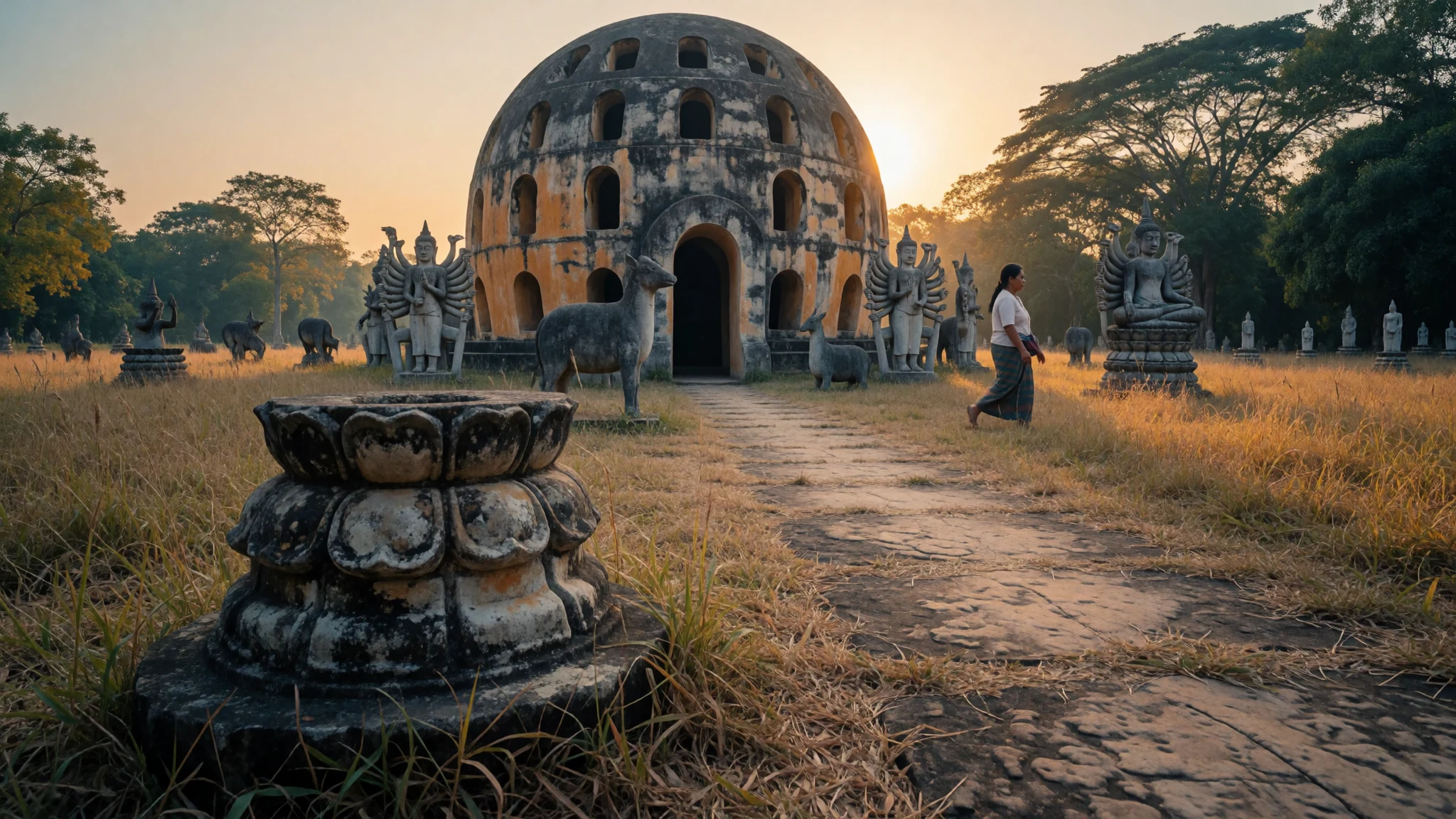
Buddha Park is a strange, open-air meadow of concrete gods and Buddhas by the Mekong, an easy half-day from Vientiane.
The place
Buddha Park, known locally as Xieng Khuan, sits in an open meadow beside the Mekong, a short drive southeast of Vientiane in Laos. The name translates as "spirit city", which suits the feel of the place: concrete figures of deities, humans and animals stand scattered across the grass, some weathered grey, some streaked green with moss and damp. Despite the alternative name Wat Xieng Khuan, it is not a working temple, only a sculpture garden that happens to be full of religious imagery. Hundreds of statues drawn from both Hindu and Buddhist traditions share the ground, so a multi-armed god may stand a few paces from a seated Buddha. The government runs the site as a visitor attraction and public park, and local people use it as an outing as much as foreign travellers do. The river lies just beyond the edge of the grounds, and the flat light over the water makes the sculptures look softer than the photographs suggest. Shade is limited, so the open ground gets hot by late morning for much of the year. The park is easy to cover in a couple of hours, and it pairs well with a morning of temples in the capital. It is quirky rather than grand, and its appeal lies in the scale and the handmade, improvised look of the figures rather than in any polished curation.
Its story
Buddha Park dates from 1958, when Luang Pu Bunleua Sulilat, a priest and shaman, began raising its first figures in a meadow by the Mekong. His own beliefs wove Hinduism and Buddhism together, and the park is that blend made physical: Hindu deities, Buddhist figures and mythical beasts stand in the same open ground, with no wall between them. The statues are cast in concrete, a cheap and forgiving material that let one determined builder work at a scale that stone carving would hardly have allowed. Over the decades the weather has done its own work, darkening the surfaces and giving the older pieces an ageing, overgrown look that is partly accidental. The place is also called Xieng Khuan, "spirit city", a name that hints at the idea behind it: a landscape where gods, people and spirits share space. Today it is not run as a monastery. The state operates it as a tourist attraction and public park, so what began as one man's religious vision is now part of the standard circuit around Vientiane. That shift has brought visitors and upkeep, and probably a certain tidiness, to what was once a field of experiments. The sculptures themselves remain odd, personal and a little unruly, and they still read as the work of one imagination rather than a committee.
What to see
- The three-storey sphere — Centre of the park
A large hollow sphere with a demon's open mouth for a doorway dominates the park. Inside, its three floors stand for hell, earth and heaven, and narrow stairs climb through them to the top. The upper level gives a view over the statues and the Mekong meadow, so it is worth saving for the end of the visit.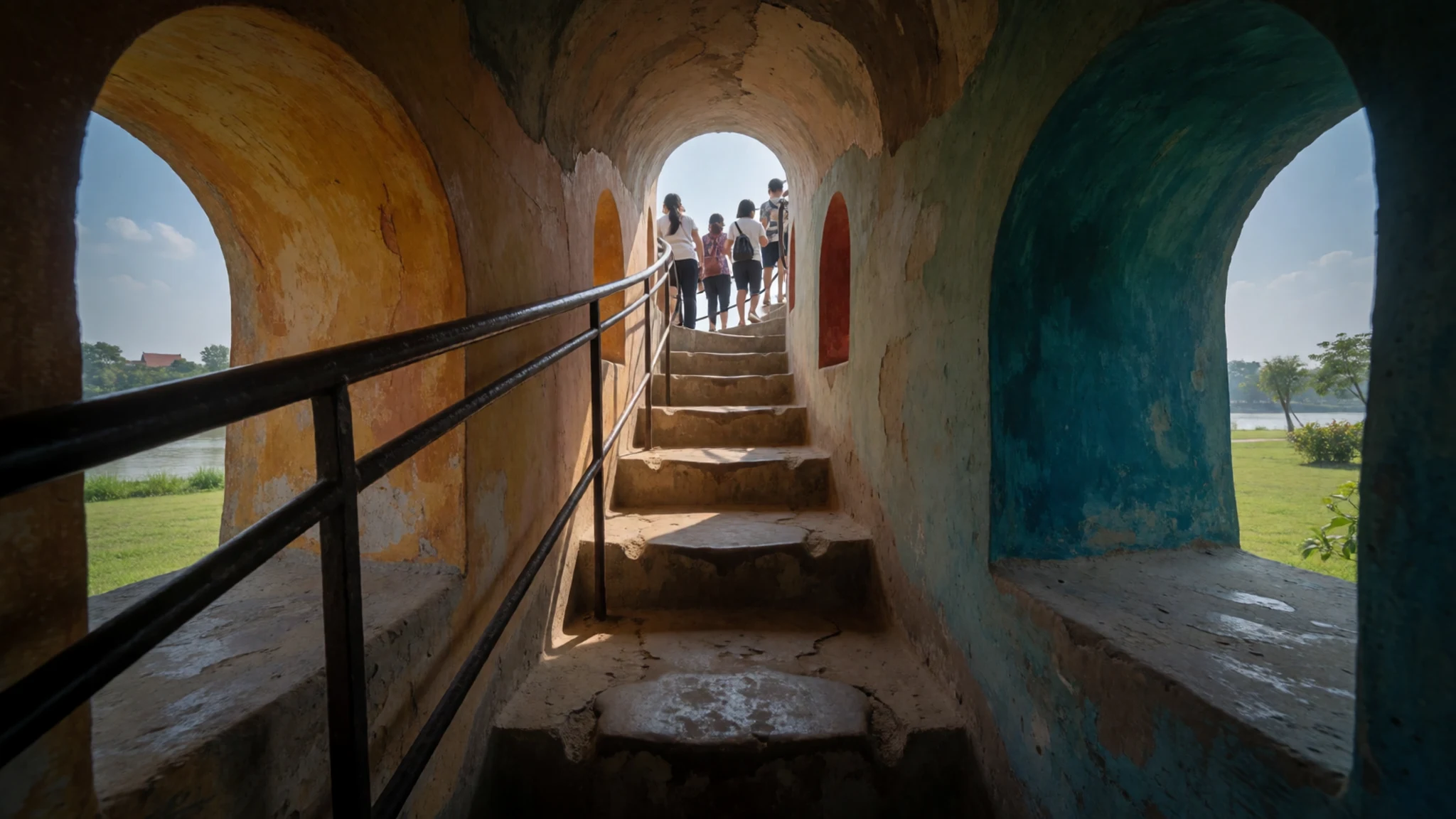
- The reclining Buddha — Main lawn
A long reclining Buddha lies on its side in the grounds, head propped on one arm in the traditional pose. It makes a good place to judge the scale of the garden against the human visitors beside it. Early morning light along the weathered concrete is kinder than the harsh glare at midday.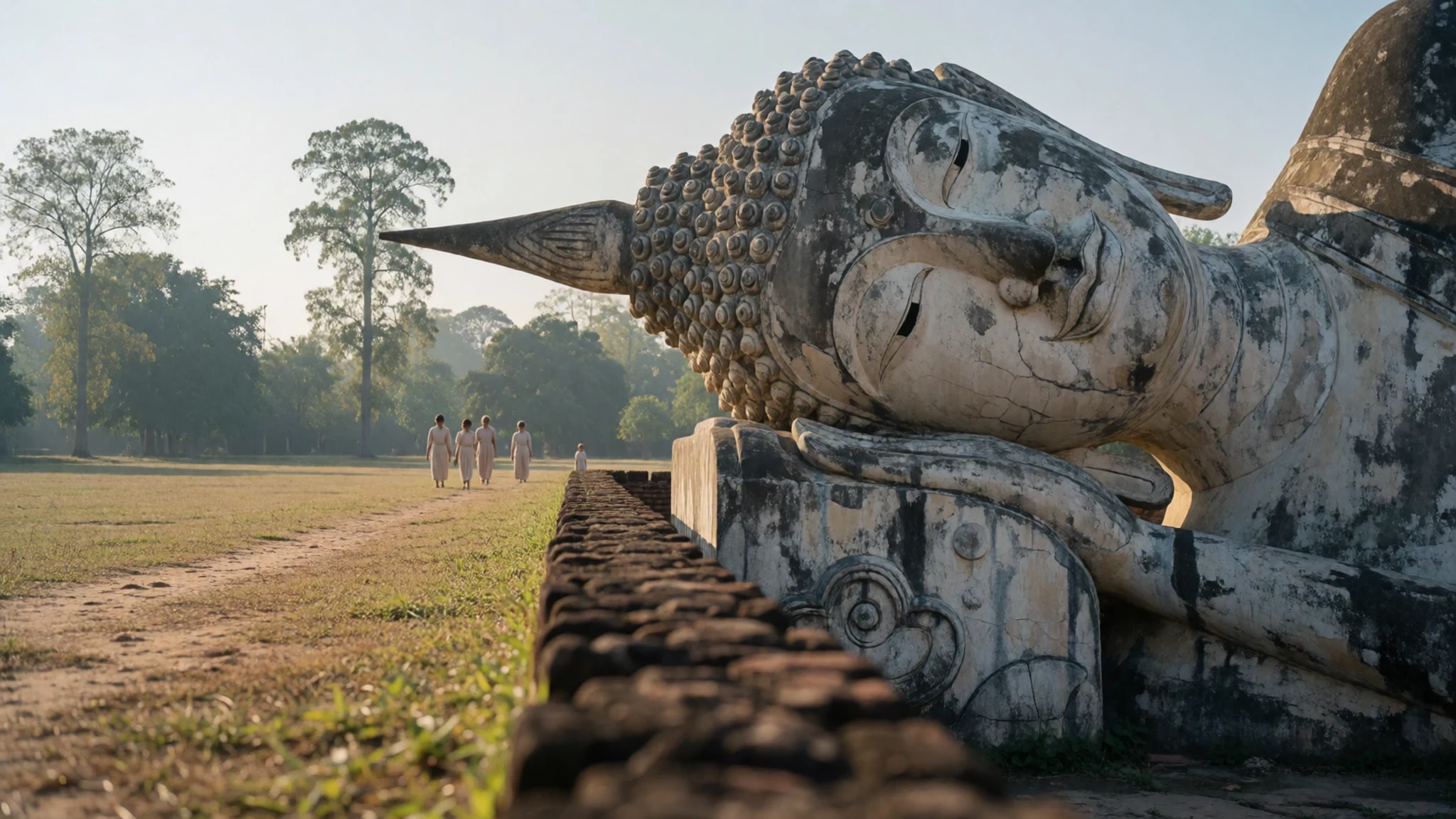
- Bhūmī-Devī, Mother Earth — Among the central sculptures
The statue of Bhūmī-Devī represents the earth goddess, whom Buddhist tradition calls on as witness to the Buddha's awakening. She is one of the clearest examples of the park's mix of beliefs, since a figure from the Buddhist story stands here among Hindu gods and guardians.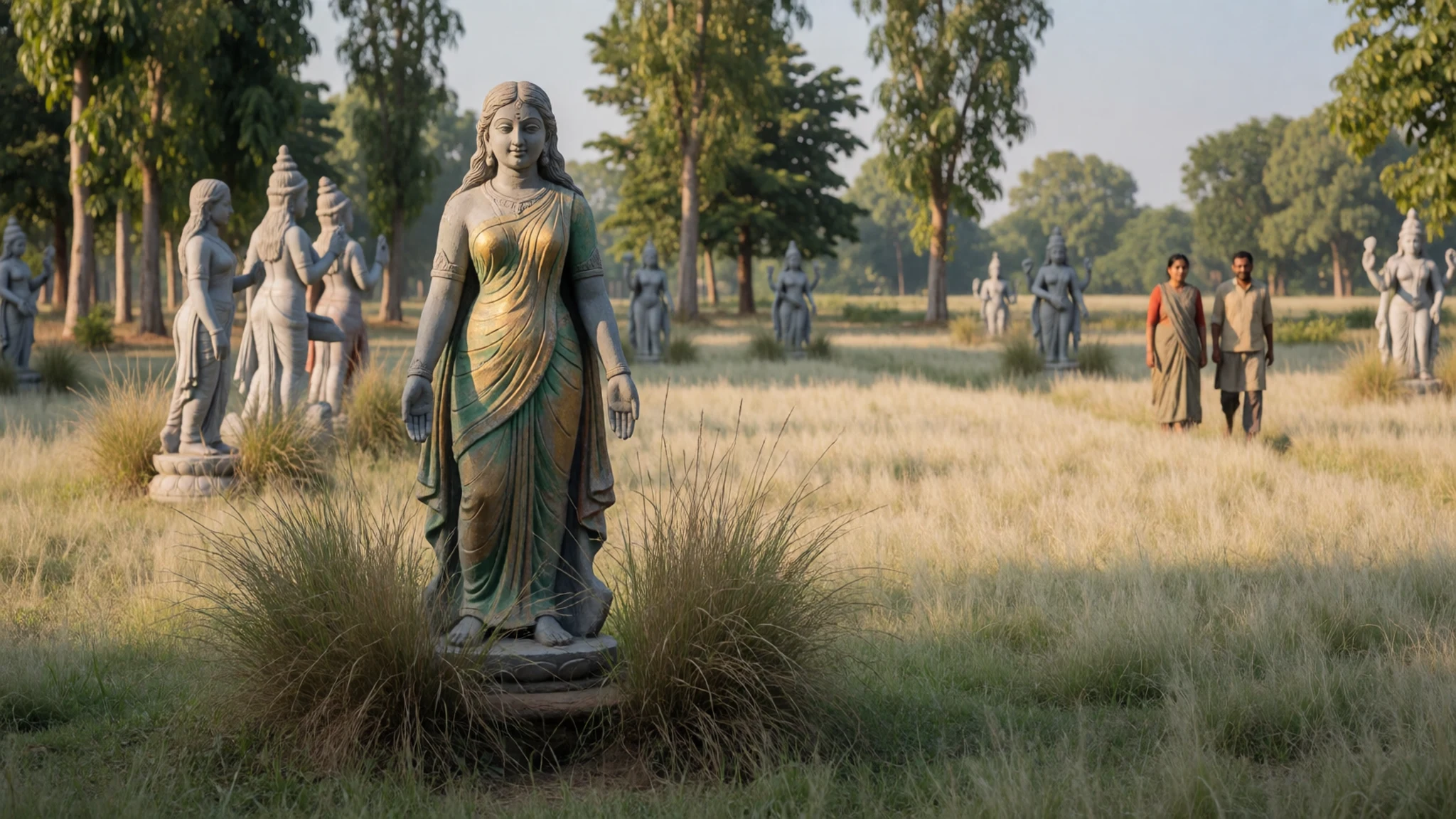
- Hanuman — Open meadow
The monkey god Hanuman, hero of the Ramayana, appears in the park in the same painted and weathered concrete as the Buddhas. His presence is a reminder that Hindu epics have long been part of Lao art and storytelling, and he is a favourite subject for visitors' photographs.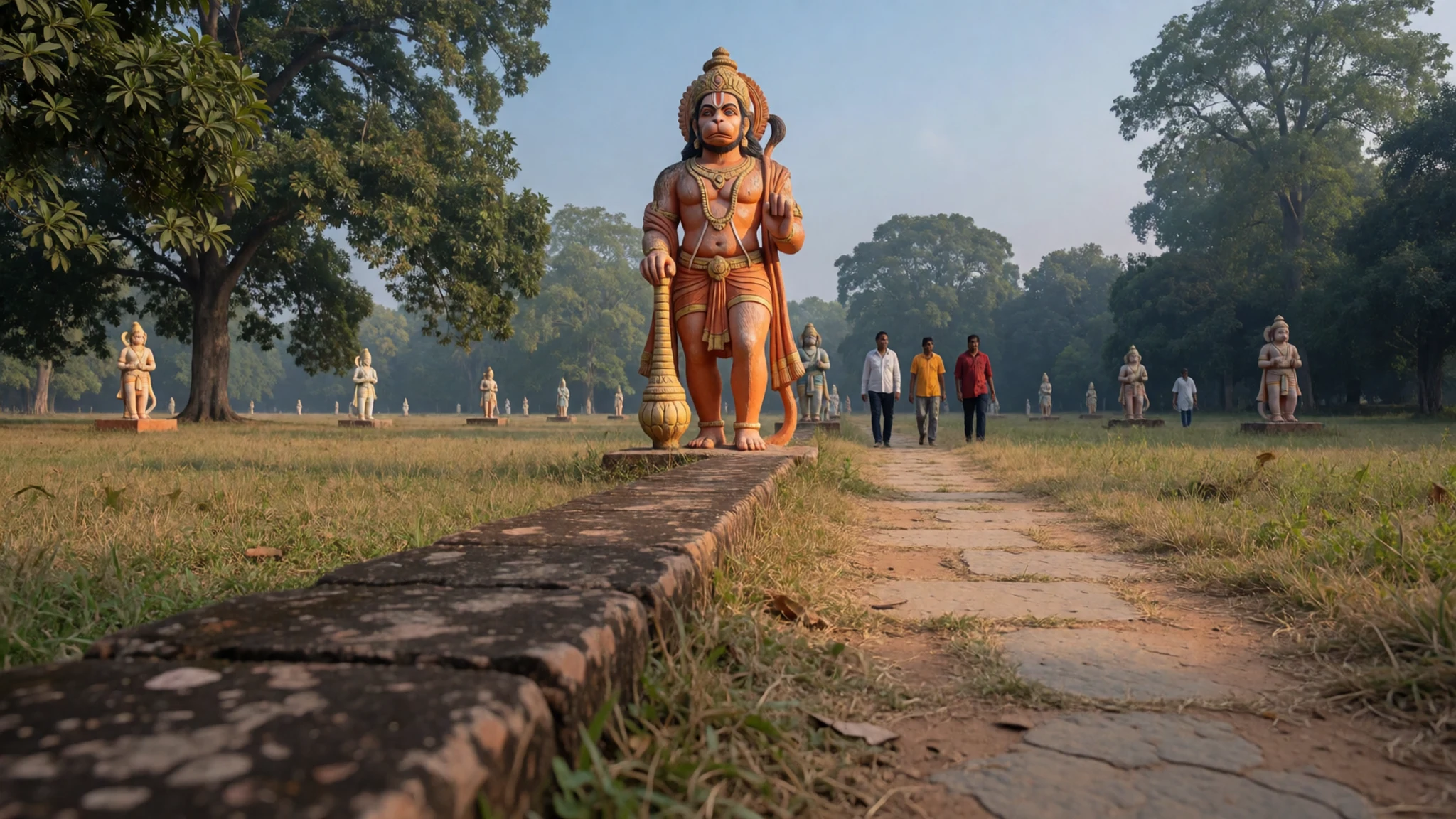
- The many-armed deities and giant heads — Throughout the grounds
Scattered across the grass are large heads, fierce guardians and deities with many arms, many of them stained dark by years of rain. Wandering without a fixed route works best here, since each turn reveals another odd figure, and the older pieces have the most character.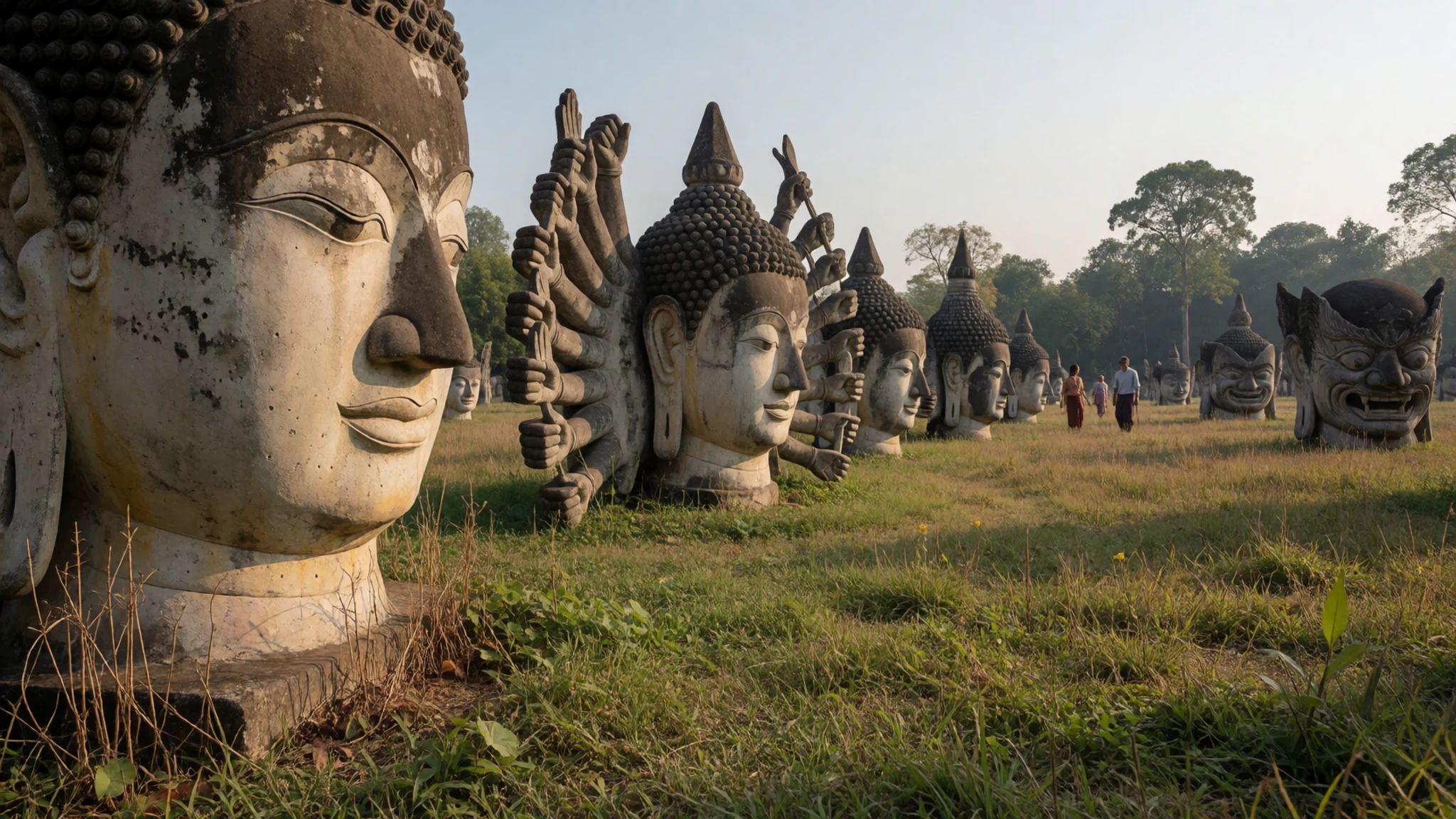
Culture
Buddha Park sits in a Lao cultural setting where Theravada Buddhism shapes daily life, yet the park itself is a deliberately mixed space. The founder, Luang Pu Bunleua Sulilat, treated Hindu and Buddhist figures as parts of one story, and that blending is easy to recognise in the sculptures: deities, a Buddha, Hanuman and Mother Earth all share the same field. Hindu epics, especially the Ramayana, have long been part of Lao art, dance and storytelling, so the imagery is less foreign to local visitors than it may seem to outsiders. The park is not a temple, but many Lao people still treat Buddha images with respect, offering a bow, a small gift or a moment of quiet. Families come for outings, and the mood is relaxed rather than solemn. Spirit beliefs also run through Lao life alongside Buddhism, which fits the name Xieng Khuan, meaning "spirit city". Visitors will see the same mixture across Vientiane, where temples, shrines and spirit houses sit side by side. Do not climb on the statues or pose in disrespectful ways with the Buddha figures, and keep your voice low near anyone who stops to pray.
What to wear
Around Buddha Park, as across Laos, the traditional woman's garment is the sinh, a wrapped tubular skirt of handwoven silk or cotton, usually finished with a patterned border. It is paired with a blouse and sometimes a pha biang, a narrow woven shawl worn over one shoulder. Lao weaving varies by region and community, and the best pieces carry motifs passed down through families. The sinh is worn for festivals, weddings, temple visits and, in many offices and schools, as everyday formal dress. Men's traditional clothing is less often seen now and tends to appear at ceremonies. On an ordinary day in Vientiane, people mostly wear what is common across Southeast Asia: light shirts, T-shirts, trousers and jeans, with sandals or trainers. Visitors should dress for heat and open ground. Wear breathable cotton or linen, a hat and sunscreen, and comfortable closed shoes or sturdy sandals, because the grass and concrete paths can be uneven and damp after rain. Buddha Park is not a temple, but covering shoulders and knees is a sensible courtesy near Buddha images and when you visit wats elsewhere in the city. In the rainy season a light waterproof layer is more useful than an umbrella on exposed ground, and insect repellent helps near the river.
What to eat
- Khao niao and ping kai — Roadside eateries on the way from Vientiane, and city markets
Sticky rice, eaten by hand from a small basket, served with grilled marinated chicken. This is a standard Lao meal, and it suits a day out because it is filling and easy to share. Look for it at roadside eateries and market stalls.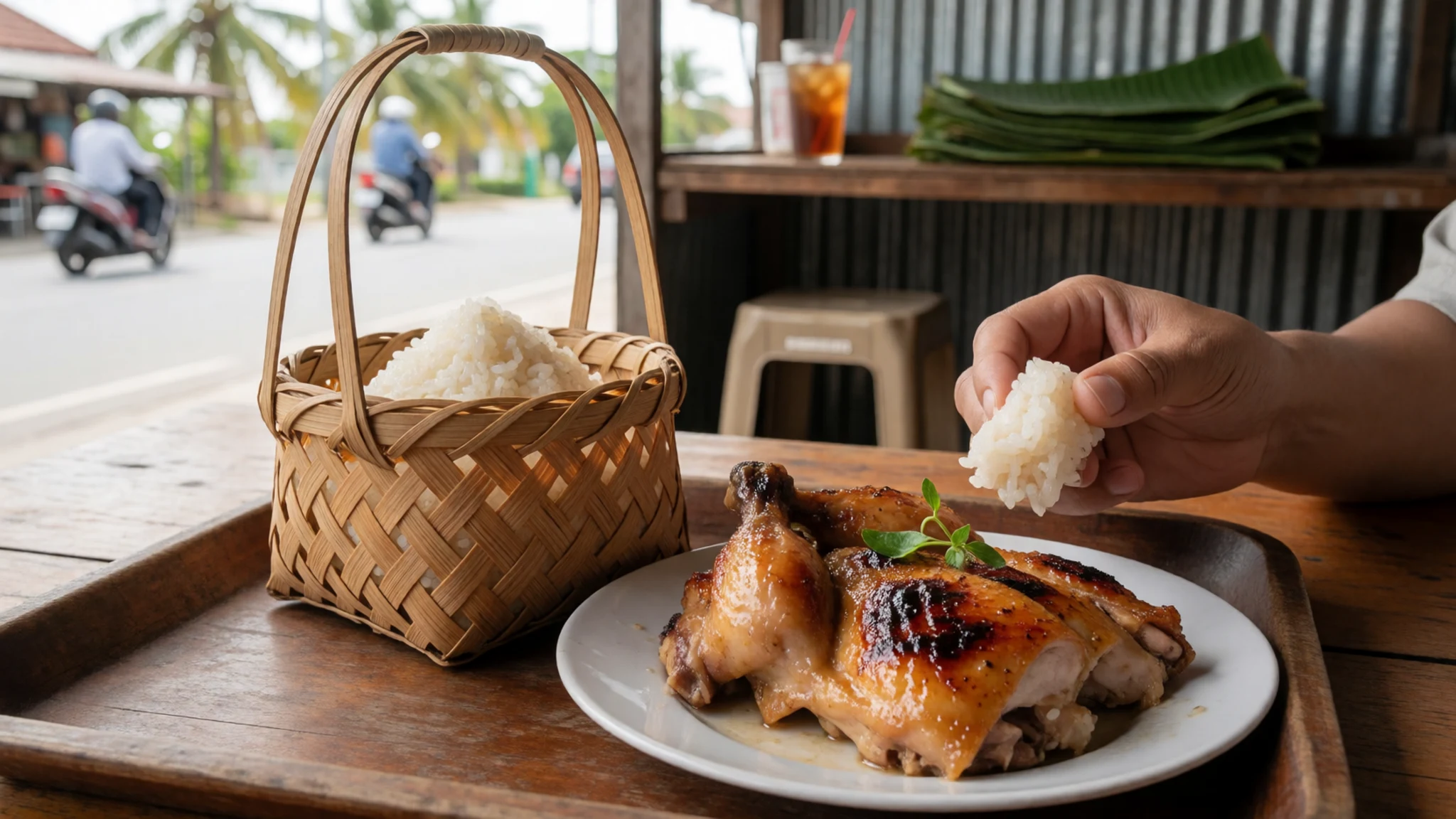
- Tam mak hoong — Market stalls and simple eateries in Vientiane
Lao-style papaya salad, pounded in a mortar with chilli, lime, fish sauce and often a fermented fish seasoning. It is sharper and funkier than the Thai version many visitors know. Ask for less chilli if you are cautious.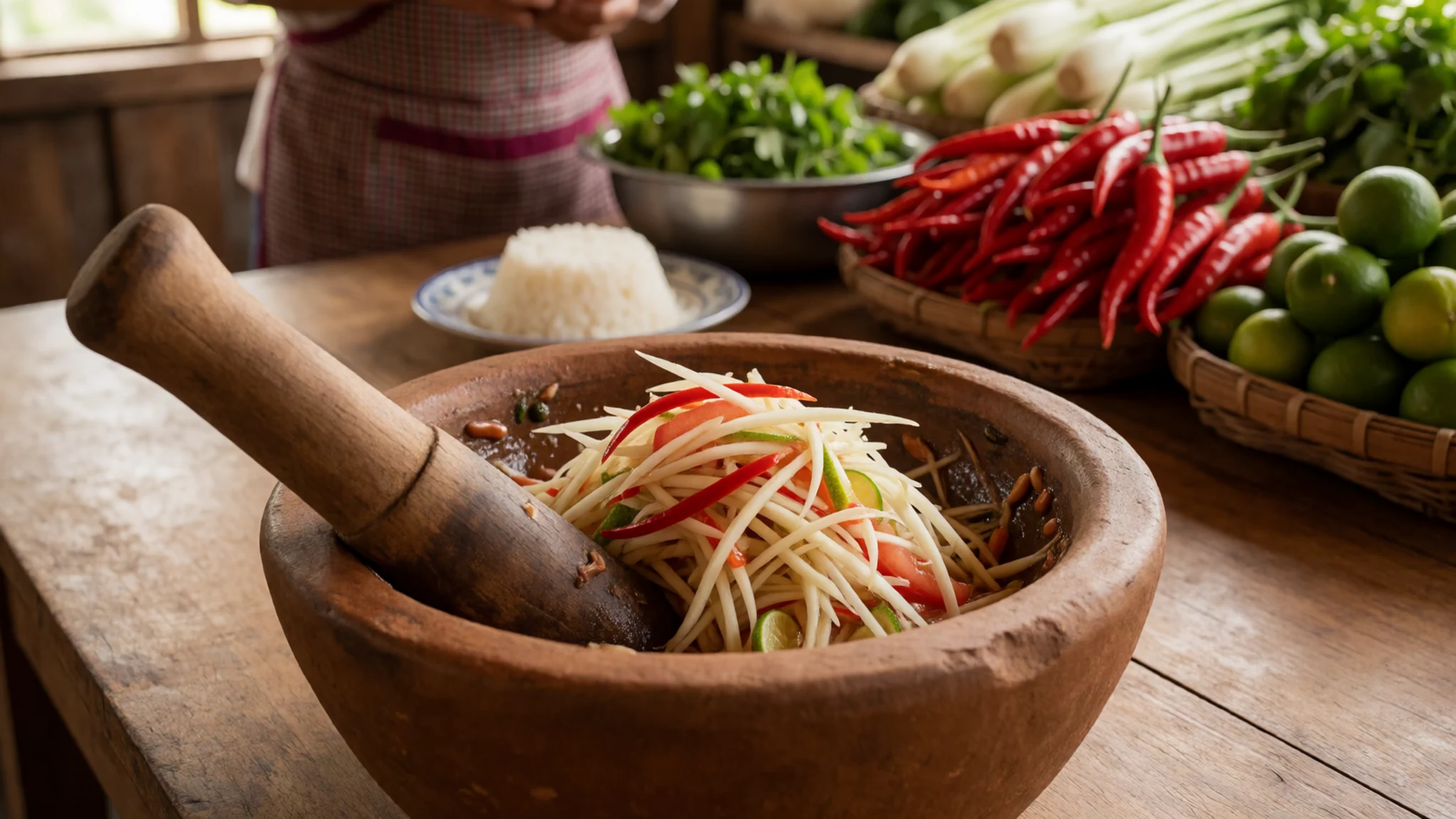
- Laap — Local eateries across Vientiane
A minced meat salad, typically of chicken, pork or fish, dressed with lime, herbs and toasted ground rice. It is eaten with sticky rice and raw vegetables. Flavours are bright and herbal rather than heavy, and it is a good first Lao dish. - Khao piak sen — Morning markets and noodle shops in the capital
A comforting noodle soup of thick, chewy rice noodles in a clear, savoury broth, usually with chicken or pork. It is a common breakfast, so it fits an early start before heading out to the park. - Khao jee pâté — Street-side bakeries and sandwich stalls in Vientiane
A Lao baguette sandwich, a legacy of French influence, filled with pâté, cold cuts, vegetables and chilli sauce. It makes a cheap, portable lunch for a day at the park, where shade is limited.
Plan it
Best time. November to February is the most comfortable window, being cooler and drier, which matters in a park with little shade. March to May is hot, and the rainy season brings downpours and muddy paths, though greener scenery.
How long. 1
Getting there. Fly into Wattay International Airport in Vientiane. From the city centre the park is a short ride southeast along the Mekong, by taxi, tuk-tuk or local bus; confirm the current bus route and a fair tuk-tuk fare with your guesthouse before you set off.
Budget. low
Tips
- Go early in the morning to avoid the heat and the tour groups
- Carry water, a hat and sunscreen, since shade is limited
- Climb the sphere's stairs only when it is not crowded, as the passages are narrow
- Carry some cash for entry, snacks and local transport, and check the current entrance details locally before you go
- Agree the return trip with your tuk-tuk driver in advance, or ask them to wait
Etiquette
- Do not climb on the statues or pose disrespectfully with Buddha figures
- Dress modestly, covering shoulders and knees
- Keep noise down near anyone praying or leaving offerings
Nearby
Sources
- Wikidata Q655853 (CC0)
- Wikipedia: Buddha Park (rev 1376988233) (CC BY-SA 4.0)
- Wikivoyage: Vientiane (CC BY-SA 4.0)
- Photo: The Buddha Park near Vientiane, Laos (Dezwitser) (CC BY 3.0)
- Photo: Xieng Khuan Buddha Park (Tango7174) (CC BY-SA 1.0)
- Photo: Xieng Khuan (GuillaumeG) (CC BY 3.0)
- Photo: Buddha Park statues (Mark Fischer) (CC BY 2.5)
- Photo: Buddha Park head (Paul Stevenson) (CC BY 2.5)
- Photo: Bhūmī-Devī statue (Jakub Hałun) (CC BY-SA 4.0)
- Photo: Giant sculpture, Buddha Park (Jakub Hałun) (CC BY-SA 4.0)
- Photo: Hanuman statue (Jakub Hałun) (CC BY-SA 4.0)


