Liuwa Plain
Liuwa Plain, Zambia
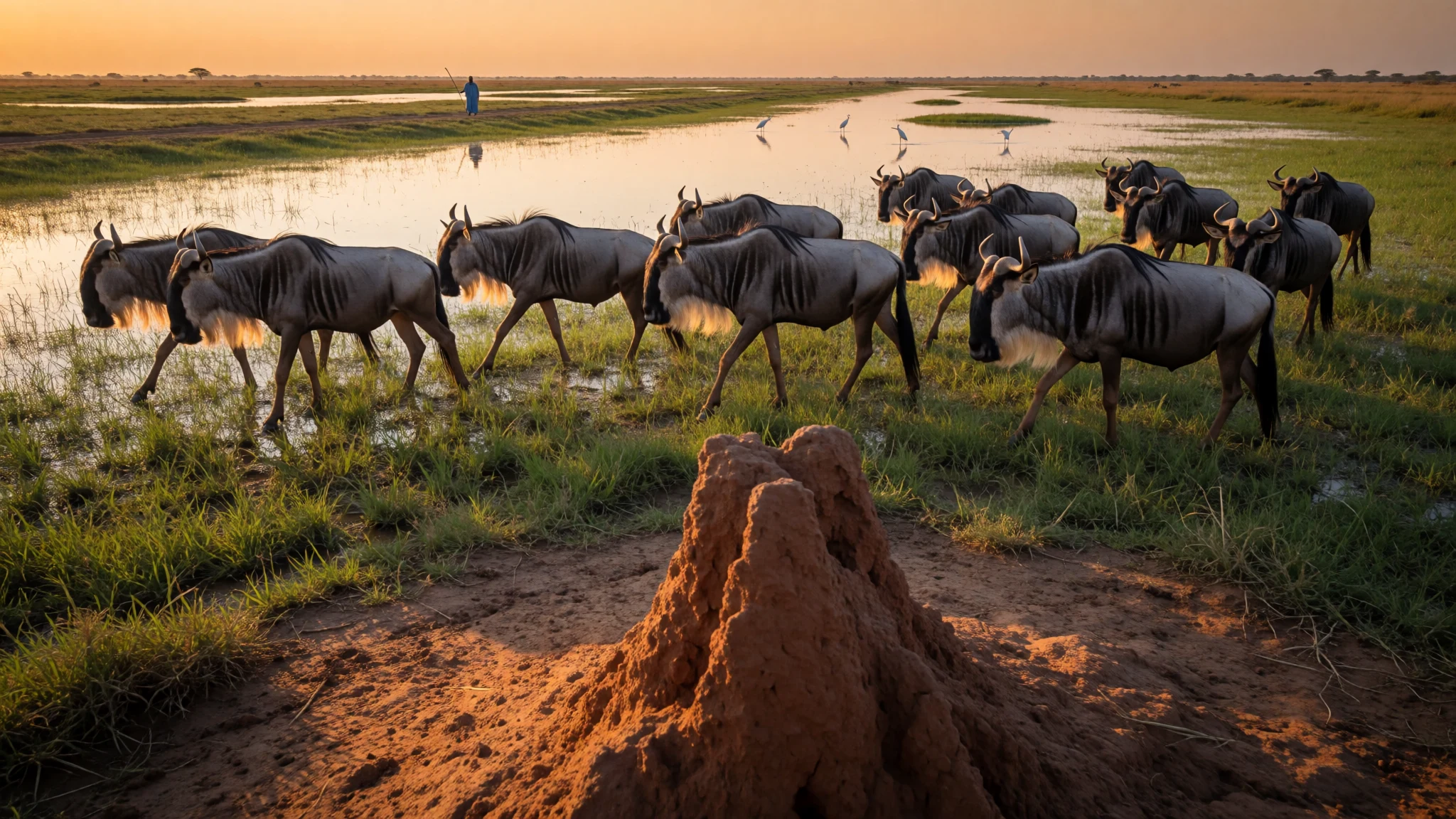
Liuwa Plain is a wide Zambian floodplain where wildebeest gather with the rains and lions still cross an open horizon.
The place
Liuwa Plain lies in western Zambia, a grassland under shallow water for part of the year and open range for the rest. The land is nearly level, broken by termite mounds, pale pans and small islands of trees. In the dry months the grass thins to gold and the tracks set hard. When the rains return the plain greens, the pans fill, and a journey becomes a reading of water as much as of road.
The protected area sits in Western Province, in the country of the Lozi people of Barotseland, near the border with Angola. Villages, cattle and wildlife share a floodplain. That sharing is the character of Liuwa Plain: a national park that is also a lived landscape, with homesteads and grazing on the same wide grass. A game drive passes the signs of herding and fishing as often as it passes a herd.
The animals are those of open country. Blue wildebeest and zebra range the grass, with oribi and tsessebe among the smaller antelope. Spotted hyenas are commonly the predator a party actually sees. Lions, carrying the memory of the lioness called Lady Liuwa, mark a long effort to put a pride back where lions had nearly disappeared. Other large predators turn up far less often than the hyenas. Where water stands, cranes, storks and waders gather on the pans, and raptors hang over the mounds.
Camps are few and the sky fills the view. Nights stay quiet until hyenas call or thunder walks the wet-season horizon. Liuwa Plain suits travellers who can accept dust, mud and animals that keep no timetable.
Its story
Liuwa Plain has stories that meet on the same grass: a royal hunting landscape of the Lozi kingdom, and a lioness who came to stand for what that landscape had lost. For generations the plain was linked to the Litunga, the Lozi king, and treated as a ground of the court rather than an open commons. People still speak of the park in that light. Protection sits beside traditional authority, and the name of Liuwa Plain is heard together with the Barotse court.
Through the later decades of the last century, hunting and insecurity thinned the larger animals. Lions dwindled until a single lioness remained, known to scouts and researchers as Lady Liuwa. She crossed the grass alone for a long time, and her solitary life made the emptiness of the pride impossible to ignore. Lions were brought from elsewhere to rebuild a population, and her name is still what travellers ask for, even though the animals on the plain now are a pride rather than a single cat.
Liuwa Plain belongs to the upper Zambezi flood. Rain on the grass and water from upstream spread across the plain, and Lozi life has long been arranged around that rise and fall. The Kuomboka, the Litunga's move from a flooded royal valley to higher ground, is a public form of a habit every household already keeps: when the water comes, sleep, grazing and the usable path all change.
Conservation has had to work inside that habit, with people who fish, herd and plant on the same seasons as the wildebeest. Recent chapters turn on agreement: local scouts, traditional leadership, and visits meant to keep a living landscape intact.
What to see
- Wildebeest on the grass — open pans across the plain
Liuwa Plain draws people for the seasonal gathering of blue wildebeest as rain greens the grass. Herds spread over pans and short grazing, so a day here is a search of the horizon rather than a wait at a riverbank. Zebra often travel with them. In a thin year the animals sit far apart; once pans hold water the groups show more clearly from a mound.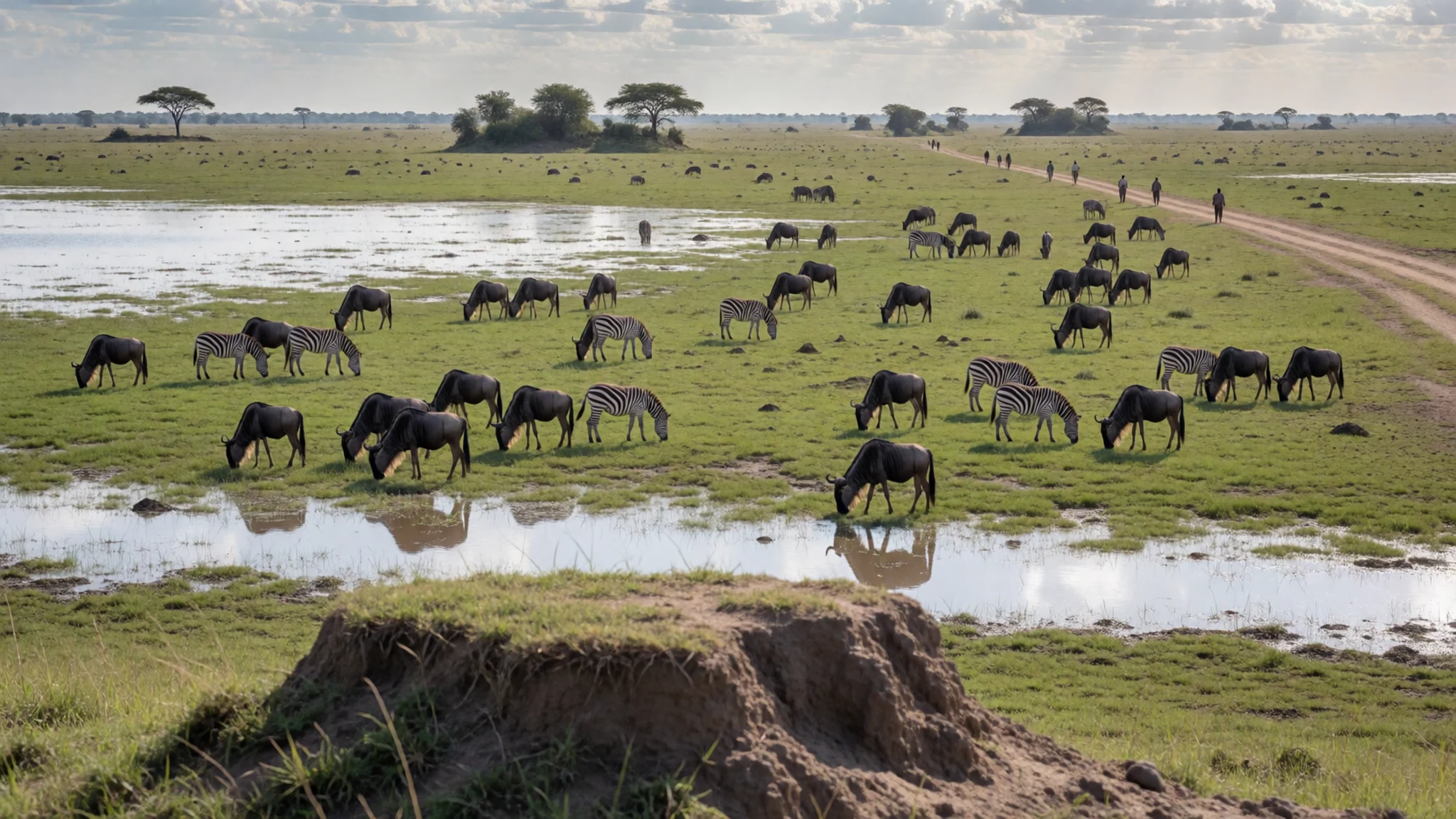
- Lions and the Lady Liuwa story — wooded islands and open grass
On Liuwa Plain the lion story is still told through Lady Liuwa, the lioness who remained when the pride had thinned to almost nothing. She is gone, and the cats sought today belong to the pride built after lions were brought back onto the grass. Sightings stay uncertain: the plain is wide, and the animals shift between mounds, cover and the edge of a pan.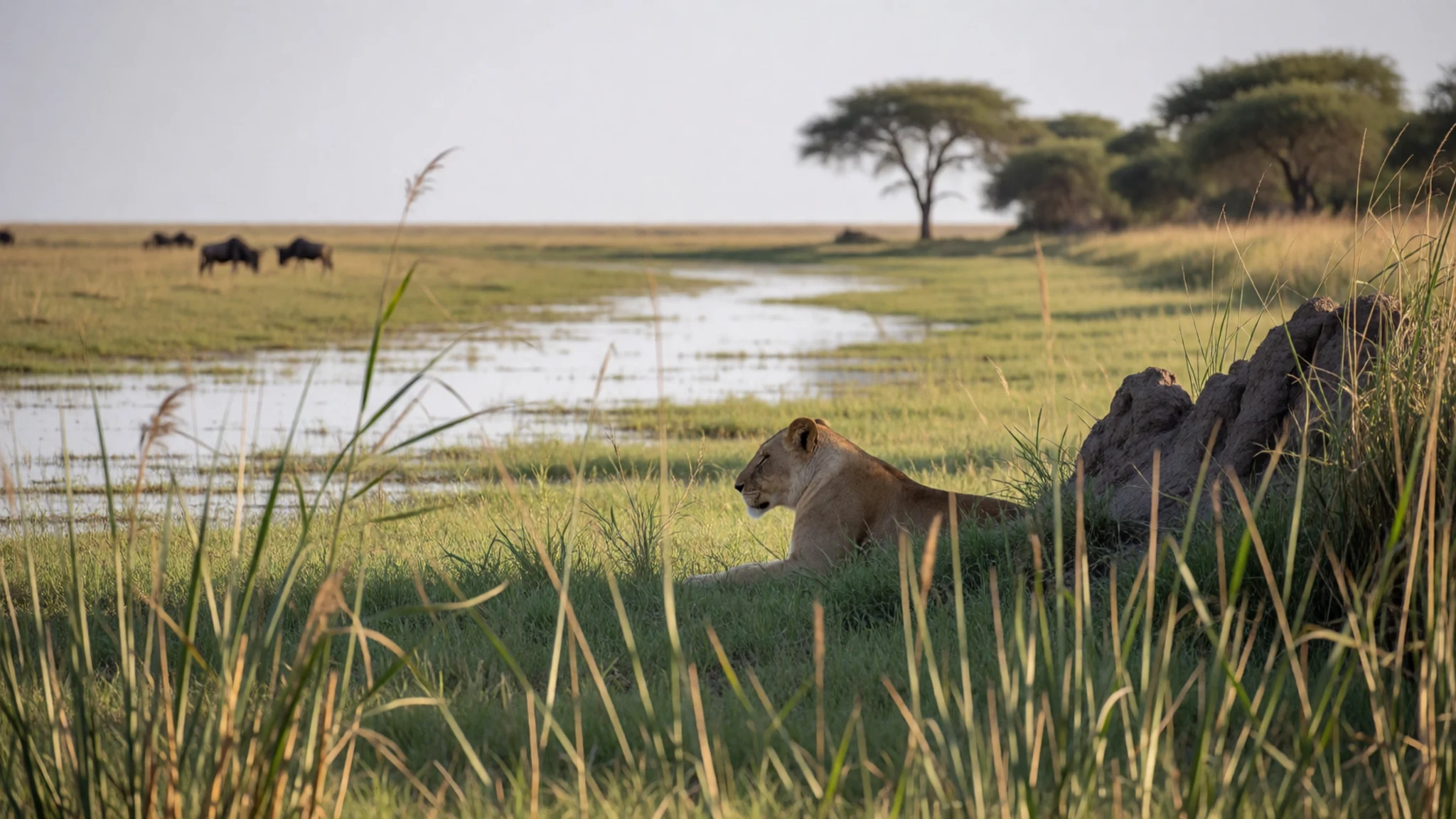
- Spotted hyenas — dens and night tracks on the plain
Spotted hyenas are large carnivores that parties on Liuwa Plain often meet. Clans use the open grass, the mounds and the verges of pans, and they are active enough in daylight that a drive can find them without waiting for dark. Cubs at a den are sometimes watched from a respectful distance. At night their whoops carry far and steer the next morning's drive.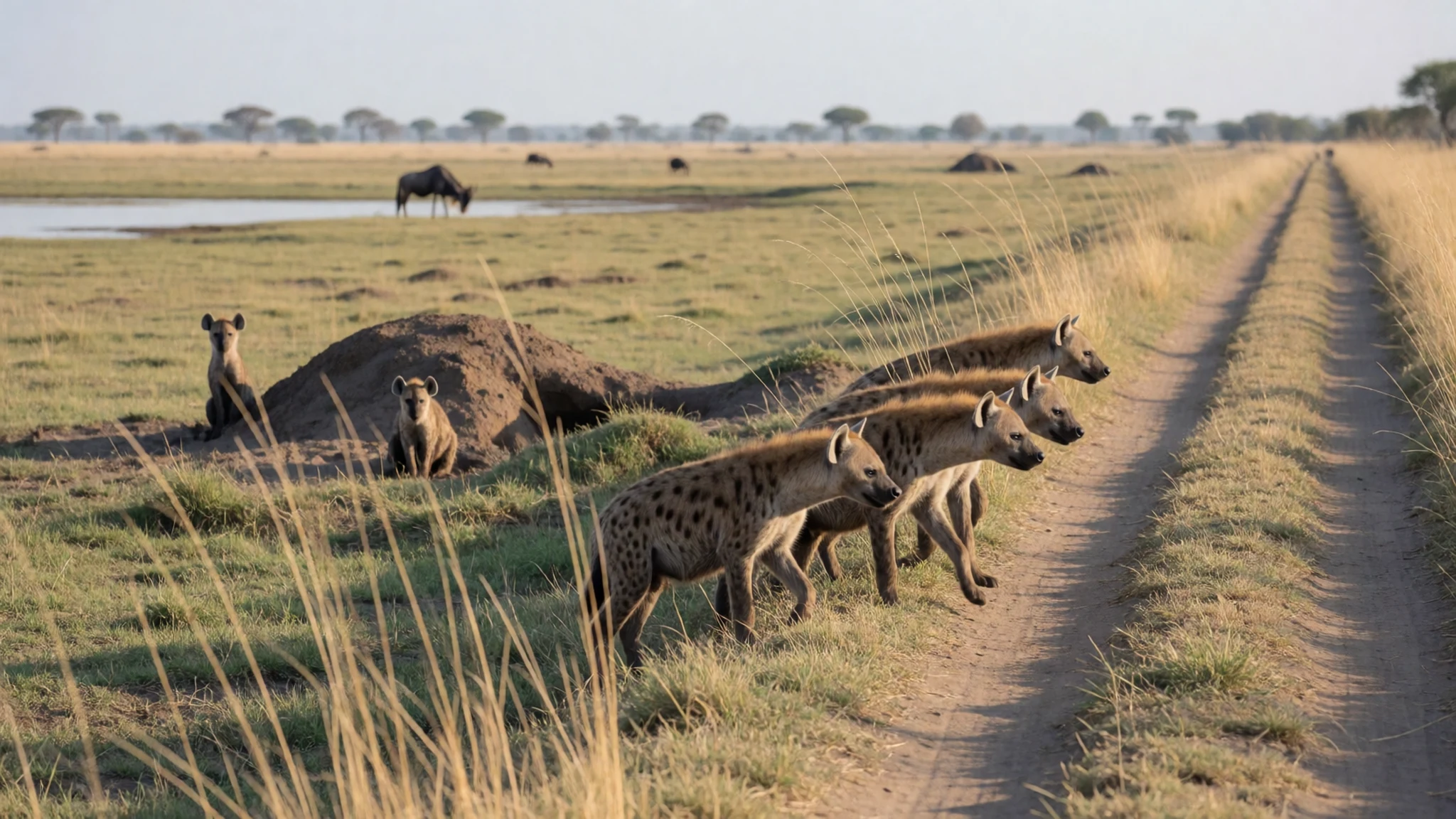
- Pans and waterbirds — seasonal pans and shallow floodwater
When rain sits on Liuwa Plain, the pans become the other reason to slow down. Cranes, storks and flocks of waterfowl use the shallows, and waders work the mud as the water rises or falls. A mound or a slow loop along a drying edge gives a wide view without pushing the birds into flight.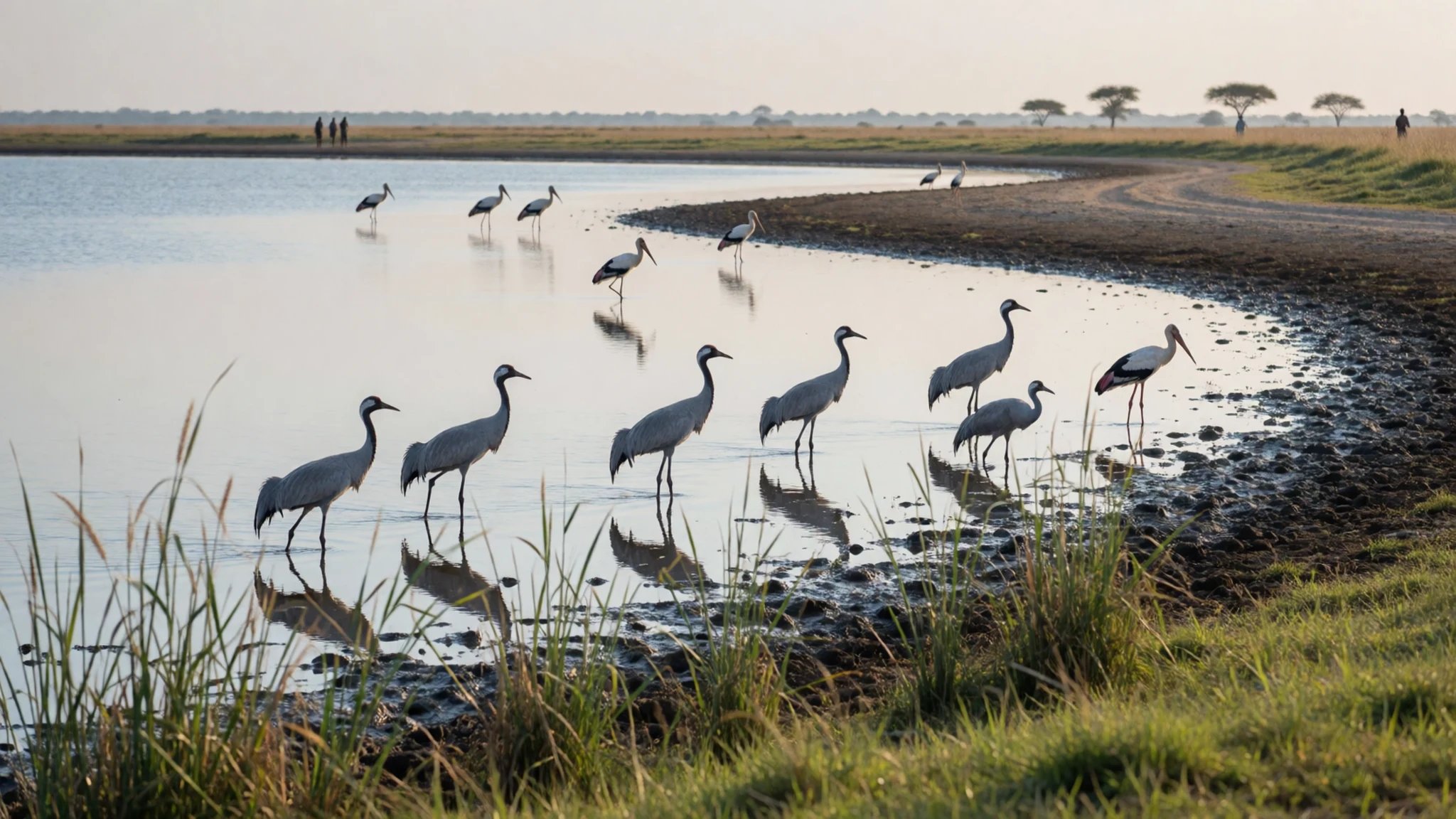
- Sleeping under a wide sky — community camps and small lodges on the plain
Staying on Liuwa Plain is itself part of what there is to see. Community camps and a handful of small lodges sit with almost nothing between the tent and the horizon, so sunrise and sunset are the daily events. Nights are dark enough for a full bowl of stars when cloud stays away.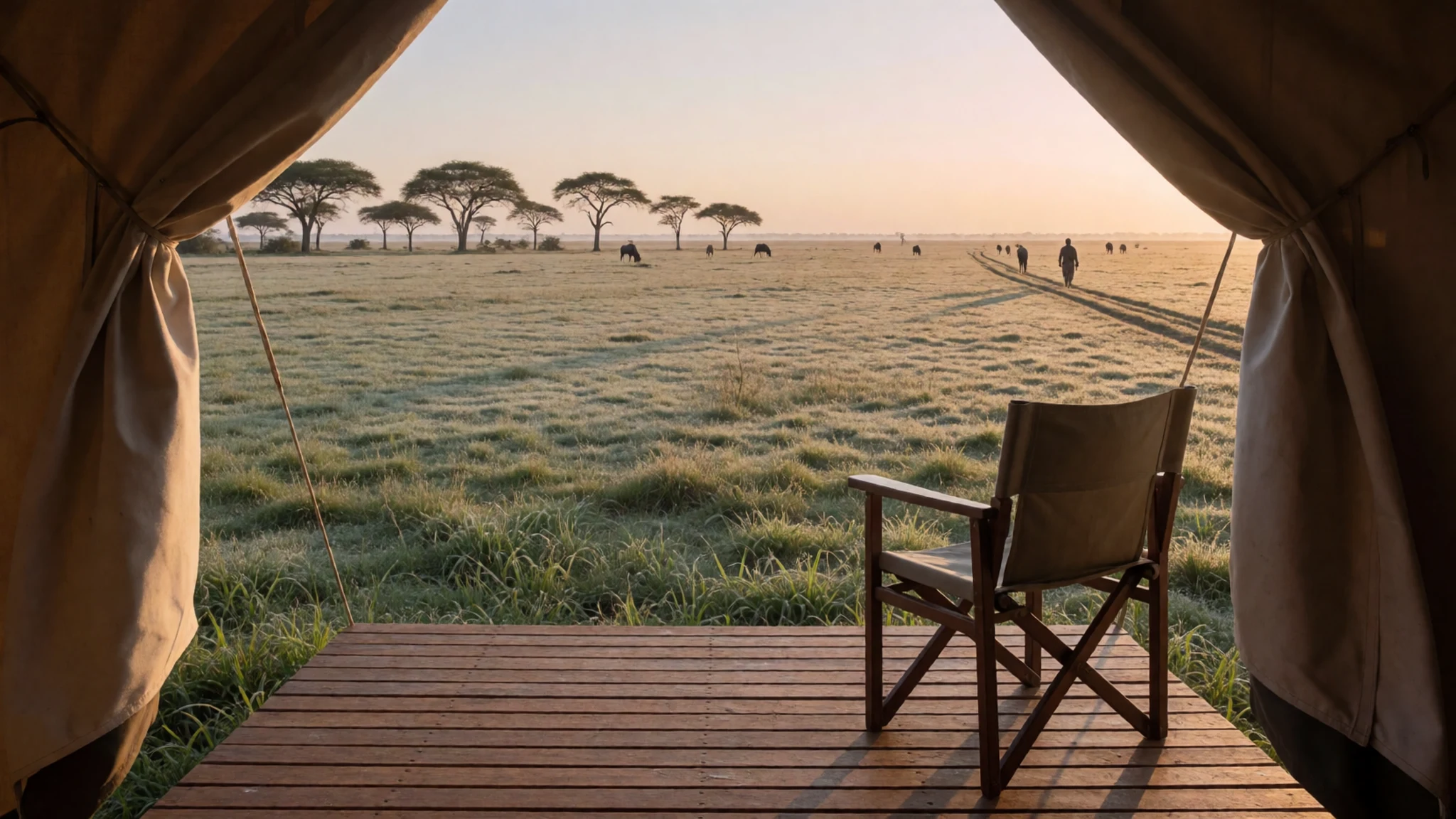
Culture
Liuwa Plain is Lozi country, in the Barotse floodplain of western Zambia, and the culture a visitor meets is the culture of people who live by a seasonal flood. The Litunga remains a central figure of respect. Historical use of this grass as a royal hunting landscape still colours how elders talk about wildlife, rules and who may speak for the land. Households move their emphasis with the water: fishing when the plain is wet, grazing and fields as it dries, travel by whichever path the season leaves open. Greetings matter.
Craft and gathering sit beside herding. Baskets, reed work and the practical arts of the floodplain are ordinary skills, not a show put on for outsiders. Celebrations follow the calendar of rain and royalty, and the Kuomboka, the Litunga's move to higher ground when floods take the low-lying royal valley, is a ceremony many outsiders have already heard of, though it is centred away from the park itself. On Liuwa Plain the equivalent knowledge is local and quiet: which pan is fished, whose cattle use a mound, when a track is no longer wise.
Churches, radios and town goods from Mongu and Kalabo are part of present-day life, so the plain is not a preserved past. Ask before you photograph people, and do not enter a homestead, a fishing spot or a cattle ground unless someone who lives there has invited you.
What to wear
On Liuwa Plain, Lozi dress still marks the occasion. For ceremonies, and when people gather for the Litunga, women wear the musisi, a wrapped skirt of printed cotton, with a matching top or shawl, and men wear a formal shirt or jacket. Kuomboka attendants are recognised by traditional skirts and sashes made for the royal move to higher ground. The cloth of ordinary life is chitenge, the printed cotton used as a wrapper, a headcloth, a baby-carrier or a gift.
Day to day, people around Liuwa Plain dress for herding, fishing and the road to Mongu. Men wear trousers and shirts, with a cap or a wide hat against the sun; women wear a chitenge over a blouse, plus a sweater on cold dry-season mornings. Sandals or boots handle mud and cattle. Town clothes and local cloth mix without comment.
A visitor should pack for sun, biting flies, cold dawns and sudden rain, and for villages that expect modest dress. Neutral colours make sense on a game drive. Long sleeves and long trousers help; add a warm layer in the dry months and a light waterproof once storms start. Covered shoulders and knees are the right choice in a homestead. Closed shoes beat sandals on floodplain tracks. Clean, dull, practical clothes suit Liuwa Plain.
What to eat
- Buhobe — a homestead kitchen or a camp kitchen
Buhobe is the Lozi staple around Liuwa Plain, a stiff porridge of maize meal or cassava, rolled in the hand and eaten with a relish. It anchors an ordinary meal rather than a performance for visitors. Camp kitchens serve it with whatever fish or greens the season provides.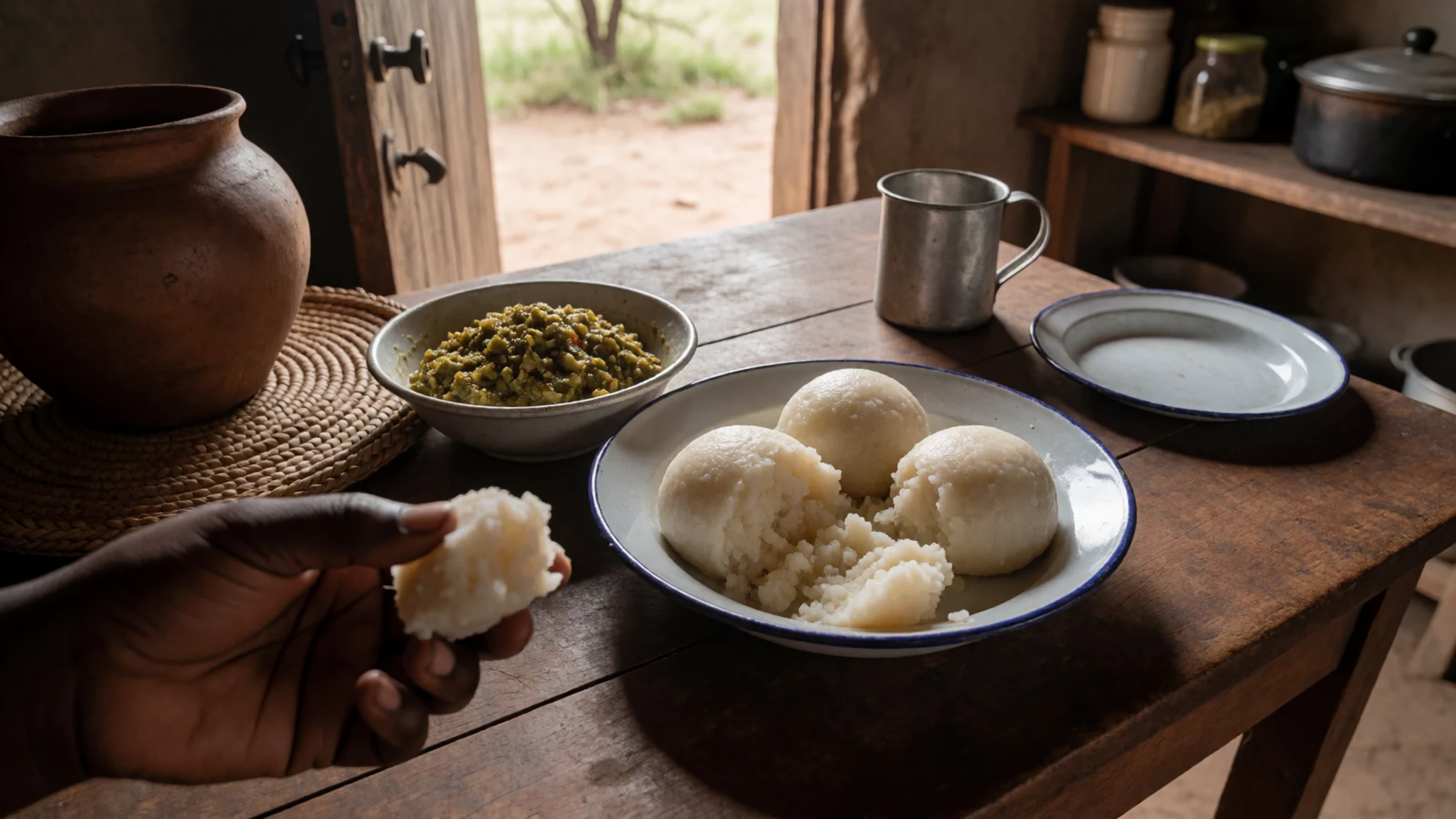
- Floodplain bream — markets in Mongu and Kalabo, and camp kitchens
Fresh bream and other floodplain fish are the relish people around Liuwa Plain want when the water is productive. The fish is grilled over coals, fried, or simmered with tomato and onion, and eaten with buhobe. In town markets the catch is sold whole.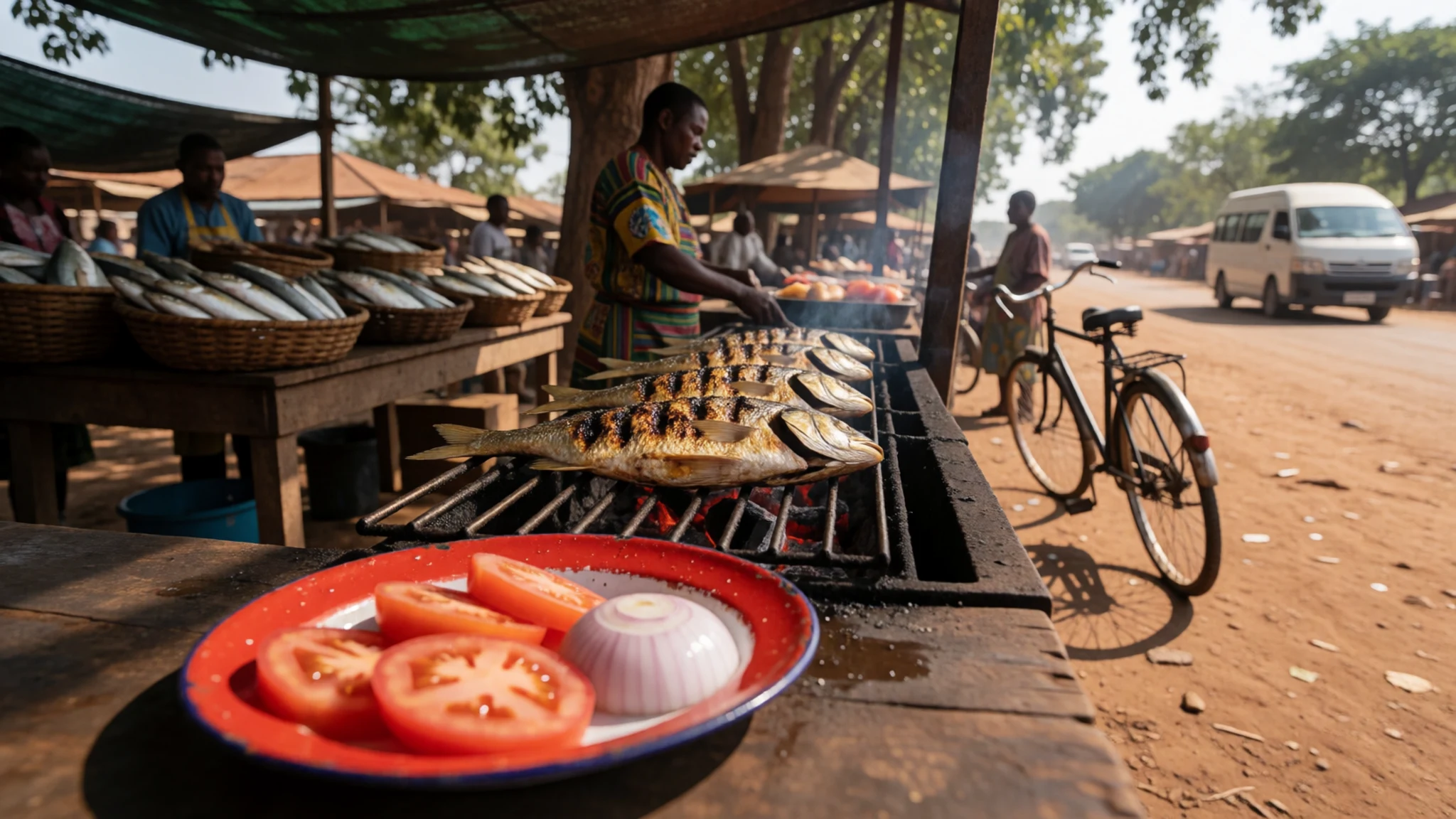
- Smoked and dried fish — roadside stalls and town markets on the way to the park
Smoked and sun-dried fish travel better than fresh catch, so they are a store-cupboard food of the Liuwa Plain region. Torn into a stew or heated and served beside buhobe, they give a strong, salty relish when the pans are far from the kitchen. - Mabisi — homesteads and informal markets in Western Province
Mabisi is fermented milk, thick and tart, drunk on its own or with a meal around Liuwa Plain. Households sour it in the traditional way, and it turns up in markets wherever cattle are part of the week. The taste is closer to a loose yoghurt than to fresh milk. - Pumpkin-leaf relish — home cooking and camp kitchens near the plain
Pumpkin leaves, sometimes called chibwabwa, are cooked down as a green relish and served with buhobe wherever vegetables are growing near Liuwa Plain. Groundnuts or a little tomato may go into the pot, depending on the cook. It is an everyday bowl, soft and earthy.
Plan it
Best time. November to February for the return of the rains, green grass and gathering wildebeest on Liuwa Plain. Later in the wet season, floodwater can close the tracks. Dry months are easier for driving, with cold dawns and more scattered wildlife.
How long. 4-5
Getting there. Lusaka is the usual international arrival point, with an overland journey through Mongu and Kalabo to Liuwa Plain. The last leg is a sandy floodplain track, slow after rain and sometimes closed when the water is high. Some camps offer a light-aircraft connection; check the present route with the operator, since conditions change with the season.
Budget. high
Tips
- Reserve a camp bed or a community pitch early for the opening green weeks, when more parties come for the herds.
- Ask each morning which tracks are still open; standing water matters more than the map.
- Drive in the cool morning and late afternoon, and pause through the midday heat.
- Carry drinking water, fuel and a spare wheel, because supplies inside the park are sparse.
- Take cash for markets and small community payments, and sort out cards before leaving Lusaka.
Etiquette
- Ask before photographing people, and accept a refusal without debate.
- Keep to existing tracks and a generous distance from wildlife.
- Pass homesteads, nets and cattle slowly, and do not leave the track to cross someone's ground.
Nearby
Sources
- Wikidata (CC0)
- Wikipedia (CC BY-SA 4.0)
- Wikivoyage (CC BY-SA 4.0)
Wildlife
- Blue wildebeest (animal)
The blue wildebeest is a big antelope with a pale, beard-like fringe, and some people call it a gnu. On Liuwa Plain it ranges over the open grassland, often sharing the space with zebra, while little oribi and tsessebe graze nearby. Ask your guide which season and hour suit them best. Watch from a comfortable distance, speak softly, stay with your guide, and never offer food, however close they seem.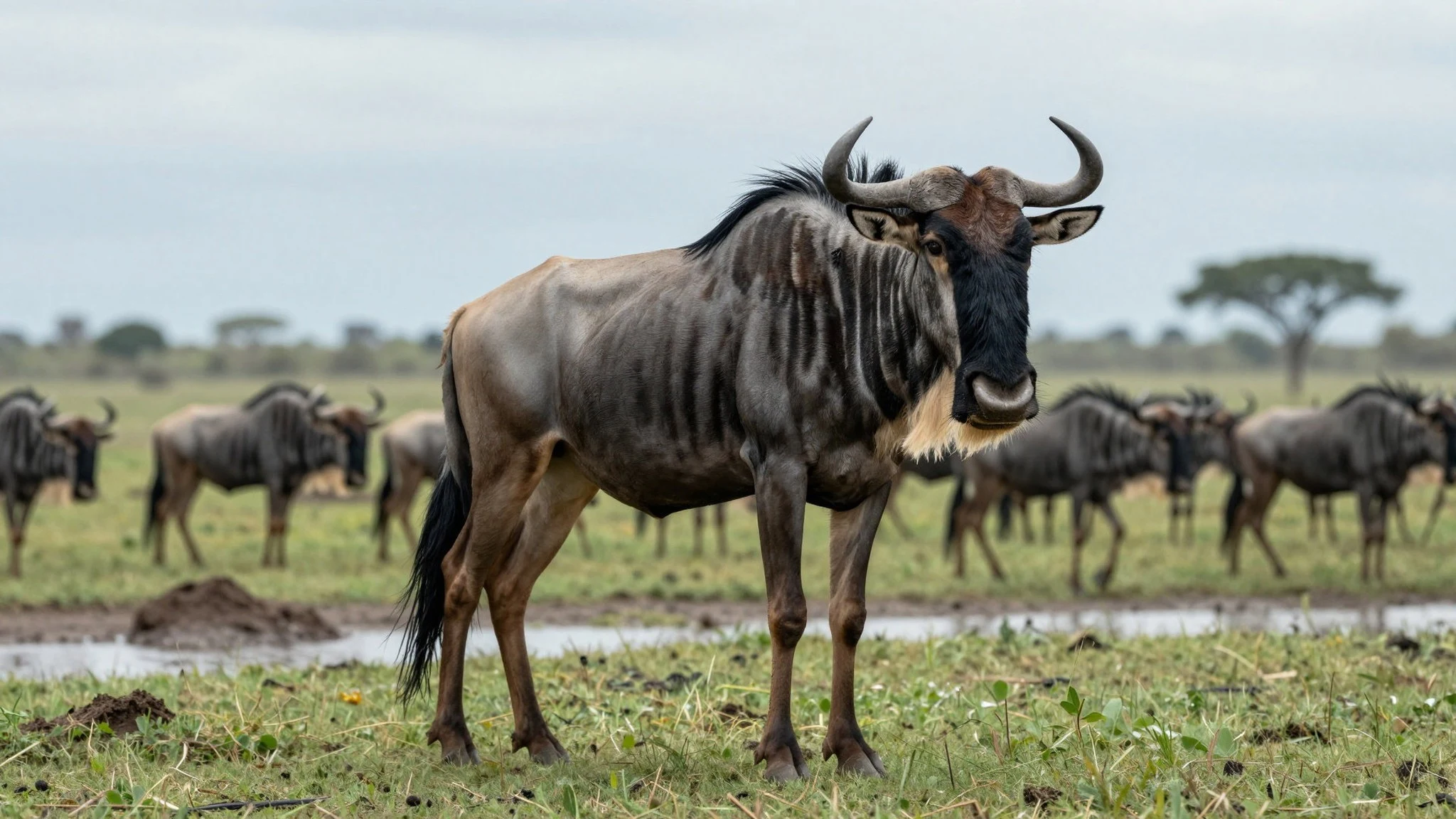
- Spotted hyena (animal)
The spotted hyena, sometimes called the laughing hyena, is a sturdy animal with rounded ears and a spotted coat, a little like a bear in shape. Of all the predators on Liuwa Plain, it is the one a group of visitors most often actually meets. Ask your guide where and when to look. Watch from a good distance, keep quiet, stay with your guide, and never feed it. - Wattled crane (bird)
The wattled crane is a tall, threatened bird of wetlands and grassland, so every sighting feels special. On Liuwa Plain, cranes gather on the pans wherever water stands, alongside storks and waders, while birds of prey hang in the air above the mounds. Ask your guide about the best season and hour. Watch from afar, stay hushed so you do not startle them, follow your guide, and never feed them. - Saddle-billed stork (bird)
The saddle-billed stork is a big wading bird that steps through shallow water looking for food. On Liuwa Plain, look for it in the shallows of the pans, where storks share the water with cranes, waterfowl and waders that work the mud as levels rise or fall. Ask your guide about the best season and hour. Keep a respectful distance, stay quiet, and never offer it food.