Bangweulu
Bangweulu, Zambia
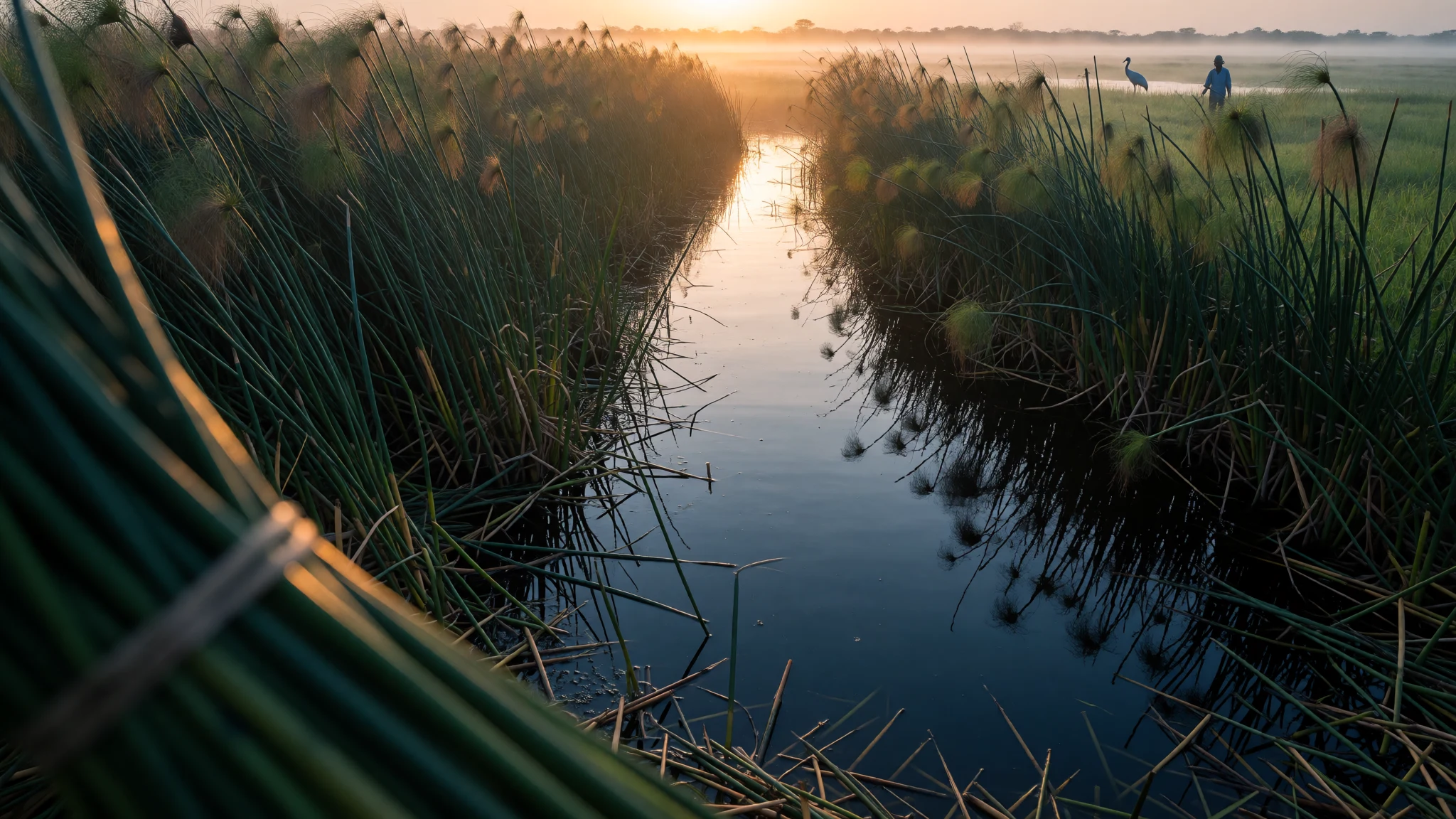
Bangweulu is a flooded, bird-filled wilderness in northern Zambia where canoes replace roads and shoebills stalk the papyrus.
The place
Bangweulu is a wetland system in northern Zambia, set around the shallow Lake Bangweulu at an elevation of 1,171 metres. The name is applied loosely. Maps and locals split it into parts: the Bangweulu Swamps are the papyrus and reed beds, while the Bangweulu Flats are the open grassy floodplains between them. Water is the organising fact. Rain and river flow fill the flats each wet season, islands shrink, and the whole landscape changes character within a few months, so the place can look quite different from one visit to the next.
The wetlands are a Ramsar site and an Important Bird Area under BirdLife International. Around the northeast, east and south sit seven protected areas: several game management areas, where people live and fish alongside wildlife, plus Isangano and Kasanka national parks. Lavushi Manda National Park lies next door, but it protects hills rather than wetland.
Reaching Bangweulu is part of the experience. Tracks are rough, distances are long, and facilities are thin compared with Zambia's busier safari parks. Camps are small, and the pace is set by canoes and walking rather than by game-drive vehicles. Visitors come mainly for birds and for wide skies over flat water, not for a checklist of big cats. Expect heat, insects, and the quiet of a place that few other tourists reach.
Its story
The story of Bangweulu is mostly one of people who learnt to live with seasonal flooding. Fishing households have long arranged their year around the rising and falling water, using dugout canoes, reed shelters and temporary camps on higher ground. The name is often translated as "where the water meets the sky", which suits a horizon with almost no relief.
European explorers reached the lake in the nineteenth century. A map among the staged photos, drawn from the journeys of Victor Giraud and Paul Reichard, shows how hazy the geography still was: the lake, the Luapula river flowing out of it and the wider Congo system were being pieced together from short expeditions and local accounts. David Livingstone died in this region while searching for the sources of the great rivers, and that death remains part of the area's memory.
Colonial rule followed. The territory was Northern Rhodesia, administered first by a company and then by Britain, and the mining boom on the Copperbelt pulled labour and investment far to the south-west while the wetlands stayed on the margins. Zambia took its present name at independence. Hard economic decades followed, and in places like Bangweulu, far from the copper towns, fishing, farming and reed gathering carried on as the everyday economy.
More recently conservation has become part of the story. The protected areas around the wetlands exist alongside communities, and in the game management areas local people have a say in how wildlife and fishing are managed.
What to see
- Shoebill Island and the papyrus channels — Bangweulu Swamps
Shoebill Island is a base for exploring the Bangweulu Swamps, where narrow channels cut through papyrus and reed beds. The shoebill, a tall grey bird with a heavy bill, is the draw, and a sighting takes patience and an early start. Even without one, the stillness and the walls of reed make the trip worthwhile.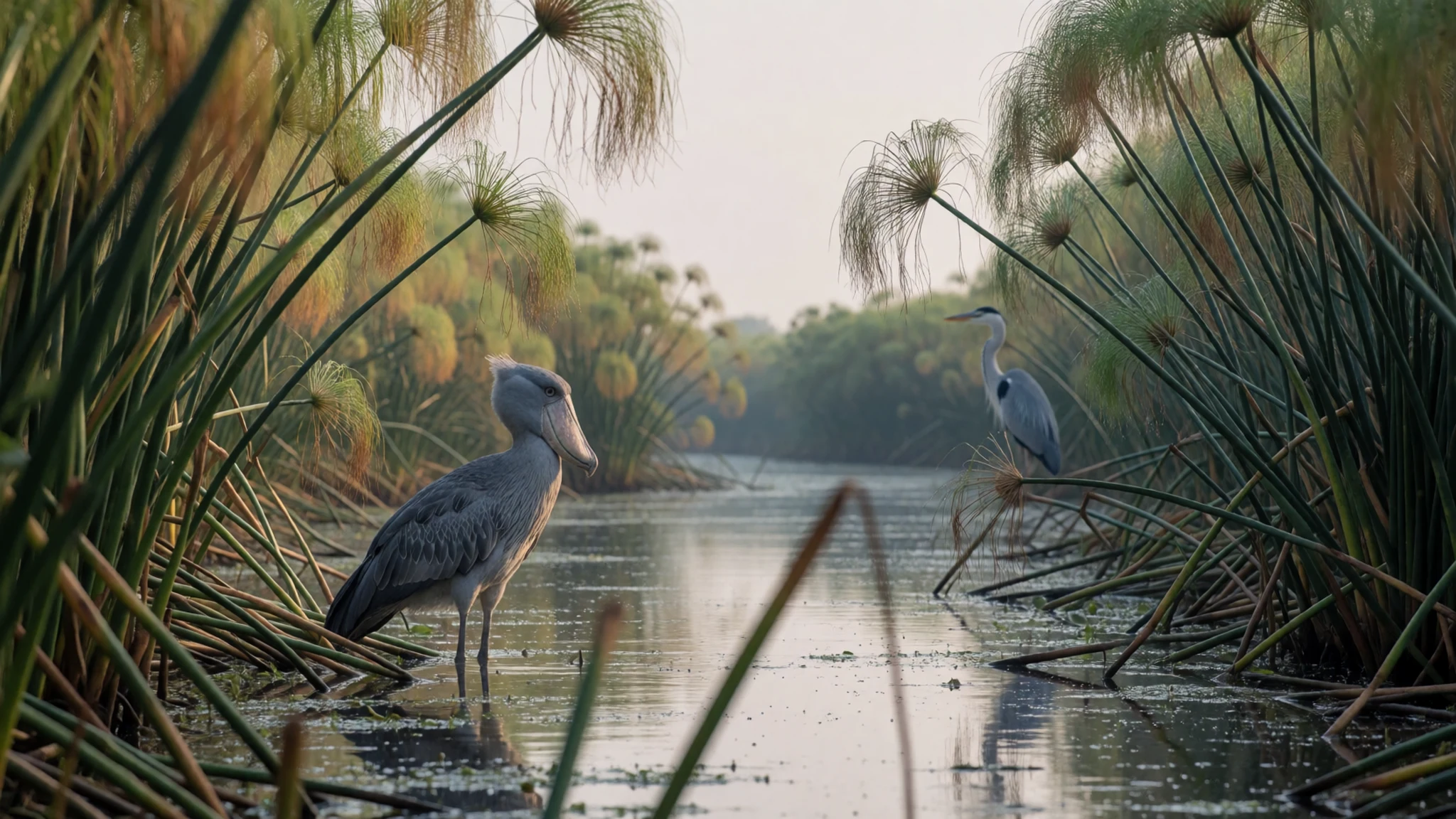
- Dugout canoe trips — Bangweulu Swamps
Dugout canoes are how most people move through the wetlands, visitors included. A boatman poles along the shallow channels, and the low seat puts the eye almost level with the water, close to reeds, dragonflies and wading birds. Trips are slow, hot by midday, and best at dawn or late afternoon.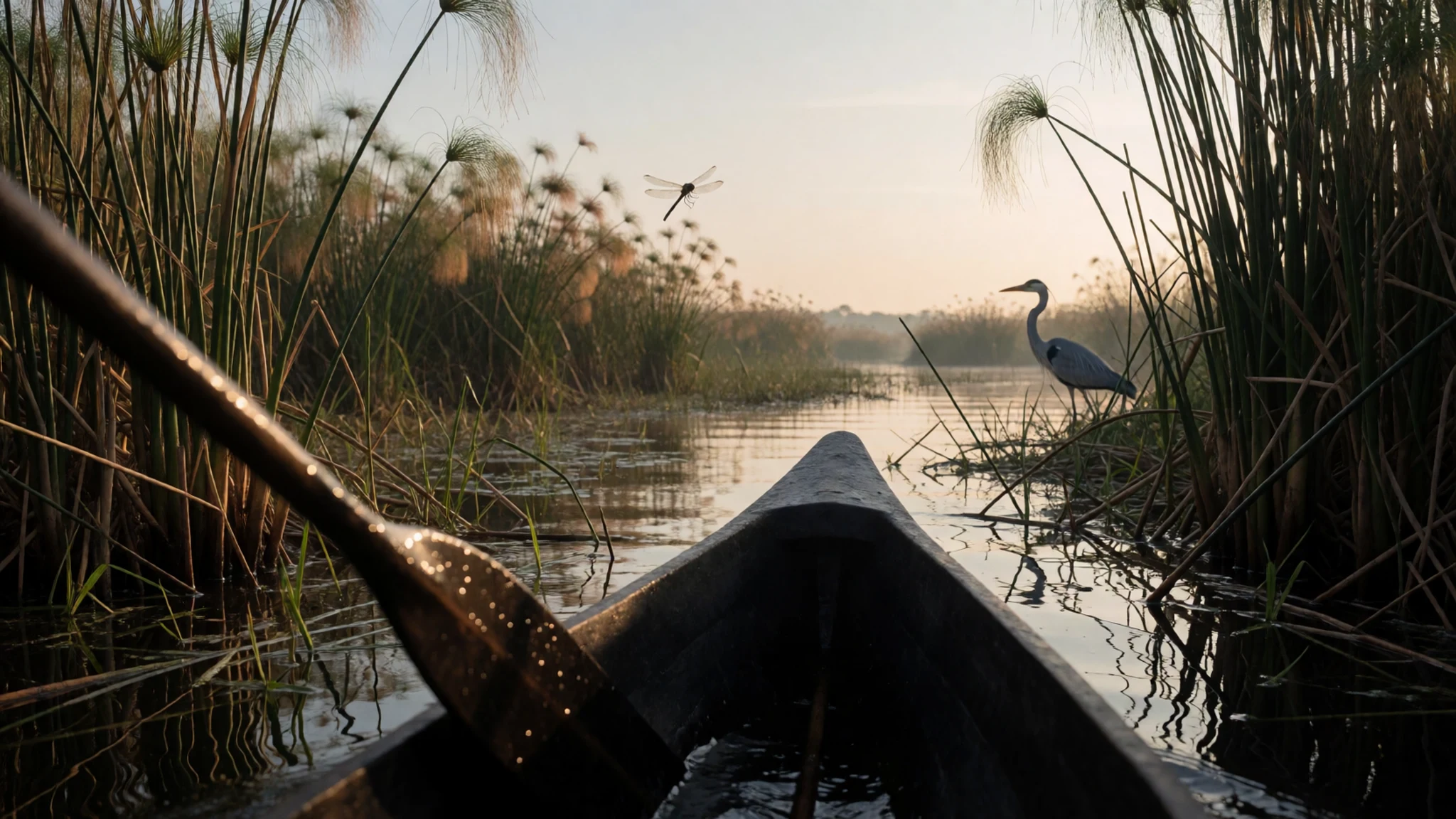
- Wattled cranes and floodplain birds — Bangweulu Flats
The open Bangweulu Flats are good ground for birds. Wattled cranes pick their way across wet grass, while African openbills and banded martins turn up around the water's edge. Because the area is a BirdLife International Important Bird Area, even casual watchers should bring binoculars and a field guide.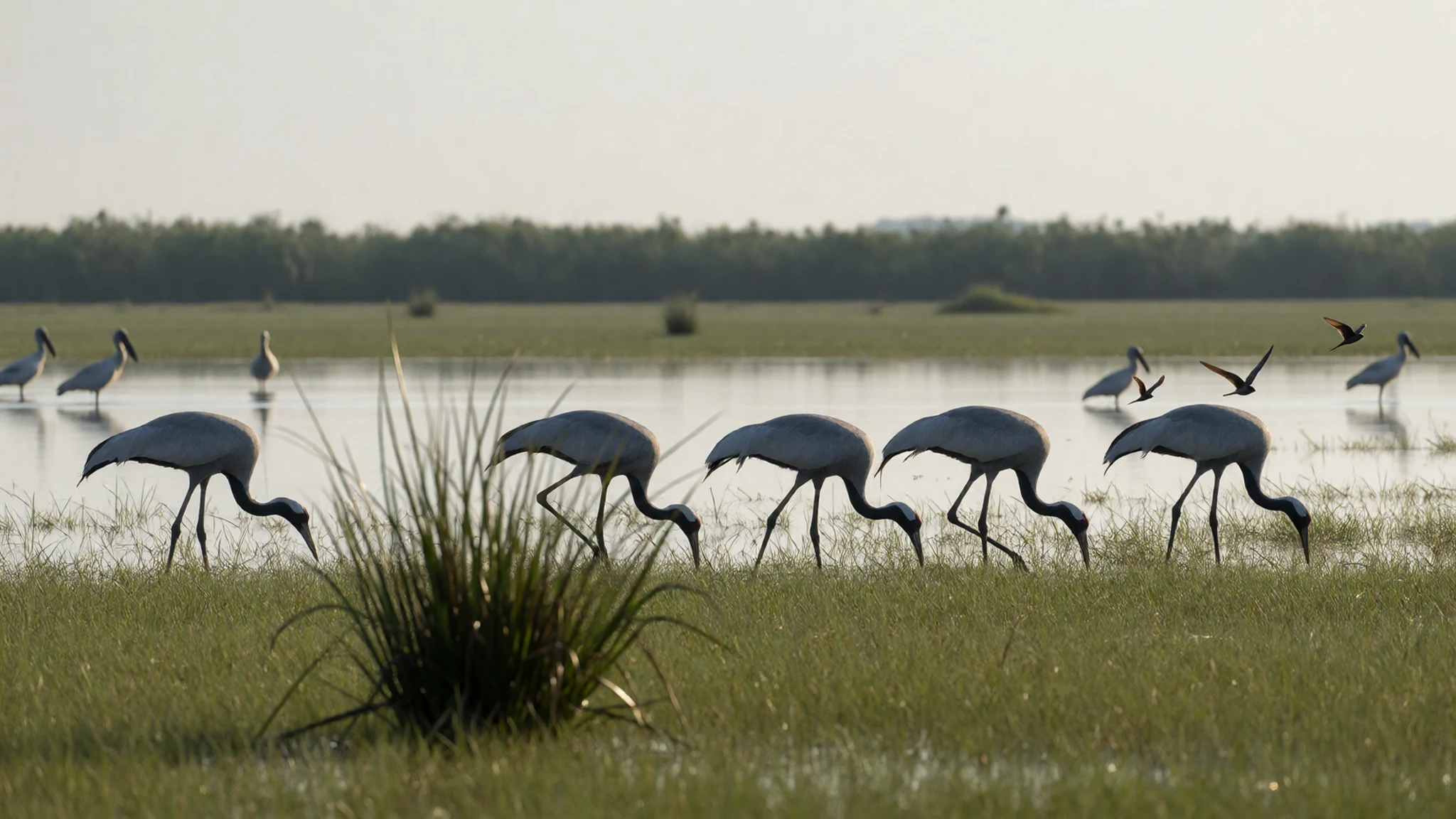
- Isangano National Park — Northern wetlands
Isangano National Park covers part of the northern floodplain and sees far fewer visitors than Zambia's better-known safari parks. It suits travellers who are happy with rough tracks, open horizons and a sense of remoteness rather than a guaranteed wildlife list. Arrange transport and access through a local operator.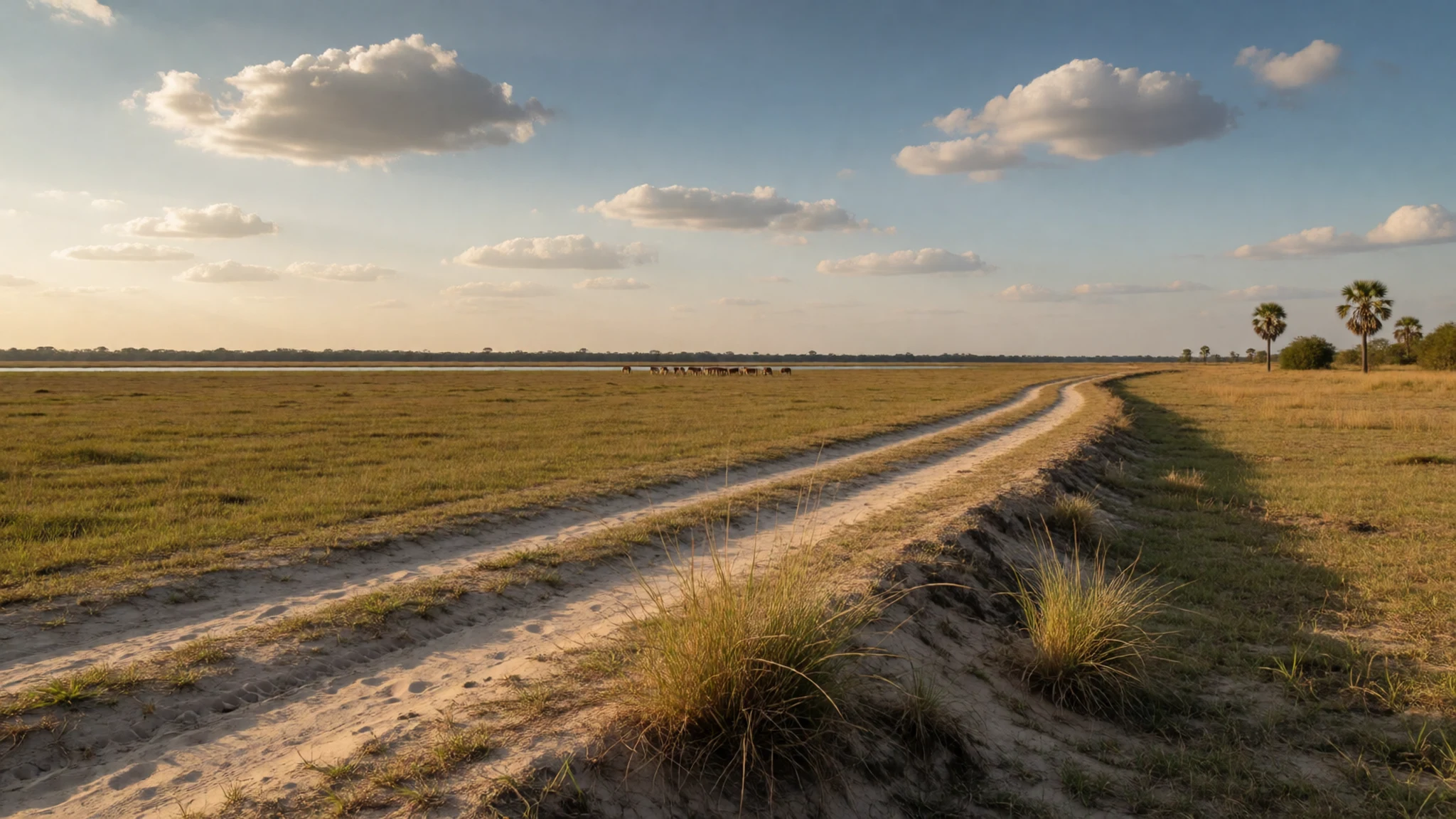
- Kasanka National Park — South of the wetlands
Kasanka National Park lies on the southern side of the Bangweulu area and is known for its enormous bat migration in October, when fruit bats fill the sky at dusk. Timing matters and beds fill early, so plan well ahead and check current arrangements with the park.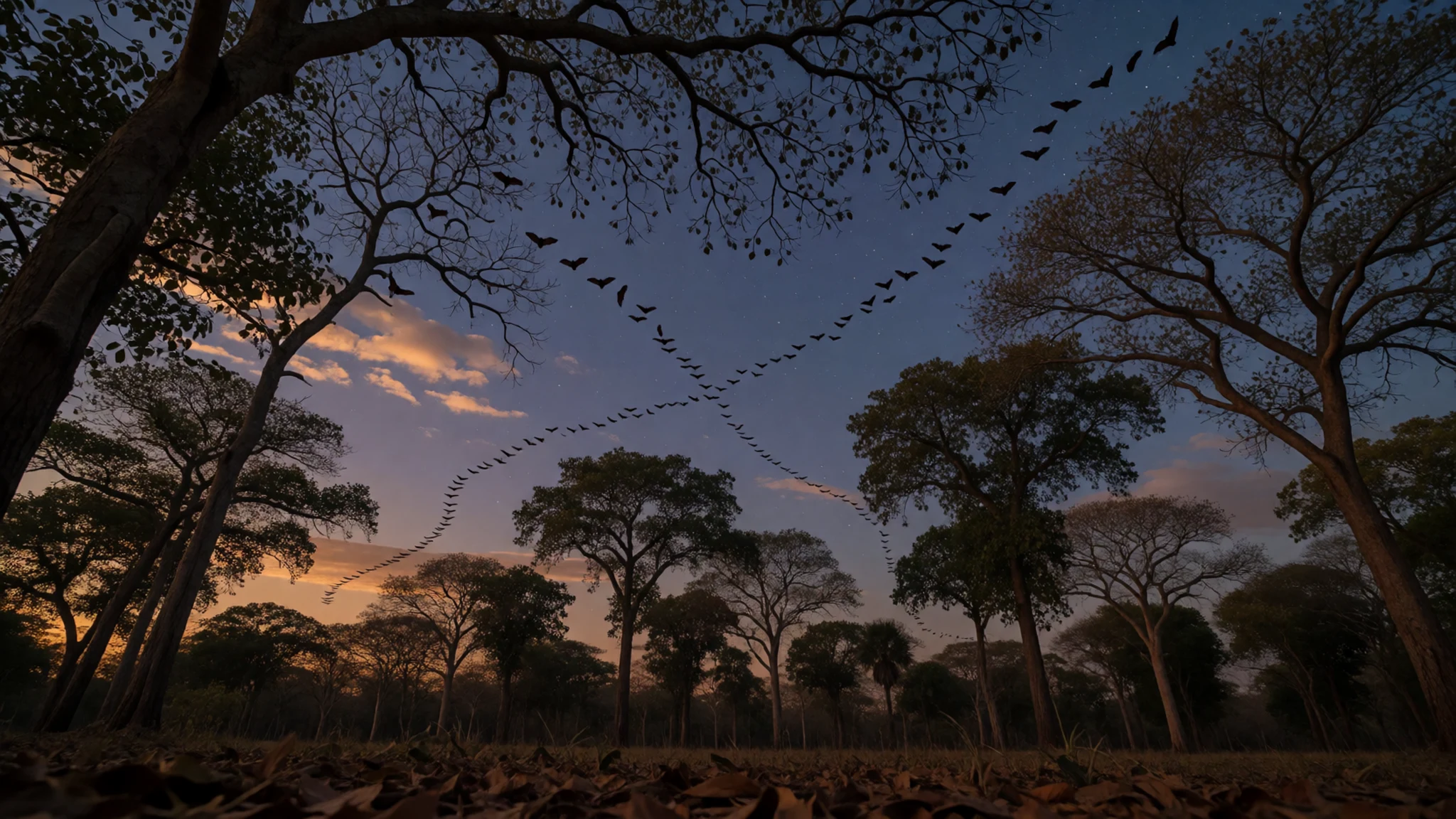
Culture
Bangweulu's communities are rural, fishing-centred and generally courteous, and social life follows patterns common across Zambia. Respect is structured by age and gender: older men are heard first, and elders are greeted with care. Visitors, particularly white visitors, may be treated with a deference that can feel awkward, but it is usually just good manners, and the easy response is to accept hospitality gracefully.
Curiosity is normal. Expect to be looked at, talked about in your hearing and asked many questions about where you come from and what you do. Children may call out "mzungu", a word for a foreigner, and a smile and a wave is the usual reply. Handshakes are the standard greeting and are often long; some people keep hold of a hand throughout a conversation. This is friendliness rather than anything romantic, and a gentle withdrawal is fine if it is uncomfortable.
Life on the wetlands revolves around the water. Fishing, drying fish, gathering reeds and farming on higher ground set the daily rhythm, and the best hours for work are early. Canoes and nets are livelihoods, not props, and a guide or boatman is a working professional who deserves a fair and prompt payment.
Shake hands when you meet people, and ask permission before photographing anyone, especially fishers at work or women preparing food.
What to wear
Bangweulu's everyday dress is built around the chitenge, a printed cotton cloth sold by the length across Zambia. Women wrap it as a skirt, tie it as a headscarf, or use it to carry a baby on the back, and the patterns and slogans printed on it are part of the fun. Men's traditional clothing is less visible day to day. Chitenge outfits appear in force at weddings, church services and funerals, when people wear their best.
What people actually wear is practical. Fishers work in shorts or old trousers, often barefoot or in rubber sandals, with second-hand T-shirts and football shirts common. Women usually wear a chitenge over a blouse or T-shirt, and in towns western-style clothes mix with wrapped cloth.
For visitors the aims are sun, insects and respect. Light long-sleeved shirts and long trousers in neutral colours keep off mosquitoes and the glare on open water, and a wide-brimmed hat helps. Choose shoes that can get wet and dry quickly, plus sturdy closed shoes for walking on rough ground. In villages, cover knees and shoulders as a courtesy. Avoid camouflage patterns, which can attract unwanted attention. A chitenge bought locally makes a useful sarong, sunshade or picnic cloth, and a good souvenir.
What to eat
- Nsima with relish — Any village kitchen or small local eatery
Nsima is a thick maize porridge, rolled into a ball with the right hand and used to scoop up stews called relishes. In Bangweulu the relish is often fish or beans. It is the everyday meal, served warm and filling.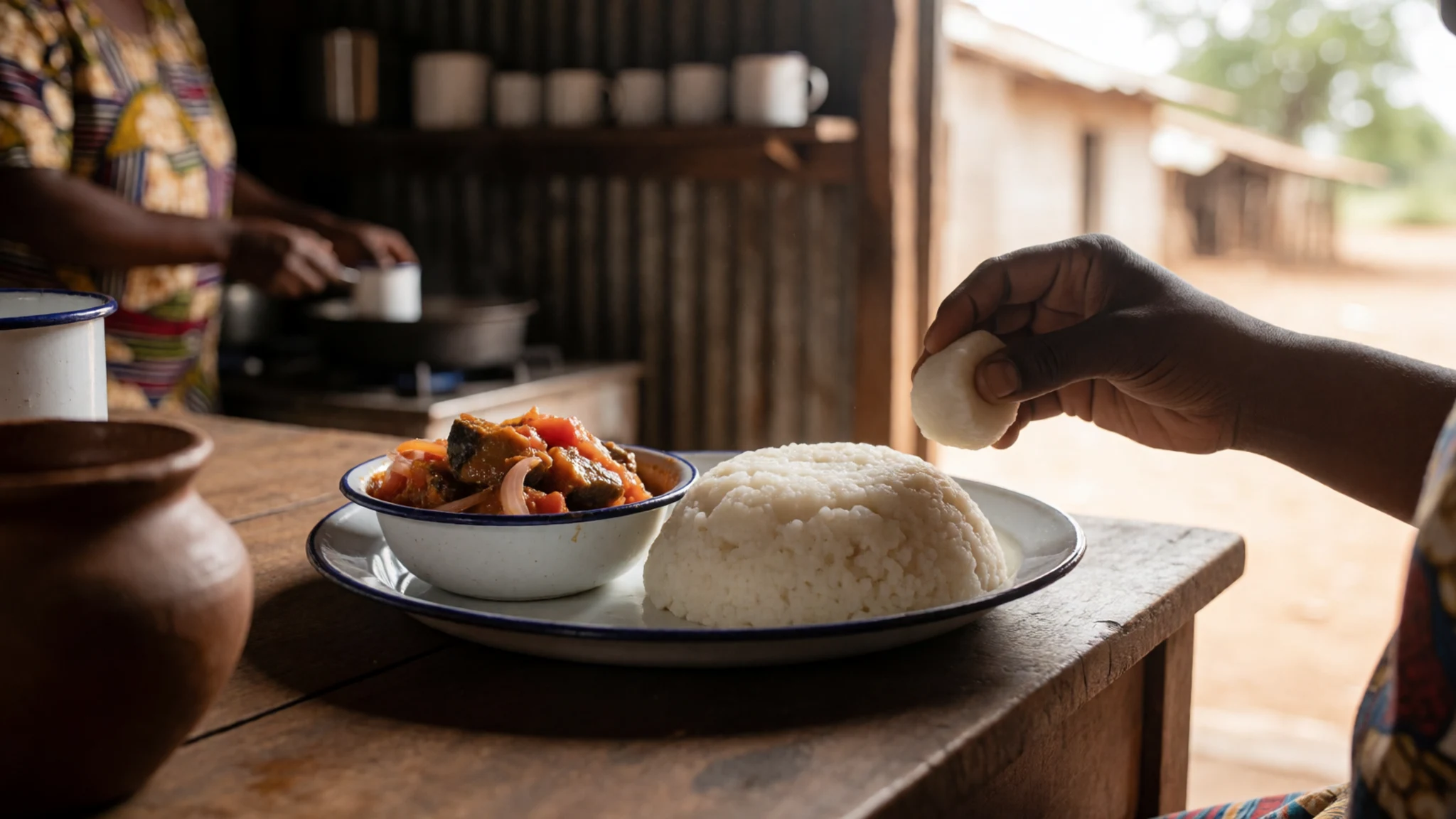
- Kapenta — Roadside stalls and local markets in the nearby towns
Kapenta are tiny dried fish, salty and crunchy, usually cooked into a tomato and onion relish to eat with nsima. They travel well, which makes them a staple far from shops, and they smell strongly while drying in the sun.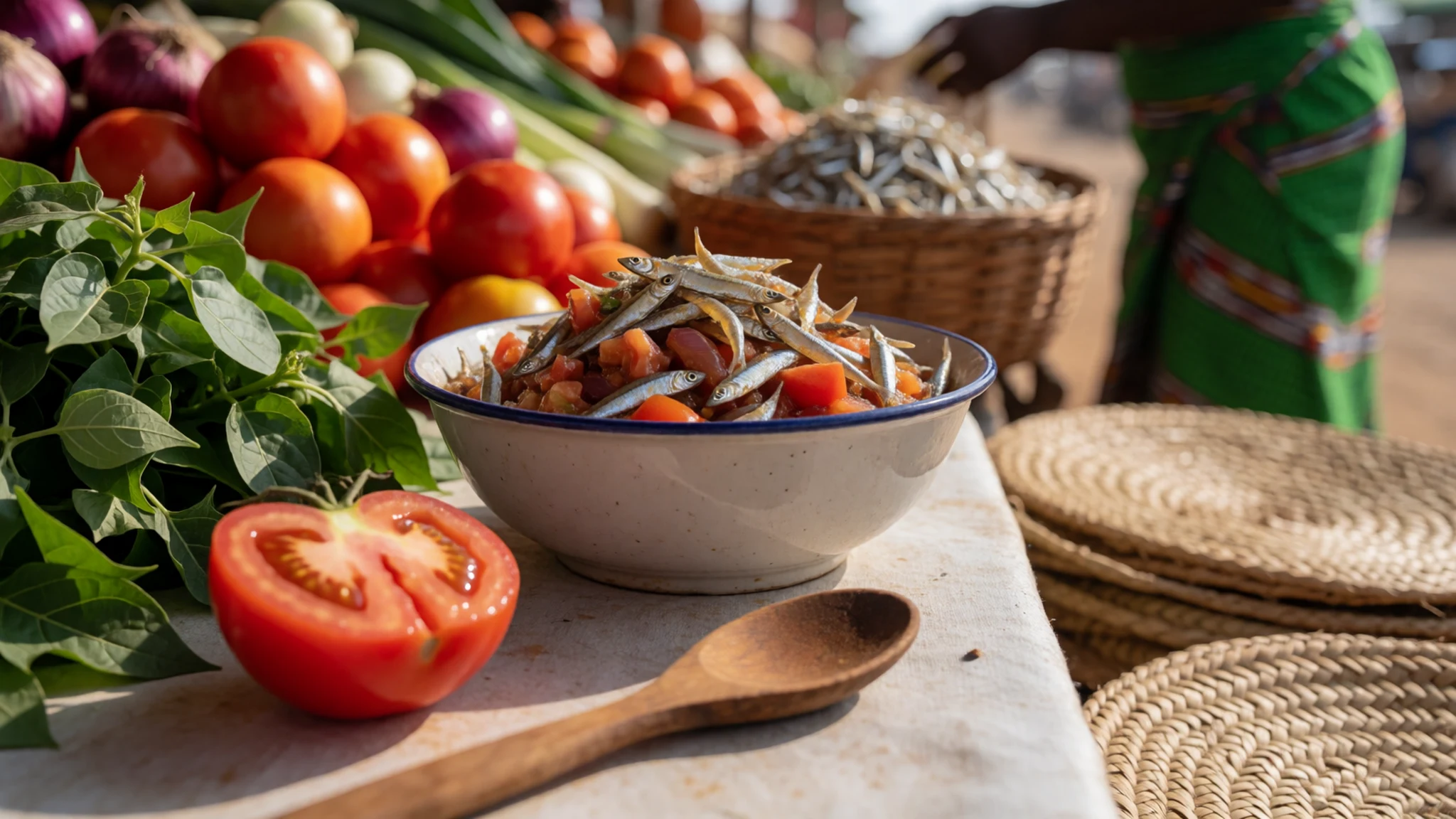
- Fresh and smoked river fish — Fishing camps and lakeside landing places
Fishing is central to life on the wetlands, so fish turns up fresh, grilled over coals, or smoked and dried for sale. Bream-type fish are common. Eating it at a camp with a boatman beside you is the simplest way to taste the place. - Chibwabwa — Home cooking in villages and simple local eateries
Chibwabwa are pumpkin leaves, simmered until soft and often finished with groundnut paste or tomato. The dish is earthy and slightly bitter, a common vegetable relish for nsima when meat is not available. - Ndelele (okra) — Local eateries and market-day food stalls
Ndelele is okra cooked into a slippery, savoury relish. The texture surprises first-timers, but with nsima it is a familiar and well-loved combination. It is often cooked with tomato and sometimes with dried fish.
Plan it
Best time. June to October is the dry season: water levels fall, tracks are firmer, mornings are cool and birdwatching is at its best. Heat builds towards October, and Kasanka's bat migration also falls then. The rains from roughly November flood the wetlands, close some tracks and make travel slow, so check with camps before booking.
How long. 3–4
Getting there. Fly to Lusaka, then travel north by road towards Mpika or Kasama and on to the wetlands on rough tracks in a 4x4, a long journey best arranged through a camp or operator. Light aircraft transfers to local airstrips may be available.
Budget. high
Tips
- Book camps and transfers well ahead, since accommodation is small and logistics are tricky
- Bring cash, as cards and mobile signal are unreliable in the wetlands
- Carry plenty of drinking water, sun protection and insect repellent
- Start canoe trips at dawn for cooler air and better birdlife
- Check the Zambian immigration department's website for current visa rules before you travel
Etiquette
- Ask before photographing people, canoes or fishing gear
- Greet people with a handshake and a few words before asking for anything
- Stay seated and keep movement slow in canoes to avoid disturbing birds
Nearby
Sources
- Wikidata Q806561 (CC0)
- Wikipedia: Bangweulu wetlands conservation areas (rev 1384326054) (CC BY-SA 4.0)
- Wikivoyage: Zambia (rev 5367077) (CC BY-SA 4.0)
- Bangweulu Swamps, Shoebill Island — Mehmet Karatay (CC BY 3.0)
- African Openbill, Bangweulu — Fabrice Stoger (CC BY-SA 4.0)
- Banded martin, Bangweulu — Fabrice Stoger (CC BY-SA 4.0)
- Wattled Crane, Bangweulu — Fabrice Stoger (CC BY-SA 4.0)
- Bangweolo, Luapula and Lualaba according to Victor Giraud and Paul Reichard — Edward Weller (Public domain)
- Lake Bangweulu and wetlands, NASA Earth Observatory (Public domain)
- Dugout canoes in the Bangweulu Swamps — Mehmet Karatay (CC BY-SA 2.5)
- Isangano National Park satellite image — Kalulu Sydney (CC BY 4.0)


Wildlife
- Shoebill (animal)
The shoebill is a lanky grey bird whose enormous bill looks just like a wooden clog, which is hard to forget. It wades through vast swamplands, and Bangweulu is where you can find it in Zambia. Spotting one rewards those who wait calmly and rise early, so be out at first light. Keep a respectful distance, stay quiet and move slowly, ideally with a local guide who knows where to look. Never feed it; it is wild and must stay so.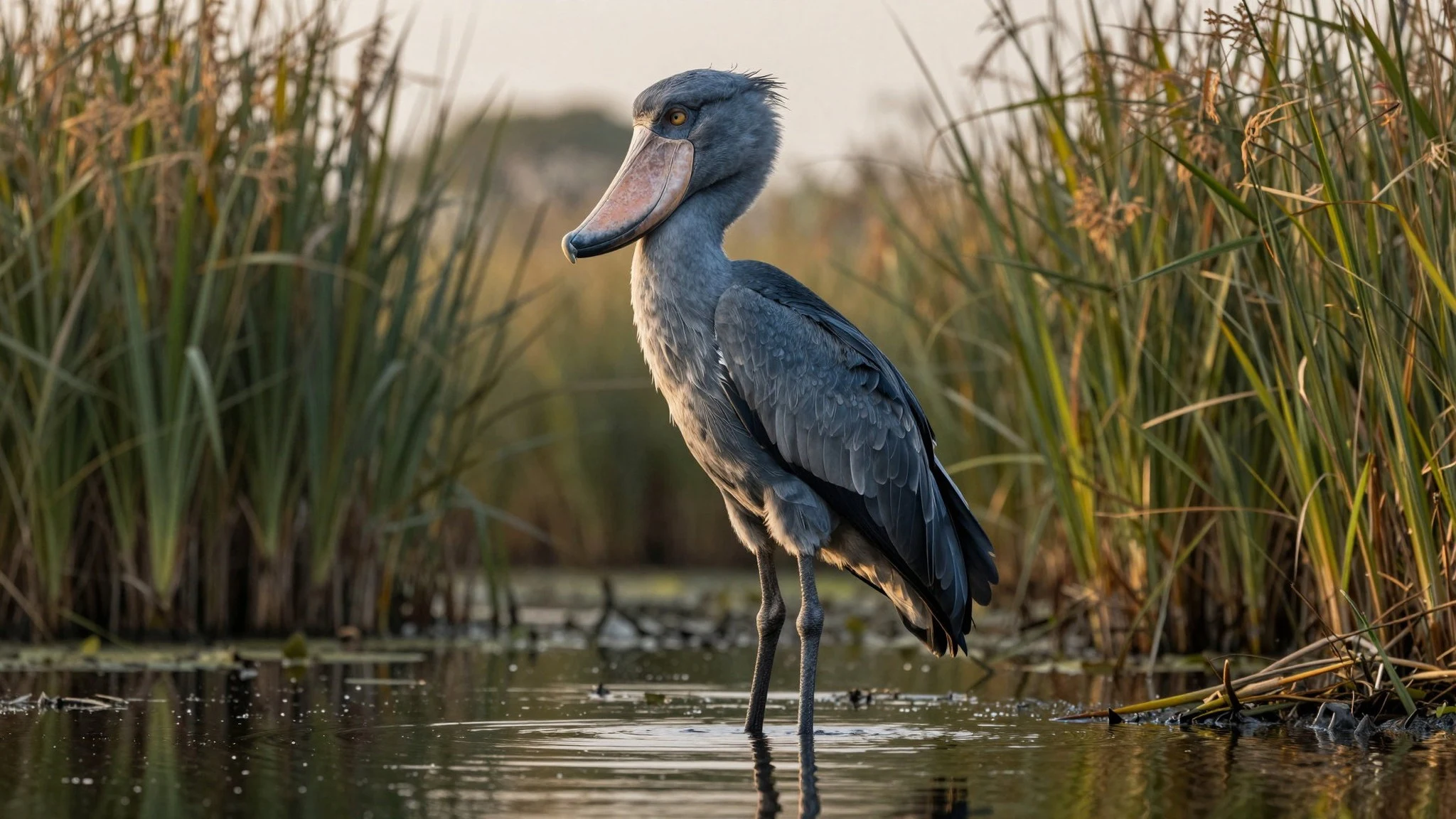
- Shoebill (bird)
The shoebill is a lanky grey bird whose enormous bill looks just like a wooden clog, which is hard to forget. It wades through vast swamplands, and Bangweulu is where you can find it in Zambia. Spotting one rewards those who wait calmly and rise early, so be out at first light. Keep a respectful distance, stay quiet and move slowly, ideally with a local guide who knows where to look. Never feed it; it is wild and must stay so. - Wattled crane (animal)
The wattled crane is a very tall, long-legged bird that stalks through marshes like a patient stilt-walker, and it is rare enough that every sighting counts. In Bangweulu you may find it stepping slowly over damp, grassy ground. The notes give no season or hour, so ask your guide when to look. Keep well back, speak softly and let the bird go about its business. Never offer it food. - Wattled crane (bird)
The wattled crane is a very tall, long-legged bird that stalks through marshes like a patient stilt-walker, and it is rare enough that every sighting counts. In Bangweulu you may find it stepping slowly over damp, grassy ground. The notes give no season or hour, so ask your guide when to look. Keep well back, speak softly and let the bird go about its business. Never offer it food.