Kubu Island
Kubu Island, Botswana
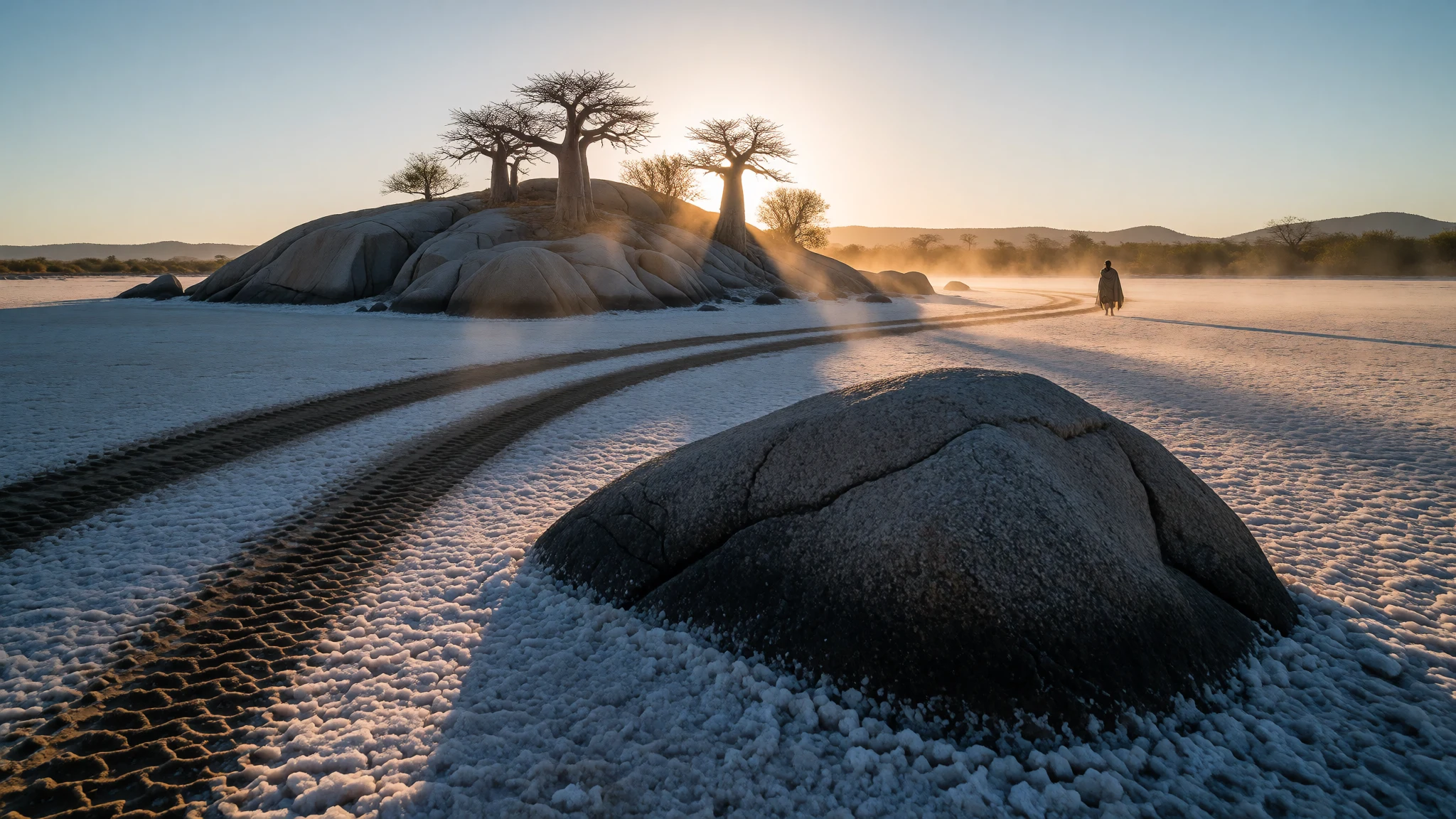
Kubu Island is a granite rise of baobabs in Botswana's Makgadikgadi salt pans, reached only by a slow four-wheel-drive track.
The place
Kubu Island rises from the salt of the Makgadikgadi in northern Botswana, a low granite hill between Sowa Pan and Ntwetwe Pan. In the dry months the island is a dark rock in a white plain; after rain, shallow water can return and the hill is an island again. Baobabs grip the stone, their trunks pale against the crust, and the horizon stays empty in every direction. The surface underfoot changes within a few steps: cracked granite, pockets of sand, then the hard salt of the pan, which looks solid and is not always so. Tracks wander in from the scrub rather than a sealed road, and the last approach is the point of the visit — slow, dusty, and dependent on a vehicle built for sand. There is no town on Kubu Island. Camp sits at the foot of the rock, and the day is walking, watching the light move across the pan, and waiting for the temperature to drop. Wildlife is occasional rather than constant: springbok or oryx may cross the flats, and birds use the baobabs, but this is not a game-drive landscape. Heat is the honest fact of the warmer months, and wind on the open pan can feel colder than the season suggests once the sun goes. The quiet is real, and so is the exposure. Shade is the trees and the camp, not a street of shops. Kubu Island rewards anyone who likes a spare landscape and a long approach; it frustrates anyone who wants a lodge, a timetable, or a quick stop between other sights.
Its story
Kubu Island has been a landmark for people crossing the pans long before it appeared on a visitor's map. When the Makgadikgadi held more water, this granite stood as a true island, a dry stop above the flood, and the baobabs would have shown for a long way across the flat. Hunter-gatherers who lived by the pans, ancestors of Kalahari San communities, used the hill; scatters of worked stone and low lines of rock are still there for anyone who walks with attention rather than speed. Later herders and traders moved through the same country, and the outcrop remained a rare fixed point in a plain that offers almost none. Communities around the pans still treat Kubu Island as a place with weight, which is why the stones and the trees are not souvenirs. Protection in the present is quiet rather than grand. The site is kept as a national monument, with a simple camp at the base for travellers who arrive from Maun, Gweta or the road through Nata. A few tents and a track that changes with the rains have not turned the hill into a resort. The same trees mark it. The story of Kubu Island is not a list of kings. It is the habit of coming back to that rock when the salt will carry a person, and of leaving the rock so the next crossing can still find it.
What to see
- The baobabs — On the granite of Kubu Island
The baobabs of Kubu Island grow out of the granite, pale trunks splitting the rock and throwing a hard shade at midday. A short walk on the higher ground links the main trees. Bark that feels cool at sunrise is painful to touch by early afternoon. Birds use the branches, and the trunks should stay unmarked and unclimbed.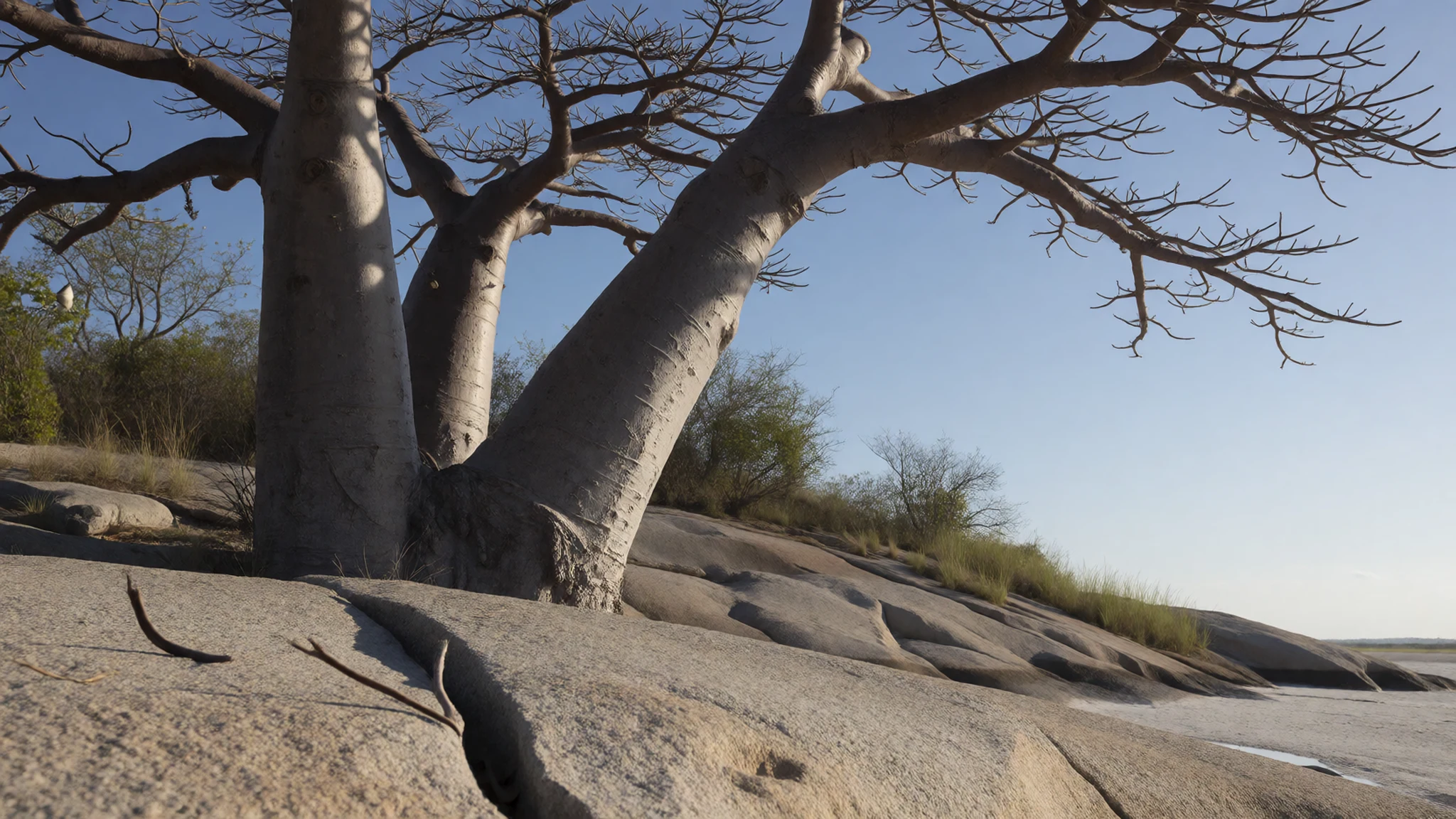
- The granite crest — The high ground of Kubu Island
The crest of Kubu Island is bare granite, easy in parts and awkward where the rock breaks into slabs. From the top the pans run to a flat horizon, white in the dry months. Sunrise and late afternoon warm the stone; noon washes the view out. The walk is short, and the footing asks for closed shoes.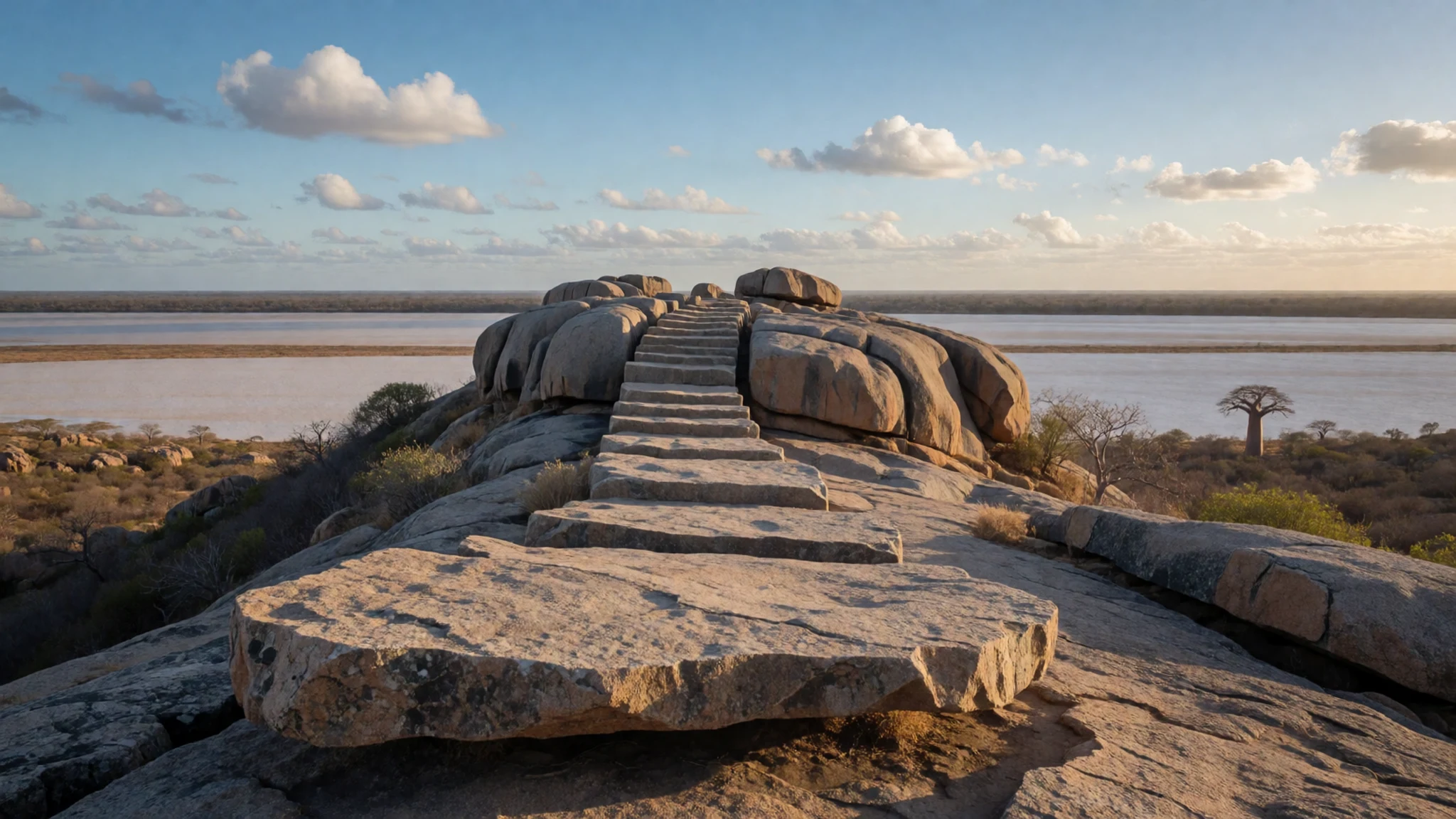
- The salt flats — Between Sowa Pan and Ntwetwe Pan
The salt around Kubu Island is the other half of the view, a pale crust running from the rock towards Sowa Pan and Ntwetwe Pan. Dry months make it look firm; thin crust is not. Marks last, so tyres belong on existing tracks only. After rain the flats hold shallow water and the way in can close.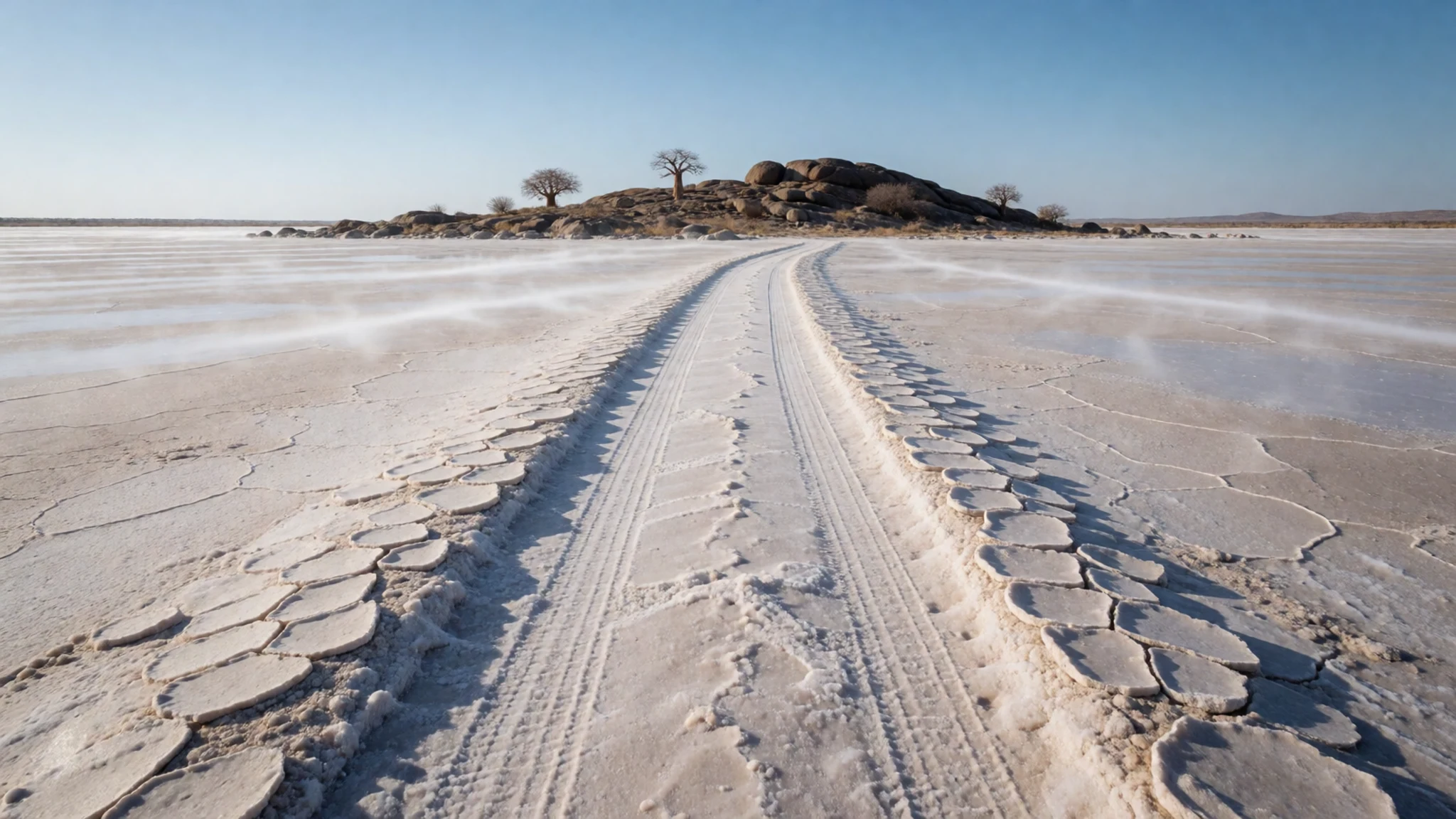
- Old stone lines — Among the rocks on Kubu Island
Low lines of stone on Kubu Island are easy to mistake for a natural scatter. They are not. People who used this hill laid rock into short walls and small heaps that still sit among the granite and the baobab roots. Nothing is signed. The point is to notice the pattern and leave every stone where it lies.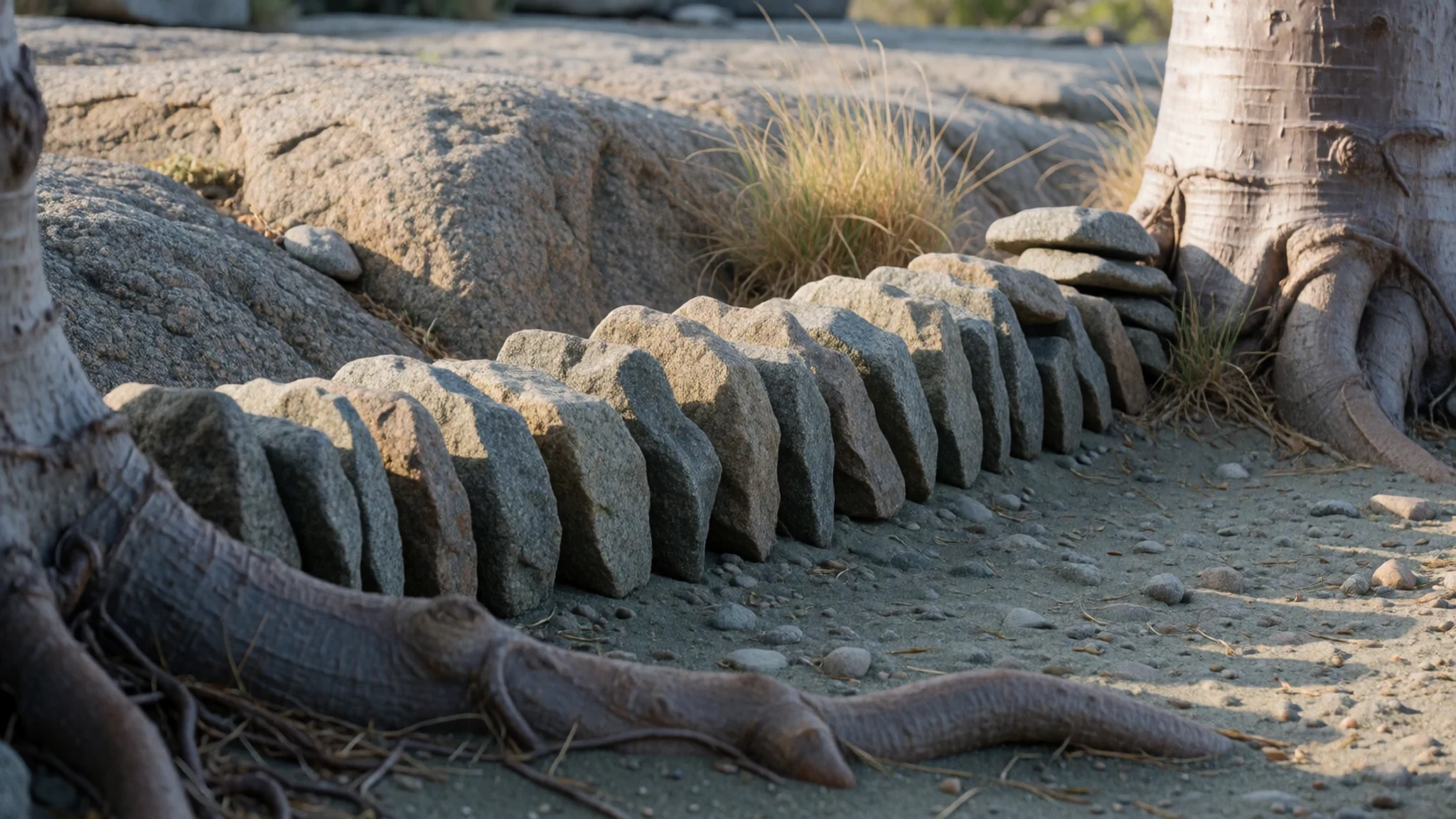
- The camp — The base of Kubu Island
The camp at the foot of Kubu Island is a small open site, not a lodge: room for tents, only basic facilities, and the rock as the view. At night the pan goes quiet, the air cools, and the sky darkens over the baobabs. In the dry season the few pitches can fill. There is no shop; water, food and fuel come in with the vehicle.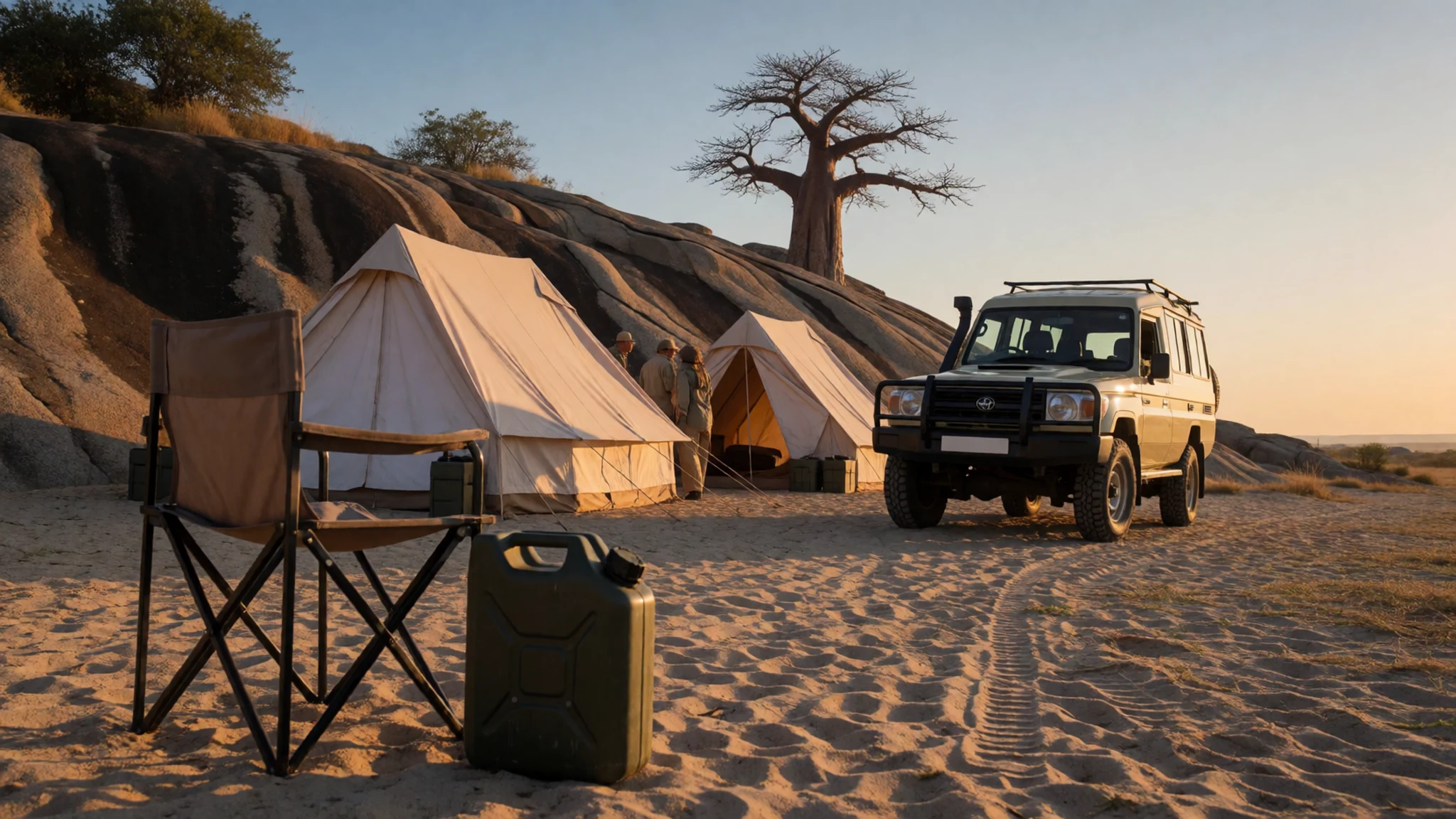
Culture
Kubu Island sits in a part of Botswana where San heritage, Setswana-speaking communities and the life of the cattle posts all meet the salt pan. The hill is not a stage for a performance; it is a known place in local geography, and older residents around Gweta and Nata still speak of it as somewhere to approach with care. Visitors who treat the stones as a photo prop and the baobabs as climbing frames miss that. Out in the villages the pace is set by livestock, borehole water and the long drive to a town, not by a sightseeing schedule. Greetings matter. A simple hello in Setswana, dumela, before a question is ordinary courtesy at a shop, a gate or a guide's camp. Guiding on the pans is skilled work: reading which crust will hold a vehicle is local knowledge, and it deserves a proper fee arranged in advance rather than a hurried tip at the end. Rubbish does not disappear in this landscape, and neither does a name carved in a tree. On Kubu Island, stay on the tracks, do not remove stones, salt or bark, and ask before you photograph people.
What to wear
Kubu Island has no resident tailors and no dress code posted on the rock, so clothing here follows the towns that send people out to the pans. For ceremonies, church and weddings, many Setswana women still wear leteisi, a crisp cotton print made into a long dress with a matching shawl and a headscarf; men often wear a tailored jacket or a smart shirt, and at some gatherings a woollen blanket, the kobo, still appears as formal dress. San traditional clothing, of softened skin and ostrich-eggshell beadwork, belongs to heritage and to particular communities; it is not what people wear to the petrol station in Gweta. Day to day, northern Botswana dresses for heat and dust: jeans or cotton trousers, T-shirts, caps, sundresses, football shirts and practical jackets, with a sweater or a padded coat added on winter mornings when the pan has lost the night's heat. School uniforms and workwear are as common in Nata and Maun as anything cut from leteisi. A visitor on Kubu Island should copy the practical layer, not the ceremony. Strong sun calls for a hat, long sleeves and a light scarf against glare off the salt. Closed shoes grip the granite better than sandals. Modesty is simple away from the camp, with covered shoulders in a village, and a warm layer is the difference between a pleasant night and a cold one in the dry season.
What to eat
- Seswaa — Local eateries in Gweta, Nata or Maun
Seswaa is beef simmered until soft, then salted and pounded. In a local eatery in Gweta, Nata or Maun, before the drive to Kubu Island, it is the plate to ask for, usually with stiff maize porridge. The day's batch often sells out by late afternoon.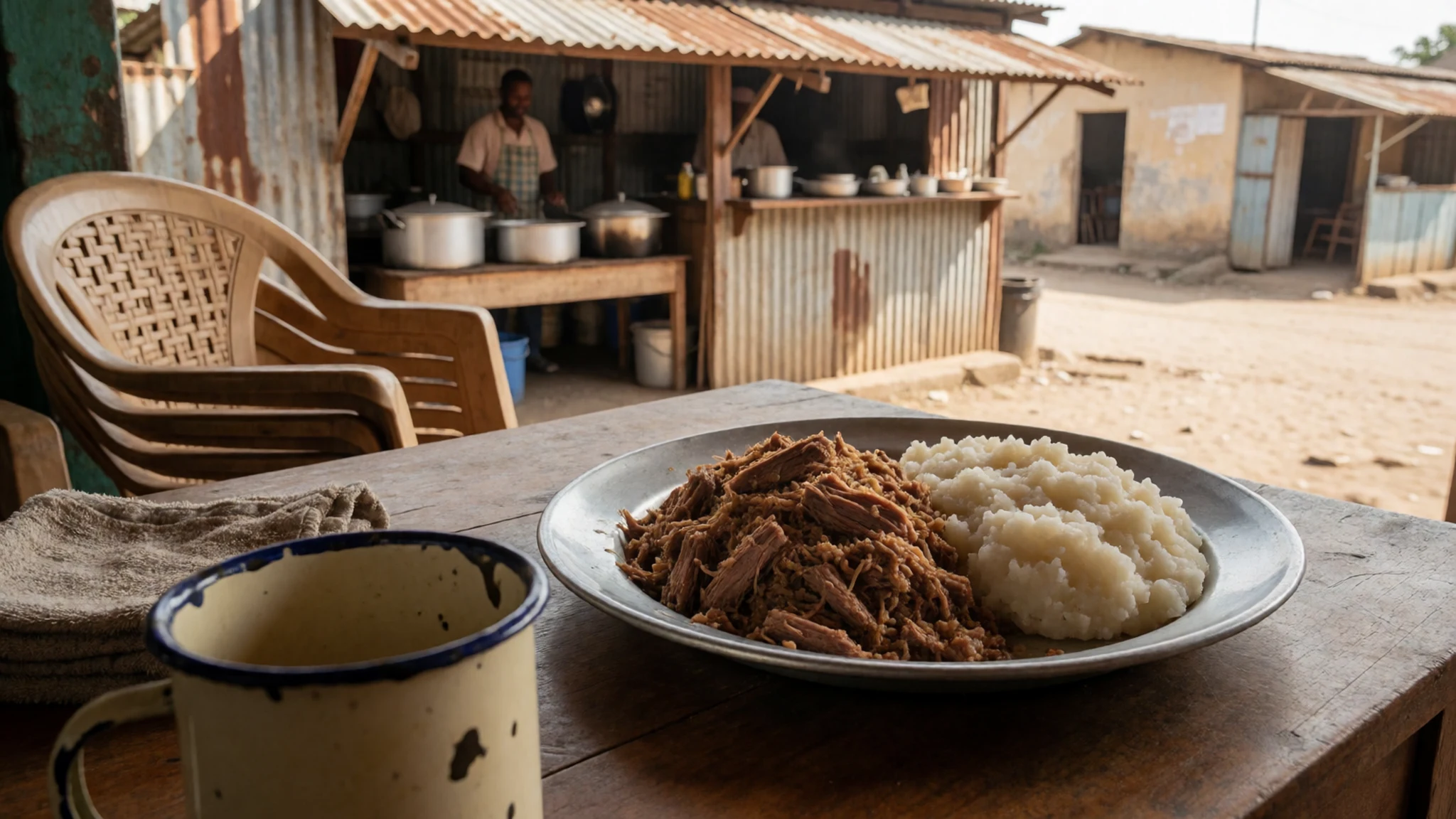
- Bogobe — Local eateries on the road towards Kubu Island
Bogobe is a thick porridge of maize or sorghum meal, the starch beside almost every savoury plate in northern Botswana. Local eateries on the way to Kubu Island serve it in a mound next to meat or a relish, and eating it with the hand is normal.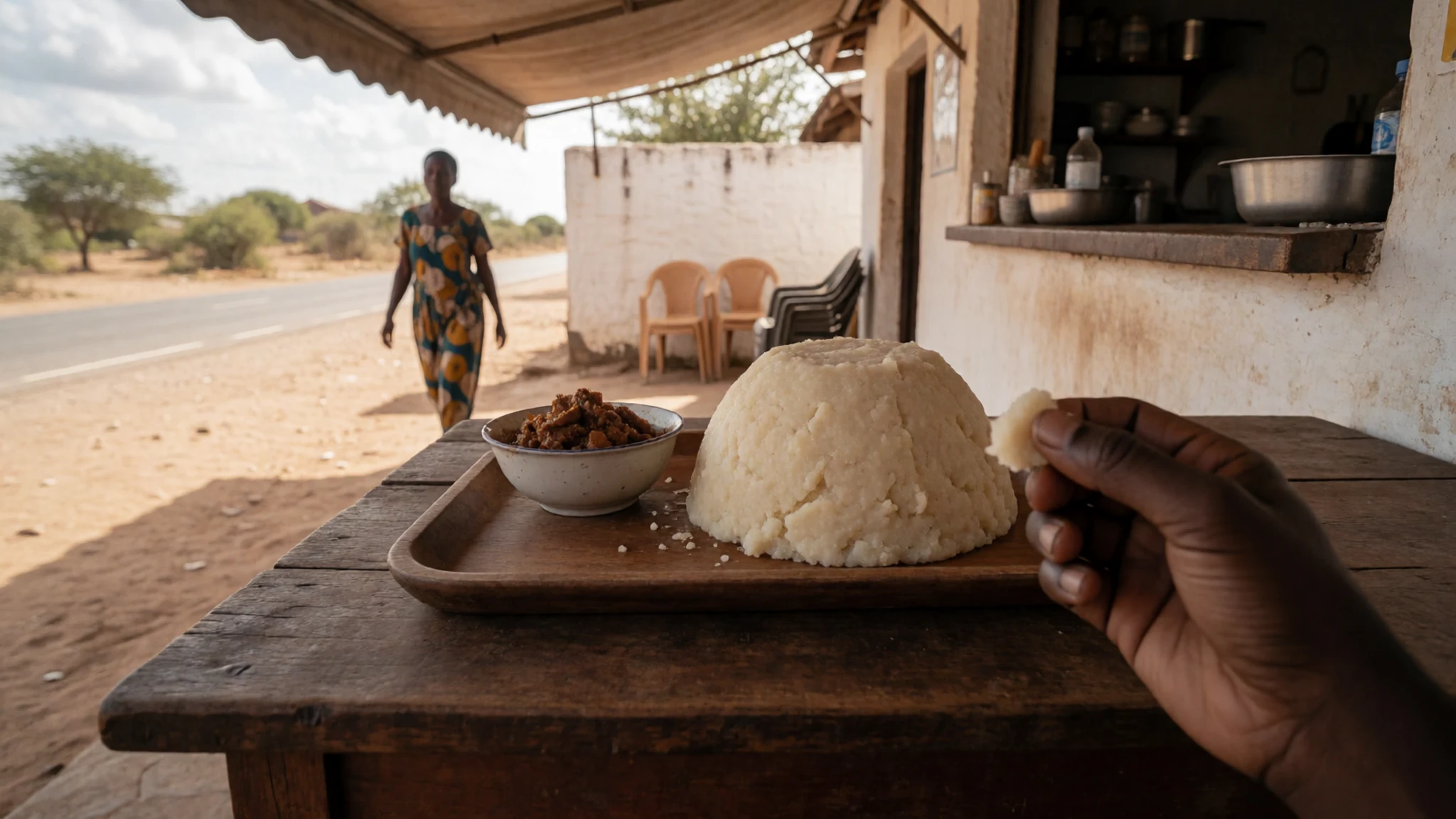
- Phane — Markets and roadside sellers around Nata
Phane are mopane worms, dried or cooked, and a staple rather than a novelty in northern Botswana. Markets and roadside sellers around Nata, on the road towards Kubu Island, sell them by the cup in a good season. They taste earthy and savoury. - Morogo — Eateries in Maun and villages on the way
Morogo is a relish of wild or garden greens cooked with onion, and it is the leafy side of an ordinary plate in northern Botswana. Eateries in Maun and the villages before Kubu Island serve it beside bogobe. Flavour changes with the leaves that were picked. - Magwinya — Bakery counters and roadside stalls in Maun, Gweta or Nata
Magwinya are deep-fried dough balls, sold hot from a bakery counter or roadside stall in Maun, Gweta or Nata. The morning of a drive to Kubu Island is the time to buy them; sales stop where the tar stops. They are heavy, filling and best the same day.
Plan it
Best time. May to September, the dry, cooler months, when the crust around Kubu Island is firmer and tracks are more often open. October grows very hot. From November into March, rain can lay water on the flats and shut the sandy last stretches. April is a transition: drier than summer, not yet dependable.
How long. 2-3
Getting there. Fly into Maun, the usual airport for the pans, or take the tar road from Francistown through Nata. The last leg to Kubu Island is a four-wheel-drive track over sand and salt from the Gweta or Nata side, and an ordinary car will not do it. Ask in town on the day of departure which line is holding, because wind and rain change it. No public bus reaches the rock.
Budget. high
Tips
- Check the track in Gweta or Nata on the day you leave; last week's route may be soft.
- Carry extra drinking water and fuel. Kubu Island has no shop and no pump.
- Arrange a campsite before the main dry months. The pitch count is small.
- Stay in existing tyre tracks. Pale crust can look solid and still take a wheel.
- Bring cash. Cards are common in Maun and unreliable once the tar ends.
Etiquette
- Do not carve, climb or pull bark from the baobabs.
- Leave stones, salt and any old worked rock where they lie.
- Ask before you photograph people, and follow a local guide on which ground will hold a vehicle.
Nearby
Sources
- Wikidata (CC0)
- Wikipedia, Kubu Island (CC BY-SA 4.0)
- Wikivoyage, Makgadikgadi Pans (CC BY-SA 4.0)
- Kubu Island, Makgadikgadi Pans, Flickr (CC BY-SA 2.5)
- The baobabs on Kubu island (CC BY 2.5)
- Kubu Island in the salt flats (CC BY 3.0)
Wildlife
- Springbok (animal)
The springbok is a slender, long-legged antelope, easy to know by its white face, the dark stripe from eye to mouth and its curved black horns. At Kubu Island you may glimpse one crossing the open flats, though sightings are occasional and never guaranteed. Watch from a good distance, keep your voice low and your movements slow, and let your guide choose a quiet place to stand. Never feed it; a wild springbok should stay wholly wild.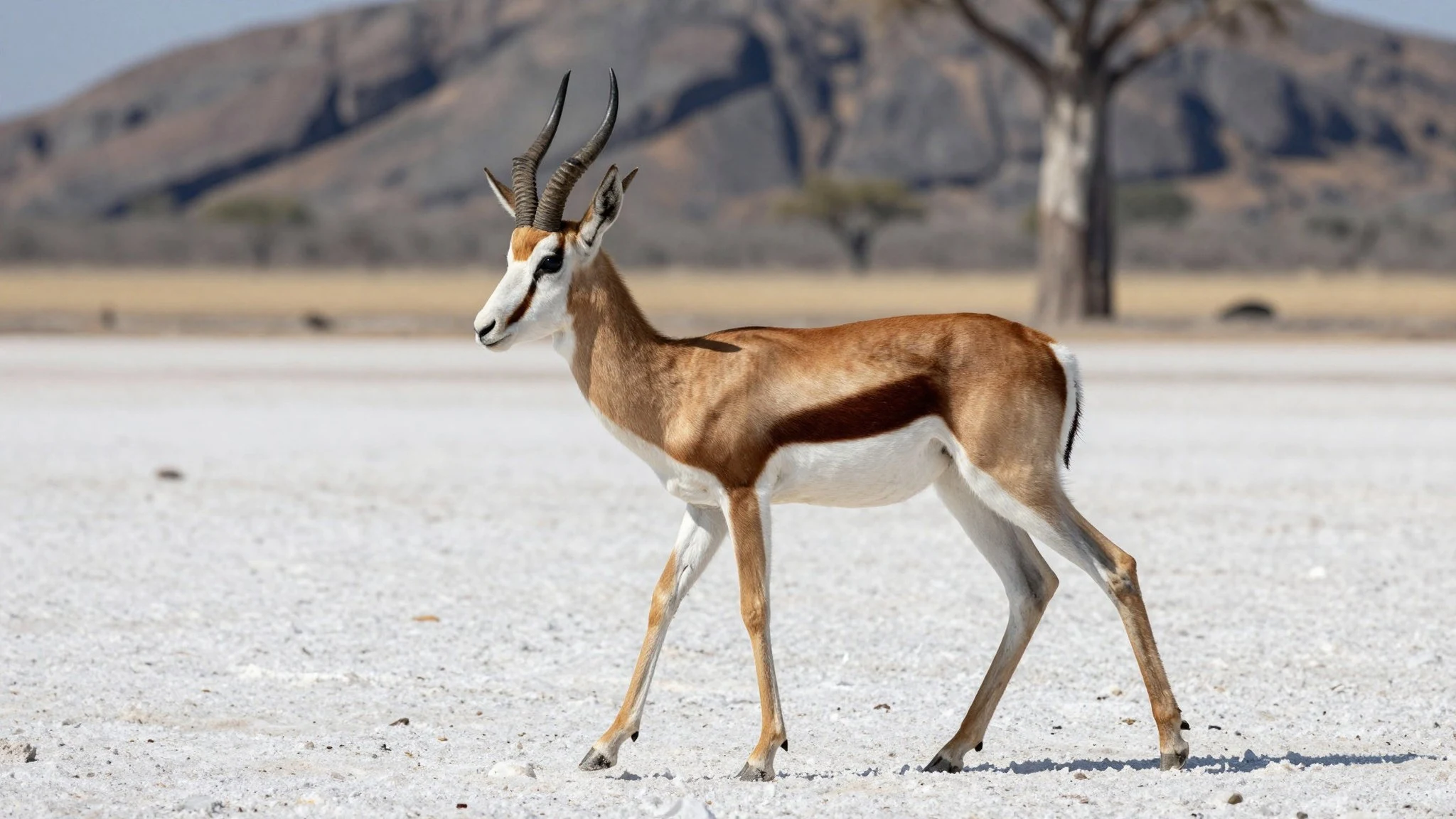
- Oryx (animal)
The gemsbok is a big, tough desert antelope, built for dry and barren country like the Kalahari. At Kubu Island one may wander across the flats now and then, so think of a sighting as a happy gift rather than a promise. Stay well back, speak softly and move slowly, and ask your guide where it is best to stand. Never feed it; wild animals are healthiest finding their own food.