Voltzberg
Voltzberg, Suriname
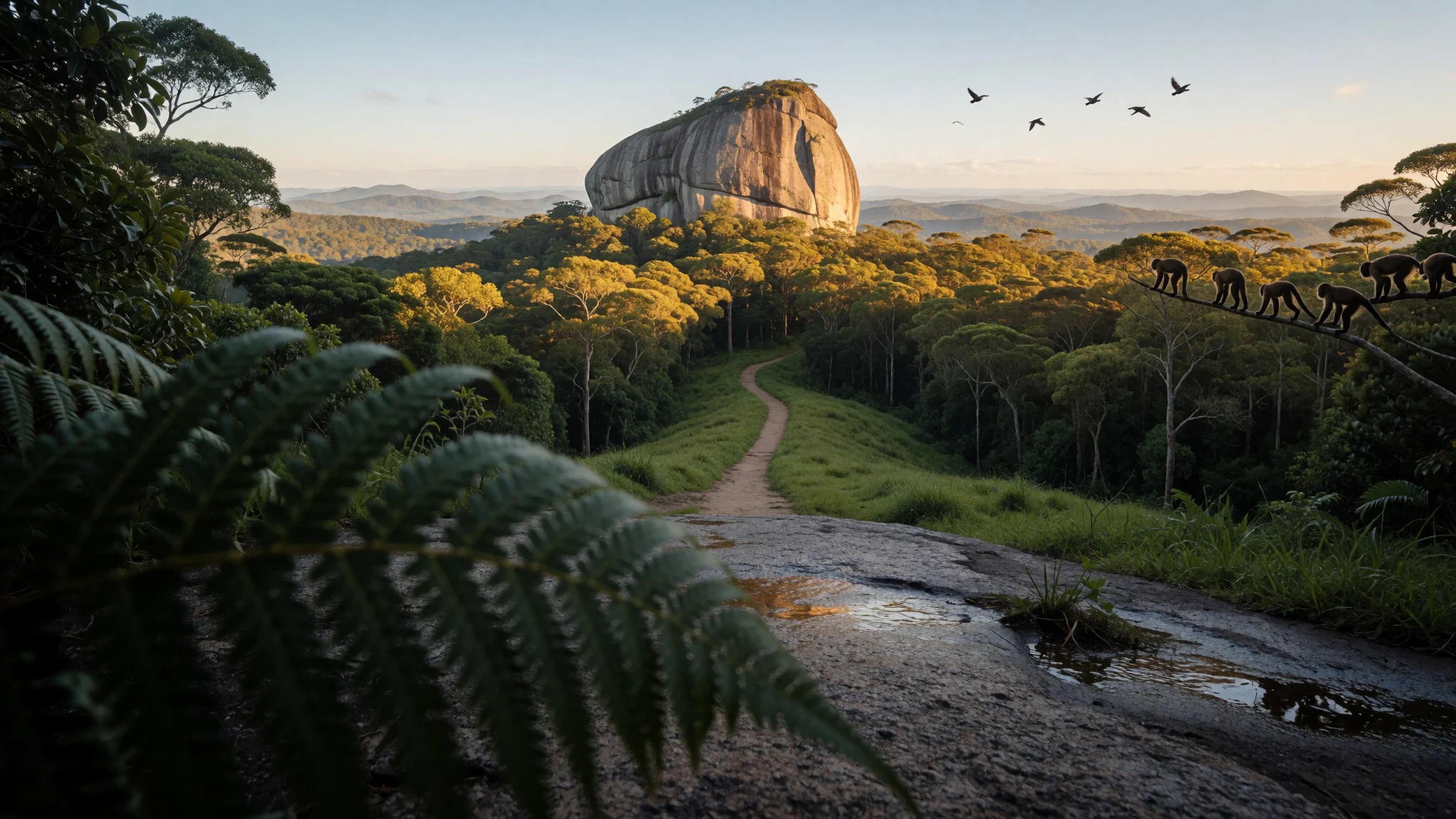
Voltzberg is a bare rock dome in Suriname's rainforest, climbed for a summit view over unbroken canopy, monkeys and birdsong.
The place
Voltzberg is an inselberg, a lone mass of bare rock that stands 240 metres above the forest in the Emma Range of Suriname's Sipaliwini District. Three of its sides rise steeply and look forbidding from below. The fourth flank is far gentler, and that is the side walkers use. Its neighbour, Van Stockumberg, is the tougher climb, so Voltzberg is the one most visitors choose. The summit is open rock, which means the view runs in every direction over a canopy with very few signs of human life. The mountain sits inside the Central Suriname Nature Reserve, together with the nearby Raleigh Falls, and reaching it takes planning and a local guide rather than a simple drive from the capital. Monkeys live on and around the slopes, and birdwatchers come for the forest species, including the Guianan cock-of-the-rock, a bird with bright orange plumage. The place is familiar to Surinamese people even if they have never visited, because the mountain is printed on the 20 dollar banknote. Expect heat and humidity all year, sudden rain, insects at dusk and basic forest accommodation, usually a hammock under a roof. Voltzberg suits people who enjoy slow travel, early starts and a sweaty scramble that ends with a view few places in South America can offer without a long walk. It is a trip for a few days, not an afternoon, and the journey in through the forest is part of the point.
Its story
Voltzberg carries the name of Friedrich Voltz, a German geologist, a reminder that Suriname's interior was mapped by outsiders with rock hammers and notebooks long after the coast was settled. The coastal story is older. Dutch settlers from Zeeland colonised the territory in the 17th century, and British administration came and went until 1816. Plantations of sugar, coffee and cocoa dominated, worked by enslaved Africans, many of whom died under the system. Some escaped into the forest and founded Maroon communities, whose descendants still live along the rivers of the interior. Slavery ended in 1863, and planters then recruited contract workers, from British India until 1916 and from Java until 1936. Many stayed, which is why people of Indian and Javanese descent remain a lasting part of Surinamese life, and why roti and Javanese noodle stalls sit comfortably beside Creole and Chinese cooking. Independence from the Netherlands came in 1975, and many Surinamese then left for the Netherlands to keep Dutch nationality. Years of military rule and political violence followed, and an elected government was back in power by 1991. Protection of the interior came later. Voltzberg and Raleigh Falls had been a small reserve of their own, and in 1998 they were folded into the larger Central Suriname Nature Reserve. Today the mountain stands for the forest itself, a place valued for being left largely alone.
What to see
- The summit climb — Voltzberg, Central Suriname Nature Reserve
The route to the top of Voltzberg follows the gentler fourth side of the dome, over bare rock with forest at its foot. Footing is better than it looks, but the surface turns slick after rain and shade is scarce. Start early, carry plenty of water, and leave time to sit on top.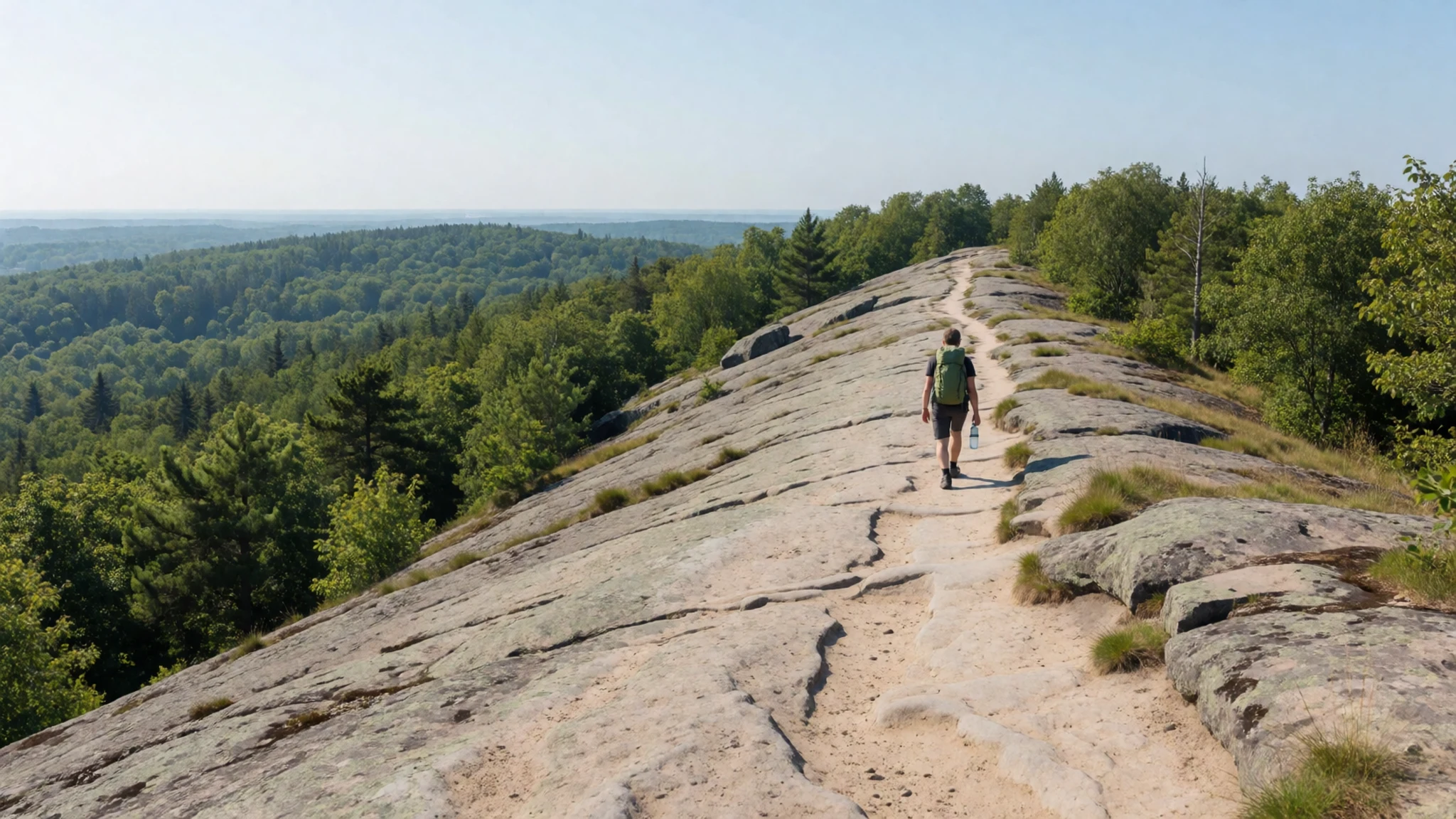
- Canopy view from the top — Voltzberg summit
The Central Suriname Nature Reserve protects the forest around Voltzberg, and the summit shows why. Trees run unbroken to the horizon, interrupted only by the odd bare rock summit. Mist often fills the valleys at first light, so a sunrise start is worth the effort where operators allow an overnight stay.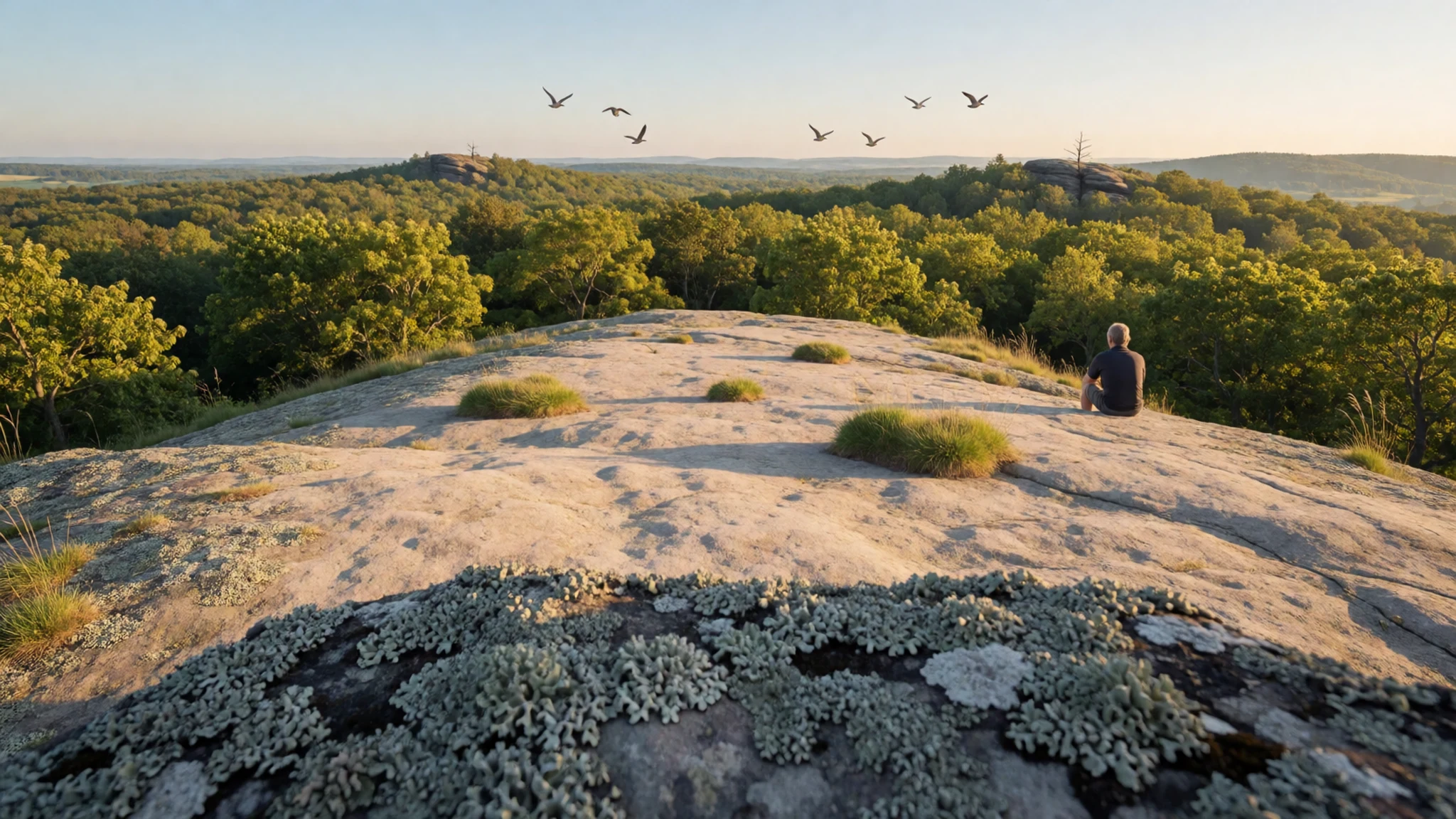
- Raleigh Falls — Near Voltzberg, Coppename area
Raleigh Falls lies close to Voltzberg and was once protected together with it. Water spills over rock ledges in the rainforest, and in drier months the ledges turn into pools and sandbanks. Boat transfers are usually arranged by the operator, and swimming depends on water level, so ask the guide before getting in.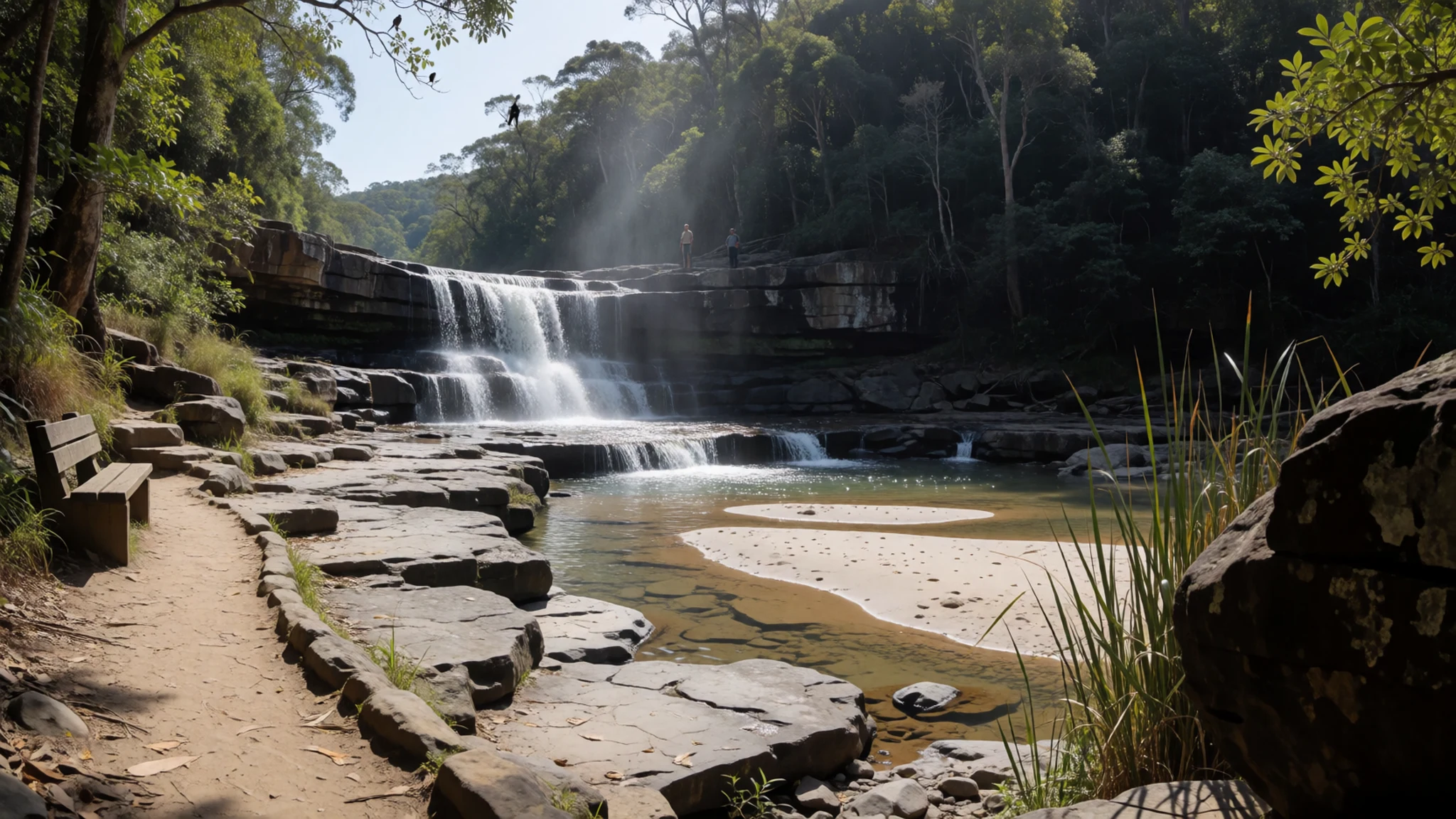
- Van Stockumberg — Emma Range, next to Voltzberg
Van Stockumberg is Voltzberg's neighbour in the Emma Range and a harder climb. Most visitors admire it from Voltzberg's top rather than attempt it, and it gives a sense of how steep these rock domes are. Anyone tempted should ask an experienced guide about conditions instead of assuming a route.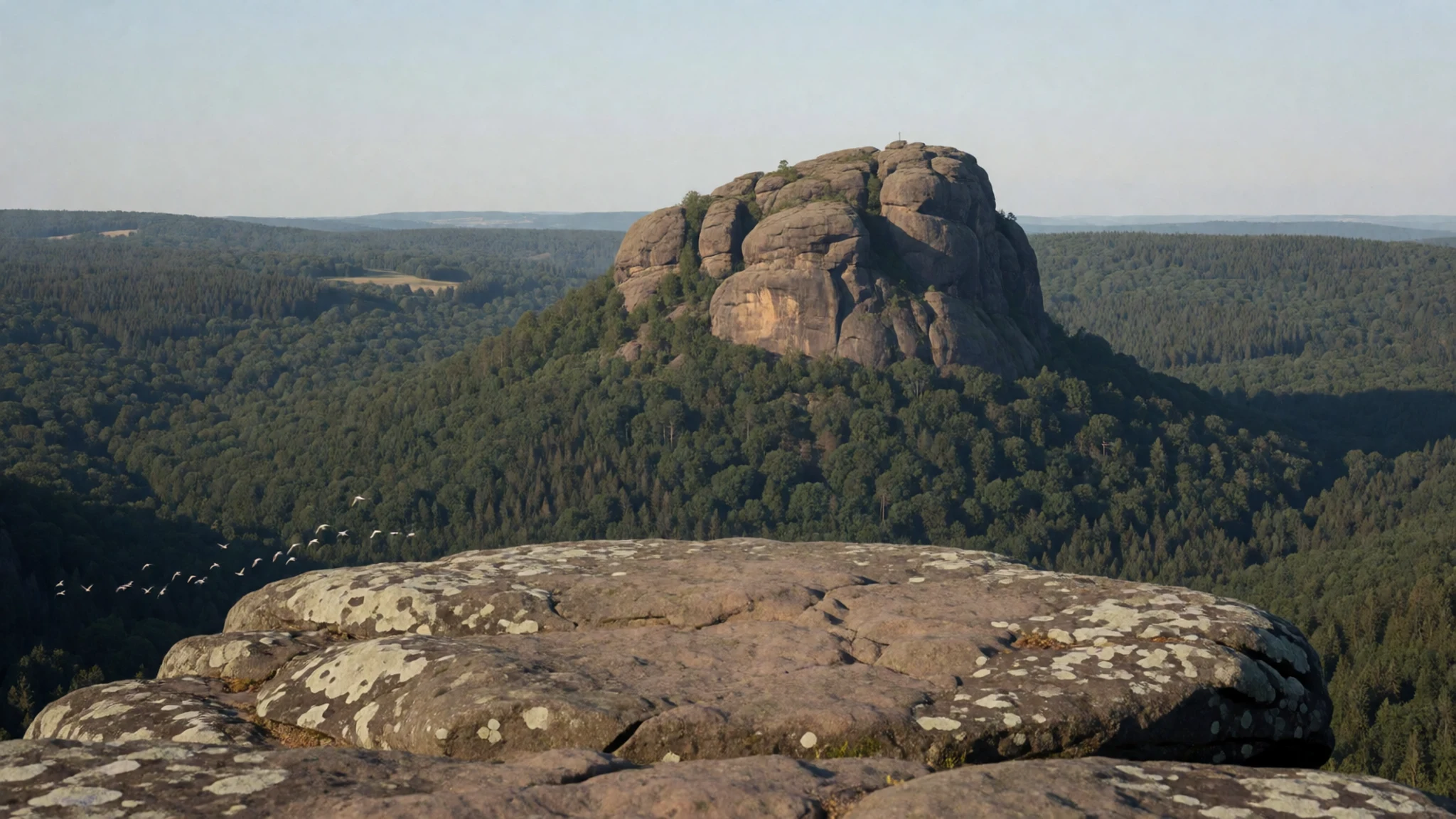
- Birds and monkeys — Forest around Voltzberg
The forest around Voltzberg draws birdwatchers, who come for species such as the Guianan cock-of-the-rock, a rock-loving bird with striking orange plumage. Monkeys are common on and around the mountain. Bring binoculars, listen before looking, and let a guide lead the way to display sites at dawn.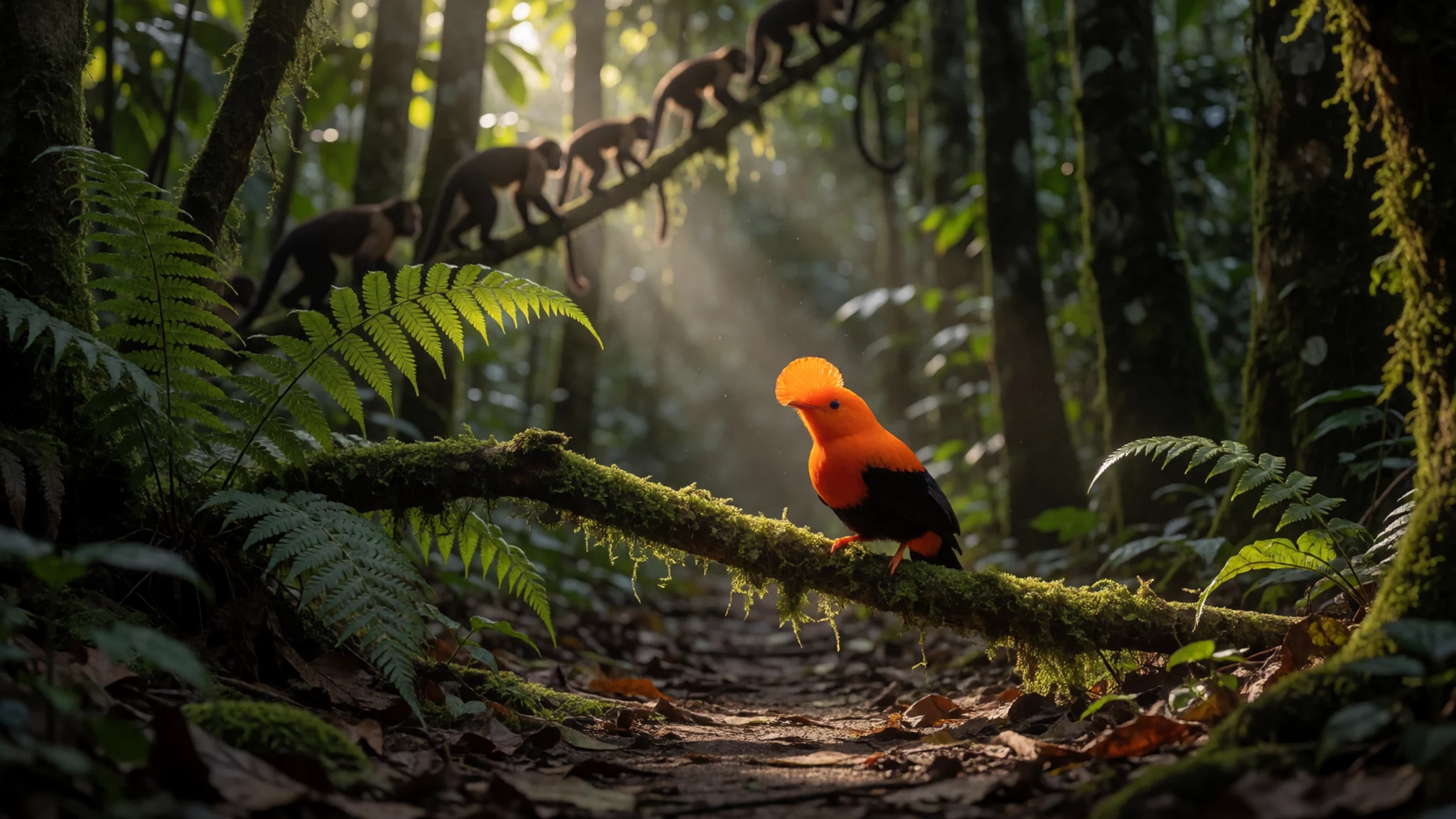
Culture
Voltzberg lies in a country where several cultures sit side by side. Suriname's people descend from Amerindian communities, Maroons, Creoles, and workers brought from India, Java and China, so a single trip can include Hindi, Javanese, Dutch, Sranan Tongo and several Maroon languages. Dutch is the official language, and the common street language is Sranan Tongo. In the interior, villages along the rivers keep their own customs, and some trees and places are considered sacred. Guides know which these are and will usually say so, but it is sensible to ask rather than assume. Respect for the forest is also a cultural matter here, since many communities depend on it for food, travel and belief, and the reserve around Voltzberg is protected for that reason as much as for wildlife. Visitors from India or the UK will find that people are relaxed and hospitable, that a greeting goes a long way, and that evenings in lodges are often social, with shared meals and stories in the hammock hut. Religion is mixed too, with mosques, temples and churches all in everyday use in Paramaribo, which is a good place to see how the communities live together. Ask permission before photographing people or any sacred tree or spot in a village, and accept the answer if your guide or the person says no.
What to wear
Around Voltzberg, clothing is shaped by forest and heat more than by tradition, though Suriname's dress history is rich. The best-known traditional outfit is the Creole kotomisi, made of layered koto cloth with a fitted jacket and a folded angisa headscarf, whose folds can carry messages. It is worn at festivals and cultural events. Javanese families wear batik sarongs and shirts for celebrations, women of Indian descent wear saris and shalwar suits at weddings and religious days, and Maroon communities are known for bright patchwork cloth and carved wooden items. Day to day in Paramaribo, people wear light cotton shirts, shorts, jeans and trainers, with smarter clothes for church, mosque or office. Visitors going to Voltzberg should wear quick-dry long sleeves and trousers against insects and scratches, plus a hat, a rain jacket and a change of socks. Shoes matter most: choose closed ones with a good grip, since the bare rock is slippery when wet and the forest paths are muddy. Sandals suit camp only. In villages and in towns, covered shoulders and knees are the polite default, and swimwear belongs at the water. Bring a small dry bag for phones and cameras, because humidity and sudden showers affect every piece of kit.
What to eat
- Roti with chicken — Roti shops and small eateries in Paramaribo
A soft flatbread served with chicken curry, potato and long beans, brought to Suriname by workers from British India. The seasoning is milder than in India, so it suits a first day. Eaten by hand, it is a filling meal before a forest trip.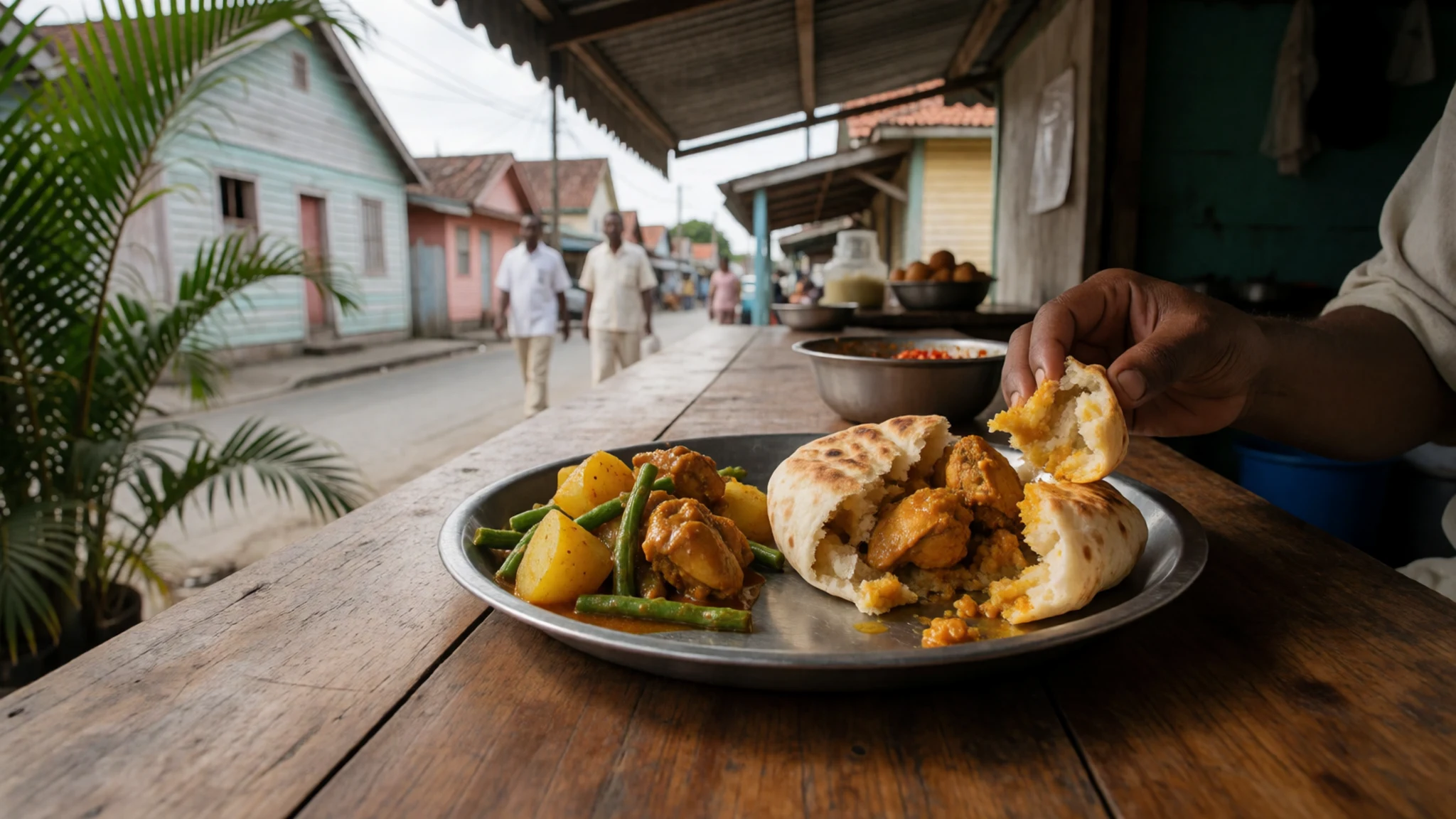
- Bami and nasi — Javanese warungs in Lelydorp and Blauwgrond
Noodles and fried rice are the staples of a Javanese warung, the small family eatery. They come with spicy chicken or satay in peanut sauce. Warungs along the road from the airport towards Paramaribo are a convenient first stop for travellers.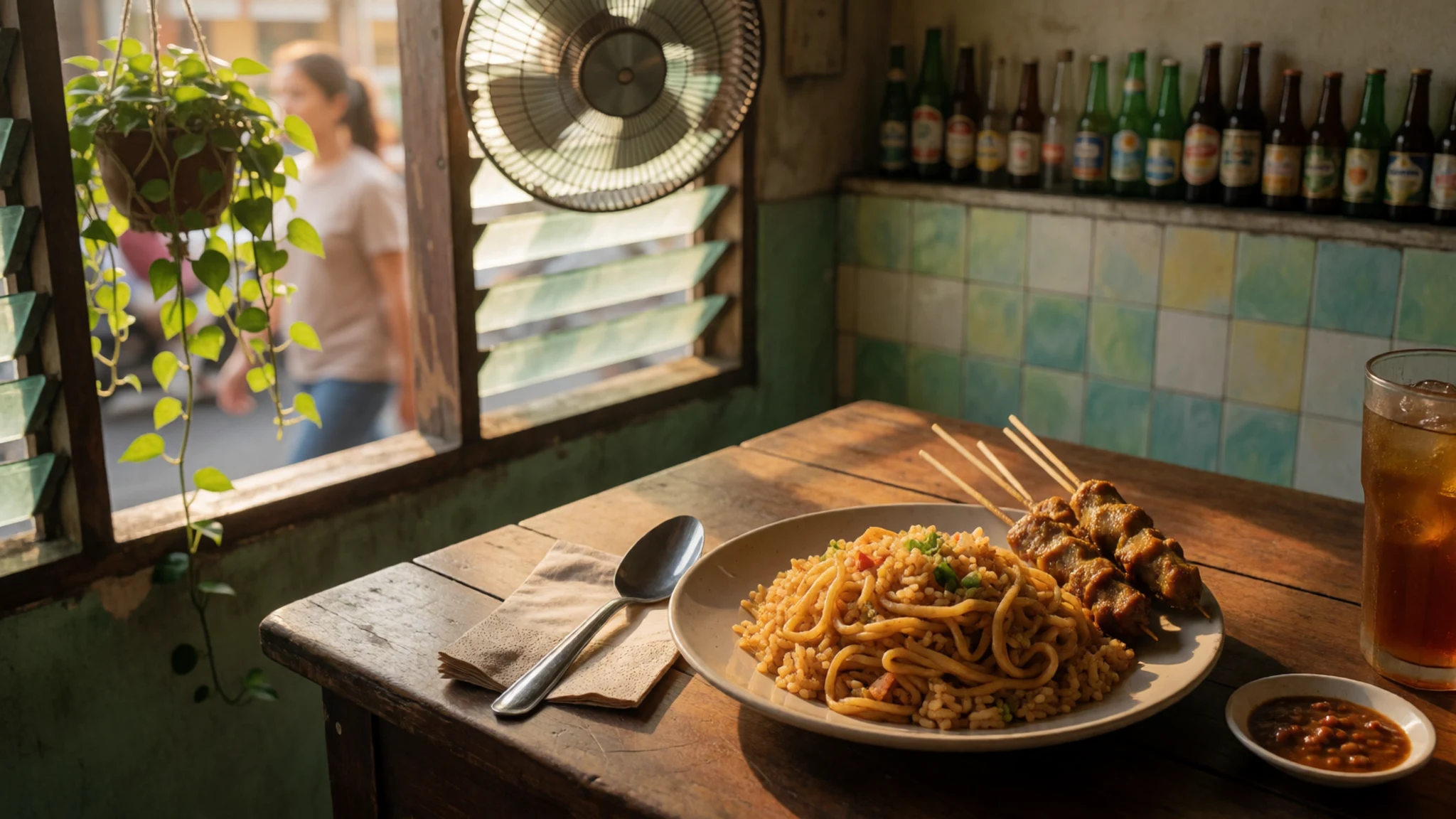
- Petjil and baka bana — Warungs and street stalls around Paramaribo
Petjil is a vegetable dish in peanut sauce, useful for vegetarians, and baka bana is fried banana, sweet and crisp at the edges. Both are Javanese in origin and have developed their own Surinamese character over generations. - Soto — Javanese warungs, spelled soato locally
A warming Javanese broth served with shredded chicken, egg, beansprouts and fresh chilli. It is eaten at any time of day and is a good choice after a rainy morning on the trail or a long drive. - Fresh fruit juices — Juice stalls and markets in Paramaribo
Passion fruit, called markoesa, and soursop, called zuurzak, are the local favourites. Bottled juices are generally sweet, since Surinamese tastes lean that way, so ask for less sugar when buying fresh. A cold glass is welcome after the heat of a forest day.
Plan it
Best time. The drier months are the easier time for the rock and the trails: roughly August to October, with a shorter dry spell around February and March. Expect heat and humidity all year, and heavy rain in the wet seasons can make trails and river transfers harder, so confirm conditions with the operator.
How long. 3–5
Getting there. Fly to Johan Adolf Pengel International Airport near Paramaribo. Voltzberg itself is reached through a Paramaribo tour operator, usually with a river transfer and a forest walk, sometimes with a flight. Confirm the exact route, as it varies with water levels.
Budget. high
Tips
- Book a guided trip well ahead, as independent travel into the interior is not advised
- Buy a hammock in Paramaribo before heading into the forest
- Carry mosquito repellent, sunblock and more water than seems necessary
- Start the climb early, before the heat builds and while the rock is cooler
- Check visa rules for your passport before booking flights
Etiquette
- Ask before photographing people, villages or sacred trees
- Follow the guide's lead on where to walk and camp
- Carry all rubbish out and do not disturb wildlife
Nearby
Sources
- Wikidata Q16740373 (CC0)
- Wikipedia: Voltzberg (CC BY-SA 4.0)
- Wikivoyage: Suriname (CC BY-SA 4.0)
- Top of Voltzberg, Suriname — Jan Willem Broekema, Hans Erren (CC BY-SA 4.0)
- 20 Suriname Dollar Banknote — Brokopondo (CC0 1.0)
- Amazon jungle from above — David Evers (CC BY 2.5)
- Mt. Voltzberg, Suriname — David Evers (CC BY 2.5)
- Suriname 20 dollar bill: Volzberg mountain — Jan Willem Broekema (CC BY-SA 2.0)


Wildlife
- Guianan cock-of-the-rock (animal)
The Guianan cock-of-the-rock is a plump rainforest bird, and the male is a showy orange with a crest shaped like a half-moon. Around Voltzberg, birdwatchers look for it in the forest by the slopes, where rocks rise among the trees; the smoky-brown female is much harder to notice. Go with a local guide, stand well back, and stay quiet so it is not startled. Never feed it; fruit is its main food, and the forest provides.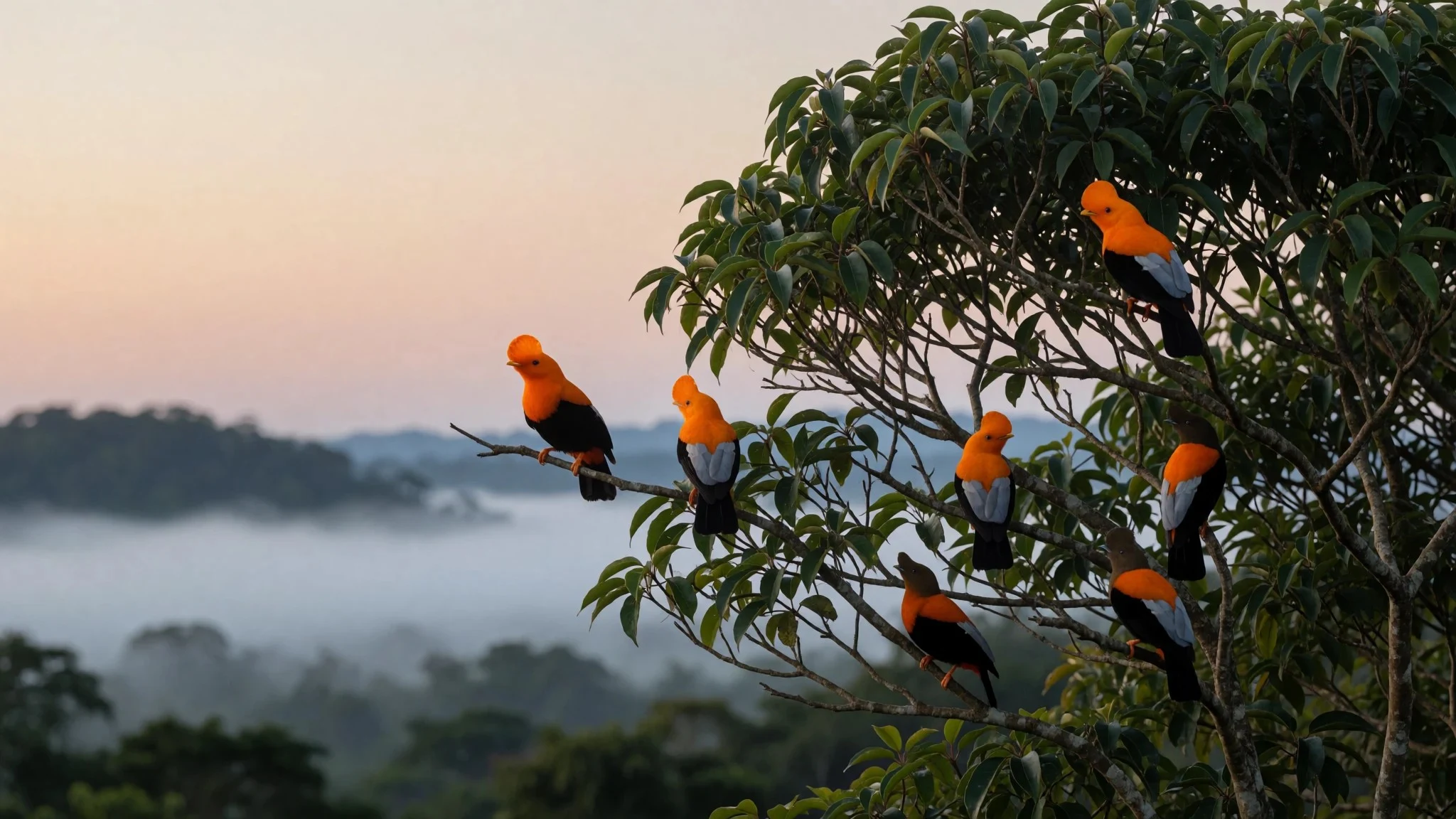
- Guianan cock-of-the-rock (bird)
The Guianan cock-of-the-rock is a plump rainforest bird, and the male is a showy orange with a crest shaped like a half-moon. Around Voltzberg, birdwatchers look for it in the forest by the slopes, where rocks rise among the trees; the smoky-brown female is much harder to notice. Go with a local guide, stand well back, and stay quiet so it is not startled. Never feed it; fruit is its main food, and the forest provides.