Derawar Fort
Derawar Fort, Pakistan
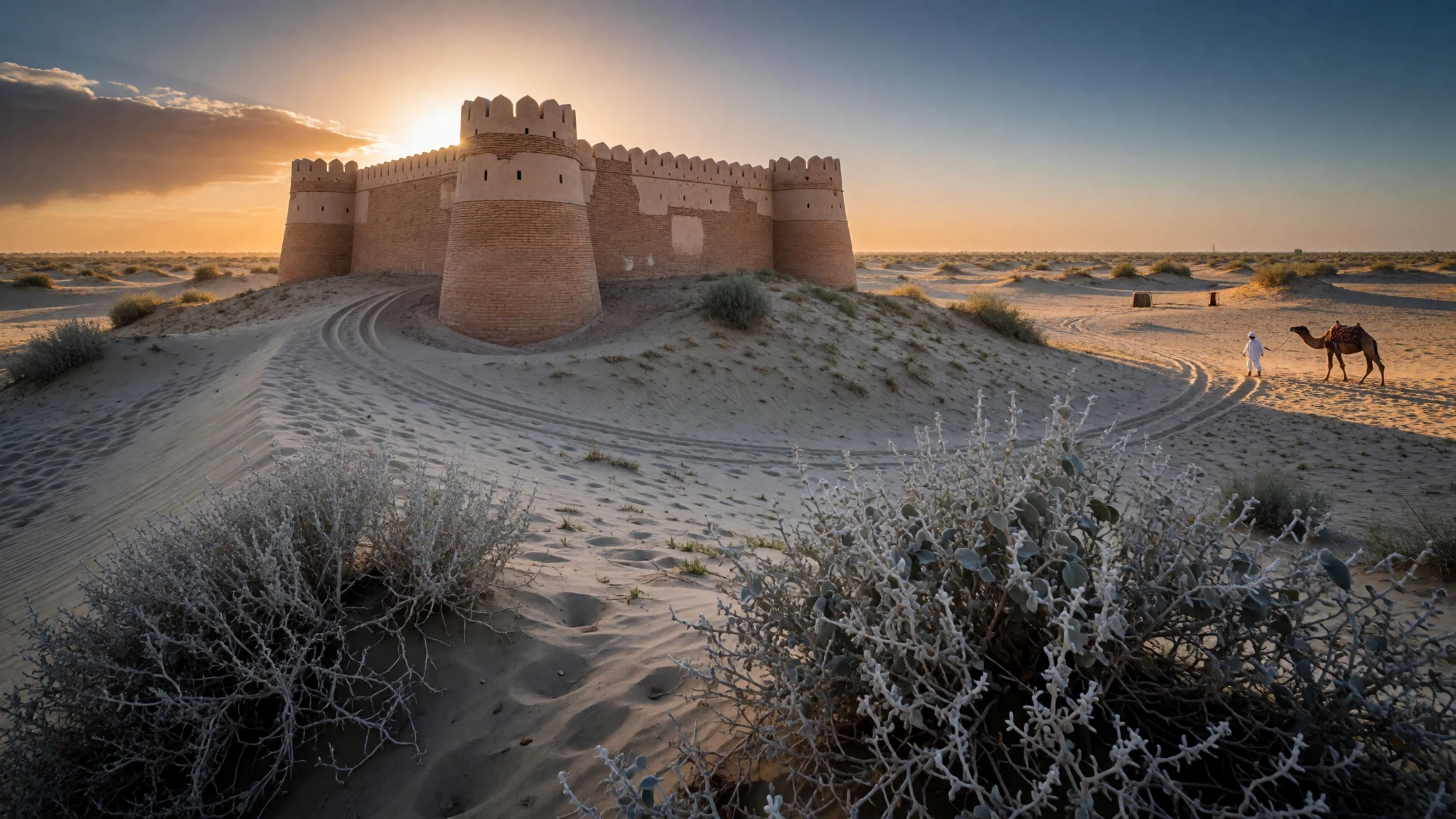
Derawar Fort rises from the Cholistan sand as a ring of round bastions, a desert seat of the Nawabs of Bahawalpur.
The place
Derawar Fort stands alone in the Cholistan Desert of Punjab, a square of high walls and round bastions set on a low dune ridge. The country around it is called the Rohi: hard sand, salt-bush, and a scatter of wells and camel tracks rather than a town. Bahawalpur, the old princely capital, lies well to the north-northeast; the fort itself sits in open desert with almost nothing built against its walls. From a distance the bastions read as a single pale mass. Close up, the brickwork shows repairs of several ages, and the corners turn sharply, so the plan stays readable even when haze flattens the horizon.
Inside, the ground is a broad courtyard rather than a maze of palaces. A white mosque stands nearby, and traces of painted work survive on stretches of the eastern wall. A Hindu temple remains within the same enclosure, a reminder that the desert route carried more than a single community. The Abbasi graveyard lies a short distance east, a low field of tombs belonging to the nawab family that held Bahawalpur. Wind, sand, and strong sun are the daily conditions: shade is limited to wall-foot and mosque, and the light goes white by late morning.
The place is a monument and a working desert edge at once. Herders still move through the Rohi, and the road that reaches the fort is the same road that serves scattered settlements. Visitors usually come for the walls against the sky, then find the quieter facts of the site: the mosque, the temple, the graves, and the long view back across empty sand. There is no dense bazaar at the gate. What the fort offers is scale, silence, and the odd intimacy of a royal building left in a landscape that has not filled in around it.
Its story
Derawar Fort belongs to overlapping histories: a Rajput desert stronghold and the court of the Abbasi nawabs of Bahawalpur. Local tradition credits the Bhati clan with the earlier fort on this ground, part of a chain of posts that watched the routes across the Rohi. Those routes were never rich in water. Whoever held the wells held the road, and a high brick circuit was as much a store and a refuge as a palace.
The story that visitors meet today is the Abbasi story. The family, claiming descent through the Abbasid line, established itself in this part of Punjab and made Bahawalpur its capital. Derawar became a desert seat of that state: a place to keep, to visit, and to be buried beside. The nawabs rebuilt and maintained the walls, raised the mosque that still stands nearby, and left their tombs in the sand a short distance east. Court life itself stayed mostly in Bahawalpur; the fort's role was presence, a marker that the state ran all the way into the Cholistan.
After the princely state joined Pakistan, the family connection did not vanish. The graves, the mosque, and the quiet of the interior still read as family heritage as much as public monument. Painted fragments on the eastern wall and a Hindu temple inside the enclosure point to a wider cast of makers and worshippers than a single dynasty. What survives is not a continuous chronicle with dates carved for the visitor. It is a brick argument: that this empty quarter was governed, prayed in, and remembered, and that the memory was built thick enough to outlast the camps that once stood around it.
What to see
- The bastioned walls — Cholistan, Bahawalpur District
Derawar Fort's outer walls are a long run of brick punctuated by round bastions set close together. From the desert side they are the whole silhouette. A slow circuit shows the repaired brick and the sand heaped at each foot, which is how the building meets the desert.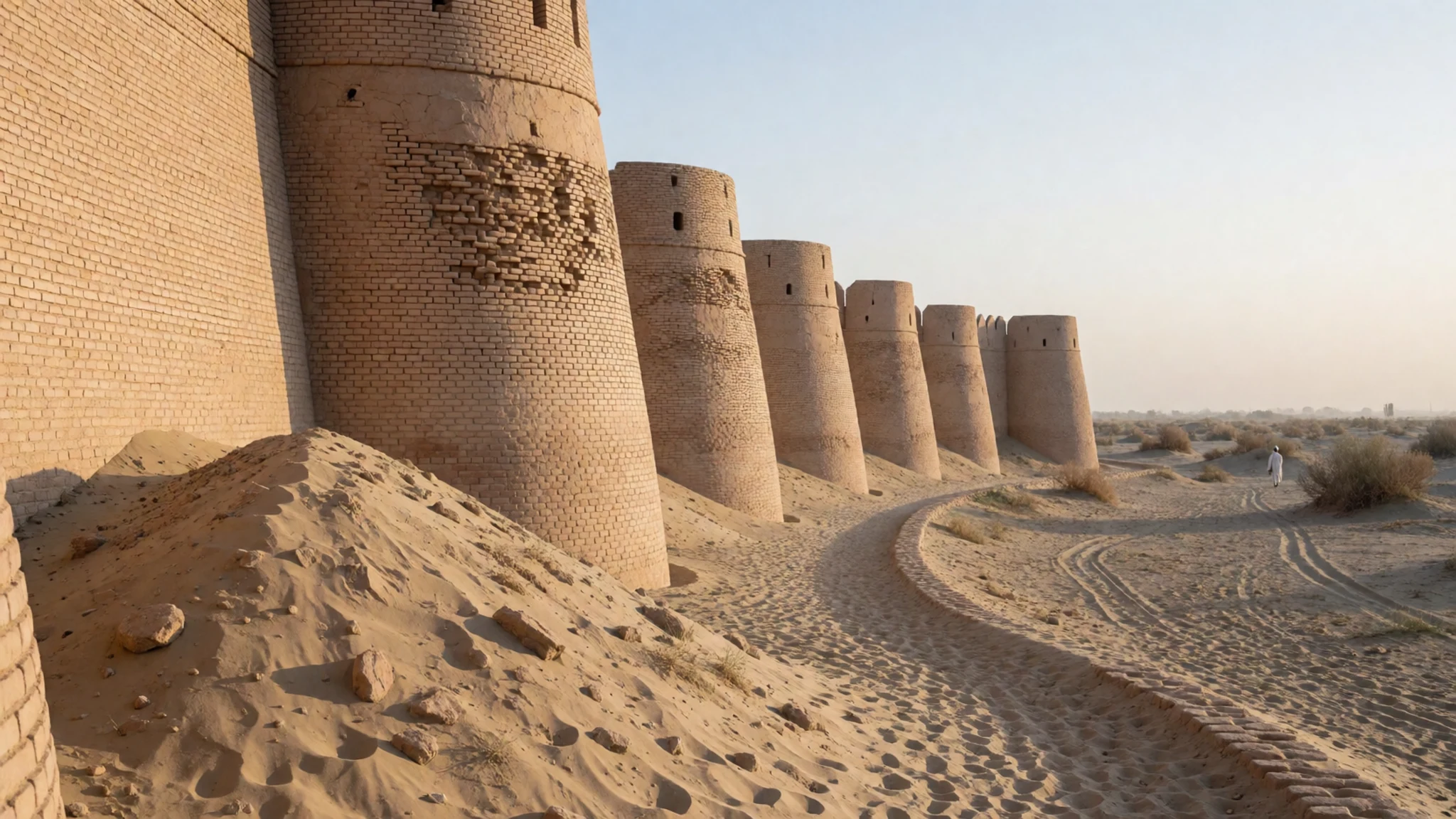
- Sunset on the sand — Cholistan, Bahawalpur District
Derawar Fort is clearest in the last light, when the bastions separate from the haze and the sand takes a warmer colour. Cloud banks often sit on the horizon, so the sky matters as much as the walls. From a short way out, the fort reads as a single mass.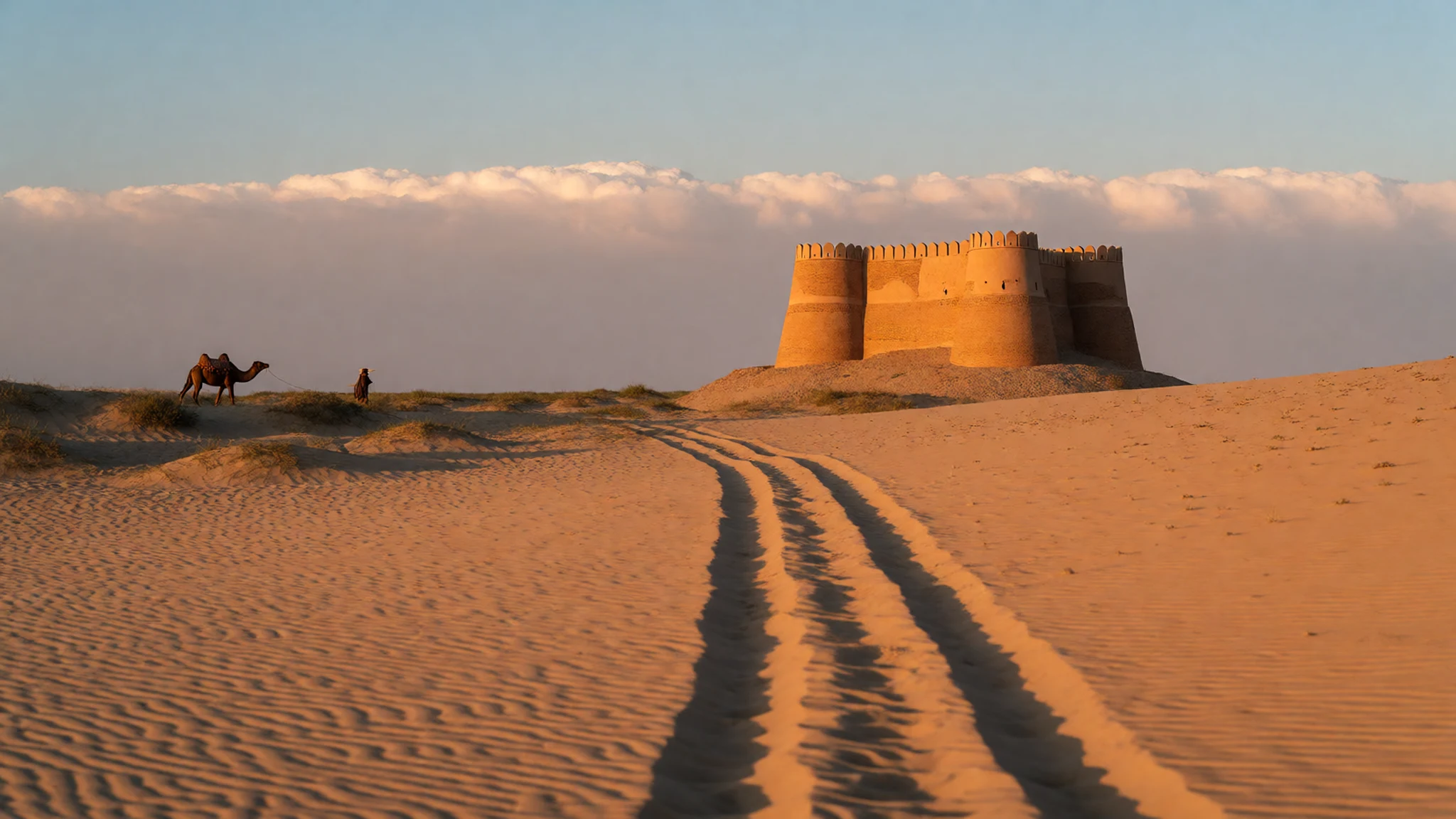
- After sunset — Cholistan, Bahawalpur District
Derawar Fort after sunset is a different building. In the blue hour the bastions turn into a dark comb against the sky, and any lamps later pick out the brick. A night stop makes sense only when the ride back to Bahawalpur is already fixed; the return road is empty and unlit.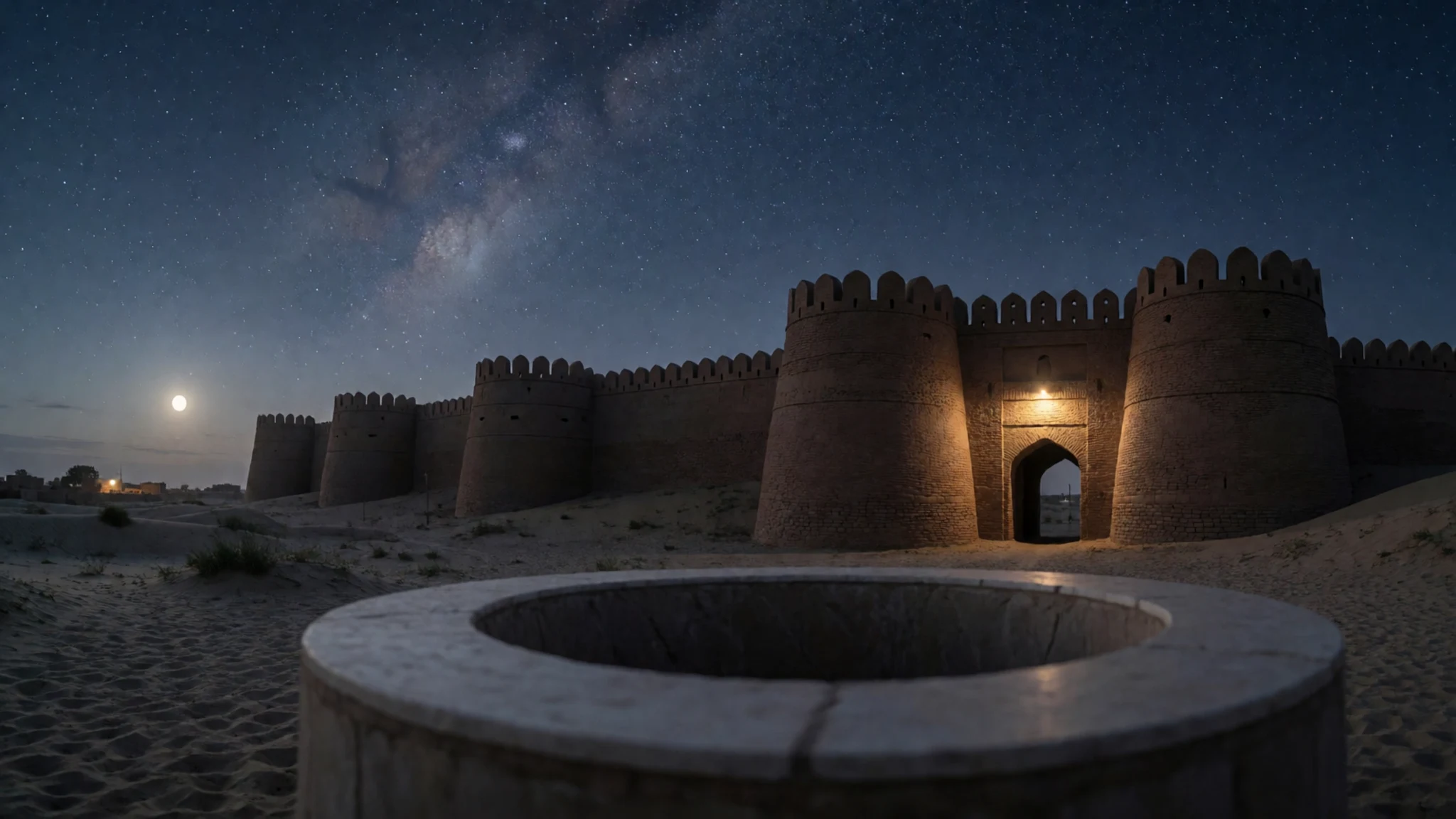
- The Hindu temple — Inside the fort, Cholistan
Derawar Fort holds a Hindu temple inside its walls. Finished with a tower and much smaller than the bastions, it records a desert route shared by more than a single community. The carved stonework rewards a close look.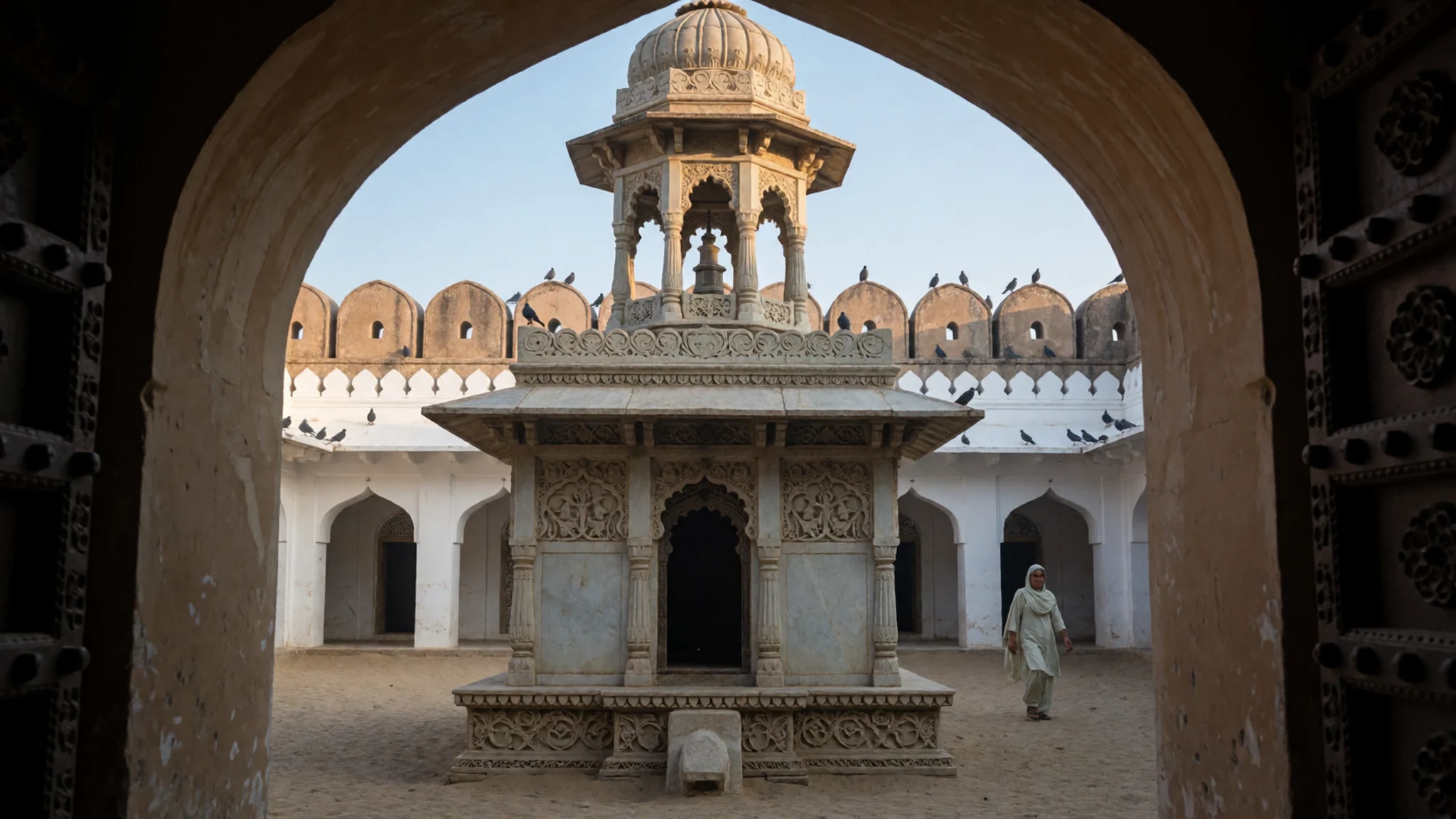
- Artwork on the eastern wall — Eastern wall, Cholistan
Derawar Fort keeps painted and plastered work on its eastern wall, easy to miss while the eye stays on the bastions. The patterns are faded: colour was once part of this military building, not only of the mosque. Early light on this side makes the remaining lines easier to read.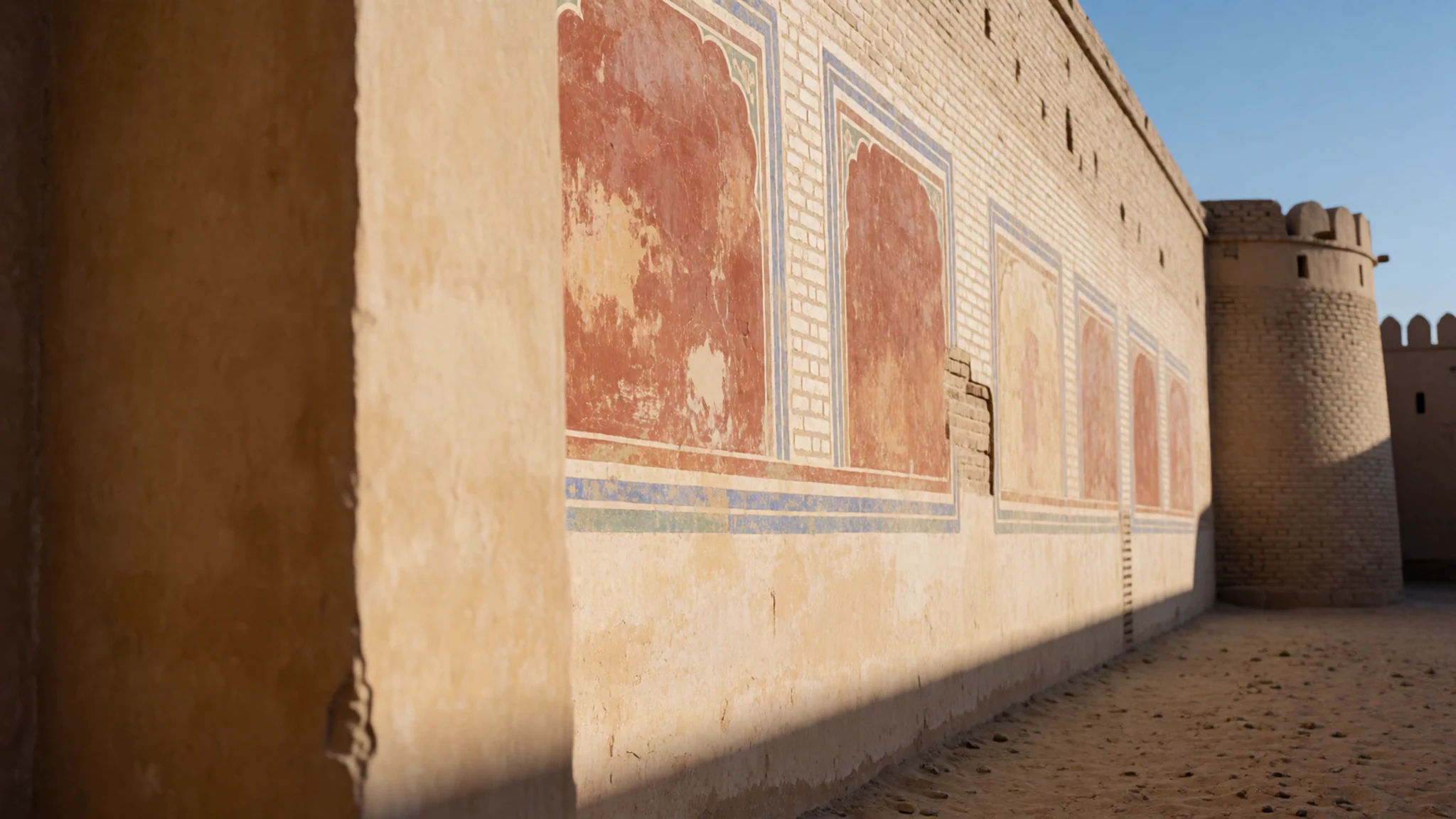
- The mosque and the Abbasi tombs — Courtyard and graveyard, Cholistan
Derawar Fort's white mosque stands nearby, and the Abbasi tombs lie in the sand a short distance east. Together they turn the visit from fortification toward a family seat. The tombs are low and spread out, and they explain the nawabs' long attachment to this dune.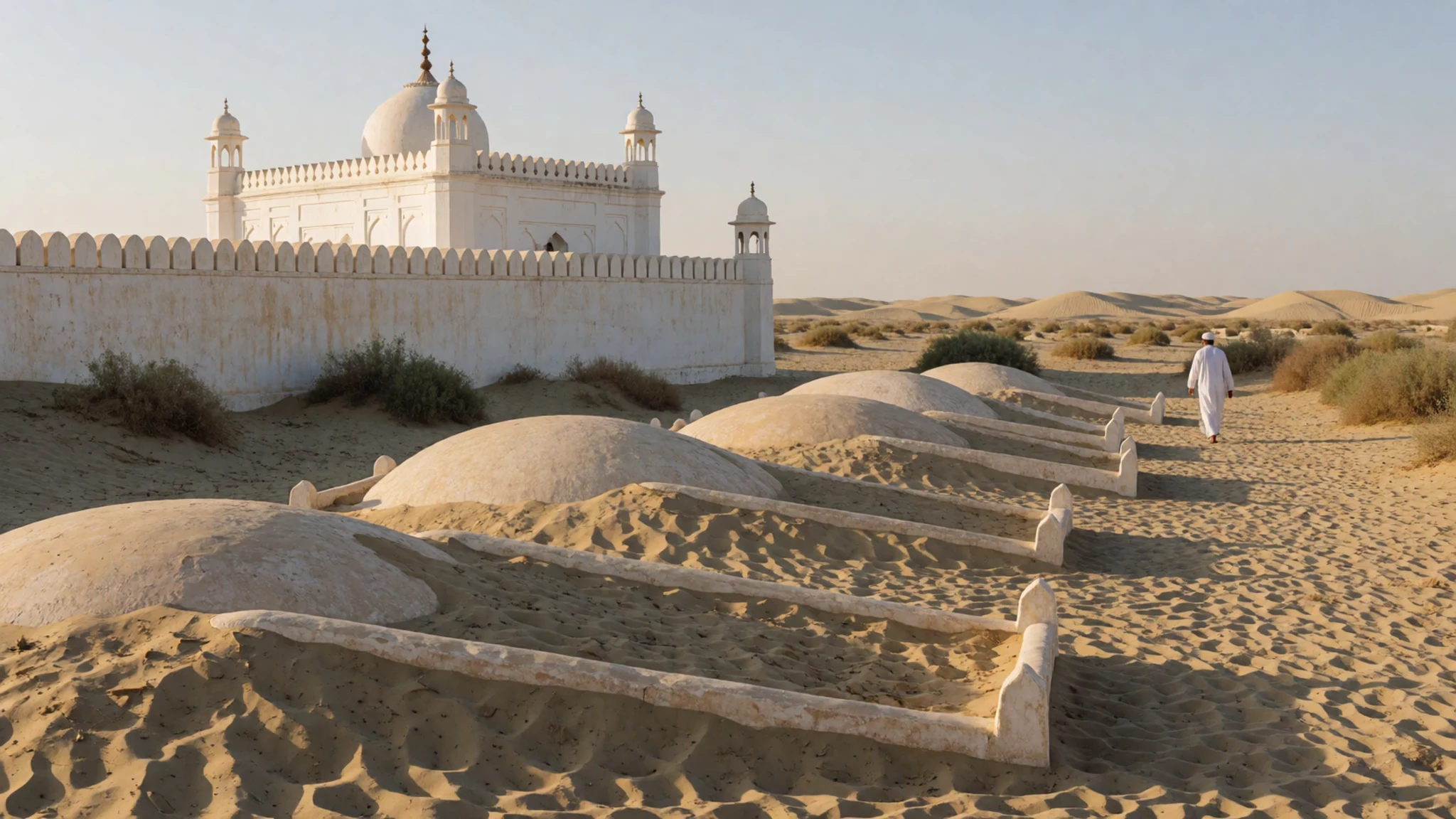
Culture
Derawar Fort sits in a Saraiki- and Punjabi-speaking desert culture shaped by herding, wells, and the old Bahawalpur court. Cholistan life still turns on camels, seasonal grazing, and the knowledge of where the water is. Hospitality is formal and generous: tea arrives quickly, and a guest is expected to sit before any talk of business. The nawabi past shows up in pride about the Abbasi name, in the care of the family tombs, and in a taste for ceremony that city weddings in Bahawalpur still echo.
Faith is visible and daily. The mosque near the fort is a working pattern, not a backdrop, and the wider district keeps a dense calendar of prayer, urs gatherings, and shrine visits. The Hindu temple within the walls is a surviving sign of an older mix; it should be treated as a sacred room, not a curiosity. People photograph the fort constantly and photograph each other far less comfortably.
Women travellers will find the public desert road a male space, especially away from Bahawalpur, and modest cotton with a dupatta draws less comment than bare arms. Ask before you photograph people at Derawar Fort, and remove your shoes before stepping into the mosque or onto any tomb platform.
What to wear
Derawar Fort's country dresses for heat, dust, and ceremony. Traditional men's dress is a loose shalwar kameez in white or light cotton, sometimes with a waistcoat, and a pagri when the occasion is formal; the Bahawalpur turban is a point of local pride, tied full and worn for weddings and receptions rather than for herding. Women's formal clothes are also shalwar kameez, cut with more cloth and often covered in gota, mukesh, and dense embroidery in gold, crimson, and green. Cholistan textiles add another language: ralli quilts stitched from scrap cotton in bold geometric patches, made for the home and for gifting, not for the street.
Everyday dress at the fort and in Yazman is simpler. Men wear practical shalwar kameez in cotton or lawn, with a scarf against the sun and sandals or shoes that can take sand. Younger people add jackets, caps, and the occasional pair of jeans under a kameez. Women in town wear printed lawn suits and a dupatta; on the open road the dupatta stays on, less as costume than as cover from dust and from notice.
A visitor should copy the practical layer, not the wedding layer. Light cotton that covers shoulders and knees, a scarf for the head at the mosque, and closed shoes or sturdy sandals for hot sand and rough brick are enough. Heavy silk and new embroidery belong at a Bahawalpur wedding, not on the fort, where they only collect dust.
What to eat
- Sohan halwa — Sweet shops in the Bahawalpur bazaar
Sohan halwa is Bahawalpur's dense ghee-cooked sweet of wheat, sugar, and nuts, sold in wedges. Derawar Fort has almost nothing to buy, so take it from an old sweet shop in the Bahawalpur bazaar before the desert drive.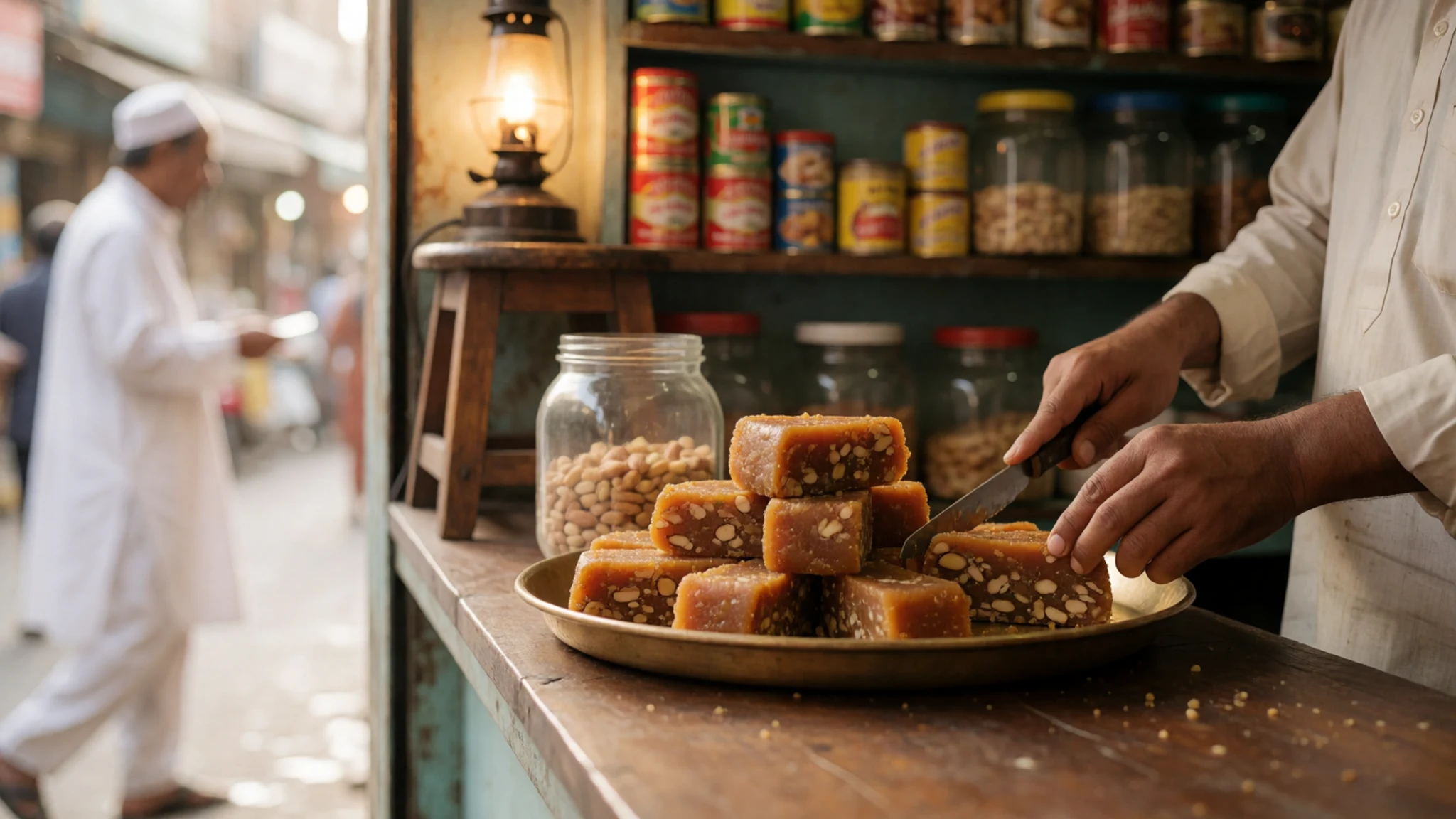
- Sajji — Roadside eateries on the Bahawalpur–Yazman road
Sajji is lamb or chicken salted and roasted over a trench of coals, juicy under a spiced crust. It suits the desert. Roadside eateries on the Bahawalpur–Yazman road, where a spit outside is the sign, are the place to find it.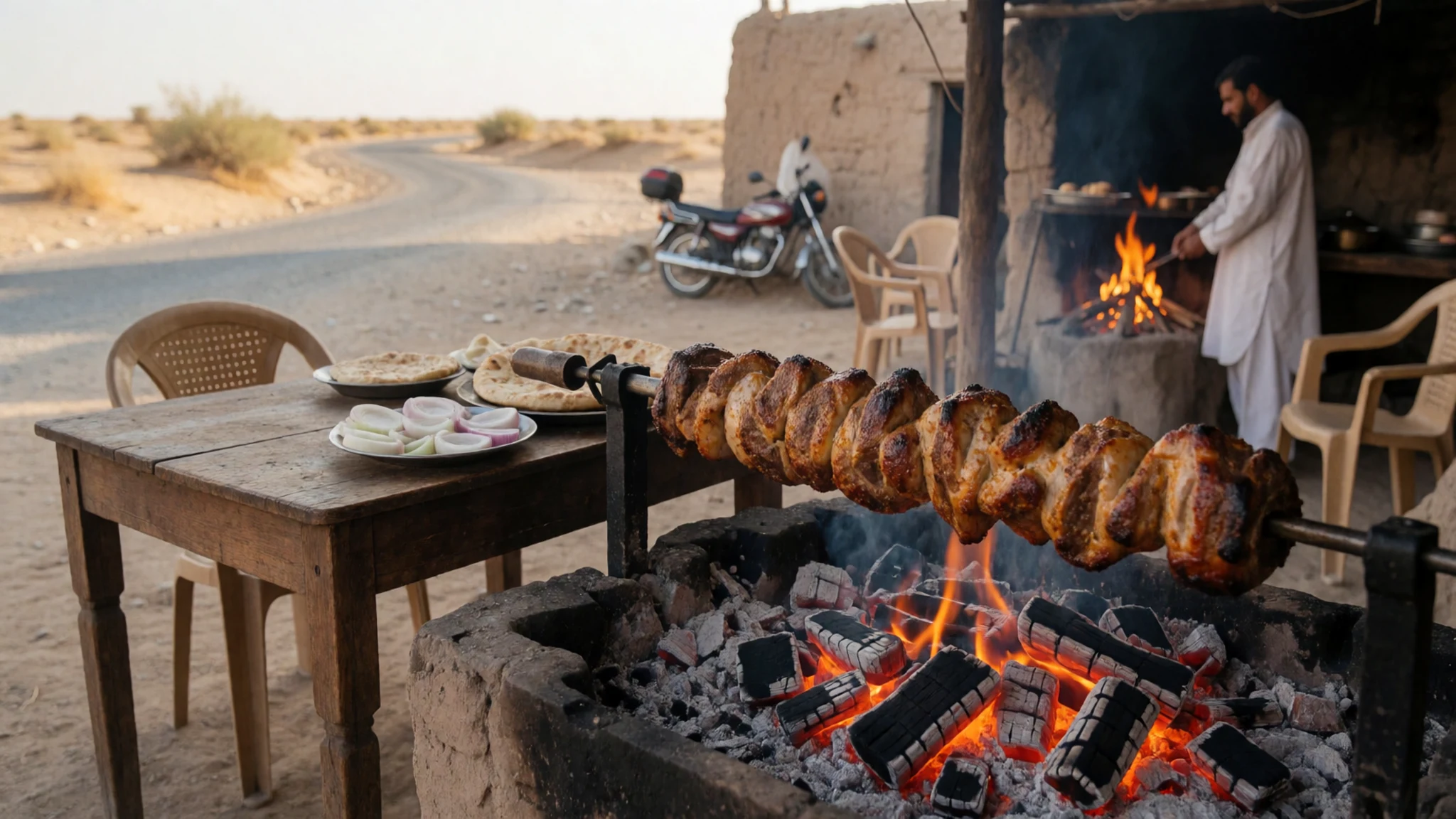
- Mutton karahi — Simple eateries in Yazman or on the edge of Bahawalpur
Mutton karahi is the everyday feast near Derawar Fort: goat cooked in a shallow pan with tomato, ginger, and green chilli until the gravy clings. Eat it with tandoori roti at a simple eatery in Yazman or on the edge of Bahawalpur. - Lassi — Tea stalls in Yazman
Lassi, salted or sweet, is the drink that makes a hot courtyard bearable. Around Derawar Fort it is yoghurt thinned with water, salt, and roasted cumin. A tea stall in Yazman will have a jug; have it there, before the drive. - Pheni — Sweet shops in the Bahawalpur bazaar
Pheni is a crisp nest of fine fried vermicelli, eaten with sugar syrup and thickened milk. Bahawalpur sweet shops sell it beside sohan halwa. Carry the dry nests toward Derawar Fort, where the monument itself offers no dessert. - Daal mash — Small eateries in Yazman
Daal mash, white lentils cooked with garlic and finished with ghee, is the meal that fills a day of walking near Derawar Fort. Small eateries in Yazman serve it with roti and raw onion. Trust it when the menu is short.
Plan it
Best time. At Derawar Fort, December and January bring the most comfortable days and cold winter nights. October and March stay hot; May is the hottest month and August the wettest. From April through September the heat is severe, and a summer midday at the walls is punishing.
How long. 1–2
Getting there. Bahawalpur Airport is the nearest airport to Derawar Fort, and Bahawalpur railway station takes trains from Lahore and Karachi. From the city, the last leg is a road through Yazman into the Cholistan; hire a car and driver, because public transport does not reliably reach the fort.
Budget. mid
Tips
- Arrange the car in Bahawalpur the day before; do not count on hiring transport in Yazman.
- Carry more drinking water than a city day would need, and keep the bottles in the shade.
- Leave Bahawalpur before dawn so the walls are seen before the heat and the haze build.
- Do not rely on food or shade at the gate; eat in Bahawalpur or Yazman.
- Carry cash; card machines are usual in Bahawalpur and unusual on the desert road.
Etiquette
- Remove shoes at the mosque and on tomb platforms.
- Ask before photographing people, and do not photograph women without a clear yes.
- Cover shoulders and knees, and take a scarf for the mosque.
- Do not climb the bastions or disturb loose brick and painted plaster.
Nearby
Sources
- Wikidata (CC0)
- Wikipedia — Derawar Fort (CC BY-SA 4.0)
- Wikivoyage — Bahawalpur (CC BY-SA 4.0)