Faisalabad
Faisalabad, Pakistan
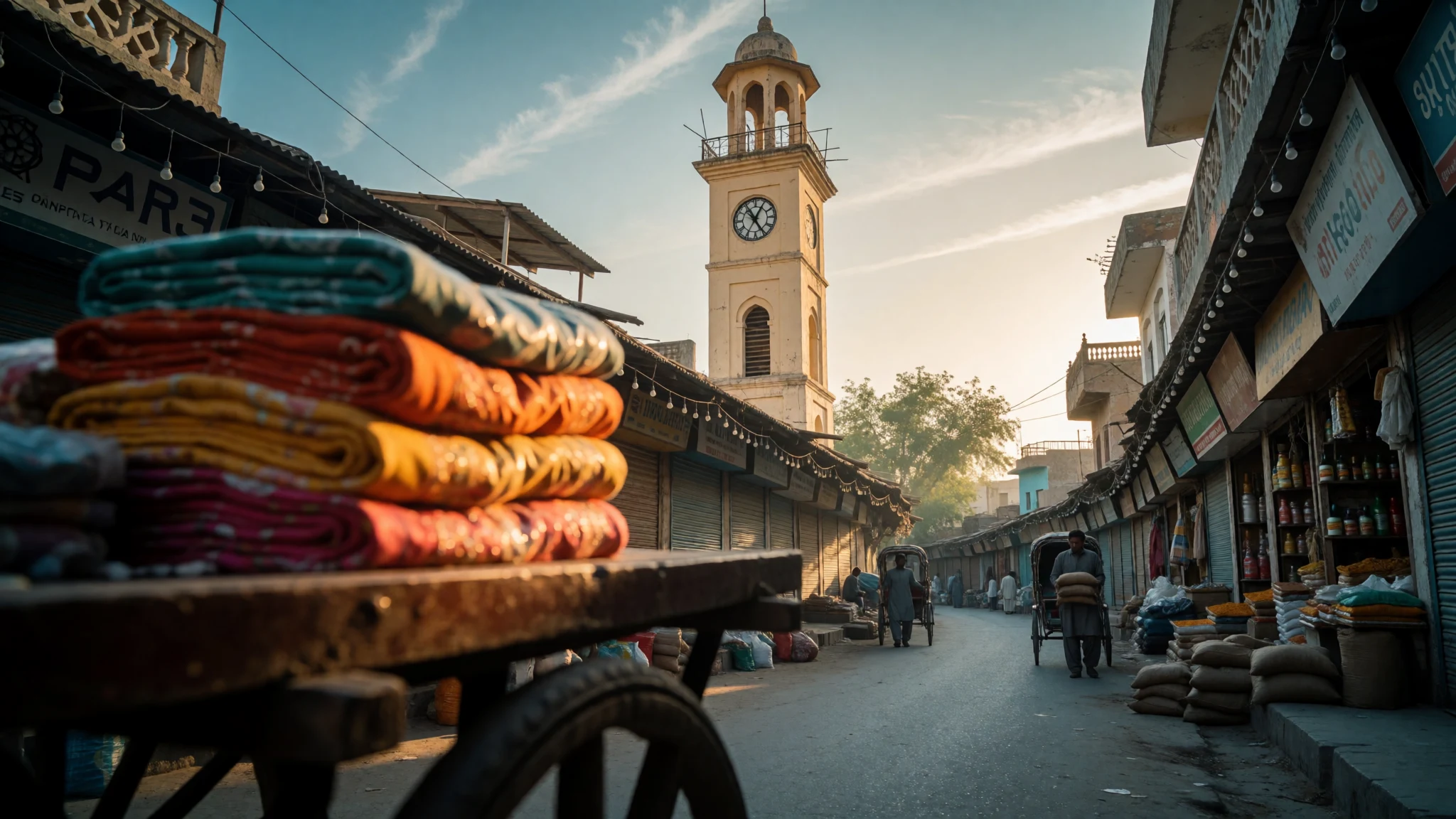
Faisalabad is a working Punjab city of textile mills, colonial-planned bazaars and lively street snacks, rewarding for travellers curious about everyday Pakistan.
The place
Faisalabad sits on the flat plains of central Punjab in Pakistan, at an elevation of 184 m, in the stretch of land between rivers known as the Rachna Doab. With about 3.2 million people, it is a working city rather than a sightseeing one: the reason to come is to see how a modern Pakistani industrial centre lives, trades and eats. Textile mills, dyeing works and powerloom workshops shape the economy, and the city is often nicknamed the Manchester of Pakistan for that reason. The centre follows a planned colonial layout, with the old market district fanning out from a clock tower and wider avenues, gardens and civil-lines buildings arranged around it. Beyond the centre the city spreads into factory belts, housing colonies and the farmland that feeds them. The pace is brisk and loud. Rickshaws, motorbikes and handcarts share the roads with buses, and evenings bring families out to the markets and food streets. Roads, rail and air links make Faisalabad an easy stop between larger cities such as Lahore, Islamabad and Karachi. Expect heat for much of the year, dust, traffic and very little polished tourism. What the city offers instead is directness, good street food and a clear view of how Punjab earns its living. Older residents and institutions still use the former name, Lyallpur.
Its story
Faisalabad began as a colonial experiment in turning dry grazing country into farmland. Before the late nineteenth century the land belonged to scattered forest-dwelling tribes, part of the old Sandalbar tract. After British rule extended over the whole of Punjab in 1849, officials planned canals to carry river water to the western plains and settled farmers along them. The Chenab colony became the biggest of these schemes, and a new market town was laid out to serve it. The facts record the city's founding as 1892. Its first name, Lyallpur, honoured Sir James Broadwood Lyall, the lieutenant-governor of Punjab linked with the canal project, and a municipality was formed in 1898. Bhavanidas Sikka, who received land grants from the colonial government, is remembered as its settler, and the architect Ganga Ram is credited with the principal buildings. The street plan, with bazaars fanning out from a central tower, was part of that design. Wheat and cotton did well on the irrigated land, and cotton drew in ginning, spinning and weaving, which set the city on its industrial path. Partition brought the sharpest change: hundreds of thousands of Muslim migrants from East Punjab settled here and the population rose about six times within a decade, while Hindu and Sikh families, the Sikkas among them, moved to India. The city was later renamed Faisalabad, after King Faisal of Saudi Arabia.
What to see
- Ghanta Ghar (the clock tower) — Old city centre
Ghanta Ghar is the heart of old Faisalabad and a good place to grasp the city's plan. Eight bazaars run out from the tower, and together they trace the pattern of a Union Jack, a colonial-era design choice. Go in the morning, when the lanes are full of cloth, spices and household goods but the heat is still bearable. Keep bags close in the crush.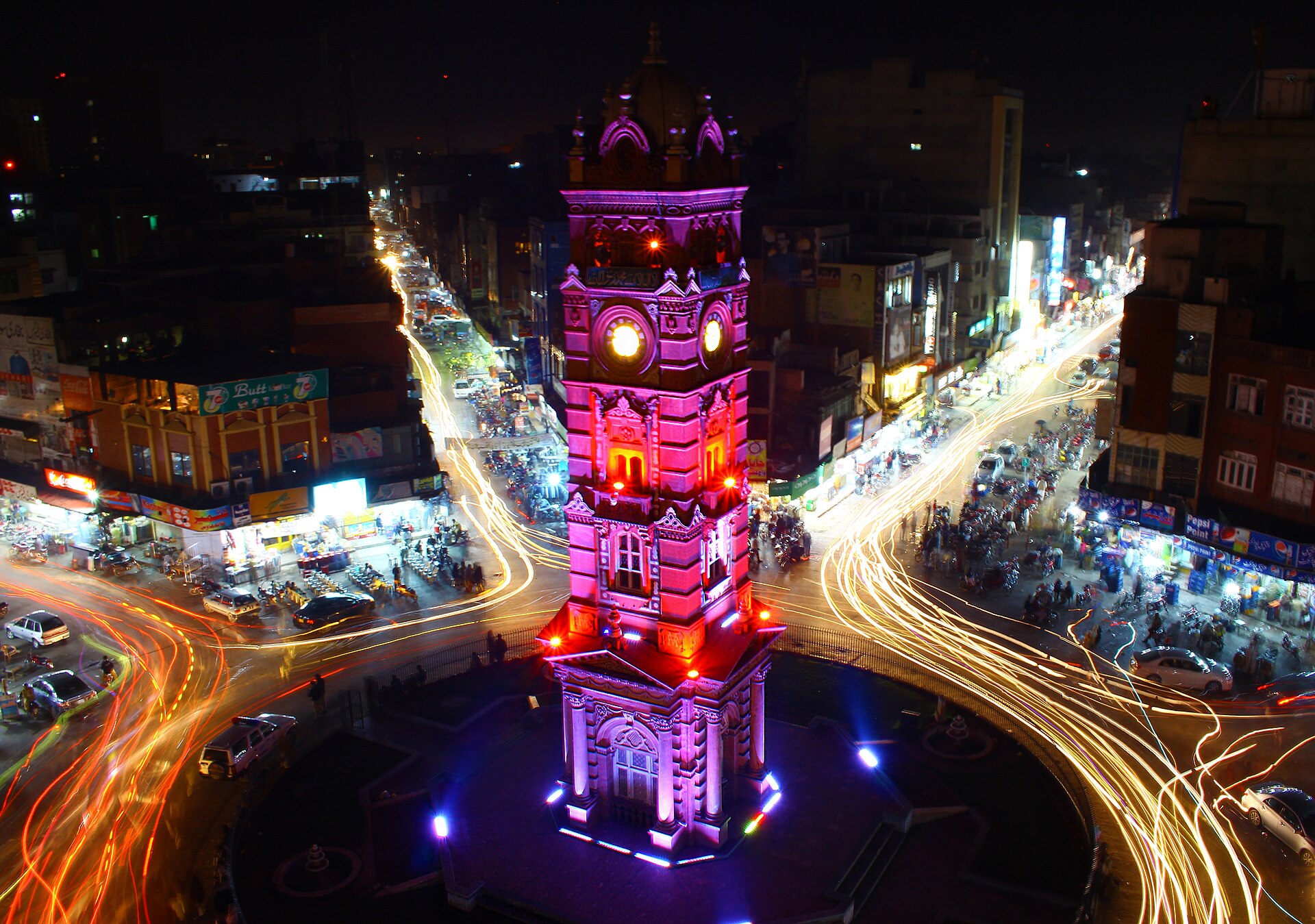
- Lyallpur Museum — Central Faisalabad
The Lyallpur Museum keeps the city's older name alive and is a sensible stop for context on the district's history and local life. It makes a quieter counterweight to the bazaars nearby. Opening days and entry terms change, so check locally or on the city's official website before making a special trip. - Cathedral of Saints Peter and Paul — Faisalabad city
This Catholic cathedral dates from 1969 and is a reminder that Faisalabad's communities include Christians as well as a Muslim majority. It is valued locally for helping religious communities understand one another. Visit outside service times, ask permission before taking photographs, and treat it as a place of worship rather than a monument. - Jinnah Garden (Company Bagh) — Central Faisalabad
Jinnah Garden, widely called Company Bagh, is one of the city's green pockets, useful for a slow hour away from traffic. A tomb of Sir Charles James Lyall, a colonial figure tied to the city's first name, is said to lie here. Families come in the cooler hours, so late afternoon is the liveliest time. - D Ground market — D Ground, central Faisalabad
D Ground is the city's second great market district after the clock tower area, and it is busiest in the evening. Locals come as much for the outing as for shopping, strolling past clothing shops, snack stalls and many restaurants. It is a good place to eat, people-watch and see modern Faisalabad at ease.
Culture
Faisalabad's culture is Punjabi at its core: hospitable, loud, food-minded and tied to trade. Conversation in the markets runs in Punjabi and Urdu, and shopkeepers often offer tea before any sale is discussed. The city's cultural institutions are modest but real. The Punjab government set up the Faisalabad Arts Council in 1982, and its building, finished in 2006, includes an auditorium named after the singer Nusrat Fateh Ali Khan, a nod to the qawwali tradition of devotional music. Religious life is mostly Muslim, with a Christian community around the cathedral, and the calendar follows the Islamic year. Ramadan and Eid change the rhythm of the whole city, with markets opening late, streets emptying at the breaking of the fast and crowds swelling in the days before Eid. Civic occasions matter too: on 14 August, Independence Day, the national flag is raised at the clock tower. Hospitality is a point of pride, so invitations to a home or a tea stall are common and worth accepting when they feel genuine. Visitors should dress modestly, ask before photographing people, especially women and families, and remove shoes before entering a mosque or a private home.
What to wear
Faisalabad's everyday traditional dress is the shalwar kameez, a long tunic worn over loose trousers. Women add a dupatta, a long scarf, and men sometimes wear a kurta with shalwar or a waistcoat. Cotton and lawn, a fine light cotton, suit the hot months, while thicker khaddar and wool shawls appear in winter. Weddings and festivals bring out embroidery, brighter colours and silk or heavily worked fabrics. As a textile city, Faisalabad is a place where locals buy cloth by the length and have it stitched by a tailor, often within days. Today, many men wear shalwar kameez or shirts with trousers, women mostly wear shalwar kameez, some with a headscarf or abaya, and younger people mix in jeans and branded streetwear. Visitors should choose loose, light, long-sleeved clothing that covers shoulders and knees, in cotton to handle the heat. Women will be more comfortable carrying a scarf for mosques and conservative areas. Wear sturdy, closed shoes or sandals with grip for dusty, uneven pavements and wet lanes, and bring a hat and sunglasses for midday. Buying a locally stitched outfit is a practical souvenir and helps visitors blend in.
What to eat
- Samosa with chutney — Samosa Chowk and D Ground
Faisalabad is proud of its samosas, often served with a tangy chutney that locals say sets them apart. A junction known as Samosa Chowk is named for them, and D Ground has well-known stalls. Eat them hot, standing at the counter, as a mid-afternoon snack. - Tea with sweet rusks — Tea stalls in Madan Pura
Tea here is strong, milky and sweet, and Madan Pura has a reputation for some of the city's favourite tea spots. Order it with sweet rusks for dunking. It is a cheap, slow way to rest between market lanes and listen to local conversation. - Dahi bhalla — Street carts in Jinnah Colony and Nisar Colony
Dahi bhalla is soft lentil dumplings soaked in cool, whipped yoghurt, topped with chutney and spices. It is a favourite in hot weather and sold from carts. Jinnah Colony, near Chatri Wala Ground, and Nisar Colony are mentioned by locals for good versions. - Gol gappe — Street carts around the main bazaars and D Ground
Gol gappe are crisp hollow shells filled with chickpeas, potato and onion, then dunked in sharp, spiced tamarind water and eaten in one bite. They are a classic evening snack. Choose a busy cart with quick turnover and bottled or well-filtered water. - Shawarma and grills — Restaurants and eateries around D Ground
Alongside Punjabi snacks, D Ground has fast-food counters serving shawarma, steaks and Chinese-style dishes, popular with families after shopping. It is useful when you want a seated meal with air conditioning, or something milder than street chaat.
Plan it
Best time. October–November and February–March, when days are warm rather than fierce. May to July is very hot, and the monsoon months that follow bring heavy, humid air.
How long. 1–2
Getting there. Faisalabad has an airport with flights from major Pakistani cities, and rail links to Lahore and Karachi. Coaches run from Lahore and Islamabad by motorway. For the last leg, use a local cab, an auto rickshaw or the city's Metro bus.
Budget. low
Tips
- Visit the bazaars early in the morning and eat in the evening, when D Ground is at its liveliest
- Carry cash in small notes for markets, snack stalls and rickshaws
- Drink bottled or filtered water and carry sun protection in the warmer months
- Save the emergency numbers: 1122 for Rescue, 15 for police and 115 for an ambulance
- For museum hours and civic information, check the official website, http://www.faisalabad.gov.pk/
Etiquette
- Dress modestly and carry a scarf for mosque visits
- Ask before photographing people, especially women and families
- Remove shoes before entering a mosque or a home
Nearby
Sources
- Wikidata Q173985 (CC0)
- Wikipedia: Faisalabad (rev 1383759447) (CC BY-SA 4.0)
- Wikivoyage: Faisalabad (rev 5410760) (CC BY-SA 4.0)
- Clocktower Faisalabad, Panorama — Minhajian (CC BY-SA 4.0)
- Clock Tower Faisalabad — Usman Nadeem (CC BY-SA 4.0)
- Gurdwara-School inner front — Khalid Mahmood (CC BY 3.0)
- Jhal flay over Faisalabad — Maqsood aktar (CC BY-SA 4.0)
- Circuit House, Faisalabad — Salar Lateef (CC BY-SA 4.0)
- Railway station of Faisalabad — Hussain kevin (CC BY 3.0)
- Lyallpur Galleria — Muhammad Ameer Hamza (CC BY-SA 4.0)
- Faisalabad City Flag — Aml-401 (CC BY-SA 1.0)


