Tree of Life
Tree of Life, Bahrain
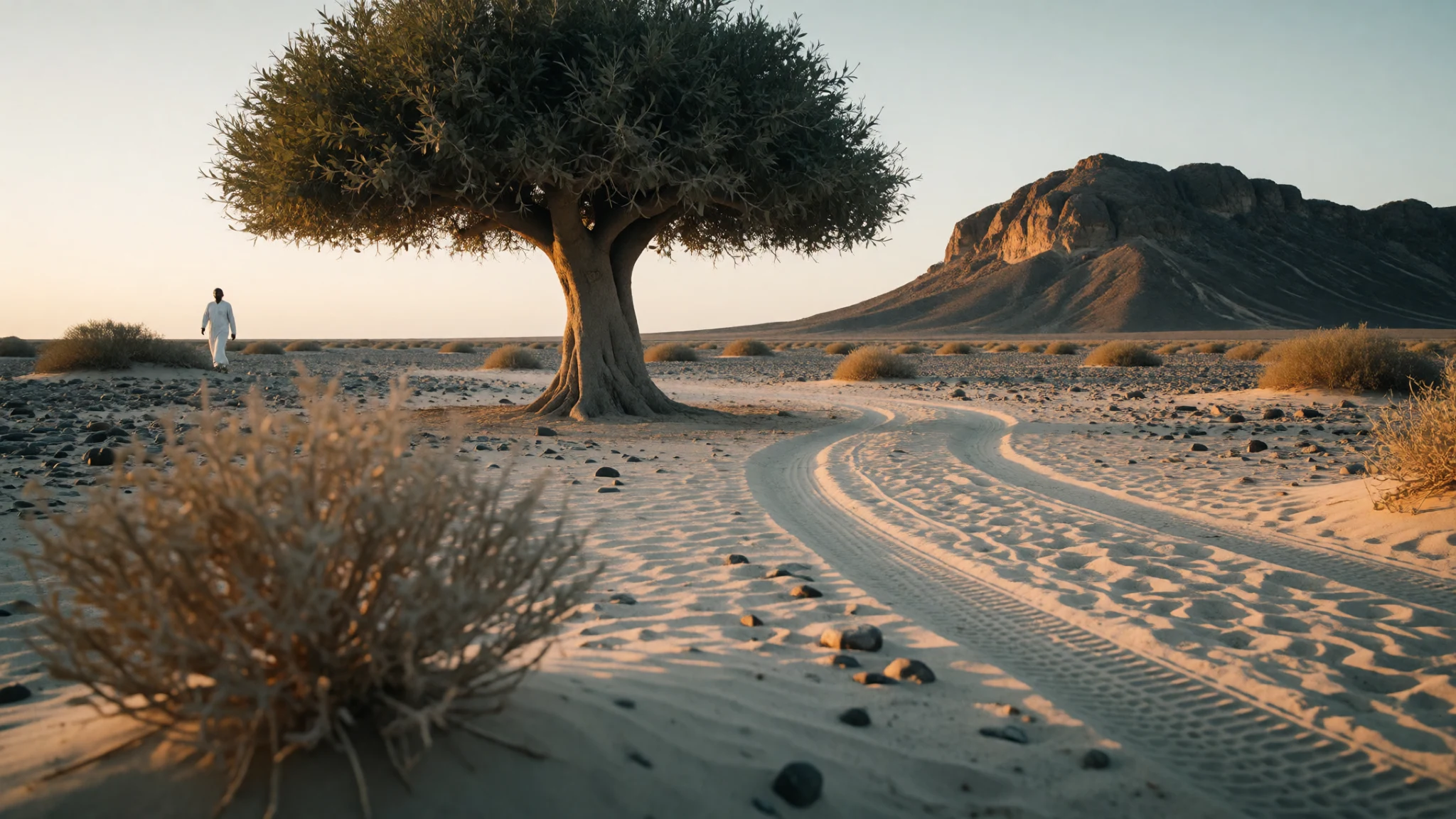
The Tree of Life is a single desert tree in Bahrain that has kept its green crown with no river or well in sight.
The place
The Tree of Life, known in Arabic as Shajarat al-Hayat (شجرة الحياة), stands alone on a flat sheet of sand in the interior of Bahrain. Around it the ground is pale, stony and almost bare: a few low shrubs, tyre tracks, and the hard light of the Gulf. There is no stream, no irrigated grove and no shade except the tree’s own. That contrast — a living canopy in a landscape that looks empty of water — is why the place has a name that sounds like a legend and a steady flow of visitors.
Bahrain is a small island state in the Gulf, and its people are concentrated in the towns along the northern shore. The tree sits away from that coastal sprawl, out in the open desert near Jabal Dukhan. The approach leaves the highways and the apartment blocks behind and ends on a plain where the horizon is the main landmark. This is not a woodland or a tended garden. It is one tree, with a heavy trunk and a wide crown of small green leaves that reads as a dark island against the sky.
Daylight at the Tree of Life is simple and harsh. Sand throws the sun back, and visitors circle the same trunk for photographs of tree, sand and sky. After dark the crown stands against the moon and a black horizon, and the air eases. The stop is short, and the picture is hard to confuse with any other in the Gulf.
Its story
The Tree of Life has gathered stories because the landscape refuses to explain it. Bahrainis call it Shajarat al-Hayat, and the English name is a straight translation: a tree that stands for life in a place where life looks unlikely. There is no inscription, no dated founding and no royal chronicle that says who planted it or whether anyone planted it at all. It simply occupies the sand, older than the people who come to look at it, and the absence of a paper trail is part of the attraction.
The usual account is botanical, though it is told like a riddle. The tree is a mesquite, a tough kind of Prosopis that can send roots down after moisture. Nothing at the surface explains the leaves: no hose, no ditch, no wet ground once rain has passed. The favoured idea is groundwater under the crust, reached by roots the visitor cannot see. A fonder version says the tree is simply blessed. Looking cannot settle it. The crown is green and the sand is dry.
Its fame as a landmark is younger than the wood. Oil remade the ground near Jabal Dukhan into a working landscape of roads and pipes. The tree remained, a green exception above an industry that depends on what lies underneath. School groups, evening drives and postcards folded the Tree of Life into the national album. It is still there, still leafed, and still the reason a desert track fills with cars when the heat eases.
What to see
- The Tree of Life — desert plain near Jabal Dukhan
The Tree of Life is the whole sight: one spreading tree on open sand, with a thick trunk and a canopy large enough to throw a small patch of shade. Visitors walk a slow circuit. From a distance the crown reads as a single dark mass; from closer in, the branches divide and the leaves show as a fine green. Nothing else is planted beside it. The bark and the surface roots are the relic itself, so the circuit is for looking, not for climbing.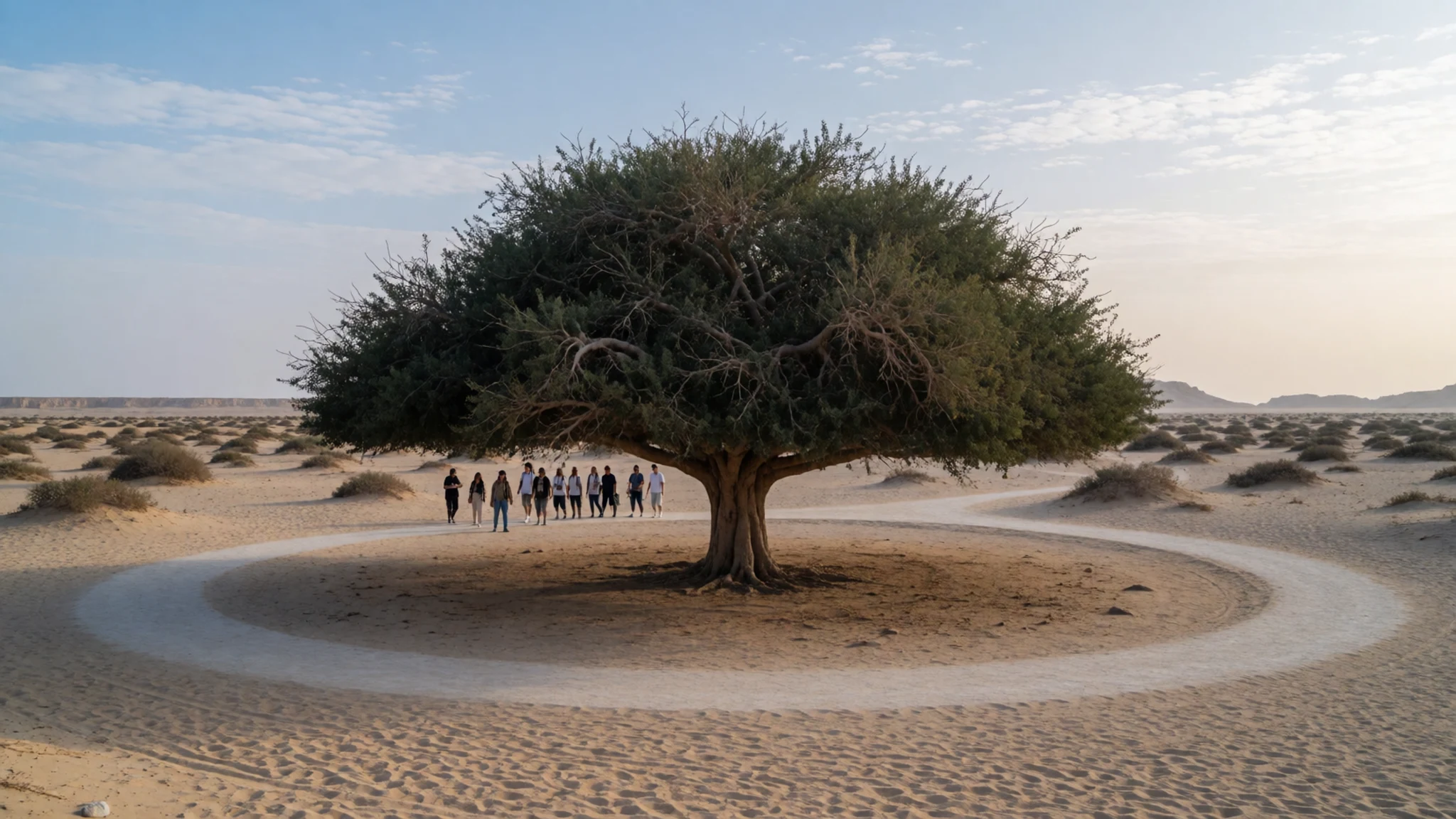
- The tree after dark — desert plain near Jabal Dukhan
After sunset the Tree of Life becomes a different photograph. The trunk and crown read as a dark shape, and on a clear night the moon can share the frame with the branches. The air is kinder than at midday, which makes a late visit the comfortable one. Footprints stay sharp in the cooler sand. The tree does not change; the sky does the rest.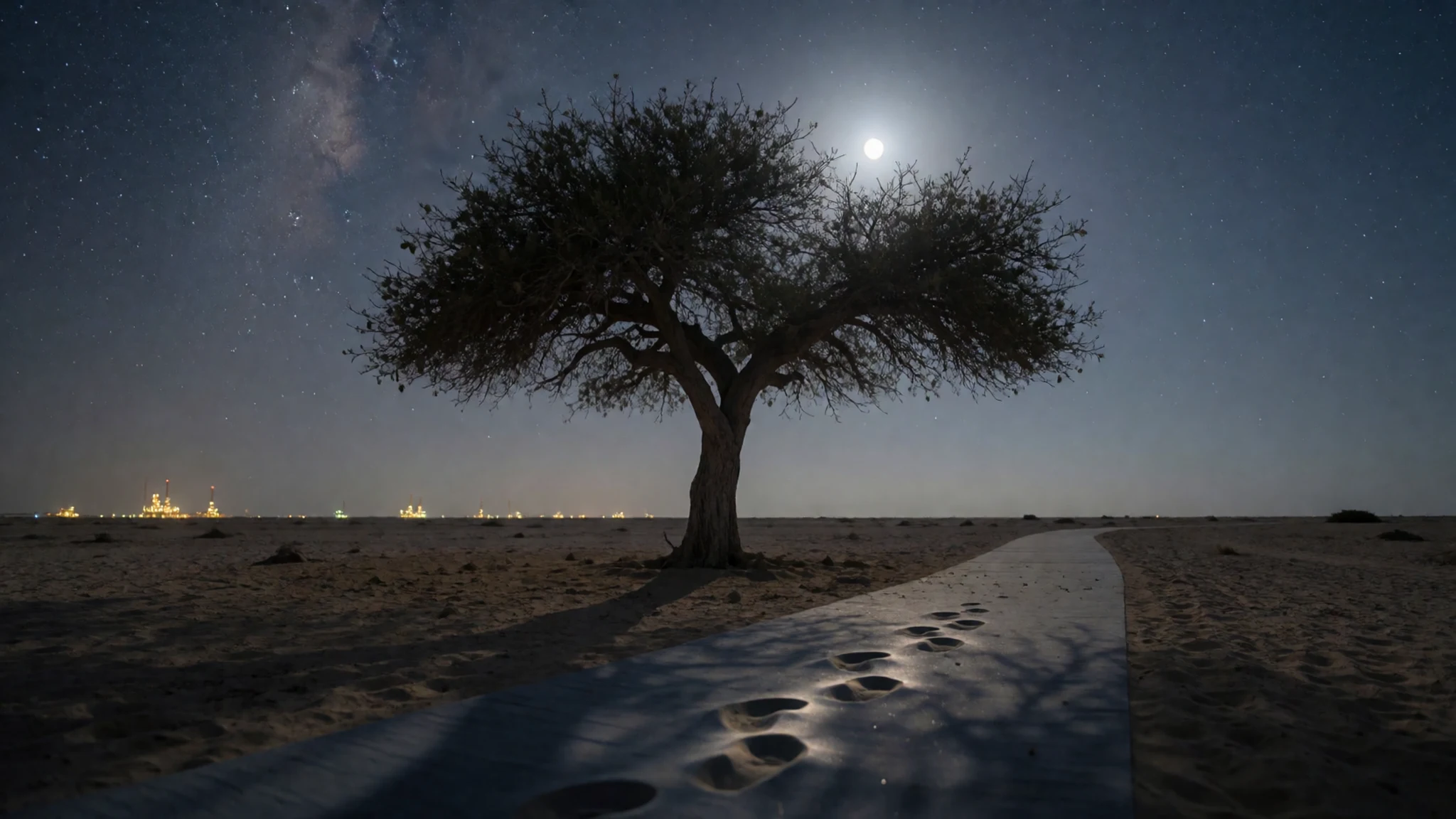
- The open plain — desert plain near Jabal Dukhan
The ground around the Tree of Life is the other half of the picture. It is a pale, nearly level plain of stones, a few tough shrubs and vehicle tracks. No riverbed shows where water would run, so the green crown looks unexplained. Late light warms the sand and stretches the shadow into a long dark stripe. The name feels literal: life, then empty ground.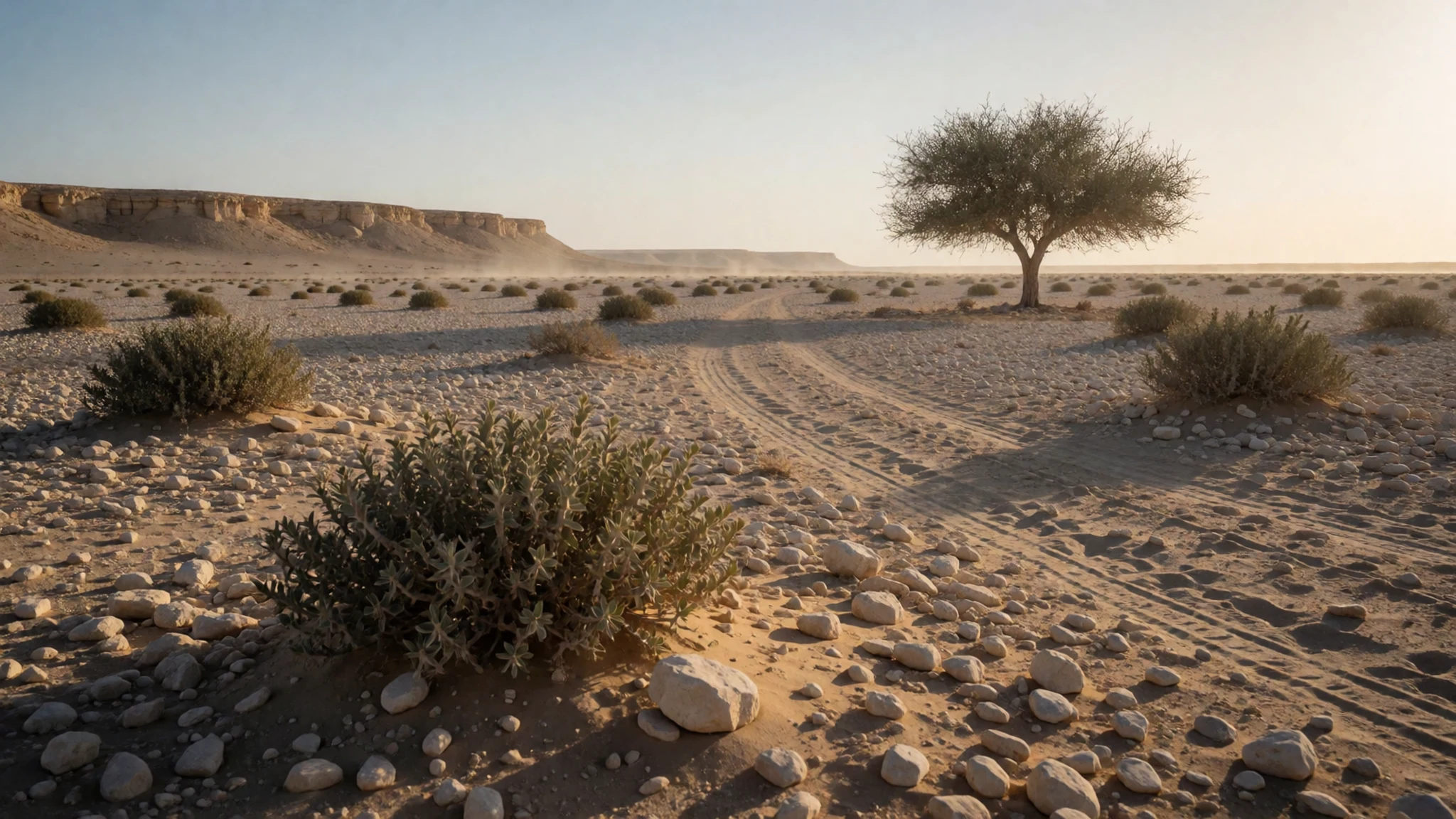
- Jabal Dukhan — Jabal Dukhan
Jabal Dukhan, the Mountain of Smoke, orients the desert around the Tree of Life. The tree stands on the plain, not on the hill, with the jabal as the high ground nearby. Those slopes lie in Bahrain’s oil country, so the view mixes bare rock, sand and traces of industry. The hill places the map; the tree is why the cars stop.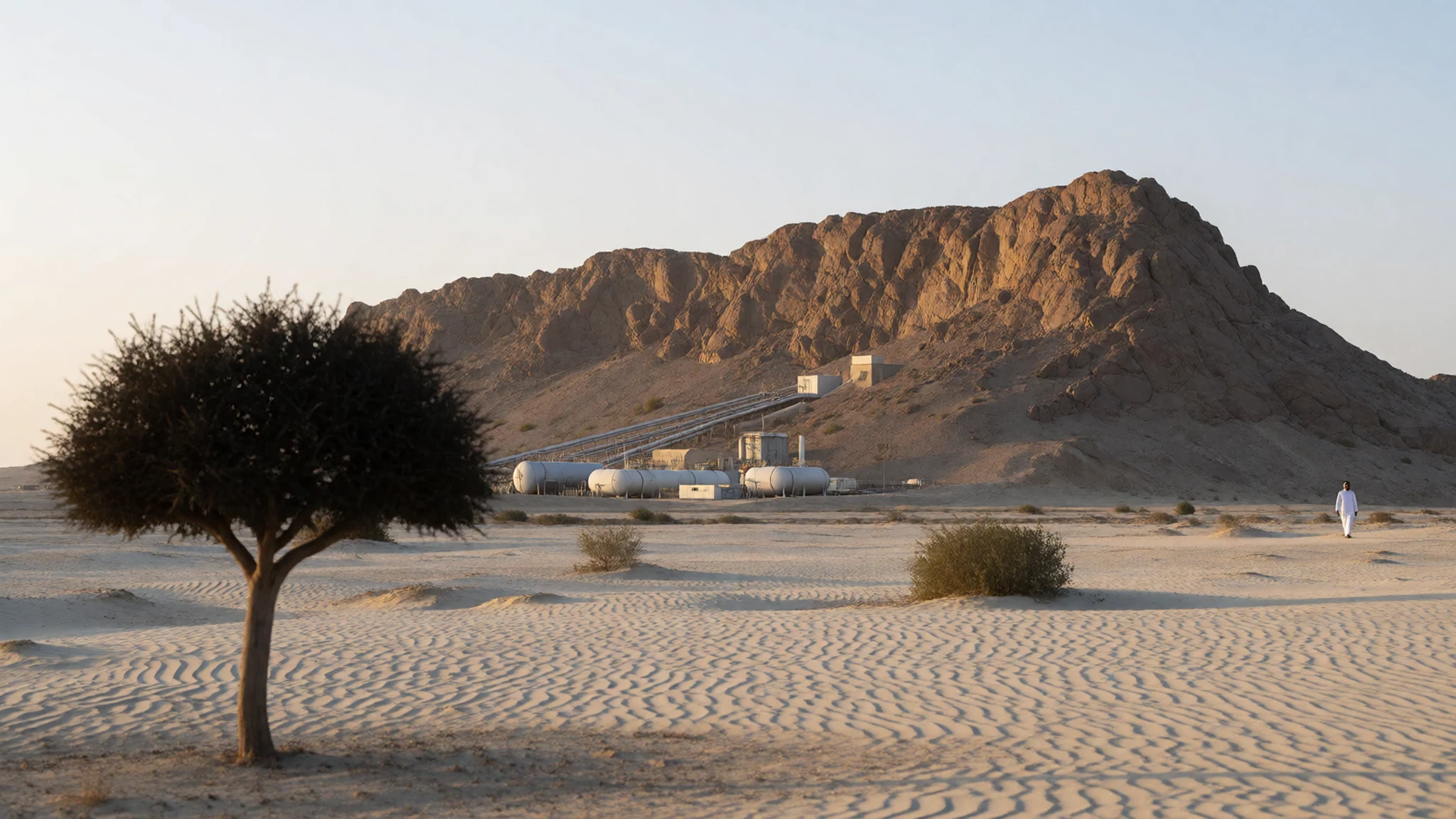
- The trunk at close range — desert plain near Jabal Dukhan
Close in, the Tree of Life stops being a silhouette and becomes bark, forks and a low tangle of growth. The leaves are small and the shade is only a tight pool. At this distance the survival looks practical: a desert plant with no neighbours. A photograph from the road misses the thickness of the wood. A slow loop, without touching, is the close visit.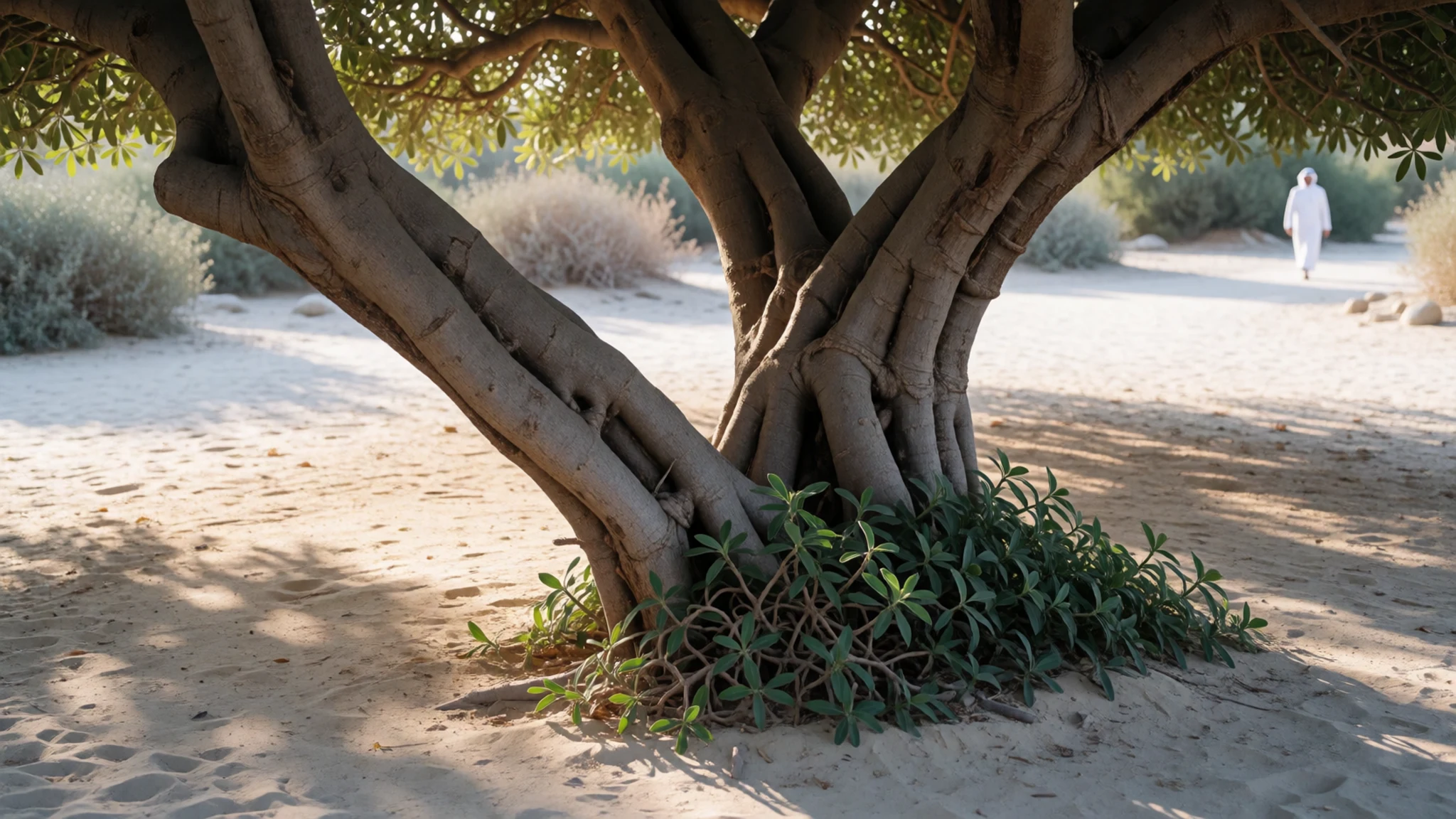
Culture
The Tree of Life sits inside a Gulf Arab culture that treats hospitality, faith and family outings as ordinary parts of the week. Bahrain is a Muslim island society with a long pearl-diving past and a modern oil economy, and both histories show up in how people use the desert: as workspace and as a place to drive when the day cools. A visit here is rarely silent or solitary. Cars arrive together, children run the circuit, and someone pours coffee from a thermos. The tree is public in the way a seafront is public.
Arabic is the language of the visit, and English is widely understood in the towns and often at the site. Weekends follow the Gulf pattern, so late-week evenings and the cooler hours after work are when the plain is busiest. Modest dress is the norm even with no mosque door in sight: covered shoulders and knees read as ordinary respect. Photography of the tree is the point of most visits. Photography of strangers is not.
Bahrainis tell the Tree of Life with a mix of pride and tease. They expect the question about where it drinks, and they let the tree stand for a dry island that learned how to thrive. Dates, cardamom coffee and a willingness to point a stranger the right way are the manners that come with that pride. At the Tree of Life, keep to the path, do not climb or carve the trunk, and ask before you photograph people.
What to wear
At the Tree of Life the clothes that still signal a Bahraini occasion are Gulf clothes, even on a casual visit. Men wear the thobe, a long white or pale cotton robe, with a ghutra or shemagh held by a black agal; the headscarf is sun protection as much as formality. Women wear the abaya, a loose black cloak, often with a shayla. These are not festival costumes. They appear at Friday gatherings and family drives, and they turn up in the desert beside ordinary weekend shirts.
In Manama and on the road out, daily dress has widened. Younger people mix the thobe or abaya with trainers, jeans and simple dresses, especially in malls and offices. At the tree the split is easy to see: a pressed white thobe, teenagers in T-shirts, an abaya stepping over sand. Cotton breathes; heavy synthetic layers do not. Jewellery stays small once the wind lifts grit.
Visitors should dress for strong sun, blowing sand and a modest public. Loose long sleeves and trousers, or a long skirt, work better than short shorts. A scarf covers the head at midday or the shoulders beside a family picnic. Closed shoes beat thin flip-flops on hot sand. A hat and sunglasses matter more than a formal outfit, and light colours stay cooler while showing the dust. No dress code is posted, but covered, loose and practical clothing keeps the Tree of Life easy for everyone there.
What to eat
- Machboos — family eateries in Manama and Muharraq
Machboos is Bahrain’s everyday celebration plate: rice cooked with baharat, dried lime and saffron, under lamb, chicken or fish. The dried lime, loomi, is the sour note that marks Gulf rice. Family eateries around Manama and Muharraq serve it; the desert at the Tree of Life does not.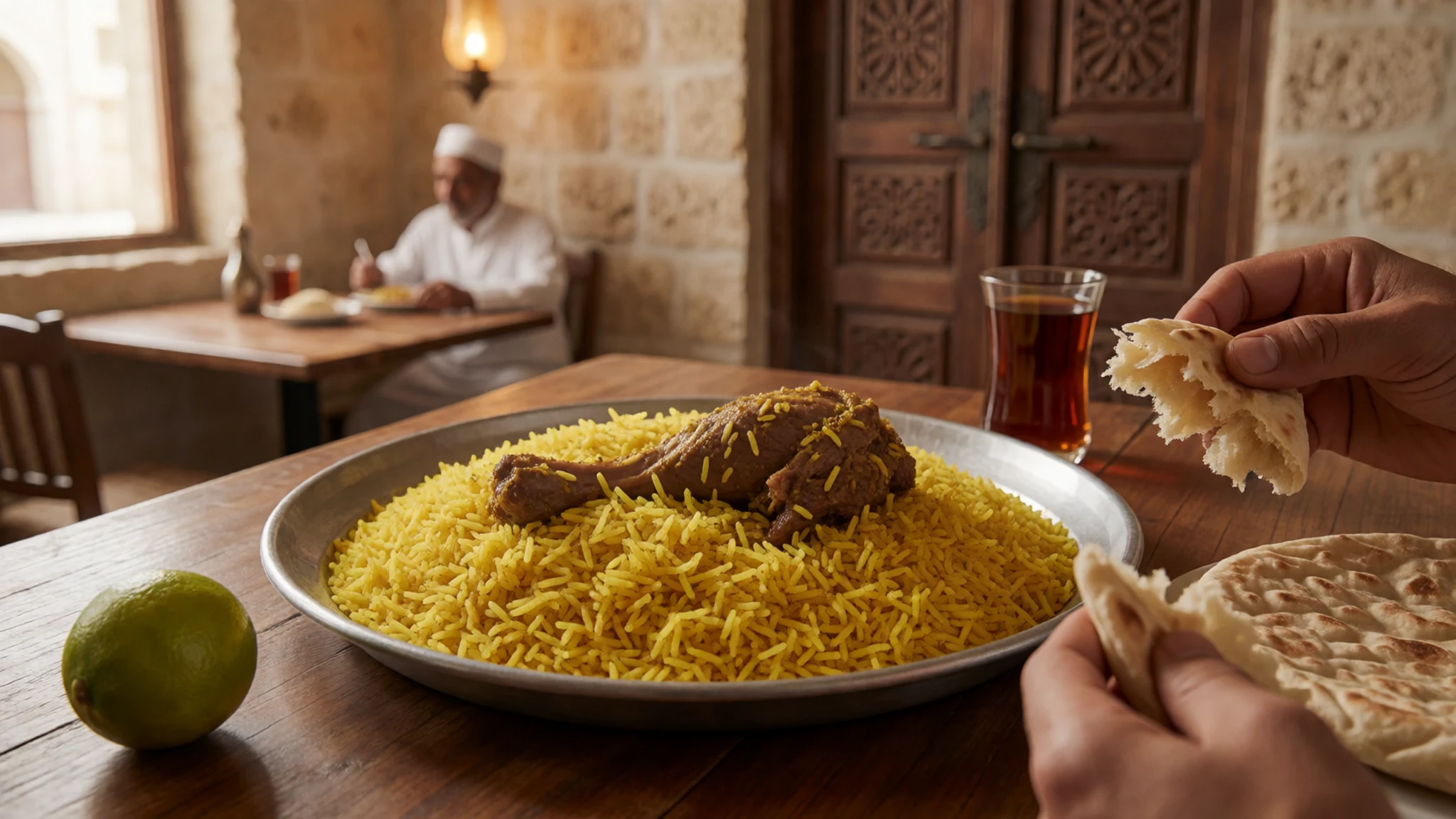
- Balaleet — morning cafés in Manama
Balaleet is a breakfast of thin vermicelli fried with sugar, cardamom and rose water, topped with an omelette. Sweet and savoury share the plate, which surprises first-time visitors. Manama cafés serve it in the morning, hours before a drive to the Tree of Life.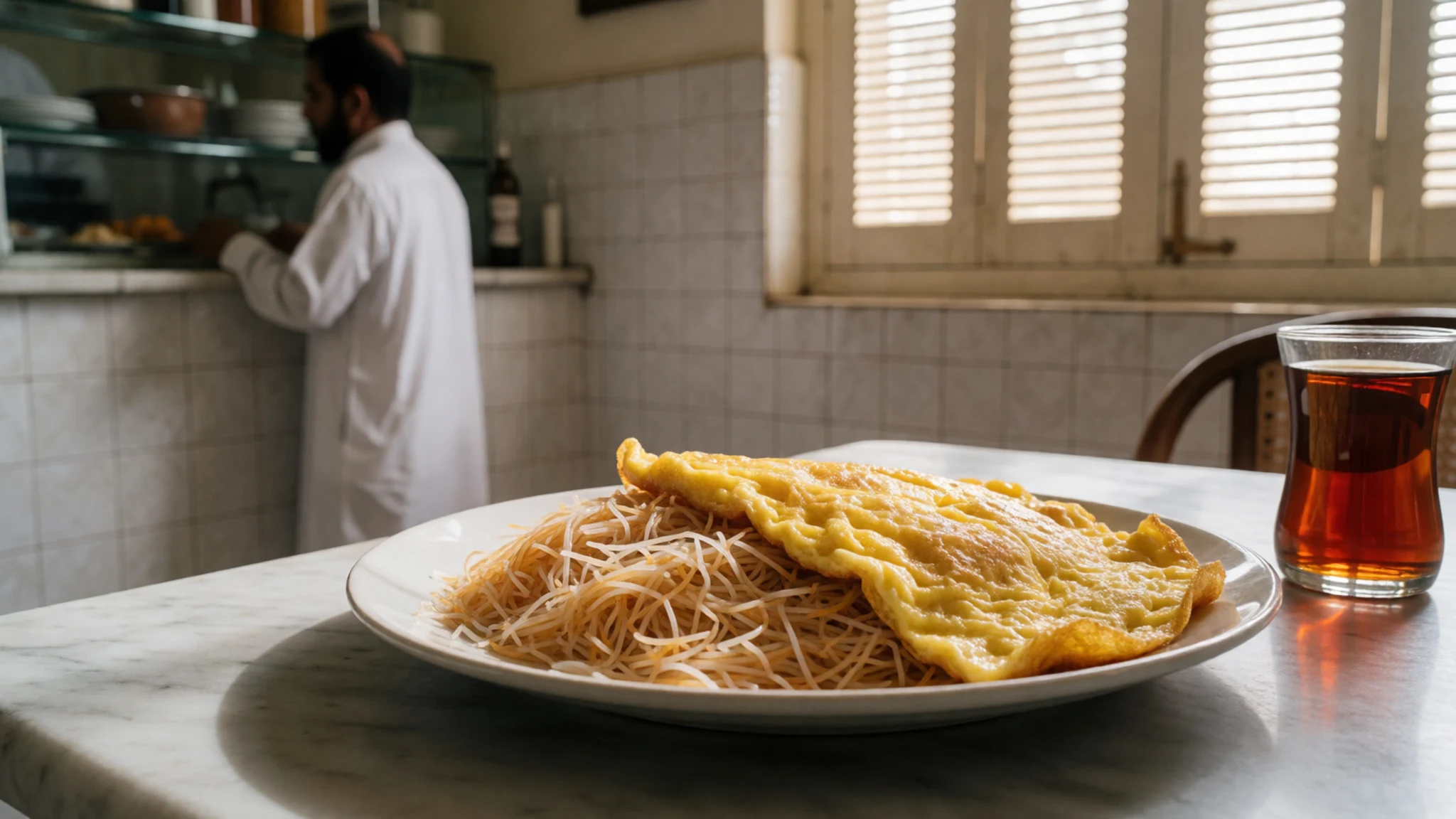
- Harees — traditional eateries in Manama
Harees is wheat and meat beaten slowly into a mild, heavy porridge, often finished with cinnamon. It belongs to Ramadan nights and large family pots more than to a quick snack. Traditional eateries in Manama make it, and picnics near the Tree of Life sometimes arrive with a covered pot. - Grilled Gulf fish — fish eateries in Muharraq and the Manama waterfront
Hamour and safi are grilled or fried and served with rice, parsley and lime. The sea supplies them, so the place to find them is a fish eatery in Muharraq or on the Manama waterfront. The Tree of Life has wind and sand, not a market. - Samboosa — bakeries and souq counters in Manama
Samboosa are small fried pastries filled with spiced meat, cheese or vegetables, eaten with afternoon tea. Bakeries and souq counters in Manama sell them hot by the piece. They travel in a paper bag for a late stop at the Tree of Life, once the desert has cooled. - Gahwa and dates — a majlis in Manama, or a flask on the drive
Gahwa is Gulf coffee with cardamom, poured in small cups and drunk with dates from the region’s groves. A host may offer both in a Manama majlis, and drivers carry a flask toward the Tree of Life. The first cup is the one to accept.
Plan it
Best time. November to March, when desert days are warm rather than severe. Summer afternoons are fiercely hot and the crown gives little shade. Mornings and the hour before sunset are easier, and a clear night gives the tree, the moon and a cooler plain.
How long. half a day
Getting there. Bahrain International Airport on Muharraq, then a car through Manama and on to the desert near Jabal Dukhan. Taxis and hired cars do the last leg; the Tree of Life has no station of its own. Agree the return before the driver leaves.
Budget. mid
Tips
- Arrive early or after sunset rather than at noon.
- Carry water; shade is limited to the tree.
- Use a taxi or hire car that will wait.
- Keep some cash for coffee and snacks in town.
- Check current local advice before a night visit.
Etiquette
- Do not climb, carve or cut the tree.
- Ask before photographing people.
- Dress modestly, with shoulders and knees covered.
- Take all litter away; the plain does not hide it.
Nearby
Sources
- Wikidata (CC0)
- Wikipedia (CC BY-SA 4.0)
- Wikivoyage (CC BY-SA 4.0)