Vaduz Castle
Vaduz Castle, Liechtenstein
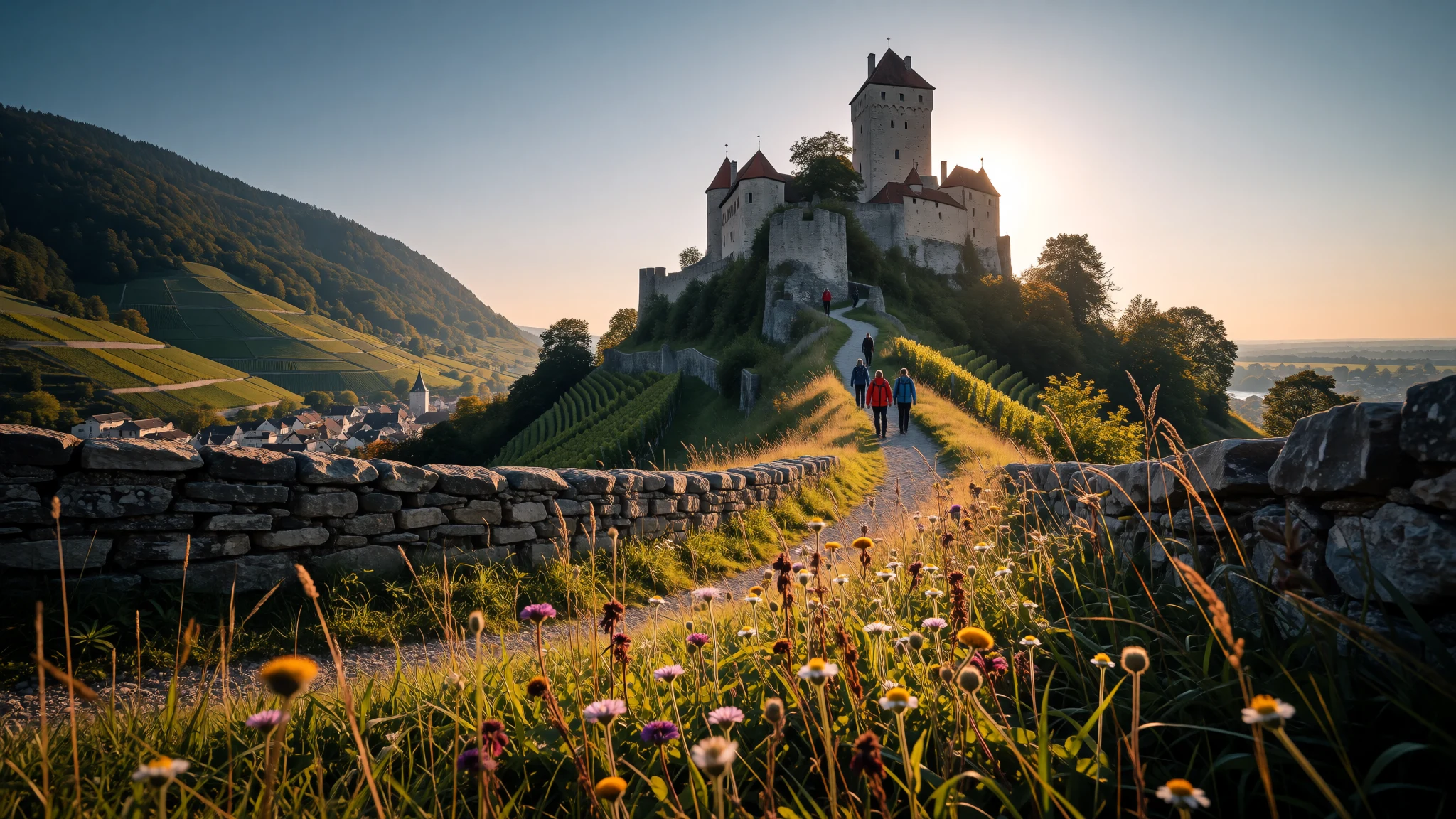
Vaduz Castle is the prince's hilltop residence above Liechtenstein's capital, and the public reward is the walk and the valley view.
The place
Vaduz Castle stands on a hill beside Vaduz, capital of Liechtenstein, and looks over the town and the Rhine. The reigning prince lives here, and German speakers call the palace Schloss Vaduz. Castle and capital share the name. The town is small and sits at the foot of the slope rather than in a wide urban spread, and Schaan, the next settlement up the valley, outnumbers it. German-language writers often note that Vaduz never received Stadtrecht, so the capital can still be described as a village housing a reigning prince. The ridge is close enough that the castle reads as part of the town, not as a distant fortress, and the streets below stay small even where ministries sit.
What visitors come up for is the outline on the ridge and the land in front of it. Princely vineyards occupy the lower slope. The way up from the centre is a short walk. Because the building is a working residence, the ordinary visit is that approach and the view back out: roofs, the river, and the mountains on the Swiss side of the valley. In town the bus station marks the middle, and the main square lies just behind it. Towards the river, Zollstrasse leads to a timber bridge with a roof across the Rhine, admitting walkers and cyclists and shutting vehicles out. Passport control does not interrupt that road out of the centre. What the household opens to the public is posted on the town site at http://www.vaduz.li/.
Its story
Vaduz Castle is thought to have been built by the counts of Werdenberg-Sargans. The oldest fabric is the bergfried — the keep — and parts of the eastern side, and that keep dates from the 12th century. Measured at the base, the keep covers 12 by 13 metres. Down at ground level the masonry reaches 4 metres through. Whoever entered from the courtyard had to come in 11 metres above the ground. The chapel of St Anna is also taken to be medieval. Nothing about that chapel turns the hill into a pilgrimage church; it is part of the house. The altarpiece is late Gothic work.
Fire destroyed the castle during the Swabian War in 1499, set by forces of the Swiss Confederacy. Count Kaspar von Hohenems, in the years 1613 to 1640, pushed the house out on the west. In 1712 the princes bought the countship of Vaduz, and the castle changed hands with the title. They had already bought the Lordship of Schellenberg, in 1699. The Holy Roman Emperor Charles VI then fused that countship with Schellenberg, and the fused territory is the principality that still bears the family's name. Vaduz Castle is the residence that came with the purchase, and it remains the official home of the prince rather than a shell left empty on the hill.
What to see
- Vaduz Castle — hill above the town centre
Vaduz Castle (Schloss Vaduz) is the prince's residence on the ridge, and the building is lived in. What the public can count on is the climb from the centre and the prospect from the slope: tiled roofs, the princely vines, the Rhine and the far mountains. Interior access is not part of an ordinary walk; the town website is where any opening is announced. - Kunstmuseum Liechtenstein — central Vaduz
Kunstmuseum Liechtenstein occupies central Vaduz, a short walk below Vaduz Castle. One floor holds the standing collection and another turns over modern exhibitions. It is the capital's home for contemporary art, separate in purpose from the national history museum nearby. The building is a town stop before or after the climb, not an annexe of the residence. - Vaduz Cathedral — town centre below the castle
Vaduz Cathedral serves the capital in the streets below Vaduz Castle. An archdiocese has had its seat in the town from 1997, and this church, built in the 19th century, is the one that carries the role. The scale stays parish-like. It fits easily between the museums and the start of the hill path, and a quiet visit inside depends on the service schedule. - Liechtensteinisches Landesmuseum — central Vaduz
The Liechtensteinisches Landesmuseum sits in central Vaduz beneath Vaduz Castle. Galleries move through the country's past, the natural world and postage stamps, and the calendar includes events as well as the fixed displays. It is a national collection, not a wing of the residence. It asks for its own slot in the day; the hill walk does not replace it. - Red House — north of the centre
The Red House stands on the valley floor north of central Vaduz, below Vaduz Castle. Its crimson façade and stair-stepped gable are the markers, and the house may go back to the early 16th century. Next to the princely residence it is domestic building: a town house, not a keep. Colour and gable are how to recognise it from the street.
Culture
Vaduz Castle is the working centre of a principality, and the town beneath it behaves like a small capital that knows it is being looked at. The prince — the Fürst — is part of ordinary political speech here, because government is split between the elected Landtag and powers that stay with the reigning house. Ceremonial days pull attention up the hill; on a normal weekday the castle is simply the residence above the ministries. Vaduz packs a cathedral, a national museum, parliament and government offices into a compact centre, so it can feel like a village and a state at once. German is the language on the street and in official life. Local bus fares are charged in Swiss francs, so the practical currency of a visit is the franc even though the country is not Switzerland. People cross to the Swiss bank on foot by the old wooden bridge with no border formalities, and the bus from Buchs or Sargans is just as straightforward. Visitors photographing the skyline are a normal part of the day. Queues are rare; the constraint is space, not a turnstile. Keep to the public path at Vaduz Castle, speak quietly beside the residence, and ask before photographing people at close range in the lanes below.
What to wear
Vaduz Castle looks down on a capital where festive Alpine dress and ordinary European clothes share the same short streets. Traditional costume here belongs to the wider Alpine Tracht: for women a fitted bodice, full skirt, apron and blouse, often in wool or cotton with embroidery; for men wool shorts or dark wool suits, embroidered braces and a hat for feast days. Those clothes come out for national and parish celebrations and for choirs and clubs, not for the morning bus. The textiles are practical mountain parish wear made formal — heavy wool for cold, linen and cotton for warmer months, with woven ribbons and stitched floral work as the decoration. Most people in Vaduz on a weekday wear ordinary European clothes: office dress near the government buildings, and a coat plus comfortable shoes for the climb to the castle. A visitor does not need Tracht. Sensible shoes with grip matter more than style on the castle path and the vineyard lanes. Layers beat a single coat, because the ridge can feel cooler than the square. At the cathedral, covered shoulders and knees are the respectful choice. The path at the residence calls for the same ordinary clothes; Vaduz Castle is a home above a small town, and loud dress draws more notice than it would in a large city.
What to eat
- Käsknöpfle — eateries by the main square behind the bus station
Käsknöpfle are small dough pieces tossed with cheese and fried onions, the sort of Alpine plate a hungry visitor eats in Vaduz after walking up to Vaduz Castle. Eateries around the main square, just behind the bus station, are the place to ask for them. - Ribel — traditional kitchens in central Vaduz
Ribel is a maize dish, soft or fried, eaten with apple sauce or as a savoury side, and it is a valley staple in Vaduz below Vaduz Castle. Traditional kitchens in the centre are the place to look, usually among the Swiss dishes. - Pasta — Italian rooms in the centre and the main square
Pasta is the reliable Italian option in the heart of Vaduz, close to the hill path up to Vaduz Castle. Trattoria-style rooms around the centre and the main square serve it as a full meal. It is the useful alternative when the Alpine cheese plates feel too heavy. - Thai curry — takeaway counters, including on the northern side of town
Thai curries and rice plates turn up at takeaway counters in Vaduz, including on the northern side of town below Vaduz Castle. The setup is a canteen: dishes sit in trays and are served quickly. They are the practical hot meal when the centre's Swiss and Italian tables are full. - Rösti — traditional eateries on the main square behind the bus station
Rösti, a fried potato cake, is the Swiss-style staple in central Vaduz, served with meat or cheese in traditional eateries below Vaduz Castle. The main square behind the bus station is where to look.
Plan it
Best time. May and June, then September and October, are the easier months for the walk up to Vaduz Castle, when the hill path and the vineyard lanes are the visit. High summer is warmer on the valley floor, and midwinter can ice the climb, so those seasons suit a shorter look from town.
How long. 2–3
Getting there. Rail is the practical way to Vaduz Castle. Trains from Vienna, Zurich and Chur arrive at Buchs in Switzerland; Sargans is the other Swiss railhead, and Feldkirch the Austrian one. ÖBB runs to Schaan-Vaduz station, near Schaan, from Buchs SG and from Feldkirch. Yellow-green Liechtenstein buses link Sargans and Buchs through central Vaduz and Schaan. Check the SBB timetable for the connection. The last leg is the bus into town, then the walk up the hill.
Budget. mid
Tips
- Check http://www.vaduz.li/ before promising an interior visit; Vaduz Castle is a residence.
- Walk up early in the day if a quieter path matters; the view works in both directions.
- Buy the bus ticket on board and confirm the current fare locally; do not rely on an old printed price.
- Use the covered Rhine bridge on foot or by bicycle only, and do not try to reach its Swiss end by car from the motorway.
- Carry Swiss francs as well as a card, since bus tickets are sold on the bus.
Etiquette
- Stay on the public path at Vaduz Castle and treat the building as someone's home.
- Ask before photographing people in the streets; the skyline is fair game, faces are not.
- In Vaduz Cathedral, keep quiet and dress so shoulders and knees are covered.
Nearby
Sources
- Wikidata Q694782 (CC0)
- Wikipedia (rev 1381546889) (CC BY-SA 4.0)
- Wikivoyage (rev 5421010) (CC BY-SA 4.0)
- Diego Delso — Castillo, Vaduz, Liechtenstein, 2022-10-23, DD 30 (CC BY-SA 4.0)
- Diego Delso — Castillo, Vaduz, Liechtenstein, 2022-10-23, DD 65 (CC BY-SA 4.0)
- Asknine2 — ViewFromVaduzCastle (Public domain)
- Extraordinary — Schlossvaduzvineyards (CC BY 3.0)
- Norbert Aepli — 2008-05-19 Vaduz Liechtenstein 5522 (CC BY 3.0)
- Norbert Aepli — 2008-05-19 Vaduz Liechtenstein 5523 (CC BY 3.0)
- Rafael P. D. Suppmann — 2018-10-05 Liechtenstein, Vaduz, Burg (KPFC) 01 (CC BY 3.0)
- Rafael P. D. Suppmann — 2018-10-05 Liechtenstein, Vaduz, Burg (KPFC) 02 (CC BY 3.0)


