Umm ar-Rasas
Umm ar-Rasas, Jordan
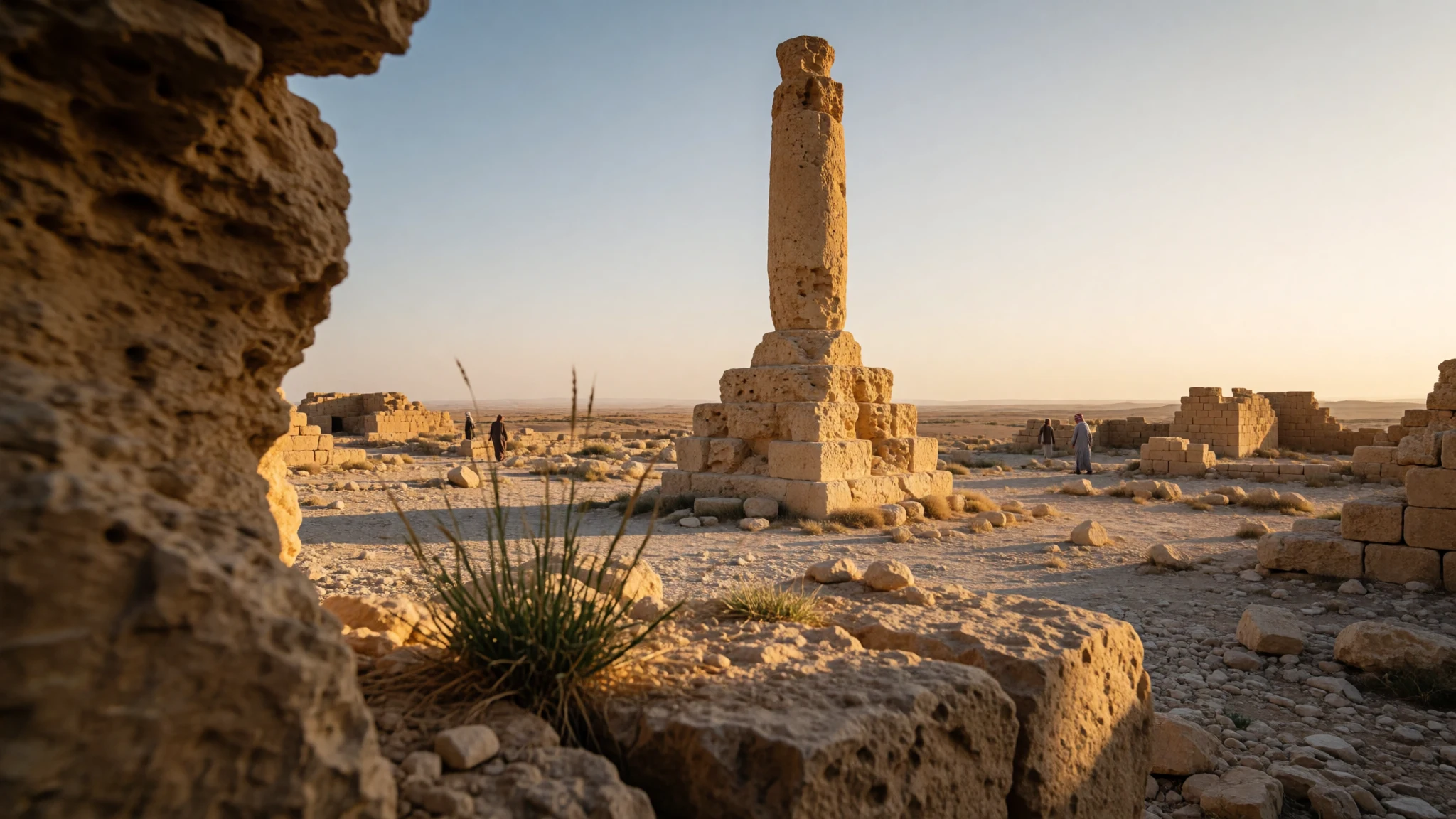
Umm ar-Rasas layers Roman, Byzantine, and early Muslim remains in the same dusty landscape—especially for its church mosaics.
The place
Umm ar-Rasas, known in antiquity as Kastron Mefa'a, is an archaeological site on the semi-arid steppe of central Jordan. It sits in the wider region associated with the biblical settlement of Mephaat, and over time the same patch of land was used by different communities: Roman military garrisoning, later Christian occupation, and then early Islamic life.
What makes the site feel different from many “ruins in the desert” stops is the mix of structures and the sheer emphasis on church architecture and decoration. Roman-era military layouts sit alongside the remains of churches and public buildings, and much of the broader site still lies under debris and has not been excavated.
The best-known discovery is linked to the Church of St Stephen: a mosaic floor dated to 785, found after excavations in the north of the site in 1986. The design includes hunting and fishing scenes, plus a central panel showing key cities of the region alongside a decorative frame. Beneath and alongside, archaeologists have also documented an earlier, damaged mosaic floor connected with the Church of Bishop Sergius, as well as the traces of mosaic decoration in additional nearby churches.
As a visitor, the experience is part walking, part imagining: stone arcs, broken walls, and mosaic fragments give the feeling of a settlement that once sat on important routes. The steppe setting means light and shadows do a lot of the storytelling, and the day’s heat can be the main rival to slow, careful looking.
Its story
Umm ar-Rasas began as more than a religious stop; it functioned as a strategic point when Roman forces turned the area into a garrison. That early military presence helps explain why the site carries traces of organised occupation rather than only scattered settlement debris.
Christian communities later took hold, and the landscape shifts in tone. Churches appear among the remains, and with them comes the kind of craft that outlasts empires: mosaic floors. The Church of St Stephen is the headline, not just because the floor exists, but because of what it depicts and how completely it has survived compared with many mosaic discoveries.
A key turning point for the modern story of the site was the excavations at the north end in 1986, which revealed how many layers were waiting under the ground. After that work, the St Stephen mosaic—dated to 785—came to light. Its scenes of hunting and fishing, along with the way the mosaic visually references cities across the region, make it feel both local and connected, like a community defining its place in a wider map.
Earlier mosaic remains under the later floor add another layer of change: an older mosaic associated with the Church of Bishop Sergius, damaged before it was covered. Over time, the settlement’s religious life continued alongside early Islamic habitation, leaving a palimpsest that archaeologists can read as successive chapters.
The practical reality for travellers is that much of Umm ar-Rasas remains unexcavated, so not every “layer” is visible. Still, walking between arcs and church remains gives a clear sense of depth: occupation, rebuilding, and decoration, repeatedly, until the desert took over.
What to see
- Arched remains around the site — main ruin area
Umm ar-Rasas Arcs are the kind of ruins that immediately show “settlement” rather than just foundations—stonework shaped into repeated curves. Walking past them feels like stepping alongside the skeleton of the Byzantine period structures, in a landscape that stays dry and open. - Ruins of domestic structures — house-ruins zone
The remains of houses at Umm ar-Rasas help balance the big church story. These fragments—walls and built spaces now weathered by the steppe—make the site feel lived-in, not only ceremonial. It’s often quieter here, with fewer people stopping than at the mosaics. - Church of St Stephen mosaic floor — north end church area
The St Stephen mosaic floor is the star attraction: a decorated surface with scenes of hunting and fishing and a central panel referencing regional cities, framed by a decorative border. Even when parts are faded by time, the layout still reads clearly enough to understand what the artists were emphasising. - Mosaic connections to Bishop Sergius — church mosaic zone
At Umm ar-Rasas, the mosaic story doesn’t start and end with one church. Evidence of an earlier, damaged mosaic floor linked with the Church of Bishop Sergius sits beneath and around later work. It’s a reminder that rebuilding was common—decoration layered over decoration. - Stylite-tower area (tower remains) — tower vicinity
The stylite-tower remains give the site a distinctive vertical note, contrasting with the low, open steppe. It suggests devotion and daily routine that could focus attention on a single figure and place. The view from the surrounding ruins helps make the setting feel intentionally strategic.
Culture
Umm ar-Rasas is a working archaeological site in a steppe setting, so the “culture” here is partly about respecting fragile remains and partly about handling the conditions. The mosaics and stonework are weathered, and they don’t bounce back if people climb or brush against them. That means staying on marked paths where available and moving slowly when someone is studying a floor design.
There’s also a simple rhythm to visiting: mornings tend to be calmer for photography and looking, while the sun in central Jordan can turn the ruins into a very literal heat test. Many visitors underestimate how exposed the site feels once you’re out of any shade, so taking breaks is normal rather than “being slow”.
If a guide explains the layered Roman, Byzantine, and early Muslim occupation, it’s worth listening for details about what’s excavated versus what remains buried—much of Umm ar-Rasas has not been excavated. That context makes the visible remains feel less like “a few stones” and more like evidence of an entire community history.
Please keep voices low and avoid touching mosaics or stepping where you see protective barriers or loose stone.
What to wear
At Umm ar-Rasas, the dress code is less about strict rules and more about coping with sun, dust, and occasional church ruins. Traditional garments in Jordan commonly include the thobe and headscarves for women, but visitors don’t need to dress traditionally—what matters is modesty when walking near church remains.
In the daytime, most people wear light, breathable clothing in natural colours, with a scarf or hat for sun protection. In hot months, sandals or sturdy closed shoes are practical depending on how rough the ground feels. When the weather cools in the evenings, a light layer helps because steppe temperatures can drop after sunset.
For visiting Umm ar-Rasas, wear long or loose trousers/long skirt and a top that covers shoulders, particularly around mosaic areas. Bring a scarf that can double as sun shade and consider closed-toe shoes with grip—stone debris and uneven surfaces are common. If there’s any chance of rain or wind, a light waterproof outer layer is useful, but don’t rely on it: conditions can change quickly in the desert steppe.
What to eat
- Mansaf-style lamb with yoghurt sauce — Madaba and Amman restaurant menus
In Jordan, mansaf is a familiar celebratory plate: lamb with yoghurt sauce (often thickened) served with rice. A good way to taste the region is to look for it at sit-down restaurants in Madaba or Amman before heading out to the site. - Zarb-style grilled meats (where offered) — local grills and eateries near Madaba
Jordanian outings often mean charcoal-grilled meats served with bread and salad. Ask for what’s being cooked that day and eat where you can sit and cool down—this pairs well with a long day around exposed ruins. - Knafeh (cheese pastry) — dessert shops in Madaba or Amman
Knafeh is the classic sweet: a warm, syrupy pastry with cheese filling, usually served hot so it stays stretchy. It’s common in Jordanian dessert places, and it’s a satisfying finish after a museum-and-walking day. - Falafel and hummus platters — street food stalls and casual eateries
For a lighter, dependable meal, look for falafel with hummus, olive oil, and salad—often vegetarian and easy to share. It’s a practical choice when travel logistics make sit-down meals tricky. - Mint tea and sweet biscuits — cafés in Madaba town
Jordanian mint tea is a simple, welcome pause: hot, fragrant, and easy to find in cafés. Pair it with local biscuits for a low-key break between sightseeing legs, especially when the steppe air has been dry.
Plan it
Best time. March–April for comfortable walking conditions; late October–November for cooler temperatures after the heat. Avoid the worst of summer and plan early if June brings hot spells.
How long. 2–3
Getting there. Use Amman as the base, then take a road transfer towards Madaba and continue onward to Umm ar-Rasas; from Madaba the site sits in the surrounding countryside in the same governorate region.
Budget. mid
Tips
- Start with the main ruin areas early to reduce heat and glare while you look closely at mosaic details
- Wear sun protection and carry water; the steppe can feel exposed even when the sky looks clear
- If visiting on a shared day trip, build in buffer time—driving conditions can be slower than expected
- Use a phone camera and then take a step back: mosaics read better when you let your eyes adjust between bright and shaded spots
Etiquette
- Avoid touching mosaic surfaces or decorative stonework, even if it looks smooth
- Stay on paths and don’t climb on fragile edges or loose blocks
- Keep voices low in church areas and allow space for others to photograph without crowding
Nearby
Sources
- Wikidata Q822842 (CC0)
- Wikipedia (rev 1367486533) (CC BY-SA 4.0)
- Wikivoyage (rev 5314261) (CC BY-SA 4.0)
- Photo photos/01-umm-rasas-house-ruins.jpg (Public domain)
- Photo photos/02-umm-ar-rasas-arcs.jpg (CC BY-SA 4.0)
- Photo photos/03-umm-rasas-fisherman.jpg (Public domain)
- Photo photos/04-rasas-bishop-sergius-icon.jpg (CC BY 3.0)
- Photo photos/05-umm-ar-rasas-stylite-tower.jpg (CC BY-SA 4.0)
- Photo photos/06-umm-ar-rasas-church-of-st-stephen-1.jpg (Public domain)
- Photo photos/07-um-er-rasas-kastrom-mefa-a-114809.jpg (CC BY-SA 3.0 igo)
- Photo photos/08-um-er-rasas-kastrom-mefa-a-114836.jpg (CC BY-SA 3.0 igo)


